Cat window enclosure designs are purpose-built structures that extend from a home’s window or wall to create a secure, enclosed outdoor access space for cats — allowing them to experience fresh air, natural light, bird-watching, and environmental enrichment without the risks of unsupervised outdoor roaming, while functioning as genuinely considered architectural additions that complement rather than compromise the home’s aesthetic. This article gives you exactly 13 cat window enclosure designs that look amazing, spanning every budget, every home style, and every cat personality from the apartment-dwelling sun-worshipper to the multi-cat household requiring a fully equipped outdoor sanctuary, with specific construction guidance and curated product tables for every design.
There is a particular domestic harmony that comes from solving a problem beautifully — from finding the design solution that meets every requirement so completely that the solution itself becomes something you would choose even if the problem did not exist. A well-designed cat window enclosure is exactly this kind of solution: it meets the cat’s profound need for environmental enrichment and outdoor sensory experience, meets the owner’s need for the cat’s safety and the home’s aesthetic integrity, and meets the eye with a structure that looks as though it was always meant to be there. These designs range from a modular panel system assembled in an afternoon to a fully custom architectural cattery addition that becomes the garden’s most discussed feature. Here are 13 designs worth building — and saving.
Why Cat Window Enclosure Designs Work So Well
The cat window enclosure — known variously as a catio, cat run, cat patio, or window box enclosure — has evolved from a utilitarian wire-and-timber structure primarily found in rescue facilities and veterinary practices into a design category of genuine architectural and interior design sophistication, driven by the intersection of several significant cultural forces. The indoor cat movement, which promotes keeping domestic cats fully indoors for their own safety and for the protection of local wildlife, has created a large and growing population of cat owners seeking ways to provide their indoor cats with the environmental enrichment that outdoor access would otherwise supply. The maker movement’s proliferation of accessible woodworking and fabrication knowledge has equipped more cat owners with the skills to build ambitious enclosure structures. And the design consciousness of a generation of pet owners who refuse to accept a false choice between their pet’s welfare and their home’s aesthetic has driven demand for enclosure designs of genuine visual quality.
The materials that define the most successful and most beautiful cat window enclosure designs combine structural durability with aesthetic appropriateness: pressure-treated or naturally rot-resistant timber (cedar, redwood, or treated pine) for the structural frame; black powder-coated steel or galvanized hardware cloth in appropriate mesh gauges (0.5-inch for small-gap security, 1-inch for larger structures with cat-appropriate mesh) for the enclosure walls; natural materials — real plants, natural wood perches, sisal-wrapped posts — within the enclosure for enrichment quality; and architectural finishing details (painted timber, natural stain finishes, decorative brackets, window box plantings) that integrate the structure with the home’s exterior aesthetic. Color palettes for the most home-integrated enclosure designs match or complement the home’s exterior paint colors — white, sage green, warm grey, and natural wood being the most universally appropriate — with the hardware cloth’s inherent dark tone receding visually to make the structure’s timber frame the visually dominant element.
Cat window enclosure design has become one of the most engaged categories in the pet-home intersection content space, with the most design-forward catio builds generating significant engagement across Pinterest, Instagram, and specialist cat welfare platforms. The cultural shift from viewing catios as purely utilitarian pet facilities to understanding them as genuine architectural additions worthy of design investment is complete — the most recent generation of catio designs are reviewed in the same design publications that cover garden rooms, home extensions, and landscape architecture.
Small apartments and terraced houses benefit most from window enclosure designs because they provide the only realistic pathway to safe outdoor access for cats in urban environments where gardens are absent and street-level outdoor roaming presents unacceptable traffic and predator risks — making the window enclosure not merely an enhancement but the fundamental enabling infrastructure for indoor cat welfare in dense urban living situations.
Style at a Glance
| Element | Trait 1 | Trait 2 |
|---|---|---|
| Philosophy | Enrichment without risk | Beautiful design without compromise |
| Materials | Cedar frame, powder-coated mesh, natural wood perch | Galvanized hardware cloth, treated pine, sisal |
| Color Palette | Exterior white, sage green, warm grey | Natural cedar, matte black mesh, warm wood |
13 Cat Window Enclosure Designs That Look Amazing
1. Classic Window Box Catio
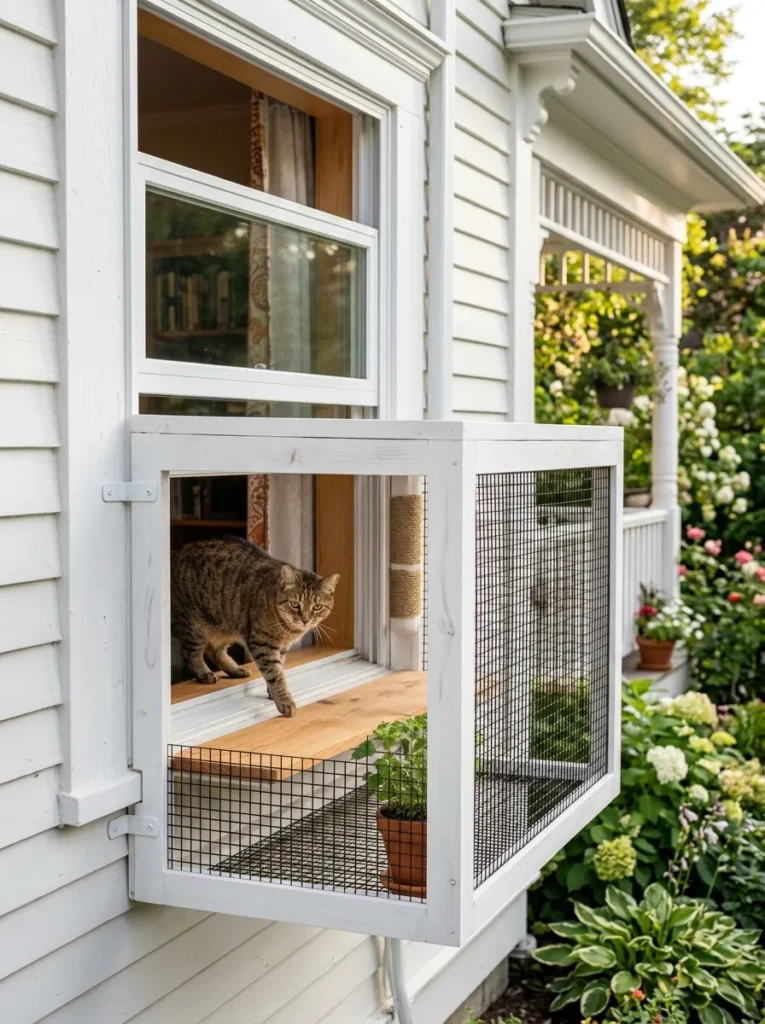
Vibe: The classic window box catio feels architecturally appropriate and cleanly executed — a structure that looks like it belongs on the house rather than an addition forced upon it.
Why it works: The classic window box catio is the foundational cat window enclosure design because it addresses the maximum number of cat and owner requirements in the minimum footprint — it provides the cat with outdoor air, natural light, bird-watching opportunity, and enrichment within a compact structure that requires no ground contact, no planning permission in most jurisdictions, and no modification to the home beyond the mounting hardware at the window frame. The design principle is window integration: by sizing the enclosure to the window’s width, painting the timber frame to match the home’s exterior trim color, and using fine black hardware cloth that recedes visually at normal viewing distances, the structure reads as a window feature rather than a pet facility — comparable in visual impact to a traditional window box planter, which the catio effectively replaces or supplements.
How to get it: Build the enclosure frame from 45x45mm cedar, treated pine, or redwood — all have adequate natural or treated rot resistance for an outdoor structure with no ground contact. Construct as a five-sided box (four sides and a top, with the rear face open to the window) of the chosen dimensions, clad all five exposed faces with 0.5-inch galvanized hardware cloth stapled with heavy-duty staples and secured with timber battens over the staple line for a clean finish. Attach to the window frame using 90mm stainless steel L-brackets screwed into the window frame’s structural members. Install an interior shelf from a smooth plank of untreated pine or cedar at approximately one-third of the enclosure’s height from the floor.
Quick Win: Painting the window box catio’s timber frame in an exact color match to the home’s exterior trim before installation is the single detail that most completely integrates the structure with the home’s architecture — a 20-minute paint step that transforms a functional timber box into a considered architectural feature.
Shop The Look
| Product |
|---|
| Cedar lumber board 45x45mm structural frame |
| Galvanized hardware cloth 0.5 inch mesh roll |
| Heavy duty staple gun 10mm staples mesh |
| Stainless steel L-bracket set 90mm window |
| Exterior timber paint white trim matching |
Also view: 14 Charming Rustic Dog Shed Ideas for Happy Pets
2. Floor-to-Ceiling Cat Tower Enclosure (LAYOUT)
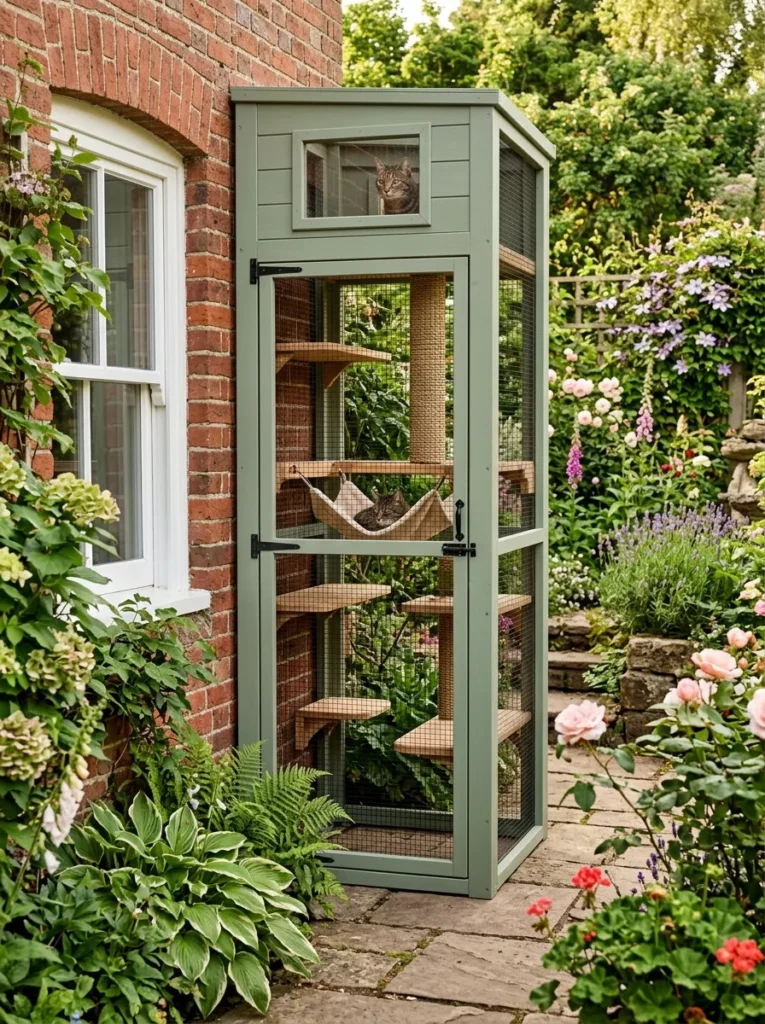
Vibe: The tower enclosure feels vertically generous — a structure that understands cats’ instinctive preference for elevation and provides it abundantly within a compact footprint.
Why it works: A floor-to-ceiling tower enclosure maximizes the most important dimension of cat environmental enrichment — height — within the smallest possible ground footprint. Cats’ natural behavioral preference is strongly vertical: wild felids and domestic cats alike seek the highest available vantage points for resting, observing, and feeling secure. A 220cm tall enclosure with five platform levels at 35–40cm vertical intervals provides the full range of feline height preference (from ground-level exploration to overhead perching) in a structure that requires less than a square meter of ground area. The design principle is vertical abundance: by using height rather than floor area as the primary spatial resource, the tower enclosure delivers more meaningful cat enrichment per square foot of garden space than any horizontally expansive but low design.
How to get it: Frame the tower from 45x45mm cedar with additional 90x45mm horizontal members at each platform level for structural rigidity — a 220cm tall structure with five cantilevered platforms requires more frame robustness than a simple window box. Build each platform from 20mm pine or cedar board, ensuring they are large enough for a cat to sit and turn comfortably (minimum 35x35cm per platform). Install a hammock shelf from a rectangle of outdoor-rated canvas or sisal fabric stretched between two dowels at shoulder width on the inside walls. Ground anchor the base of the structure with 100mm post spikes driven into a concrete base for stability against wind loads at full height.
Shop The Look
| Product |
|---|
| Cedar structural lumber 45x45mm 90x45mm |
| Post spike ground anchor 100mm heavy duty |
| Pine board 20mm platform shelf natural |
| Outdoor canvas hammock shelf material |
| Sisal rope 10mm wrapping post natural |
3. Lean-To Greenhouse Catio (MATERIAL / COLOR)
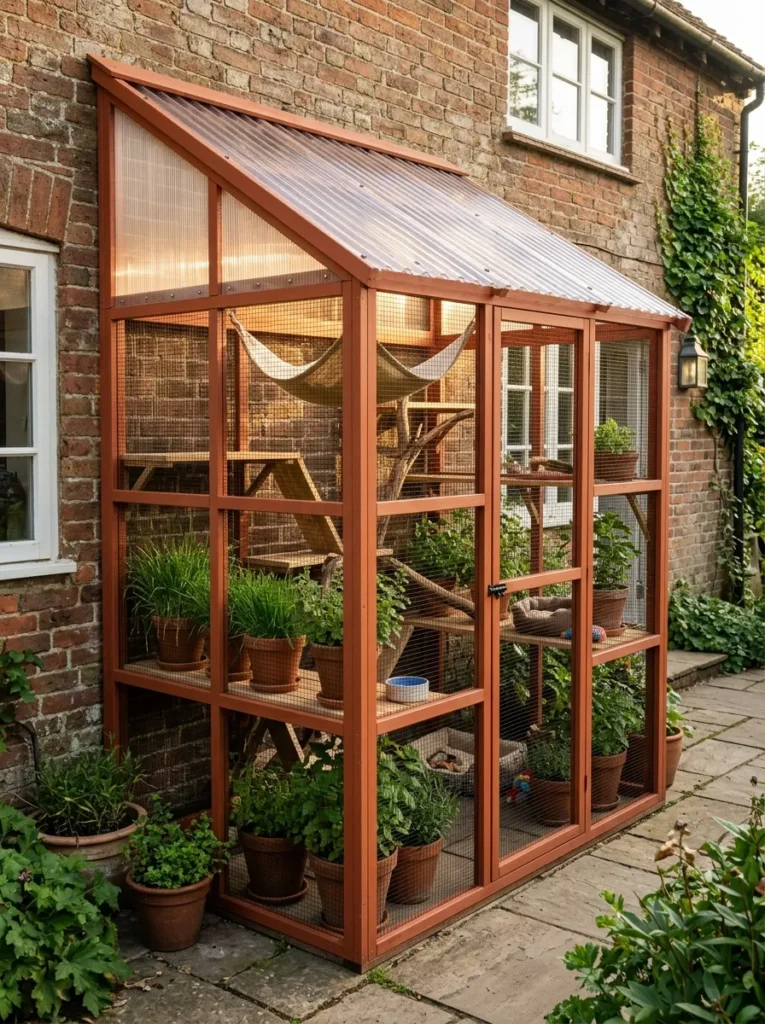
Vibe: The lean-to greenhouse catio feels warmly botanical — a structure that works as both a cat enclosure and a small garden feature, making it a visual asset rather than a concession.
Why it works: A lean-to greenhouse-style cat enclosure is the design that most successfully creates a dual-purpose garden structure — it provides cat enrichment while simultaneously functioning as a small greenhouse for growing cat-appropriate plants (cat grass, catnip, valerian) that enhance the enrichment experience. The clear polycarbonate roof section provides rain and wind protection while maintaining excellent light transmission, creating a warm, sheltered microclimate within the enclosure that extends the weather window for cat outdoor time significantly beyond what an open mesh structure allows. The design principle is horticultural integration: by incorporating genuine plants in the enclosure, the designer creates an enrichment environment of genuine ecological richness — smells, textures, tastes, and the movement of growing plants — that dramatically exceeds the enrichment quality of a bare wire enclosure of equivalent size.
How to get it: Frame the lean-to from 70x45mm treated timber, pitching the roof at a minimum 15-degree slope for rain runoff from the polycarbonate roof panel. Use 6mm twin-wall polycarbonate panels for the roof section — they provide good light transmission, adequate weather protection, and natural UV diffusion that prevents the heat buildup of single-wall polycarbonate in direct sun positions. Fix the structure’s top plate to the home’s exterior wall using 100mm coach bolts into wall plugs. Install terracotta pots on a low shelf inside for cat-safe plants — cat grass (Dactylis glomerata), catnip (Nepeta cataria), and valerian (Valeriana officinalis) are the most appropriate and most enriching plantings.
Shop The Look
| Product |
|---|
| Twin wall polycarbonate panel 6mm roof clear |
| Structural timber 70x45mm treated lean-to |
| Coach bolt set 100mm wall fixing anchor |
| Terracotta pot set small indoor garden |
| Cat grass seed kit grow indoor outdoor |
4. Japanese-Inspired Catio with Shoji Screens (COLOR / MATERIAL)
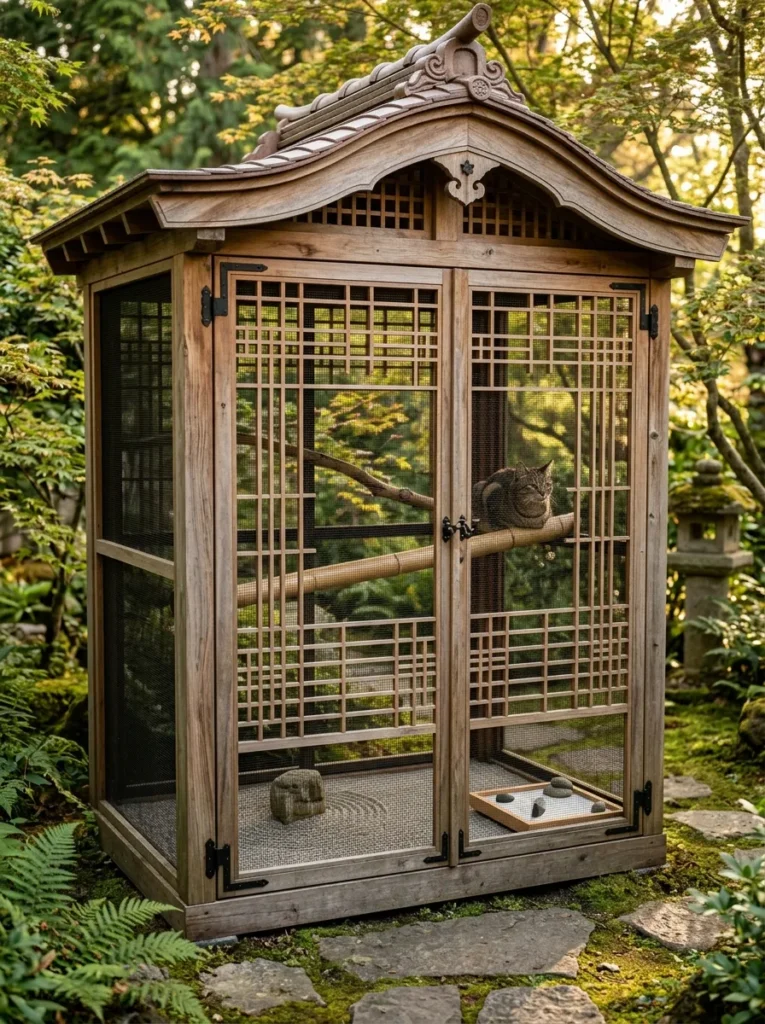
Vibe: The Japanese-inspired catio feels serenely considered — a garden structure beautiful enough to be a deliberate design feature of a Japanese-inspired garden rather than a pet enclosure placed within it.
Why it works: A Japanese-inspired cat enclosure applies the aesthetic discipline of Japanese garden design — restraint, natural materials, considered asymmetry, and the integration of structural elements with living botanical context — to the cat enclosure form, producing a structure of genuinely architectural quality that enhances rather than interrupts a considered garden aesthetic. The shoji lattice panel detail (a grid of thin cedar strips creating a decorative screen with hardware cloth behind) is the specific design element that most elevates the structure’s visual quality — it transforms the standard hardware cloth wall into a screen of genuine decorative interest that references Japanese interior and garden architecture. The design principle is aesthetic specificity: by committing to a specific architectural reference (Japanese design) and applying its vocabulary consistently throughout the enclosure’s details, the designer creates a structure with a coherent design identity that reads as intended rather than improvised.
How to get it: Create the shoji lattice panels from 20x10mm cedar battens arranged in a 100mm grid pattern on a backing frame, with the hardware cloth stapled to the back of the frame before the lattice is applied — the lattice covers the staple line and creates the decorative screen effect. Build the pagoda-style roof peak from four rafters meeting at a central crown point, adding a slight upward curve to each rafter’s lower end using a 10mm kerf cut and bending to shape before the wood dries. Finish all timber in a natural cedar oil rather than paint — the natural wood tone is the most appropriate finish for Japanese aesthetic references.
Shop The Look
| Product |
|---|
| Cedar batten 20x10mm shoji lattice panel |
| Cedar oil natural timber finish exterior |
| Bamboo pole 30mm natural perch post |
| Zen garden tray small sand stone set |
| Decorative river stone set natural grey |
5. Industrial Chic Black Steel Frame Catio (MATERIAL)
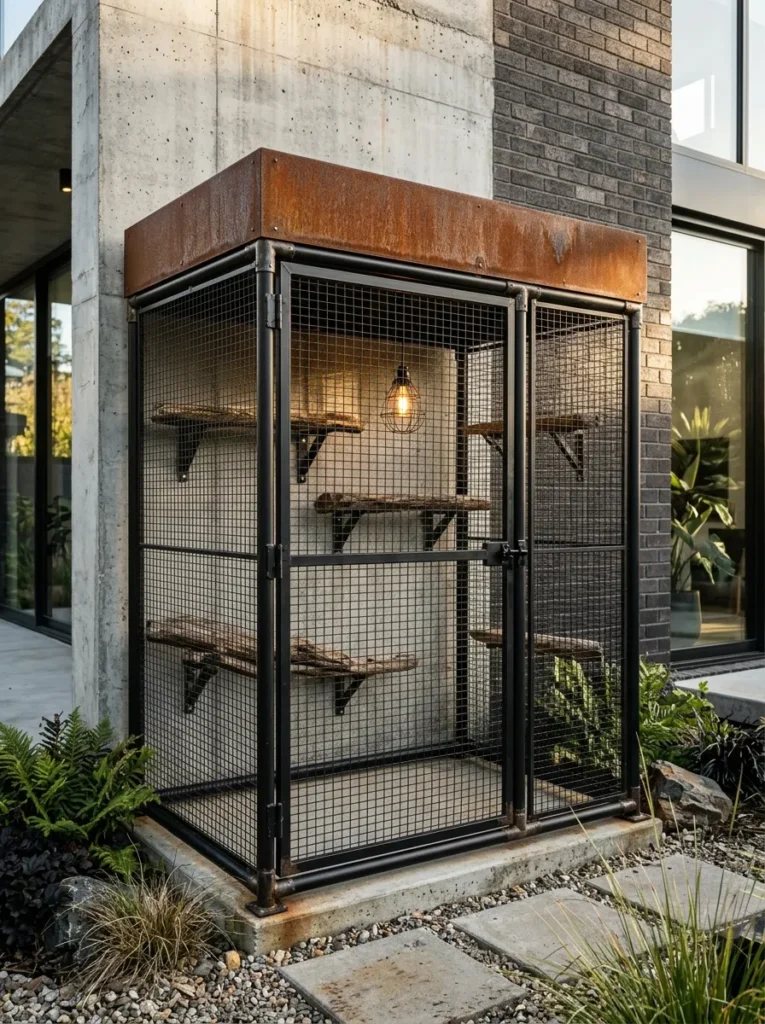
Vibe: The industrial catio feels dramatically considered — a structure built from genuinely architectural materials that would look at home in a design magazine feature on industrial outdoor spaces.
Why it works: An industrial-style cat enclosure in black steel tube framing is the design approach that most successfully makes the catio’s necessary structural elements — the frame and the mesh — into the design’s primary aesthetic statement rather than elements to be disguised or minimized. The design principle is material honesty: industrial design’s defining quality is the celebration of structural materials used visibly and deliberately, and in a cat enclosure context this translates to a welded steel frame where the frame’s construction details (visible joints, raw metal surfaces) are celebrated rather than hidden behind paint or cladding. The driftwood perches inside the industrial frame create the material contrast that prevents the all-metal structure from reading as purely institutional — the organic, irregular forms of driftwood against the precise geometry of the steel frame create a visual tension of considerable interest.
How to get it: The welded steel tube frame requires either welding skill or commission from a local metal fabricator — specify 25mm square or round steel tube in 3mm wall thickness for adequate rigidity at this scale. Powder coat the finished frame in matte black rather than paint — powder coating provides superior outdoor durability and a more refined surface quality than paint on steel. Alternatively, achieve a similar aesthetic using a heavy-gauge welded wire panel system (commonly used for livestock enclosures) in a black galvanized finish, which avoids the welding requirement while maintaining the industrial material aesthetic.
Shop The Look
| Product |
|---|
| Black powder coated steel tube 25mm structural |
| Heavy gauge welded wire panel black galvanized |
| Driftwood branch set natural decorative perch |
| Concrete paving slab base enclosure floor |
| Industrial cage pendant light outdoor rated |
6. Cottage Garden Catio with Climbing Plants (ACCESSORIES / COLOR)
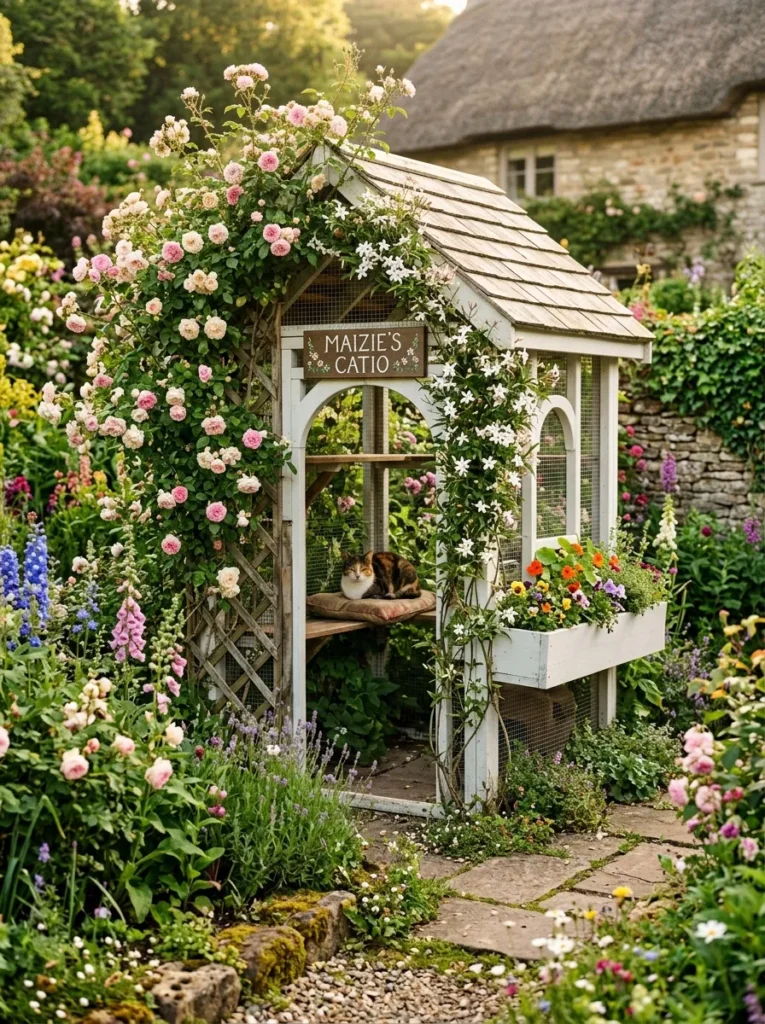
Vibe: The cottage garden catio feels charming and beloved — a garden feature so beautifully planted that it looks like the garden’s most intentional focal point.
Why it works: A cottage garden cat enclosure with climbing plants trained over its exterior transforms the structure from a pet facility into a garden feature of genuine horticultural beauty — the climbing roses and jasmine growing over the mesh and trellis exterior create a floral bower that is both visually beautiful and aromatically rich, adding an olfactory dimension to the cat’s enrichment experience while making the structure one of the garden’s most attractive visual elements. The design principle is botanical concealment through enhancement: rather than hiding the enclosure structure behind plants, the designer uses the structure as a support for climbing plants that enhance both the structure’s appearance and the cat’s sensory environment. The climbing plants’ flowers, fragrance, and rustling movement in the breeze provide ongoing sensory enrichment for the cat within.
How to get it: Build the base enclosure structure with a trellis layer attached to the exterior of the hardware cloth walls — fix 20x10mm timber battens in a diagonal or square trellis pattern to the outside of the frame, giving climbing plants a surface to attach to without compromising the security of the inner hardware cloth barrier. Plant climbing roses (Rosa) and jasmine (Jasminum officinale) at the base of each trellis panel — both are non-toxic to cats and will grow to cover the enclosure within two growing seasons. Choose single or semi-double rose varieties (rather than highly bred double roses) for the fullest, most cottage-appropriate flowers and the greatest bee and butterfly benefit.
Shop The Look
| Product |
|---|
| Cedar trellis panel exterior climbing plant |
| Climbing rose bare root pink cottage |
| Jasmine plant climbing summer flowering |
| White exterior timber paint cottage finish |
| Small decorative timber sign personalised |
7. Minimalist Modern Glass and Steel Catio (COLOR / LAYOUT)
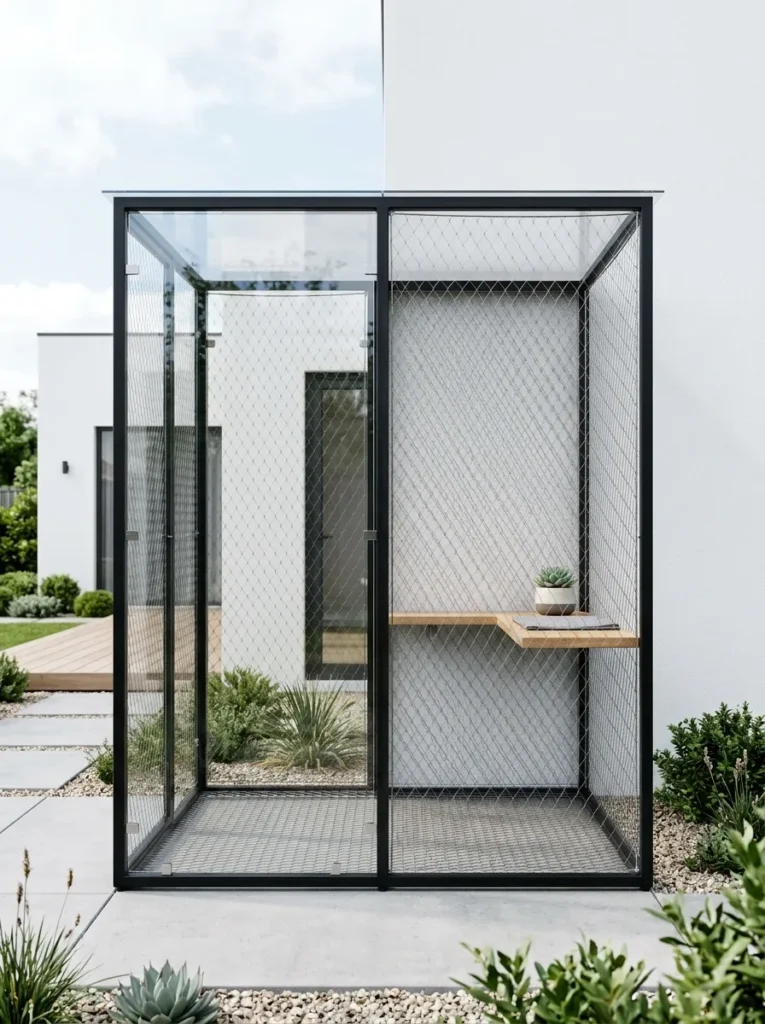
Vibe: The minimalist glass catio feels architecturally seamless — a structure so visually light that it reads as a transparent architectural element rather than an addition.
Why it works: A minimalist glass and steel cat enclosure is the design that most successfully makes the enclosure nearly invisible by maximizing transparency — the clear glass panels and nearly invisible stainless wire cable mesh on the remaining sides allow the home’s exterior architecture to read through the structure with minimal visual interruption, creating a cat enclosure that appears to float rather than being bolted onto the facade. The stainless wire cable mesh system (commonly used in architectural balustrade design) is the critical technical innovation that makes this design possible — fine stainless cables at 50–75mm horizontal spacing are entirely cat-proof at this tension while being substantially more visually transparent than any hardware cloth mesh. The design principle is minimum visual intervention: the most architecturally sophisticated enclosure is the one that achieves the security function with the least visual mass.
How to get it: The stainless wire cable mesh system is a specialist product available from balustrade and architectural mesh suppliers — specify a maximum 50mm horizontal cable spacing for cat security and marine-grade 316 stainless steel cables for coastal and outdoor corrosion resistance. Source clear tempered glass panels from a glazing supplier — 6mm tempered safety glass is the appropriate specification for an enclosure panel subject to cat impact. The thin steel frame (25mm square tube in 3mm wall thickness, powder-coated matte black) requires welding or specialist fabrication, making this the highest-investment design on the list, but also the most architecturally refined.
Shop The Look
| Product |
|---|
| Stainless steel cable mesh 316 marine grade |
| Clear tempered glass panel 6mm safety grade |
| Thin square steel tube 25mm black powder |
| Clear polycarbonate flat roof panel 6mm |
| Natural wood shelf plank untreated cedar |
8. DIY Modular Panel System Catio (SMALL SPACE / LAYOUT)
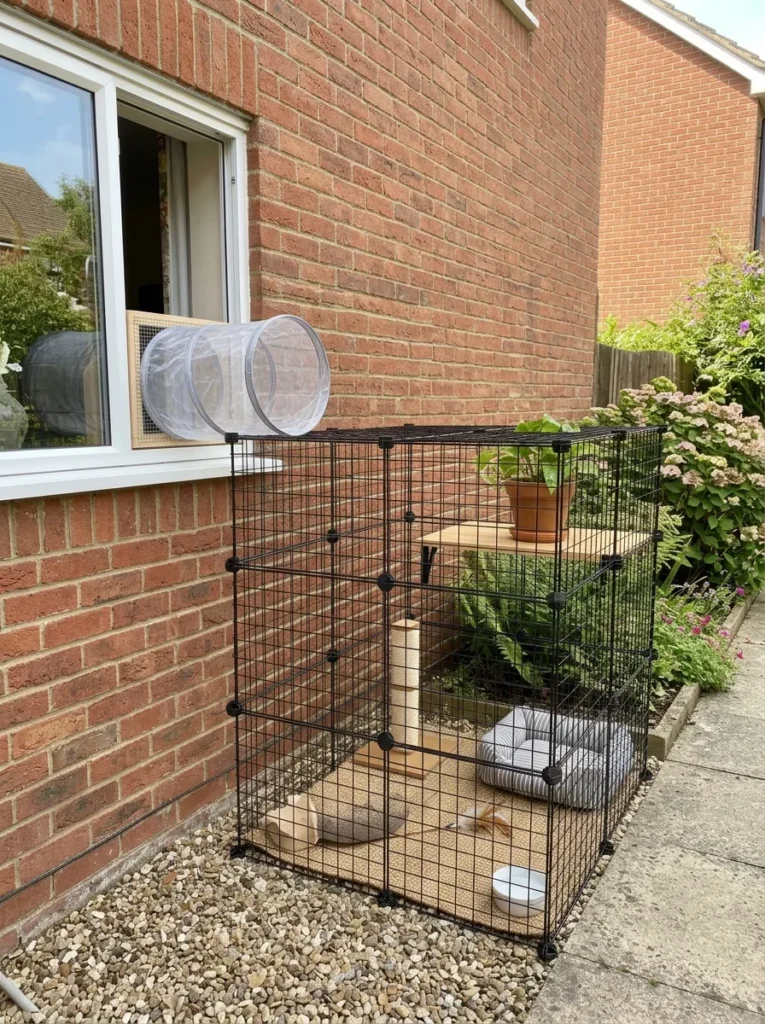
Vibe: The modular panel catio feels practically achievable — the design that proves a genuinely good cat enclosure does not require carpentry skills, power tools, or significant budget.
Why it works: A DIY modular panel system catio uses standardized, commercially available mesh panels (designed for dog kennels, rabbit runs, or purpose-made catio panel kits) assembled into a custom configuration without any cutting, framing, or structural woodworking — making this the most accessible cat enclosure design for households without carpentry experience or specialist tools. The design principle is modular assembly: by working with pre-made structural units (the mesh panels) rather than building from raw materials, the maker achieves structural adequacy and geometric precision automatically while focusing creative energy on the configuration and enrichment decisions rather than the construction fundamentals. The result is not as architecturally refined as a custom-built timber enclosure, but it is genuinely functional, completely secure, and assembles in a single afternoon.
How to get it: Source a catio panel kit from specialist suppliers (Catastrophic Creations, Kittywalk, or equivalent), which provide standardized mesh panels, tunnel sections, and connection hardware in a coordinated system. Alternatively, repurpose dog kennel or rabbit run panels — typically available in 90x90cm and 90x180cm sizes — into a custom configuration using cable ties and panel clips at all joins. Configure the panels into an L-shape, U-shape, or straight run depending on available garden space, connecting one panel section to the window opening through a tunnel section. Add enrichment through panel-mounted shelves, clip-on hammocks, and hanging toys that attach directly to the mesh without requiring fixed installation.
Shop The Look
| Product |
|---|
| Catio modular panel kit black galvanized |
| Cable tie set stainless 300mm panel join |
| Panel clip set mesh connector heavy duty |
| Clip-on mesh shelf bracket adjustable |
| Outdoor cat tunnel connector window mesh |
9. Treehouse-Style Elevated Catio (LAYOUT / ACCESSORIES)
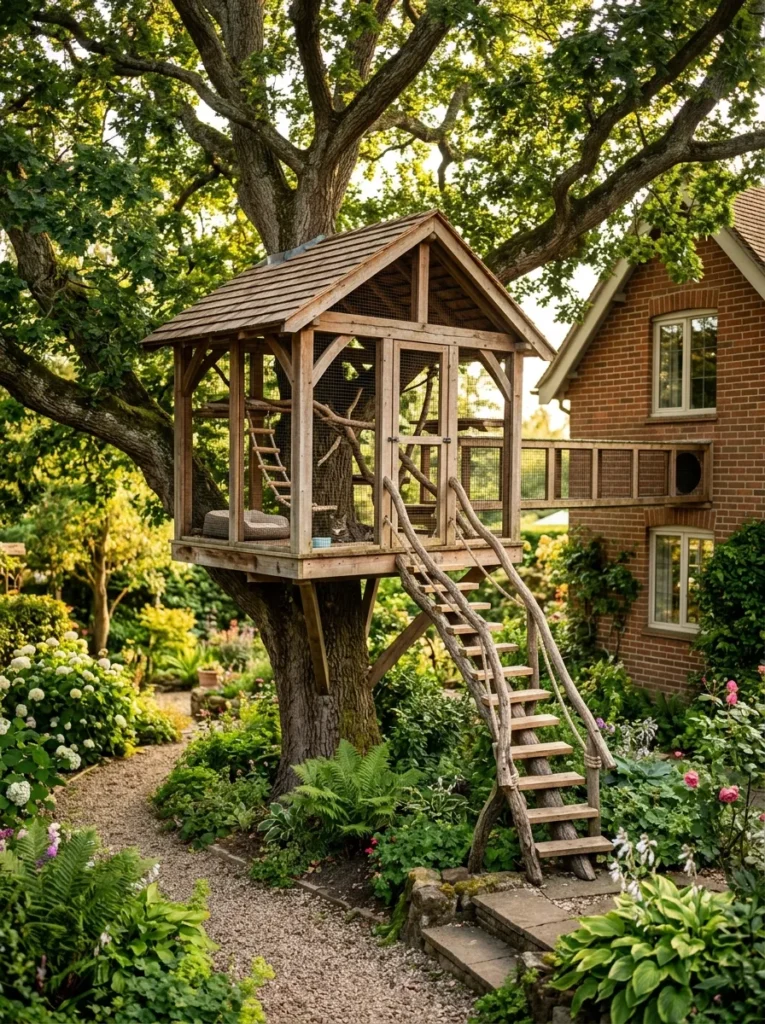
Vibe: The treehouse catio feels adventurously elevated — a structure that gives cats the arboreal experience that is their evolutionary birthright within a completely secure environment.
Why it works: An elevated treehouse-style cat enclosure built into or around an existing garden tree is the catio design that most completely satisfies the cat’s deepest behavioral preferences — the elevated position in the tree canopy provides the height security, the natural branch textures and smells provide unparalleled sensory richness, and the connection to the home through a tunnel provides the access security that allows the cat complete freedom of movement between indoor and outdoor environments. The design principle is environmental authenticity: by using the existing tree as an integral structural and enrichment element, the designer creates an enclosure environment of ecological richness that no purpose-built structure standing alone in a garden can replicate — the cat is genuinely in a tree rather than merely elevated above ground level.
How to get it: Assess the tree’s structural health with an arborist before building — the enclosure platform should use the tree’s major structural branches as support without damaging living tissue. Use adjustable tree attachment bolts (commercially available as GL bolts from arborist suppliers) that can expand as the tree grows, preventing girdling damage. Build the platform frame from 90x45mm structural timber spanning between tree attachment points, ensuring all platform members are level. The tunnel from the home window to the platform can be constructed from timber and mesh or from a flexible polycarbonate tunnel tube — allow 10–15cm of slack in the tunnel length to accommodate seasonal tree movement.
Shop The Look
| Product |
|---|
| Tree attachment bolt GL bolt arborist |
| Structural timber 90x45mm platform frame |
| Cedar shingle roofing small batch natural |
| Flexible polycarbonate cat tunnel connector |
| Rope ladder natural fiber cat climbing |
10. Scandinavian Minimal White Catio (COLOR)
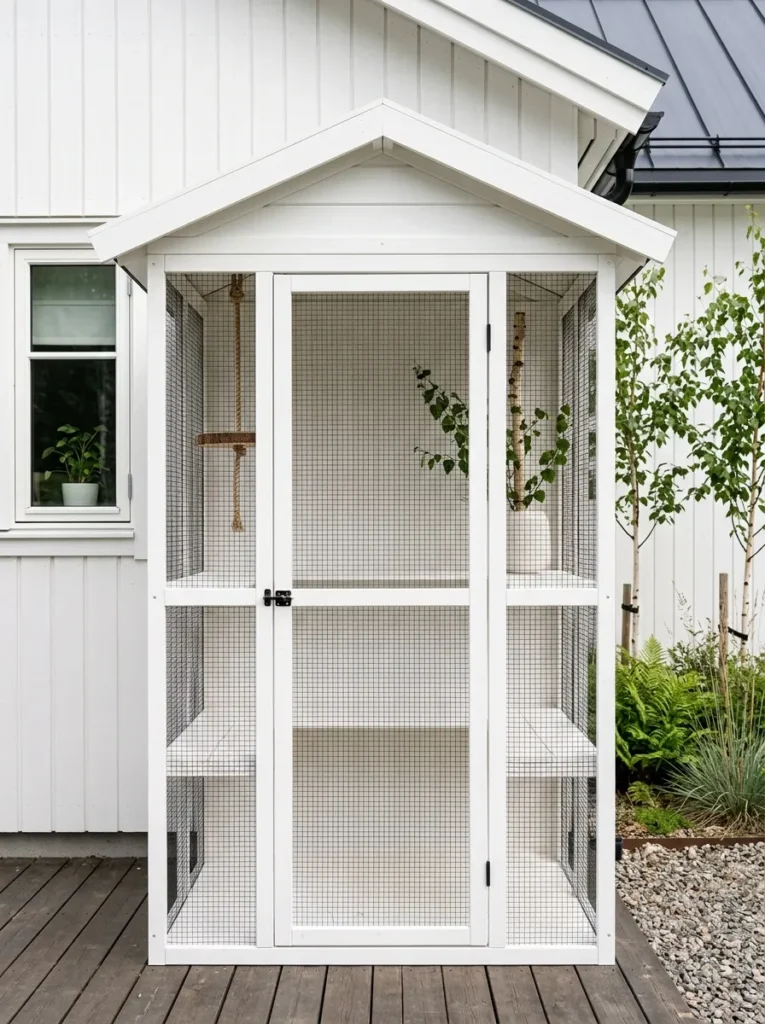
Vibe: The Scandinavian white catio feels purely architectural — a structure so clean and considered that it makes the adjacent house look more resolved by proximity.
Why it works: A Scandinavian minimal white cat enclosure is the catio design that most powerfully demonstrates that the cat enclosure form can achieve genuine architectural quality when treated with the same design discipline applied to the home’s architecture itself. The all-white paint treatment (interior and exterior frame, interior shelving) creates a visual continuity that makes the structure read as a single coherent object rather than an assembly of components, while the fine black hardware cloth walls recede so completely against the white frame that the structure appears to be a white grid of pure timber with transparent walls. The design principle is material reduction: by eliminating color variation from all elements except the black mesh (which performs a visual function of near-invisibility rather than decoration), the designer creates a structure of maximal visual simplicity that reads as architecturally confident.
How to get it: Prime all timber with an exterior primer before painting — hardware cloth stapled and battened to a primed and painted frame will maintain clean paint edges at the mesh-timber junction more successfully than paint applied after assembly. Use exterior semi-gloss or satin paint rather than matte — the slight sheen of satin or semi-gloss paint is more weather-resistant than matte on outdoor timber and produces the clean, crisp surface quality appropriate for the Scandinavian aesthetic. The single birch stem in a white ceramic pot is the specific Scandinavian decorative gesture — a single natural element of genuine botanical elegance that is the opposite of abundant botanical decoration.
Shop The Look
| Product |
|---|
| Exterior semi-gloss paint crisp white timber |
| Exterior timber primer undercoat white |
| Fine gauge hardware cloth 0.5 inch natural |
| White ceramic plant pot small interior |
| Birch stem branch natural decorative single |
11. Upcycled Greenhouse Conversion Catio (MATERIAL / SMALL SPACE)
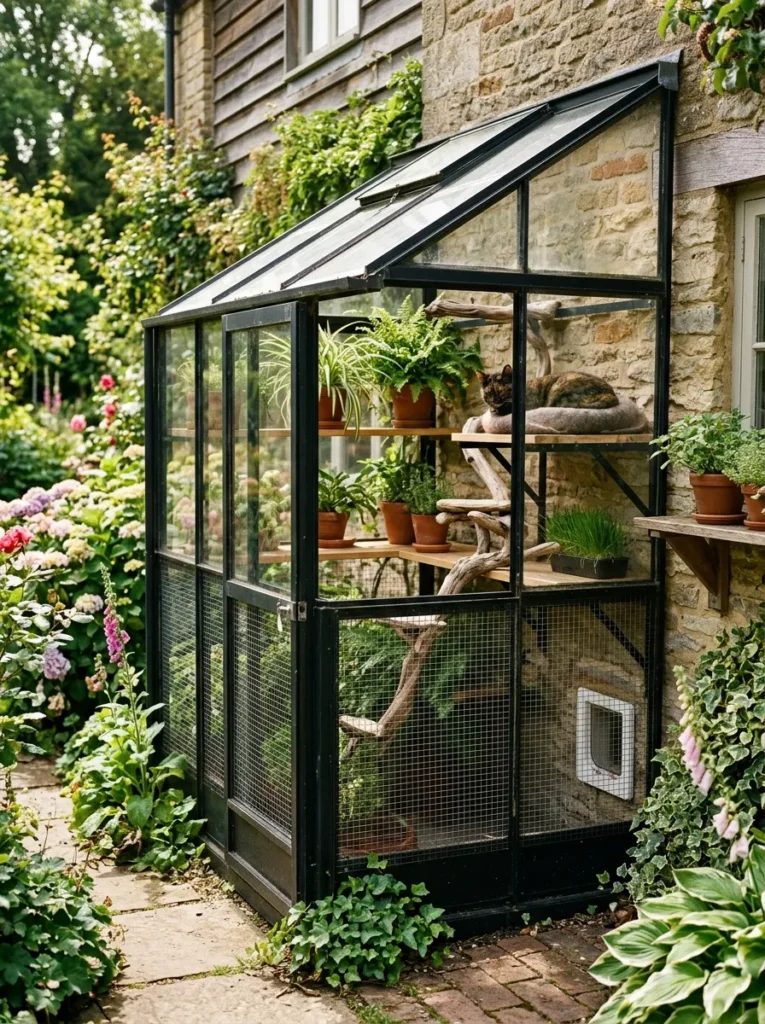
Vibe: The greenhouse catio feels warmly upcycled and resourcefully beautiful — a conversion that improves both the greenhouse and the cat’s outdoor life simultaneously.
Why it works: Converting an existing lean-to greenhouse into a cat enclosure is the catio approach with the highest ratio of quality outcome to material cost because the greenhouse structure already provides the most valuable elements of a cat enclosure — structural rigidity, weather protection from a glass or polycarbonate roof, and the wall attachment to the home that provides the connection point for cat access. The design principle is structural reuse: rather than building a new enclosure structure, the maker modifies an existing structure by replacing its lower glass panels with security mesh (the single modification that converts a greenhouse from plant-only to cat-accessible) and adding cat-specific enrichment elements (perches, shelves, plants) to the existing greenhouse shelving infrastructure. The result is more weather-proof, more thermally comfortable, and more light-filled than a purely mesh enclosure of comparable footprint.
How to get it: Source a secondhand lean-to greenhouse (available regularly from garden centers, online marketplaces, and architectural salvage dealers) of appropriate dimensions. Remove the lower glass panels (typically the bottom two rows of panes) and replace with hardware cloth stapled to a timber sub-frame fitted within the existing glazing bars — leave the upper glass panels and roof intact for weather protection. Paint the metal greenhouse frame with a rust-inhibiting black metal paint. Add cat-specific enrichment by mounting natural wood shelves across the existing greenhouse shelf brackets at varied heights, and place cat-safe plants in terracotta pots on multiple shelf levels.
Shop The Look
| Product |
|---|
| Lean-to greenhouse vintage style small |
| Black metal paint rust inhibiting exterior |
| Hardware cloth 0.5 inch mesh roll natural |
| Cat safe plant set catnip valerian grass |
| Natural wood board shelf plank 20mm |
12. Multi-Level Cat Condo Enclosure (LAYOUT / ACCESSORIES)
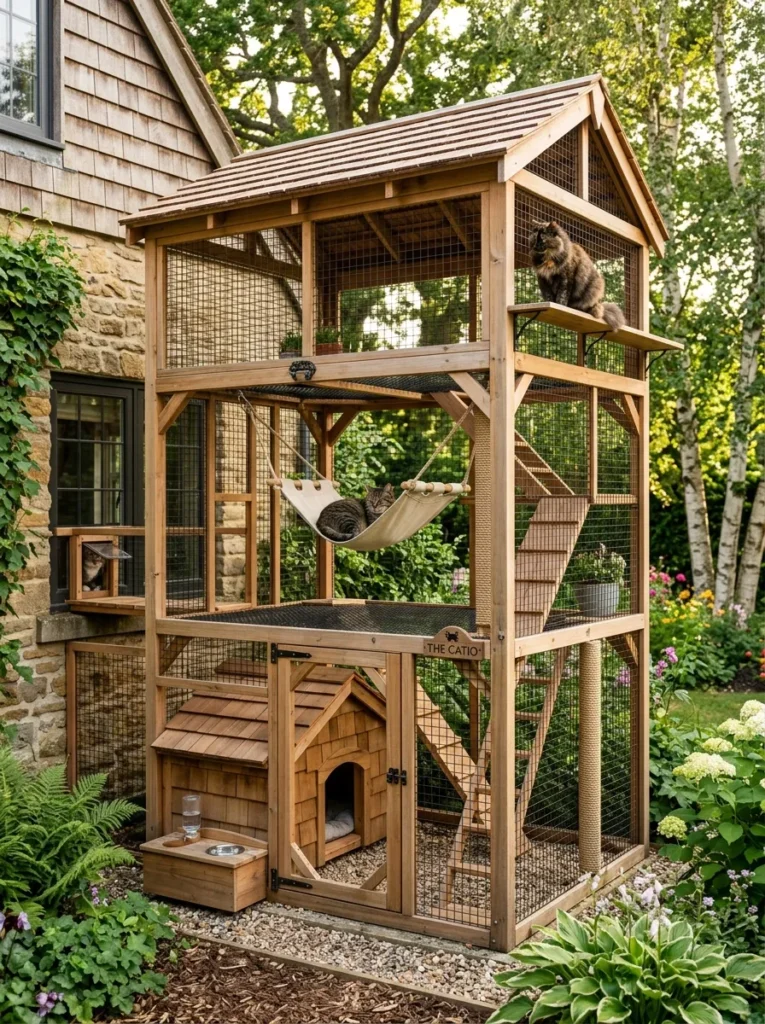
Vibe: The multi-level condo catio feels ambitiously cat-centred — the enclosure that makes cat enrichment genuinely abundant rather than merely adequate.
Why it works: A multi-level cat enclosure with three functionally distinct floors — sleeping den, activity platform, and elevated lookout — provides the full range of feline behavioral needs within a single structure: privacy and enclosed security in the sleeping den, active movement and play on the activity platform, and the elevated observation that is cats’ most fundamental behavioral preference in the top-floor lookout. The design principle is behavioral zoning: by designing each level for a specific behavioral function rather than creating three identical platforms, the designer maximizes the enrichment value of every square meter of enclosure space. A multi-cat household particularly benefits from this zoning approach — multiple cats can use different levels simultaneously without conflict, because each level offers a different behavioral experience.
How to get it: Build the structure’s primary frame from 90x45mm treated timber, with floor platforms from 20mm marine-grade plywood for the covered den sections and slatted timber for the open-air platforms (to allow weather drainage). Install the ground-floor sleeping den with three solid cedar shingle walls and a fourth entry wall of hardware cloth to provide visual security without full enclosure. The internal ramp (gradient of maximum 30 degrees) and vertical ladders (natural wood rungs at 15cm intervals) provide the movement connections between levels. Ensure the top-level lookout platform has a covered section using cedar shingles for weather protection and an open mesh section for the panoramic view that is the primary behavioral driver for cats using elevated positions.
Shop The Look
| Product |
|---|
| Marine plywood 20mm platform floor panels |
| Structural timber 90x45mm multi-level frame |
| Cedar shingle roofing den sleeping area |
| Natural wood ladder rung set internal climb |
| Cat hammock outdoor large hanging platform |
13. Tunnel Network Catio System (LAYOUT)
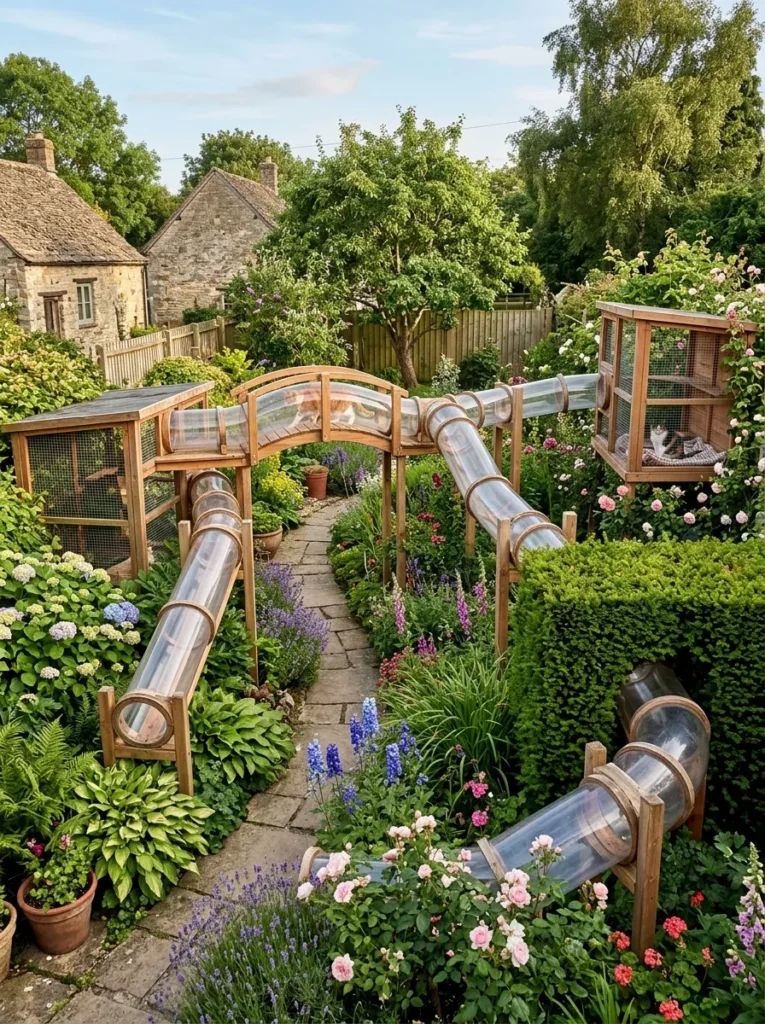
Vibe: The tunnel network catio feels playfully elaborate — the cat enrichment system that makes the garden itself part of the cat’s daily adventure without compromising any plant or bird.
Why it works: A tunnel network catio system is the most experientially rich cat enclosure design because it transforms the cat’s outdoor experience from a static space (a box to be in) into a dynamic journey (a network of routes to travel) — the movement through varied tunnel heights, the experience of garden views from different vantage points, and the physical engagement of navigating elevation changes and bends all provide the kind of continuous environmental stimulation that most closely approximates the experience of genuinely free outdoor roaming. The design principle is experiential journey: rather than concentrating all enrichment in a single enclosure space, the tunnel network distributes enrichment across the garden’s full extent, making the cat’s outdoor experience proportionally richer with every meter of tunnel added to the system.
How to get it: Build straight tunnel sections from 30cm diameter PVC drainage pipe (available from building merchants) or from flat timber sheets formed into a square cross-section tunnel — the square cross-section is easier to build than circular but offers less roll protection if a cat misjudges a turn. Cover the top half of each tunnel section with hardware cloth for ventilation, leaving the lower half as solid material for weather protection. Mount elevated sections on 90x90mm timber posts anchored in post spikes or concrete footings, ensuring all elevated sections are at a gradient of less than 25 degrees for comfortable cat movement. Connect sections at T-junctions and bends using custom-built junction boxes of the appropriate cross-section dimensions.
Quick Win: Starting with a single tunnel section connecting the home’s window to a basic enclosure, then extending the tunnel network by one section per season, is the most manageable approach to building a complex tunnel network — each addition is immediately functional and the network grows at a pace that suits the builder’s time and budget.
Shop The Look
| Product |
|---|
| PVC drainage pipe 30cm diameter tunnel |
| Post spike ground anchor 90x90mm timber |
| Structural timber 90x90mm post tunnel mount |
| Junction box kit tunnel T-junction set |
| Hardware cloth ventilation strip roll |
How to Start Your Cat Window Enclosure Design
Your single best first move is to observe your cat’s window behavior for one full week before designing anything — noting which windows it sits at most frequently, at what times of day, whether it prefers the elevated position of a high window or the ground-level view of a low one, whether it is primarily attracted by bird activity, garden movement, or sun exposure, and how much time it actually spends looking out versus simply sitting in the sun. These behavioral observations are the design brief that determines which enclosure design from this list best serves your specific cat’s specific needs — a cat that is primarily sun-motivated needs maximum south-facing glazing; a cat that is primarily bird-watching motivated needs the highest possible elevated position; a cat that is primarily movement-motivated needs a multi-level or tunnel system.
The most common mistake in cat window enclosure design is building for human aesthetic preference rather than cat behavioral need — creating a beautiful structure that the cat uses minimally because its enrichment features do not match the specific behavioral preferences of that individual animal. Fix this by conducting the behavioral observation first, identifying the one or two dominant behavioral motivations (sun, birds, height, movement, smells), and selecting the enclosure design that most specifically addresses those motivations, even if a different design would look more impressive in a photograph. A cat that enthusiastically uses a simple modular panel enclosure is better enriched than a cat that ignores a beautifully crafted Japanese-inspired structure that does not provide the specific thing it wants.
Three specific items under $50 that create the most immediate cat window enrichment: a window-mounted cat perch shelf ($18–$35) that extends the windowsill’s resting surface to accommodate the cat comfortably while the window is open with a security screen fitted; a roll of 0.5-inch galvanized hardware cloth ($15–$22 for a 30cm x 10m roll) that allows a window to be fully opened with a fitted mesh screen providing outdoor air and enrichment without outdoor access; and a small pot of growing cat grass ($8–$12) placed on the existing windowsill providing the olfactory and taste enrichment that approximates garden access within a purely indoor context.
A simple window box catio built from cedar and hardware cloth costs $80–$150 in materials and takes one full day to build. A mid-level multi-platform enclosure with a tunnel connection costs $300–$600 in materials and takes a weekend. A comprehensive multi-level condo enclosure or tunnel network costs $600–$1,500 in materials for a fully DIY build, or $2,000–$8,000 professionally built — with the professional build appropriate when structural complexity, multi-story height, or tree integration requires engineering assessment beyond a confident DIYer’s capability.
Frequently Asked Questions About Cat Window Enclosure Designs
What mesh size is safe and appropriate for a cat window enclosure?
The mesh gauge and aperture requirements for a cat window enclosure depend on the cats being housed and any adjacent wildlife considerations. For cats alone, 1-inch (25mm) square galvanized hardware cloth provides adequate containment — a cat cannot pass through a 25mm aperture. However, for households in areas where small wildlife (birds, mice, shrews) entering the enclosure represents a concern for the wildlife’s safety, or where very small kittens might be housed, 0.5-inch (12.5mm) hardware cloth is the more appropriate specification that prevents both cat escape and small animal entry. The gauge (wire thickness) should be a minimum of 19 gauge (approximately 1mm wire diameter) for all cat enclosures — lighter gauge hardware cloth can be pushed open by a determined cat or deformed by repeated impact.
Do cat window enclosures require planning permission?
In most residential jurisdictions, a small cat window enclosure attached to a home’s window and not exceeding standard permitted development size limits (typically 1–2 cubic meters in volume and not projecting significantly beyond the home’s existing building line) does not require planning permission as a permitted development. Larger structures, those that touch or are built within the boundary of a neighboring property, those in conservation areas or on listed buildings, and those in areas with specific local planning controls may require formal approval. Always check with your local planning authority before beginning any structure that is larger than a simple window box enclosure, that is positioned near a property boundary, or that is in an area with any planning designation.
How do I maintain and clean a cat window enclosure?
Cat window enclosures require monthly cleaning as a minimum to prevent the buildup of waste, hair, and organic debris that attracts insects and creates hygiene concerns for the cat. Remove and wash any fabric elements (hammocks, cushion covers) in a machine wash at 60°C monthly. Scrub all hard surfaces (wooden shelves, platforms, walls) with a pet-safe disinfectant solution and allow to dry completely in sunlight before the cat re-enters — sunlight’s UV is a natural disinfectant that supplements chemical cleaning effectively. Inspect all mesh panels, frame joints, and fasteners every six months for signs of rust, wear, or deformation — address any structural issues immediately, as a compromised mesh panel creates an escape risk. Replace natural sisal rope wrapping on climbing posts when it becomes frayed or worn — worn sisal is a potential ingestion hazard.
Can a cat window enclosure be used in a rented property?
Most cat window enclosures can be installed and removed without permanent structural modification to a rented property if they use the window frame’s existing screw holes (filled and painted on removal) or external mounting brackets that attach to the home’s exterior render or brickwork through reversible fixings. The modular panel system catio (design 8) is the most appropriate for rental situations because it requires no permanent installation — it simply stands in the garden or on a balcony and connects to the window via a removable tunnel. Always consult the landlord before any external installation — most landlords will approve a cat enclosure when the lease permits cats, particularly when the enclosure’s reversible nature is clearly explained and the reinstatement commitment is documented.
What cat-safe plants can I include in a cat window enclosure?
The most appropriate and most enriching plants for cat window enclosures are those that are both non-toxic to cats and specifically attractive or beneficial to them: catnip (Nepeta cataria) — produces the well-known euphoric behavioral response in approximately 50% of cats and is safe for all; cat grass (a blend of barley, wheat, and oat grass) — provides a digestive grass fiber supplement that many cats seek naturally; valerian (Valeriana officinalis) — a potent cat attractant that produces a response similar to catnip; cat thyme (Teucrium marum) — a Mediterranean herb strongly attractive to cats; and silvervine (Actinidia polygama) — an Asian climbing vine that produces a catnip-like response even in cats that do not respond to catnip. All five species are genuinely non-toxic to cats and provide ongoing olfactory, taste, and tactile enrichment throughout their growing season.
Ready to Build Your Dream Cat Window Enclosure?
These 13 designs span the full range of cat window enclosure possibility — from the architecturally integrated window box and the purely minimal Scandinavian white structure, through the botanically rich cottage garden bower and the warmly botanical lean-to greenhouse conversion, to the adventurously elevated treehouse and the experientially abundant tunnel network, the industrially dramatic black steel frame and the Japanistically serene pagoda style — covering every budget from $80 to $8,000, every garden size from a narrow balcony to a generous suburban plot, every aesthetic from contemporary minimalist to warmly eclectic, and every cat personality from the contemplative sun-worshipper to the active explorer who needs a network of routes to satisfy their daily movement needs. Begin with the behavioral observation week — not a design decision, not a material purchase, but seven days of genuinely paying attention to your specific cat’s specific window behavior — because the enclosure that is built in response to what your cat actually does will be used every day it is available, and the enclosure built in response to what looks best in a photograph may be ignored in favor of the same corner of the sofa. Today’s specific action: identify the one window your cat uses most frequently and measure its external dimensions, because every design on this list begins with that measurement — the window width, height, and sill depth that determine the enclosure’s foundational scale. When your cat settles into its new enclosure on its first morning — nose twitching at garden air, ears tracking a bird call from the garden bed, tail curled around its feet in the particular satisfaction of an animal whose needs have been genuinely understood and met — you will understand exactly why cat window enclosure design earns its devoted, growing community and the permanent place it holds at the top of every thoughtful cat owner’s home improvement list. Save your favorites now, especially the cottage garden bower and the treehouse design — they are the two ideas that, once built, make the garden feel as much the cat’s as it is yours.