Modern cat window enclosures — also called catios, cat window boxes, tunnel systems, and cat perch enclosures — are enclosed or semi-enclosed structures that attach to, extend from, or replace a home’s windows to give indoor cats safe access to fresh air, natural light, outdoor sights, sounds, and scents without the risks of unsupervised outdoor access. This article gives you 14 modern cat window enclosure ideas that range from a $30 DIY mesh window insert to a full architectural catio spanning an entire exterior wall, designed to work with every home type, every budget, and every level of building skill — all while keeping the cat genuinely enriched and the home genuinely designed.
Picture a cat who has spent their entire indoor life watching birds through glass, pressing a paw against the window at the sound of rustling leaves, and spending hours at the most interesting square foot in the apartment — the windowsill. Now imagine that same cat stepping through a cat flap into a mesh-enclosed bay of fresh air, watching a sparrow from 30cm away, smelling the rain on the garden below, and choosing to stay out there for hours because the environment is genuinely stimulating in a way the interior never is. That is what a cat window enclosure provides — not a luxury accessory but a genuine welfare intervention. Here are 14 ideas worth saving — and building.
Why Modern Cat Window Enclosures Work So Well
Cat window enclosures succeed as a cat welfare intervention because they address the specific enrichment deficit that most profoundly affects indoor cats — the absence of the sensory complexity, unpredictability, and natural stimulus variety that outdoor environments provide and that indoor environments, however well designed, cannot replicate. The behavioral science behind enrichment feeding, puzzle toys, and environmental complexity all converge on the same conclusion: cats are cognitively sophisticated predatory animals whose behavioral repertoire requires a complexity of environmental input that most indoor spaces cannot sustain, and the most direct source of that complexity for an indoor cat is controlled access to the outdoor environment.
The materials that define modern, design-forward cat enclosures are those that balance structural integrity with visual minimalism — powder-coated aluminum framing that provides structural strength without the visual bulk of timber, stainless steel mesh with small enough apertures to contain a curious cat while maintaining clear sightlines, tempered glass or UV-stable polycarbonate panels for weather protection, natural cedar or untreated pine for timber-frame builds that weather gracefully, and the same powder-coated or anodized finishes in charcoal, black, or white that are used in modern architectural window and door systems. The design direction of modern cat enclosures has moved significantly from the chicken-wire-and-timber agricultural aesthetic toward architectural enclosure systems that integrate with the home’s exterior as deliberately as any other window treatment.
The cat enrichment movement has produced extensive research demonstrating the specific welfare benefits of window and outdoor access for indoor cats — reduced anxiety behaviors (over-grooming, hiding, aggression), reduced boredom-driven destructive behaviors, increased activity levels, improved cognitive function through novel environmental stimulation, and improved emotional wellbeing as measured by reduced cortisol levels and increased play behavior. These documented welfare benefits make cat window enclosures one of the most evidence-supported investments available in pet care, and the design sophistication of contemporary enclosure systems means that this welfare investment no longer requires an aesthetic compromise for design-conscious cat owners.
Even a one-bedroom apartment with a single double-hung window can accommodate a meaningful cat window enclosure — a simple mesh window insert that allows the window to be opened with the cat safely contained, combined with a cat perch mounted inside the window frame, provides the fresh air, natural light, and sensory contact with the outdoors that produces measurable enrichment benefits without any structural modification to the building.
Build and Style at a Glance
| Element | Trait 1 | Trait 2 |
|---|---|---|
| Philosophy | Environmental enrichment as welfare imperative — the cat’s need for sensory complexity is as real as their need for food and shelter | Architectural integration — enclosures designed with the same intention as the home’s other exterior elements |
| Materials | Powder-coated aluminum, stainless steel mesh, cedar timber, UV-stable polycarbonate, tempered glass | Marine-grade hardware, exterior wood stain, galvanized wire, weatherproof sealant |
| Style Range | Minimalist mesh insert → architectural full-wall catio → biophilic living wall enclosure |
1. Simple Mesh Window Insert (Apartment-Friendly, No Tools)
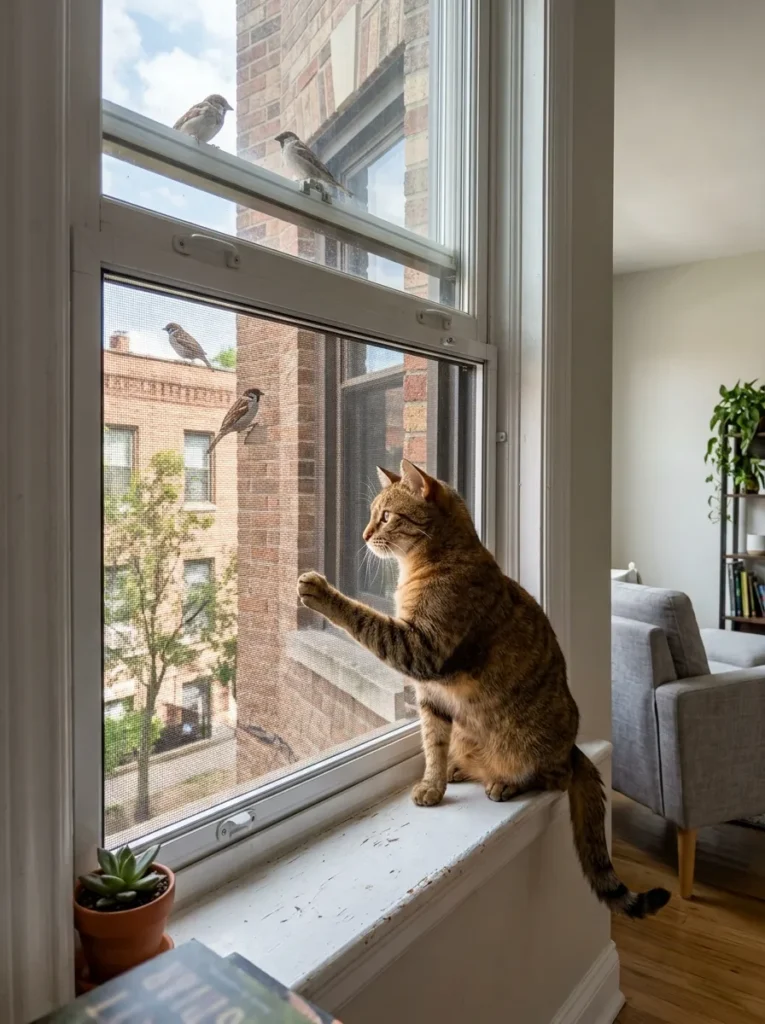
Vibe: Practical and light — the enrichment solution that does everything it needs to and disappears into the window frame.
Why it works: A mesh window insert applies the design principle of minimal intervention maximum benefit — a precisely fitted aluminum mesh frame that drops into the window opening allows the window to be opened fully above the insert while the mesh provides complete containment below. The cat gains access to fresh air, natural soundscape, scent complexity, and visual stimulus through the mesh at a cost and complexity that no other enrichment intervention can match. The white powder-coated frame reading against the white window frame is the integration quality that makes this solution disappear from the exterior view — the mesh insert reads as a window screen rather than a pet accessory from the street.
How to get it: Measure the interior window opening precisely (width and height from frame interior to frame interior) and order a custom mesh insert from specialist pet screen suppliers — several online suppliers produce custom-fit cat mesh inserts to any dimension at $30–$80 depending on size. Alternatively, construct from aluminum door and window screen frame components (available at hardware stores) cut to the window opening dimensions and fitted with 19-gauge galvanized or stainless steel wire mesh at 12mm x 12mm aperture. The insert sits in the window opening without any fixing — gravity and the window sash lowered onto the insert’s top edge holds it in position.
Quick Win: A $25 adjustable pet screen from an online pet supplier provides a functional same-day solution for apartments where a custom-built insert is not immediately available — the adjustable spring mechanism fits standard window widths without cutting or measuring.
| Product |
|---|
| Custom cat mesh window insert aluminum |
| Stainless steel mesh 12mm aperture |
| Aluminum screen frame corner kit |
| Screen spline and roller for mesh attachment |
| Adjustable pet screen apartment ready |
Also view: 15 Modern Small Dog Houses for Indoor and Outdoor Use
2. Window Box Cat Perch with Mesh Enclosure
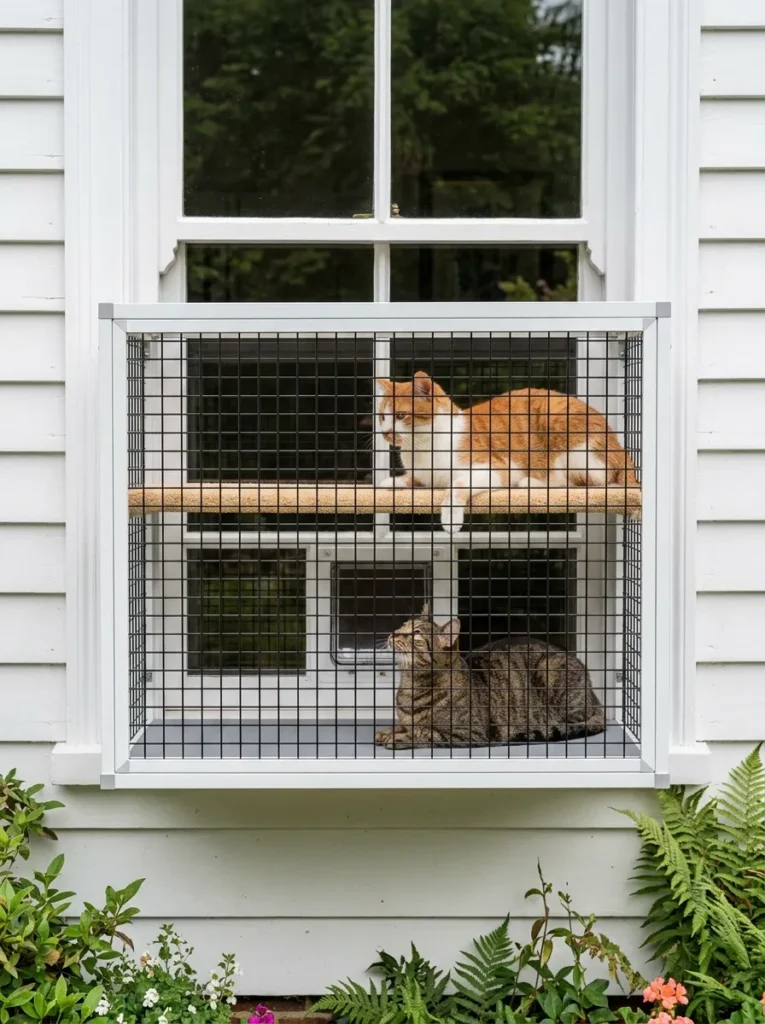
Vibe: Functional and considered — the window box that gives two cats a proper outdoor room without modifying the house.
Why it works: A window box cat enclosure extending outside the window applies the design principle of space creation through minimal footprint projection — by extending 60cm beyond the window’s exterior face, the enclosure creates a genuine three-dimensional outdoor room for the cat within a volume that has no impact on the home’s interior floor plan. The mesh front and sides provide panoramic outdoor sightlines in three directions, making the box enclosure the most visually stimulating fixed enclosure format available because the cat can observe 180 degrees of the outdoor environment from their elevated position. The carpeted interior shelf at window sill height is the transition element that makes the enclosure naturally accessible — the cat steps directly from the indoor windowsill onto the enclosure shelf without any climbing or jumping.
How to get it: Build the box frame from 25x25mm powder-coated aluminum square section tube, cutting to the desired dimensions with a metal cutting circular saw blade or angle grinder. Join frame corners using internal corner brackets designed for aluminum tubing. Attach stainless steel mesh to the frame faces using aluminum mesh clips at 100mm intervals — the mesh aperture must be 12mm or smaller for the enclosure to be secure for any cat breed. Mount to the exterior window frame using four stainless steel mounting brackets with stainless screws into the window frame timber. Install a cat door in the window glazing using a mounting kit or in a plywood panel fitted into the window opening to allow passage between interior and enclosure.
| Product |
|---|
| Aluminum square tube 25x25mm for frame |
| Internal corner bracket aluminum frame |
| Stainless steel mesh roll 12mm |
| Aluminum mesh clip set |
| Cat flap for window panel installation |
3. Lean-To Cedar Catio Against Exterior Wall
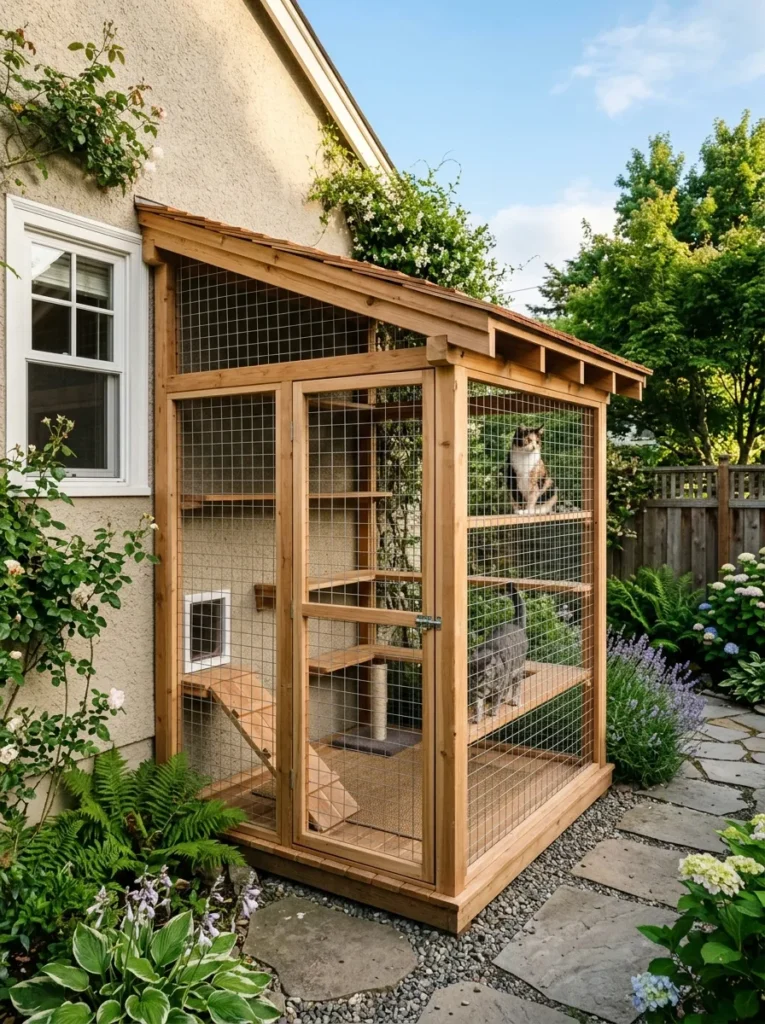
Vibe: Natural and generous — the backyard catio that gives cats a proper outdoor room and gives the garden a structure that belongs in it.
Why it works: A lean-to cedar catio against the exterior wall applies the design principle of architectural integration through material matching — cedar timber is a traditional outdoor building material whose warm color and graceful weathering to silver-gray connects the enclosure to the material language of garden structures rather than marking it as a pet accessory. The lean-to format using the house wall as the structure’s back face is the most structurally efficient catio configuration because it reduces the number of posts required and uses the house wall’s thermal mass and wind-break quality to improve the enclosure’s interior climate. The interior shelf system at varied heights is the behavioral design decision that most directly improves the enclosure’s enrichment value — cats prefer elevated positions and a multilevel shelf system allows several cats to occupy the space simultaneously at positions that satisfy their individual height preference hierarchy.
How to get it: Build the lean-to frame from 90x90mm cedar posts at each front corner and along the front at 1.2m intervals — the house wall provides the back support without requiring additional rear posts. Build the roof from cedar rafters pitched at 10 degrees minimum from the house wall downward, covered in corrugated polycarbonate sheeting for light transmission. Attach galvanized wire mesh (2mm wire, 25mm aperture) to all open faces using stainless staples. Build interior shelving from cedar planks at 30cm, 80cm, and 150cm heights — stagger the shelf positions so cats can jump between levels rather than requiring a single large leap.
| Product |
|---|
| Cedar timber post 90x90mm structural |
| Cedar plank for interior shelving |
| Galvanized wire mesh 25mm aperture 2mm wire |
| Corrugated polycarbonate sheet for roof |
| Stainless staple set for mesh attachment |
4. Modern Black Aluminum Catio with Clean Lines
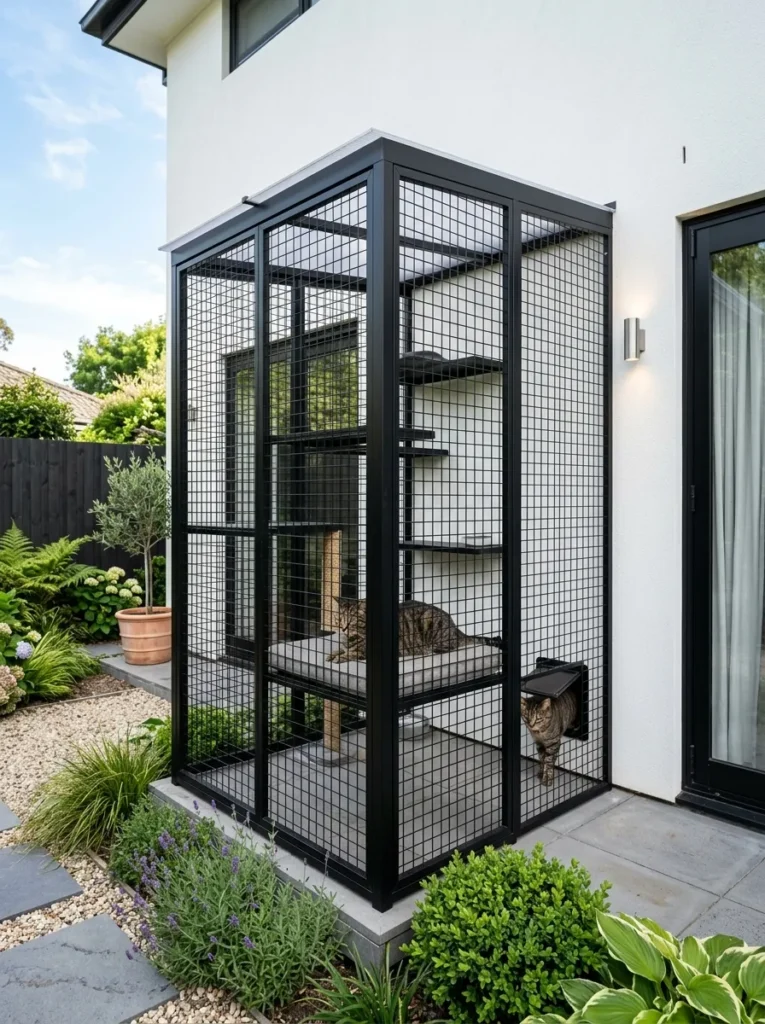
Vibe: Architectural and modern — the catio that an architect would design for their cat and their house simultaneously.
Why it works: A modern black aluminum catio with clean architectural lines applies the design principle of design system extension — by using the same powder-coated matte black aluminum framing and mesh panels used in contemporary architectural window, door, and garden screen systems, the catio becomes indistinguishable at first glance from an intentional architectural outdoor room rather than a pet enclosure. The flat or minimal-slope roof profile is the specific design decision that most clearly separates the modern aluminum catio from the agricultural lean-to timber catio aesthetic — the flat roof reads as architecture while the pitched roof reads as outbuilding. Black mesh against a white rendered exterior wall creates the strongest possible visual integration with modern Scandinavian and contemporary residential architecture.
How to get it: Source 40x40mm matte black powder-coated aluminum square section tube from an architectural metal supplier — the same product used in modern garden screens and architectural metalwork projects. Join using weld-on internal corner brackets (black powder-coated) or have a local metal fabricator weld the frame corners for a cleaner structural connection. Specify black stainless steel woven wire mesh in 19-gauge at 12mm aperture for the most refined appearance — the black stainless wire is barely visible against the black frame, creating the impression of open mesh rather than an enclosure.
| Product |
|---|
| Matte black powder-coated aluminum tube 40mm |
| Black stainless steel mesh 12mm fine |
| Black corner bracket powder-coated |
| UV polycarbonate roof panel clear |
| Concrete paver set for catio floor |
5. Tunnel System Connecting Window to Outdoor Catio
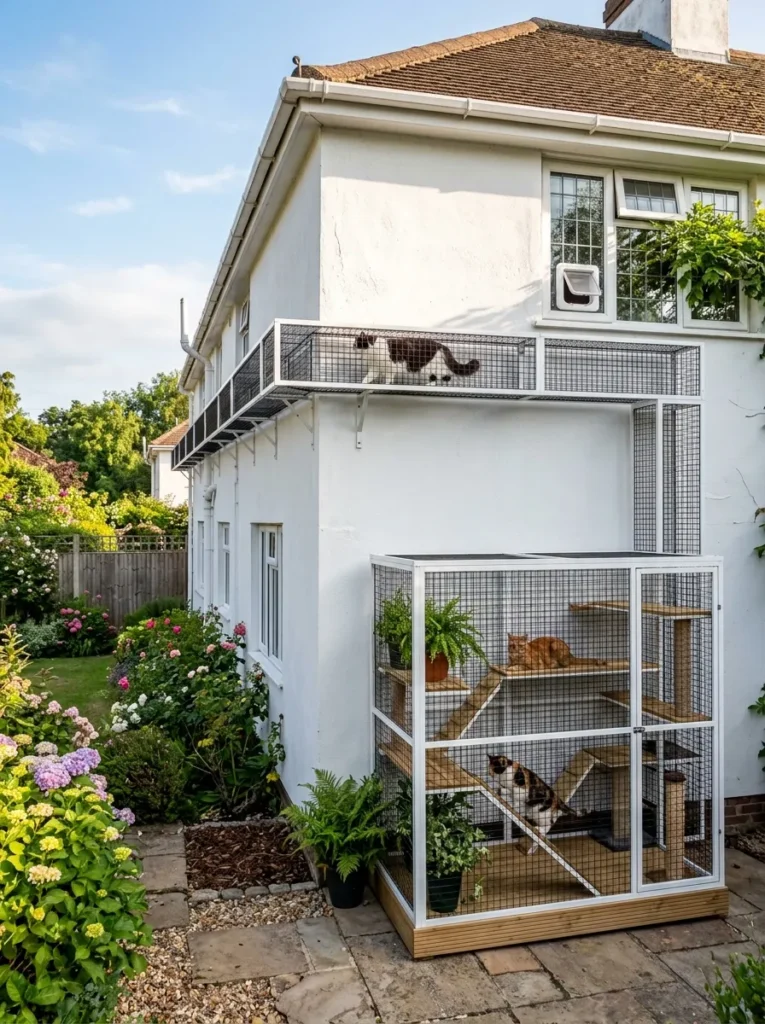
Vibe: Clever and integrated — the tunnel system that lets a cat explore from bedroom window to garden catio without the owner opening a single door.
Why it works: A cat tunnel system connecting an upper-floor window to a ground-level catio applies the design principle of environmental range extension — rather than limiting the cat’s outdoor access to the volume immediately adjacent to a single window, the tunnel system connects multiple outdoor zones (the window-level view, the along-wall perch position, and the ground-level catio with its different sensory inputs) into a single continuous accessible territory. The tunnel’s 30cm square cross-section is the minimum comfortable navigation width for most adult cats — the cat can move through a 30cm tunnel without crouching uncomfortably but the dimension keeps the tunnel lightweight and visually minimal against the house wall. The white aluminum framing against a white exterior wall creates the most minimal possible visual presence for the tunnel system.
How to get it: Build tunnel sections from 25mm aluminum angle section frames covered in 12mm stainless mesh, assembled in 60cm or 90cm lengths for manageable installation. Join tunnel sections using internal sleeve connectors that allow the tunnel to turn corners by combining straight and corner section units. Attach to the house wall using stainless L-bracket wall mounts at 90cm intervals. Build the tunnel vertical drop section with slight internal horizontal platforms at 40cm intervals to allow the cat to descend safely rather than falling the full drop length.
| Product |
|---|
| Aluminum angle section frame 25mm |
| Tunnel corner section connector |
| Wall bracket mount stainless L-shape |
| Tunnel internal platform bracket set |
| Mesh roll 12mm for tunnel panels |
6. Biophilic Living Wall Cat Enclosure
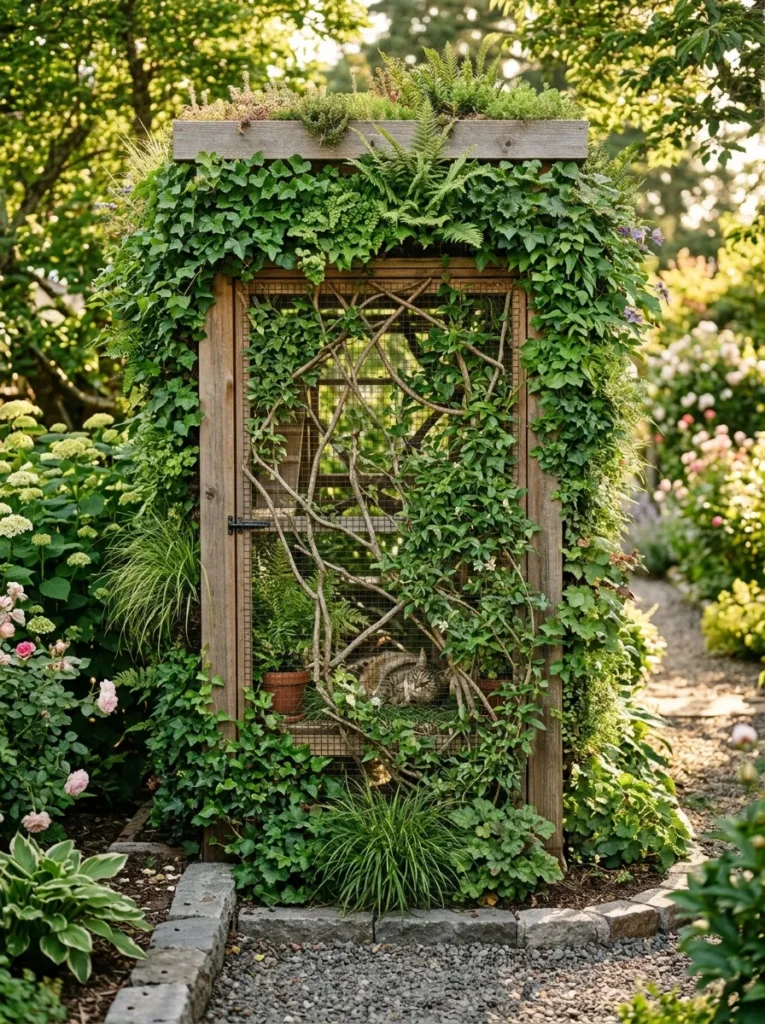
Vibe: Lush and natural — the cat enclosure that becomes a garden feature in its own right and enriches the cat through direct contact with growing plants.
Why it works: A biophilic living wall cat enclosure applies the design principle of nature integration as dual benefit — the climbing plants growing over the exterior mesh provide the cat with moving plant material visible and scent-accessible through the mesh (a genuinely stimulating enrichment input), provide the garden with a planted feature that conceals the enclosure’s functional infrastructure, and provide the homeowner with a structure that contributes to rather than compromises the garden’s aesthetic. Cat-safe climbing plants (jasmine, ivy, honeysuckle in climate-appropriate varieties) growing over the exterior mesh within a single growing season can make the enclosure’s wire infrastructure nearly invisible behind the foliage. The interior planting of catgrass, catnip, and valerian is the enrichment provision that most directly addresses the olfactory enrichment dimension that standard enclosures cannot provide.
How to get it: Build the cedar frame catio first as a standard structure. Install planted beds at the base of each exterior mesh panel — raised beds constructed from cedar boards with appropriate soil depth for climbing plant establishment. Plant cat-safe climbing species at the base of each exterior mesh panel and train them upward using garden wire clips attached to the mesh. Inside the enclosure, install raised planters at ground level and on interior shelves, planted with catgrass (Dactylis glomerata), catnip (Nepeta cataria), and valerian (Valeriana officinalis) — all genuinely safe for cat contact and highly attractive to most cats.
| Product |
|---|
| Cat-safe climbing plant set jasmine ivy |
| Cedar raised bed kit for exterior planting |
| Catgrass seed or plug plant set |
| Catnip plug plant set |
| Climbing plant mesh clip set |
7. Bay Window Cat Enclosure Extension
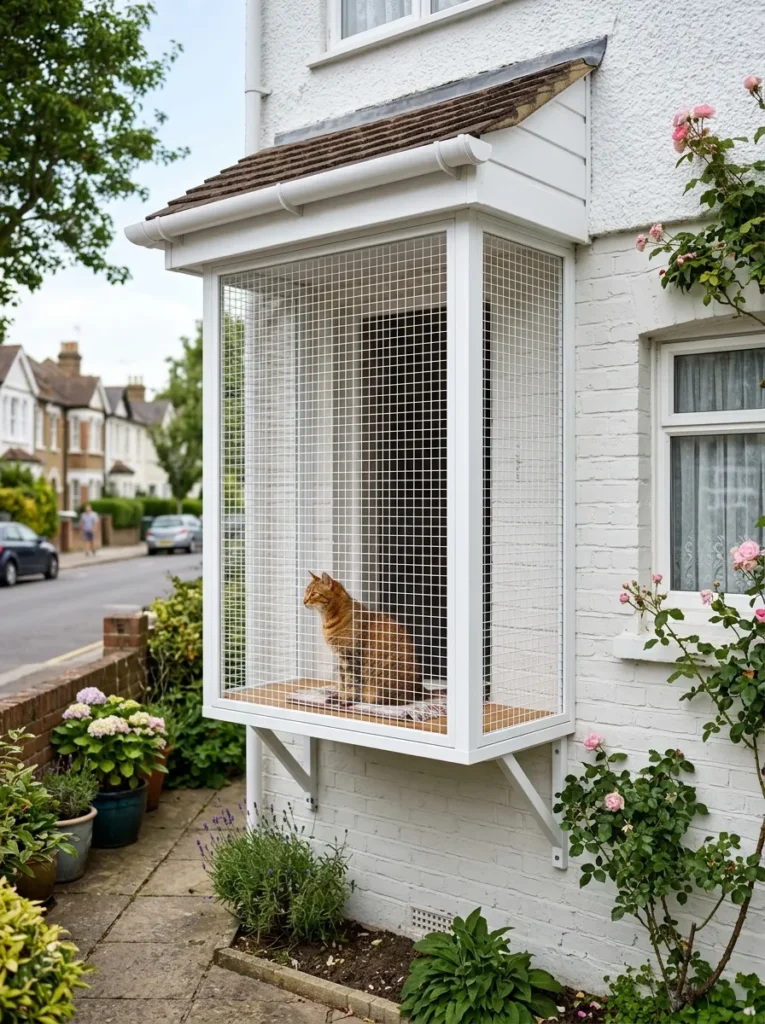
Vibe: Architectural and integrated — the enclosure that looks like a bay window from the street and functions as a cat’s private observation deck.
Why it works: A bay window cat enclosure extension applies the design principle of architectural illusion through form reference — by projecting from the window in a bay window profile (three-sided, with angled sides at 135 degrees to the house face), the enclosure reads as a conventional residential bay window from exterior viewing angles, making it indistinguishable from a genuine architectural bay window at street distance. This is the cat enclosure format with the highest architectural integration quality and the lowest visual impact on the home’s exterior appearance. The 40cm projection provides enough interior volume for a cat to turn, sit, and lie in all directions while remaining compact enough to fall within most planning and building regulations that apply to minor exterior alterations.
How to get it: Build the bay frame from 40x40mm aluminum square tube in white powder coat, creating two angled side panels at 135 degrees to the house face and a front panel perpendicular to the house. Mount the assembled bay to the window frame using heavy-duty stainless mounting brackets bolted through the external window frame into the window reveal structure. Install a solid waterproof floor at window sill height — 12mm marine plywood covered in outdoor carpet or astroturf provides a comfortable, cleanable surface. Cover the side panels and front panel with 12mm stainless mesh.
| Product |
|---|
| White aluminum tube 40mm bay frame |
| 135-degree corner connector aluminum |
| Marine plywood 12mm for bay floor |
| Outdoor carpet for bay floor surface |
| Heavy-duty stainless mounting bracket |
8. Juliet Balcony Cat Enclosure with Mesh Railing
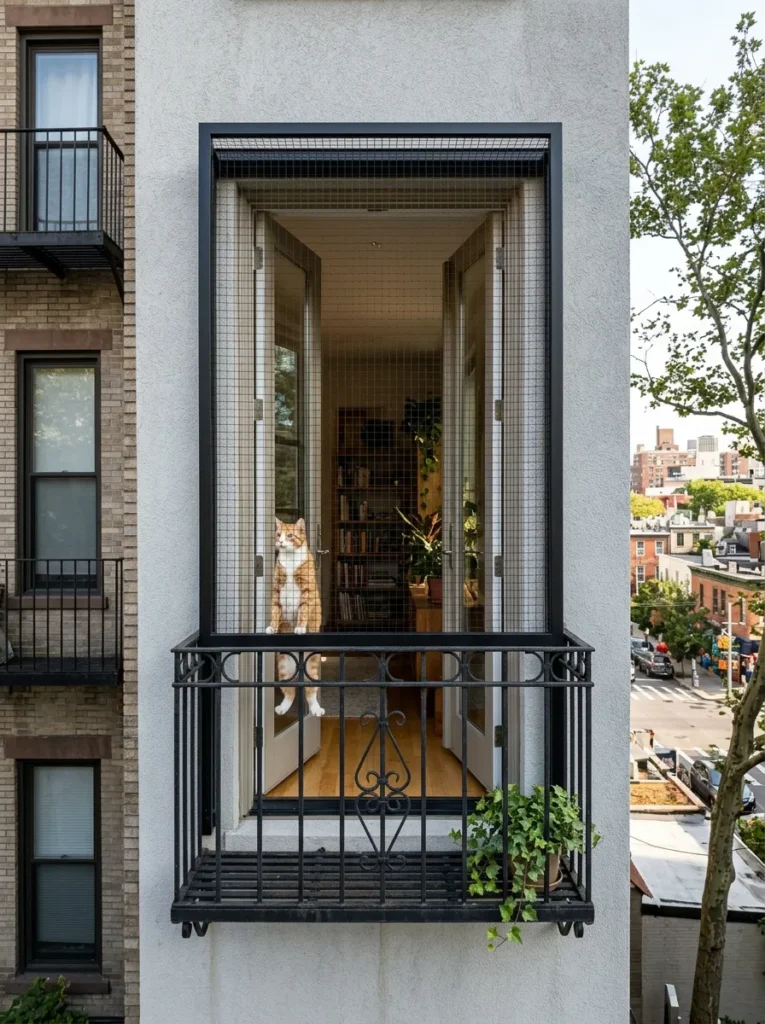
Vibe: Urban and refined — the apartment solution that looks like a thoughtful architectural detail from the street and functions as full cat containment.
Why it works: A Juliet balcony cat mesh system applies the design principle of functional element as decorative architecture — a fine black stainless steel mesh stretched across a full-height door opening on a slim black aluminum frame reads from exterior viewing distance as a contemporary Juliet balcony railing, which is a recognized architectural feature that adds visual refinement to apartment exteriors. The door behind the mesh can be fully opened to provide maximum air circulation — the cat can press against the mesh, smell the air, and watch the street without any risk of falling or escaping. This is the most suitable cat enclosure format for rental apartments where no permanent exterior modification is permissible — the mesh system attaches to the interior of the door frame with removable brackets.
How to get it: Build a frame from 20x20mm black aluminum flat bar in the door opening’s exact dimensions. Stretch 19-gauge black stainless mesh across the frame and secure with aluminum rivets or pop-rivet adhesive at 50mm intervals. Mount the framed mesh to the interior door frame using four removable stainless hook-and-eye fittings that allow the mesh panel to be removed completely when needed. The hook-and-eye mounting leaves no permanent marks on the door frame and is suitable for rental properties.
| Product |
|---|
| Black aluminum flat bar 20x20mm |
| Fine black stainless mesh 12mm |
| Pop rivet aluminum set for mesh |
| Hook and eye fitting stainless set |
| Corner gusset for frame corners |
9. Full Window Replacement with Cat Door and Mesh
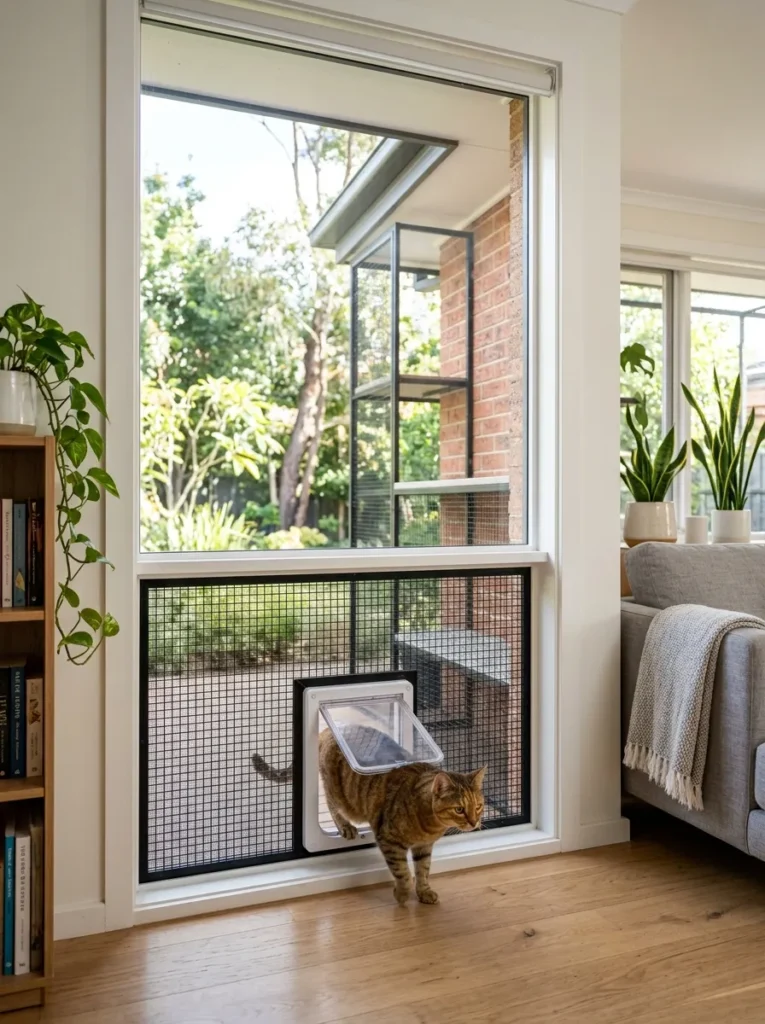
Vibe: Clean and functional — the permanent solution that makes cat access as natural and unobtrusive as any other architectural feature.
Why it works: A full window replacement with integrated cat door and mesh panel applies the design principle of permanent architectural integration — rather than adding an enclosure to an existing window, the window itself becomes the cat access point, with the mesh panel and cat door integrated into the window frame as a single manufactured unit. This approach produces the cleanest possible interior appearance because there are no added structures, no visible mounting hardware, and no elements that read as afterthoughts — the window simply functions differently from a standard glazed window. The upper tempered glass section maintains the window’s primary function of natural light provision while the lower mesh section provides the ventilation and cat access that would previously have required a separate structure.
How to get it: Commission a custom window unit from a window manufacturer or joinery specialist who can produce a combination glass-and-mesh glazed frame to the existing window opening dimensions — specify tempered glass for the upper section and stainless mesh panel with integral cat door for the lower section. Alternatively, create the combination panel as a secondary insert: remove the existing glass pane, cut a plywood panel to the lower third of the opening, cut the cat door aperture in the plywood, install the cat door unit, cover the plywood in stainless mesh, and reinstall the upper glass section above. Seal all junctions with exterior-grade weatherproof sealant.
| Product |
|---|
| Custom mesh panel window lower section |
| Lockable cat door with clear magnetic flap |
| Exterior weatherproof sealant clear |
| Stainless mesh for panel fabrication |
| Plywood panel for lower section base |
10. Rooftop or Balcony Cat Safety Net System
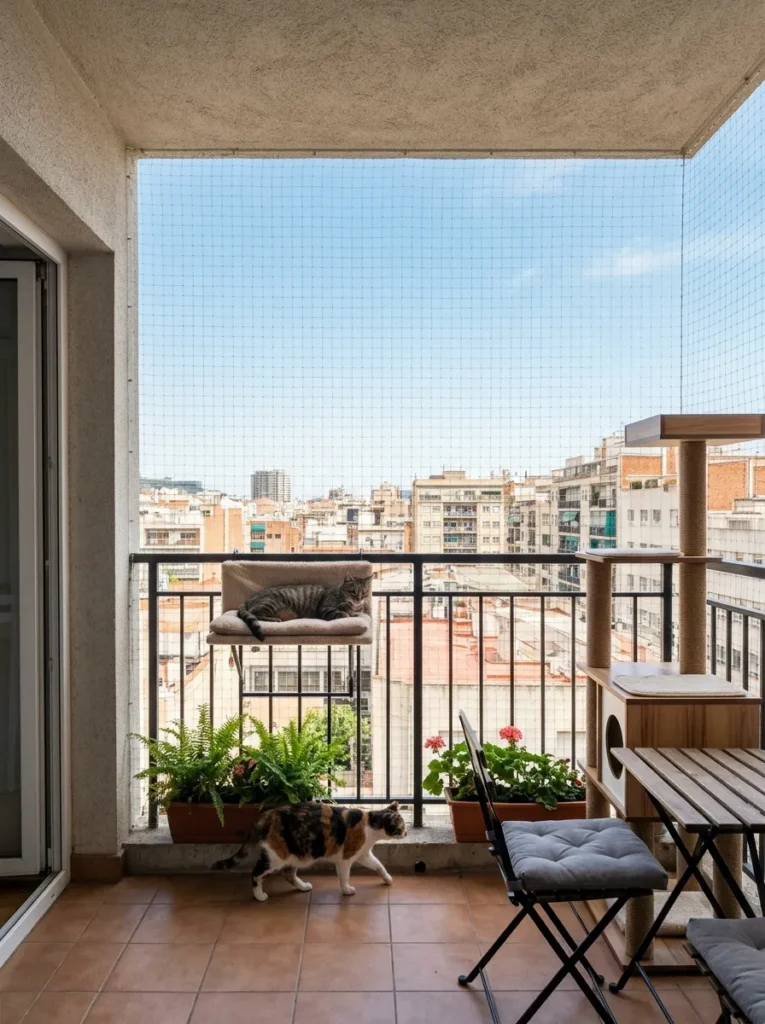
Vibe: Open and airy — the containment system that lets the cat experience the full balcony without any visible enclosure from inside.
Why it works: A fine black UV-resistant nylon cat safety net for a balcony or rooftop terrace applies the design principle of minimum visible intervention — fine black nylon mesh, when viewed from the interior against a bright sky background, becomes nearly invisible to human observation while providing complete containment for any cat. The net system converts the full balcony volume into a cat-safe outdoor space rather than the limited zone of a window box or small catio, providing the maximum possible outdoor territory for apartment cats. The black color is specifically chosen for visual minimalism — white or natural-colored netting is visible against any background, while black netting disappears against the sky’s luminosity through the contrast effect.
How to get it: Source fine-gauge UV-resistant nylon cat safety net (sold specifically for balcony cat containment in European markets under the term “balcony net” or “catio net”) in black or dark gray. Attach to the balcony perimeter using stainless steel cable and turnbuckle tensioning systems that pull the net taut without visible sagging. The net requires attachment points at the balcony ceiling or soffit above and at the balcony floor level on all open sides — install screw-in eye bolts at 60cm intervals as the net attachment grid.
| Product |
|---|
| UV-resistant black nylon cat safety net |
| Stainless cable set for net tensioning |
| Turnbuckle set for net tightening |
| Eye bolt stainless for attachment grid |
| Net edge tape reinforcement |
11. Internal Window Seat with Integrated Mesh Enclosure
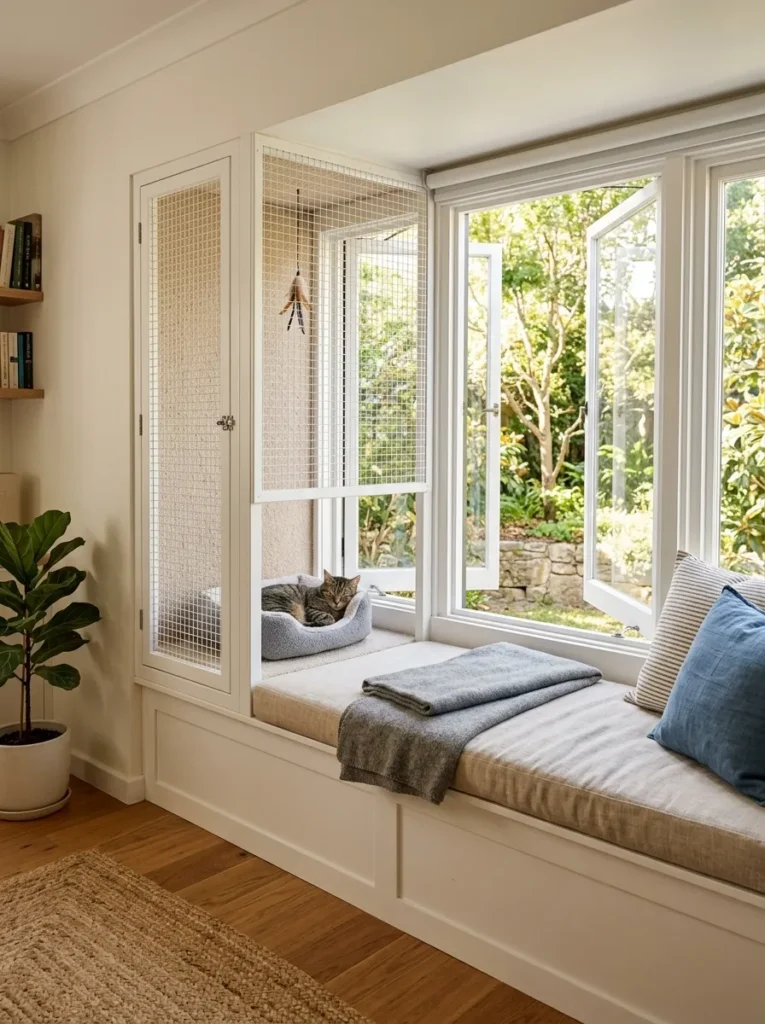
Vibe: Considered and domestic — the cat enclosure that reads as a built-in architectural feature rather than a pet product.
Why it works: An internal window seat with integrated mesh enclosure applies the design principle of function concealment within architectural furniture — by integrating the cat’s enclosed window access space within a window seat that is itself a valued architectural feature of the room, the cat enclosure becomes invisible as a category and is absorbed into the room’s design language as a considered built-in element. The window seat serves human functions (seating, storage, reading perch) while its integrated upper mesh section serves exclusively as the cat’s fresh air and window access zone — the cat can be enclosed in the mesh section when unsupervised and released into the full room when supervised, which makes the enclosure appropriate for cats who need controlled window access rather than constant access.
How to get it: Build the window seat platform from 18mm MDF or plywood with a painted finish, incorporating storage drawers or a lift-top storage section below the seat cushion. Build the mesh enclosure section from timber framing above the seat level, incorporating the cat door access from the seat surface into the enclosure above, the mesh panels on all four visible sides, and a small cushioned floor area inside. Size the enclosure interior to allow a cat to stand, turn, and stretch — minimum 50cm cube interior dimensions. Integrate the enclosure’s timber framing with the window seat’s framing for visual continuity.
| Product |
|---|
| MDF sheet for window seat construction |
| Stainless mesh for enclosure panels |
| White paint for timber frame |
| Carpet tile set for enclosure interior |
| Internal cat door access panel |
12. Freestanding Indoor-Outdoor Cat Window Tower
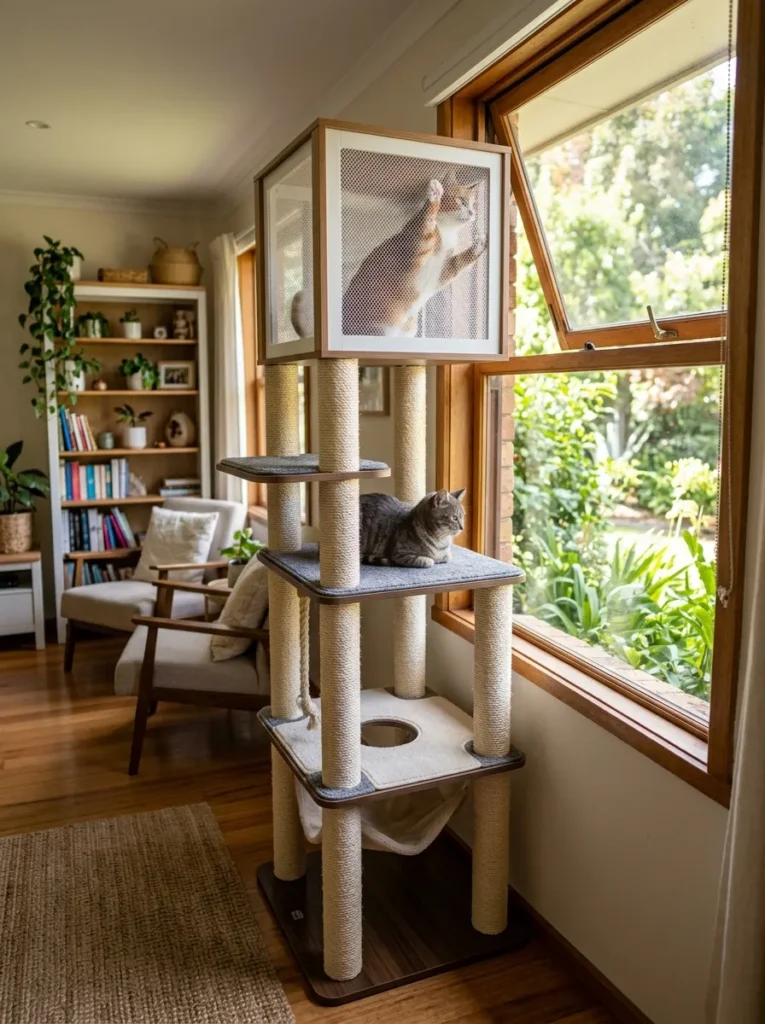
Vibe: Playful and practical — the enrichment solution for renters who want genuine fresh air access without any permanent modification.
Why it works: A freestanding indoor-outdoor cat window tower with an integrated mesh pod applies the design principle of positioning-based access without attachment — by building the mesh enclosure pod into the top of a cat tower that is positioned directly against an open window, fresh air flows through the mesh pod naturally without any permanent connection to the window or wall. The tower can be repositioned to any window in the home according to seasonal sun position, outdoor activity patterns (bird feeders at different windows in different seasons), or the cat’s current preference. The multilevel tower design below the mesh pod provides climbing, scratching, and resting infrastructure that makes the whole installation a complete enrichment system rather than simply an access point.
How to get it: Build or purchase a cat tower base with platforms at multiple heights, ensuring the top platform height aligns with the window sill height of the window it will serve — this alignment allows the cat to step directly from the tower top into the mesh pod at window level. Build the mesh pod as a separate unit that mounts to the tower top using simple bracket connections — this allows the pod to be removed for cleaning or storage independently of the tower. The pod must be positioned so its mesh face aligns with the open window and its interior is at the same level as the window opening.
| Product |
|---|
| Sisal cat tower base tall |
| Mesh pod frame kit 50cm cube |
| Stainless mesh for pod panels |
| Platform height extender for tower |
| Tower stabilizer base weight |
13. Multi-Room Connected Cat Highway with Window Access
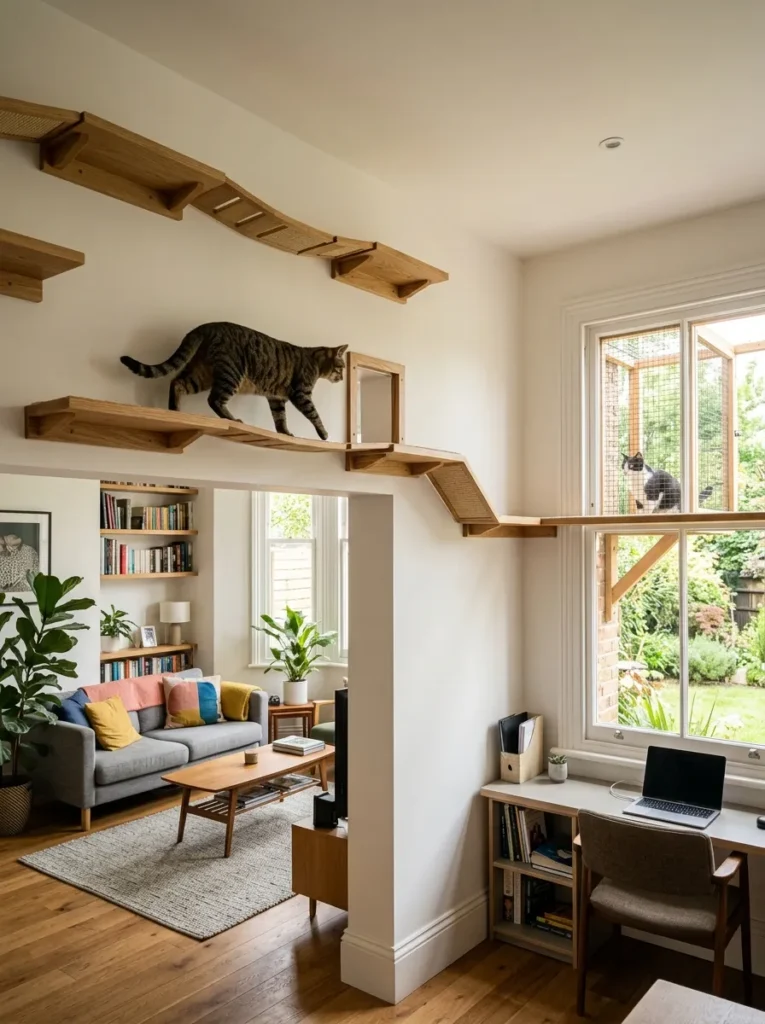
Vibe: Clever and integrated — the cat infrastructure that turns the whole house into a three-dimensional territory with outdoor access at the end.
Why it works: A multi-room connected cat highway with window access applies the design principle of territorial range maximization through vertical infrastructure — rather than limiting cat activity to the ground plane of the home where human furniture and circulation occupy the majority of usable space, the ceiling-level cat highway creates a separate territory layer above human occupation height where the cat can move freely between rooms without ground-level navigation. This upper-level territory is behaviorally significant because it satisfies the cat’s instinct for high-position observation and the preference for unobstructed movement pathways that ground-level furniture arrangements cannot provide. The mesh window enclosure at the highway’s terminal point connects this entire elevated territory system to the outdoor environment, making the enclosure the destination of a genuinely stimulating internal journey.
How to get it: Install the cat highway from natural timber floating shelves (30cm wide, 2.5cm thick, spaced at 50cm vertical increments where needed to assist climbing) wall-mounted at 180cm height using heavy-duty floating shelf brackets rated for 30kg or more — the cat’s jumping and landing creates dynamic loads that standard shelf brackets cannot reliably support. Cut cat door apertures in partition walls at the 180cm shelf height using a jigsaw, finishing the opening with a timber frame that reads as an architectural portal at ceiling height. Connect all shelf sections with ramp sections where height changes exceed a single cat’s comfortable jump.
| Product |
|---|
| Natural timber shelf 30cm wide |
| Heavy-duty floating shelf bracket set |
| Cat door through wall kit |
| Shelf connector ramp section |
| Wall anchor heavy-duty drywall |
14. Full Architectural Catio Room Addition
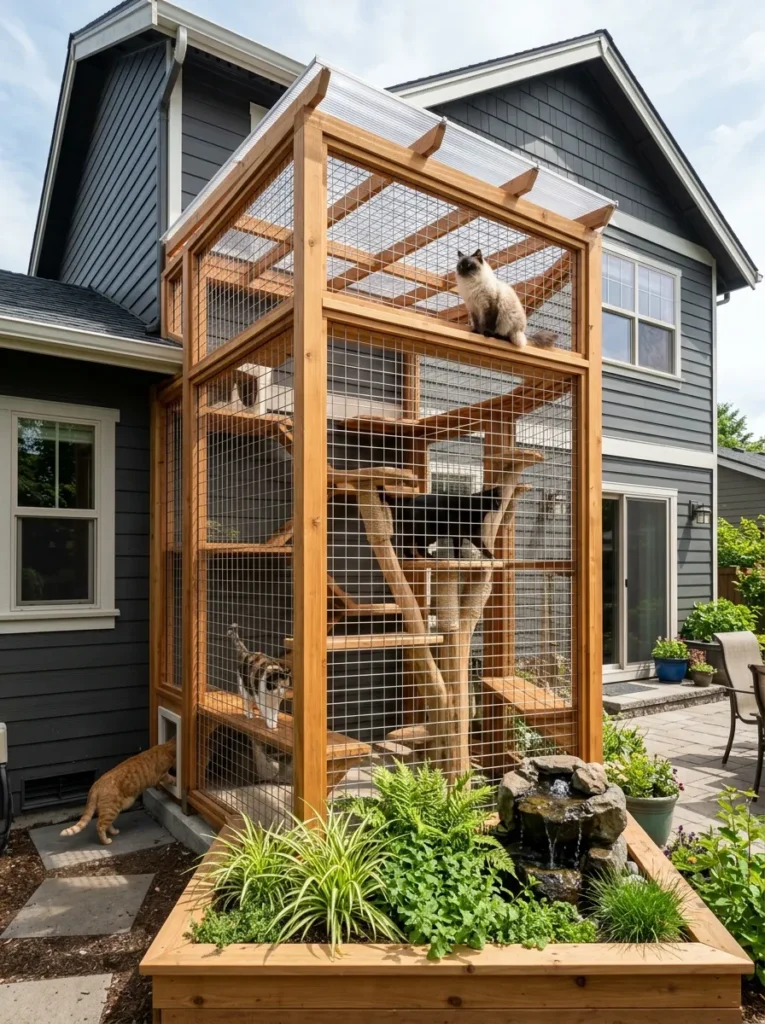
Vibe: Generous and architectural — the catio that is genuinely the best room in the house for the cats who live in it.
Why it works: A full architectural catio room addition applies the design principle of pet infrastructure at the scale of human infrastructure — a 3x4m enclosed outdoor room with multiple interior levels, a water feature, planted beds, and a polycarbonate roof is the cat enrichment equivalent of a properly designed human outdoor room. The behavioral benefits scale with the space — a room-scale catio provides territory large enough for multiple cats to establish their own zones within the shared space, for genuine athletic movement (jumping, climbing, running), and for the extended periods of outdoor sensory stimulation that short-duration window access cannot achieve. This is the cat enrichment investment with the highest welfare return per square meter of any option available to cat owners with outdoor space.
How to get it: Plan the catio room’s footprint on the property’s site plan, checking local planning permissions for outbuilding structures — most residential planning codes permit structures below a certain height and footprint without formal permission, but this varies significantly by jurisdiction. Build the structural frame from cedar posts at 1.2m centers set in concrete footings, with horizontal rails at 1.2m vertical spacing. Install the roof as a combination of fixed polycarbonate panels (for weather protection and light) and mesh panels (for ventilation) — a 70/30 polycarbonate-to-mesh roof ratio provides adequate rain protection while maintaining significant fresh air exchange. Line all wall faces with 2mm galvanized wire mesh at 25mm aperture. Build interior shelving, climbing structures, and planting beds as the final fit-out stage.
| Product |
|---|
| Cedar post 90x90mm structural catio |
| UV polycarbonate panel for roof |
| Galvanized wire mesh 25mm 2mm wire |
| Concrete footing mix for post bases |
| Cedar shelf planks for interior levels |
How to Start Your Cat Window Enclosure Project
Start with a mesh window insert. Before planning a tunnel system, ordering cedar timber, or researching planning permissions for a catio room, spend $30–$60 on a simple mesh window insert fitted to the window your cat already uses most frequently — the one they sit beside, scratch at, and watch through most often. Install it, open the window behind it, and observe your cat’s response over the following two weeks. The behavioral evidence of how your cat uses their first mesh insert — how many hours they spend at the open window, whether they press against the mesh to smell the air, whether they begin spending more time at the window than previously — will tell you everything you need to know about how much further to invest in their window enrichment system. Many cats’ needs are fully met by a mesh window insert and an interior perch; others demonstrate through their behavior that they would benefit from a more generous external enclosure. The insert is both the first enrichment intervention and the evidence base for every subsequent decision.
The most common mistake cat enclosure builders make is using mesh with apertures too large for their cat — galvanized chicken wire with 50mm hexagonal openings is the most commonly available and cheapest wire mesh, but a determined cat can push their head through a 50mm aperture and in the worst case become trapped. The correct mesh aperture for any cat enclosure is 12mm x 12mm for domestic cats of all breeds, which prevents both the cat’s head from fitting through and potential predator access through the mesh. Specify either galvanized welded wire at 12mm or stainless steel woven mesh at 12mm — both are appropriate in weight and aperture for any cat weight. Never use chicken wire, rabbit wire, or hardware cloth with apertures larger than 12mm for any part of a cat enclosure.
Three items under $50 that make every cat window enclosure project better: A roll of 19-gauge stainless steel mesh at 12mm aperture ($25–$40 for a 1m x 5m roll) that is the correct, safe, and durable mesh material for any part of the enclosure whether temporary or permanent; a tube of marine-grade silicone sealant ($8–$12) for weatherproofing all joints between the enclosure frame and the house exterior — unsealed joints allow rain infiltration that deteriorates timber framing and creates damp conditions inside the enclosure; and a packet of stainless steel staples for a heavy-duty staple gun ($6–$10) for attaching mesh to timber frames more quickly, securely, and cleanly than screws with washers.
Realistic expectations: A simple mesh window insert takes one afternoon to build or configure and costs $30–$80. A window box cat enclosure takes one weekend to build and costs $150–$400 in materials. A lean-to cedar catio takes 2–3 weekends to build and costs $400–$900 in materials. A full architectural catio room addition typically takes 3–5 weekends and costs $1,500–$5,000 in materials depending on size, or $5,000–$20,000 for professional design and build. Planning permission may be required for structures above certain dimensions — check local regulations before beginning any permanent external structure.
Frequently Asked Questions About Modern Cat Window Enclosures
What is the safest mesh material for a cat window enclosure?
The two safest mesh materials for cat window enclosures are 19-gauge galvanized welded wire mesh at 12mm x 12mm aperture (for cost-accessible timber frame builds) and 19-gauge stainless steel woven wire mesh at 12mm x 12mm aperture (for aluminum frame builds where visual refinement is important). Both provide the aperture size needed to prevent domestic cats of any breed from pushing their head through, the wire gauge needed to resist bending under sustained paw pressure and lateral body weight, and the corrosion resistance appropriate for long-term outdoor exposure. Never use: chicken wire (hexagonal apertures too large, wire gauge too light), PVC-coated wire (PVC coating degrades with UV and temperature cycling), or galvanized welded wire in apertures larger than 12mm for cats.
Do cat window enclosures require planning permission?
Planning permission requirements for cat enclosures vary significantly by jurisdiction and by the scale of the structure. In most residential areas, small structures (window box enclosures, lean-to catios under 2m height and 5 square meter footprint) do not require formal planning permission as they fall within permitted development or minor works categories. Larger catio room additions may require planning permission depending on the structure’s height, proximity to property boundaries, and percentage of available garden area covered. Listed buildings or properties in conservation areas may have stricter restrictions on external alterations that would apply to enclosures visible from the street. Always check with the local planning authority before beginning any external structure that involves permanent fixings to the house exterior or ground-level footings.
How do I prevent predators from accessing a cat enclosure from outside?
The most effective predator exclusion measures for outdoor cat enclosures are: mesh aperture of 12mm or smaller (prevents predatory birds, foxes, and domestic dogs from pushing limbs through the mesh), roof enclosure in mesh or solid roofing (prevents raptor attack from above), a mesh apron buried 30cm into the ground around the enclosure perimeter extending 30cm outward horizontally from the catio walls (prevents digging entry from foxes and other burrowing predators), and a roof overhang on all sides that prevents predators from reaching over the top of the walls. In areas with specific predator concerns (raccoons in North America, foxes in the United Kingdom, quolls in Australia), heavier gauge mesh (14-gauge welded wire) provides additional resistance to tearing and bending.
Can a cat enclosure be used in winter?
Cat enclosures provide meaningful enrichment value year-round in most temperate climates — cats remain behaviorally active in cold weather and benefit from fresh air access even when they prefer to limit their time outside the main structure. For winter usability, the most important modifications are: a weatherproof roof (either full polycarbonate roofing or an overhang that prevents rain and snow entering the enclosure), draught exclusion at the cat door (a heavy vinyl or carpet flap prevents cold air flowing through the door opening when the cat is not using it), and an interior thermal refuge such as a plastic igloo cat shelter placed inside the enclosure with a self-heating pad or water-activated heat pad inside it. Cats will self-regulate their time in the enclosure according to temperature — most cats are comfortable to −5°C in a sheltered, wind-protected enclosure.
What plants are safe to include inside a cat enclosure?
Cat-safe plants that actively benefit from catio inclusion include: catnip (Nepeta cataria) — a genuine behavioral attractant that many cats roll in and chew with obvious pleasure; catgrass (common wheat grass, Dactylis glomerata, or barley grass) — provides digestive fiber and satisfies grass-chewing instincts; valerian (Valeriana officinalis) — stimulates similar euphoric responses in cats as catnip; silver vine (Actinidia polygama) — particularly effective in cats who do not respond strongly to catnip; and cat thyme (Teucrium marum) — aromatic herbs that cats frequently investigate and roll against. Plants to strictly avoid in any cat-accessible area: lilies of any species (highly toxic to cats), autumn crocus, foxglove, rhododendron, oleander, wisteria, and all bulb species. The ASPCA maintains a comprehensive database of toxic and non-toxic plants for cats that should be consulted before adding any new plant species to a cat enclosure.
Ready to Create Your Cat’s Dream Window Enclosure?
These 14 ideas cover the complete range of what cat window enrichment can achieve — from the simplest mesh insert that gives an apartment cat their first breath of fresh outside air, to the full architectural catio room that provides multiple cats with a complete outdoor territory as generous as any room in the house. Every cat window enclosure project begins with the same observation: the window your cat already gravitates toward, the one they watch with the most sustained attention, the one they press against when something moves outside. That window is where you start — with a mesh insert that costs $50 and one afternoon to fit, that opens the window safely for the first time, and that lets you watch your cat discover what fresh air and real outdoor sound actually smells and sounds like from 30 centimeters away rather than through glass. The enrichment benefit is immediate, measurable, and visible in the cat’s behavior from the first hour the window is open. Save the enclosure ideas that match your home’s architecture, your budget, and the territory your cat most needs — and begin from that first open window.