How to Bond With Your Guinea Pig: 12 Trust-Building Tips
You brought home a guinea pig, and instead of the cuddly companion you imagined, you got a small furry missile that bolts into its hideout every time you walk past the cage. Sound familiar? How to bond with a guinea pig is one of the most-searched questions new owners ask — and the answer is reassuring: almost every guinea pig can be tamed with patience and the right approach. This guide gives you 12 proven, trust-building tips that actually work, plus an honest timeline and the mistakes that undo your progress.
First, Understand Why Bonding Takes Time
Guinea pigs are prey animals. In the wild, their survival depends on assuming everything big is trying to eat them — and you are very big. When your new pig runs from your hand, it is not rejecting you. It is running a millions-of-years-old survival programme that says “large shape approaching = danger”.
This is the single most important thing to internalise: your pig is not being difficult, unfriendly, or broken. It is being a perfectly normal prey animal in a new environment. Bonding is the slow process of teaching its nervous system that you are not a predator — and that takes repetition, not force. Every tip below works on that one principle: prove you are safe, over and over, until they believe it.
Personality plays a role too. Bold pigs may climb into your hand within days; nervous ones can take months. Rescues and previously mishandled pigs often need the longest. All of these are normal — the timeline below is a guide, not a deadline.
12 Trust-Building Tips That Actually Work
1. Start by just being present
For the first few days, do not try to touch your pig at all. Sit near the cage, read a book, scroll your phone, talk quietly. You are background furniture — and that is the point. They need to learn that your presence does not lead to being grabbed. This passive stage is boring for you and essential for them.
2. Let them learn your voice
Talk to your pig every time you are near the cage — softly, consistently, using the same phrases. “Hello, little one” in the same gentle tone, every time. Guinea pigs have excellent hearing and quickly learn to associate your voice with safety. Many owners find their pigs start wheeking at the sound of their voice within a couple of weeks — that is trust, arriving.
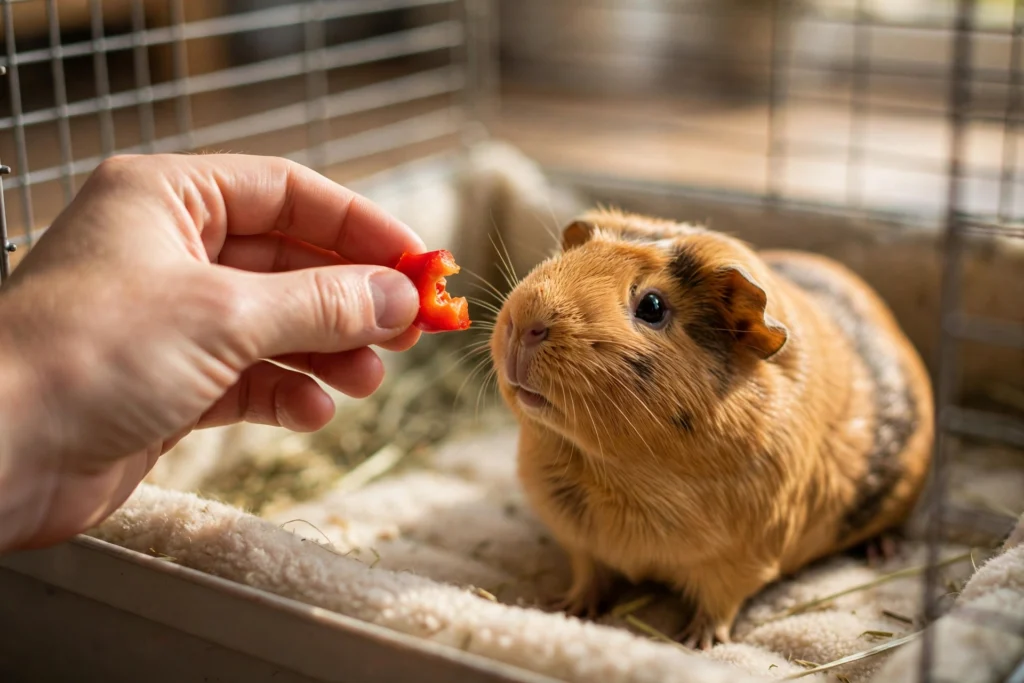
3. Hand-feed their favourite veggies
This is the single fastest trust-builder there is. Offer a sliver of bell pepper, a sprig of coriander, or a leaf of romaine from your open palm. At first they will snatch it and run. Then they will eat it a foot away. Then, one day, they will eat it from your fingers — and that is a milestone worth celebrating. Check our safe food list for the best bonding treats (and what to avoid).
4. Never chase — let them come to you
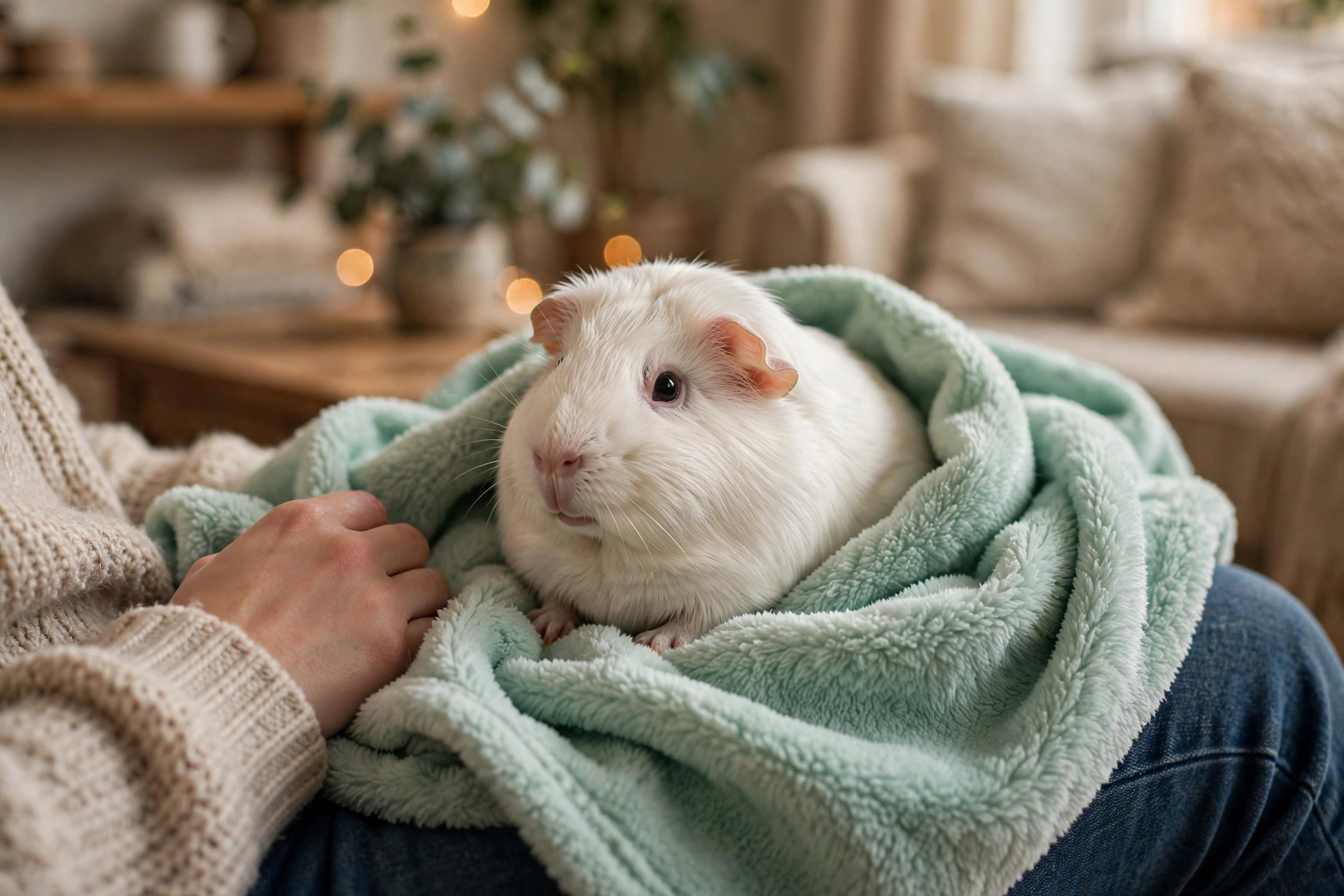
Chasing a pig around the cage to pick it up teaches exactly one lesson: your hand is a predator. Instead, lure with food, or use a fleece cuddle sack or tunnel — pigs walk into hideouts voluntarily, and you lift the sack, not the pig. The rule is simple: every interaction should be the pig’s choice whenever possible. Voluntary contact builds trust; forced contact destroys it.
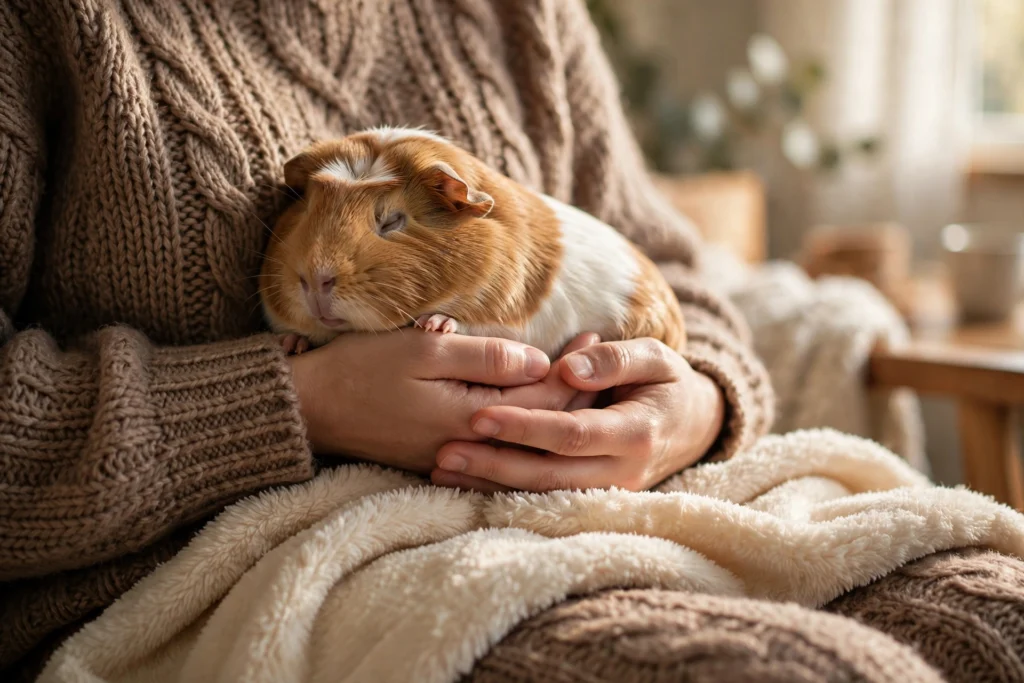
5. Build a lap-time routine
Once they tolerate being picked up (see our guide on how to hold a guinea pig properly), start daily lap time: same time, same spot, same fleece on your lap, same treat. Routine is deeply reassuring to prey animals — predictability means safety. Start with 10–15 minutes and build up. End every session with a treat so the last memory is a good one.
6. Get down to their level for floor time
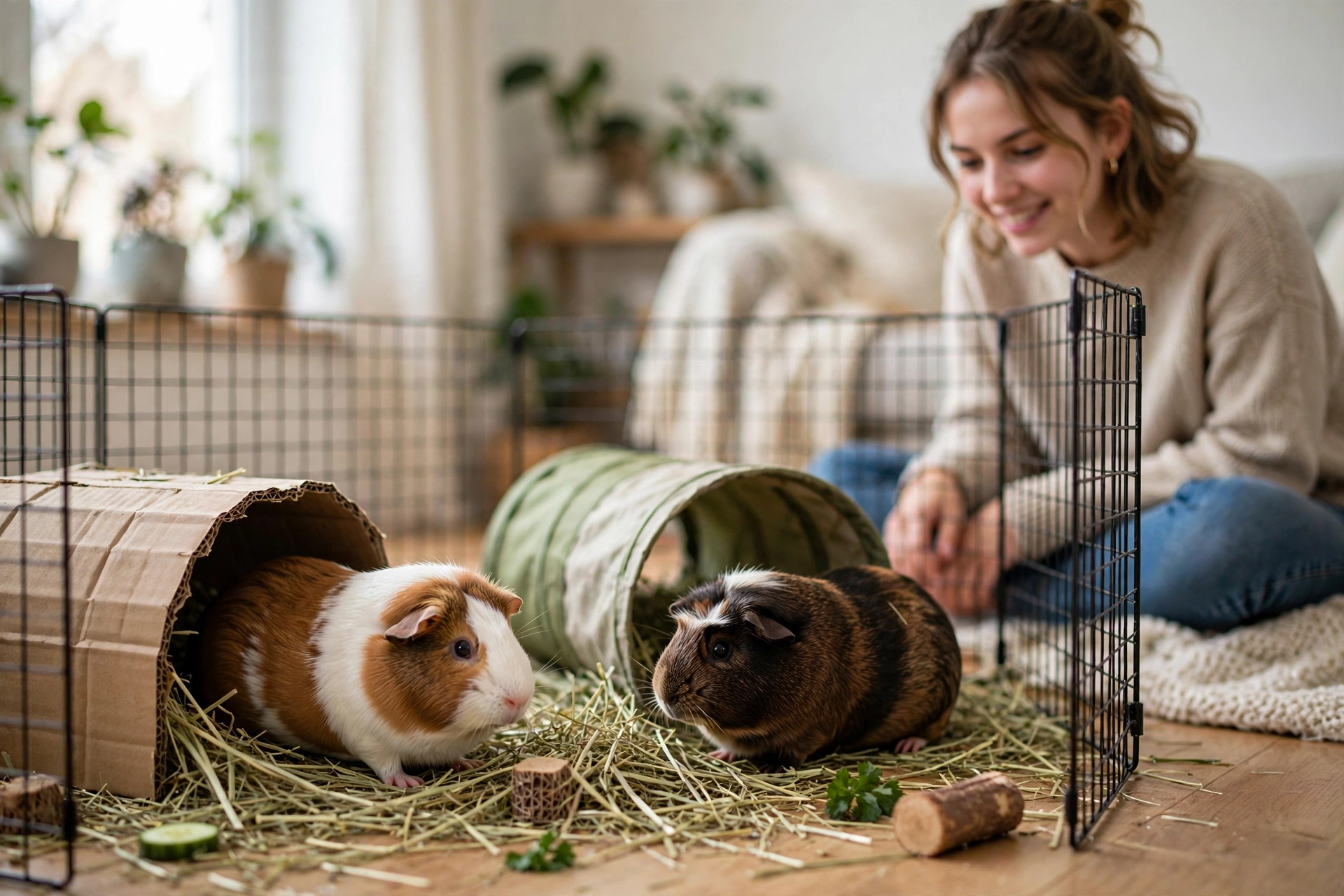
Floor time is bonding gold — but only if you do it right. Set up a safe enclosed pen, scatter some veggies and tunnels, put the pigs in, and then sit on the floor with them. Do not loom over them standing up. Lying or sitting at pig level, letting them sniff your hands, climb on your legs, and investigate you on their terms, teaches them you are part of the landscape, not a threat above it.
7. Stroke the way they like it
Guinea pigs have strong preferences. Most love gentle strokes from nose to rump, following the fur direction, and many adore chin and ear rubs. Most hate having their feet touched, being stroked against the fur, or sudden pats on the head (a hand descending from above = predator, remember). Learn your individual pig’s preferences and respect them — a pig that gets the strokes it likes will start soliciting them.
8. Learn their language
Bonding is a conversation, and your pig is talking constantly — in wheeks, purrs, chutts, and rumbles. A low relaxed purr during stroking means “keep going”. Teeth chattering means “back off”. A shriek means “stop, I am scared”. Learning to read these signals — and responding to them — is what turns handling into a relationship. Our guinea pig sounds guide decodes every noise you will hear.
9. Be consistent — same person, same routine
Pigs bond fastest with one primary person. If four different family members all handle the pig differently, progress is slow. Nominate one person as the main bonder for the first month: same feeding times, same voice, same lap-time spot. Once trust is established, it generalises to others much faster.
10. Respect the hideout
Never drag a pig out of its hidey house. The hideout is their safe place — the one spot in the world where nothing bad happens. Violating it teaches them that nowhere is safe, including you. If you need them out, lure with food or lift the whole hideout gently. Protecting their safe space is one of the fastest ways to earn trust.
11. Keep handling positive-only for a while
In the early weeks, every pick-up should lead to something good: lap time with treats, floor time with veggies, gentle strokes. If the only handling they get is nail trims and medicine, they will dread your hands. Once the bond is solid, they will tolerate the unpleasant stuff — but earn the trust first.
12. Consider a friend — bonded pigs are bolder pigs
A lonely guinea pig is a stressed guinea pig, and a stressed pig bonds slowly. Pigs with a companion are measurably bolder, more active, and more willing to approach humans — confidence is contagious. If your pig seems stuck in fear mode despite your best efforts, the missing ingredient may be a friend, not more handling. Read why guinea pigs should not live alone — it matters for bonding too.
A Realistic Bonding Timeline
Everyone wants to know how long this takes. Here is what to actually expect:
- Days 1–3: Settling in. Hiding most of the time, freezing or bolting when you approach. Completely normal. Just be present and quiet.
- Week 1–2: Curiosity begins. They eat while you are nearby, come out of the hideout when you sit by the cage, maybe take food from your fingers and run.
- Week 2–4: First breakthroughs. Eating from your hand without fleeing, tolerating brief strokes, wheeking when they hear your voice. Lap time becomes possible.
- Month 2–3: Real trust. Relaxed lap time, purring during strokes, approaching you voluntarily during floor time, popcorning after handling. This is a bonded pig.
- Month 3+: Deep bond. They seek you out, fall asleep on you, and treat you as furniture — the highest compliment a prey animal can pay.
Some pigs move faster, some slower. If progress stalls for weeks, check the basics: is the pig healthy, does it have a companion, is handling truly chase-free? Pain and loneliness both masquerade as “unfriendly”. If something seems medically off, our illnesses guide will help you spot red flags — I am not a vet, and neither is this article, so see one when in doubt.
What Kills Trust (Avoid These)
- Chasing them to catch them: the number one trust-killer. Five minutes of pursuit undoes a week of progress. Use food lures or a cuddle sack instead.
- Loud, sudden movements: slamming cage doors, shouting, grabbing quickly. Move slowly and predictably around nervous pigs.
- Forcing interaction: holding a squirming pig “until it calms down” teaches them that struggling is pointless, not that you are safe. Put them down when they ask and try again later.
- Punishing normal behaviour: never flick, tap, or shout at a pig for biting or running. They do not understand punishment — they only learn that you are scary.
- Inconsistent handling: gentle one day, rough the next. Pigs need predictability; mixed signals keep them in permanent alert mode.
How to Bond With Your Guinea Pig — FAQs
How long does it take to bond with a guinea pig?
Most pigs show real progress within 2–4 weeks of daily gentle interaction, with a solid bond forming by 2–3 months. Shy pigs, rescues, and previously mishandled pigs can take longer. Consistency matters more than speed.
Do guinea pigs bond with one person?
They often have a favourite — usually whoever feeds them and does lap time — but well-socialised pigs are friendly with the whole household.
Why does my guinea pig still run away from me?
Running from the pick-up is normal prey instinct and often never fully disappears — even bonded pigs bolt from a descending hand. What changes with bonding is what happens after: a bonded pig settles quickly on your lap instead of panicking. Judge the bond by the lap, not the chase.
Can you bond with an older or rescue guinea pig?
Absolutely — it just takes longer, sometimes months rather than weeks. The same tips apply; just extend the timeline. Many owners say rescue pigs become the most affectionate of all once trust is earned.
Should I get two guinea pigs to help with bonding?
Yes — guinea pigs are herd animals and should live in pairs or groups regardless. A companion reduces stress and makes pigs bolder around humans. A lonely pig is harder to bond with, full stop.
My guinea pig bites me — does that mean it hates me?
Almost never. Nips usually mean “put me down, I need the toilet”, “that stroke bothers me”, or occasionally “your finger smells like carrot”. True aggression is rare and usually fear-based. Read the signal, adjust, and carry on — it is communication, not hatred.
Bottom line: learning how to bond with a guinea pig is really learning to think like a prey animal. Be predictable, be gentle, let them choose, and reward every brave step with food and calm. Do that daily, and the pig that once fled from your shadow will be the one wheeking at your footsteps.