Stylish dog bedroom designs are dedicated sleeping and resting spaces created specifically for dogs within the home — combining thoughtful spatial planning, pet-appropriate materials, and genuine interior design sensibility to produce dog areas that serve the animal’s comfort and behavioral needs while integrating seamlessly with the home’s overall aesthetic. This article gives you exactly 14 stylish dog bedroom designs for happy pets, spanning every home size, design style, and budget, with specific design guidance, material recommendations, and curated product tables for every idea.
There is a particular quality of domestic harmony that comes from a home where the dog has been genuinely considered — not merely accommodated with a bed pushed into a corner, but given a space designed with the same intentionality applied to every other area of the house. Dogs are profoundly sensitive to the quality of their resting environment: the enclosure level, the surface warmth, the proximity to family activity, and the visual and olfactory context of their sleeping space all affect the depth and quality of canine rest. A well-designed dog bedroom addresses all of these needs while producing a space that its human occupants are genuinely pleased to have in their home. Here are 14 ideas worth designing — and saving.
Why Stylish Dog Bedroom Designs Work So Well
The concept of a dedicated, designed dog sleeping space has roots in the long tradition of working dog kennels — purpose-built structures sized and constructed to suit the specific physical and behavioral needs of individual working breeds — but has evolved dramatically in the contemporary domestic context to reflect both the changed status of dogs in human households and the design literacy of a generation of pet owners who are unwilling to accept a false choice between beautiful interiors and genuinely comfortable spaces for their animals. The contemporary dog bedroom sits at the intersection of interior design, animal behavior science, and the premium pet care industry, drawing from all three to produce spaces that are simultaneously beautiful, behaviorally appropriate, and practically functional.
The materials and elements that define the most successful stylish dog bedroom designs are specifically selected for their combination of aesthetic quality and practical pet-appropriateness: solid wood in natural oak, walnut, and pine for structural elements (durable, refinishable, and visually warm); performance fabrics in washable bouclé, indoor-outdoor linen, and Crypton-treated textiles for bedding and soft furnishings (aesthetically sophisticated and practically washable); natural fiber rugs in jute, seagrass, and washable cotton for floor definition (textural warmth with practical cleanability); matte black metal for hardware and frame details (graphic without being industrial); and living botanical elements — trailing pothos, small olive trees, air plants — for the biophilic warmth that benefits both dog and human occupant. Color palettes lean toward warm neutrals that complement dog coat colors — warm ivory, natural greige, warm oak, dusty sage, warm terracotta, and soft charcoal — chosen to make the dog visually at home in the space rather than contrasting awkwardly against it.
The cultural moment for stylish dog bedroom design is exceptionally strong, driven by the record pet ownership rates that emerged from the pandemic years and have remained embedded in household demographics globally, combined with the design-conscious pet owner’s growing rejection of the commercial pet product aesthetic — bright primary colors, cartoon graphics, plastic construction — in favor of natural materials, sophisticated colorways, and design-forward pieces that function as genuine home décor objects. Pinterest data consistently shows dog bedroom and dog room content among the highest-engagement categories in the home design vertical, with designs that integrate the dog space into the broader home aesthetic generating the most saves.
Small homes and apartments gain the most from designed dog spaces because a thoughtfully planned dog area that uses vertical space, built-in storage, and multi-function furniture delivers far more practical value per square foot than an unplanned corner with a commercial dog bed — and because the visual integration of a well-designed dog space into a small home’s overall aesthetic makes the difference between a home that feels crowded by pet equipment and one that feels considered despite its compact scale.
Style at a Glance
| Element | Trait 1 | Trait 2 |
|---|---|---|
| Philosophy | Pet needs met through design | Aesthetics without compromise |
| Materials | Solid oak, performance fabric, jute | Matte black metal, natural fiber, washable linen |
| Color Palette | Warm ivory, natural greige, warm oak | Dusty sage, terracotta, soft charcoal |
14 Stylish Dog Bedroom Designs for Happy Pets
1. Under-Stair Dog Bedroom Nook
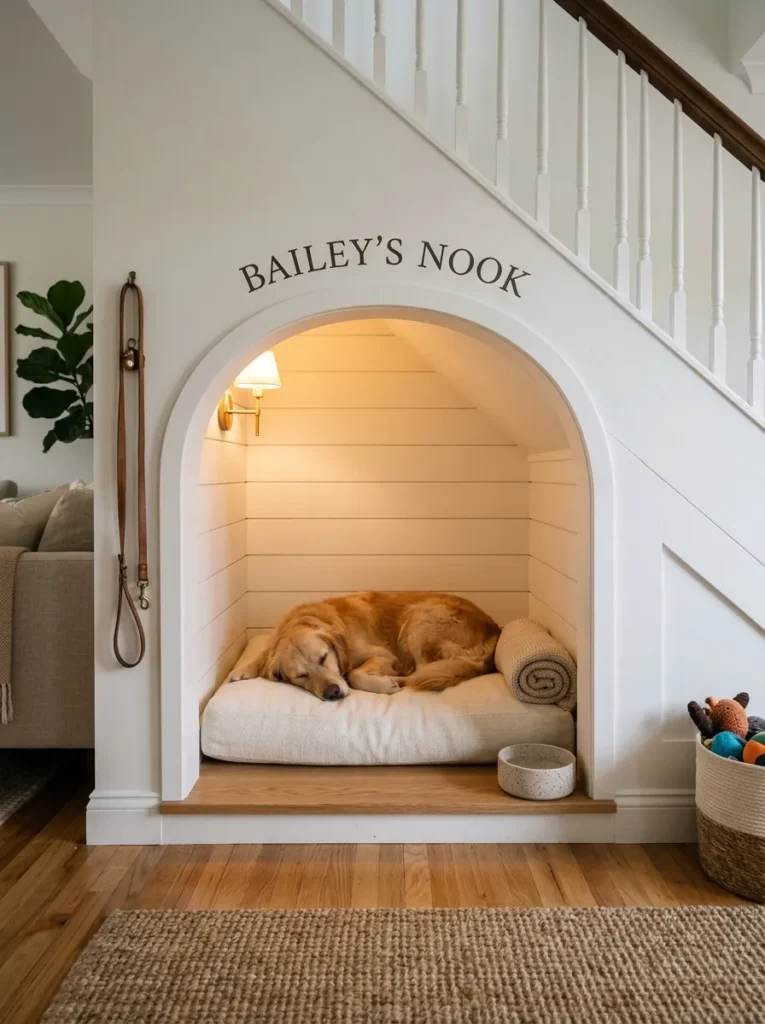
Vibe: The under-stair nook feels architecturally inevitable — the most satisfying use of a space that every home with stairs has and most waste entirely.
Why it works: The under-stair dog bedroom is the most spatially efficient dog room design available in any home with a staircase because it converts dead architectural space — the typically underutilized triangular volume beneath a flight of stairs — into a dedicated, enclosed sleeping area that dogs genuinely prefer for its den-like enclosure quality. The design principle is spatial repurposing: the under-stair volume’s sloped ceiling creates the naturally enclosed, overhead-covered quality that most dogs seek in a sleeping space, and its location beneath the family’s circulation path places the dog within the flow of household life without consuming primary living space. The arched entrance treatment elevates what could be a utilitarian cutout into a considered architectural feature that reads as designed rather than improvised.
How to get it: The under-stair nook requires careful measurement before any finishing work — measure the usable height at the nook’s tallest point (beside the stair stringer) and the depth from the entrance wall to the back. For most domestic staircases, this produces a space of 90–110cm width, 70–90cm maximum height, and 80–100cm depth — sufficient for a medium to large dog with a correctly sized mattress. Finish the interior with painted MDF paneling or shiplap for a clean, washable surface. Install a recessed or wall-mounted light source inside the nook — the enclosed space requires its own lighting to be genuinely useful to the dog and visually appealing to the occupants. Add a low threshold of solid oak or similar hardwood at the entrance to define the nook boundary and prevent bedding from migrating outward.
Quick Win: A simple wooden arch frame (cut from 18mm MDF or solid pine and painted to match the surrounding wall) applied over an existing under-stair opening transforms the visual quality of the nook from a utilitarian hole to a considered architectural feature for under $50 in materials and two hours of installation work.
Shop The Look
| Product |
|---|
| Orthopedic dog mattress linen cover washable |
| Brass wall sconce plug in warm light nook |
| Wood letter set serif name personalize wall |
| Lead hook brass wall mount entryway dog |
| Shiplap wall panel white MDF paintable |
Also view: 14 DIY Pet Accessory Ideas for Happy Pets
2. Built-In Dog Bedroom with Storage Drawers (LAYOUT / FURNITURE)
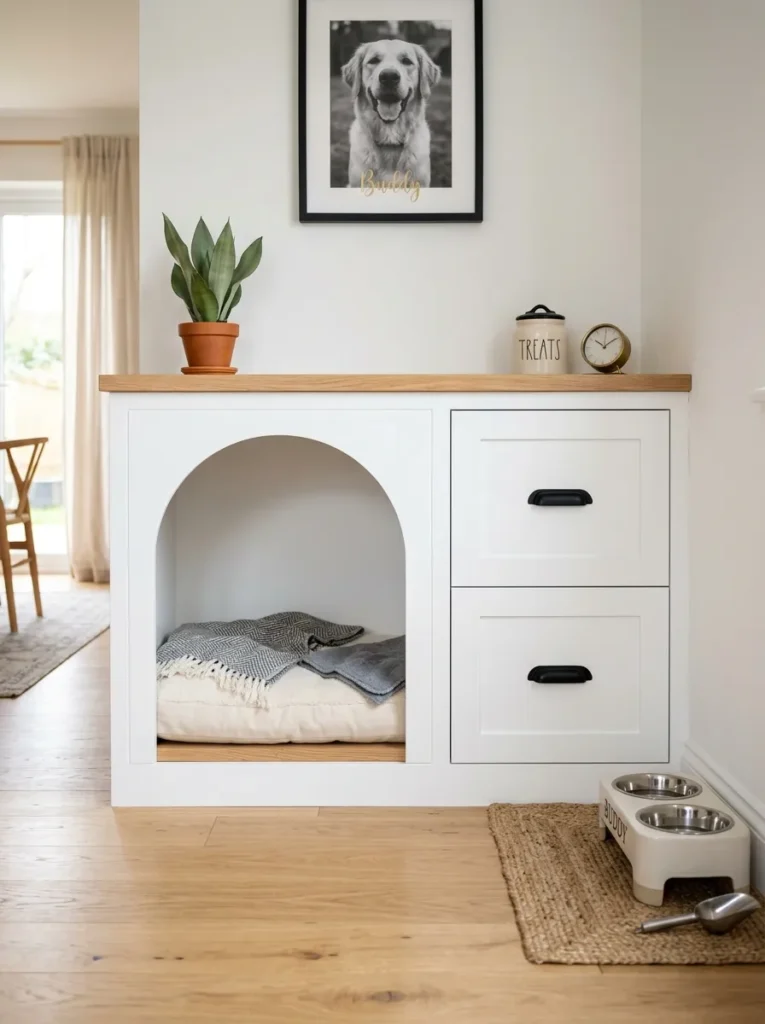
Vibe: The built-in unit feels functionally resolved — every dog-related supply in one location, every surface considered, the dog’s sleeping space integrated as a genuine architectural element.
Why it works: A built-in dog bedroom with integrated storage drawers is the most comprehensively functional dog space design because it addresses the full ecosystem of dog care — sleeping, supply storage, and display — in a single, wall-integrated unit that consumes no more floor space than a standard bookcase while delivering far greater practical value. The design principle is whole-system design: by building the sleeping compartment and storage drawers as a unified piece rather than purchasing them separately, the designer creates a coherent visual and functional system where every element is proportioned, finished, and positioned in relation to every other. The sleeping compartment’s solid oak interior platform (raised slightly from the floor) creates a thermally efficient sleeping surface that avoids the colder temperatures at floor level.
How to get it: Commission a carpenter or build from birch plywood and MDF using standard cabinet-making techniques — the unit’s basic form is a simple box divided into sleeping compartment (left) and drawer stack (right) by a central vertical divider. The sleeping compartment opening should be 20% wider and 10% taller than the dog’s shoulder height and body length respectively for comfortable entry and exit. Line the sleeping compartment interior with painted or lacquered surfaces for easy cleaning. Specify solid timber (oak, ash, or pine) for the top display surface and interior sleeping platform — these are the surfaces that visually anchor the unit and benefit most from natural material warmth. Install drawers on full-extension soft-close runners for smooth, quiet operation.
Shop The Look
| Product |
|---|
| Washable dog mattress cover performance fabric |
| Matte black drawer pull set cabinet hardware |
| Solid oak shelf board display surface natural |
| Dog supply organizer drawer divider insert |
| Framed dog portrait print personalized gift |
3. Japandi Dog Bedroom Corner (COLOR / MATERIAL)
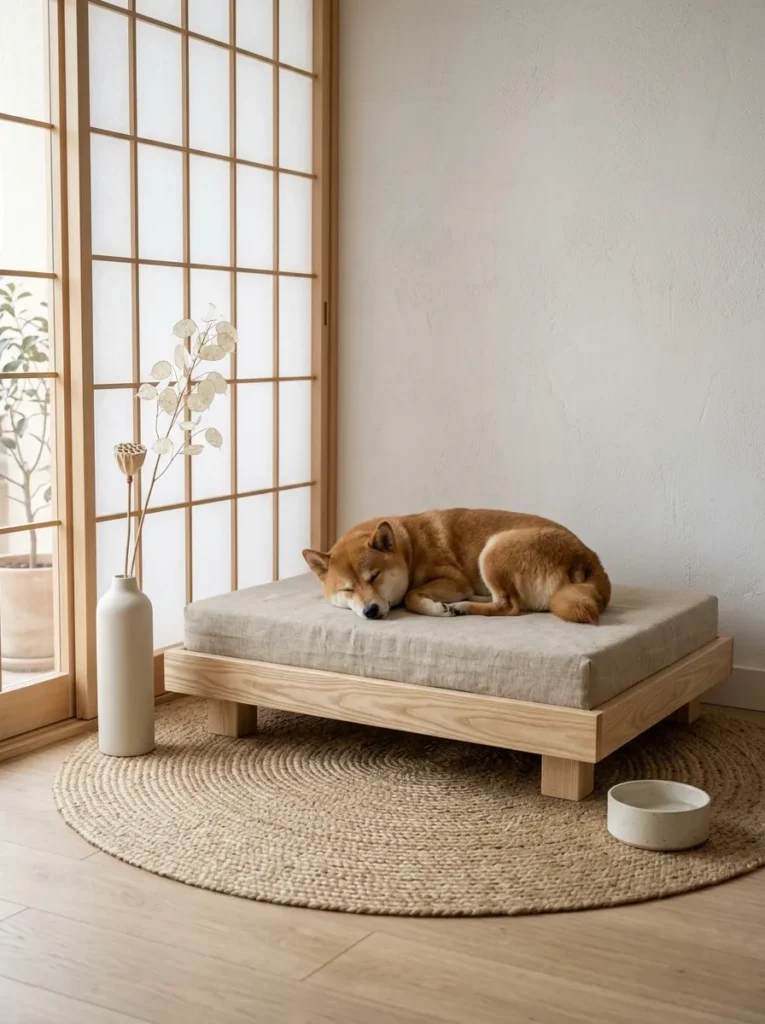
Vibe: The Japandi dog corner feels meditative and purposeful — a sleeping space for a dog that simultaneously embodies the most restrained and most considered interior design philosophy.
Why it works: A Japandi-influenced dog bedroom design is the most aesthetically integrated approach to dog space design in the contemporary interior design context because it applies the wabi-sabi principle — finding beauty in natural materials, imperfection, and the essentials of function — to pet furniture in a way that makes the dog’s sleeping space visually indistinguishable from a meditation corner or reading nook. The low platform bed (raised only 10cm from the floor) suits the Japandi aesthetic’s preference for grounded, floor-proximate furniture while providing the slight elevation that keeps the dog off the cold floor and creates the defined sleeping territory that most dogs benefit from. The strict four-object maximum (platform bed, mattress, rug, botanical element) applies the same editing discipline to the dog space that Japandi applies to every other room in the home.
How to get it: Source or commission a simple low platform bed in solid ash, oak, or natural pine — the platform should be a simple rectangular box with four short block legs of 8–10cm height, no decorative details, finished with hard-wax oil rather than lacquer for a natural surface quality. Top with a flat orthopedic dog mattress (3–5cm memory foam or orthopedic foam) covered in undyed or natural-washed linen — the cover must be removable and machine-washable. Define the sleeping zone with a natural jute rug extending 30cm beyond the platform on all accessible sides — this creates a clean visual boundary for the dog’s space without physical barriers. Add one tall botanical element in the corner to create the single natural accent that prevents the Japandi dog corner from reading as merely minimal.
Shop The Look
| Product |
|---|
| Low platform dog bed solid ash natural oak |
| Orthopedic dog mattress undyed linen cover |
| Natural jute rug 90x120cm dog zone floor |
| Tall narrow ceramic vase matte white 40cm |
| Dried pampas stem large natural botanical |
4. Dog Bedroom with Personalized Name Sign (ACCESSORIES / COLOR)
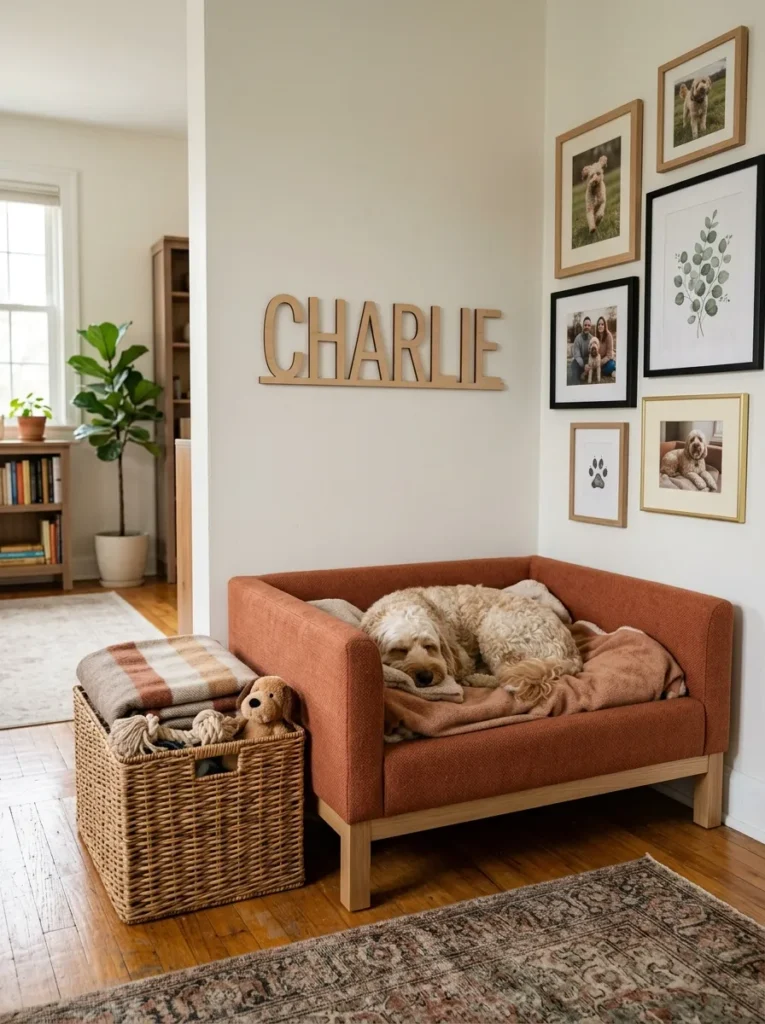
Vibe: The personalized dog bedroom feels warmly claimed — a space that announces its occupant’s name and makes the dog’s belonging in the home completely explicit.
Why it works: A personalized dog bedroom design with a name sign and dedicated gallery wall treats the dog’s sleeping space with the same level of personal investment applied to a child’s bedroom — creating a space that communicates genuine belonging and considered care rather than mere accommodation. The design principle is identity declaration: the name sign, the gallery wall of dog photographs, and the consistently applied color palette all communicate that this space was designed for a specific animal, not simply furnished with pet-appropriate products. The warm terracotta bed color is the most home-integrating choice for a personalized dog bedroom because its earth tone coordinates with warm wood, natural fiber, and botanical elements without asserting itself as a commercial pet product color.
How to get it: Source a laser-cut wooden name sign from an Etsy maker or cut from 6mm birch plywood using a laser cutter at a local maker space — allow 2–3 weeks for a custom order. Mount approximately 30cm above the bed’s backboard or headboard, centered on the wall above the sleeping surface. Build the adjacent gallery wall from a mix of framed dog photographs (printed at 5×7 and 4×6 inch sizes for variety), a botanical print, and one simple art print in a coordinating color — all in matching natural wood frames for visual coherence. The wicker storage basket beside the bed contains the dog’s daily-use items (blanket, one or two toys, a grooming brush) and serves as both storage and a styled accessory.
Shop The Look
| Product |
|---|
| Custom laser cut wooden dog name sign birch |
| Elevated dog bed terracotta performance fabric |
| Wicker storage basket natural large dog toys |
| Natural wood picture frame set assorted sizes |
| Dog photograph print custom pet portrait |
5. Minimalist Dog Crate Redesign (SMALL SPACE / LAYOUT)
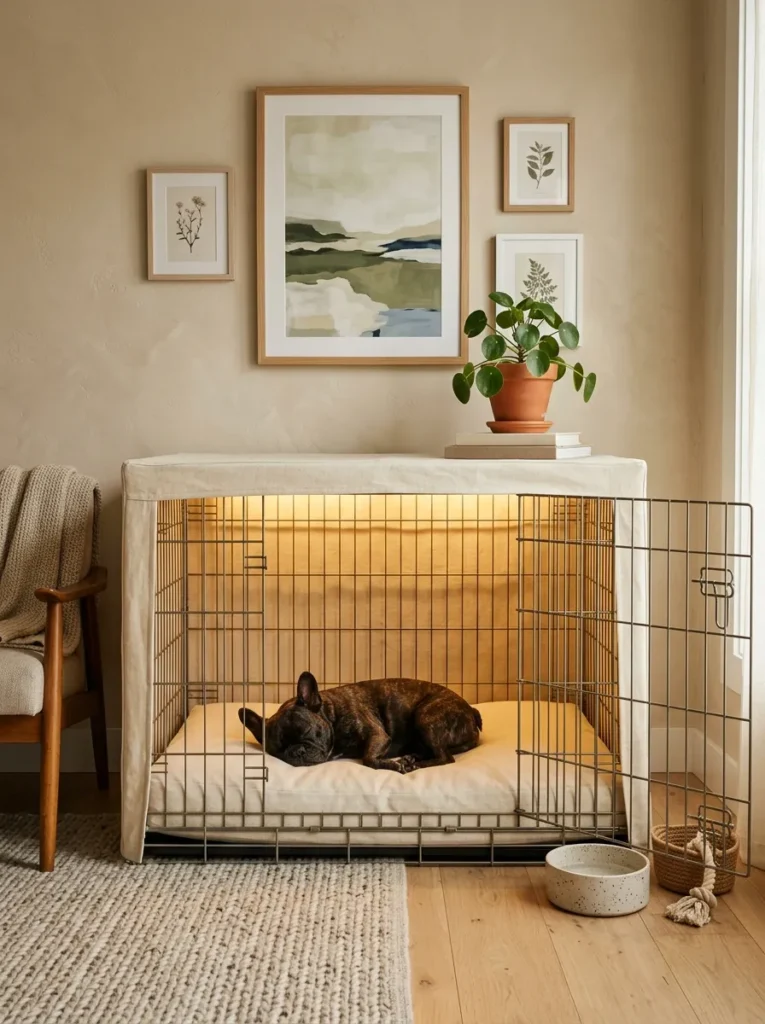
Vibe: The redesigned crate feels home-integrated and genuinely stylish — the transformation that makes the most common dog furniture item look like it belongs.
Why it works: A stylishly redesigned dog crate is the highest-impact, lowest-cost dog bedroom design intervention available to any dog owner because it transforms an existing piece of equipment — the wire crate that most dog owners already own — from a visually industrial intrusion into the living space into a considered, furniture-quality piece that reads as a deliberate interior design choice. The linen crate cover is the primary transformation tool: it obscures the wire construction that reads as utilitarian and introduces the warm, natural textile quality that makes the crate look like a designed dog sleeping pod. The placement strategy — positioning the crate against a wall as furniture, placing a plant on top, and hanging art above — applies the same styling logic used for any low furniture piece and completes the visual integration.
How to get it: Measure the crate’s exterior dimensions precisely and source a fitted linen cover — available from specialist pet product makers on Etsy or sewable from a 1.5m length of medium-weight linen for under $20 in materials. The cover should fit over the top and three sides, leaving the front panel either covered with a separate removable panel (for nighttime privacy) or left open (for daytime use with the crate door open). Install a small battery-operated warm LED strip along the crate ceiling interior — this provides the warm light within the sleeping space that makes the crate interior feel inviting rather than utilitarian. Position the crate against a wall at the same height as surrounding furniture, treating it as a piece rather than equipment.
Shop The Look
| Product |
|---|
| Linen dog crate cover fitted warm ivory |
| Battery LED strip warm white crate interior |
| Orthopedic dog crate mattress washable cover |
| Medium wire dog crate fold flat storage |
| Small trailing plant ceramic pot crate top |
6. Dog Bedroom in a Mudroom Station (LAYOUT)
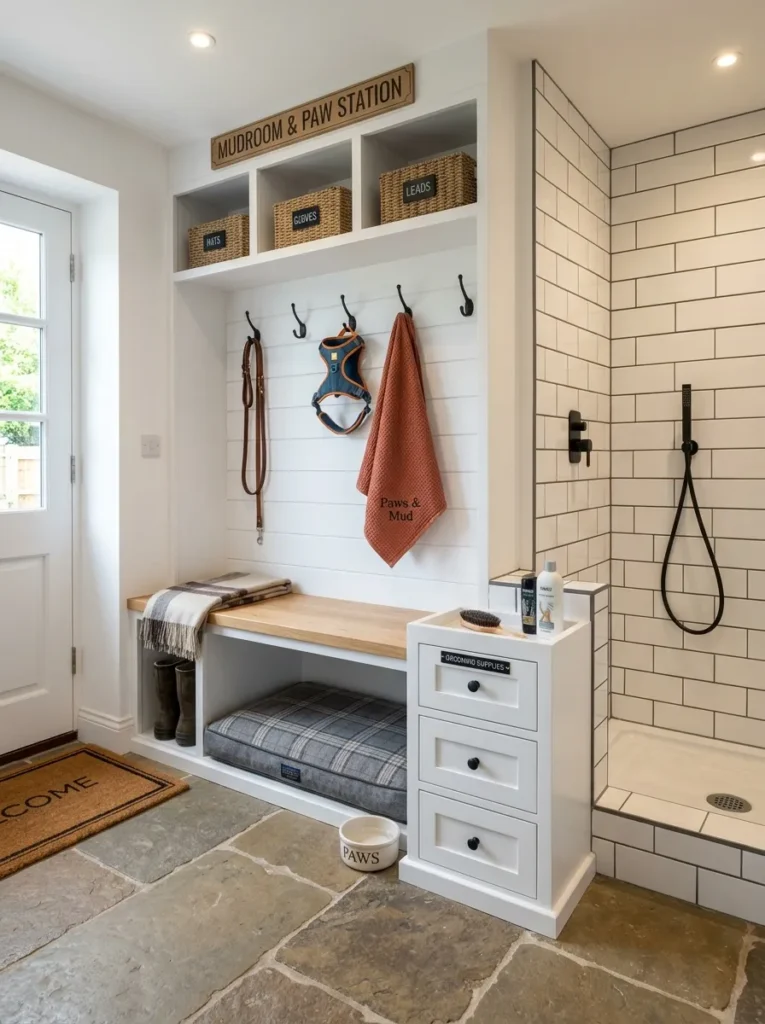
Vibe: The mudroom dog station feels practically complete — the most logistically efficient dog bedroom design, placing sleeping, grooming, and supply storage in the room where dogs most naturally begin and end their outdoor life.
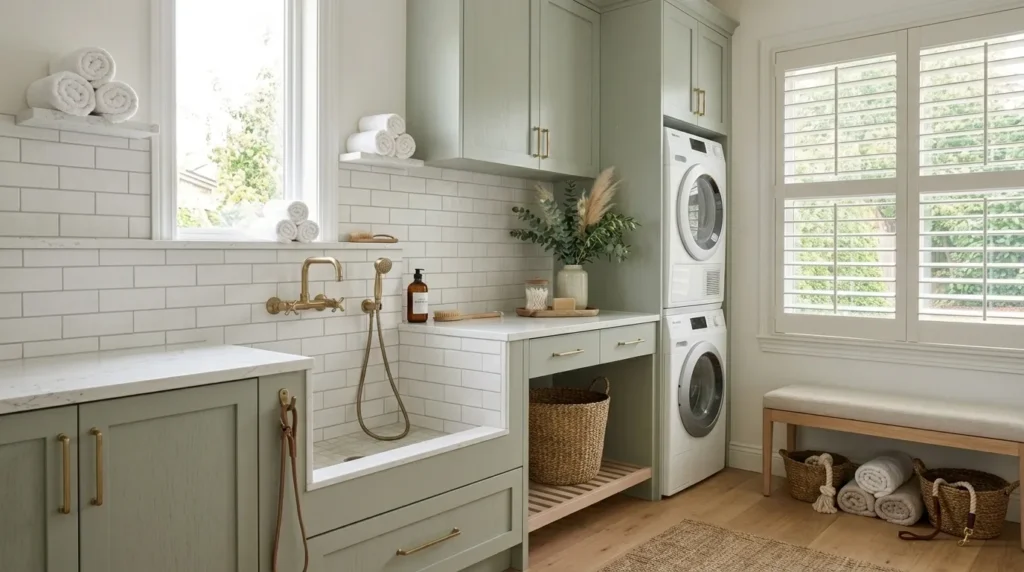
Why it works: A mudroom dog bedroom station is the most functionally coherent dog space design because it locates the dog’s sleeping area within the transitional zone where dogs enter and exit the home — the space where leads are collected before walks and removed after, where muddy paws are wiped, and where the dog naturally decompresses after outdoor activity. This spatial logic means the dog’s bedroom is at the intersection of its two primary daily activities — resting and going outside — reducing the indoor tracking of outdoor dirt and moisture that occurs when dogs travel through the house between the entry point and a sleeping area located elsewhere. The built-in bench above the sleeping compartment provides a practical surface for the owner during the dressing and undressing process of walks.
How to get it: Plan the mudroom dog station as a bench with a 50–60cm deep compartment below one section, sized to the dog’s body length plus 20cm. The compartment should be fully accessible from the front (no door is preferable for daily use — doors impede the dog’s free access to its sleeping area) with wipeable painted interior surfaces. Install matte black hooks above the bench at varying heights for leads (tall hooks), harnesses (medium hooks), and towels (low hooks). If space permits, allocate one bench section for a drawer stack of grooming supplies. The dog wash station (a tiled corner with a handheld shower head at dog height) is the premium addition — even a modest tiled area with a drain serves the post-walk cleanup function that significantly reduces indoor dirt distribution.
Shop The Look
| Product |
|---|
| Washable dog mattress waterproof cover mudroom |
| Matte black wall hook set 5 piece hallway |
| Dog towel absorbent quick dry microfiber |
| Handheld shower head flexible hose dog wash |
| Dog lead organizer hook set wall mount |
7. Luxury Dog Bedroom with Canopy Bed (ACCESSORIES / COLOR)
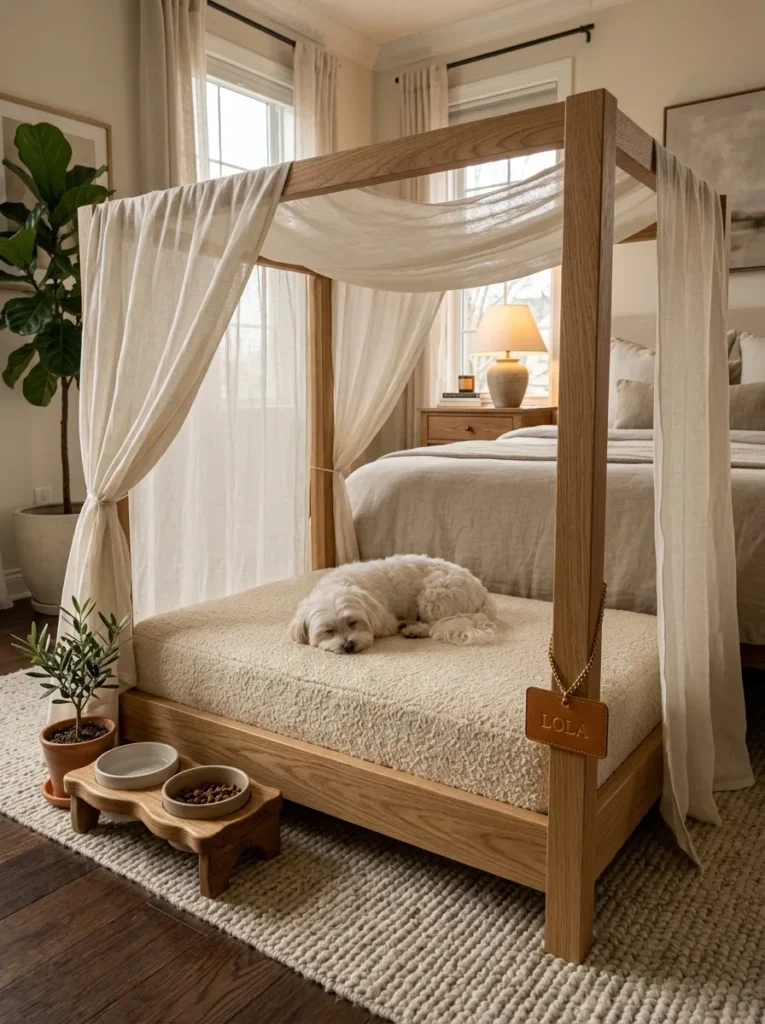
Vibe: The luxury canopy dog bed feels warmly extravagant — the most overtly loving design statement available in dog bedroom design, treating the dog’s sleeping space as a genuine piece of bedroom furniture.
Why it works: A four-post canopy dog bed is the dog bedroom design that most explicitly communicates the depth of the human-animal bond it represents — a piece of furniture constructed at the same quality level as human bedroom furniture, finished with the same natural materials, and designed with the same attention to visual detail. The canopy serves a practical purpose beyond its obvious visual impact: the linen draping creates a semi-enclosed sleeping environment that reduces visual stimulation from the surrounding room, which benefits dogs that are sensitive to environmental disturbance during sleep. The solid oak frame construction ensures the piece has the physical permanence and visual weight of a genuine furniture item rather than a novelty pet product.
How to get it: Source or commission the four-post frame from a furniture maker or woodworker — the construction is simpler than it appears, consisting of four identical posts joined by two side rails and two end rails at a height of 25cm from the floor (the platform height), with posts extending to 60cm total height above the platform for the canopy mounting points. Drape two 150cm panels of sheer natural linen over the posts, gathering at the top of each post with a simple fabric tie. The canopy should hang loosely, touching the mattress surface at the front corners and leaving the sides open for easy dog access. Fit a 5cm orthopedic foam mattress covered in bouclé or linen inside the frame.
Shop The Look
| Product |
|---|
| Orthopedic dog mattress bouclé cover luxury |
| Sheer natural linen fabric drape canopy 150cm |
| Carved wood dog bowl stand elevated natural |
| Leather pet name tag personalized engraved |
| Small plant ceramic white pot luxury bedroom |
8. Industrial Chic Dog Bedroom Corner (MATERIAL / COLOR)
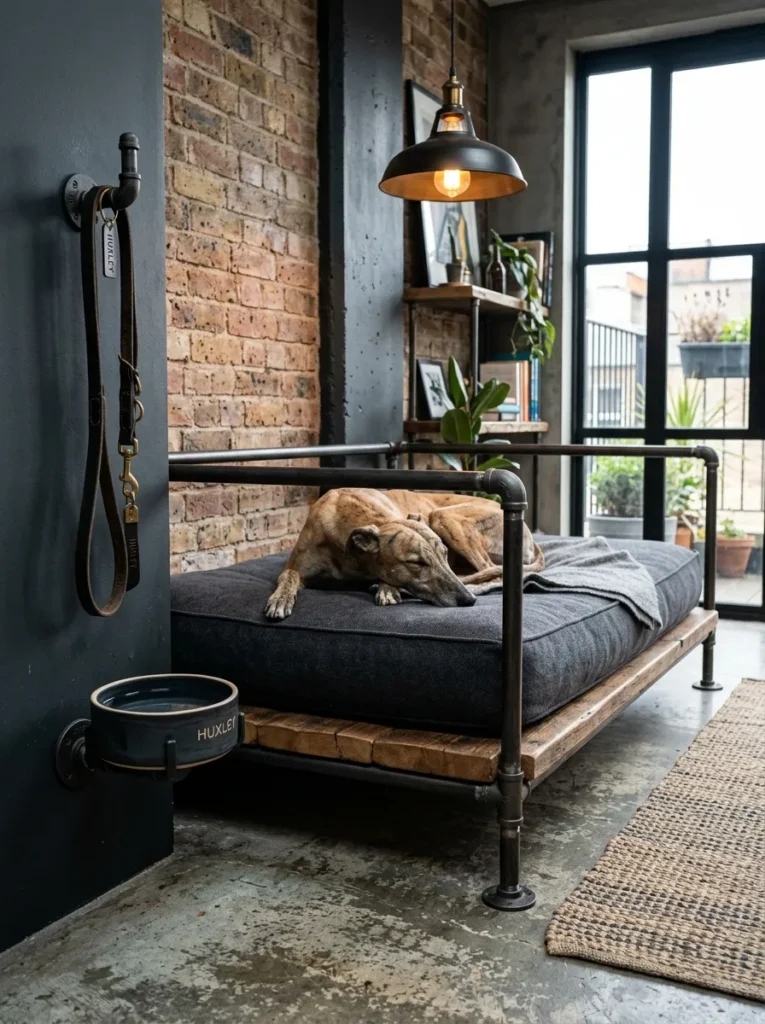
Vibe: The industrial dog bedroom feels warm and confidently graphic — the material honesty of steel and reclaimed wood creating a dog space of genuine design authority.
Why it works: An industrial chic dog bedroom applies the raw material aesthetic of industrial interior design — exposed steel pipe, reclaimed timber, concrete, matte black hardware — to pet furniture in a way that produces a dog sleeping space entirely coherent with its surrounding aesthetic context. The design principle is material authenticity: industrial design’s defining quality is the celebration of structural materials used honestly and visibly rather than hidden behind decorative surfaces, and this translates directly to a dog bed platform built from the same pipe and timber combination used for shelving, lighting, and furniture throughout an industrial-style home. The charcoal performance fabric mattress is the most appropriate upholstery choice — its dark tone minimizes visible pet hair and coordinates with the grey steel pipe and black hardware of the frame.
How to get it: Build the platform frame using standard 25mm steel pipe and floor flanges (available from plumbing suppliers) assembled with a pipe wrench — no welding required. Cut reclaimed pine or oak boards to the platform dimensions and attach to a simple rectangular pipe frame using pipe straps. The frame’s height should be 20–25cm from the floor, and the platform should extend 15cm beyond the mattress dimensions on all sides for a solid visual base. Mount a matte black wall bracket for the dog’s water bowl at nose height for the specific breed — this keeps the water bowl off the floor and within the defined dog zone without requiring a separate bowl stand.
Shop The Look
| Product |
|---|
| Dog mattress charcoal performance fabric large |
| Steel pipe set flanges 25mm platform frame |
| Reclaimed wood board platform surface rustic |
| Matte black wall bowl holder ceramic bowl |
| Industrial pipe hook matte black wall mount |
9. Dog Bedroom with Window Seat Integration (SMALL SPACE / LAYOUT)
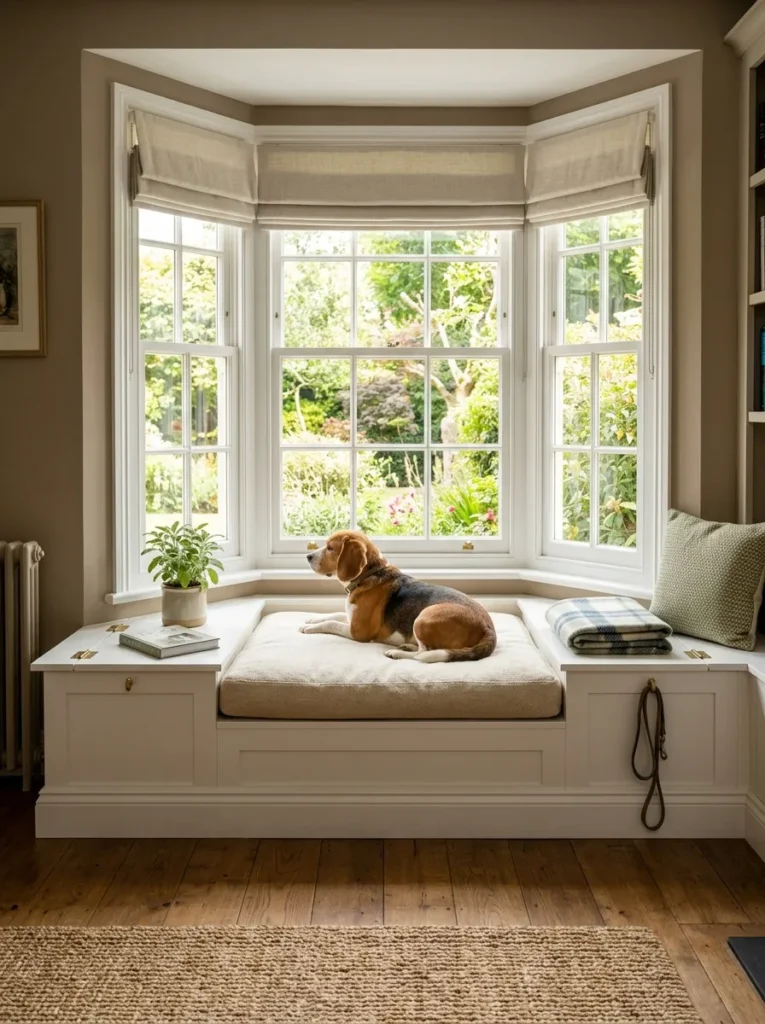
Vibe: The window seat dog bedroom feels warmly dual-purpose — serving the dog’s two most fundamental preferences simultaneously, sleeping comfort and environmental observation.
Why it works: Integrating a dog sleeping area into a window seat design is the dog bedroom solution that most directly addresses the specific behavioral preference that most dog owners observe — the dog’s tendency to choose elevated positions near windows for resting, combining the desire for visual access to the outside world with the comfort of a soft sleeping surface. Dogs are naturally surveillance-oriented animals whose resting behavior includes monitoring the immediate environment, and a window seat sleeping position satisfies this behavioral need while providing physical comfort. The dual storage sections flanking the dog mattress section create the supply storage that would otherwise require a separate piece of furniture, making the window seat dog bedroom the most space-efficient dog bedroom design available for rooms with existing or potential window seat installations.
How to get it: Build the window seat as a continuous bench running the full window width, with the central section dedicated to the dog mattress and the end sections as storage compartments with lift-up tops. The dog section should be the same height as a standard window seat (45cm), ensuring the dog can jump up independently. The mattress section should be sized to the dog’s body length plus 20cm for movement — for a medium-sized dog, approximately 80–100cm. Finish the bench face in the same material as the surrounding interior — painted MDF for a clean contemporary look, beadboard for a more traditional aesthetic, or tongue-and-groove timber for a warmer, organic quality.
Shop The Look
| Product |
|---|
| Dog mattress performance linen washable window |
| Lift up bench seat hinge set storage furniture |
| Window seat cushion foam cut to size custom |
| Storage basket pair window seat section |
| Dog throw blanket washable soft natural |
10. Dog Bedroom Gallery Wall Display (ACCESSORIES)
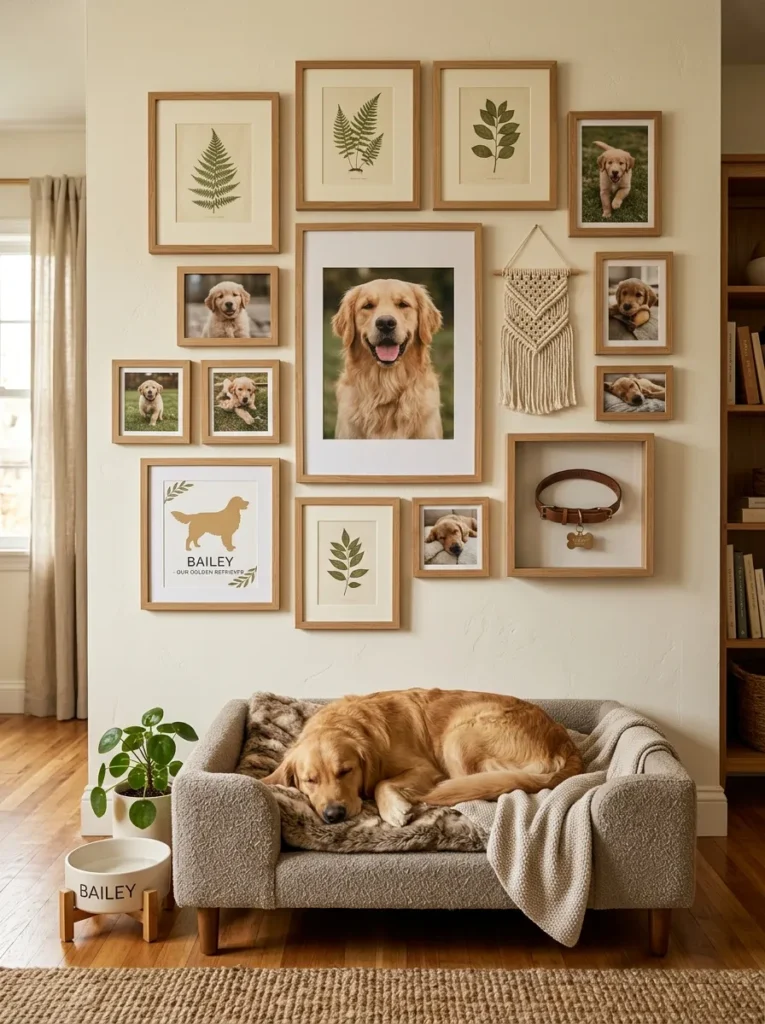
Vibe: The gallery wall dog bedroom feels deeply personal — the wall above the dog’s bed becoming the home’s most genuinely felt display of love and belonging.
Why it works: A dedicated dog bedroom gallery wall applies the interior design language of the curated personal display — the gallery wall — to the space most associated with the dog, creating a visual context for the sleeping area that communicates the depth of the human-animal relationship with more nuance and personal specificity than any commercial pet product can convey. The design principle is narrative display: each element on the gallery wall tells a specific story about the dog — the portrait captures its appearance, the breed print acknowledges its heritage, the collar display marks a milestone, the botanical elements connect the animal to the natural world — and together these elements create a display that improves with the accumulation of the relationship’s history.
How to get it: Begin the gallery wall with the largest anchor piece — a custom dog portrait print at 30x40cm or larger — hung at the center of the intended display area. Build outward from the anchor piece, adding frames of decreasing size as you move toward the gallery wall’s edges. Mix frame finishes only within the natural wood family — oak, ash, and pine frames can mix harmoniously; introducing black or gold frames creates visual inconsistency. Commission a custom illustrated or photographic dog portrait from an Etsy artist — budget $30–$80 for a digital file that can be printed at any size — as the gallery wall’s primary investment piece.
Shop The Look
| Product |
|---|
| Custom dog portrait print digital art Etsy |
| Natural wood picture frame set assorted sizes |
| Elevated dog bed greige bouclé performance |
| Small woven wall hanging natural cotton boho |
| Dog breed art print framed natural wood |
11. Dog Bedroom with Dedicated Toy Storage (LAYOUT / ACCESSORIES)
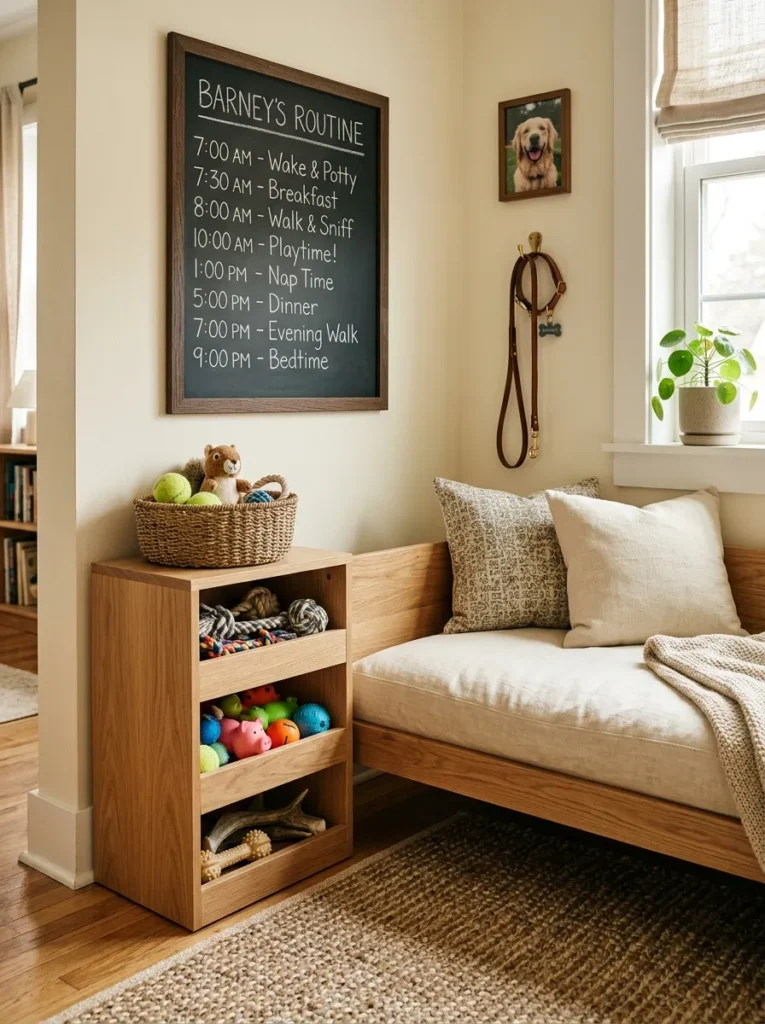
Vibe: The organized dog bedroom feels practically warm — a sleeping space and supply system that acknowledges the full reality of living with a dog, not just its sleeping requirements.
Why it works: A dog bedroom with dedicated, organized toy storage is the most practically complete dog space design because it acknowledges that the dog’s bedroom is also the hub of its waking life — the starting point for play, the location of its most-used enrichment objects, and the space from which its daily routine is organized. The open-front compartment storage unit (sized and positioned at dog height) serves both the practical function of organizing toys by type and the behavioral function of allowing the dog independent access to its own enrichment objects — which supports the dog’s agency and reduces the frustration-related behavior that occurs when dogs cannot independently access stimulation. The routine board above the storage unit serves the human occupant’s organizational needs while treating the dog’s daily schedule as worthy of the same wall-mounted planning system used for any other household activity.
How to get it: Source a low open storage unit of approximately 60cm width and 40cm height (slightly below the dog’s nose height for independent access) with three compartments of equal size — IKEA’s KALLAX unit configured as a 1×3 horizontal arrangement is an ideal size for this purpose. Position directly beside the dog bed so the dog can move naturally between sleeping and toy selection. Label each compartment with a simple hand-lettered sign (rope toys, soft toys, chew toys) and maintain the categorization consistently — the categorized storage creates the visual calm of an organized system rather than a jumbled toy collection.
Shop The Look
| Product |
|---|
| Low open storage unit 3 compartment natural |
| Woven seagrass basket dog toy daily selection |
| Rope toy set natural cotton dog enrichment |
| Chalkboard frame small wall mount routine |
| Dog toy basket label set hand lettered natural |
12. Outdoor-Inspired Dog Bedroom (MATERIAL / COLOR)
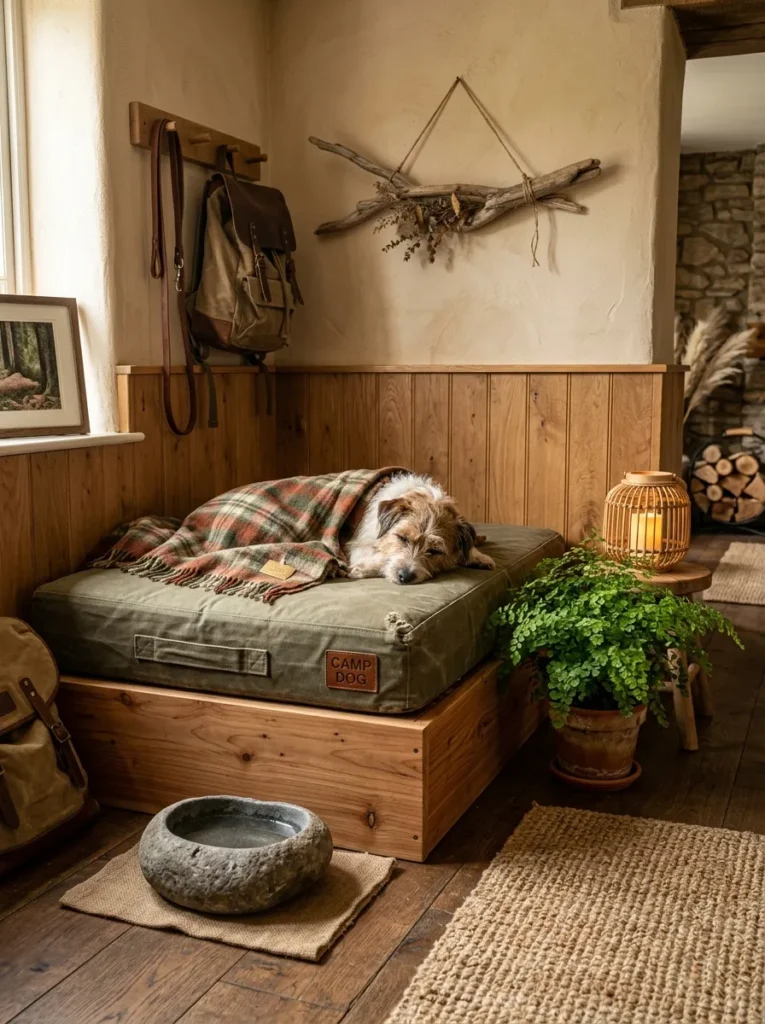
Vibe: The outdoor-inspired dog bedroom feels naturally grounded — an interior space that celebrates the dog’s connection to the natural world through every material choice.
Why it works: An outdoor-inspired dog bedroom design is the most biophilically coherent approach to dog space design because it acknowledges that dogs are fundamentally natural animals whose comfort needs and sensory preferences are shaped by evolutionary adaptation to outdoor environments — rough natural surfaces, organic material textures, earthy color tones, and botanical scents all provide sensory stimulation that is simultaneously appropriate to the dog’s natural preferences and aesthetically aligned with the biophilic design movement that has shaped contemporary interior design broadly. The cedar platform bed is specifically appropriate — cedar’s natural aromatic oils act as a mild insect deterrent (particularly effective against fleas and dust mites in the sleeping environment) and the wood’s warm reddish tone coordinates naturally with the earth-tone palette of the outdoor-inspired scheme.
How to get it: Source a solid cedar deck board or cedar fence plank and construct the platform bed using simple box joint construction — cedar is soft enough to cut with a hand saw and available at most lumber merchants as decking or fencing material. The platform’s cedar construction requires no finishing (cedar’s natural oils provide weather resistance) and will develop a natural silver-grey patina over time that adds character. Source a canvas or waxed cotton mattress cover in olive, khaki, or natural in preference to synthetic fabrics — natural fibers suit the outdoor-inspired aesthetic and are more breathable for the dog. Add a river stone water bowl (a wide, shallow river stone with a natural depression, or a ceramic bowl in a river stone finish) to complete the natural material composition.
Shop The Look
| Product |
|---|
| Cedar plank board natural dog bed platform |
| Canvas dog mattress cover olive green outdoor |
| River stone ceramic water bowl natural grey |
| Potted fern plant indoor natural moisture |
| Rattan lantern candle holder warm light |
13. Dog Bedroom in a Dedicated Room Corner (SMALL SPACE / COLOR)
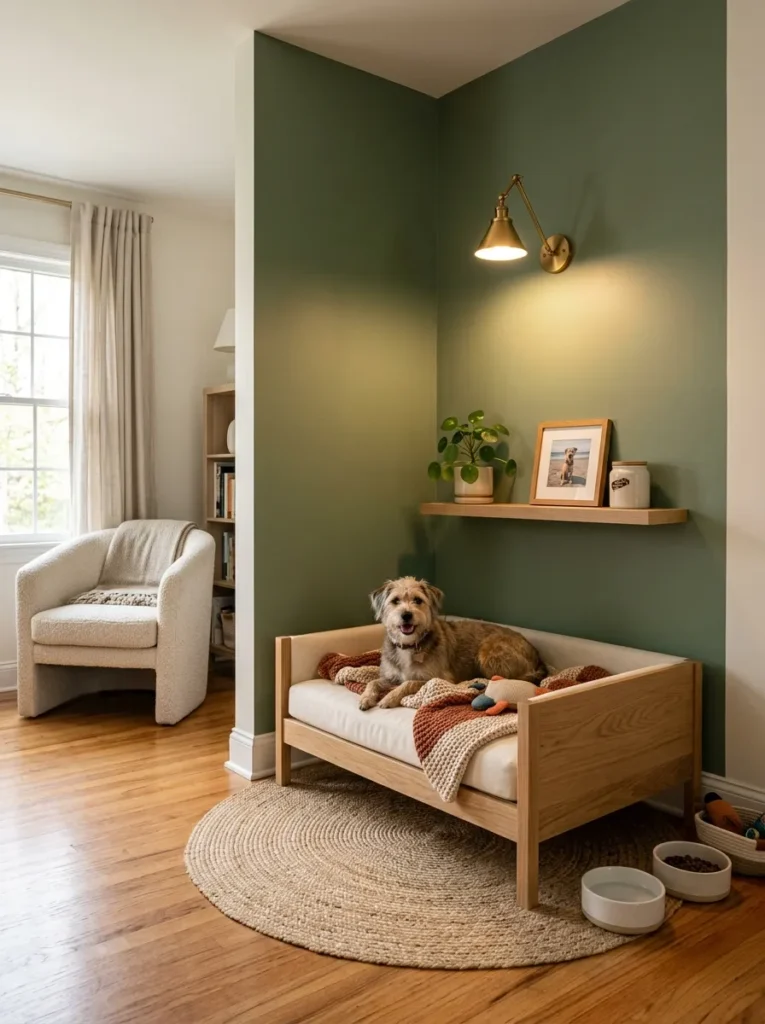
Vibe: The sage corner dog bedroom feels warmly zoned — a room-within-a-room created by paint alone, giving the dog a visually defined territory without structural intervention.
Why it works: Defining a dog bedroom area through an accent paint color applied to one corner of a room is the most cost-effective and most visually impactful dog space design intervention available without carpentry, because paint color creates a powerful visual zone that reads as a dedicated, considered space rather than merely a corner where a dog bed happens to sit. The design principle is chromatic zone creation: by painting the two walls of a corner in a coordinating accent color distinct from the surrounding room’s neutral palette, the designer creates a visual enclosure — a color-defined room within the room — that gives the dog’s sleeping area the same psychological and visual definition as a built-in nook without any structural work. Warm sage green is the most universally appropriate accent color for a dog bedroom corner because it coordinates with natural materials, reads as calm and restful, and complements a wide range of dog coat colors.
How to get it: Paint the two walls of the chosen corner from floor to ceiling in the accent color — using a consistent paint brand for both the accent color and the surrounding neutral ensures the undertones are compatible and the colors read as deliberately designed rather than accidentally mismatched. Install a floating shelf at 120cm height (directly above the dog bed headboard) as the primary display surface for the corner — plant, framed photo, and one small decorative object. Position the dog bed with its back against the painted corner, so the dog’s sleeping position is within the colored zone and the painted walls serve as the visual background for the sleeping space.
Shop The Look
| Product |
|---|
| Warm sage green interior paint matte finish |
| Elevated dog bed natural oak frame ivory |
| Floating shelf natural wood 60cm wall mount |
| Jute rug small 60x90cm dog zone natural |
| Warm wall sconce plug in dog bedroom light |
14. Multi-Dog Bedroom with Bunk Bed Design (LAYOUT / FURNITURE)
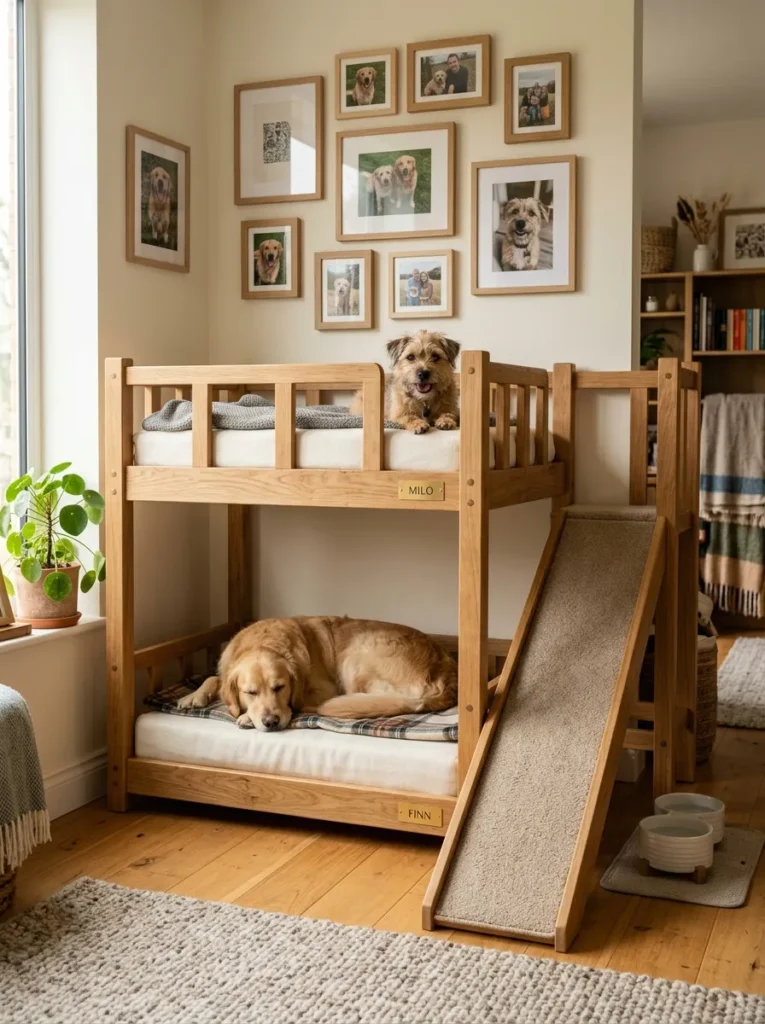
Vibe: The double dog bunk bed feels playfully genius — the solution to the multi-dog household’s perpetual floor space challenge, delivered with the same furniture-quality construction as every other idea in this list.
Why it works: A double-dog bunk bed design is the most spatially efficient solution for multi-dog households because it doubles the sleeping surface area within the same floor footprint as a single dog bed — a critical advantage in smaller homes where multiple large dog beds would consume a disproportionate share of living space. The bunk format also addresses the social dynamics of multi-dog households: dogs that share space but prefer individual sleeping territories (the majority of multi-dog households) benefit from vertically separated sleeping positions that provide personal space without physical separation. The lower-to-upper hierarchy of the bunk naturally suits the social dynamic of multi-dog households where one dog is dominant — dominant dogs typically prefer higher sleeping positions, and the upper bunk is usually claimed by whichever dog’s personality drives it there.
How to get it: Construct the bunk frame from solid pine or oak — the frame requires greater structural robustness than a single platform bed because the upper bunk must support a dog’s dynamic weight during jumping or ramp use. Use mortise and tenon or dowel joinery for the post-to-rail connections rather than screws alone. Size each sleeping platform to the larger dog’s body length plus 20cm for movement. The ramp (essential for smaller dogs and aging larger dogs accessing the upper bunk) should have a 30-degree maximum incline and be covered with non-slip matting — rubber stair treads cut to the ramp width work effectively and are available from hardware stores.
Shop The Look
| Product |
|---|
| Orthopedic dog mattress set 2 piece washable |
| Non-slip rubber stair tread ramp dog access |
| Solid pine timber frame set custom bunk dog |
| Performance fabric mattress cover set 2 piece |
| Dog water bowl station double bowl stand |
How to Start Your Dog Bedroom Design Transformation
Your single best first move is to observe where your dog currently chooses to sleep and rest during a full 24-hour period before making any purchasing or building decisions. The locations a dog chooses independently — near the family’s primary sitting area, under a desk, against a radiator, in a corner with wall contact on two sides — reveal the specific spatial preferences that the designed dog bedroom should satisfy rather than override. A dog bedroom designed in response to observed behavior is always more occupied and more genuinely valued by the animal than one designed in response to the human’s aesthetic aspirations alone. Note the light level, the temperature, the distance from family activity, and the degree of enclosure at each preferred spot — these four qualities are the design brief for the ideal dog bedroom.
The most common mistake in dog bedroom design is prioritizing visual aesthetics over behavioral appropriateness — purchasing a stylish but inappropriately sized bed (too small for the dog to fully stretch on, too large for the dog to feel enclosed), siting the bed in a visually convenient but behaviorally wrong location (away from family activity when the dog is socially motivated, or in a high-traffic area when the dog needs quiet), or choosing a material that is visually appealing but practically unmanageable (a white linen cover for a muddy dog, or a deep pile fabric that traps the hair of a heavy-shedding breed). Fix this by establishing the behavioral and practical requirements — correct size, appropriate enclosure level, washable cover, suitable location — as non-negotiable criteria before considering any aesthetic decisions.
Three specific items under $50 that create immediate dog bedroom design impact: a washable performance linen or canvas mattress cover in a warm neutral ($22–$38) that replaces a commercial pet bed’s typically garish fabric and immediately elevates the sleeping surface into a home-integrated textile object; a natural jute or seagrass small rug ($18–$28) placed under and around the dog bed to define the zone and add the natural fiber texture that gives the sleeping area genuine floor presence; and a single wall-mounted hook in matte black or brushed brass ($8–$14) installed directly beside the dog bed for the lead, harness, or a folded spare blanket — the single functional addition that most immediately communicates a considered, organized dog space.
A basic dog bedroom refresh — new mattress cover, zone-defining rug, and wall hook — takes one afternoon and costs $50–$80. A fully designed dog corner with a platform bed, gallery wall, dedicated storage, and zone-defining color takes one weekend and costs $150–$400 depending on whether the platform bed is purchased or built. A built-in dog bedroom nook, window seat integration, or bunk bed construction requires 2–3 weekends and costs $300–$800 in materials, producing a dog sleeping space of genuinely architectural quality that adds measurable value to the home as well as to the animal’s daily quality of life.
Frequently Asked Questions About Stylish Dog Bedroom Designs
What size should a dog bedroom be for different breeds?
The sleeping surface should be at least 1.5 times the dog’s body length from nose to tail base, measured while the dog is lying in its preferred sleeping position — stretched flat for most dogs, curled for some breeds. Width should be at least equal to the dog’s shoulder-to-hip length when lying on its side. For breed-specific guidance: small breeds (under 10kg) need a minimum sleeping surface of 55x45cm; medium breeds (10–25kg) need 80x60cm; large breeds (25–45kg) need 100x75cm; giant breeds (over 45kg) need 120x90cm minimum. For enclosed sleeping spaces (nooks, caves, crates), add 20% to each dimension to allow comfortable turning and movement.
What fabrics are best for dog bedroom furniture and bedding?
Performance fabrics specifically engineered for pet use — often marketed as indoor-outdoor fabric, Crypton, or performance linen — are the most practical choices for dog bedroom bedding because they combine visual sophistication with genuine washability, moisture resistance, and resistance to the odor absorption that makes conventional upholstery fabrics inappropriate for dog contact. Tightly woven natural fabrics (linen, canvas, denim) are the most aesthetically appropriate and can work practically if they are machine-washable and can be removed from the dog bed for washing — avoid any fabric that must be dry-cleaned, which is impractical for dog bedding. Avoid velvet, chenille, or loosely woven fabrics that trap dog hair and shed fibers onto the dog’s coat.
Where is the best location for a dog bedroom within the home?
The optimal dog bedroom location balances the dog’s social needs with its rest requirements — most dogs benefit from a sleeping space that is within the primary family living area (within sightline of the family’s primary activity zone) but positioned against a wall or in a corner that provides the partial enclosure that most dogs seek during rest. Avoid placing the dog bed in high-traffic corridors (disturbs the dog during rest), directly beside heating appliances (overheating risk, particularly for senior dogs), or in isolated rooms away from family activity (increases separation anxiety in socially bonded dogs). The under-stair nook, window seat, and mudroom station are the three location types that most consistently produce high occupancy rates because they naturally satisfy the enclosure preference while maintaining proximity to family activity.
How do I stop a dog bed from smelling without replacing it?
A regular washing schedule is the most effective odor management approach — the frequency depends on the dog’s coat type, activity level, and the fabric of the cover, but weekly washing of the mattress cover and monthly washing of the mattress insert (for foam inserts that are machine-washable) prevents odor accumulation from reaching the point where it is noticeable from a normal room distance. Between washes, baking soda sprinkled over the mattress surface, left for 30 minutes, and vacuumed off is the most effective interim deodorizer. Choosing a performance fabric mattress cover with antimicrobial treatment (available from specialist pet bedding suppliers) significantly extends the interval between washes while maintaining a hygienic sleeping surface.
Can I design a stylish dog bedroom in a small apartment?
Absolutely — the window seat integration, the minimalist crate redesign, the Japandi dog corner, and the accent wall zone-creation are the four designs in this list most specifically suited to small apartment spaces because they use existing architectural features, transform existing equipment, minimize floor footprint, and create visual definition through paint rather than structure respectively. The key principle for small apartment dog bedrooms is multi-function integration: every element of the dog bedroom should serve at least two purposes (the window seat stores supplies and provides the dog’s bed; the crate provides training security and a styled furniture piece; the corner rug defines the dog zone and improves the room’s floor layering). Avoid large, freestanding dog furniture in small apartments — it consumes floor space without offering the storage or display functions that built-in or integrated solutions provide.
Ready to Create Your Dream Dog Bedroom Design?
These 14 ideas span the full range of stylish dog bedroom design possibility — from the architecturally satisfying under-stair nook and the storage-integrated built-in unit, through the meditative restraint of the Japandi corner and the organizational completeness of the mudroom station, to the playful extravagance of the luxury canopy bed, the biophilic warmth of the outdoor-inspired cedar platform, and the spatial ingenuity of the double bunk design — covering every home size, every design aesthetic, every budget, and every behavioral need from the socially anxious dog that needs proximity to the family to the privacy-seeking hound that prefers a fully enclosed cave. Begin by watching your dog for 24 hours before spending a single dollar — note where it chooses to rest, how much enclosure it seeks, how close to family activity it positions itself, and what surface it gravitates toward — because the dog bedroom that responds to those observed preferences will be occupied every day, while the bed that responds to aesthetic aspiration alone may be ignored in favor of the corner of the sofa. Today’s specific action: identify the one location in your home where your dog already most consistently chooses to rest, and ask what single design intervention — a rug to define the zone, a cover to improve the surface, a hook to organize the lead — would most immediately upgrade that existing preferred spot into a designed dog bedroom. When your dog settles into a space made specifically for it — choosing it reliably over the sofa cushion or the bathroom floor — you will understand exactly why stylish dog bedroom design earns its passionate, growing community of pet-loving designers and the permanent place it holds at the top of every design-conscious dog owner’s Pinterest board. Save your favorites now, especially the under-stair nook and the Japandi dog corner — they are the two ideas that, once realized in your own home, make every other corner of the house feel like it is waiting for the same level of considered, loving attention.