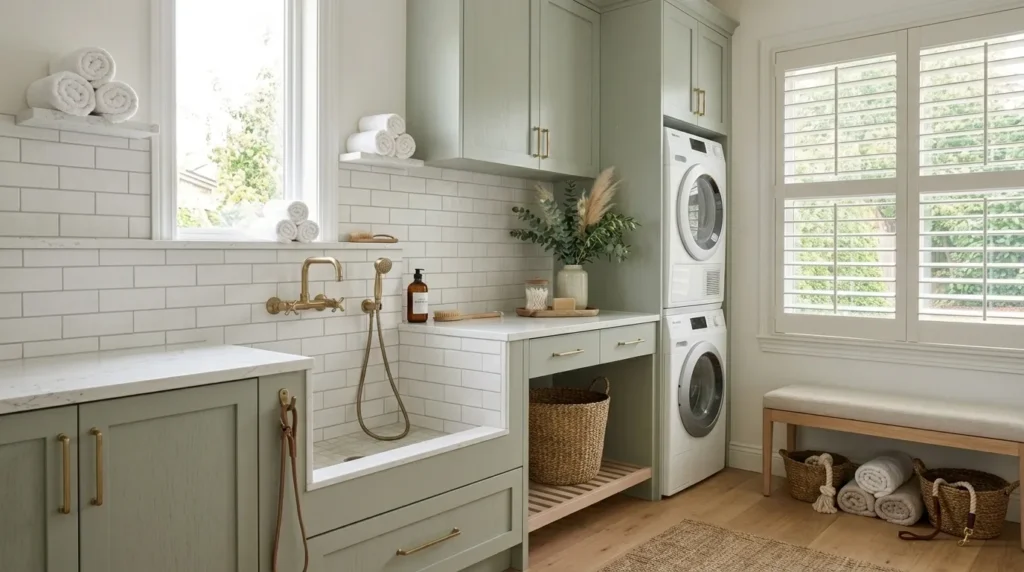
Cozy cat garden retreat ideas for backyards create dedicated outdoor spaces — enclosed catios, garden runs, planted climbing structures, tunnel systems, and shaded lounging zones — that give cats access to the enriching sensory experiences of the outdoor environment while keeping them safe from traffic, predators, toxic plants, and the statistical risks of free-roaming outdoor life. This article gives you exactly 16 ideas spanning full enclosures, modular additions to existing structures, planted enrichment zones, DIY builds, and design-forward cat garden aesthetics so every backyard, every budget, and every cat finds a retreat approach that balances safety with genuine outdoor experience.
A cat garden retreat done well gives a cat something that indoor life alone cannot — the smell of fresh air and rain and soil, the visual complexity of moving leaves and insects and birds at a safe distance, the sensation of grass underfoot and sun on fur. It does this without the cost that unmanaged outdoor access imposes — on the cat’s lifespan (documented at significantly lower for outdoor cats), on local wildlife, and on the owner’s peace of mind. The two values are not in conflict. Here are 16 ideas worth building.
Why Cozy Cat Garden Retreat Ideas Work So Well for Backyards
The domestic cat’s relationship with outdoor space is among the most contested welfare questions in companion animal care. The American Bird Conservancy, the Royal Society for the Protection of Birds, and major veterinary welfare organizations uniformly recommend keeping domestic cats contained or supervised in outdoor settings, citing both feline welfare data (the Association for Pet Obesity Prevention documents median lifespan for indoor cats at 12–18 years versus 2–5 years for fully outdoor cats) and ecological impact data (domestic and feral cats are documented predators of songbirds, small mammals, and reptiles at ecologically significant levels). At the same time, behavioral science consistently documents that cats benefit significantly from access to outdoor sensory environments — natural light, olfactory complexity, visual stimulation from wildlife, and the physical engagement of natural substrates like grass, soil, and bark.
The cat garden retreat category — catios, garden runs, contained outdoor enrichment spaces — resolves this tension by providing outdoor experience within a managed containment system. The design challenge of a cat garden retreat is specifically different from a standard garden design challenge because the primary user (the cat) has a fundamentally different relationship to space than the human users of the garden: cats are vertical animals (they prioritize height and perching opportunities over horizontal floor area), tactile browsers (they experience spaces through smell and texture at close range rather than through visual overview), ambush predators (they seek concealment and shelter from which to observe rather than open exposure), and thermoregulators (they seek sunny patches for warming and shaded areas for cooling within very short distances of each other). A cat garden retreat that addresses these four behavioral needs simultaneously — height, tactile richness, concealment, and thermoregulation — is a space that a cat will actively choose to use.
The catio and cat garden retreat market has grown substantially since approximately 2016, when the term “catio” entered mainstream pet media and the combination of urbanization (reducing free-roaming outdoor space), traffic density (increasing outdoor cat fatality rates), and social media sharing of beautiful enclosed cat spaces drove significant consumer interest. Specialist catio manufacturers including Aivituvin, Catio Spaces, and numerous independent builders offer commercial solutions from $200 to $8,000, while the DIY catio community (documented extensively on Catio Spaces’ free plan resource, on Reddit’s r/CatAdvice and r/DIYCatStuff communities, and across YouTube) produces results of comparable quality and welfare value at 40–60% of the commercial cost. The design quality range extends from purely functional (wire cage with a shelf) to genuinely beautiful architectural spaces that read as designed garden features rather than pet containment systems.
Small backyards benefit particularly from the modular, space-efficient cat retreat formats in this list — a lean-to catio against a house wall, a cat tunnel connecting two small enclosures, or a vertical climbing tower in a 2×2 metre garden corner can provide an extraordinary level of enrichment from a very small garden footprint. The honest constraint: any enclosed outdoor space must provide shade, shelter from rain, and adequate ventilation — a fully sun-exposed wire cage with no shade can reach dangerously high temperatures in summer, and an under-ventilated enclosed space creates humidity and respiratory concerns. Every idea in this list includes specific guidance on the environmental management provisions that make the enclosed space genuinely comfortable rather than merely contained.
Style at a Glance
| Element | Welfare Function | Design Edge |
|---|---|---|
| Philosophy | Outdoor enrichment within managed containment | The retreat should look like a garden feature |
| Materials | Hardware cloth, cedar, pine, polycarbonate | Reclaimed timber, climbing plants, planted shelving |
| Key Features | Height, tactile richness, concealment, thermoregulation |
16 Cozy Cat Garden Retreat Ideas for Backyards
1. Lean-To Cedar Catio Against the House Wall
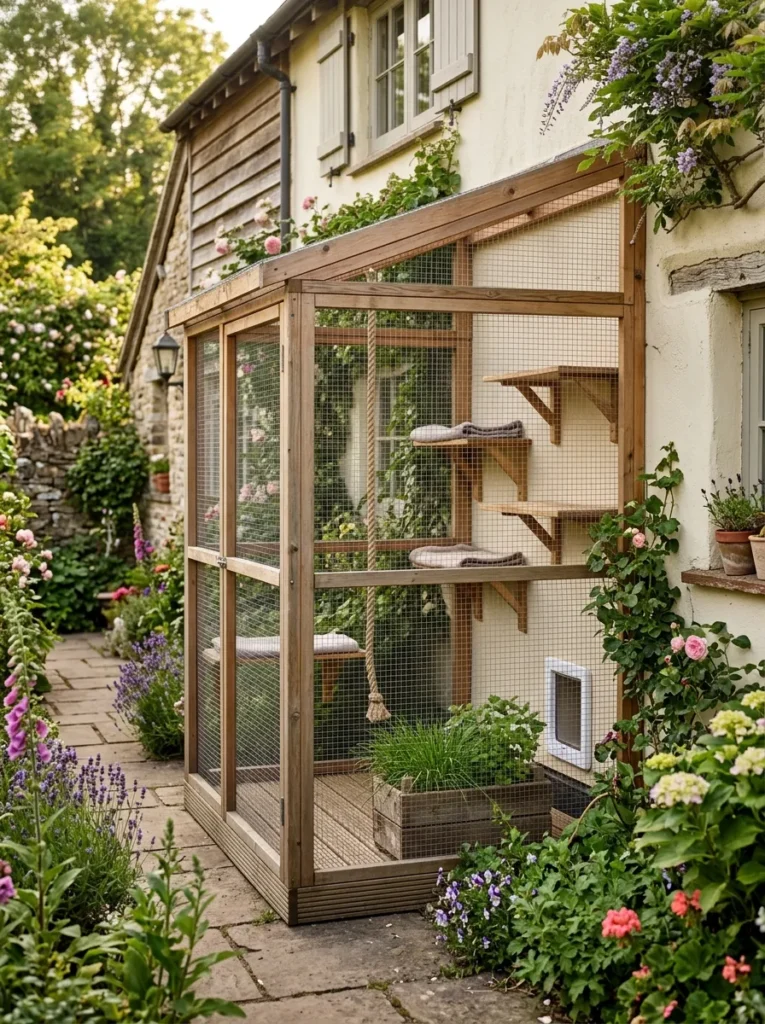
Vibe: The cedar lean-to catio feels like a beautifully designed sunroom that happens to have a wire wall — the cedar frame integrating it into the house’s architecture rather than reading as a cage attachment.
Why it works: A cedar lean-to catio against a house wall applies the architectural integration principle — by using the same material language as the house (cedar matches cedar-clad houses, painted timber frames match painted houses), the catio reads as a designed addition to the building rather than an afterthought attachment. The lean-to format specifically is the most garden-space-efficient catio format because it uses the house wall as one structural side of the enclosure, requiring only three additional framed sides and a sloped roof rather than a freestanding four-sided structure. The house wall also provides the primary sheltered surface, reducing the enclosure’s wind and rain exposure.
How to get it: Frame the lean-to from 50×50mm cedar posts (weather-resistant without preservative treatment) at 1.5–2 metre centres. Attach the ridge board to the house wall using coach bolts into structural fixings. Clad all sides and the roof with 19mm galvanized hardware cloth (not chicken wire — chicken wire’s hexagonal openings are too large to prevent small cat-paw injury and do not resist predator access). Install a cat door in the house wall at the catio’s interior height (approximately 30cm from the catio floor). Line the catio floor with a layer of pea gravel for drainage, covered with a rubber mat section for comfort at the primary perch base.
Budget: Materials for a 2×1.5m lean-to: $400–700. Professional build: $1,200–2,500.
Shop The Look
| Product |
|---|
| Cedar timber post 50mm catio frame |
| 19mm galvanized hardware cloth roll |
| Cat door wall-mount tunnel |
| Cedar shelf board set interior perch |
| Sisal rope hanging scratch toy |
Also view: 15 Pet Supply Storage Ideas That Keep Homes Tidy
2. Victorian Greenhouse-Style Catio with Polycarbonate Roof
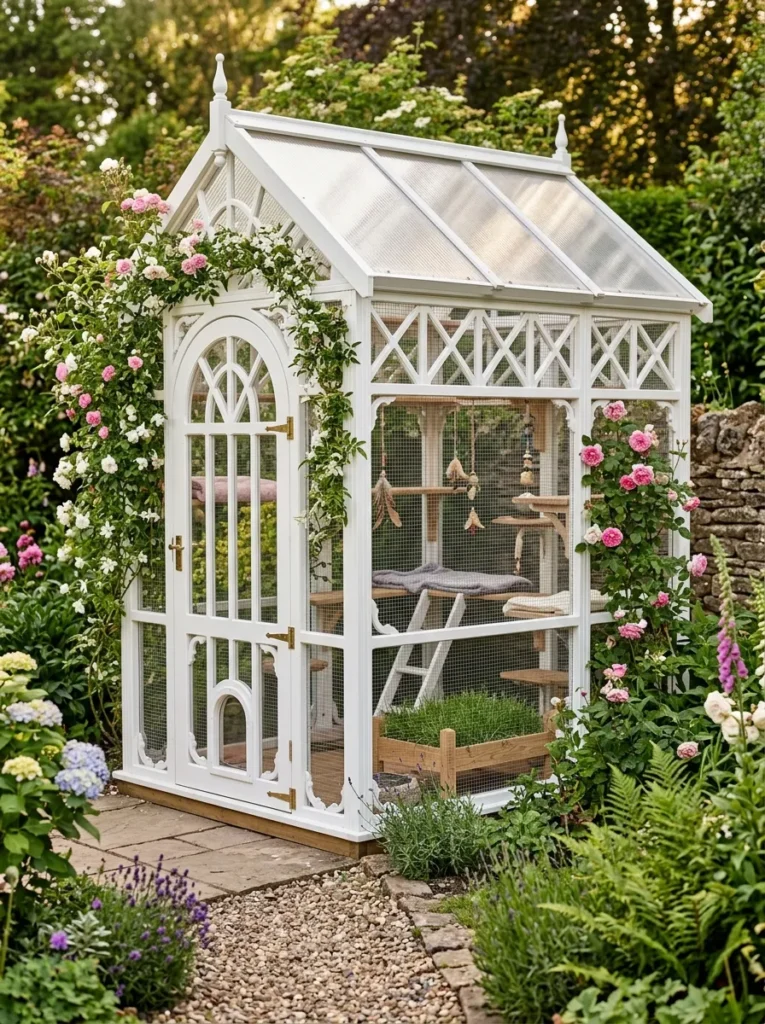
Vibe: The Victorian greenhouse catio feels like a heritage garden feature that happens to be a cat space — the climbing roses and white-painted frame giving it the aesthetic authority of a genuine Victorian glasshouse.
Why it works: A Victorian greenhouse-style catio applies the garden feature camouflage principle — a catio that reads as a genuine garden feature (a greenhouse, a summerhouse, an arbor) integrates into the backyard landscape with the same aesthetic authority as those structures, making it a garden asset rather than a practical intrusion. The polycarbonate twin-wall roof (not glass) provides the specific benefit of diffused natural light without direct solar heat gain in summer — twin-wall polycarbonate diffuses and insulates simultaneously, creating a warm but not overheating interior in spring and autumn while requiring adequate ventilation management in summer.
How to get it: Frame from 75×50mm pressure-treated or hardwood timber in the Victorian glazing-bar pattern (vertical uprights at 60cm centres with horizontal rails at 30cm centres to create the glazing-bar aesthetic without actual glazed panels). Roof with 10mm twin-wall polycarbonate (minimum — 16mm is better for thermal management). Clad the walls with 19mm hardware cloth within the decorative timber framework. Install a ridge vent along the apex of the roof for warm-weather ventilation. Train climbing roses or jasmine on the exterior frame — avoid plants that are toxic to cats inside the enclosure (check the ASPCA toxic plant list before planting anything accessible to the cat).
Budget: Materials for a 2×3m Victorian greenhouse catio: $800–1,500. Professional build: $2,500–5,000.
Shop The Look
| Product |
|---|
| 10mm twin-wall polycarbonate roofing |
| White timber paint exterior grade |
| Climbing rose non-toxic variety |
| Victorian greenhouse ridge vent |
| Cedar shelf board interior set |
3. Cat Tunnel Highway Connecting House to Garden Enclosure
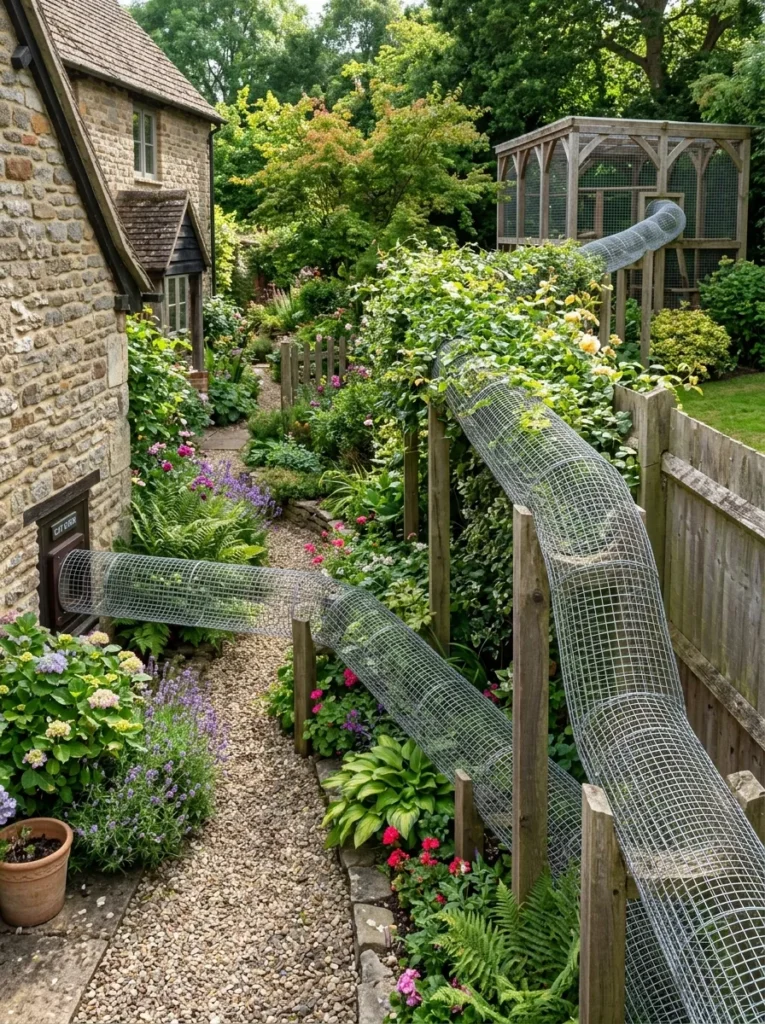
Vibe: The cat tunnel highway feels like an adventure park that lives inside the existing garden — the route weaving through and above the garden beds creating a journey experience.
Why it works: A cat tunnel highway applies the journey enrichment principle — cats benefit as much from the route through outdoor space as from any specific destination within it, because the tunnel’s varied stimuli (different light levels, different smells from adjacent garden beds, different heights) provide continuous olfactory and sensory enrichment throughout the journey. The tunnel format is the most garden-space-efficient outdoor enrichment option because the tunnel occupies the air space above garden beds rather than the garden’s usable horizontal area — a tunnel running above a flower bed occupies none of the flower bed’s productive area while providing the cat access to the scents and sights of that bed through the tunnel’s mesh walls.
How to get it: Source prefabricated wire mesh cat tunnel sections (available from specialist catio retailers and Amazon in 30–40cm diameter flexible and rigid sections, in 1–2 metre lengths with connecting collars). For a permanent installation, support the tunnel on timber posts at 1-metre intervals, using U-bolt clamps to secure the tunnel to each post top. Plan the tunnel route before purchasing — measure the total desired route length and identify where elevated sections (at 80–100cm height) would provide additional enrichment. Connect to the house via a wall cat door with a tunnel extension reaching from the door to the garden-level tunnel.
Budget: Materials for a 10-metre tunnel route: $150–350. Professional installation: $400–800.
Shop The Look
| Product |
|---|
| Cat tunnel section 35cm diameter mesh |
| Tunnel connector collar set |
| Timber post 50mm ground mount set |
| U-bolt tunnel post clamp set |
| Cat door wall tunnel extension |
4. Planted Cat Garden with Cat-Safe Botanicals
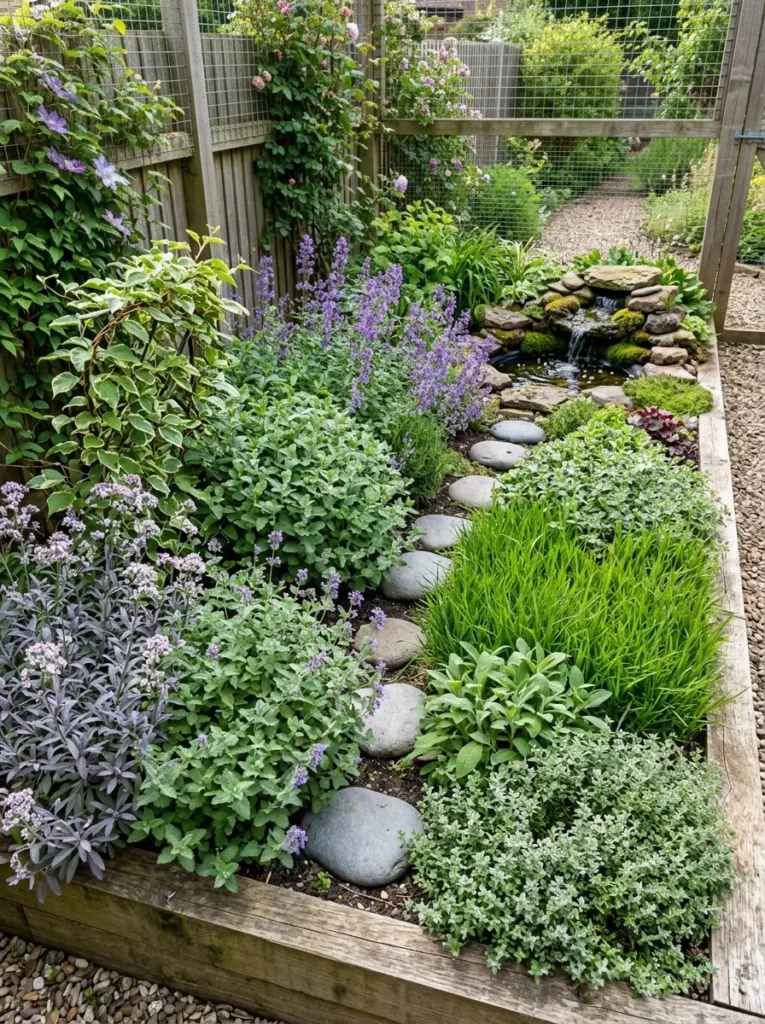
Vibe: The cat-safe botanical garden feels like a curated sensory landscape for a species that experiences the world primarily through smell — the specific plants chosen for what they give a cat to experience rather than for their visual appeal to humans.
Why it works: A dedicated cat-safe planted zone applies the olfactory enrichment principle — cats experience their environment primarily through smell, and access to the complex, varied, and continuously changing olfactory environment of a planted garden provides a level of sensory stimulation that no manufactured toy or indoor enrichment tool can replicate. The specific cat-attracting plants (catnip, Nepeta cataria; silvervine, Actinidia polygama; valerian, Valeriana officinalis; catmint, Nepeta mussinii) produce volatile compounds that directly stimulate feline neurological reward pathways, creating a genuine euphoric response in most cats regardless of whether they respond to catnip specifically. Cat grass (typically wheat grass or barley grass) provides a fiber supplement and a chewing texture that satisfies the grass-eating behavior that cats engage in naturally.
How to get it: Source cat-safe plants from a specialist cat garden supplier or from a general nursery, verifying each species against the ASPCA toxic plant database. Plant in a dedicated raised bed within the cat enclosure at approximately 40cm height — the raised bed position allows cats to browse the planting at nose level rather than ground level. Incorporate smooth stepping stones through the planting at 35–40cm intervals to allow access without trampling. Install a small solar-powered water feature (a shallow recirculating basin) at one corner — moving water is strongly attractive to many cats.
Budget: Plants and raised bed materials: $80–200. Solar water feature: $30–60.
Shop The Look
| Product |
|---|
| Catnip plant Nepeta cataria |
| Catmint plant Nepeta mussinii |
| Cat grass seed wheat or barley |
| Raised bed timber 40cm height |
| Solar water feature small recirculating |
5. Multi-Level Tower Catio for Small Gardens
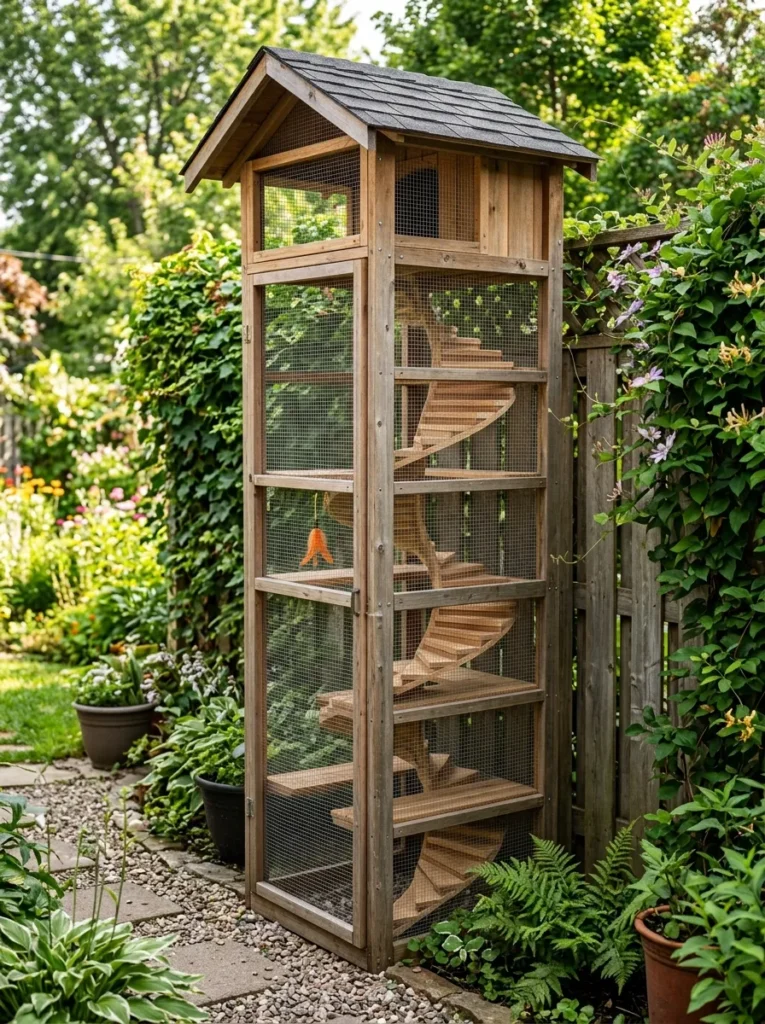
Vibe: The multi-level tower catio feels like a purpose-built feline skyscraper — the vertical maximization providing more enrichment per square foot of garden footprint than any horizontal enclosure.
Why it works: A multi-level tower catio applies the vertical territory maximization principle — cats are instinctively height-seeking animals that establish social status and achieve stress reduction by occupying elevated positions. A vertical tower structure that provides six or more distinct height levels within a minimal floor footprint (80×80cm) provides more behavioral enrichment value than a much larger ground-level enclosure with the same total interior volume, because the height variation delivers the territorial security function that cats specifically seek. The covered sleeping box at the top provides the highest and most protected position in the structure — the position a cat in its own territory would instinctively claim as the primary rest site.
How to get it: Build the tower frame from 50×50mm cedar posts at each corner, with horizontal rails at the height of each shelf platform. Install shelf platforms from 18mm exterior-grade plywood covered with a non-slip surface (indoor-outdoor carpet tiles are ideal — warm, grippy, and washable). Install the spiral ramp (a series of small shelves with 20-degree tilt connecting to the full-width platform above) on the tower’s interior diagonal. Build the sleeping box from 18mm marine ply with a waterproofing membrane on the exterior and line the interior with a removable fleece pad. Cover the box roof with a small cedar shingle or aluminum mini-roof.
Budget: Materials for 80×80×220cm tower: $250–450.
Shop The Look
| Product |
|---|
| Cedar post 50mm tower frame set |
| Marine plywood 18mm shelf platform |
| Indoor-outdoor carpet tile shelf cover |
| Cedar shingle small roof set |
| Removable fleece sleeping box liner |
6. Converted Garden Shed Cat Clubhouse
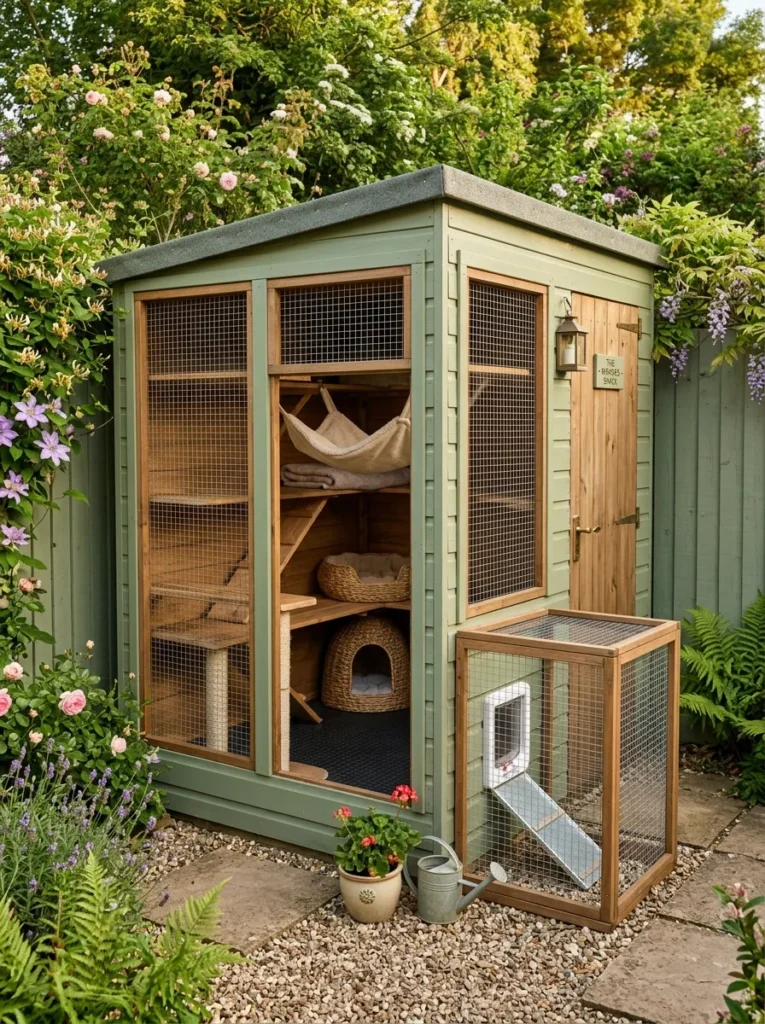
Vibe: The converted shed cat clubhouse feels like the most resourceful possible use of an existing structure — the shed that was storing garden tools repurposed as the most beloved square footage in the garden.
Why it works: A converted garden shed cat clubhouse applies the existing infrastructure principle — a standard garden shed provides a weatherproof, insulated structure that already meets most of the requirements of a permanent cat retreat (solid walls, a roof, a floor, adequate height, and a door opening). The conversion work (replacing solid windows with hardware cloth, installing platforms and hammocks, adding a cat door) is significantly less construction effort and cost than building a new catio from scratch, and the result provides a significantly higher-quality shelter from adverse weather than any mesh-walled catio can achieve. The retained shed walls provide insulation and weather protection that give the cat retreat genuine all-season usability.
How to get it: Remove the existing shed windows and replace each window opening with a hardware cloth panel in a timber frame sized to fit the opening — this provides the ventilation and view access that a solid shed window does not, while maintaining the shed’s structural integrity. Install a cat door in the shed’s main door or in one wall. Build interior platforms from timber off-cuts at multiple heights on each wall. Install a cat hammock (a simple rectangular hammock made from a piece of fabric between two wall-mounted brackets) at two or three heights on the shed’s interior walls. Cover the shed floor with rubber matting for warmth and grip.
Budget: Conversion materials for a standard shed: $150–350. New shed purchase if not existing: $200–600 additional.
Shop The Look
| Product |
|---|
| Sage green exterior shed paint |
| Hardware cloth replacement window panel |
| Cat hammock indoor set |
| Rubber matting floor shed |
| Cat door standard flap |
7. Under-Deck Cat Haven
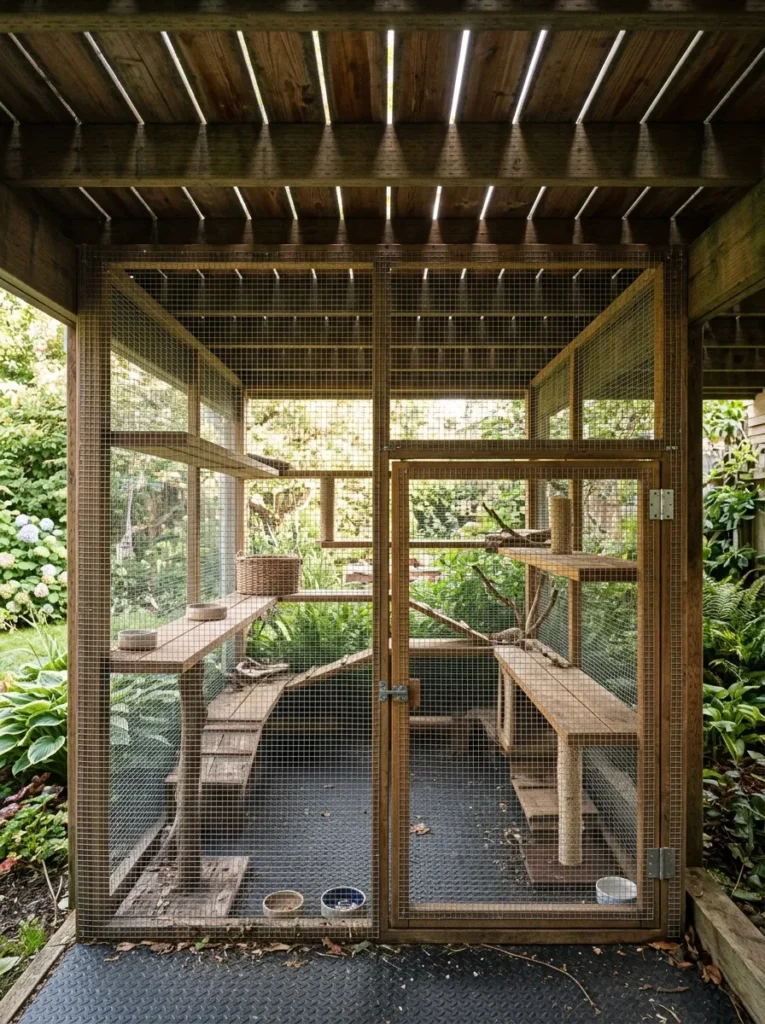
Vibe: The under-deck cat haven feels like the best hiding spot in the garden transformed into a permanent sheltered retreat — the deck above providing natural shelter that no separate structure could replicate.
Why it works: An under-deck cat haven applies the existing shelter principle — the space beneath a raised garden deck is naturally sheltered from rain and sun (the deck surface provides a solid waterproof roof), naturally shaded and cool (deck boards create a naturally ventilated roof with consistent shade), and naturally enclosed on three sides where the deck meets the ground. Converting this existing sheltered cavity to a cat retreat requires only hardware cloth enclosure of the open sides and an access door — the most structurally efficient catio format available because the most expensive construction elements (the roof and the solid structural walls) already exist.
How to get it: Measure all open sides of the under-deck space. Cut and attach 19mm hardware cloth panels to the deck’s structural frame on all open sides using U-staples and a timber border frame for neatness. Install a small hinged door (approximately 50×70cm) in one hardware cloth panel for human access (cat access is typically through a tunnel from the house, or through a small cat-specific flap in the door). Level and compact the ground within the under-deck space and cover with rubber matting or pea gravel. Install low timber platforms (30–50cm height) throughout the space on 2×4 timber legs.
Budget: Materials for a standard under-deck conversion: $200–400.
Shop The Look
| Product |
|---|
| Hardware cloth 19mm roll under-deck |
| U-staple gun and staple set |
| Rubber matting ground floor roll |
| Low timber platform kit 2×4 |
| Hinged access door panel hardware cloth |
8. Japanese-Inspired Zen Cat Garden
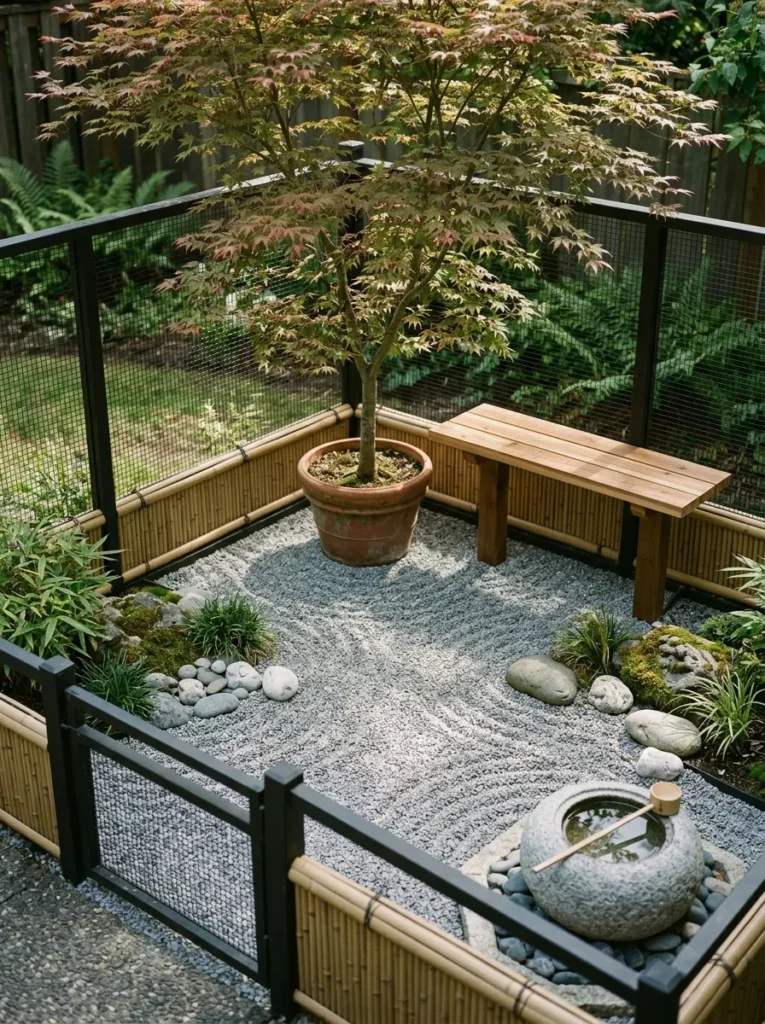
Vibe: The zen cat garden feels like a space designed for contemplation that happens to be measured in cat scale — the considered simplicity creating beauty that the human and the cat experience differently but equally.
Why it works: A Japanese-inspired zen cat garden applies the multi-species design principle — a thoughtfully designed outdoor space can be genuinely beautiful for the human observers and genuinely enriching for the cat users simultaneously, with no compromise required. The raked gravel provides a tactile substrate that cats find satisfying for pawing and lying in; the potted Japanese maple provides both the dappled light quality that cats seek for thermoregulation and a perching-adjacent structure; the granite water basin provides the moving water source that many cats prefer; and the minimal dark-frame enclosure reads as a garden border rather than a cage. The Zen aesthetic’s emphasis on negative space, material honesty, and considered placement serves both the human aesthetic and the feline behavioral preference for spatial clarity.
How to get it: Select non-clumping, contained bamboo varieties (Fargesia murielae or similar) for the border elements and verify all plant species against the ASPCA toxic list — some common Zen garden plants (including certain mosses and some ornamental grasses) can be harmful if ingested. Install a layer of raked gravel (granite chips or similar natural stone) to 5–7cm depth on a weed-suppressing membrane base. Position smooth stepping stones and garden rocks in an asymmetric, naturalistic arrangement. Install the enclosure using dark-painted (charcoal or black) 75×75mm timber posts with 19mm hardware cloth — the dark frame reads as minimal and recessive in the Zen composition.
Budget: Materials for a 2×2m Zen cat garden: $350–700.
Shop The Look
| Product |
|---|
| Raked garden gravel silver-gray |
| Japanese maple pot large outdoor |
| Granite garden water basin small |
| Dark charcoal timber post paint |
| Mondo grass non-toxic plant set |
9. Window Box Catio — Extension from a Window Opening
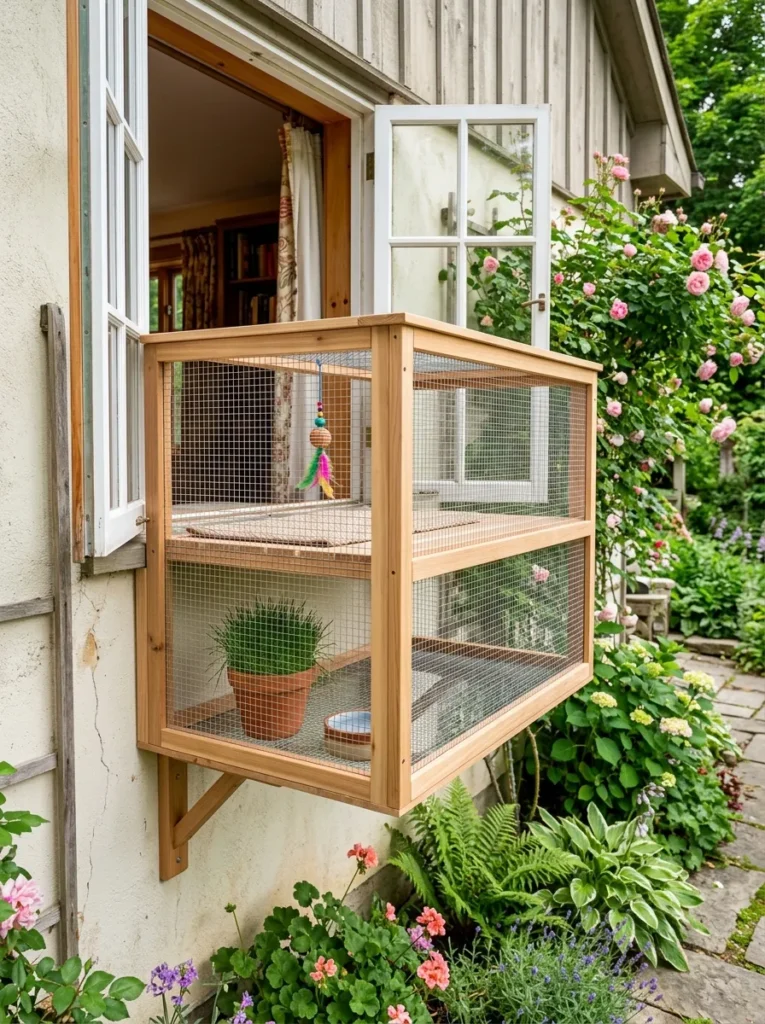
Vibe: The window box catio feels like the most efficient possible outdoor enrichment — a small, sunny, birdwatching station that connects to the inside world through a single window opening.
Why it works: A window box catio applies the minimum viable outdoor enrichment principle — for cats in apartments or in homes where a full garden enclosure is not possible, a window box catio extending from an existing window provides genuine outdoor experience (direct sunlight, natural air movement, bird and wildlife viewing at close range) from a minimal exterior footprint. The window box is also the most accessible catio format for rental properties and apartments, as it requires only a single window modification and can be removed without significant damage to the building.
How to get it: Build the box from 50×50mm cedar with a cedar floor and hardware cloth on the outer three sides. The box attaches to the house wall below the window using two sturdy L-bracket shelf supports (rated for the total weight of the box plus a cat — minimum 10kg combined) and the window’s sill as an additional support surface. The window frame’s opening must be modified to remain open (a simple wooden filler block in the open section above and beside the box prevents rain and heat loss while keeping the aperture safe). The box’s interior dimensions should allow a cat to turn around comfortably — a minimum of 60×50cm floor area.
Budget: Materials for a window box catio: $80–180.
Shop The Look
| Product |
|---|
| Cedar frame 50mm window box build |
| Hardware cloth 19mm three sides |
| Heavy L-bracket shelf support set |
| Window wooden filler block set |
| Cat grass small pot window box |
10. Pergola Catio with Wisteria Canopy
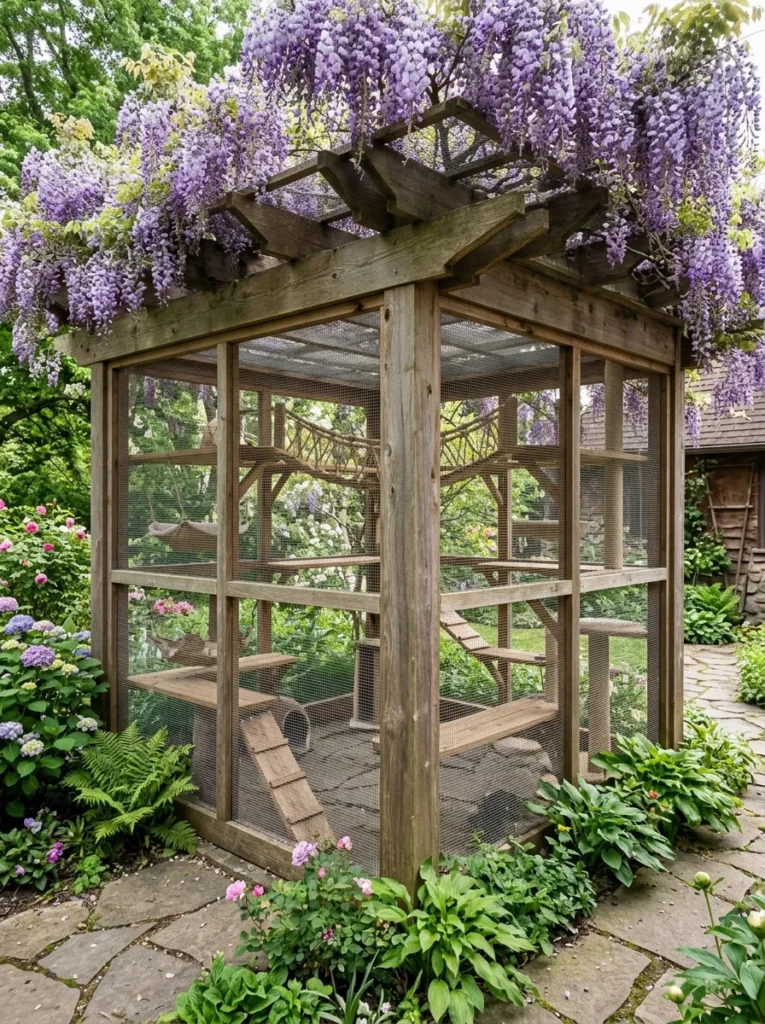
Vibe: The wisteria pergola catio feels like a secret garden that the cat has claimed as entirely their own — the flowering canopy making the enclosure disappear into the garden.
Why it works: A pergola catio with a wisteria canopy applies the plant-integration camouflage principle — growing a significant climbing plant over the catio structure converts the enclosure from a visible wire cage (which may read as industrial in a beautiful garden) into a plant-integrated garden feature that reads first as a pergola and only secondarily as an enclosed space. The wisteria provides dense seasonal shade in summer (when the enclosure needs shading for thermoregulation), allows more light in autumn after leaf drop, and provides visual interest and olfactory enrichment through its flowers. Note: wisteria is listed as mildly toxic to cats if significant amounts are ingested — the choice to grow it over (rather than inside) the enclosure is the critical welfare distinction.
How to get it: Build the pergola frame from 100×100mm cedar posts at each corner with 50×100mm overhead beams and cross-rafters at 60cm intervals. Staple hardware cloth to the inner face of the vertical posts on all four sides and across the underside of the first rafter layer (creating the enclosed roof just below the growing surface of the pergola beams above). Plant wisteria at the base of each post and train it upward and over the beams, growing above the hardware cloth roof level. Interior platforms from cedar shelf boards on brackets at three to four heights.
Budget: Materials for 3×3m pergola catio: $600–1,200. Professional build: $2,000–4,000.
Shop The Look
| Product |
|---|
| Cedar post 100mm pergola frame |
| Hardware cloth sub-roof underrafter |
| Wisteria plant trained exterior |
| Cedar shelf platform bracket set |
| Rope bridge cat 80cm length |
11. Recycled Pallet Cat Castle
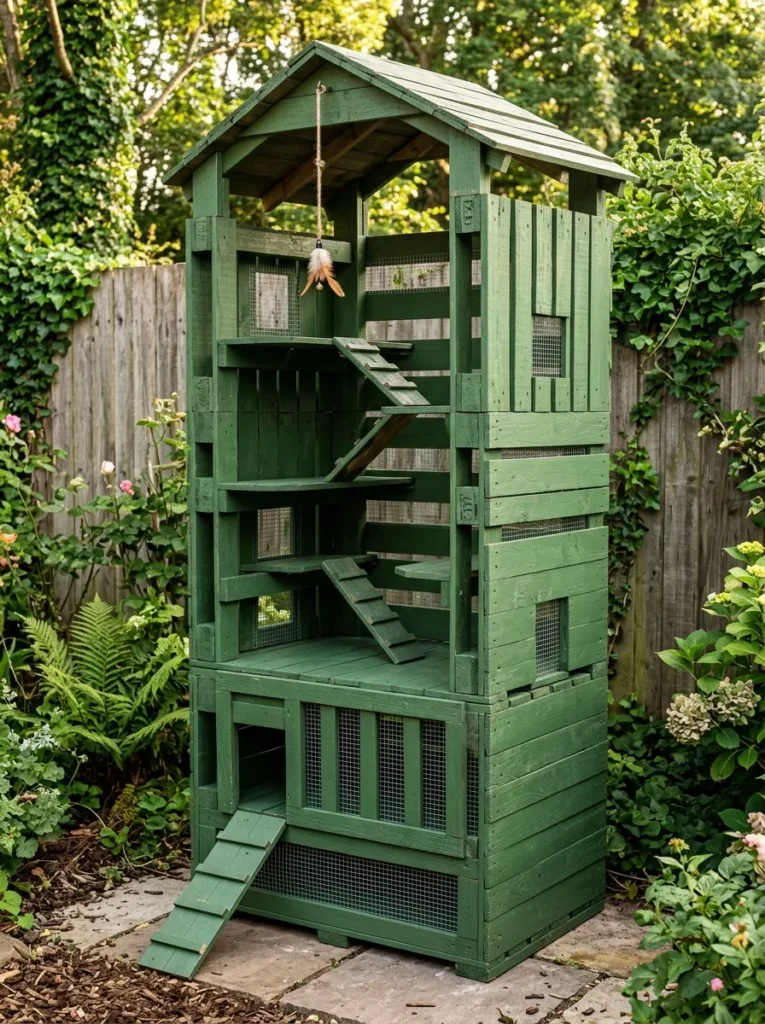
Vibe: The pallet cat castle feels like the most resourceful version of a fully featured catio — the reclaimed timber communicating both sustainability values and the maker’s investment of effort.
Why it works: A reclaimed pallet cat castle applies the zero-cost material principle — standard timber pallets (EPAL certified heat-treated pallets, not chemically treated) are available free from most garden centres, DIY retailers, and logistics facilities, making the primary structural material of this catio genuinely free. Pallets’ dimensional standardization (typically 120×80cm) simplifies the construction planning and provides a modular building block system — each pallet can be oriented vertically (as a wall panel), horizontally (as a platform floor), or at an angle (as a ramp section). The slatted timber construction naturally provides ventilation and partial shade while creating visual interest through the varied timber pattern.
How to get it: Source EPAL-stamped heat-treated pallets only (avoid HT-marked chemical-treated pallets, which may off-gas compounds harmful to cats). Sand all exposed timber to remove splinters before construction. Connect pallets using coach bolts at the junction points between adjacent pallets. Cover all slatted sections with hardware cloth on the interior face to prevent a cat’s head or paw becoming stuck between slats. Apply a non-toxic exterior paint (Farrow & Ball exterior eggshell or an equivalent solvent-free formulation) to the exterior surfaces. Install hardware cloth panels over all openings that are not covered by solid pallet board sections.
Budget: Primary materials (pallets) free; hardware cloth, fixings, and paint: $80–180.
Shop The Look
| Product |
|---|
| EPAL heat-treated pallet free source |
| Hardware cloth opening cover set |
| Non-toxic exterior paint green |
| Coach bolt set timber connection |
| Cat ramp timber board small |
12. Cat-Safe Herb Garden with Stepping Stone Path
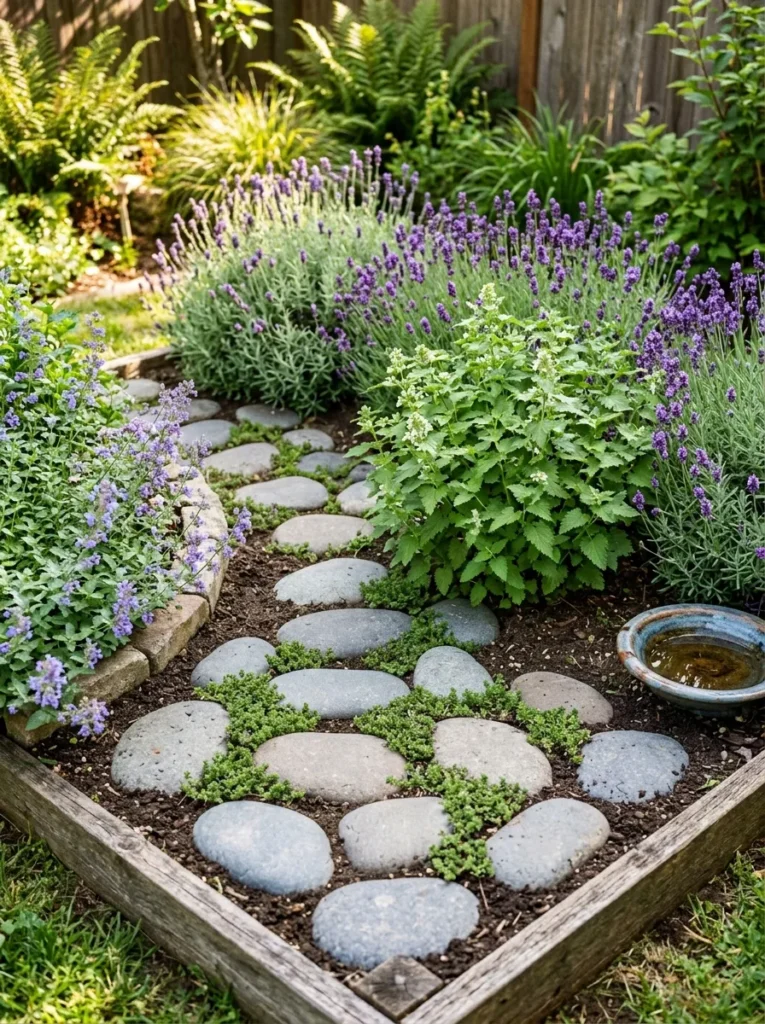
Vibe: The cat herb garden feels like a sensory laboratory designed for a nose twelve times more sensitive than a human’s — every plant chosen for what it gives a cat to smell rather than for what it gives a human to see.
Why it works: A cat-safe herb garden with stepping stones applies the olfactory landscape design principle — the stepping stone path through the planted area creates a structured route that guides a cat through different olfactory zones (thyme underfoot, lavender beside, catnip ahead), providing a sequential sensory experience that closely mirrors the naturalistic herb browsing behavior that cats exhibit in open countryside. The raised planting provides plants at nose height for a cat walking between the stepping stones, maximizing the olfactory contact with each plant variety. Note: not all lavender is safe for all cats — English lavender (Lavandula angustifolia) in small exposures is generally tolerated, but ingestion of essential oils from any lavender is toxic. Position lavender at the planting border where cats are unlikely to chew.
How to get it: Verify all plants against the ASPCA toxic plant database before planting. Prepare the area with quality loam soil mix in a raised bed or level planting bed. Install stepping stones at 35–40cm intervals (cat stride width) in a gently curving path through the planting. Plant thyme (Thymus vulgaris) as groundcover between stepping stones — it withstands light foot traffic and releases its scent when walked on. Position catnip and catmint plants at the center of the planting where they will receive the most cat attention.
Budget: Plants and stepping stones: $60–150.
Shop The Look
| Product |
|---|
| Thyme groundcover plant set |
| Catnip plant large Nepeta cataria |
| Catmint plant Nepeta mussinii |
| Smooth flat river stone stepping set |
| Small ceramic bird bath garden |
13. Nighttime Cat Garden with Solar Lighting
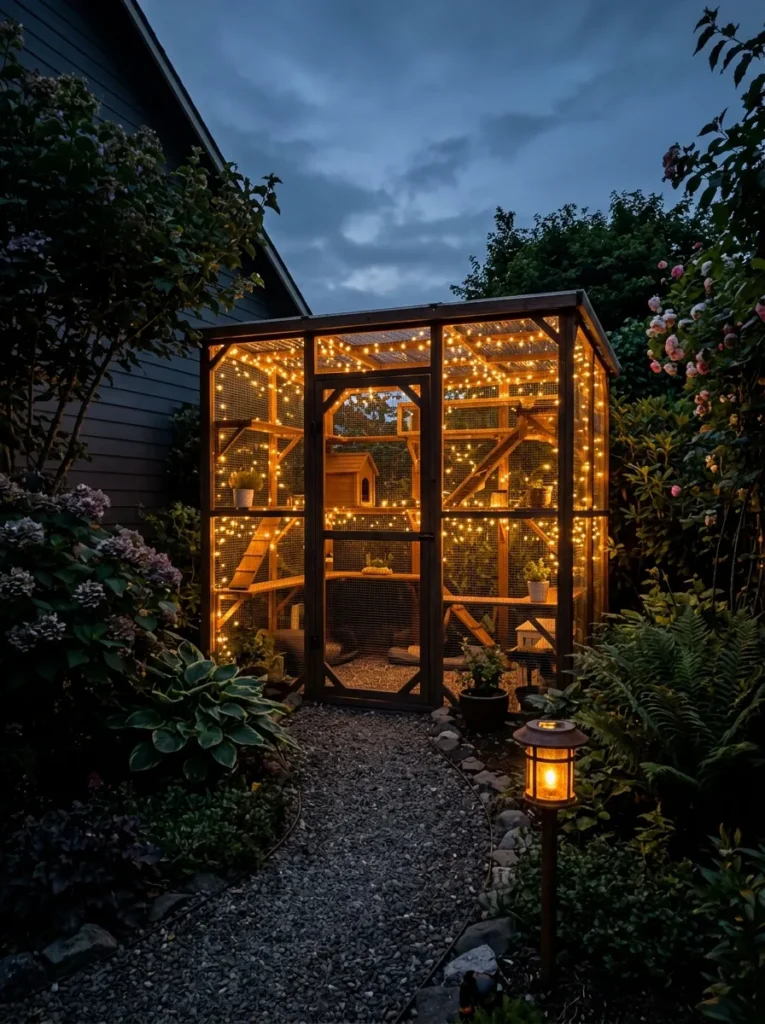
Vibe: The night-lit cat garden feels like a lantern in the garden — the warm amber glow converting the enclosure from a daytime utility structure to an evening garden feature.
Why it works: A nighttime cat garden with solar lighting applies the extended enrichment hours principle — cats are crepuscular animals (most active at dawn and dusk) rather than diurnal or nocturnal, meaning the dusk and early evening hours are among a cat’s most naturally active periods. A cat garden with adequate nighttime lighting extends the usable hours of the outdoor enrichment space into the precisely most behaviorally appropriate time, while also serving the human purpose of converting the enclosure into a beautiful garden feature at dusk and evening. Solar-powered warm amber string lights (rather than cool-white security lights) provide adequate cat visibility without disrupting the cat’s circadian rhythm or creating light pollution.
How to get it: Install solar-powered warm amber LED string lights (minimum 5-metre string for a 2×2 metre enclosure) by threading through the enclosure’s interior frame members. Solar panels mount on the enclosure roof or an adjacent fence post with full sun exposure. Add a small solar pathway light on the garden path leading to the enclosure door — this provides sufficient light for the human to operate the door safely without disturbing the enclosure’s warm ambient light. Ensure all lighting components are rated for outdoor use and all wire connections are protected from moisture.
Budget: Solar string lights and path light: $25–55.
Shop The Look
| Product |
|---|
| Solar string light warm amber outdoor |
| Solar pathway light small garden |
| Weatherproof cable clip set outdoor |
| Outdoor rated extension hook set |
| Solar panel mounting bracket fence |
14. Raised Platform Observation Deck for Bird Watching
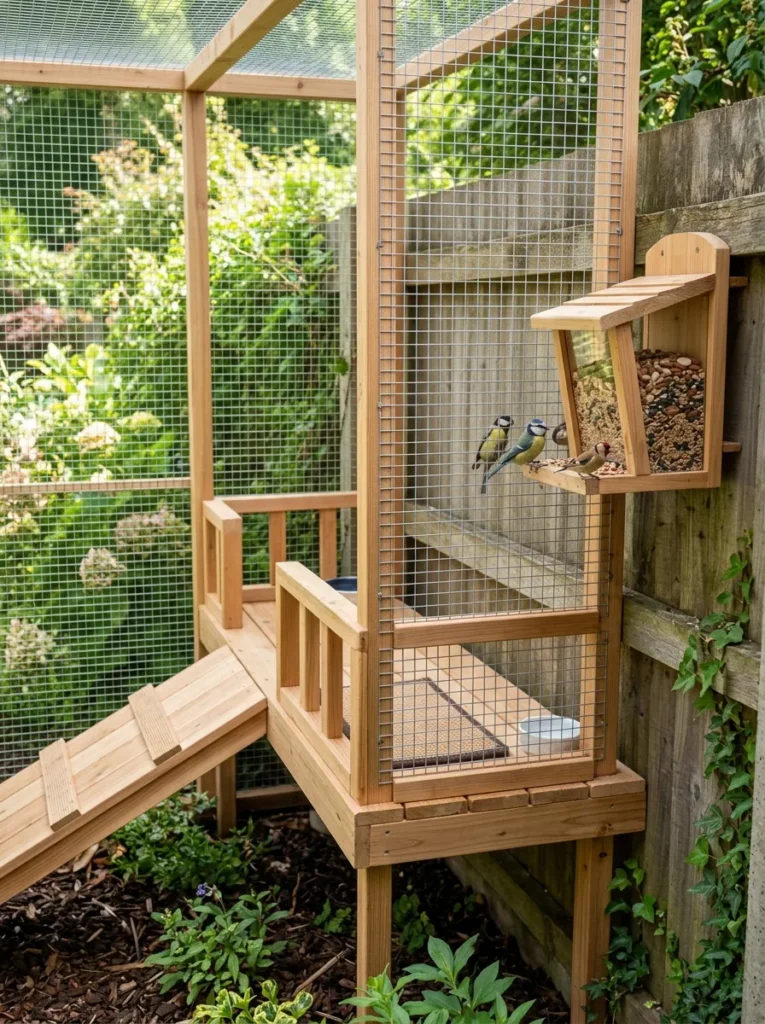
Vibe: The observation deck with bird feeder feels like the most considered form of feline television available — the raised platform and adjacent bird activity providing hours of species-appropriate visual enrichment.
Why it works: A raised observation platform positioned near a bird feeder applies the enrichment specificity principle — identifying what provides a specific cat with its highest level of engagement and designing the space to maximize that specific stimulus. For the majority of cats, bird watching from an elevated, stable platform is the highest-engagement activity available in a contained outdoor space. Positioning the platform at close range to a bird feeder (mounted on the enclosure’s external fence rather than inside — this is the critical welfare detail that allows birds to visit without entering the predator’s space) creates a continuous, varied, unpredictable visual stimulus that manufactured toys cannot replicate. The slightly elevated platform (at 90cm) provides the cat a viewing position above the fence-line bird feeder, allowing a natural downward gaze that matches the predatory visual scanning position.
How to get it: Build the platform from 18mm exterior plywood or cedar slats on a 2×4 timber frame at 90cm height. Install a gentle ramp (approximately 100cm long for a 90cm rise — a 42-degree slope) with crosswise batten strips for grip at 15cm intervals. Install a low timber railing on the platform’s three exposed edges at 20cm height — high enough to reassure a cat at height but with spacing between balusters sufficient to allow unobstructed viewing. Mount a bird feeder on the fence exterior immediately adjacent to the platform — seed feeders attract finches and sparrows; suet feeders attract woodpeckers and tits depending on geographic location.
Budget: Platform and ramp materials: $80–180. Bird feeder: $15–40.
Shop The Look
| Product |
|---|
| Cedar shelf board 18mm platform |
| 2×4 timber frame platform legs |
| Grip batten strip ramp set |
| Bird seed feeder fence mount |
| Suet block bird feeder weather cage |
15. Cozy Insulated Cat House Within the Garden Enclosure
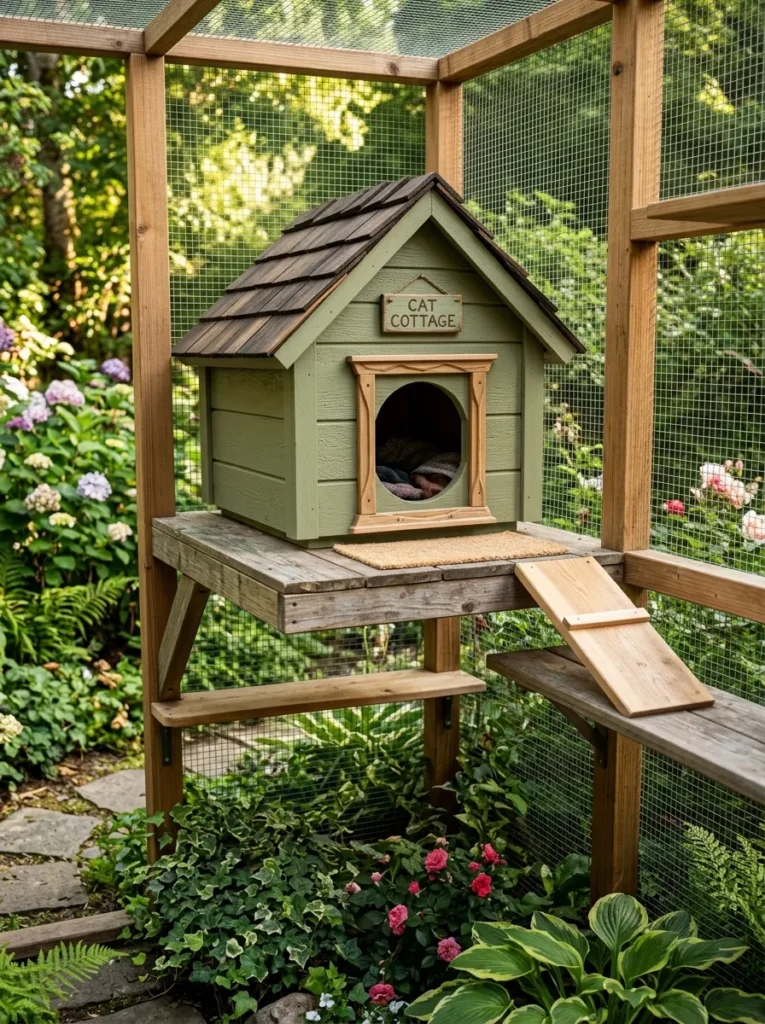
Vibe: The insulated cat house within the enclosure feels like a house within a house — the enclosed garden space containing its own further enclosed shelter, providing the nested den-within-territory quality that cats specifically seek.
Why it works: An insulated cat house within the garden enclosure applies the layered shelter principle — cats instinctively seek a den within a territory (a small, dark, enclosed space within a larger, protected, outdoor space). An insulated cat house positioned on the highest platform of the garden enclosure provides the optimal behavioral environment: the cat’s territory is the garden enclosure, and the cat’s den is the insulated house within it. The insulation specifically extends the enclosure’s usable season into winter — an uninsulated shelter in a cold-climate winter can reach outdoor temperatures and provide inadequate thermal protection for a cat resting in it; an insulated shelter (walls lined with closed-cell foam and interior lined with a removable fleece pad) maintains a temperature significantly above ambient and allows year-round outdoor enrichment access.
How to get it: Build the cat house from 18mm marine ply for the structural shell, lined on the interior with 12mm closed-cell foam board insulation, covered with a cedar veneer or painted interior panel. The entry hole should be 15–18cm diameter for most domestic cats — large enough for comfortable entry and exit, small enough to retain body heat. Roof with cedar shingles or corrugated mini-roofing aluminum. Line the interior with a removable fleece pad for warmth. The house should have no floor ventilation opening — the only opening should be the entry hole, which the cat covers with their body when inside.
Budget: Materials for an insulated cat house: $60–150.
Shop The Look
| Product |
|---|
| Marine plywood 18mm cat house |
| Closed-cell foam board insulation 12mm |
| Cedar shingle small roof kit |
| Removable fleece interior pad |
| Small cedar shingle adhesive set |
16. Vertical Garden Wall with Cat-Safe Climbing Planting
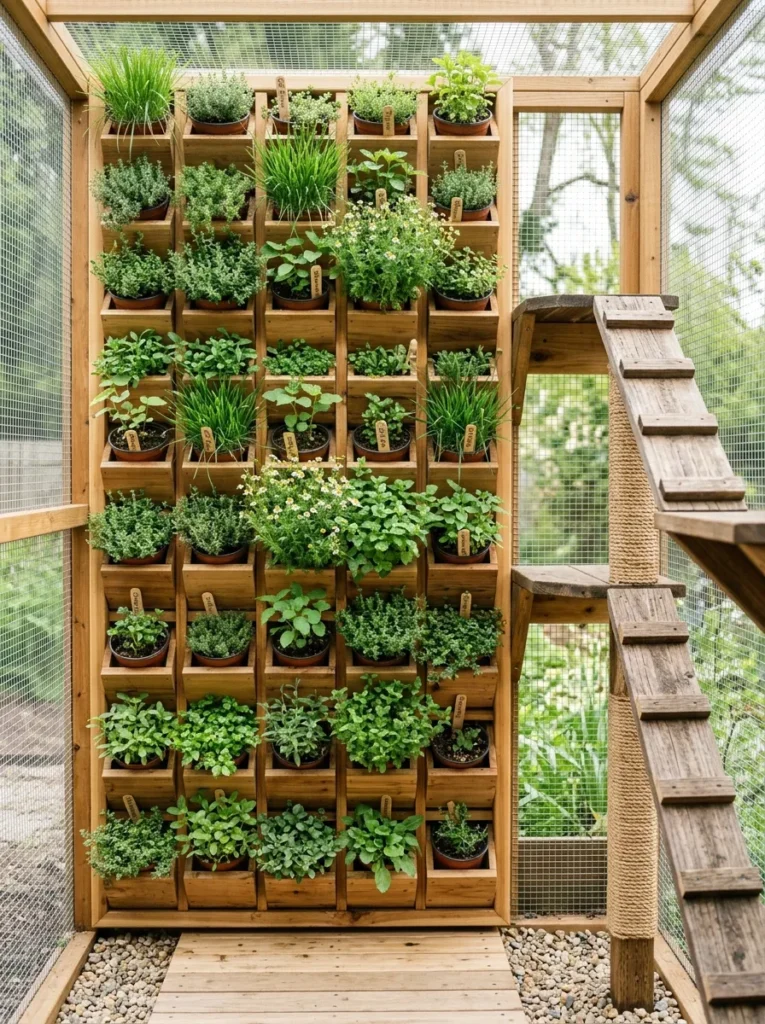
Vibe: The vertical garden wall feels like a living library of feline botanical experiences — the varied planting creating a browsing wall that is as visually beautiful from the human’s garden perspective as it is olfactorily rich from the cat’s perspective.
Why it works: A vertical garden wall with cat-safe climbing plants applies the space-maximizing enrichment principle — a vertical garden wall occupies only the depth of the planting pockets (typically 15–20cm) against one wall of the enclosure, but provides a continuous floor-to-ceiling plane of olfactory enrichment that cats can browse at every height. The vertical format also maximizes the planting area within a limited horizontal footprint — a 2-metre tall by 1-metre wide vertical garden provides the same planting area as a 2×2 metre ground-level bed in one-quarter of the horizontal space. Varying plant species at different heights (ground-level grasses, mid-height herbs, upper-level trailing varieties) creates different olfactory zones through the vertical range.
How to get it: Build the vertical garden frame from a 50×25mm timber grid attached to the enclosure’s interior wall, with planting pockets made from coir liner material stapled to the frame (coir is the most appropriate material — it drains freely, is non-toxic to cats, and is biodegradable). Alternatively, source a pre-made vertical garden felt pocket system and attach to the catio wall. Plant only after verifying each species against the ASPCA toxic plant database. Water the vertical garden with a fine-mist spray attachment on a watering can — the pocket planters drain quickly and require daily watering in dry weather.
Budget: Vertical garden frame and planting: $80–200.
Shop The Look
| Product |
|---|
| Vertical garden timber frame grid |
| Coir liner planting pocket set |
| Vertical felt pocket planter set |
| Cat-safe herb plant assortment |
| Fine mist watering spray small |
How to Start Your Cat Garden Retreat
The single best first move before building any cat garden retreat is observing the cat’s existing behavior within the indoor environment for one week, specifically noting: which window the cat most consistently sits at (this indicates the direction and visual content that most engages the cat — the garden retreat should be positioned to access this view), what height the cat most consistently rests at (a high-perching cat needs multiple elevated platforms; a low-resting cat needs secure, lower-level shelter), and what indoor activities the cat most consistently seeks (a cat that chases moving toys is a strong candidate for a bird-watching observation deck; a cat that seeks warmth and sleep is a strong candidate for an insulated cat house with solar lighting). This behavioral observation costs nothing and takes a week, but it produces the specific knowledge that converts a generic cat retreat into a genuinely used and appreciated one.
The most common mistake in cat garden retreat design is building an enclosure that is adequate for a cat to exist in rather than one that is genuinely enriching for a cat to choose to use. An adequate enclosure has shelter, a litter tray, water, and food access. A genuinely enriching enclosure has height variation, olfactory interest, visual stimulation, concealment options, and thermoregulation zones — it is a space a cat chooses to enter and remain in rather than one a cat endures when placed there. The behavioral science distinction is important: a cat that uses an outdoor retreat voluntarily receives significant welfare benefit; a cat that avoids an outdoor retreat despite having access to it receives zero welfare benefit from the structure regardless of its construction quality.
Three specific items under $50 that immediately improve any existing or planned cat garden retreat: a cat grass growing kit ($8–15, providing the olfactory and fiber-supplement enrichment that is the highest-impact botanical addition to any cat garden); a solar-powered warm amber string light set ($12–20, extending the usable hours of any outdoor space into the crepuscular hours when cats are most active and converting any enclosure into an evening garden feature); and a hanging sisal rope toy ($8–15 installed at mid-height in any enclosure, providing the most engaging single interactive enrichment element available for an outdoor cat space). These three items combined for under $50 improve the enrichment quality of any existing enclosed space immediately.
A minimal cat garden retreat (window box catio, under-deck conversion, or small tunnel from an existing cat door) is achievable in a weekend for $80–300 in materials. A mid-range cat garden retreat (lean-to cedar catio, converted shed, or pergola enclosure with planted elements) takes two to three weekends and costs $400–1,200 in materials. A premium fully designed cat garden retreat (Victorian greenhouse style, multi-level with Zen garden, or comprehensive planted enclosure with observation deck and insulated house) represents a $1,500–5,000 material investment with 4–8 weekends of build time or the equivalent professional installation cost. The cat grass, the string lights, and the sisal rope are achievable today; the lean-to catio follows this weekend, and the Victorian greenhouse takes its time and arrives as the most beautiful garden feature the backyard will ever have.
Frequently Asked Questions About Cat Garden Retreat Ideas
What is the minimum size for a cat garden retreat to provide genuine enrichment?
The minimum size that provides genuine behavioral enrichment is less about total floor area and more about height variation and sensory complexity. A space of 1×1 metre with three height levels (ground level, a mid-level platform at 60cm, and an upper platform at 120cm) provides more behavioral enrichment than a 2×2 metre flat enclosure, because the height variation delivers the territorial security function that cats specifically seek. The absolute minimum floor area for a single cat to be able to turn around, stretch, and move between levels is approximately 60×60cm per level — a three-level tower catio on a 60×60cm footprint can appropriately serve a single cat as a supplementary outdoor enrichment space alongside indoor living. For a multi-cat household, multiply the minimum by the number of cats and add a factor of 1.5 for social buffering.
What materials are safe for a cat garden retreat?
Safe construction materials include: naturally rot-resistant timber (cedar, redwood, Douglas fir, pressure-treated pine using modern ACQ or CA preservatives — avoid old CCA preservative timber), 19mm galvanized or PVC-coated hardware cloth (welded wire mesh — not chicken wire, which can injure paws and does not exclude small predators), twin-wall polycarbonate or tempered safety glass for roof panels, and exterior-grade non-toxic paint (water-based acrylics and natural oil finishes rated as safe once fully cured). Materials to avoid: raw MDF (absorbs moisture, not structural for outdoor use), chicken wire (unsuitable for predator exclusion and paw safety), lightweight plastic netting (not cat-proof or predator-proof), and any preservative-treated timber with unknown chemical content.
How do you keep a cat garden retreat secure from predators?
Predator security in a cat garden retreat requires addressing three access vectors: digging under (extend hardware cloth 30–45cm outward at ground level, buried or pegged flat on the garden surface to prevent foxes, coyotes, and dogs from digging under the enclosure walls), climbing over (ensure the enclosure’s walls and roof form a continuous enclosed surface with no gap larger than 2.5cm — mesh panels should be fixed to frame members with U-staples at maximum 10cm intervals), and reaching through (use 19mm galvanized hardware cloth throughout — the welded grid openings at 19mm are too small for a fox paw to reach through to a cat pressed against the interior of the mesh). Double the hardware cloth at ground level (two layers of mesh) in areas with known fox, raccoon, or coyote pressure.
How do you manage temperature and ventilation in a cat garden retreat?
Temperature management in a cat garden retreat requires providing options for the cat to self-select across a thermal range: a sunny, direct-sun section where the cat can seek warmth on cool days, and a shaded, naturally ventilated section where the cat can seek coolness on warm days. Both must be accessible simultaneously — a cat locked in a fully sun-exposed enclosure in summer or a fully shaded enclosure in winter has no thermoregulatory choice and the welfare outcome is poor. In enclosed structures (the greenhouse-style catio, the converted shed), ventilation is critical — minimum 15% of the total wall area should be provided as ventilation openings (hardware cloth panels or ridge vents). Solar-powered automatic vent openers (designed for greenhouse use) can open and close roof vents automatically based on interior temperature, providing temperature management without daily manual adjustment.
Can cat garden retreats be built in rented properties?
Yes — several of the ideas in this list are specifically appropriate for rented properties. The window box catio (Idea 9) requires only reversible modifications to a window and can be removed without damage. The cat tunnel highway (Idea 3) runs at ground level without permanent installation when using moveable post supports. Freestanding enclosures (the multi-level tower catio, the converted pallet structure, the small lean-to using tensioned posts rather than concreted posts) leave no permanent marks when removed. The key rental-property considerations are: avoiding concrete-in-ground post installation (use base plate post anchors that bolt to an existing surface or use weighted ballast bases), avoiding permanent wall penetrations beyond a single cat door installation, and documenting pre-installation garden condition photographically so that any landscaping impact can be assessed at end of tenancy.
Ready to Build Your Cat’s Dream Garden Retreat?
These 16 ideas move through every dimension of what makes a cat garden retreat genuinely enriching — from the architectural integration of lean-to cedar catios and Victorian greenhouse enclosures, to the sensory depth of planted cat herb gardens and vertical botanical walls, to the behavioral intelligence of bird-watching platforms and Zen gardens designed for a species that experiences space through smell as much as sight. Starting with the one-week behavioral observation — watching which window the cat sits at, what height it rests at, and what activities most engage it — is the beginning that makes every subsequent design decision purposeful rather than generic. It costs nothing and takes a week. From that knowledge, the right retreat format, the right placement in the garden, and the right enrichment features become clear. Order the cat grass and the solar string lights this week, observe the cat’s behavior every evening, and let the cat show you what it is asking for. When the retreat is built and the cat chooses it — walks in voluntarily, lies in the sun patch, watches the birds from the observation deck, sleeps in the cedar house at dusk — the garden will have become something it was not before: a space that serves the whole household, including the member who weighs four kilograms and experiences the world through its nose.