An extra large dog crate is an enclosed den space designed for dogs typically over 70 lbs or standing over 25 inches at the shoulder — breeds including German Shepherds, Golden Retrievers, Labrador Retrievers, Bernese Mountain Dogs, Standard Poodles, and similar large breeds — providing secure confinement, behavioral training support, and the den-like refuge that dogs instinctively seek when well crate-trained. Here are 15 ideas for choosing, placing, styling, and integrating an extra large dog crate into your home in ways that serve both your dog’s genuine needs and your home’s aesthetic quality.
A well-chosen crate in the right location, introduced correctly to a dog that has been given the time to see it as its own space, is one of the most genuinely useful things you can provide for a large dog. It is not a punishment, not a cage in the pejorative sense, and not a convenience purely for the owner. It is a den — the enclosed, secure, personally scented resting space that dogs evolved to seek. Getting the crate right requires thinking about the dog’s experience first and the room’s aesthetics second. Here are 15 ideas worth considering — for the dog’s sake, and for the home’s.
Why Extra Large Dog Crate Selection and Placement Matters
What makes an extra large dog crate genuinely functional rather than merely purchased? An extra large dog crate functions as a genuine behavioral tool and welfare provision only when it is correctly sized, correctly introduced, correctly placed, and correctly integrated into the dog’s daily routine. A crate that is too small creates anxiety and physical discomfort; one that is placed in an isolated or high-traffic-stress location undermines the den-quality the crate is intended to provide; one that is introduced through coercion rather than positive association trains the dog to fear rather than seek the crate. The most expensive crate in the wrong location, introduced incorrectly, provides less welfare benefit than the most basic wire crate correctly placed and positively associated.
Core sizing requirements for extra large dog crates. The correct crate size allows a dog to stand up fully without the top of its head touching the roof, turn in a complete circle without touching the walls, and lie fully extended in any direction. For most extra large breed dogs, this requires a crate of minimum 48 inches (122 cm) in length and 30 inches (76 cm) in width. Dogs at the upper size range of large breeds (Great Danes, St. Bernards, Irish Wolfhounds) may require 54-inch or 60-inch crates. The incorrect instinct is to choose a crate that is “just big enough” — a crate with meaningful additional space beyond the minimum allows the dog to move naturally during rest and is consistently preferred by dogs when they have a choice.
Why crate aesthetics have become a genuine design consideration. The growing size of the companion dog population, the increasing average size of family dogs, and the interior design industry’s recognition that pet furniture is a legitimate design category have converged to produce a wide range of extra large crate options that function aesthetically as furniture rather than industrial equipment. This shift benefits both dog welfare (crates that integrate into the home visually are more likely to be placed in the social spaces where dogs most benefit from proximity to the family) and home aesthetics. A large dog crate placed in a living room or bedroom is a design decision as much as a functional one.
Safety and material considerations. Any extra large dog crate used for an unsupervised dog must be structurally rated for the dog’s strength and behavioral characteristics — an anxious, powerful large dog will stress-test a crate’s welds, latches, and panel integrity in ways that most entry-level crates cannot withstand. Crates for dogs prone to escape attempts, separation anxiety, or high-energy containment should be rated accordingly.
Selection at a Glance
| Element | Detail |
|---|---|
| Philosophy | Den welfare first, aesthetics second, convenience third |
| Key Sizing | 48-inch minimum length for most extra large breeds |
| Key Materials | Powder-coated steel, solid wood, rattan, wrought iron |
15 Extra Large Dog Crate Ideas for Every Home
1. Heavy-Duty Steel Wire Crate with Divider Panel
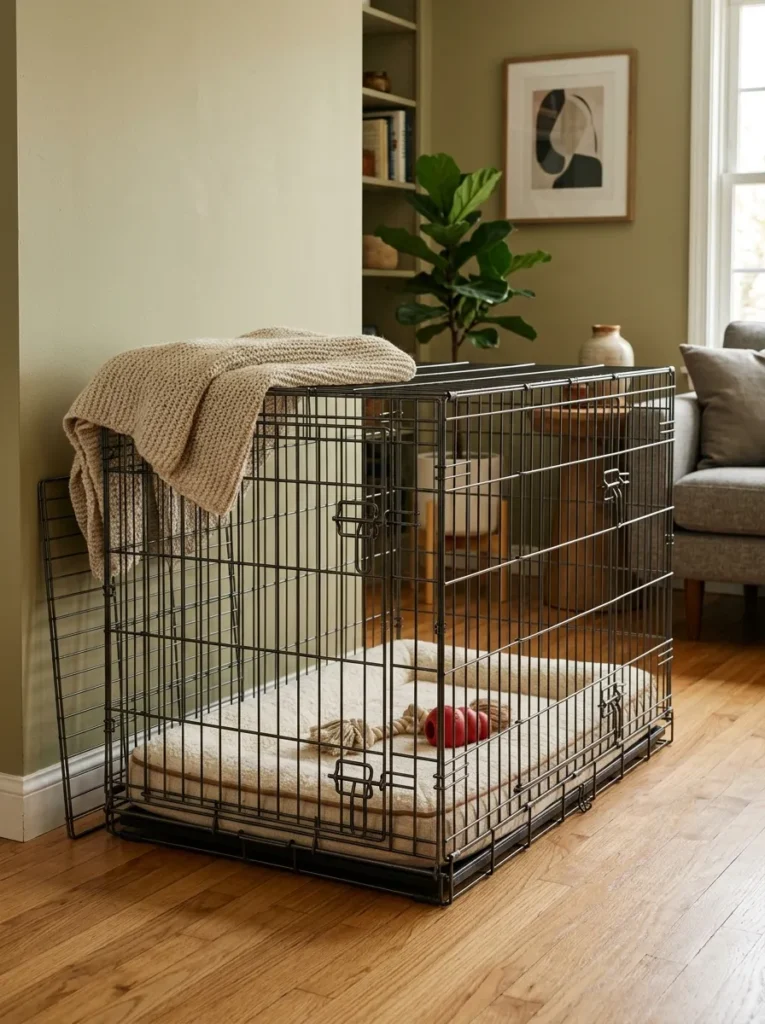
Vibe: A heavy-duty wire crate feels solidly reliable — the functional foundation that keeps a large dog safely contained while giving it maximum ventilation and visual connection to the household.
Why it works: The heavy-gauge wire crate is the most versatile extra large crate available because it combines maximum ventilation (critical for large, warm-running dogs), visual connection to the household (wire panels allow the dog to see its environment, reducing isolation anxiety), and portability (it folds flat for storage or travel). The design principle is maximum functionality with minimal aesthetic compromise: a dark charcoal wire crate in a thoughtfully placed position — with a quality mat inside and a throw blanket draped over the top two-thirds — reads as purposeful and considered rather than industrial or institutional. The divider panel is a specific functional virtue for puppies or dogs being introduced to crating — it reduces the crate to the appropriate den size and expands as the dog grows.
How to get it: Choose a crate with wire gauge rated at 12 gauge or heavier for extra large breeds — lighter gauge wire bends under the stress of a large dog pressing against it. Look for reinforced corner welds and a double-latch system on all doors. Position with the back and sides against walls (this reduces the dog’s visual stimulation and creates the three-enclosed-sides quality of a natural den). Drape a throw blanket over the top, back, and sides — leaving the front door area open for ventilation — to increase the den quality. Place a high-density orthopedic foam mat inside rather than a thin flat pad.
Quick Win: Draping a blanket over the top and sides of a wire crate transforms the dog’s experience of the space from a wire pen to a den — this single free modification is the most impactful crate improvement available and can be done with any blanket already in the house.
Shop The Look
| Product |
|---|
| Heavy duty wire dog crate 48 inch XL |
| Orthopedic memory foam dog crate mat XL |
| Double latch crate door replacement set |
| Heavy wool throw blanket for crate covering |
| Crate divider panel heavy duty extra large |
Also view: 15 Modern Small Dog Houses for Indoor and Outdoor Use
2. Furniture-Style Wooden Dog Crate as Side Table
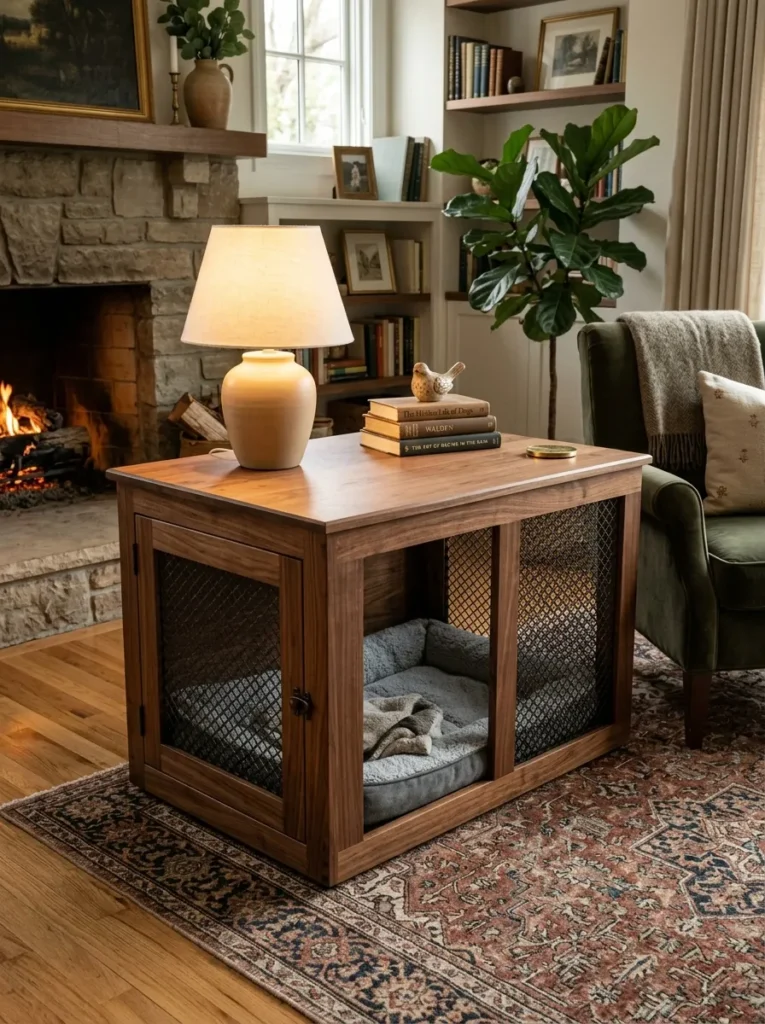
Vibe: A furniture-style wooden crate feels deliberately designed — the dog crate that a house guest notices as a piece of furniture before they notice it’s a crate.
Why it works: The furniture-style wooden dog crate resolves the primary aesthetic challenge of large dog crate ownership — it converts the crate from a visible functional intrusion into the home’s interior into a furniture piece that contributes positively to the room’s design. The design principle is dual function as visual integration: a wooden crate at the correct height (45–50 cm top surface) functions as a genuine side table or end table, which earns its placement in a primary living space through furniture function rather than merely tolerating it as a necessary utility. The warm wood tone bridges the crate’s functional nature and the home’s material palette more effectively than any metal or plastic crate can.
How to get it: Furniture-style dog crates in extra large sizes are available from specialist pet furniture companies (Merry Products, Ecoflex, Crown Pet Products) and increasingly from mainstream furniture retailers. For a 48-inch extra large version, expect to pay $250–$600 depending on material quality. The critical functional requirement is ventilation — ensure the door panel and any side panels provide adequate airflow for a large dog in warm conditions. The top surface must be properly load-bearing — do not place heavy objects on furniture crates whose top is not structurally designed for table load.
Shop The Look
| Product |
|---|
| Wooden furniture dog crate 48 inch XL |
| Orthopedic mat for wooden crate |
| Small table lamp for crate top styling |
| Decorative object set for crate top |
| Wood furniture polish for crate maintenance |
3. Heavy-Duty Escape-Proof Crate for Anxious Dogs
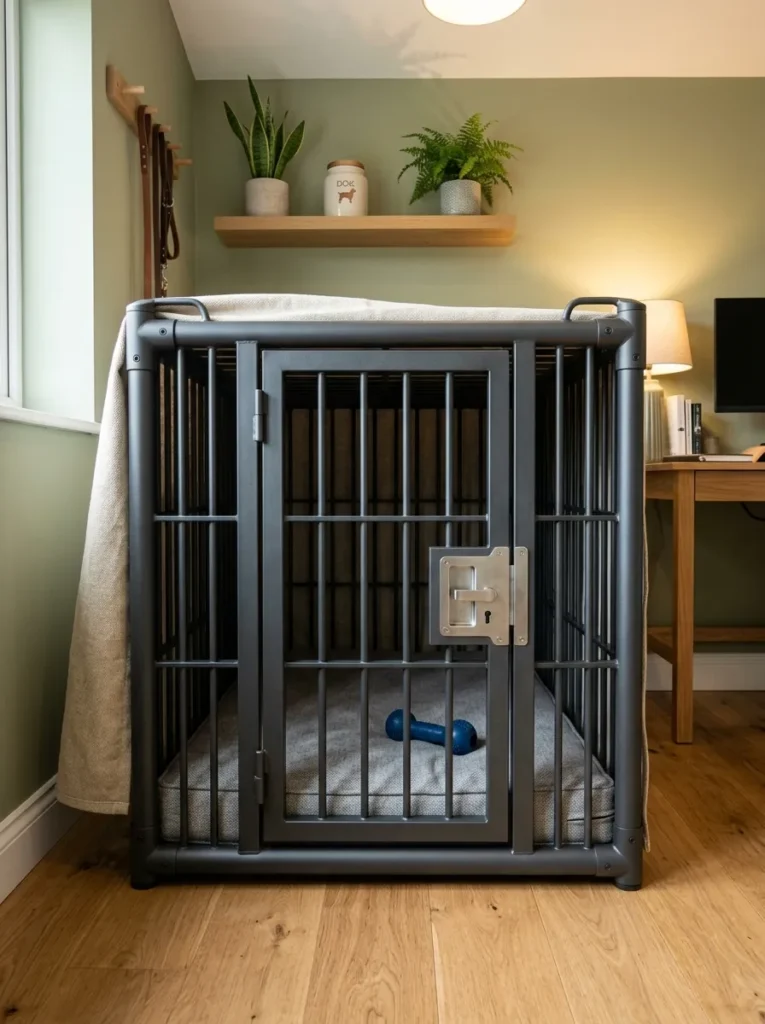
Vibe: A heavy-duty escape-proof crate feels seriously considered — the crate that communicates genuine understanding of what a large, anxious dog is capable of.
Why it works: A standard wire crate is not appropriate for dogs with separation anxiety, escape history, or high stress during confinement — these dogs can and do bend wire panels, force latches, and injure themselves in the process of escape attempts. A heavy-duty crate with tubular steel construction, solid rod panels (rather than wire mesh), and a multi-point locking system provides the containment security that prevents both escape and the injury risk associated with escape attempts. The design principle is appropriate engineering for the specific dog’s behavioral profile: matching the crate’s structural specification to the dog’s actual behavioral characteristics is as important as matching the crate’s size to the dog’s physical dimensions.
How to get it: Heavy-duty escape-proof crates are produced by specialist manufacturers — Impact Dog Crates, ProSelect Empire, and Gunner Kennels are the most widely recommended brands for dogs with serious containment requirements. These crates cost $300–$700 and significantly outperform standard wire crates for anxious or escape-prone dogs in both structural integrity and psychological security. Pair with appropriate behavioral support — an escape-proof crate alone does not address the separation anxiety that drives escape behavior; veterinary behavioral consultation and positive crate training are essential complements to any containment solution.
Shop The Look
| Product |
|---|
| Heavy duty escape proof crate XL impact |
| Anxiety calming dog crate cover |
| High density orthopedic crate pad XL |
| Calming dog spray lavender for crate |
| Multi-point crate lock additional security |
4. Rattan or Wicker-Look Dog Crate for Bohemian Interiors
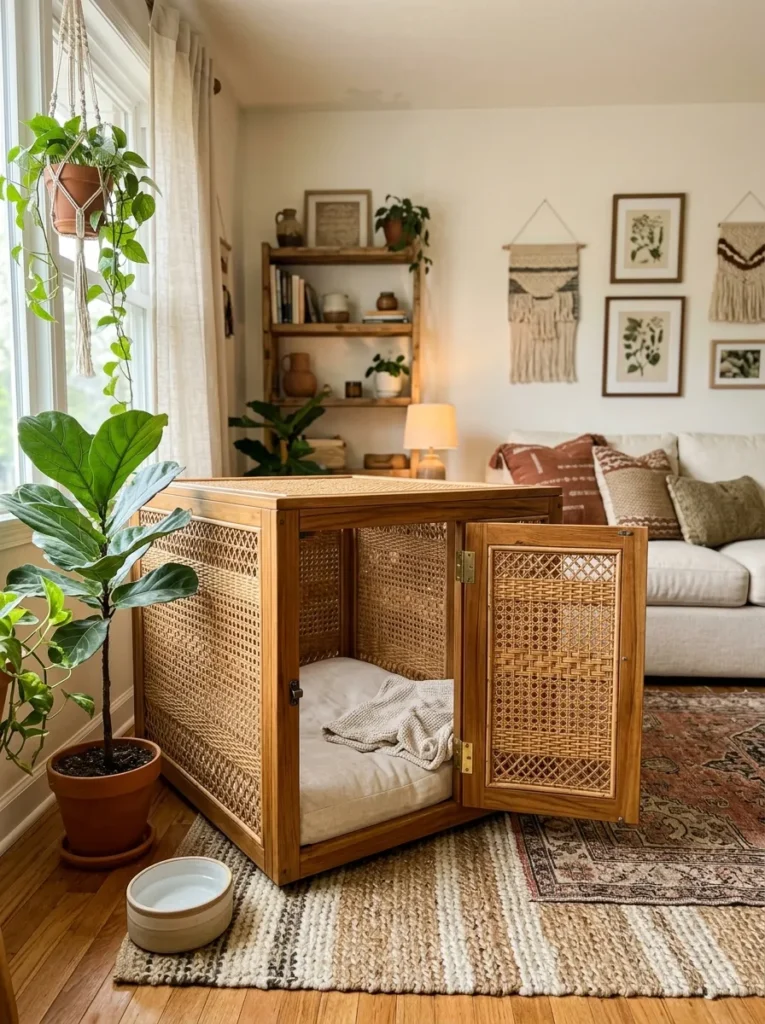
Vibe: A rattan-look dog crate in a bohemian interior feels seamlessly placed — the crate that disappears into the room’s natural material palette rather than announcing its function.
Why it works: A rattan or natural-material-finish dog crate in an interior that uses rattan, wicker, and natural fiber materials throughout achieves the most complete visual integration available to any dog crate — it becomes indistinguishable from the room’s other furniture materials at a glance. The design principle is material continuity as visual integration: when the crate’s surface material matches the room’s dominant natural material palette, the functional difference between the crate and the room’s non-functional furniture is minimized, and the crate reads as belonging rather than intruding. This integration is more important for the room’s atmosphere than any amount of styling around a crate that is fundamentally material-mismatched with its setting.
How to get it: Genuine rattan dog crates in extra large sizes are relatively rare and typically expensive ($400–$800). More accessible are crates with rattan-pattern molded resin panels or wooden frames with rattan-look inserts — these provide the aesthetic integration at more accessible price points ($150–$350). Verify ventilation adequacy before purchasing any decorative-panel crate — rattan-look patterns with small openings may not provide adequate airflow for a large dog, particularly in warm climates. Position in a location with natural air circulation.
Shop The Look
| Product |
|---|
| Rattan look dog crate large decorative |
| Natural woven cushion for rattan crate |
| Trailing plant for crate side styling |
| Woven jute rug for in front of crate |
| Rattan accent furniture set for room |
5. Under-Stair Dog Crate Integration
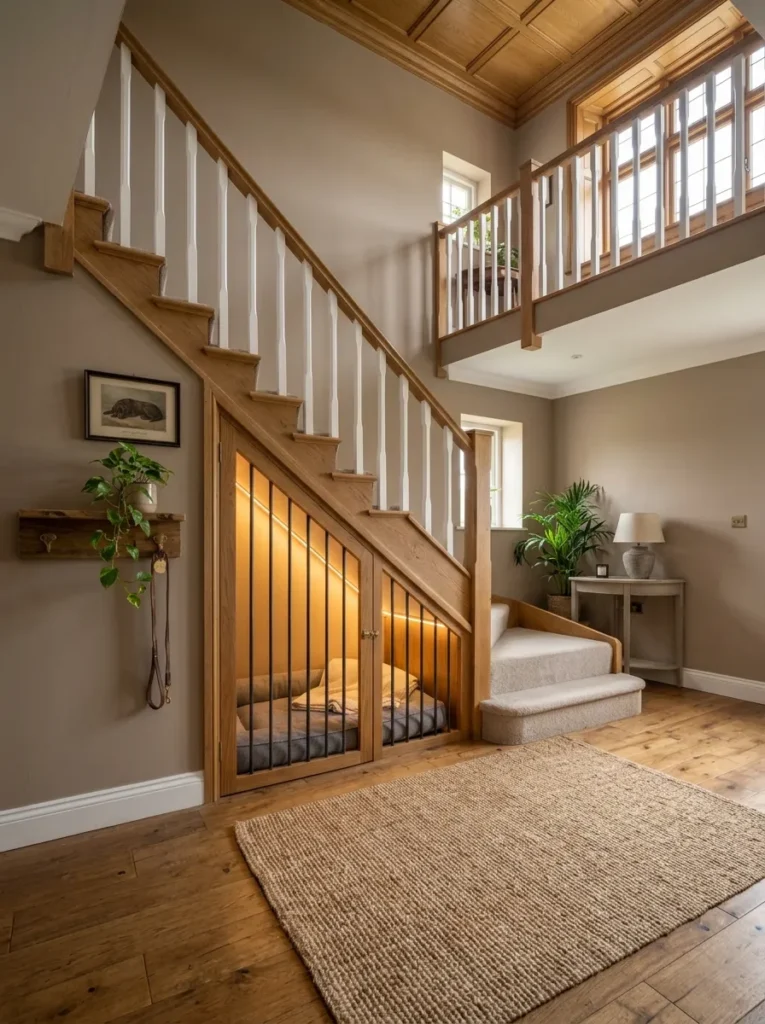
Vibe: An under-stair dog den feels architecturally intentional — the space that looks like it was always meant to be a dog’s personal room.
Why it works: Converting the under-stair space into a permanent built-in dog den is the most architecturally integrated crate solution available in any home with a staircase — it uses a space that is frequently underutilized, provides three enclosed walls and a ceiling naturally (the maximum den-quality enclosure), and creates a designated dog space that reads as architecturally designed rather than functionally accommodated. The design principle is existing architectural space activation as designed functional space: the under-stair void already has three solid walls and a sloped ceiling, making it the natural den space in any home that has one — adding a simple barred or mesh door on the open face is the only construction required to complete the crate.
How to get it: Measure the under-stair space carefully — most standard under-stair spaces accommodate a large dog den but not all will comfortably fit an extra large breed. The critical measurement is ceiling height at the deepest point — if your dog is 28 inches at the shoulder, you need a ceiling height of at least 34 inches at the point where the dog will stand. Install a simple wooden bar door (horizontal or vertical bars spaced at maximum 4 inches to prevent large dog head entrapment) on a frame set in the open face. Line the interior with a foam-filled, washable mat. Install warm LED strip lighting (2700K) for ambient illumination of the den space.
Shop The Look
| Product |
|---|
| Custom bar door insert for under stair |
| LED strip warm 2700K for den interior |
| Orthopedic foam mat cut to measure |
| Decorative hook for lead storage |
| Dog name sign for den entrance |
6. Crate as Room Divider in Open-Plan Spaces
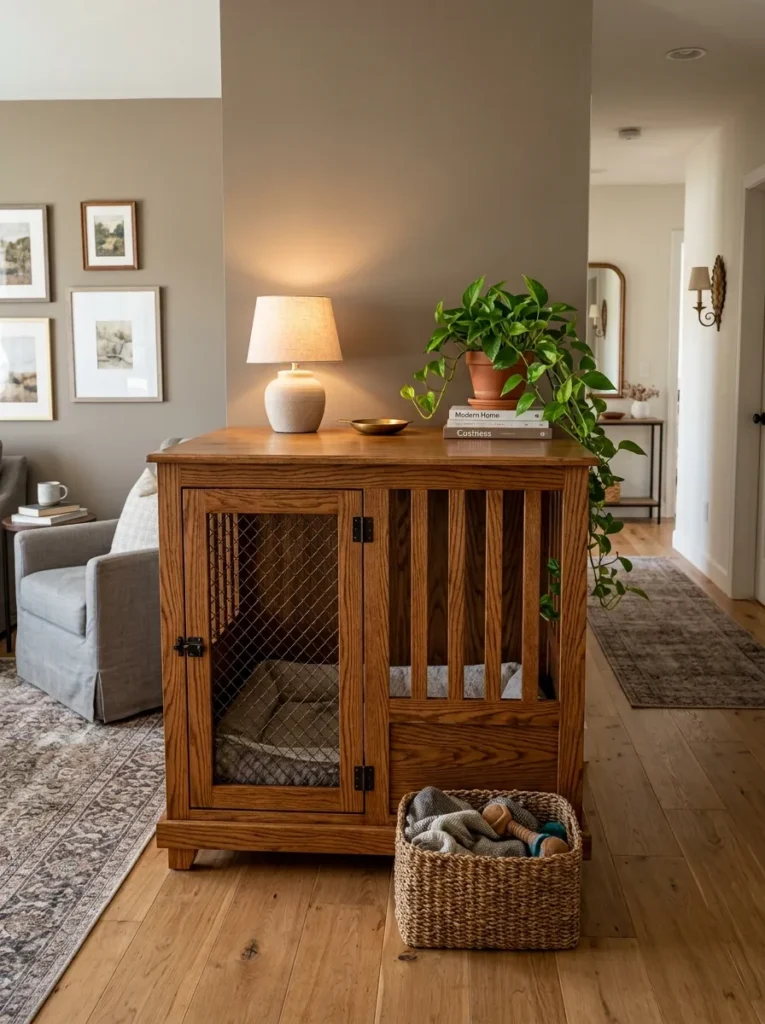
Vibe: A crate-as-divider placement feels spatially considered — the functional object that earns its position by doing two jobs simultaneously.
Why it works: Positioning a furniture-style dog crate perpendicular to the wall in an open-plan space creates a partial room division that defines two distinct zones while accommodating the crate’s functional requirements — the dog has access to the crate from the living space side while the crate’s back panel provides a partial visual division between the living zone and the adjacent space. The design principle is multi-function furniture placement as spatial design: a large dog crate at 48 inches long and 30 inches deep has the visual mass of a credenza or sideboard — placing it to serve a spatial organization function as well as a dog welfare function extracts maximum value from the space the crate occupies regardless.
How to get it: This placement works best with furniture-style wooden crates whose all four sides present a finished, attractive appearance rather than the functional-only appearance of wire or metal crates. The crate’s orientation — door facing the primary living space — ensures the dog can enter and exit into the social area of the home rather than into a transitional or secondary space. The top surface of the crate, now functioning as a shelf or surface in the room division, should be styled with objects of appropriate weight and stability.
Shop The Look
| Product |
|---|
| Furniture crate large wooden room divider |
| Ceramic table lamp for crate top |
| Trailing plant floor pot for crate beside |
| Decorative basket for base of crate |
| Orthopedic mat for crate interior |
7. Outdoor-Rated Crate for Covered Porch or Garage
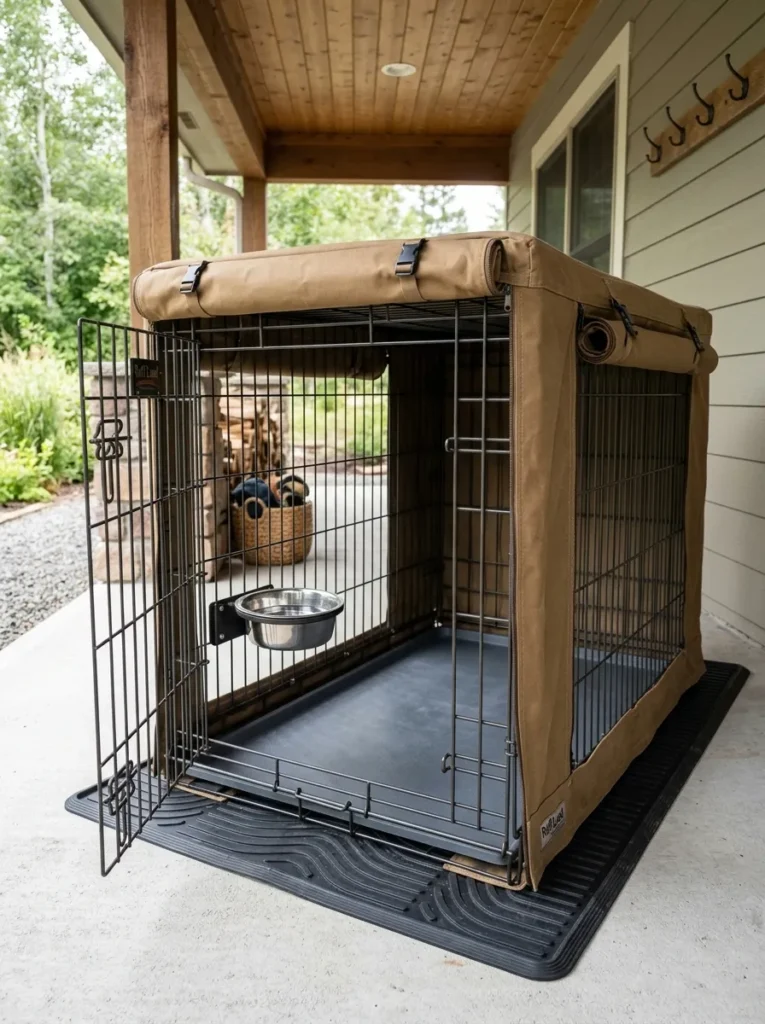
Vibe: An outdoor-rated crate setup feels practically considered — the solution for a large dog’s outdoor time that doesn’t treat the porch as an afterthought.
Why it works: A dog crate on a covered porch or in a garage serves a specific purpose distinct from indoor crating — it provides secure outdoor containment for a large dog during periods when supervised outdoor access isn’t possible, while keeping the dog in a familiar den-type space with weather protection. The design principle is environmental appropriate specification: an outdoor-positioned crate requires specific adaptations from its indoor equivalent — weatherproof cover for rain protection, rubber drainage mat for moisture management, secure water bowl mounting for independent access, and a crate material specification (heavy-gauge wire or steel, powder-coated for corrosion resistance) appropriate to outdoor humidity and temperature variation.
How to get it: Any heavy-duty wire crate can be positioned outdoors on a covered porch or in a garage provided it is protected from direct rain (a weatherproof crate cover provides this) and from direct sun exposure in warm climates (shade is critical — a dog confined in a crate in direct sun is at serious heat stress risk). Add a rubber-matted floor beneath the crate for drainage and underfoot comfort. Mount a stainless steel water bowl on the interior of the crate door using a bowl mount bracket — this ensures the dog always has water access without the bowl being knocked over inside the crate.
Shop The Look
| Product |
|---|
| Waterproof dog crate cover XL outdoor |
| Rubber drainage mat for outdoor crate |
| Stainless water bowl door mount crate |
| Heavy gauge wire crate outdoor rated |
| Weatherproof orthopedic crate pad |
8. Crate with Built-In Feeding Station Integration
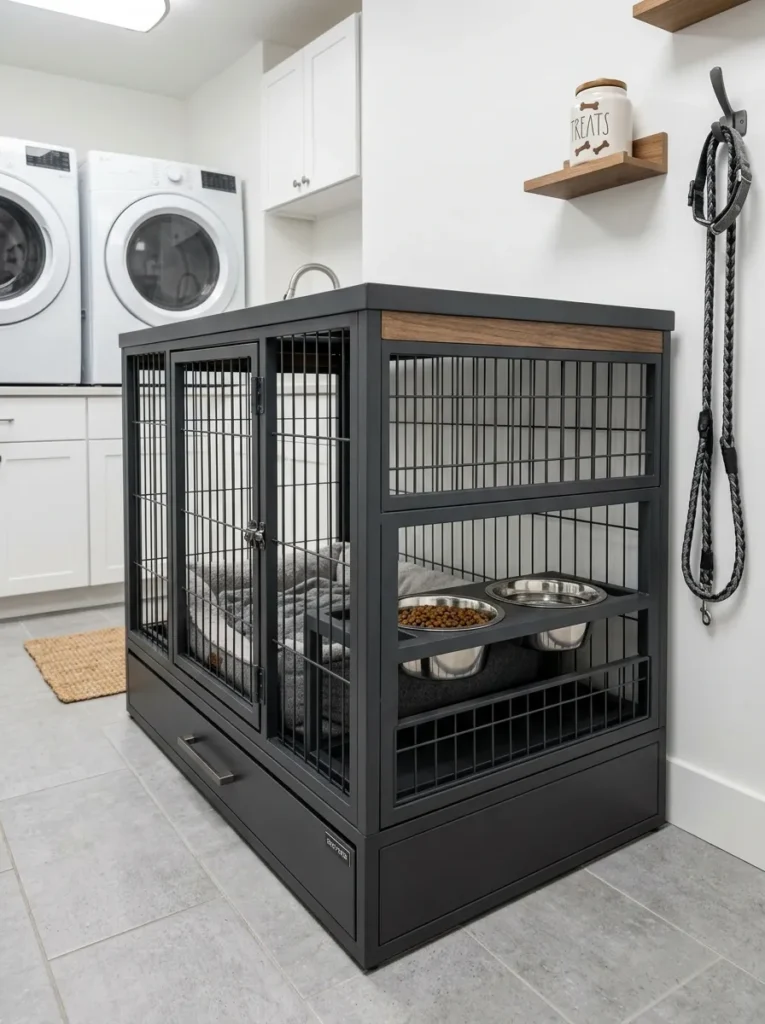
Vibe: A crate with integrated feeding station feels systemically organized — the dog care setup that contains the full feeding and resting routine in one thoughtfully designed zone.
Why it works: Integrating a feeding station into or beside the crate creates a defined dog care zone that contains the dog’s primary daily activities (feeding, resting, confinement) in a single organized location — reducing the footprint of dog care infrastructure in the home and making the daily routine more efficient for the owner and the dog. The design principle is zone consolidation as operational efficiency: when the crate, the feeding bowls, and the food storage are all in the same location, the feeding routine requires less movement, generates less mess across the home, and creates a cleaner organization of dog care within the home’s overall layout.
How to get it: Some furniture-style crates include integrated feeding station features — bowl mounts, food storage drawers, and raised feeder platforms. These are available from specialist pet furniture manufacturers. Alternatively, a simple wire crate can be paired with a separate raised feeder positioned immediately beside the crate door — creating the functional zone without the requirement for a specialized integrated product. Position the feeding area so spilled water and food fall onto a wipeable rubber mat or tile floor section rather than carpet.
Shop The Look
| Product |
|---|
| Dog crate with feeding station integrated |
| Raised feeder station large dog |
| Stainless steel bowl set large dog |
| Food storage container airtight large |
| Rubber mat for under feeding station |
9. Soft-Sided Crate for Travel and Guest Rooms
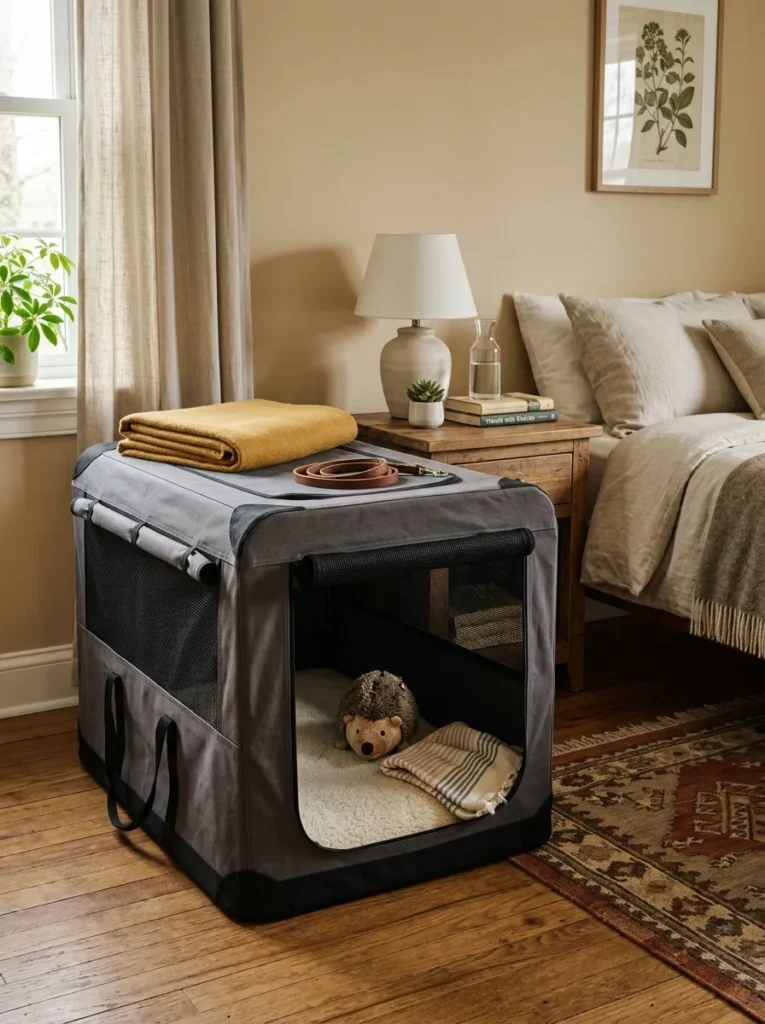
Vibe: A soft-sided travel crate set up in a guest room feels thoughtfully accommodating — the acknowledgment that a large dog’s familiar den space is as important as its familiar food.
Why it works: A soft-sided crate serves a specific situation that rigid crates cannot match — travel, temporary accommodation in guest rooms, and situations where the crate must be set up and taken down repeatedly. Its design principle is familiar den space in unfamiliar environments: a dog that is well-established with its crate at home will transfer the crate’s positive associations to a soft-sided travel version of similar dimensions, which makes the travel crate a portable piece of the dog’s home environment rather than an unfamiliar new confinement space. The soft-sided crate is not appropriate for dogs who chew, escape-attempt, or are not fully crate-trained — it provides no structural resistance to these behaviors.
How to get it: Quality soft-sided crates for extra large dogs are available from Midwest Homes, EliteField, and similar manufacturers. Look for reinforced steel tube framing (rather than plastic), heavy-duty canvas exterior, and mesh panels on at least three sides for ventilation. The mat inside should be the dog’s familiar home crate mat — bringing the familiar scented mat significantly improves the dog’s acceptance of the temporary crate setup. Set up in a quiet guest room or corner rather than in a high-traffic or noisy location.
Shop The Look
| Product |
|---|
| Soft sided crate XL canvas travel |
| Orthopedic travel mat familiar scented |
| Crate fan small clip for warm travel |
| Familiar toy for travel crate |
| Crate carry bag for transport |
10. Crate with Personalized Interior Design — Dog’s Own Space
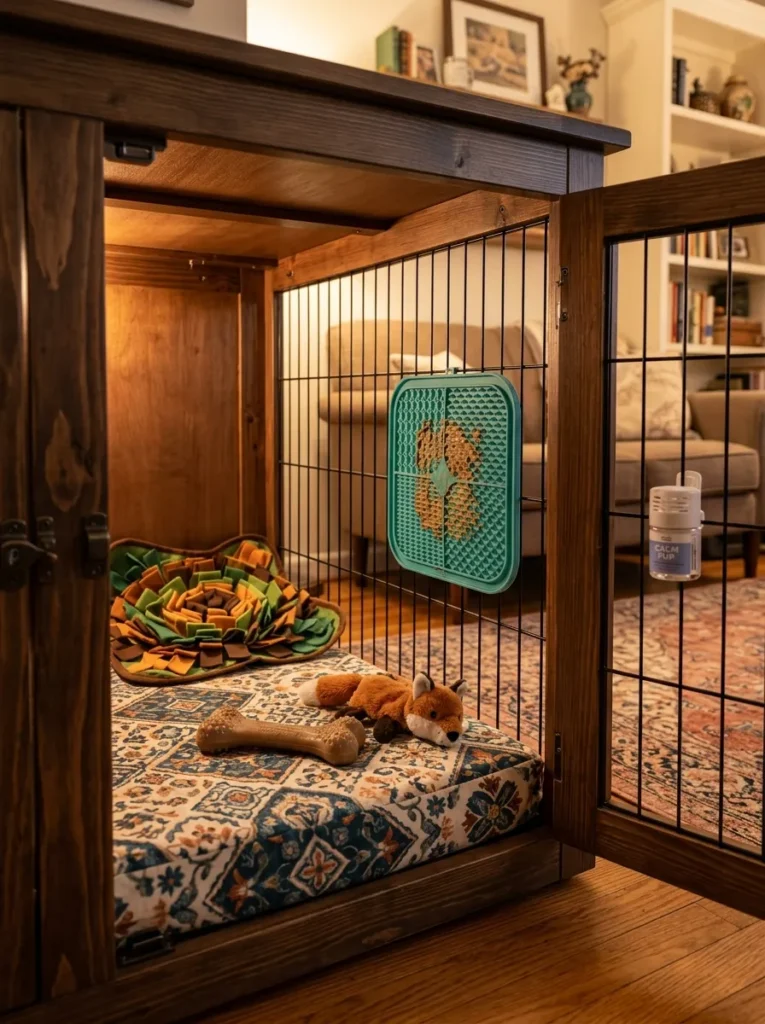
Vibe: A personalized dog crate interior feels genuinely considered — the crate setup that demonstrates the owner understands the crate is the dog’s space, not a storage unit for the dog.
Why it works: The interior of a dog crate is as important as its exterior design and placement — a crate that contains only a thin mat and nothing else serves the dog’s minimum containment need but none of its enrichment, comfort, or behavioral support needs during crate time. The design principle is interior design for species-appropriate needs: a quality orthopedic mat for joint comfort, a lick mat for self-calming stimulation during the first period of crate occupancy, a snuffle mat for nose work enrichment during longer periods, a familiar-scented toy for comfort, and a calming diffuser for dogs with anxiety responses together create a crate interior that serves the dog’s wellbeing throughout its time in the crate rather than simply containing it.
How to get it: Build the crate interior in layers: quality orthopedic foam base mat first (memory foam minimum 3 inches thickness for large breeds — their joints carry significant weight and benefit from genuine cushioning), a fitted washable cover over the mat, a lick mat with a frozen treat fixed to the side panel using suction cups or a clip mount, a small snuffle mat in the corner for nose work stimulation, and a familiar toy (the dog’s chosen comfort toy, not a new one). A DAP (dog-appeasing pheromone) diffuser clipped to the door exterior provides passive calming support for anxious dogs.
Shop The Look
| Product |
|---|
| Orthopedic memory foam crate mat XL 3 inch |
| Fitted washable mat cover large |
| Lick mat with suction mount for crate |
| Snuffle mat small for crate corner |
| DAP calming diffuser clip for crate |
11. Double-Crate Side-by-Side for Multi-Dog Households
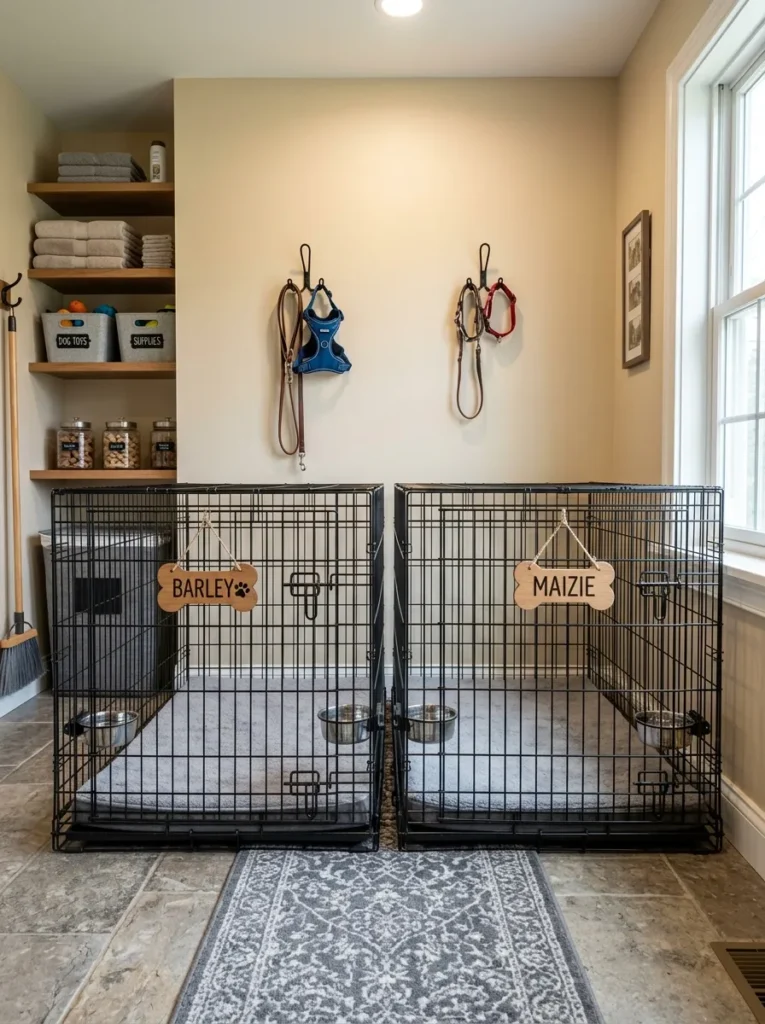
Vibe: A side-by-side double crate setup feels logically organized — the multi-dog household solution that gives each dog its own space while maintaining the social proximity large dogs consistently prefer.
Why it works: Dogs in multi-dog households benefit from individual crate spaces — each dog has its own den, its own mat, and its own door — while the side-by-side configuration allows the dogs to smell and see each other through the shared panel, which reduces isolation stress that a completely separate crating arrangement would create. The design principle is individual space with maintained social proximity: many large dogs in multi-dog households experience more stress when crated in complete visual and olfactory isolation from their companion dogs than they do when crated individually within sensory range. The side-by-side configuration meets both the individual den requirement and the social proximity preference simultaneously.
How to get it: Choose matching crates — identical wire gauge, identical door position — and position them with their long sides adjacent. The shared center panel should have wire spacing that allows nose-to-nose contact without the possibility of jaw entrapment or sustained fence-fighting behavior between the dogs. If the dogs have any history of redirected frustration or barrier reactivity toward each other, a solid divider between the crates rather than the shared wire panel eliminates the stimulus while maintaining olfactory proximity. Personalize each crate with the individual dog’s name tag on the door.
Shop The Look
| Product |
|---|
| Heavy duty wire crate 48 inch XL pair |
| Individual orthopedic mat set for pair |
| Dog name tag set personalized for doors |
| Solid crate divider panel between crates |
| Leash hook wall mount above crates |
12. Crate Placement in the Bedroom — Overnight Den
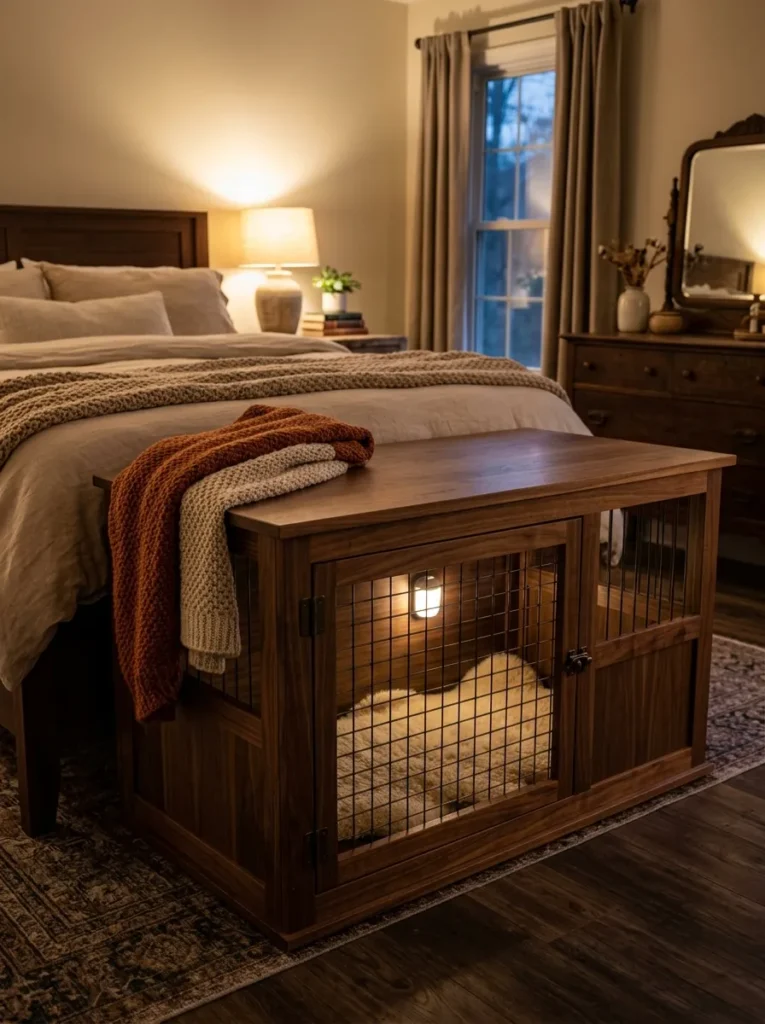
Vibe: A bedroom-placed crate at the foot of the bed feels pack-appropriate — the sleeping arrangement that acknowledges a large dog’s need for proximity to its people even during rest.
Why it works: Many large dogs experience significantly reduced overnight anxiety when crated in the same room as their owners rather than in a separate room — the olfactory proximity and the auditory presence of the sleeping owner provides the social security that reduces the separation-related distress that overnight crating in a separate room can create. The design principle is social proximity during rest as welfare provision: dogs are social sleepers by nature, and a crate placed within the bedroom maintains the social quality of the sleeping arrangement while providing the individual den space that crate training establishes. A furniture-style wooden crate at the foot of the bed reads as a bedroom piece rather than an intrusion.
How to get it: Position a furniture-style wooden crate at the foot of the bed, oriented so the crate door opens toward the room rather than toward the bed — this allows the dog to exit and re-enter freely without disturbing the sleeper. The crate’s height should not exceed 50 cm if positioned at the foot of the bed to avoid blocking natural sightlines. A small warm-amber night light clipped to the interior of the crate (2700K, very low lux) provides minimal orientation light without disrupting canine or human sleep.
Shop The Look
| Product |
|---|
| Wooden furniture crate bedroom sized |
| Small amber night light clip crate |
| Orthopedic mat bedroom crate |
| Matching throw for crate top and bed |
| Bedroom crate cover for daytime |
13. Crate in the Kitchen or Mudroom — Practical Family Hub Placement
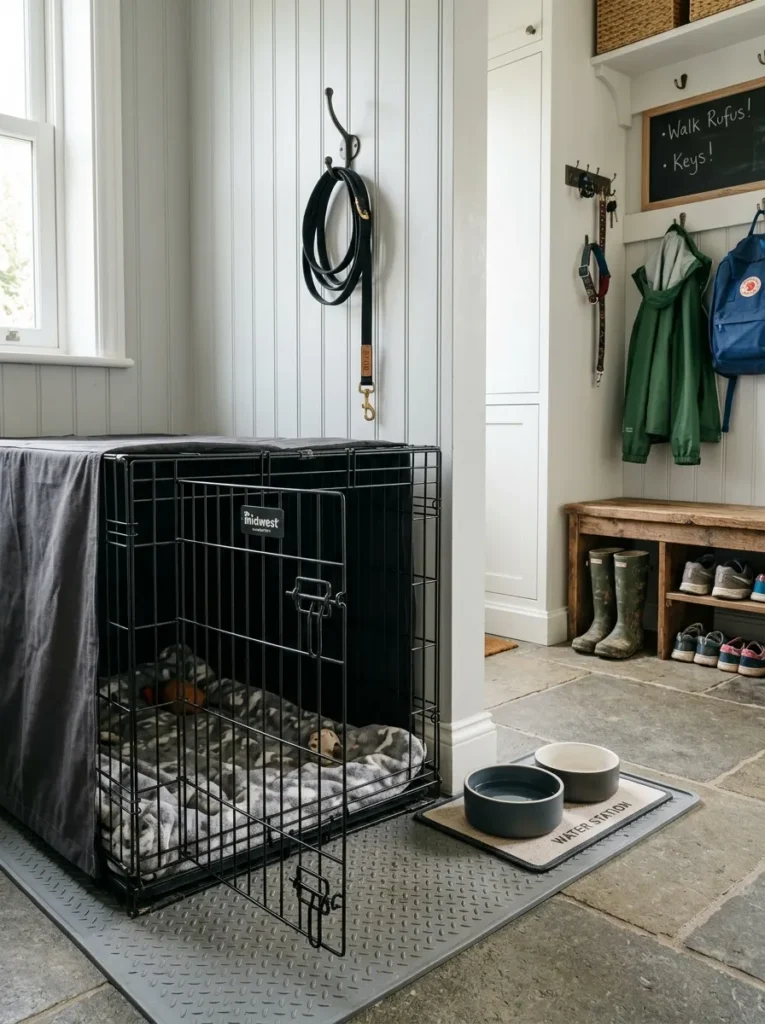
Vibe: A mudroom or kitchen crate placement feels pragmatically correct — the crate in the location where the dog is most naturally engaged with the household’s daily rhythm.
Why it works: The mudroom or kitchen is the home’s primary entry and exit zone — the location of the most significant daily activity (people coming and going, food preparation, family gathering) that a dog most benefits from being proximally engaged with. A crate in this zone keeps the dog connected to household activity rather than isolated from it, which is particularly valuable for dogs whose primary anxiety is separation from household activity rather than physical isolation. The design principle is high-activity proximity as welfare placement: a dog crated in the hub of family activity is socially included even while confined — it can hear, smell, and see the household’s activity, which is the social inclusion that reduces crate anxiety in many dogs.
How to get it: In a mudroom, position the crate in the corner opposite the door — this keeps it out of the primary traffic path while maintaining full engagement with the arrival and departure activities. Install a leash hook directly above the crate to create a complete dog management zone (crate, leash, water station in one location). A waterproof rubber mat below the crate manages mudroom moisture and dog-related mess. A partial crate cover on the back and sides provides den quality while keeping the front open toward the room activity.
Shop The Look
| Product |
|---|
| Waterproof rubber mat under crate mudroom |
| Leash hook wall mount above crate |
| Wire crate XL heavy duty mudroom |
| Water station mounted beside crate |
| Partial crate cover mudroom use |
14. Crate with Anxiety-Support Setup for New Dogs
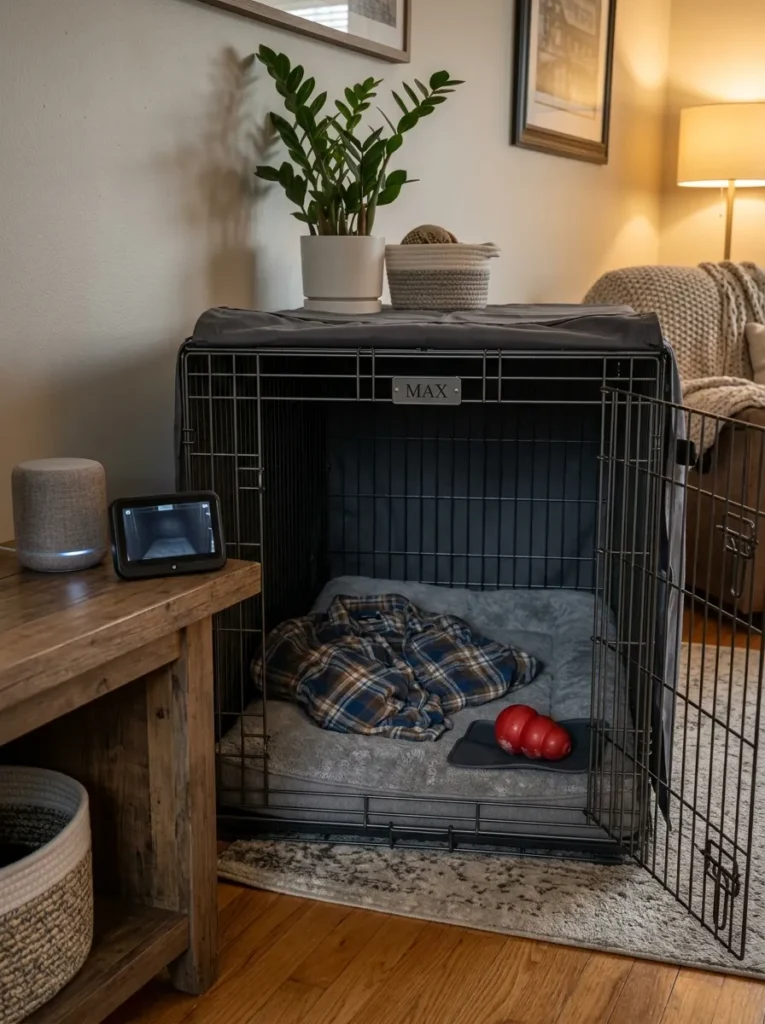
Vibe: An anxiety-support crate setup feels specifically caring — the setup that communicates genuine understanding of what a newly homed or anxious large dog actually needs in those first weeks.
Why it works: The anxiety-support crate setup addresses the specific welfare needs of newly adopted dogs, dogs transitioning to a new home, and dogs with established crate anxiety — a population for whom the standard crate introduction protocols may need supplementation with additional sensory and behavioral support. The design principle is multi-channel anxiety reduction as welfare intervention: calming music (specifically canine-targeted music at 50–60 beats per minute, researched to reduce canine heart rate), familiar human scent (a recently worn shirt), food-based positive association (a frozen Kong that takes 20–30 minutes to work through), and visual monitoring (a dog camera that allows the owner to observe and respond to distress signals) together address multiple sources of crate anxiety simultaneously.
How to get it: Place a recently worn shirt or other item carrying familiar human scent inside the crate — this is the highest-impact single addition for a newly homed dog and costs nothing. Prepare a Kong toy frozen the night before with a mixture of the dog’s regular food and high-value additions (peanut butter, canned pumpkin) — introduce this in the crate at the beginning of each crating session. Position a small Bluetooth speaker or purpose-built pet music player beside the crate playing calming canine music at low volume. Install a dog camera with two-way audio capability beside the crate for remote monitoring and reassurance.
Shop The Look
| Product |
|---|
| Kong toy large breed XL for freezing |
| Dog camera two-way audio monitor |
| Calming music player device dog |
| DAP dog appeasing pheromone diffuser |
| Familiar scent spray calming dog |
15. Small-Space Extra Large Crate Solution — Studio or Apartment Integration
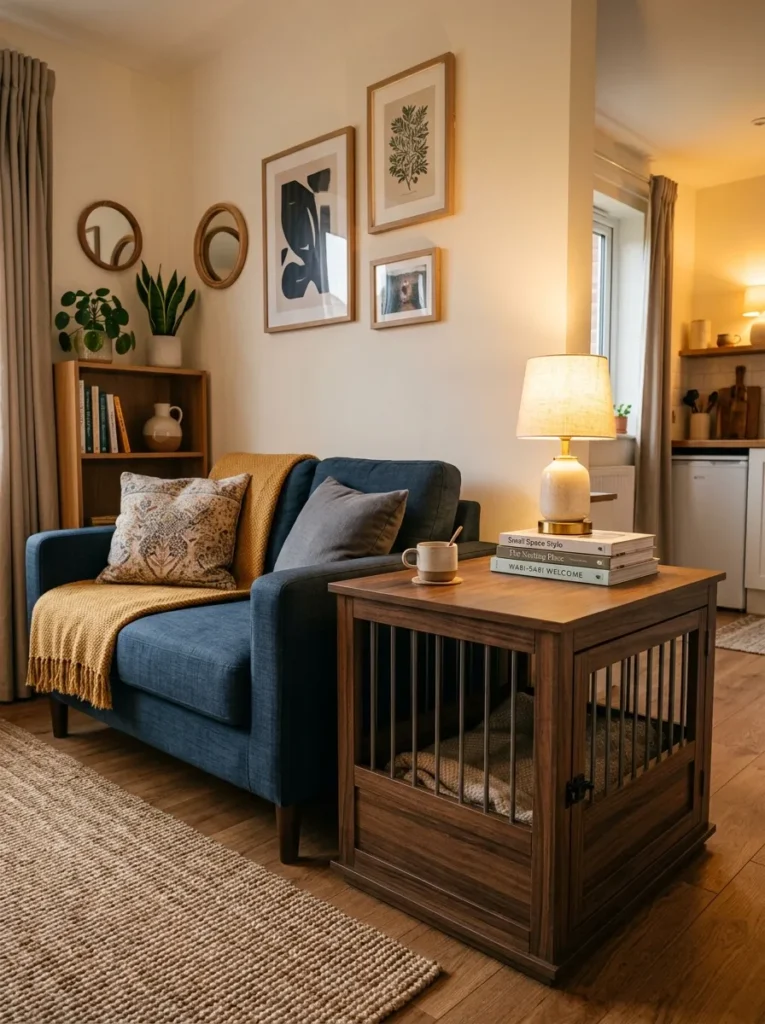
Vibe: A studio apartment large dog crate solution feels ingeniously economical — the space that houses a large dog and a functional living room in the same square footage without compromise.
Why it works: The small-space large dog crate challenge is the design problem that most acutely requires the furniture-function double use that the furniture-style crate provides — in a studio or compact apartment, every piece of furniture must earn its footprint through multiple functions, and a crate that occupies 48×30 inches of floor space while providing only a dog crate function is a significant footprint investment. A furniture-style crate that simultaneously functions as a side table, a visual space divider, and a dog crate provides three functions from one footprint — which is the spatial efficiency that small-space living requires. The design principle is maximal function per footprint unit as small-space constraint resolution.
How to get it: In a studio or small apartment, choose the highest quality furniture-style crate the budget allows — the visual integration of the crate into the living space is more important here than in a house with separate rooms, because the crate is always visible and always part of the primary living space. Position as the primary side table beside the main seating — this earns the crate its floor space through daily functional use (the lamp on top provides task lighting, the table surface holds drinks and books) while providing the dog its den in the most socially connected location of the apartment. The crate door should face away from the primary seating direction to allow the dog to enter and exit without visual interruption of the seating zone.
Shop The Look
| Product |
|---|
| Furniture style crate apartment XL |
| Slim table lamp for crate top apartment |
| Quality mat for apartment crate |
| Crate cover for aesthetic integration |
| Decorative book set for crate top |
How to Choose and Introduce Your Extra Large Dog Crate
The single most important decision in extra large dog crate selection is sizing — specifically, measuring your dog (length from nose to base of tail plus 10 cm; height from floor to top of head while standing plus 10 cm) and selecting a crate that exceeds these measurements rather than merely meeting them. The common error is selecting the smallest crate that technically fits — a dog that fits into a crate with 2 cm of clearance above its head is in a crate that is too small for comfortable occupation. The 48-inch crate commonly sold as “extra large” is appropriate for dogs up to approximately 90 lbs and 28 inches at the shoulder; larger breeds require 54-inch or 60-inch options.
The most consequential mistake in crate use is introducing the crate through coercion — placing the dog inside and closing the door before positive crate association has been established. This single mistake is responsible for the majority of negative crate associations in dogs and the majority of anxiety behaviors that owners subsequently attribute to the crate itself. The correct introduction sequence is: door open crate as feeding location (3–5 days), door closed briefly with dog willingly entering (5–7 days), gradually increasing duration with positive association (1–2 weeks). The total time investment in correct introduction is 2–3 weeks; the return is a dog that chooses the crate voluntarily and uses it as a genuine resting refuge throughout its life.
Three crate setup investments that most improve the dog’s crate experience: a quality orthopedic memory foam mat (joint comfort during rest directly affects how willingly a large dog returns to the crate — a thin flat pad produces the same surface quality as lying on the floor, which provides no incentive to choose the crate), a frozen Kong or similar long-duration food puzzle introduced at the beginning of every crating session (food association training is the most powerful positive crate reinforcement available and takes less than five minutes to prepare), and a partial crate cover that creates three-sided den enclosure quality from any wire or open-sided crate (the den quality — enclosed on three sides, open at the front — is what dogs evolved to seek and what makes a correctly covered crate significantly more attractive to a dog than an uncovered equivalent).
Realistic expectations for extra large dog crates: an extra large dog crate appropriate for a German Shepherd-sized dog costs $80–$200 for a quality wire crate, $250–$600 for a furniture-style wooden crate, and $300–$700 for a heavy-duty escape-proof crate. Annual maintenance includes mat replacement (quality orthopedic mats last 2–3 years with regular washing), latch inspection and replacement as needed, and structural inspection for any signs of wire fatigue or frame compromise. A quality crate used with appropriate introduction will last 8–12 years and will be used voluntarily by the dog throughout — the crate introduced poorly will be resisted throughout its life regardless of its quality.
Frequently Asked Questions About Extra Large Dog Crates
What size crate do I need for a German Shepherd, Golden Retriever, or Labrador?
The 48-inch crate is the appropriate size for most German Shepherds (24–26 inches at shoulder, 50–90 lbs), Golden Retrievers (21–24 inches, 55–75 lbs), and Labrador Retrievers (21–25 inches, 55–80 lbs). Male dogs at the upper end of these breed ranges benefit from the 54-inch option. The correct measurement method is: measure the dog from nose tip to base of tail (not to tip of tail) and add 10 cm for the minimum crate length; measure the dog from floor to the top of the head while standing naturally and add 10 cm for the minimum crate height. If these measurements exceed 48 inches in length or 30 inches in height, size up.
How do I crate train an extra large adult dog that has never been crated?
Adult dog crate introduction follows the same positive association sequence as puppy introduction but may require more time at each stage. Begin with the crate in the dog’s primary social space with the door permanently open — feed all meals inside the crate, place high-value treats inside periodically, and allow the dog to investigate and enter voluntarily without any pressure. When the dog is consistently entering and exiting voluntarily, begin closing the door briefly (10–30 seconds) while the dog is focused on a Kong or high-value chew inside. Gradually increase the closed-door duration over days to weeks, never progressing faster than the dog’s comfort level allows. Adult dogs that have positive experiences in the crate during the introduction period frequently develop strong crate preferences within 4–6 weeks.
Is it humane to crate a large dog while at work?
The welfare answer depends entirely on duration and the individual dog’s response to crating. Veterinary behavioral organizations generally consider 4 hours the maximum comfortable crating duration for adult dogs, with a mid-day break essential for crating periods approaching 8 hours. Dogs with separation anxiety, arthritis, or other health conditions may have lower comfortable crating durations. A dog that is correctly crate-trained and willingly enters and rests in the crate for the required duration, with appropriate enrichment inside (frozen Kong, snuffle mat) and a mid-day break from a dog walker or neighbor, is in a welfare-appropriate situation. A dog showing distress indicators during crating (vocalization, self-injury, elimination in the crate) is not in an appropriate crating situation regardless of the crate’s quality.
What is the difference between a heavy-duty crate and a standard wire crate?
A standard wire crate uses relatively thin gauge wire (typically 16–18 gauge) welded into panels and connected by lightweight plastic or thin metal corner pieces — appropriate for calm dogs with no escape history and no significant separation anxiety. A heavy-duty crate uses substantially thicker materials: 12-gauge or heavier steel rods or tubes for the panel construction, reinforced corner connectors with multiple fastening points, multi-point locking systems on doors, and overall structural engineering that resists the leverage and impact forces a large, powerful, escape-motivated dog can generate. The difference matters for dogs that have bent wire crates, forced latches, or injured themselves in escape attempts — for these dogs, only a heavy-duty crate provides appropriate containment and eliminates the injury risk associated with escape attempts against inadequate crates.
Should I leave water in my dog’s crate?
For most adult dogs in standard crating sessions under 4 hours, water in the crate is not required provided the dog has had access to water immediately before crating. For longer crating sessions, a mounted water bowl or no-spill water bottle attached to the crate door provides hydration without the spillage that bowls placed on the mat invariably produce — a wet mat creates discomfort and can lead to the dog eliminating in the crate to avoid lying in wet bedding. For puppies, sick dogs, dogs on certain medications, and dogs in warm environments, water should be available during crating regardless of duration. A mounted stainless steel bowl attached to the crate door is the most practical solution — it cannot be knocked over, can be filled from outside the crate without opening the door, and is easily removed for cleaning.
Ready to Find the Right Crate for Your Large Dog?
These 15 extra large dog crate ideas span every home style, every budget, every dog behavioral profile, and every spatial constraint — from the heavy-duty escape-proof crate for anxious dogs and the furniture-style wooden crate for aesthetic integration to the under-stair built-in den, the multi-dog side-by-side setup, and the studio apartment double-function solution. The most important thing to understand about any extra large dog crate is that the crate itself is only as good as its introduction — the most beautiful, most structurally appropriate, most perfectly sized crate will fail the dog it’s intended for if it is introduced through coercion rather than positive association. Today, if your large dog doesn’t yet have a crate, place a blanket in a box in the corner of your living room, put a treat inside, and leave the flap open — watch what happens within the first hour. That instinctive investigation of an enclosed, den-quality space is what the right crate will harness. Share these ideas with any large dog owner you know who is considering a crate for the first time, and let the dog’s welfare be the first thing that gets decided right.