Handmade hamster toys are safe, species-appropriate enrichment objects crafted from non-toxic materials that support a hamster’s natural behaviors — foraging, chewing, climbing, exploring, and problem-solving — providing the cognitive and physical stimulation that commercial hamster toys rarely deliver at the correct scale, safety standard, or behavioral specificity. Here are 14 ideas for making toys that genuinely enrich a hamster’s daily life rather than simply occupying space in the enclosure.
A hamster’s toys are not decorations. They are behavioral tools — objects that activate specific natural behaviors, provide cognitive challenge, support dental health through chewing, and reduce the boredom and frustration that an under-stimulated captive hamster expresses through stereotypic behavior. The toys that work are not the ones that look most appealing to humans. They are the ones that a hamster investigates, chews, solves, hides inside, or forages through at 2am when its behavioral repertoire is fully expressed. Here are 14 ideas worth making — for the hamster’s benefit first.
Why Handmade Hamster Toys Matter for Welfare
What separates a genuinely enriching hamster toy from a commercially sold one? Commercial hamster toys are designed for human buyers — they are sized, colored, and shaped for visual appeal to the person standing in the pet store aisle rather than for behavioral relevance to the hamster. This produces toys that are consistently too small for safe use by Syrian hamsters, made from potentially toxic painted plastics, and designed around a misunderstanding of hamster behavior (hamsters do not naturally run on wheels placed inside barrels, navigate mazes designed for human entertainment, or use the vast majority of commercially sold “hamster gym” equipment in species-appropriate ways). Handmade toys crafted from confirmed-safe natural materials at species-appropriate scale consistently outperform commercial alternatives for actual behavioral engagement.
Core safety requirements for all handmade hamster toys. Every material in a handmade hamster toy must pass the chewing safety test — since hamsters chew everything they encounter, every toy is simultaneously a chew toy regardless of its intended function. Safe materials include: untreated softwoods (pine, poplar, willow, apple, hazel), natural cork, food-grade cardboard (unbleached, unprinted), natural fiber paper (plain white tissue, unbleached toilet paper), food-safe clay, unglazed terracotta, natural untreated rope (hemp, jute — in short lengths that cannot entangle limbs), and dried botanicals confirmed as hamster-safe. Unsafe materials include: any painted or varnished surface, synthetic fabrics, dyed materials of any kind, plastics not confirmed food-grade, and natural materials with unconfirmed toxicity.
Why toy variety and rotation matters more than toy quantity. A hamster’s exploratory behavior is stimulated by novelty — new objects, new smells, new textures introduced into a familiar environment activate investigative behavior that is itself enriching. A hamster with five toys in its enclosure for three months is less enriched than a hamster with two toys replaced with two different toys every two weeks, because the novelty response to the new toys provides the cognitive stimulation that familiarity cannot. Handmade toys support this rotation principle cost-effectively — a cardboard foraging box or a willow ball costs almost nothing in materials and can be replaced with a new version in minutes.
Style at a Glance
| Element | Detail |
|---|---|
| Philosophy | Behavioral relevance over visual appeal |
| Key Materials | Untreated wood, cork, cardboard, natural paper, safe botanicals |
| Key Behaviors | Chewing, foraging, exploring, problem-solving, nesting |
14 Handmade Hamster Toy Ideas for Happy Pets
1. Willow Ball Chew and Exploration Toy
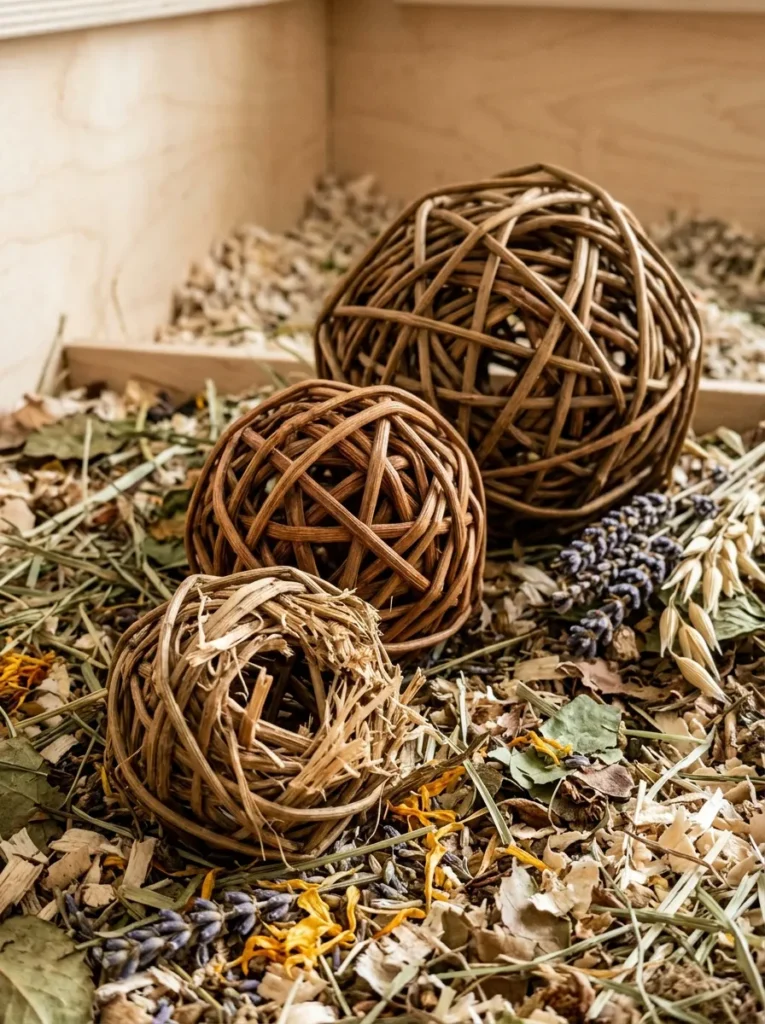
Vibe: Willow ball toys feel instinctively appropriate — the chew and exploration object that a hamster investigates, climbs on, pushes around, and systematically dismantles over several days of enriched activity.
Why it works: Willow is one of the safest and most behaviorally appropriate chew materials available for hamsters — it is naturally flexible (allowing balls and woven forms to be constructed without adhesives), completely non-toxic when ingested in the small amounts that chewing produces, and provides the correct fibrous resistance that hamster teeth require for natural wear. The ball form specifically activates three distinct behavioral modes: the hamster pushes and rolls it (locomotor play), investigates the interior through the gaps (exploratory behavior), and chews the weave strands (dental enrichment). Graduated sizes across three balls give the hamster varied interaction qualities from each object.
How to get it: Purchase willow balls from small animal or bird toy suppliers — they are widely available and inexpensive ($1–$3 each). Alternatively, cut fresh or dried willow branches into 15–20 cm lengths, soak in water for 30 minutes to increase flexibility, and weave into ball forms by interlacing strands around each other in a spherical arrangement, tucking the ends into the weave to secure. Allow to dry completely before placing in the enclosure. Replace when fully chewed — typically every one to three weeks depending on the individual hamster’s chewing intensity.
Shop The Look
| Product |
|---|
| Natural willow ball toy small animal set |
| Willow branch bundle for DIY weaving |
| Natural willow sticks chew toy hamster |
| Willow ring toy hamster natural |
| Mixed willow chew set small animal |
Also view: 15 Extra Large Dog Crate Ideas for Every Home
2. Cardboard Maze Foraging Box
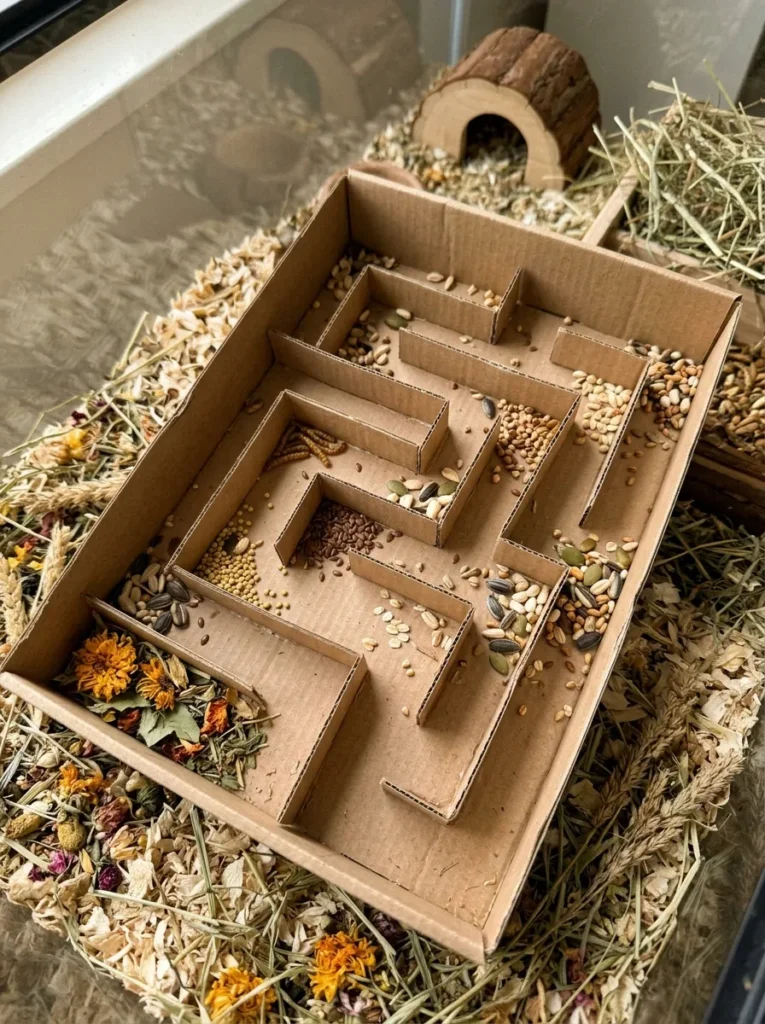
Vibe: A cardboard foraging maze feels cognitively purposeful — the enrichment object that makes a hamster’s brain work as hard as its nose.
Why it works: A cardboard maze foraging box combines two of the most welfare-significant enrichment categories — problem-solving challenge and food-motivated exploration — in a single object that costs nothing and takes ten minutes to make. The maze channels require the hamster to navigate a spatial problem to locate food items, which activates the hippocampal spatial mapping that hamsters engage during natural territory navigation. The cardboard material simultaneously serves as the maze structure and as a chewing enrichment opportunity — the hamster will work through the maze walls as it explores, which is both expected and safe. The design principle is cognitive challenge layered over instinctive behavior: the foraging motivation draws the hamster into the box, and the maze structure provides the spatial challenge that elevates the activity from simple food finding to genuine problem-solving.
How to get it: Cut a shallow cardboard box (approximately 20×15×5 cm — a shoebox lid works well) and cut cardboard strip walls from the same box material, approximately 4 cm tall. Arrange the strip walls in a simple maze pattern inside the box — three or four channels with one or two dead ends and a path to the reward location. Hold the strip walls upright using small tabs cut into the box floor. Distribute seeds, dried herbs, and small food items at varied locations along the maze channels. Replace when the hamster has chewed through the maze walls significantly — typically after two to four sessions.
Shop The Look
| Product |
|---|
| Plain cardboard box shallow for maze |
| Hamster safe seed mix for maze filling |
| Dried herb mix small animal for maze |
| Craft scissors for cardboard cutting |
| Paper tape natural for maze assembly |
3. Toilet Roll Tube Treat Parcel
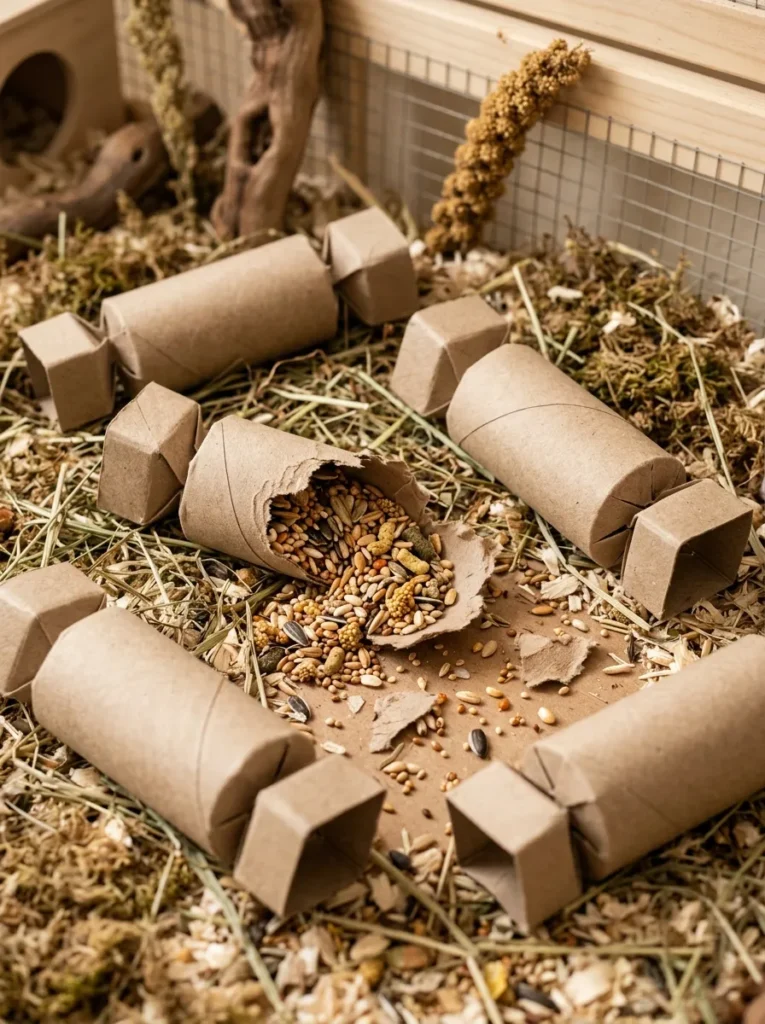
Vibe: Cardboard treat parcels feel delightfully simple — the enrichment toy that requires nothing but a toilet roll and the hamster’s instinct to investigate and chew open anything it encounters.
Why it works: The toilet roll treat parcel is the hamster enrichment toy with the highest welfare return per unit of maker effort — it takes under one minute to make, uses a material that every household generates as waste, and produces a foraging and chewing enrichment object that activates the hamster’s unwrapping behavior (the motivated dismantling of a container to access a food reward). This unwrapping behavior closely parallels the natural behavior of accessing food stored in bark crevices, seed pods, and other natural food containers — making it one of the most species-appropriate enrichment formats available. The parcel’s fragility (cardboard chews easily) means the food reward is accessible without excessive frustration while still requiring meaningful engagement to access.
How to get it: Fill a plain unprinted toilet roll tube with a small amount of the hamster’s regular food mix plus one or two higher-value additions (a small piece of dried fruit, a mealworm, a sunflower seed). Fold both ends of the tube inward in overlapping sections to close — the same way a Christmas cracker is closed. No tape or glue required — the folded ends hold adequately against the hamster’s initial investigation while being breachable through chewing. Place in the enclosure partially buried in substrate for additional foraging challenge, or leave on the surface for straightforward unwrapping.
Quick Win: Making five treat parcels at once takes under five minutes and provides five separate foraging sessions spread across several days — the highest enrichment return per minute of preparation time available in hamster toy-making.
Shop The Look
| Product |
|---|
| Plain cardboard toilet roll tube natural |
| Hamster treat mix for tube filling |
| Dried mealworm hamster treat |
| Dried fruit mix hamster safe small |
| Mixed seed reward mix hamster |
4. Cork Bark Chew and Exploration Set
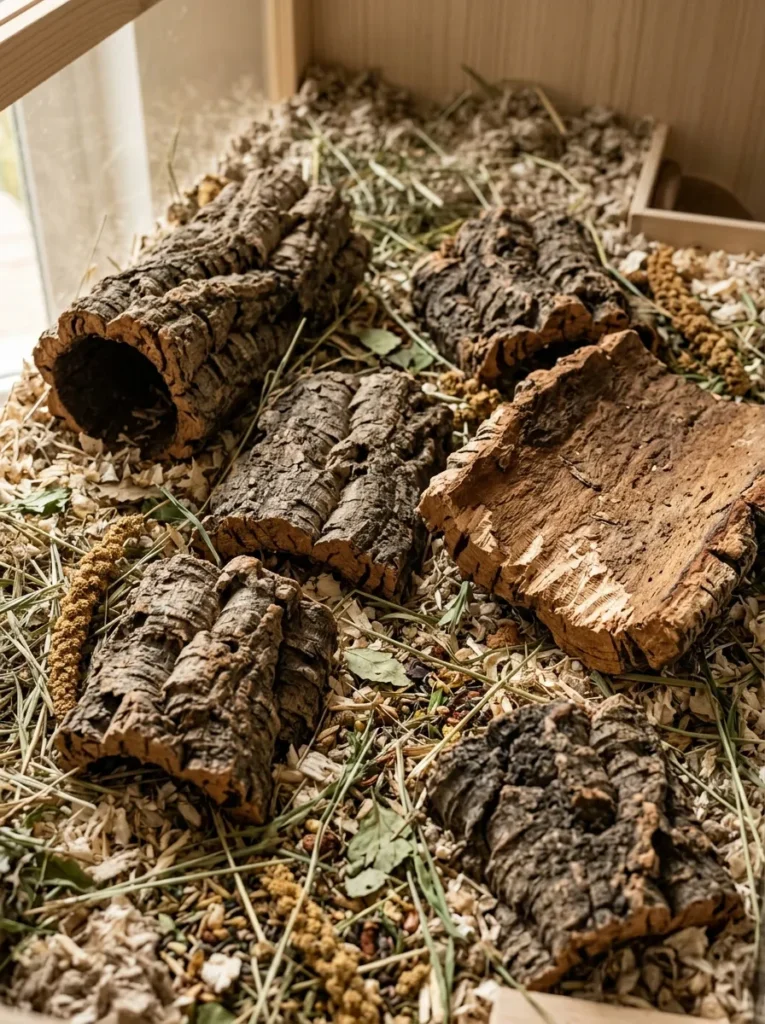
Vibe: A cork bark collection feels naturally textural — chew and exploration objects that provide the material variety a single type of enrichment toy cannot.
Why it works: Cork bark is the hamster enrichment material with the greatest behavioral versatility — it serves simultaneously as a chew toy (cork is naturally spongy and provides appropriate dental resistance), an exploration structure (the varied surface texture of natural cork stimulates the sensory exploration that smooth surfaces cannot), a hide material (curved cork pieces create partially enclosed spaces), and a scent-marking substrate (hamsters mark cork bark extensively, which establishes it as territory and produces the repeated interaction that makes a single piece of cork bark a longer-lasting enrichment object than most alternatives). The natural antimicrobial properties of cork also mean it is one of the safest chewable materials in terms of pathogen risk.
How to get it: Purchase natural cork bark pieces from reptile and terrarium suppliers — cork bark is one of the most economical hamster enrichment materials available, typically sold in mixed piece bags at $8–$15 for a quantity that will last months of rotation. Provide a minimum of three to five pieces in varied forms — at least one curved section (for hide potential), at least one flat section (for platform use), and several irregular chunks (for pure chewing and exploration). Rotate pieces out every four to six weeks and introduce new pieces to maintain the novelty response that maximizes engagement.
Shop The Look
| Product |
|---|
| Natural cork bark tube section small animal |
| Cork bark flat panel pieces set |
| Cork bark irregular chunk variety |
| Cork bark mixed enrichment pack |
| Natural cork bark small piece bag |
5. DIY Apple Stick Chew Bundle
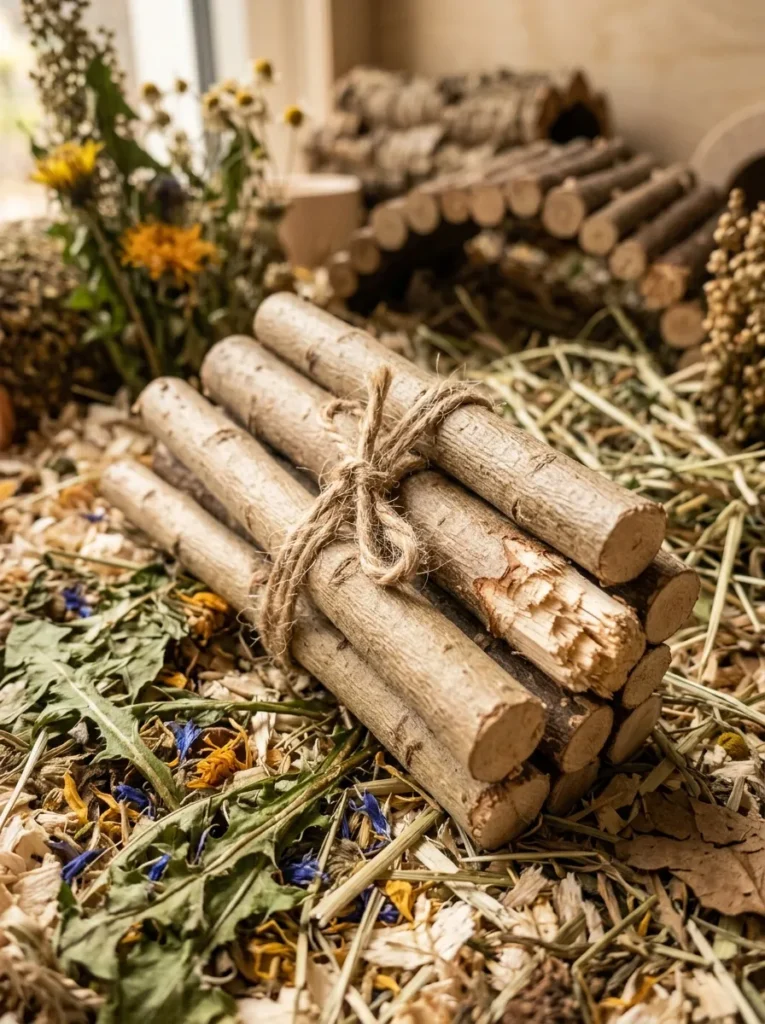
Vibe: An apple stick chew bundle feels specifically natural — the dental enrichment that provides the wood-chewing experience that hamster teeth genuinely require.
Why it works: Hamster incisors grow continuously throughout the animal’s life and require regular chewing of appropriately resistant materials to maintain correct length and angle. Without adequate hard chewing material, incisors can overgrow, misalign, or develop the malocclusion that prevents normal eating and requires veterinary intervention. Apple wood is one of the consistently safest wood species for hamster chewing — it is non-toxic, palatable to most hamsters (the slight fruit residue in the wood is attractive to hamsters), and provides the appropriate dental resistance that dental wear requires. The bundle format makes the chew toy more interesting than a single stick — the hamster must select and manipulate individual sticks from the bundle, which extends the behavioral engagement beyond simple single-stick chewing.
How to get it: Purchase apple wood sticks from small animal suppliers (they are widely available and inexpensive), or cut from a pesticide-free, organically grown apple tree using a pruning saw. If cutting from your own tree, bake the cut sticks at 120°C for one hour to eliminate any surface pathogens before giving to the hamster. Cut to approximately 10 cm lengths and 8–12 mm diameter. Bundle five to seven sticks loosely with a single loop of jute twine. The hamster will chew through the bundle and the twine separately — both are safe. Replace when all sticks are significantly chewed down, typically every two to four weeks.
Shop The Look
| Product |
|---|
| Apple wood stick bundle hamster chew |
| Apple wood sticks small animal natural |
| Jute twine thin for bundle tying |
| Fruit wood chew variety pack |
| Willow apple mixed stick set |
6. Tissue Paper Nesting Material Dispenser
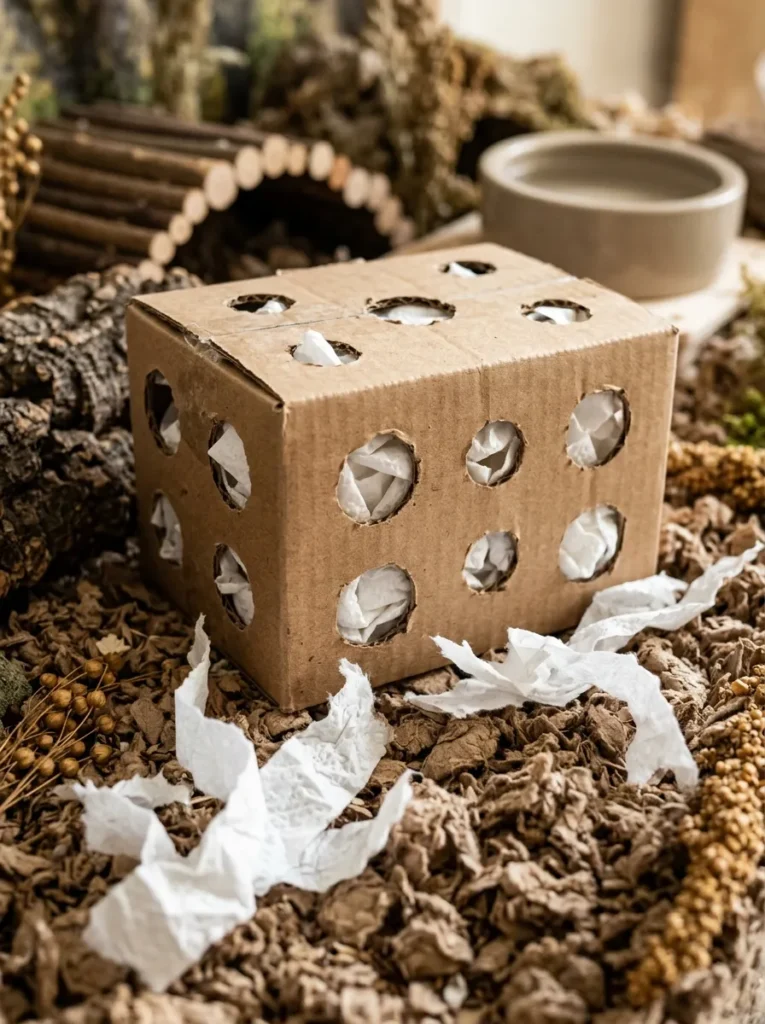
Vibe: A nesting material dispenser feels behaviorally activated — the toy that gives the hamster’s nest-building drive an interactive, problem-solving dimension.
Why it works: Nest building is one of the most fundamental hamster behavioral needs — in the wild, hamsters select, transport, and arrange nesting material with considerable care, building elaborate sleeping nests in their burrow’s sleeping chamber. A nesting material dispenser that requires the hamster to pull materials through holes (rather than simply picking them up from a pile) activates the selection and manipulation behaviors that are part of natural nest-building behavior, providing the cognitive engagement that a simple pile of nesting material cannot. The cardboard box also serves as an additional chew and exploration object — the hamster will chew the box while extracting material from it, which extends the enrichment value of the single object.
How to get it: Take a small plain cardboard box (a matchbox, a small food packaging box, or a hand-constructed cardboard cube approximately 10×8×6 cm) and cut holes of varied sizes (1–2 cm diameter) in the sides and top using scissors or a craft knife. Stuff loosely with plain white unscented tissue paper torn into strips approximately 2–3 cm wide and 10–15 cm long. Place in the enclosure near the hamster’s primary hideout — the hamster will typically pull material from the dispenser and carry it to the nest in cheek pouches or mouth. Refill when empty.
Shop The Look
| Product |
|---|
| Plain white tissue paper unscented nesting |
| Small cardboard box for dispenser |
| Craft scissors for hole cutting |
| Meadow hay for additional nesting mix |
| Unbleached toilet paper strips nesting |
7. Terracotta Pot Puzzle Feeder
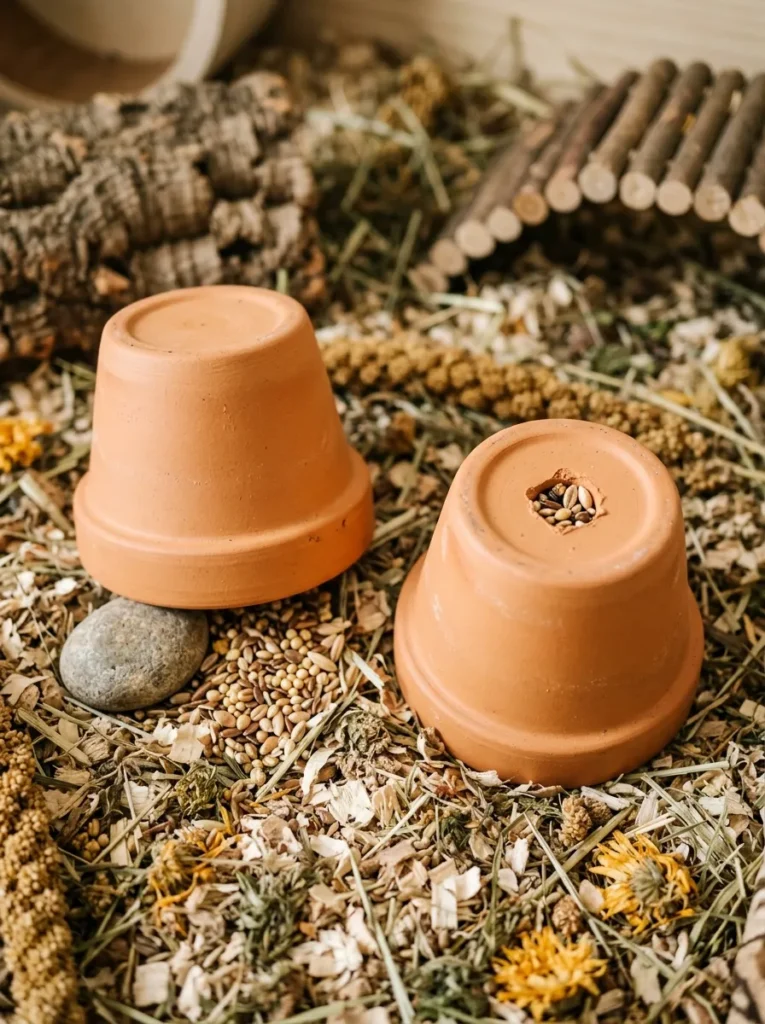
Vibe: Terracotta pot puzzle feeders feel elegantly simple — the enrichment toy that uses the most basic materials to create a genuine cognitive challenge.
Why it works: Puzzle feeders that require physical manipulation to access food rewards provide the cognitive enrichment that directly reduces stereotypic behavior in captive rodents — research on rodent cognitive enrichment consistently documents reduced repetitive behaviors and lower cortisol indicators in animals provided with food-motivated problem-solving challenges. The terracotta pot puzzle is the simplest version of this principle: the hamster must locate the food reward (olfactory challenge), identify the access method (cognitive challenge), and execute the physical manipulation required (motor challenge). The terracotta material is completely safe for hamsters to chew and gnaw, which adds an incidental dental enrichment opportunity to each puzzle feeding session.
How to get it: Use small unglazed terracotta pots (6–8 cm diameter) with no glaze, paint, or treatment. For the propped version: place seeds under the inverted pot and prop one edge approximately 1 cm off the substrate using a smooth river pebble — the hamster must knock or lift the edge to access the food. For the hole version: drill a 1.5 cm hole in the base of the pot (now at the top when inverted), fill with seeds through the hole, and place inverted — the hamster must work seeds out through the hole or tip the pot. Rotate between the two puzzle configurations to maintain novelty.
Shop The Look
| Product |
|---|
| Small unglazed terracotta pot 6-8cm set |
| Smooth river pebble set for propping |
| Drill bit 15mm for terracotta hole |
| Hamster seed reward mix for puzzle |
| Dried herb mix for puzzle filling |
8. Hanging Herb Bundle
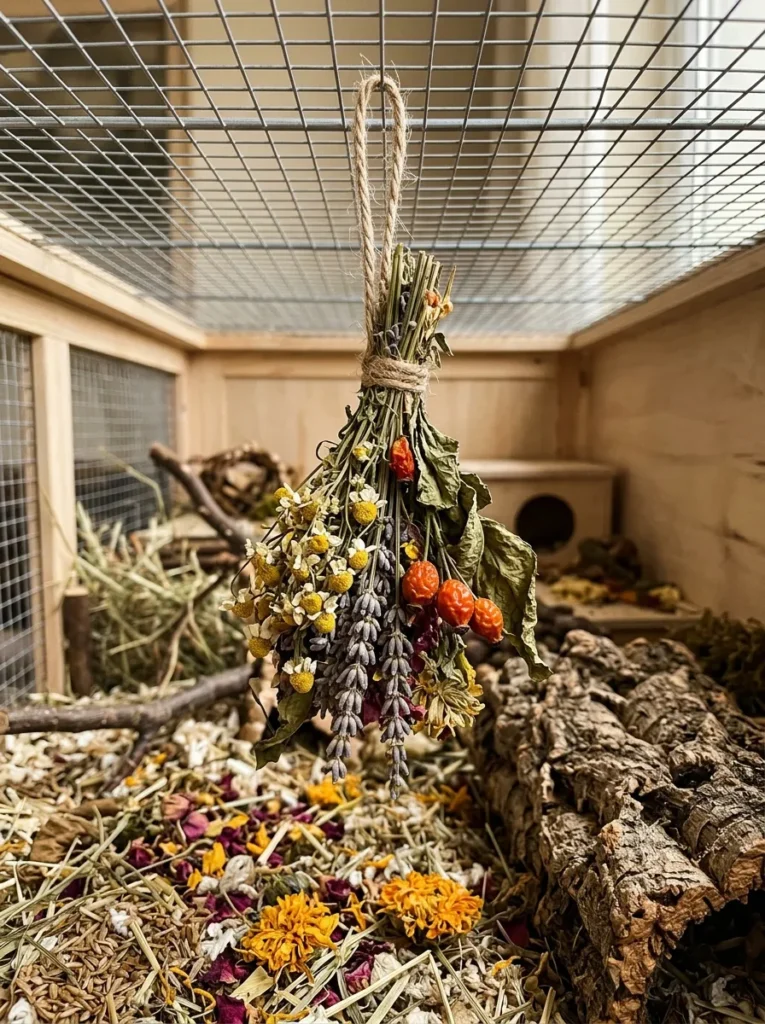
Vibe: A hanging herb bundle feels sensorially rich — the enrichment addition that activates a hamster’s most acute sense at a specific, reachable height above the substrate.
Why it works: Hanging enrichment objects that require the hamster to stand on its hind legs and reach upward activate a specific postural behavior (bipedal standing) that is natural to hamsters in their foraging and environmental investigation repertoire. The design principle is positional variation as behavioral enrichment: an object placed at a height requiring upward reach produces a different physical interaction than the same object placed at ground level, which means the hanging herb bundle provides behavioral enrichment through its placement as much as through its content. The aromatic dried herbs additionally provide olfactory enrichment — the hamster’s nose receives new scent information from the bundle on every approach, which activates investigative behavior repeatedly.
How to get it: Bundle a small selection of dried hamster-safe herbs — dried chamomile flowers, dried lavender, dried plantain leaf, dried rosehip — into a tight bundle approximately 8–10 cm long. Tie securely with a short length of jute twine, leaving a loop at the top for attachment. Hang from the enclosure’s mesh roof or upper bar at a height of approximately 10–15 cm above the substrate surface — reachable for the hamster while standing on hind legs but not resting at ground level. Replace when the herbs are fully consumed or have lost their aromatic quality — typically every one to two weeks.
Shop The Look
| Product |
|---|
| Dried chamomile flower hamster safe |
| Dried lavender bundle hamster safe |
| Dried plantain leaf small animal |
| Jute twine thin for bundle attachment |
| Mixed dried herb selection hamster |
9. DIY Wooden Foraging Log with Drilled Holes
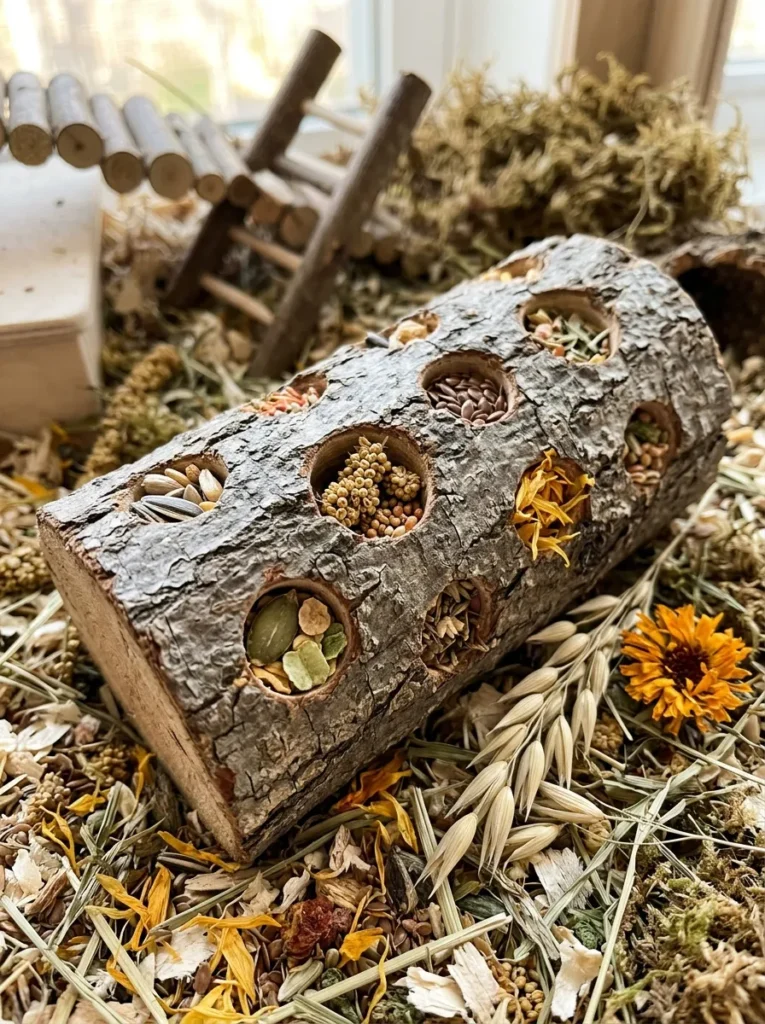
Vibe: A foraging log feels naturally complex — the enrichment object that makes a hamster work for food in exactly the way wild hamsters work for food in bark crevices and woody debris.
Why it works: Foraging from drilled log holes closely approximates one of the natural food-finding behaviors of wild hamsters — investigating crevices, holes, and woody cavities for seeds and insects cached by other animals or naturally lodged in the material. The varied hole depths in this design are functionally significant: shallow holes allow easy food extraction (low frustration, quick reward), deep holes require more sustained effort and partial entry of the hamster’s snout or paw (higher challenge, greater behavioral engagement). This graduated difficulty mirrors the natural variance of food accessibility in wild foraging environments, which research suggests is the foraging condition that produces the most sustained and welfare-positive foraging behavior.
How to get it: Select a section of natural log from a species confirmed safe for hamsters — apple, pear, hazel, willow, or birch (never cedar, yew, or any species with aromatic oils). Bake at 120°C for one hour to eliminate pathogens. Drill holes of 12–20 mm diameter at varied depths (20–40 mm) across the log surface using a standard wood drill bit. Stuff each hole with a varied combination of seeds, dried herbs, a small piece of dried fruit, or a single mealworm. Place horizontally on the substrate surface. The hamster will empty the holes in one to three foraging sessions — refill and continue using until the log is significantly chewed.
Shop The Look
| Product |
|---|
| Natural wood log section hamster safe |
| Drill bit set 12-20mm for foraging holes |
| Hamster safe seed variety for holes |
| Dried mealworm single treat for holes |
| Dried herb pack for log stuffing |
10. Paper Bag Foraging Crinkle Toy
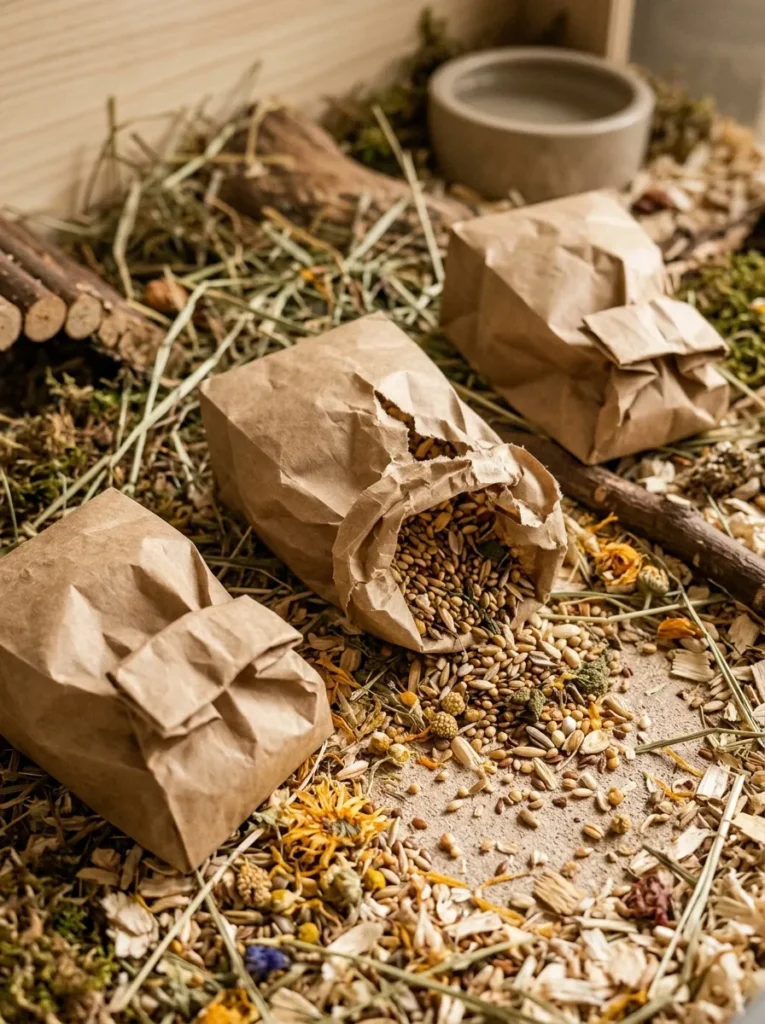
Vibe: Paper bag foraging toys feel immediately engaging — the crinkle texture and food scent combination that activates a hamster’s investigative behavior within seconds of introduction.
Why it works: The paper bag foraging toy activates two behavioral drives simultaneously — the olfactory drive (the hamster can smell the food inside through the paper) and the manipulation drive (accessing the food requires crumpling, tearing, and investigating the bag’s structure). The crinkle texture of the paper provides additional sensory stimulation through the hamster’s vibrissae (whiskers) during investigation, which activates the tactile exploratory behavior that smooth surfaces do not engage. The design principle is multi-sensory challenge as engagement multiplier: an enrichment object that engages smell, touch, and manipulation simultaneously produces more sustained and varied behavioral engagement than one that engages only a single sensory or behavioral channel.
How to get it: Use small plain kraft paper bags (no printing, no coating, no handles with synthetic material) approximately 8×5 cm in size. Place a small amount of the hamster’s food mix and a few pieces of dried herb inside each bag. Fold the top closed with two or three folds — do not tape or seal. Crumple each bag gently to create the crinkle texture and to release the food scent slightly through the paper. Place in varied locations in the enclosure — some on the surface, some partially buried in substrate. Replace each bag after one to two uses when it has been significantly crumpled or torn.
Shop The Look
| Product |
|---|
| Small plain kraft paper bag set natural |
| Hamster food mix for bag filling |
| Dried herb mix for scent enrichment |
| Dried rose petal hamster safe scent |
| Paper crinkle material natural hamster |
11. Hay Tunnel and Nest Ball Combined
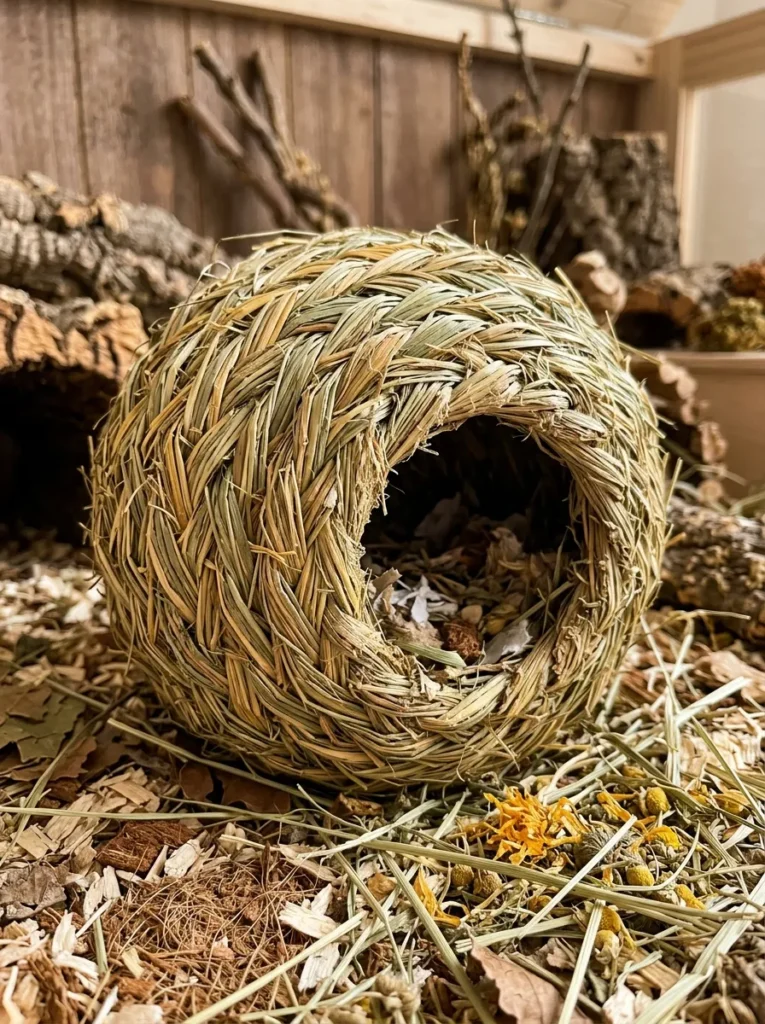
Vibe: A hay tunnel ball feels naturally purposeful — the enrichment object that a hamster can enter, sleep in, chew apart, and use as nest building material — all from one source.
Why it works: The hay tunnel ball is the enrichment toy with the greatest behavioral versatility per object — it simultaneously provides tunnel investigation opportunity (the entrance hole and hollow interior activate the exploratory behavior associated with natural burrow investigation), nest material source (the hamster will pull hay from the ball’s surface and interior to transport to the sleeping nest), and chewing enrichment (hay is an appropriate fibrous chew material). Its gradual dismantling over the course of several days means it provides sustained enrichment rather than single-session engagement. The design principle is multi-function object as sustained enrichment: an object that serves three or four behavioral functions simultaneously provides enrichment for longer and requires less frequent replacement than objects serving a single function.
How to get it: Purchase hay balls from small animal toy suppliers — they are widely available and inexpensive. Alternatively, hand-form a hay ball from meadow hay: take a large handful of hay and form into a rough sphere, then use additional hay strands to wrap the exterior and tuck into the structure to compact it. Create the tunnel entrance by pushing a finger or a 4-cm diameter dowel through the ball from one side to create a hole and partial hollow interior. The ball does not need to be perfectly formed — a loose, irregular hay ball is as enriching as a commercial version. Place on the substrate surface and allow the hamster to investigate, enter, and dismantle at its own pace.
Shop The Look
| Product |
|---|
| Hay ball tunnel toy small animal natural |
| Meadow hay premium for DIY ball |
| Orchard grass hay for ball variation |
| Natural hay nest material bag |
| Compressed hay cube alternative |
12. Wooden Seesaw Balance Toy
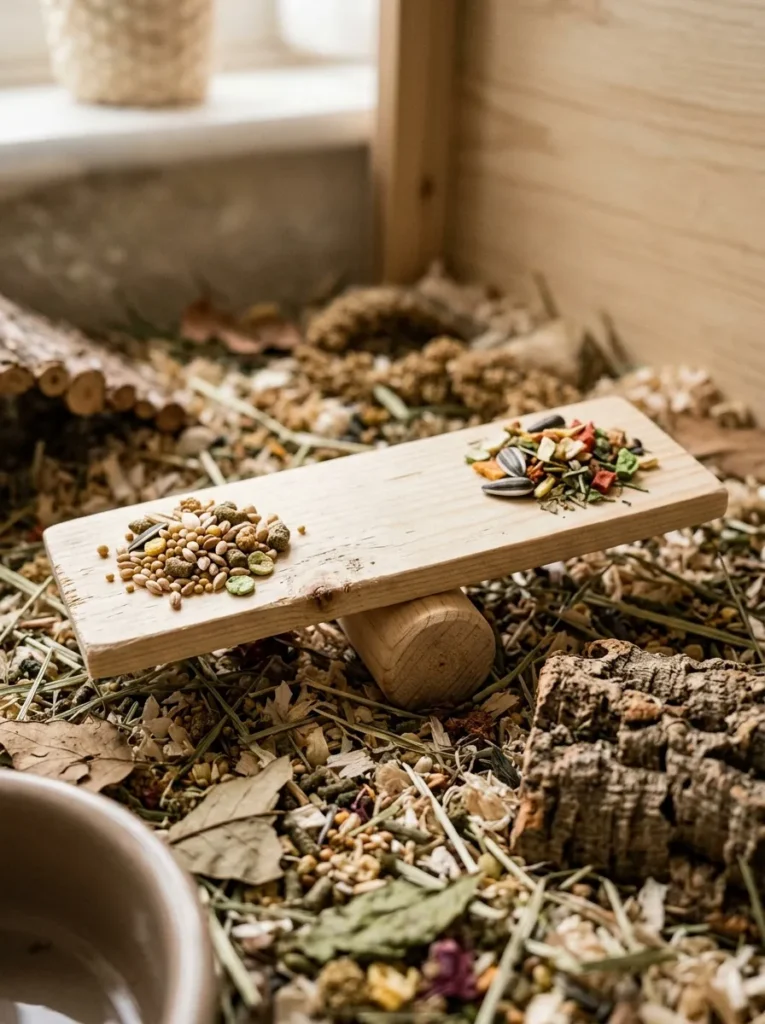
Vibe: A wooden seesaw feels kinetically engaging — the balance toy that makes a hamster’s weight create the movement that rewards continued investigation.
Why it works: A balance toy that moves in response to the hamster’s weight and position provides a kinetic enrichment experience unavailable from static objects — the hamster’s movement across the plank changes the plank’s angle, which moves the food items at the ends, which motivates continued investigative movement. This dynamic response to the hamster’s own behavior activates a more complex behavioral engagement than static objects allow, because the toy’s response varies based on where the hamster is standing rather than providing the same experience regardless of the hamster’s position. The design principle is environment responsiveness as engagement complexity: an environment that responds to the animal’s behavior produces more complex and sustained behavioral engagement than a static one.
How to get it: Cut an untreated pine plank to approximately 15 cm length and 5 cm width at 8 mm thickness. Cut a small rounded fulcrum piece — a 3 cm section of 20 mm diameter dowel works well — and glue to the center underside of the plank with a dot of PVA glue. Allow to dry fully. The assembled seesaw should balance on a flat surface with the fulcrum, tilting when weight is applied to either end. Place seeds or small treats at each end of the plank surface before introducing to the enclosure. The hamster will approach one end, causing it to lower, and investigate the other end — the movement maintains engagement throughout the foraging session.
Shop The Look
| Product |
|---|
| Untreated pine board thin for plank |
| Wooden dowel 20mm for fulcrum |
| PVA wood glue food safe |
| Sandpaper 220 grit for edge smoothing |
| Hamster treat mix for seesaw ends |
13. Scent Garden Exploration Tray
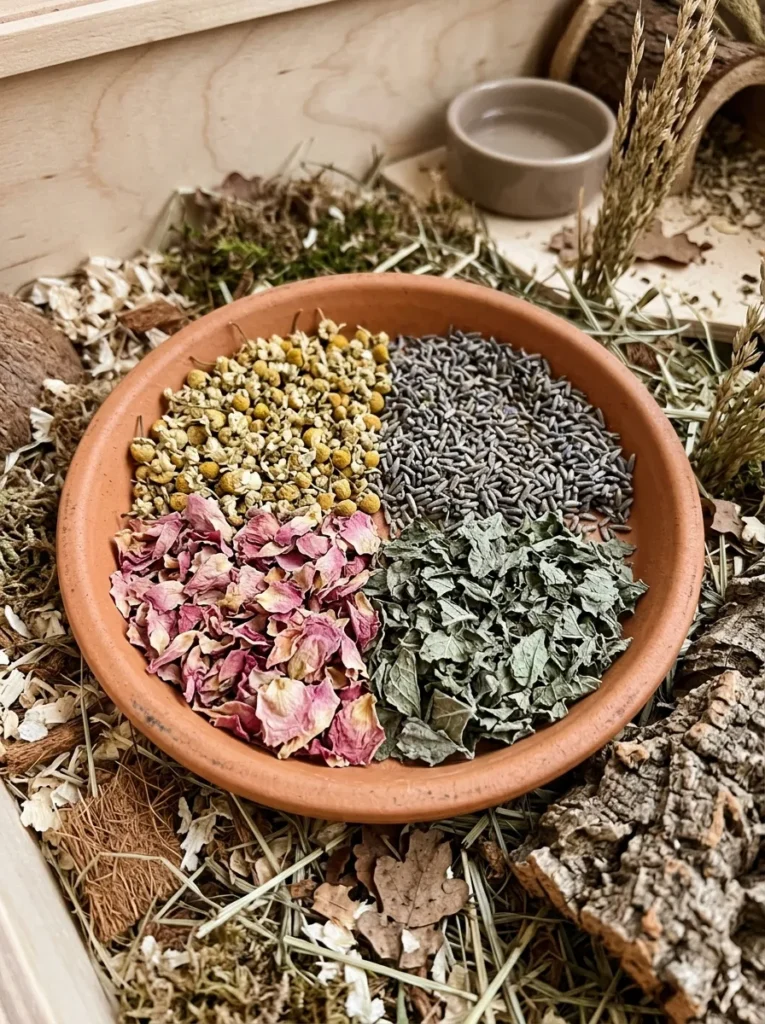
Vibe: A scent garden tray feels olfactorily generous — the exploration experience that gives the hamster’s most developed sense an entire landscape of distinct information to process.
Why it works: Olfaction is the hamster’s primary sensory modality — it navigates its environment, identifies food, communicates with conspecifics, and assesses safety primarily through smell. A scent garden that presents four or five distinct botanical scents in distinct spatial zones provides an olfactory enrichment experience with a spatial dimension — the hamster investigates each scent zone separately, processes the scent information, and moves to the next zone, which closely approximates the olfactory navigation of a varied natural environment. The design principle is spatial olfactory variety as cognitive enrichment: providing varied scents in distinct locations activates the cognitive mapping that olfactory navigation requires, providing mental stimulation through the hamster’s primary sensory channel.
How to get it: Source a selection of four to five dried botanicals confirmed as hamster-safe — dried chamomile flowers, dried lavender buds, dried rose petals, dried mint leaf, dried plantain, dried dandelion flower. Fill a large terracotta saucer (20 cm minimum diameter) with a thin base layer of fine substrate. Arrange each botanical in a distinct zone of the saucer, creating a clear spatial separation between scent types. Place the scent garden tray in the enclosure as a temporary exploration feature — leave for 24–48 hours, then remove, refresh the botanicals, and reintroduce after a week to restore the novelty response.
Shop The Look
| Product |
|---|
| Large terracotta saucer 20cm for tray |
| Dried chamomile hamster safe |
| Dried rose petal hamster safe |
| Dried mint leaf hamster safe |
| Dried botanical mix varied small animal |
14. Small-Space Toy — Cardboard House with Chewable Roof
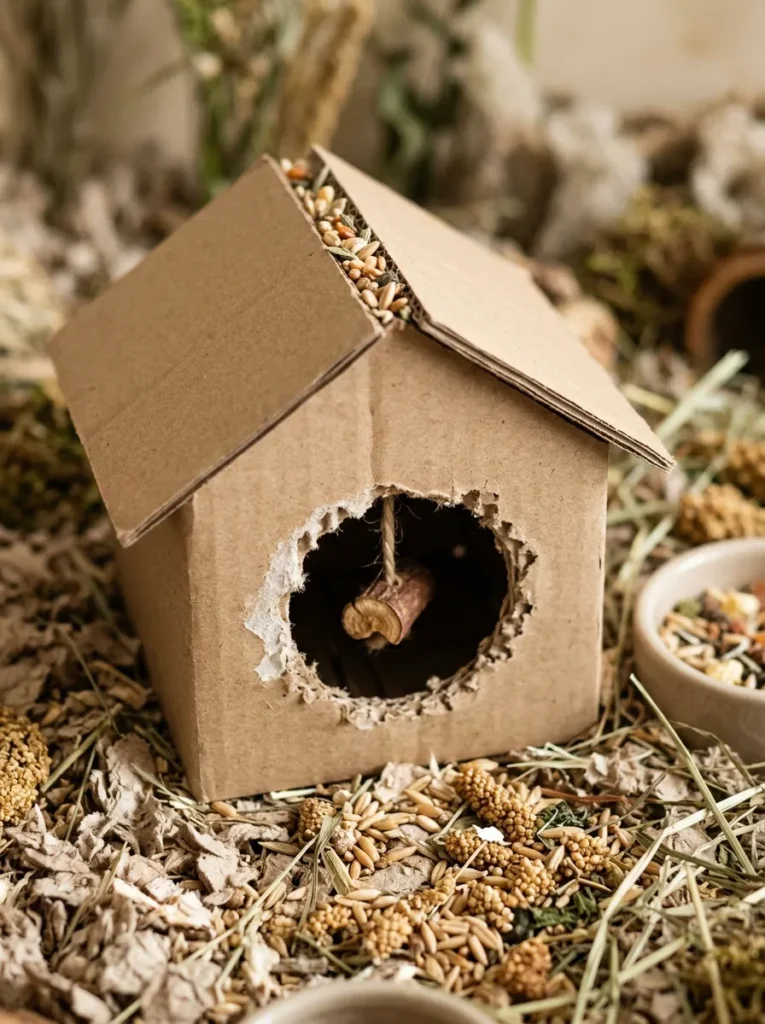
Vibe: A cardboard chew house feels completely enriched — the small toy that combines shelter, chewing, foraging, and the apple wood hanging treat into a single object the size of a matchbox.
Why it works: The cardboard house with enrichment additions is the small-space toy that delivers the highest behavioral diversity from the smallest footprint — in an enclosure already well-equipped with substrate, a wheel, and a sand bath, a small cardboard house provides the supplementary enrichment that fills the behavioral gaps those primary elements do not address. The design principle is maximum behavioral opportunity per object footprint: by combining the house form (shelter and exploration), the chewable cardboard material (dental enrichment), the seeds in the roof seam (foraging challenge), and the hanging apple stick inside (novel chew object requiring bipedal reach), a single small object provides four distinct behavioral enrichment opportunities simultaneously. This concentration of opportunity is why small, carefully designed toys often outperform larger, single-function ones.
How to get it: Construct a simple house from plain cardboard: two 10×8 cm wall pieces, two triangular gable pieces, a 10×10 cm floor, and two 6×10 cm roof pieces. Join with PVA glue and allow to dry. Cut a circular entrance hole (5 cm diameter for Syrian hamsters, 3.5 cm for dwarf) in one wall piece before assembly. Tuck seeds and dried herb pieces into the roof seam during assembly — they will be accessible to the hamster by chewing into the roof. Hang a 6 cm piece of apple stick inside the house from a jute twine loop attached at the roof peak — accessible through the entrance. Place on the substrate surface and replace when significantly chewed.
Shop The Look
| Product |
|---|
| Plain cardboard sheet for house building |
| PVA glue food safe for assembly |
| Apple wood stick for interior hanging |
| Jute twine thin for stick hanging |
| Hamster seed mix for roof seam |
How to Start Your Hamster Toy Practice
The single first move is to make five toilet roll treat parcels (project 3) right now — they take under five minutes, use materials every household already has, and introduce the foraging enrichment principle that is the foundation of all hamster toy design. Watching a hamster work through a treat parcel for the first time demonstrates the behavioral engagement that motivated enrichment produces and establishes the baseline understanding of what genuinely effective hamster toys do that all subsequent toy-making decisions build on.
The most important safety practice is confirming the safety of every new material before it enters the enclosure — not assuming, not inferring from general “pet safe” claims, but specifically confirming hamster safety for chewing and ingestion. The resource to use is the community-compiled material safety lists maintained on r/hamsters and specialist hamster care websites — these lists are more specific and more current than most commercial pet care resources and reflect actual reported hamster responses to specific materials rather than general pet safety assumptions.
Three toy-making approaches that produce the most sustained enrichment value: rotation (maintaining a collection of eight to ten different toys and rotating two to three into the enclosure every two weeks rather than keeping the same toys permanently — novelty is the enrichment mechanism, and familiar toys lose their enrichment value regardless of their quality), variety across behavioral categories (ensuring the rotation includes at least one chew toy, one foraging toy, one exploration toy, and one problem-solving toy — behavioral variety produces more complete enrichment than multiple toys of the same type), and material variety (cycling through cork, cardboard, apple wood, hay, and paper materials rather than relying on a single material — different materials provide different chewing resistance, different textures, and different sensory experiences that collectively provide richer enrichment than any single material alone).
Frequently Asked Questions About Handmade Hamster Toys
What materials are safe for handmade hamster toys?
Safe materials for hamster toys are those confirmed non-toxic for repeated chewing and small-amount ingestion: untreated softwoods (pine, poplar, willow, apple, hazel, pear, birch), natural cork bark, plain unbleached cardboard, plain white unscented tissue and toilet paper, food-grade kraft paper bags, unglazed terracotta, meadow hay and dried grasses, and dried botanicals confirmed specifically as hamster-safe. Unsafe materials include all painted or varnished surfaces, any synthetic fabric, dyed materials, non-food-grade plastics, aromatic woods (cedar, eucalyptus, pine shavings), and any material whose species-specific hamster safety cannot be confirmed from a reliable source.
How often should handmade hamster toys be replaced?
Replacement frequency depends on the material and the individual hamster’s chewing intensity. Cardboard items (treat parcels, maze boxes, foraging boxes) should be replaced when significantly chewed — typically after one to three sessions. Paper items (tissue dispensers, paper bags) replace after one to two uses. Willow balls and apple wood sticks replace when fully chewed down — typically two to four weeks. Cork bark and terracotta items last significantly longer (months) and should be replaced when they become soiled or fragmented into pieces small enough to be swallowed whole. The general principle is: if it’s significantly chewed, it’s been significantly used, and its enrichment function is depleted — replace it.
Can I use toys from the garden for hamster enrichment?
Garden materials can be used only if all of the following conditions are met: the species is confirmed non-toxic for hamsters (apple, pear, hazel, willow, and birch are safe; most ornamental plants are not), the source material has had absolutely no pesticide, herbicide, or fertilizer exposure, and the material has been baked at 120°C for one hour to eliminate pathogens and surface organisms. Never use materials from treated lawns, near roads, or from species whose hamster safety cannot be specifically confirmed — the safety standard is positive confirmation, not absence of known harm.
How many toys should a hamster have in its enclosure at one time?
Three to five toys in the enclosure at any one time is the appropriate quantity — enough to provide varied behavioral opportunity without overwhelming the enclosure’s available space or reducing the novelty response that makes individual toys engaging. More important than the number of toys in the enclosure at one time is the rotation schedule — maintaining a larger collection of eight to twelve different toys and cycling two to three in and out every two weeks provides more sustained enrichment value than keeping the same five toys permanently in the enclosure regardless of their number.
Are commercial hamster toys safe and effective?
Many commercial hamster toys have significant safety and welfare concerns — plastic components that can be chewed into sharp fragments, dyes that are not confirmed food-safe for small animals, sizes designed for visual appeal rather than species-appropriate dimensions, and behavioral concepts (hamster balls, most “gym” equipment) that do not serve genuine hamster behavioral needs. Exceptions exist: commercial willow balls, cork bark pieces, wooden bridge and ladder sets from reputable small animal suppliers, and hay-based tunnel balls are generally safe and effective. The evaluation principle for any commercial hamster toy is: is it made from confirmed-safe materials at appropriate hamster scale, and does it activate a genuine hamster natural behavior? If both answers are yes, it is worth using. If either answer is no, it should not enter the enclosure.
Ready to Make Your Hamster’s World Richer?
These 14 handmade hamster toy ideas address every dimension of hamster behavioral enrichment — from dental health through willow and apple wood chews to cognitive challenge through puzzle feeders and foraging boxes, sensory enrichment through scent gardens and hanging herb bundles, and the nest-building and exploration behaviors that define a genuinely thriving captive hamster’s daily life. The most important thing to understand about hamster toys is that the hamster’s engagement is the measure of success — not the toy’s appearance, not its cost, and not its resemblance to what commercial pet stores sell. A toilet roll treat parcel that a hamster works through for twenty minutes of active foraging is providing more genuine welfare benefit than the most expensive commercial hamster toy sitting ignored in the corner of the enclosure. Today, make five treat parcels, place them in the enclosure at lights-out, and watch what happens. That engaged, purposeful foraging behavior is exactly what every toy on this list is designed to produce. Pin the ideas that made you think about your hamster’s specific behavioral needs, and let those be the ones you make first.