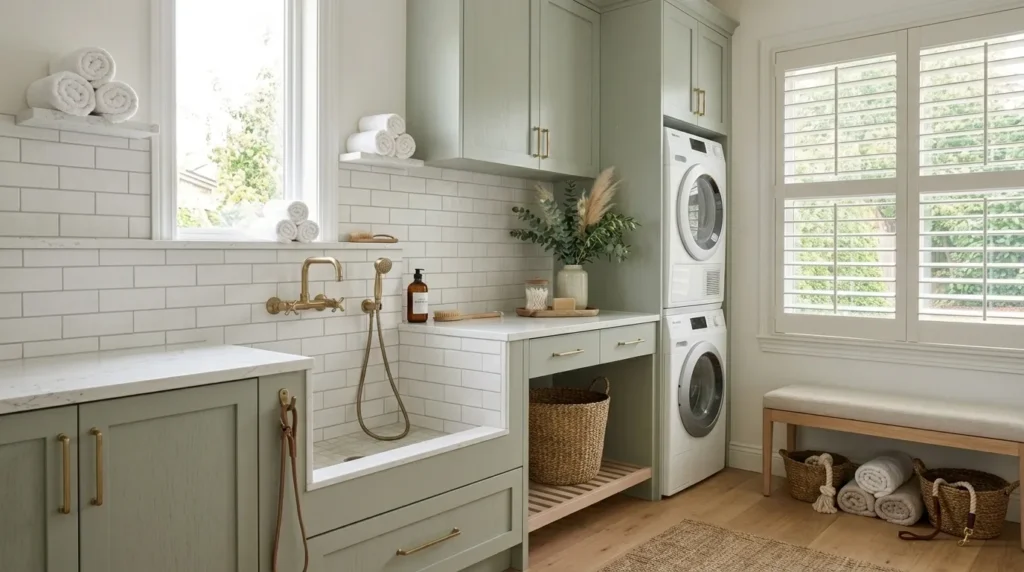
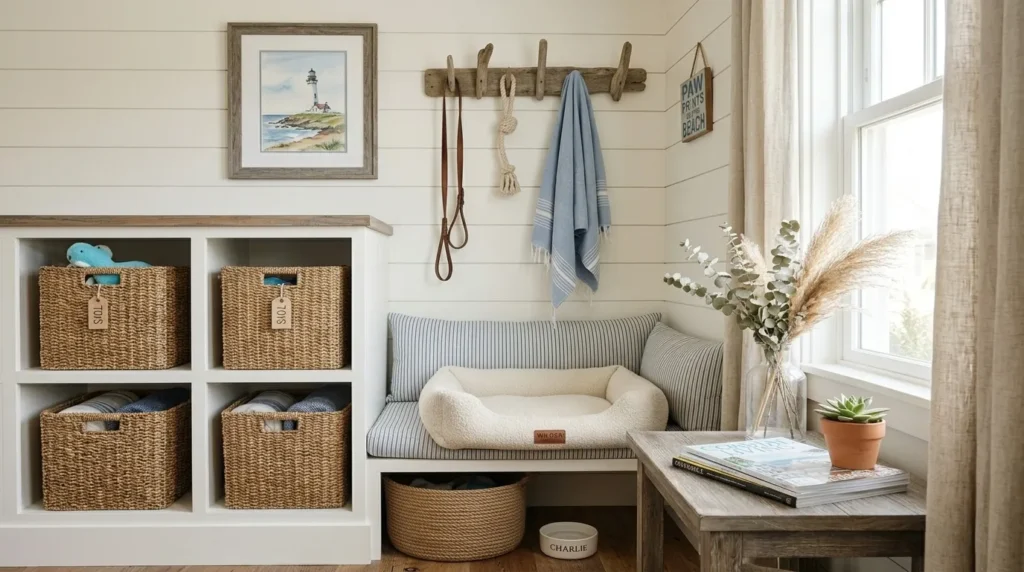
Garage dog room designs convert all or part of a residential garage into a dedicated, designed space for dogs — combining insulation, flooring, ventilation, and purpose-built furnishings to create a functional, comfortable area for dogs to sleep, be groomed, eat, and spend time safely when the main living areas of the home are in use. This article gives you exactly 14 ideas spanning full garage conversions, partial zoning solutions, grooming stations, storage systems, kennels, play areas, and small-garage adaptations so every property size and budget finds a workable design approach.
A garage dog room done well solves the problems that living with dogs creates — the mud from outdoor time contained before it reaches the kitchen, the crate tucked into a purposeful space rather than occupying a living room corner, the grooming happening somewhere with a drain rather than on the bathroom floor. It solves them permanently, in a room designed to hold them, and the rest of the house exhales. Here are 14 ideas worth saving — and building.
Why Garage Dog Room Designs Work So Well
The conversion of residential garage space to animal care areas has a long precedent in working dog and sporting dog communities — hunting lodges, field trial facilities, and professional training kennels have used converted outbuildings and garage structures as dog management spaces for over a century. The contemporary domestic garage dog room represents a domestication of this tradition, applying the same functional principles (drainage, washable surfaces, insulation, ventilation, secure containment) to a residential setting where aesthetics, comfort, and integration with the family home are equally important alongside practicality.
The materials that define a well-executed garage dog room include: sealed concrete or epoxy-coated flooring (the most durable, cleanest, and most drain-compatible surface for a multi-dog space), rubber interlocking tiles over concrete (for comfort underfoot and noise reduction), insulated stud wall framing with moisture-resistant drywall or cement board facing (for temperature regulation and washable wall surfaces), PVC or vinyl-wrapped cabinetry rather than wood veneer (for resistance to pet moisture and cleaning product contact), and galvanized or powder-coated metal for kennels, gates, and hardware. The aesthetic palette trends toward clean, practical, and visually organized — warm white or light gray walls, dark-toned flooring, natural wood accents in the upper display or storage areas above dog height, and the deliberate absence of clutter. Clutter and dogs do not coexist well in any space, and a garage dog room that reads as designed rather than improvised is one in which every element has a designated location.
The garage dog room concept has grown substantially as a home design category since approximately 2019, driven by the pandemic-era pet adoption surge combined with increased investment in the domestic property as a long-term living environment. Pinterest’s home improvement and pet categories both show strong sustained engagement with garage conversion content, and the specific pairing of garage conversion with pet space has appeared in mainstream interior design publications including Architectural Digest, Dwell, and Better Homes and Gardens since 2021. The practical driver is significant: a home with dogs that has a dedicated, equipped dog space is more manageable, more hygienic, and — when the conversion is well-executed — measurably more valuable than an equivalent home without one, as the dog room adds functional square footage while removing dog-related management from the main living areas.
Single-car garages (typically 10×20 feet, or 200 square feet) are the most common canvas for a domestic garage dog room and represent a genuinely workable footprint for most family dog scenarios. A single-car garage accommodates one grooming station, two to four sleeping areas or kennels, a washing station, and adequate storage for food, supplies, and grooming equipment without feeling confined. Two-car garages allow for the full suite of features plus a play area or training zone. The honest constraint for partial conversions where vehicle storage must be maintained: a shared vehicle-and-dog garage requires genuine zoning discipline — the dog area must be fully enclosed within the garage space to protect both the dog from vehicle exhaust and the vehicle from dog-related damage.
Style at a Glance
| Element | Functional Core | Design Edge |
|---|---|---|
| Philosophy | Every dog need solved in one room | The garage becomes a room, not a storage space |
| Materials | Epoxy floor, cement board, galvanized steel | Cedar accent, white cabinetry, rubber tile |
| Color Palette | Warm white, light gray, dark floor | Sage green, natural wood, matte black hardware |
1. Full Single-Car Garage Conversion with Epoxy Floor and Built-In Kennels

Vibe: The converted garage feels purposeful and clean — a room that was designed for this, not adapted to it.
Why it works: A full single-car garage conversion applies the design principle of purpose-built spatial organization — when the entire room is committed to the dog space function, every surface, fixture, and layout decision can be optimized for that function without compromise. Epoxy-coated concrete flooring is the foundation of any serious dog room because it is seamless (no grout lines where bacteria accumulate), completely waterproof, resistant to the cleaning chemicals necessary for effective hygiene management, and durable under heavy paw traffic and furniture movement. Built-in kennels along one wall with storage above apply the standard residential design principle of vertical zoning — dog activity at the lower zone, human storage at the upper zone — making the full wall height productive without consuming additional floor space.
How to get it: Begin the conversion with the floor — hire a concrete prep and epoxy floor specialist for professional application ($3–8 per square foot for a two-coat broadcast chip system that provides both durability and slip resistance). Frame built-in kennel units from 3/4-inch plywood painted with a semigloss moisture-resistant paint, with a piano hinge or barrel bolt metal bar door on each unit. Install white-painted MDF cabinet doors above the kennel row for supply storage. Add a floor drain if not already present — this is the most significant utility improvement and the most valuable for long-term cleaning convenience.
Quick Win: A charcoal epoxy floor coating kit ($80–130 for a 250 sq ft single-car garage, DIY application over two days) transforms the garage floor from raw concrete to a professional, easy-clean surface before any other construction begins — and is the single most impactful improvement available at this scale.
Shop The Look
| Product |
|---|
| Epoxy floor coating kit charcoal garage |
| Built-in kennel unit wooden metal bar door |
| White semigloss moisture resistant paint gallon |
| Stainless steel pet water dispenser stand |
| Dog door insert wall mount standard size |
Also view: 15 Secret Kitten Hideouts Built Into Your Home’s Walls and Corners
2. Grooming Station with Stainless Steel Tub, Ramp, and Storage

Vibe: The grooming station feels professional and serene simultaneously — the kind of setup that makes bath time something you look forward to rather than dread.
Why it works: A purpose-built grooming station with a stainless steel tub, built-in ramp, and integrated cabinetry applies the hospitality design principle of the dedicated service station — grouping all tools, supplies, and infrastructure for a single task in a single organized location produces dramatically more efficient use of time and significantly better outcomes than improvising the same task across multiple rooms and surfaces. The built-in ramp is the most welfare-significant feature of a dog grooming station — lifting dogs into a tub without a ramp causes spinal stress in large breeds and significant anxiety in dogs that associate being lifted with instability. Stainless steel tubs are the professional standard because they are seamless, bacteriostatic, and compatible with all cleaning and disinfecting chemicals.
How to get it: Source a professional stainless steel dog grooming tub (available from pet supply wholesalers and Amazon in single-tub configurations with drain fitting, $180–450 depending on size). Build the ramp from 3/4-inch plywood surfaced with non-slip rubber matting, hinged to fold flat against the tub side when not in use. Tile the wall section behind the tub to wainscot height (approximately 4 feet) using standard 3×6 inch white subway tile and waterproof grout. Install a mixer faucet with a flexible handheld shower head rated for professional use.
Shop The Look
| Product |
|---|
| Stainless steel dog grooming tub drain fitting |
| Non-slip rubber ramp mat grooming |
| White subway tile 3×6 inch set |
| Flexible handheld shower head hose |
| Grooming arm clamp mount tub side |
3. Partial Garage Dog Zone with Folding Gate Divider

Vibe: The zoned garage feels genuinely dual-purpose — both functions fully served without either compromising the other.
Why it works: A folding gate divider system applied across a shared garage space applies the architectural principle of flexible zoning — a semi-permanent boundary that can be fully open (when the vehicle is out and the full garage is available), partially open (for supervised dog access to the full space), or fully closed (when the vehicle is present and dog containment is required). Powder-coated metal gate panels are the correct material for this divider — they are strong enough to contain dogs of any size, visually open enough to maintain sightlines across the full garage (which reduces dog anxiety and allows monitoring), and weather-appropriate for a garage environment that may experience temperature extremes. Rubber interlocking tile flooring in the dog zone creates a defined surface boundary that is visually as well as functionally distinct from the vehicle bay’s concrete floor.
How to get it: Measure the garage width and source a folding gate panel system in the correct total width — commercial folding gate systems (designed for retail or industrial use) provide the most robust construction for a divider that dogs will push against repeatedly. Mount the gate system on a ceiling-mounted track or wall-mounted pivot posts at each end. Install rubber interlocking tiles across the dog zone floor, butting against the gate track’s lower edge for a clean boundary line. Build the sleeping bench from 2×4 framing and 3/4-inch plywood, surfaced with a moisture-resistant paint and fitted with a washable cushion.
Shop The Look
| Product |
|---|
| Folding gate panel system powder-coated black |
| Rubber interlocking floor tile set gray |
| Sleeping bench cushion washable outdoor fabric |
| Wall-mounted leash hook set black |
| Storage basket woven natural dog supplies |
4. Wall-Mounted Kennel System with Integrated Sleeping Lofts

Vibe: The kennel system feels vertical and enriching — dogs at multiple levels, the wall used from floor to ceiling as functional architecture.
Why it works: A wall-mounted integrated kennel and sleeping loft system applies the multi-dog husbandry principle of vertical territory management — dogs naturally seek elevated resting positions as behavioral expressions of security and environmental control, and providing sleeping loft platforms above ground-level kennels gives dogs the choice of resting at different heights based on their behavioral state. The integrated ramp between ground and loft levels accommodates dogs of all ages and mobility levels — a critical welfare consideration for multi-dog households that may include both young and senior animals. Pine construction with a clear sealant is the most cost-appropriate structural choice — it reads as warm and domestic rather than institutional, which is the design quality that distinguishes a well-designed garage dog room from a commercial kennel facility.
How to get it: Frame the kennel system from 2×4 pine studs and 3/4-inch plywood, with the kennel openings framed to accept standard welded wire dog kennel door panels (available pre-made in multiple sizes, $25–55 each). Build loft platforms at 36 inches from the floor on 2×4 framing, with the ramp connecting loft front edge to floor at approximately 30 degrees. Seal all wood surfaces with a waterborne semigloss polyurethane in at least three coats — dogs chew exposed wood edges, and sealed edges are more resistant. Install warm LED strip lighting beneath each loft shelf for the kennel below.
Shop The Look
| Product |
|---|
| Welded wire kennel door panel set |
| 3/4 inch plywood sheet project panel |
| Waterborne polyurethane sealant clear semigloss |
| LED strip light warm white under shelf |
| Dog bed cushion washable oat cover |
5. Mudroom-Style Entry Zone from Garage to House

Vibe: The transition zone feels like the house already started — the mud and the mess managed before they cross the threshold.
Why it works: A mudroom-style transition zone at the garage-to-house doorway applies the domestic architecture principle of the decontamination vestibule — a defined space between the outdoor environment (or in this case the garage dog room) and the main living areas where the transition from dirty to clean is actively managed rather than passively hoped for. This zone is the highest-return-on-investment feature in any garage dog room design because it prevents the two primary problems that living with dogs creates: mud tracked through the house and dog accessories scattered across living spaces. The paw washing station (a simple freeze-proof faucet extension with a flexible nozzle at 36 inches height) is the single most welfare and hygiene-significant individual feature in the zone.
How to get it: Build the bench from 2×4 framing and 3/4-inch MDF with painted faces and a hinged seat lid for storage below (piano hinge along the full seat length for a seamless lid). Install galvanized or powder-coated black hook rails at 60 inches (adult coat hooks) and 36 inches (small bag and lead hooks) from the floor. Mount a freeze-proof faucet extension on the adjacent wall with a flexible handheld spray head. Install a commercial-grade rubber boot scraper mat (with raised grid surface for paw mud removal) directly in front of the house door.
Shop The Look
| Product |
|---|
| Piano hinge bench seat storage lid |
| Powder-coated black hook rail set |
| Freeze-proof exterior faucet extension |
| Flexible spray head handheld hose |
| Commercial rubber boot scraper mat |
6. Insulated and Climate-Controlled Dog Room for Year-Round Comfort

Vibe: The climate-controlled room feels genuinely habitable — the difference between a dog space and a dog room is temperature.
Why it works: Climate control in a garage dog room applies the animal welfare principle of thermoneutral zone management — dogs maintain their core body temperature most efficiently within a specific ambient temperature range (approximately 65–75°F for most breeds), and exposure to temperatures outside this range creates physiological stress that affects behavior, health, and long-term welfare. A garage without insulation and climate control reaches temperatures exceeding 100°F in summer and falling below freezing in winter in most climates — conditions that are dangerous for dogs in as little as 30–60 minutes. A wall-mounted mini-split system (ductless, operating both heating and cooling from a single unit) is the most cost-effective climate control solution for a garage space because it requires no ductwork, installs in a single day, and operates efficiently on electricity without the carbon monoxide risk of combustion heating.
How to get it: Insulate the garage ceiling and all exterior walls with minimum R-13 batt insulation (fiberglass or mineral wool) in the stud cavities, covered with 1/2-inch drywall on interior faces. Install a 9,000–12,000 BTU mini-split system (appropriately sized for a single-car garage of 200 sq ft) — installation requires a licensed HVAC technician for the refrigerant line connection but the wall bracket and power supply can be pre-installed by a competent DIYer. Seal all door and window frames with weather stripping and door sweeps to maintain the climate-controlled envelope.
Quick Win: Adding R-13 batt insulation to the garage ceiling only (the single surface with the greatest thermal loss in summer) costs $80–150 in materials and reduces summer peak temperatures in the garage space by as much as 15–20°F before any mechanical cooling is installed — the most impactful single-material thermal improvement available.
Shop The Look
| Product |
|---|
| Mini-split air conditioner heater 12000 BTU |
| R-13 batt insulation roll garage ceiling |
| Digital thermostat programmable wall mount |
| Weather stripping door seal adhesive set |
| Door sweep seal bottom draft stopper |
7. Sage Green Accent Wall with Organized Display Storage

Vibe: The accent wall feels designed rather than built — the color and organization together making the garage feel like a room that belongs in the house.
Why it works: A sage green accent wall in a garage dog room applies the interior design principle of intentional color as spatial upgrade — a single wall in a considered accent color communicates that the space has been designed rather than merely fitted out, elevating the room’s perceived quality from utilitarian to residential. Sage green is the most appropriate accent color for a dog room because its botanical, natural quality references the outdoor world dogs inhabit while remaining calm and easy-clean in an eggshell finish. The combination of upper open shelving (for display and frequently accessed items) and lower cubby storage (for individual dog supplies) applies the vertical storage zoning principle — each height serves a different function and user (human at upper height, dog supplies at lower height within owner’s easy reach).
How to get it: Paint the accent wall in Benjamin Moore Saybrook Sage HC-114 or Sherwin-Williams Retreat SW 6207 in eggshell finish — eggshell is essential for a dog room wall because it wipes clean without damaging the paint film. Install white-painted MDF open shelves at 60–72 inches from the floor on adjustable brackets. Build lower cubbies from 3/4-inch painted MDF at 18 inches height, with individual openings sized for the woven baskets. Label all containers with a label maker in a consistent font for visual cohesion.
Shop The Look
| Product |
|---|
| Dusty sage eggshell interior paint quart |
| White open shelf set adjustable bracket |
| Labeled storage canister set white |
| Woven storage basket set cubby size |
| Small white ceramic pot trailing plant |
8. Dog Food Station with Airtight Storage and Elevated Bowls

Vibe: The feeding station feels like a kitchen appliance — organized, purposeful, and impossible to improve on.
Why it works: A built-in dog food station with integrated airtight storage and elevated bowls applies the kitchen design principle of dedicated task stations — concentrating all feeding infrastructure (storage, measurement, preparation, and service) in a single dedicated location eliminates the scattered dog feeding paraphernalia that spreads across kitchen counters and floor areas in homes without a designated station. Airtight storage bins with lids flush to the counter surface protect food from pests and moisture while allowing the counter surface above to be used for food preparation. Elevated bowl holders at the correct height for each dog’s size (elbow height minus 6 inches is the standard guidance for the ideal bowl height) reduce spinal strain during eating, which is a welfare benefit particularly relevant for large and giant breed dogs.
How to get it: Build the feeding station from 3/4-inch painted MDF as a freestanding or built-in cabinet unit. Size the countertop openings precisely to accept the selected airtight food storage bins (measure the bin’s rim dimensions and cut the countertop opening 3mm smaller than the rim for a supported fit). Build a pull-out drawer below at the appropriate height for the elevated bowl holders — the pull-out travels 12 inches forward for full bowl access and slides back for a clean closed appearance when not in use. Install a small hook on the interior door for the measuring scoop.
Shop The Look
| Product |
|---|
| Airtight pet food storage bin large lid |
| Elevated stainless steel bowl holder set |
| Stainless steel dog bowl set 2 sizes |
| Measuring scoop set dog food |
| Cabinet pull matte black set hardware |
9. Outdoor Access Door with Dog Door Insert and Drainage Patio

Vibe: The outdoor access feels seamlessly integrated — the dog room extends into a managed outdoor space, and the transition is effortless.
Why it works: A direct outdoor access point from the garage dog room through a dog door insert into an enclosed permeable patio applies the animal welfare principle of autonomous environmental access — dogs with the ability to choose when to be indoors and when to be outdoors demonstrate significantly lower stress behaviors than dogs fully confined to either environment. The permeable pea gravel patio surface handles the high-traffic, elimination-use outdoor area without the mud and standing water that bare soil creates — it drains freely and can be hosed clean. The enclosed patio with a gate provides the containment security of a fully fenced area without the cost and visual weight of a full perimeter fence around the entire property.
How to get it: Install a solid-core exterior door with a large dog door flap insert (sized appropriately for the largest dog — the flap should be at minimum 2 inches taller than the dog’s back height). Install the door with a dead bolt and a dog door draft excluder rated for exterior temperature differentials. Build the patio enclosure from pressure-treated 4×4 posts and 2×4 rail with dog-appropriate fencing (welded wire, cedar board, or vinyl rail) continuing the wall line. Surface with 3 inches of pea gravel on a compacted crusher run base and weed barrier membrane.
Shop The Look
| Product |
|---|
| Large dog door insert exterior door flap |
| Solid core exterior door pre-hung |
| Pea gravel 3/8 inch natural buff 50lb |
| Pressure-treated fence post 4×4 8 foot |
| Weed barrier membrane permeable landscape |
10. Rubber Tile Play Area with Agility Equipment Storage

Vibe: The training space feels ready — the equipment accessible, the floor appropriate, the light adequate.
Why it works: A dedicated play and training area within the garage dog room applies the behavioral enrichment principle of designated activity space — dogs with a defined area for active training and play activities demonstrate better ability to differentiate between rest contexts (kennel, sleeping area) and active contexts (training zone), which supports behavioral regulation and reduces overexcitement in rest spaces. Rubber tile flooring (rather than epoxy-coated concrete or hardwood) is essential for a training area because it provides the grip and cushioning that repetitive jumping and turning on hard surfaces does not, reducing the risk of paw pad abrasion and joint stress from training activities. Wall-mounted pegboard equipment storage makes the space immediately reconfigurable — agility equipment stored flat on the wall creates full floor space when the equipment is not in use.
How to get it: Install 3/4-inch thick rubber interlocking gym tiles ($2–4 per square foot) over the existing garage floor in the training zone — no adhesive required, the tiles interlock and stay in position under training use. Mount a standard pegboard panel (4×8 feet, available pre-painted or in natural wood finish) on the training zone wall with 1-inch standoffs to allow hook depth. Install large pegboard hooks at equipment-specific positions for each piece of stored agility equipment. Set up a basic training supply cabinet with treat storage, clicker tools, and training aids.
Shop The Look
| Product |
|---|
| Rubber interlocking gym tile 3/4 inch charcoal |
| Adjustable agility jump set training |
| Pegboard panel natural 4×8 foot |
| Large pegboard hook set heavy duty |
| Dog training treat pouch belt set |
11. Natural Cedar Sleeping Den with Built-In Heated Bed Platform

Vibe: The cedar den feels genuinely sheltered — an enclosed sleeping space that a dog chooses rather than tolerates.
Why it works: A cedar sleeping den with a built-in heated bed platform applies the animal behavior principle of den-seeking comfort — dogs are den animals by evolutionary history and consistently prefer sleeping in enclosed, partially concealed spaces over open floor areas or open-sided beds. A built-in alcove den provides the three-sided enclosure that mimics the den environment while the heated orthopedic platform addresses two critical welfare concerns for adult dogs: joint comfort (the raised, cushioned surface reduces pressure point contact) and thermoregulation (a gently heated surface allows a resting dog to maintain core temperature without metabolic effort). Cedar’s natural oils provide mild antimicrobial and pest-deterrent properties in an enclosed sleeping space — relevant benefits in a wood-lined den that accumulates heat and humidity.
How to get it: Build the alcove frame from 2×4 studs within the existing garage wall depth or projecting from the wall surface, framing a 4×3 foot interior. Clad all interior surfaces in tongue-and-groove cedar (1×6 cedar boards with tongue-and-groove edges, available at lumber yards in clear grade for the cleanest appearance). Build the raised platform from 3/4-inch plywood on 2×4 legs at 8 inches height. Install a low-wattage warm LED strip at the interior ceiling of the alcove, wired to a dimmer switch. Place a heated orthopedic dog bed on the platform, sized to fit precisely within the den footprint.
Shop The Look
| Product |
|---|
| Tongue-and-groove cedar board 1×6 interior |
| Heated orthopedic dog bed large electric |
| Warm LED strip light dimmable indoor |
| Dimmer switch LED compatible wall |
| Personalized wooden pet name sign carved |
12. Small Garage Adaptation — Murphy Bed Style Fold-Away Dog Crate

Vibe: The fold-away crate feels ingeniously efficient — the best solution for a small garage that needs to be two things at once.
Why it works: A fold-away Murphy-style dog crate cabinet applies the small-space design principle of temporal zoning — a space that needs to serve two functions at different times (dog crate when dogs are in the garage, clear floor space when vehicles or other activities require the garage) benefits from fold-away furniture that occupies wall space rather than floor space when not deployed. The wall-mounted cabinet format keeps the crate off the floor, which provides both a cleaner storage context (no floor dust and debris accumulating inside the crate when folded) and a more ergonomically appropriate height for loading and unloading the dog without bending. This solution is the highest-function approach for a single-car garage that must accommodate both a vehicle and a dog crate within the same footprint.
How to get it: Build the cabinet from 3/4-inch painted MDF with a wire crate panel set (the standard panels of a collapsible wire crate, repurposed as the fold-down unit’s interior) mounted to a plywood backing plate that hinges to the cabinet body. The fold-down mechanism uses a pair of heavy-duty piano hinges at the bottom edge of the crate unit and simple barrel bolt latches at the top for security in the closed position. Install a wall cleat system for mounting the full unit to the wall studs with appropriate load-bearing capacity. Line the crate interior floor with a fitted orthopedic mat.
Shop The Look
| Product |
|---|
| Heavy duty piano hinge stainless 36 inch |
| Wire crate panel set collapsible dog |
| Barrel bolt latch set cabinet security |
| Orthopedic dog mat fitted crate |
| Wall cleat mounting system heavy duty |
13. Dog Wash Station with Outdoor Shower and Drainage Grate

Vibe: The outdoor station feels purpose-built and permanent — a solution that works for every outdoor trip and eliminates the bathroom floor dog-bath entirely.
Why it works: An outdoor dog wash station set into or beside the garage exterior wall applies the domestic architecture principle of mess containment at source — washing a dog outside before they enter the garage or home eliminates the muddy water, shed fur, and wet-dog residue from every interior surface the dog would otherwise pass through. The linear drainage grate (a single long slot drain running the width of the station) handles the high water volume of a full dog wash without the standing water that a standard drain in the corner of a wet area produces. Tie-out rings mounted to the station wall at two heights (high ring for a leash tethered at the collar, low ring for a leash tethered at the harness) provide the restraint needed for a wash of a reluctant dog without requiring a second person to hold the animal.
How to get it: Build the station on the exterior garage wall using a concrete backer board substrate and porcelain tile rated for outdoor use (frost-resistant, non-slip texture). Install a linear drain (available in standard 36-inch and 48-inch lengths from plumbing suppliers) connected to the existing garage or garden drainage system. Mount stainless steel tie-out rings using stainless lag bolts into the concrete backer board. Install a mixing faucet with a thermostatic setting (preventing scalding water reaching the dog) and a long flexible handheld shower head on a hook at 48 inches from the station floor.
Shop The Look
| Product |
|---|
| Linear drain grate stainless steel 36 inch |
| Thermostatic outdoor shower faucet set |
| Long flexible handheld shower head |
| Stainless tie-out ring wall mount set |
| Non-slip outdoor porcelain tile set |
14. Fully Designed Multi-Dog Garage Room with Salon Aesthetic

Vibe: The room feels like a boutique dog hotel — the kind of space where leaving your dog for the day feels like dropping them somewhere special.
Why it works: A fully designed multi-dog garage room with a salon aesthetic applies the design principle of material and finish quality elevation — using the same material decisions in a garage dog room that would be made in a residential interior (LVT herringbone flooring, paneled wall detail, pendant lighting, brushed nickel hardware) communicates that the space is genuinely habitable rather than merely functional, which produces both better outcomes for the dogs (who benefit from a calm, well-maintained environment) and better daily experiences for the owners who use the space. The arched kennel entries (an architectural detail applied to what might otherwise be a plain rectangular opening) transform the kennel structure from a containment unit into a designed piece of furniture — the arch reads as intentional architectural design at the same level as an arched doorway or a built-in bookcase alcove in any other room.
How to get it: Install LVT herringbone flooring (luxury vinyl tile in a herringbone pattern runs $2.50–5.00 per square foot installed, significantly less than hardwood while providing superior moisture resistance) over the concrete garage floor using a floating installation method. Add MDF wall paneling (flat panel or V-groove, painted in the wall color) to the lower 36 inches of all walls for a wainscot-level paneled detail. Build the kennel units with a 6mm MDF arch panel over each opening, shaped using a router and sanded to a smooth curve. Install pendant lighting on a separate circuit from the work area LED panels for atmospheric control.
Quick Win: Herringbone peel-and-stick LVT tiles ($1.50–2.50 per square foot) installed over an existing smooth garage floor over a weekend transforms the aesthetic register of the entire space before a single cabinet or kennel is installed — the floor material change alone accounts for the majority of the “salon versus utility room” perception difference.
Shop The Look
| Product |
|---|
| Herringbone LVT flooring luxury vinyl tile |
| MDF wall panel V-groove wainscot style |
| Pendant light warm tone adjustable height |
| Brushed nickel cabinet hardware set |
| Framed vintage dog breed print set |
How to Start Your Garage Dog Room Transformation
The single best first move before purchasing any materials or planning any construction is installing a floor drain if the garage does not already have one. Every feature in a garage dog room — the grooming station, the washing station, the daily cleaning of the floor, the management of wet dogs coming in from outside — becomes significantly more practical with a floor drain and significantly more labor-intensive without one. A floor drain installation by a licensed plumber runs $300–600 for a standard garage slab and is the highest-return utility investment available in any garage dog room project. Plan the drain location at the lowest point of the garage floor (or have the floor slightly graded toward the drain if the slab is flat) before any flooring, cabinetry, or kennel construction begins.
The most common mistake in garage dog room design is failing to insulate before fitting out the room. A garage that has received kennels, flooring, grooming equipment, and wall storage — but no insulation or climate control — will be too hot in summer and too cold in winter for comfortable dog habitation, and retrofitting insulation after the fit-out requires removing and reinstalling much of the work already completed. Insulate first (ceiling and exterior walls as a minimum), then install climate control, then begin the fit-out. This sequence costs no more in total than doing it in the wrong order — but it saves the significant cost and frustration of retrofitting thermal improvements around completed cabinetry.
Three specific items under $50 that immediately improve a basic garage dog room before any major construction: a motion-activated light switch ($15–22, installed in place of the existing wall switch) that illuminates the garage automatically when a dog enters — eliminating the 3 a.m. stumble-and-fumble; a heavy-duty rubber boot scraper mat ($18–28) at the house-to-garage interior door transition; and a set of three matching hooks in powder-coated black ($12–18 installed on the wall beside the garage entry) for leashes, towels, and a paw-cleaning mitt.
A basic functional garage dog room — epoxy floor, one kennel unit, basic storage, mudroom transition zone, and motion lighting — is achievable over two weekends for $400–900 in materials. A mid-range equipped garage dog room with grooming station, climate control, multiple kennels, and organized storage runs $2,500–6,000. A fully designed salon-aesthetic garage dog room with LVT flooring, custom built-in kennels, professional grooming station, outdoor wash station, and complete fit-out represents a $8,000–20,000 project depending on the scope and whether trades are used for plumbing, electrical, and HVAC work. The floor drain, insulation, and epoxy coat are the three elements that most determine whether the finished room functions well — they are the foundation that every other feature depends on.
Frequently Asked Questions About Garage Dog Room Designs
What is the best flooring for a garage dog room?
Epoxy-coated concrete is the best all-around flooring for a garage dog room because it is seamless (critical for hygiene — no grout lines or seams where bacteria accumulate), completely waterproof, resistant to all common pet waste and cleaning chemical contact, slip-resistant when a broadcast chip or anti-slip aggregate is added to the topcoat, and extremely durable under heavy paw and foot traffic. Rubber interlocking tiles are the best secondary flooring for areas requiring additional comfort and noise reduction — a training area, a sleeping platform surface, or a play zone. Luxury vinyl tile (LVT) in a herringbone or plank format is the best flooring choice when aesthetics are prioritized alongside function — it provides a residential visual quality that epoxy and rubber tile do not while remaining sufficiently waterproof and durable for dog room use. Never use carpet, cork, bamboo, or unsealed hardwood in a garage dog room — all absorb moisture, harbor bacteria, and are destroyed by dog-related use within months.
How do you ventilate a garage dog room?
Adequate ventilation in a garage dog room requires a minimum of one air change per hour in the occupied space — a 200 sq ft single-car garage needs approximately 200 cubic feet per minute (CFM) of ventilation capacity. A wall-mounted exhaust fan (rated at 200+ CFM for a single-car garage) with a corresponding intake vent on the opposite wall provides cross-ventilation that removes odors, moisture, and airborne bacteria continuously. A mini-split air conditioning system also provides ventilation function as part of its circulation cycle. The critical ventilation detail specific to garage dog rooms is carbon monoxide risk — if a vehicle is ever started in the connected garage, even briefly, carbon monoxide will infiltrate the dog room space. Install a carbon monoxide detector at dog breathing height (approximately 18 inches from the floor) and ensure the dog room is fully sealed from the vehicle bay during any vehicle operation.
How much does it cost to convert a garage into a dog room?
The cost range for a garage dog room conversion is wide because scope varies enormously. A basic conversion — epoxy floor coating, one or two kennel units, basic storage, and a mudroom transition — costs $400–1,200 in materials for a competent DIY builder. A mid-range conversion adding insulation, a mini-split climate control system, a grooming station with plumbing, and organized built-in storage runs $3,000–8,000 including trades for electrical and plumbing work. A premium fully designed conversion with LVT flooring, custom cabinetry, professional grooming and washing stations, outdoor access and drainage patio, and complete salon-quality aesthetic finish runs $10,000–25,000 for a single-car garage. The three highest-return individual investments at any budget level are the floor drain (enables everything else), the epoxy floor coating (transforms hygiene and appearance), and the climate control system (determines year-round habitability).
Can a garage dog room be partially reversed to restore garage function?
Yes — with careful planning during the conversion, most garage dog room features can be removed or reversed. Epoxy floor coating can be ground off and the concrete restored. Rubber interlocking tiles lift out with no substrate damage. Free-standing kennel units move. Wall-mounted shelving leaves patchable holes. The elements that are most difficult to reverse are a poured floor drain (permanent structural modification), a mini-split system installation (requires refrigerant recovery and the penetration hole is permanent), and any significant plumbing additions for grooming or washing stations. For property owners concerned about resaleability, designing the conversion as a “dog room that could be a gym or workshop” — using the same materials and features — maximizes the pool of interested buyers if the property is ever sold.
How do you prevent odor in a garage dog room?
Odor prevention in a garage dog room requires addressing three sources simultaneously: substrate (all floor and wall surfaces must be sealed and non-porous — bacteria living in unsealed concrete or drywall produce odor that cleaning cannot eliminate); elimination management (daily cleaning of the floor and any outdoor elimination area, with an enzyme-based cleaner rather than bleach — bleach neutralizes odor temporarily but does not break down the organic compounds that cause it); and ventilation (continuous air exchange that removes odor-laden air before it concentrates). A floor drain makes daily floor washing practical — without a drain, washing the floor with adequate water volume is impractical and odor-causing residue accumulates. Activated charcoal air purifiers or UV-C air sterilization units provide supplemental odor management between cleanings but do not substitute for the foundational combination of sealed surfaces, regular enzyme cleaning, and adequate ventilation.
Ready to Build Your Dream Garage Dog Room?
These 14 ideas move through every dimension of what makes a garage dog room genuinely functional and genuinely designed — from the foundational engineering of epoxy floors and floor drains, to the climate science of insulation and mini-split systems, to the welfare intelligence of heated sleeping dens and autonomous outdoor access, to the design sophistication of sage green accent walls and salon-aesthetic herringbone floors. Starting with the floor drain and the epoxy coat before any other construction is not a cautious beginning — it is the correct beginning, because every feature that makes the room work depends on those two elements being right before anything is built above them. Arrange the floor drain installation this week, order the epoxy kit for next weekend, and the garage dog room has already become something more than a garage. Pin the kennel designs and grooming station ideas that match your dogs’ needs and your budget, and return to the climate control and outdoor access features when the floor is settled and the room’s potential is visible. When the room is finished and the dogs choose it willingly — when the bath time moves from the bathroom floor to the grooming station and the mud from the morning walk stays in the garage rather than crossing the kitchen threshold — the conversion will have earned every hour it took to build.