Dog bed ideas that blend with your decor refer to the design strategies, material choices, style decisions, and placement approaches that allow a dog’s sleeping space to become an integrated, considered element of a room’s design rather than a visual intrusion that conflicts with the home’s aesthetic — giving dogs the comfort and dedicated space they genuinely need while giving their owners a bedroom, living room, or entryway that looks as intentional as ever. This article gives you 15 dog bed ideas that work across every interior design style, every dog size, every room type, and every budget, from a weekend DIY build to a considered purchase from an independent maker.
Picture a living room where the dog bed in the corner doesn’t announce itself — where it sits within the room’s composition as naturally as the basket beside the fireplace or the throw draped over the sofa arm. Where the bed’s color relates to the room’s palette, its material references the room’s textile language, and its scale suits both the dog and the space it occupies. The dog has a genuinely comfortable, appropriately sized sleeping surface. The room looks exactly as considered as you want it to. That is what a well-chosen, well-placed dog bed achieves — and these 15 ideas are the blueprint for making it happen. Here are 15 ideas worth saving — and implementing.
Why Aesthetically Integrated Dog Beds Work So Well
Aesthetically integrated dog beds succeed as a design concept because they resolve the fundamental tension between the practical reality of pet ownership (dogs need a dedicated sleeping space that is comfortable, washable, and appropriately sized) and the design aspiration of a carefully considered interior (every object in the room should look like it belongs there). The design philosophy draws from the broader movement toward pet-inclusive interior design — the recognition that homes with pets are not design compromises but complete domestic environments where the needs of all inhabitants, human and canine, deserve equal consideration and equal design attention.
The materials that define dog beds that genuinely blend with home decor are those already present in the room’s material vocabulary: natural linen and cotton in the same tonal palette as the room’s upholstery, natural wicker and rattan that relates to other woven materials in the space, solid oak and walnut that references the room’s furniture legs and shelving, bouclé and sherpa that shares the material language of the room’s accent chairs and throw pillows. The specific quality that makes a dog bed blend rather than clash is material family membership — when a dog bed’s fabric is from the same material family as the room’s upholstery, and its structure is from the same material family as the room’s furniture, the bed occupies the room as a considered object rather than an incongruous necessity.
The pet furniture design market has undergone significant evolution in the past decade, driven by the growing recognition that pet owners are willing to invest in pet furniture that genuinely integrates with their homes rather than defaulting to the brightly colored foam-and-polyester options that have historically dominated the pet retail category. Independent makers, small-batch pet furniture companies, and DIY communities have produced a sophisticated body of work demonstrating that a dog bed can be as beautifully designed as any other piece of domestic furniture — and that the dogs themselves are invariably as happy on a well-made linen-upholstered cedar frame bed as they would be on a plastic-bottomed polyester-stuffed commercial alternative.
Even the most carefully decorated rental apartment can accommodate a dog bed that genuinely enhances rather than compromises the room’s design — a natural linen cushion bed in the room’s primary neutral, a wicker basket with a linen-covered foam insert, or a hand-sewn bolster bed in performance fabric that matches the sofa’s upholstery all achieve the integration goal at accessible price points and without permanent modification to the space.
Style at a Glance
| Element | Trait 1 | Trait 2 |
|---|---|---|
| Philosophy | Pet-inclusive design — the dog’s space as an integrated room element, not an afterthought | Material family membership — bed fabric and structure from the same design vocabulary as the room |
| Materials | Natural linen, performance cotton, bouclé, sherpa, natural wicker, solid oak, walnut | Sherpa fleece, canvas, jute, velvet, leather, teak, cedar, stoneware ceramic |
| Color Palette | Warm cream, natural linen, sage green, dusty rose, warm charcoal, forest green | Oatmeal, terracotta, deep navy, warm caramel, matte black, natural rattan |
1. Linen Bolster Bed for the Minimalist Interior
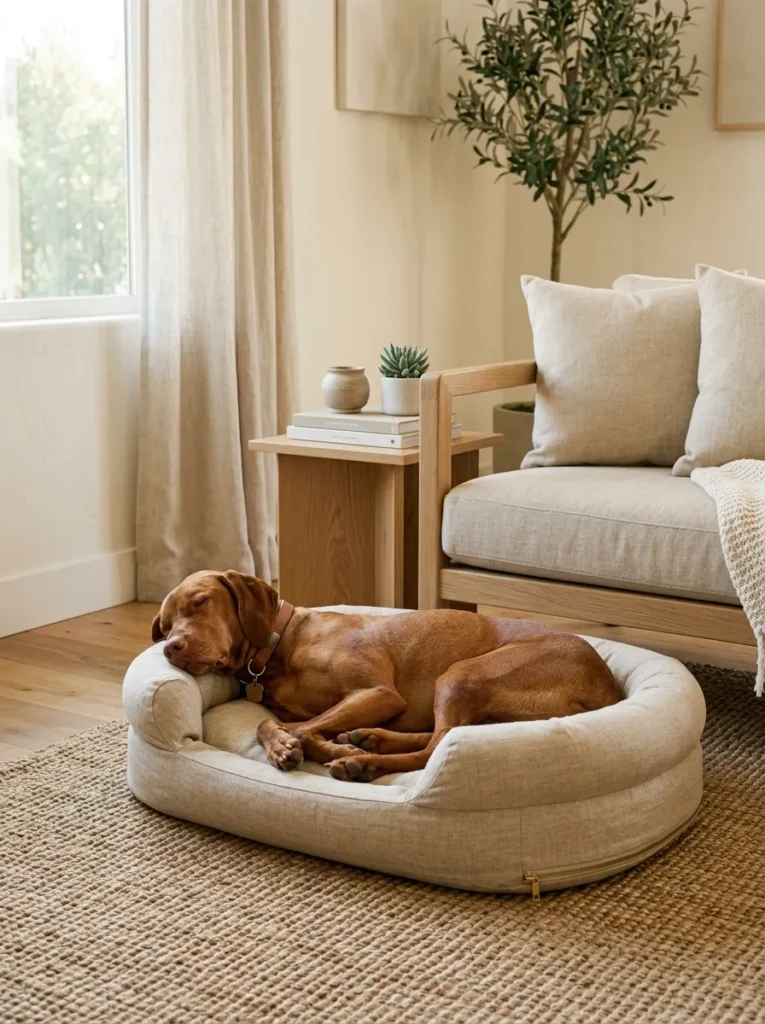
Vibe: Calm and minimal — the dog bed that disappears into a minimalist room by becoming part of its textile palette.
Why it works: A natural linen bolster dog bed in a minimalist interior applies the design principle of material continuity — when the dog bed’s fabric is indistinguishable from the room’s sofa upholstery, throw pillow covers, and window treatments in both color and texture, the bed becomes part of the room’s textile composition rather than an intruding object. The bolster edge detail — a continuous rolled edge around the perimeter that provides the resting surface dogs instinctively seek for their heads and chins — is the functional element that justifies the bolster style over a simple flat cushion, and it also provides the visual definition that gives the bed a designed rather than improvised appearance. Low profile (under 10cm height) is the dimension decision that most determines whether a dog bed reads as furniture or as an object on the floor.
How to get it: Source a bolster dog bed with a removable, machine-washable linen cover rather than a fixed linen exterior — the machine-washability of the cover is the practical requirement that makes linen appropriate for dog bedding (which requires weekly washing in most households). Specify undyed or natural-dyed linen in the room’s primary neutral rather than a white or off-white that will show soiling. Position beside (rather than in front of) the room’s primary sofa — the lateral positioning creates a dog zone adjacent to the human zone rather than blocking the room’s primary sightline.
| Product |
|---|
| Natural linen dog bed cover removable zip |
| Oval dog bed insert high-density foam |
| Bolster dog bed natural linen medium |
| Organic cotton dog bed filler washable |
| Natural undyed linen fabric for DIY cover |
Also view: 14 Stylish Dog Bedroom Designs for Happy Pets
2. Wicker Basket Dog Bed for the Coastal or Bohemian Room
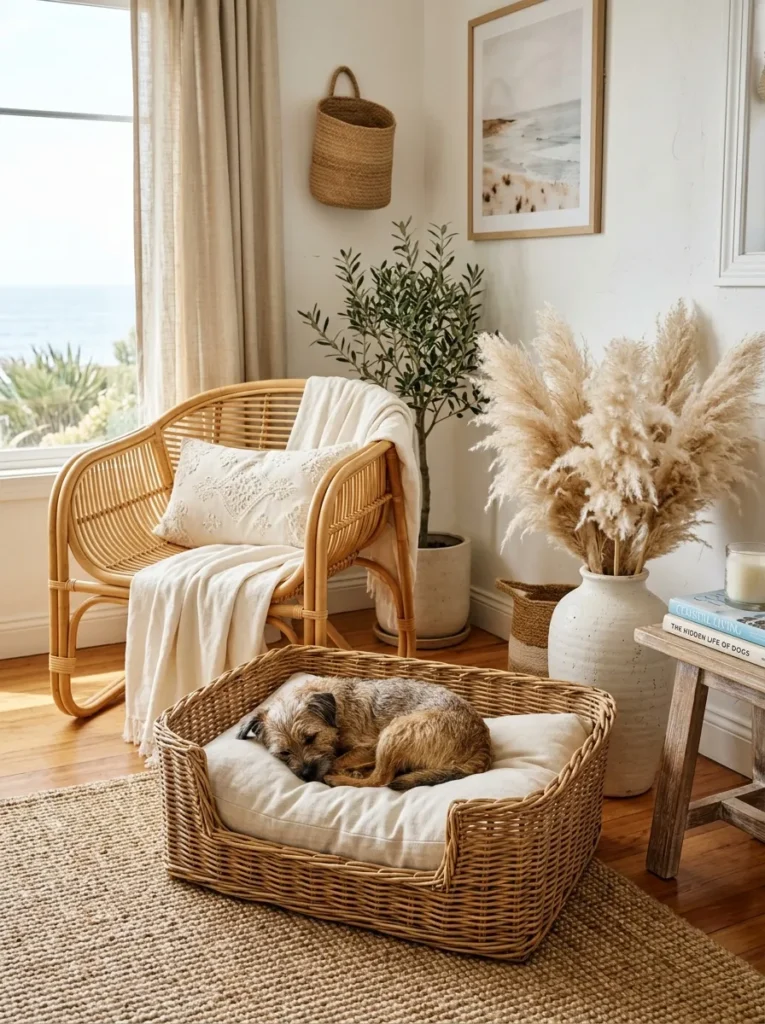
Vibe: Warm and natural — the dog bed that belongs to the room’s woven material story from the first day it is placed.
Why it works: A wicker basket dog bed in a coastal or bohemian interior applies the design principle of material family repetition — wicker, rattan, seagrass, and jute are the natural woven material family that defines coastal and bohemian interior design, and a wicker dog basket belongs to this family as naturally as the rattan pendant light and the seagrass rug. The basket format also provides the enclosed, denning quality that many dogs prefer for sleeping — the wicker walls on all sides create a defined territory that the open-platform bed format cannot provide. The removable linen cushion insert is the functional key: it provides the comfortable sleeping surface and the washable textile element without compromising the basket’s natural aesthetic.
How to get it: Size the wicker basket to allow the dog to turn a full circle inside it and lie with their legs stretched — approximately 20cm larger in diameter than the dog’s body length provides the minimum comfortable interior. Line with a custom-cut high-density foam insert covered in natural linen or cotton canvas. Avoid wicker baskets with sharp interior weave points that might scratch or catch the dog’s coat — smooth-interior wicker baskets with fully completed edge bindings are the appropriate specification.
| Product |
|---|
| Natural wicker dog basket large |
| Cream linen cushion insert for basket |
| High-density foam cut to basket diameter |
| Sisal rug natural for positioning |
| Rattan dog basket with handles set |
3. Bouclé Dog Bed for the Contemporary Luxe Room
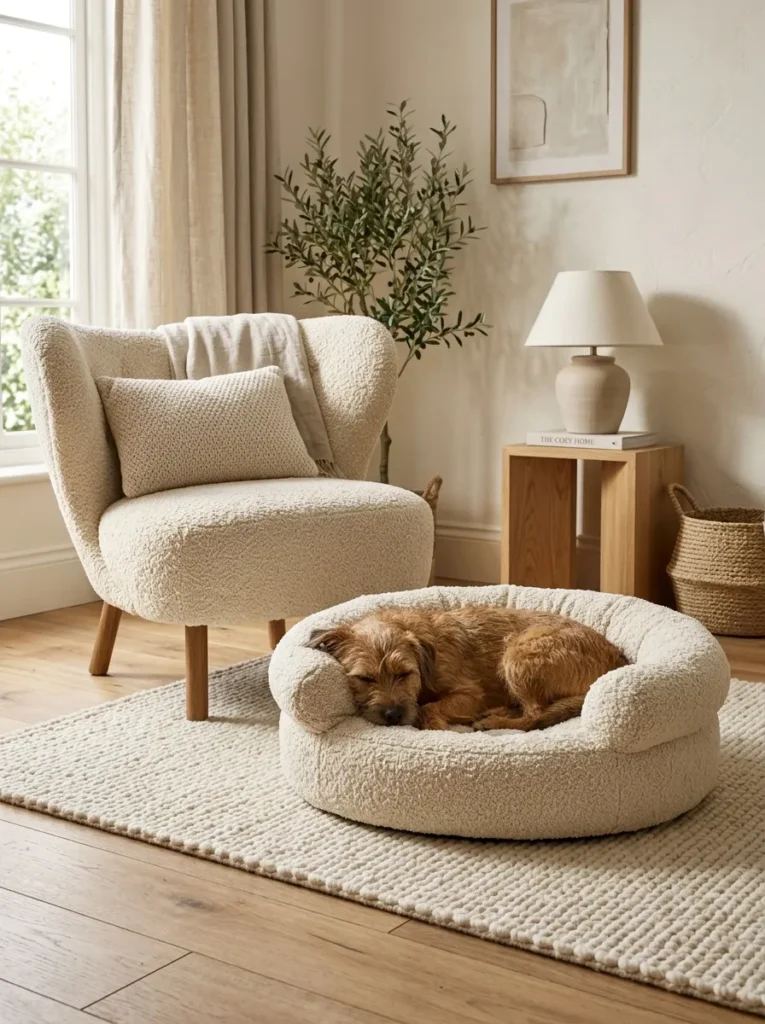
Vibe: Luxurious and considered — the dog bed that reads as the room’s most thoughtfully chosen accent piece.
Why it works: A bouclé dog bed positioned beside a bouclé accent chair applies the design principle of material echo — when the dog’s bed is upholstered in the same fabric as a nearby piece of human furniture, the two objects enter a visual dialogue that reads as deliberate design coordination rather than coincidence. The round format is the dog bed form that most successfully reads as designed domestic object — its geometric clarity and the rolled edge detail are design decisions that reference decorative objects as much as functional pet furniture. The bouclé texture is the specific material that makes this coordination most convincing because bouclé’s visual richness and warmth communicates the same luxury register whether it appears on a dog bed or a human chair.
How to get it: Source a round bouclé dog bed with a high-quality removable bouclé cover — the cover must be machine washable without the bouclé pile deteriorating, which requires a quality bouclé fabric with a tightly woven backing. Match the dog bed’s bouclé color as closely as possible to the nearest upholstered furniture piece — calling the supplier to request a fabric swatch is the most reliable way to verify the color match before purchasing. Position the dog bed within 50–100cm of the related furniture piece so the visual connection between them reads immediately.
| Product |
|---|
| Round bouclé dog bed cream large |
| Bouclé dog bed cover removable washable |
| Bouclé fabric yard for DIY cover |
| Round dog bed insert high-density foam |
| Cream wool area rug natural for positioning |
4. DIY Cedar Frame Dog Bed with Linen Cushion
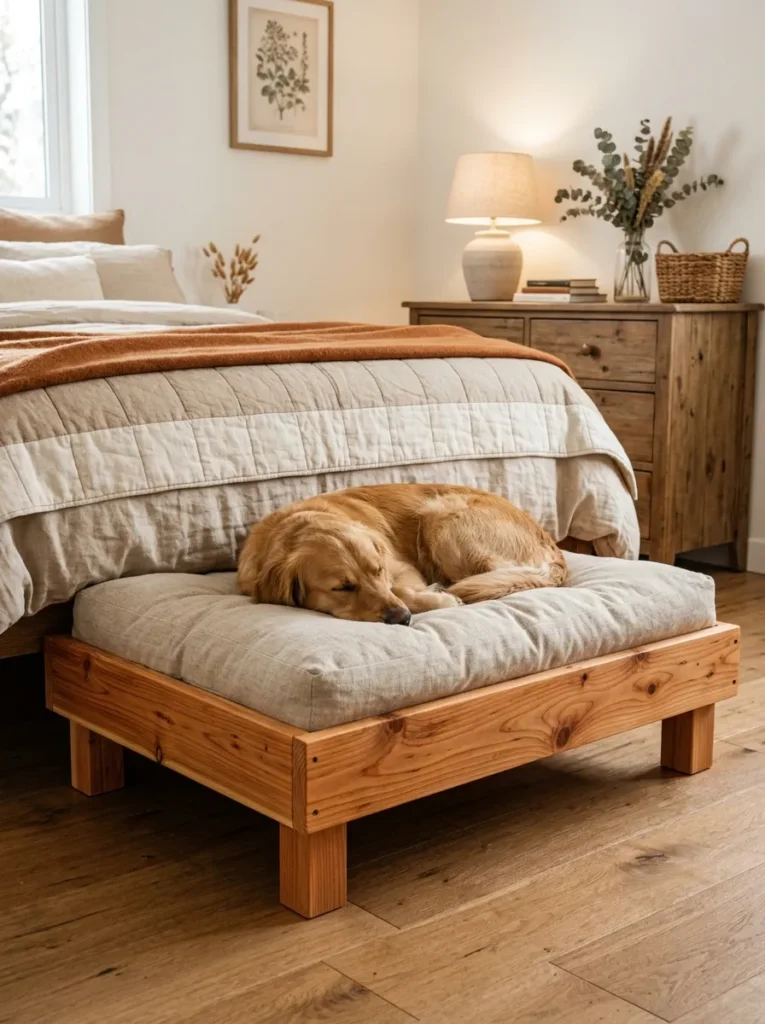
Vibe: Warm and handmade — the dog bed that carries the specific quality of something made for a specific dog in a specific room.
Why it works: A DIY cedar frame dog bed applies the design principle of furniture family construction — a simple rectangular frame built from the same timber species used in the room’s furniture (cedar, oak, walnut, or pine depending on the room) places the dog bed in the furniture rather than the pet product category. Cedar specifically is valuable for dog beds because its natural oils repel fleas, mites, and other insects that accumulate in dog sleeping areas, and its scent — familiar to anyone who has opened a cedar wardrobe — is genuinely pleasant in a bedroom or living room context. The elevated frame (legs lifting the cushion 10cm off the floor) provides the warmth insulation that floor-level beds cannot offer and creates the visual definition that separates the dog bed from a cushion placed on the floor.
How to get it: Cut cedar boards to the desired frame dimensions — add 5cm to the dog’s body length and width for a comfortable fit. Assemble the rectangle with corner lap joints or simple butt joints reinforced with countersunk screws. Add four legs cut from 4×4 cedar at the corners — the legs attach to the frame’s underside using corner brackets. Sand all surfaces to 220 grit and apply a natural wood oil finish. The cushion insert can be DIY-sewn from linen fabric over high-density foam, or a commercially purchased cushion in a complementary size can be fitted inside the frame.
Quick Win: Purchasing a cedar board dog bed frame from an independent woodworker via Etsy and pairing it with a custom linen cover sewn from fabric purchased to match the room’s existing textiles provides the designed aesthetic of a fully custom piece at significantly less time investment than a full DIY build.
| Product |
|---|
| Cedar board set for frame construction |
| Corner bracket set for frame assembly |
| Natural wood oil finish for cedar |
| Natural linen fabric yard for cushion cover |
| High-density foam insert cut to frame size |
5. Under-Stair Dog Den with Built-In Bed
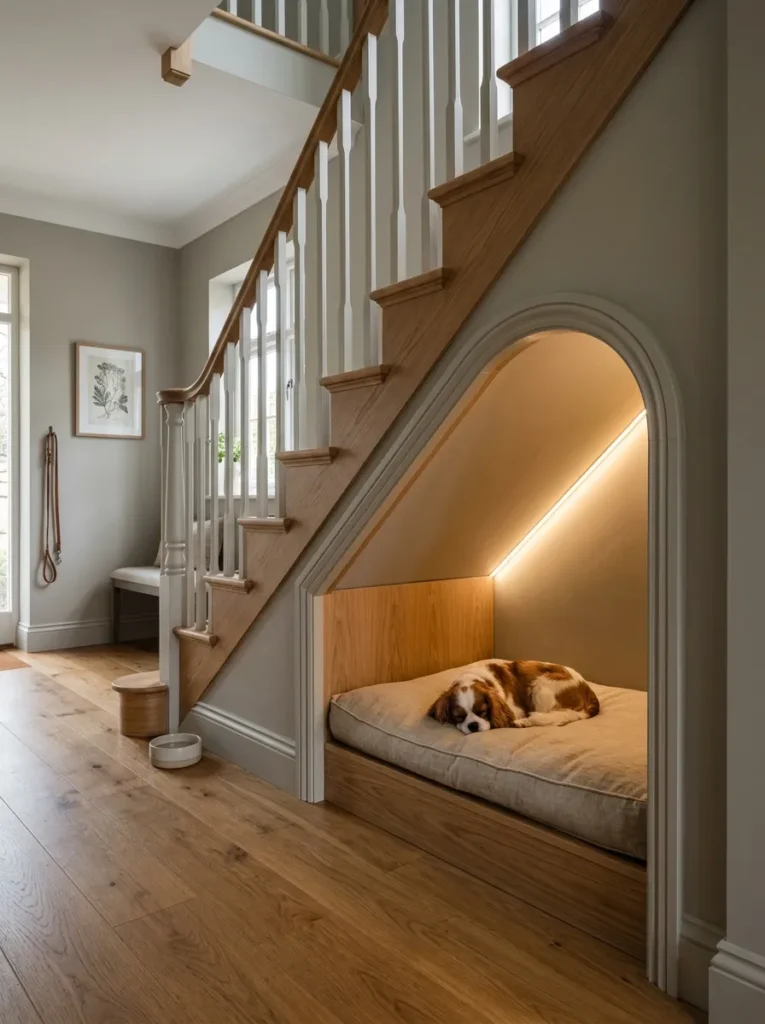
Vibe: Architectural and considered — the dog bed that looks like it was always there, because in the best version it was.
Why it works: An under-stair dog den applies the design principle of spatial activation through dedicated use assignment — the triangular under-stair volume is the most frequently unused space in any two-story home, and converting it into a dog den activates dead space while simultaneously providing the dog with the den-like enclosure that satisfies their instinct for sheltered sleeping. The architectural integration quality — painting the den interior in the hallway’s color, creating a properly finished arched opening, and installing a fitted wooden platform — is what separates this from the simpler version (a dog bed pushed under the stairs) and makes it read as a considered design feature rather than a repurposed storage area. Dogs consistently prefer the under-stair den to open-floor alternatives because the three enclosed walls and ceiling create exactly the sheltered territory their instincts seek.
How to get it: Measure the under-stair volume carefully — the available height determines the platform’s maximum size. Frame the den opening by cutting a clean arched or rectangular opening through the stair side panel using a jigsaw, finishing the cut edge with timber edging strips. Build the platform from 18mm plywood with simple timber legs, sized to fill the den floor area. Paint all den interior surfaces (walls, ceiling, platform sides) in the hallway’s existing paint color. Install LED strip lighting along the den ceiling perimeter connected to a smart plug that can be set to dim automatically at a scheduled time. Fit a natural linen cushion cut to the platform dimensions.
| Product |
|---|
| LED strip light warm white for den interior |
| Plywood sheet 18mm for platform construction |
| Timber edging strip for opening finish |
| Smart plug for LED timer control |
| Natural linen cushion custom cut to platform |
6. Vintage Suitcase Dog Bed
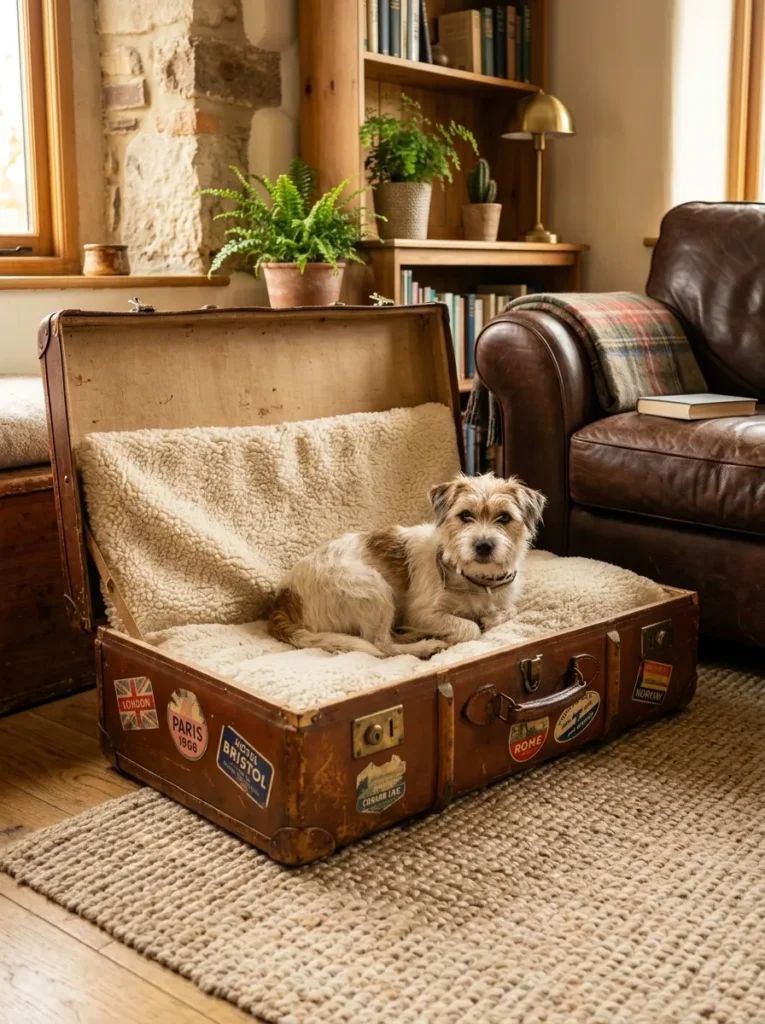
Vibe: Warm and eclectic — the dog bed that tells a story before the dog is even in it.
Why it works: A vintage suitcase dog bed applies the design principle of object repurposing as narrative decoration — the suitcase’s prior life as a travel object is visible in its aged leather, wear marks, and travel stickers, and this history gives the dog bed a layered quality that no purpose-built pet product can replicate. In a living room that already contains vintage or antique objects — aged leather furniture, vintage maps, collected ceramics — the suitcase dog bed belongs to the room’s collecting aesthetic as naturally as any other piece. The suitcase format also provides the slightly enclosed, contained sleeping space that many dogs prefer — the suitcase walls on all sides create a territory with defined boundaries that the dog learns to associate specifically with rest.
How to get it: Source a vintage leather suitcase from antique dealers, estate sales, or charity shops — size to the dog’s body dimensions plus 15–20cm clearance on all sides. Clean the interior thoroughly with a mild leather cleaner, removing any odors or residue from previous use. Cut a high-density foam insert to the suitcase’s interior floor dimensions, adding 2–3cm extra on all sides to achieve a snug fit that prevents the insert from shifting. Cover the foam in a sherpa or performance fabric cover that can be removed and washed. The suitcase can stand open against a wall as a permanent display and sleeping station, or be positioned flat on the floor when the dog is using it.
| Product |
|---|
| Vintage leather suitcase large antique |
| Cream sherpa cushion cover for interior |
| High-density foam insert cut to suitcase size |
| Leather cleaner and conditioner |
| Velvet fabric alternative for interior cover |
7. Matching Furniture Collection Dog Bed
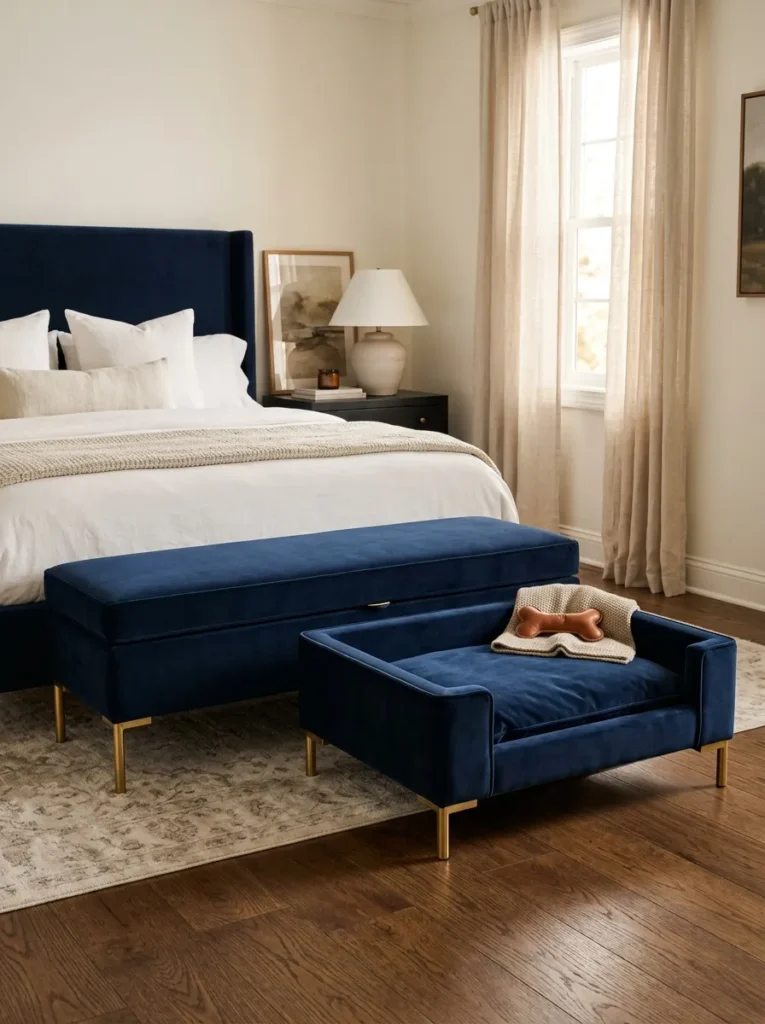
Vibe: Coordinated and designed — the dog bed that a houseguest notices on the third visit and realizes is the dog’s space, not a footstool.
Why it works: A dog bed upholstered to match the room’s primary furniture collection applies the highest expression of the material family membership principle — when the dog bed’s fabric, color, and hardware are identical to the room’s ottoman, headboard, or accent chair, the bed becomes a member of the furniture collection rather than a visitor from the pet product category. This approach requires either sourcing a dog bed from a custom upholstery maker who can work in the specified fabric, or DIY-recovering a suitable dog bed frame in matching material. The result is the most seamlessly integrated dog bed available — observers who do not own dogs may not immediately identify the piece as pet furniture, which is the ultimate test of successful design integration.
How to get it: Source the matching upholstery fabric from the same supplier as the room’s furniture fabric. Have a local upholsterer build or re-cover a simple dog bed frame in the matching fabric — most upholsterers can work from measurements and a fabric sample. Specify matching hardware (leg finish, any decorative nails or piping detail) to the room’s furniture. The foam insert must be appropriately dense for a dog’s body weight — specify a minimum 1.8 lb density foam for the dog bed insert, which is the same density appropriate for human furniture cushions.
| Product |
|---|
| Matching fabric yard from room furniture supplier |
| Low dog bed frame for upholstering |
| High-density foam 1.8 lb for insert |
| Matching leg hardware brass or matte black |
| Local upholsterer for custom covering |
8. Elevated Mid-Century Dog Bed
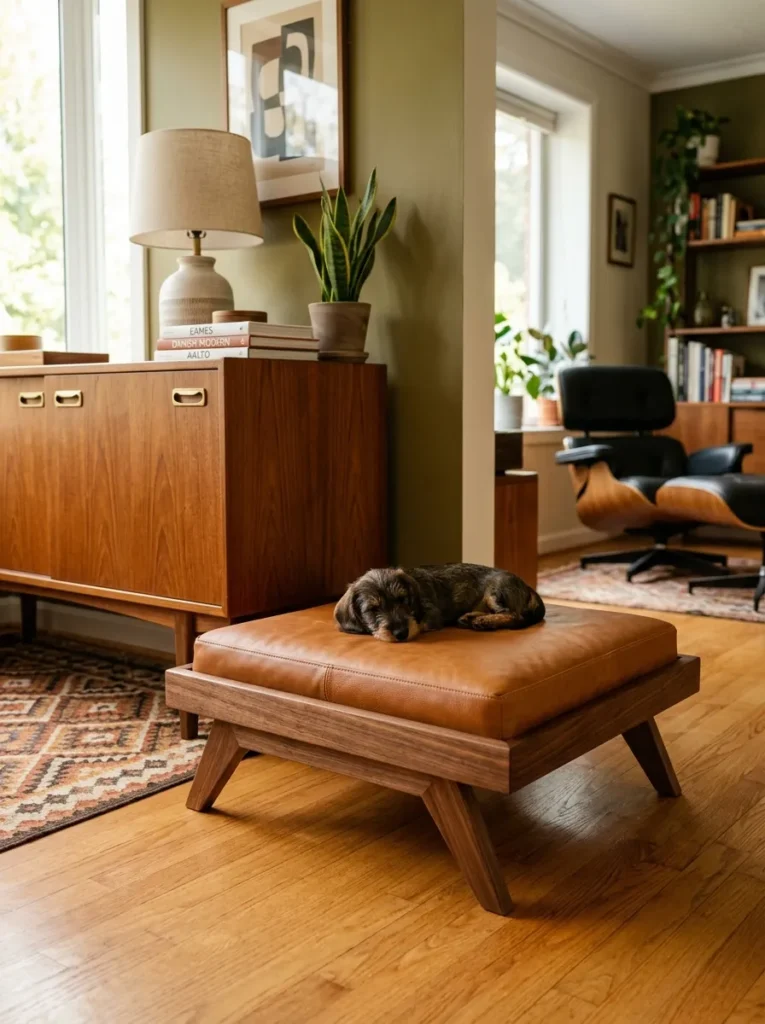
Vibe: Mid-century and considered — the dog bed that furniture designers would make if they were asked to solve the pet furniture problem.
Why it works: A mid-century style elevated dog bed with splayed walnut legs and a fitted canvas cushion applies the design principle of furniture precedent reference — the form’s angular splayed legs, low height, and clean horizontal line reference Scandinavian mid-century furniture design so directly that the piece is immediately identified as belonging to the mid-century category before it is identified as a dog bed. This category membership within furniture design rather than pet product design is the specific quality that makes this bed the most convincing integration solution for mid-century modern interior settings. The elevation on proper furniture legs is also the functional quality that most meaningfully improves on floor-level alternatives — an elevated sleeping surface stays warmer and drier than a floor-level bed and is easier for older dogs to access than beds requiring them to step up.
How to get it: Source from independent woodworking makers who produce mid-century inspired pet furniture — several small-batch makers on Etsy and direct-to-consumer pet furniture brands produce elevated teak and walnut dog beds in genuine mid-century proportions. Alternatively, build from a walnut slab cut to the dog’s dimensions, routed at the perimeter for a fitted cushion channel, and fitted with tapered walnut furniture legs at the four corners using threaded insert fittings. Canvas, leather, or performance fabric in caramel, warm cream, or natural tan are the cushion color choices that most authentically reference mid-century furniture.
| Product |
|---|
| Mid-century elevated dog bed teak walnut |
| Caramel canvas replacement cushion cover |
| Tapered walnut furniture leg set for DIY |
| Threaded insert leg fitting set |
| Performance fabric yard caramel for cover |
9. Window Seat Dog Bed Built-In
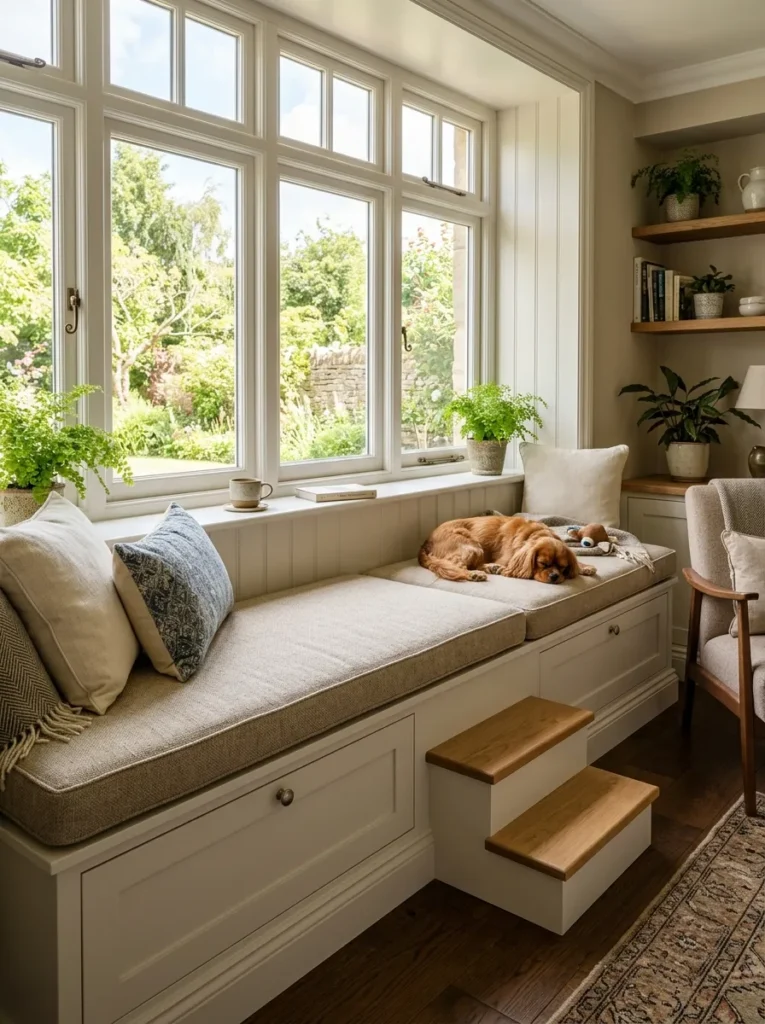
Vibe: Considered and domestic — the window seat that says both the human and the dog have their favorite spot in this room.
Why it works: A window seat with an integrated dog bed section applies the design principle of shared zone differentiation — the human and dog sections share the same furniture piece, the same window, and the same light, while the subtle difference in cushion texture between the two sections communicates their respective purposes without requiring any signage, barriers, or separate furniture pieces. Dogs are powerfully attracted to window seats for the same reasons humans are — natural light, elevated position with room sightlines, warmth from passive solar gain through the glass — and a dedicated dog section at one end of a window seat satisfies this attraction while defining the space allocation between human and dog use. The built-in step at the cabinet front is the accessibility detail that makes the window seat genuinely usable for small dogs and senior dogs who cannot jump to the seat height.
How to get it: Build the window seat cabinet from plywood with a painted MDF face frame, sizing the total run to the full window width. Divide the interior into drawers for human storage under the human section and a simple cabinet opening (or additional drawers) under the dog section. Upholster the full seat surface with a continuous piece of the chosen fabric, but use a different fill density under the dog section (firmer, washable foam) and specify the dog section’s cushion cover as a separate piece that can be removed and washed independently of the human seat cushion.
| Product |
|---|
| Plywood sheet for window seat cabinet |
| Performance fabric yard window seat |
| Washable foam insert for dog section |
| Piano hinge for access to interior |
| Step stool small for dog access |
10. Felted Wool Cave Bed for Small Dogs
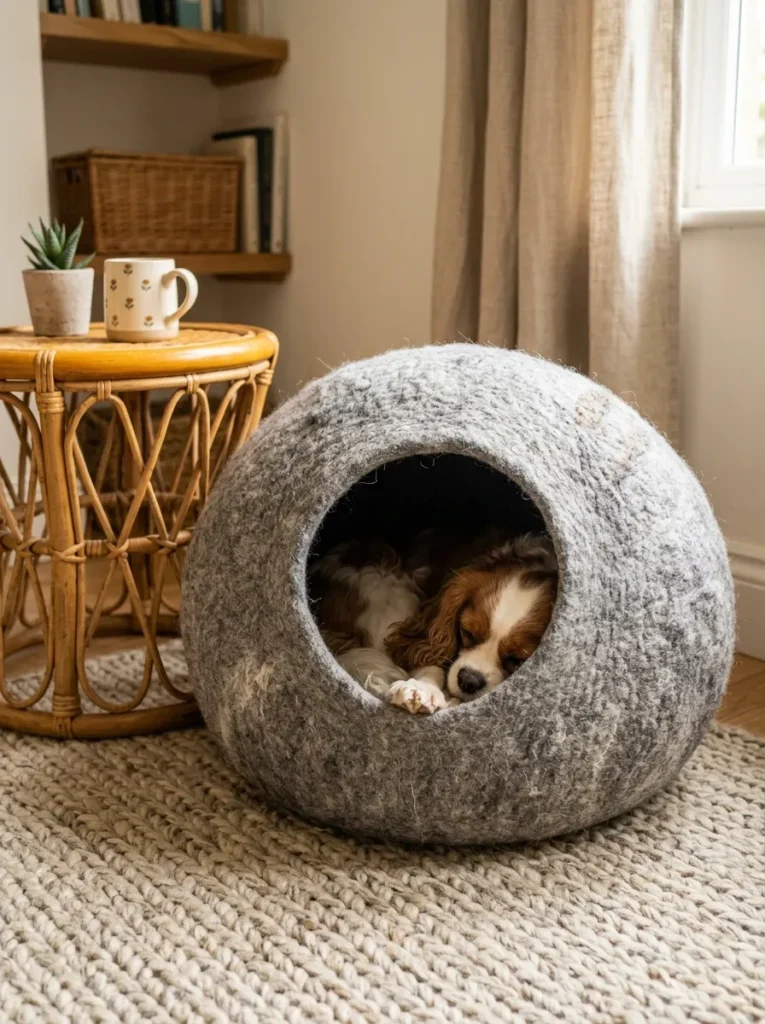
Vibe: Cozy and artisanal — the dog bed that is as much an object of craft as a place for a dog to sleep.
Why it works: A handmade felted wool cave dog bed applies the design principle of artisan object as room feature — a genuinely hand-felted wool cave bed is as much a decorative object as it is a functional pet product, and its presence in a room adds to the room’s material and craft vocabulary rather than subtracting from it. The cave format satisfies the strongest version of a small dog’s denning instinct — the completely enclosed sleeping space with a single entrance provides the maximum sense of territory and security, which is reflected in the significantly longer and deeper sleep that cave-bed users typically achieve compared to open-platform alternatives. Natural felted wool’s thermal properties also make the cave genuinely warmer in winter than any synthetic alternative — wool’s trapped-air insulation provides warmth without any heating, which is the specific comfort quality that makes dogs return to wool sleeping surfaces repeatedly.
How to get it: Source handmade felted wool cave beds from independent makers — New Zealand wool felted cave beds are the most widely available and most consistently well-reviewed category, with multiple Etsy and specialist pet furniture makers producing them in natural gray, warm cream, and rust tones. Machine-made felt cave beds are also available at lower cost but lack the slight surface texture variation and natural wool quality of hand-felted alternatives. Size to the dog’s body dimensions — the cave interior should be approximately 30% larger than the dog’s curled sleeping position for comfortable movement within the cave.
| Product |
|---|
| Handmade felted wool cave bed natural gray |
| New Zealand wool cave dog bed |
| Felted wool cave bed natural cream |
| Natural wool rug for positioning beneath |
| Small dog cave bed artisan maker |
11. Performance Fabric Dog Sofa Bed
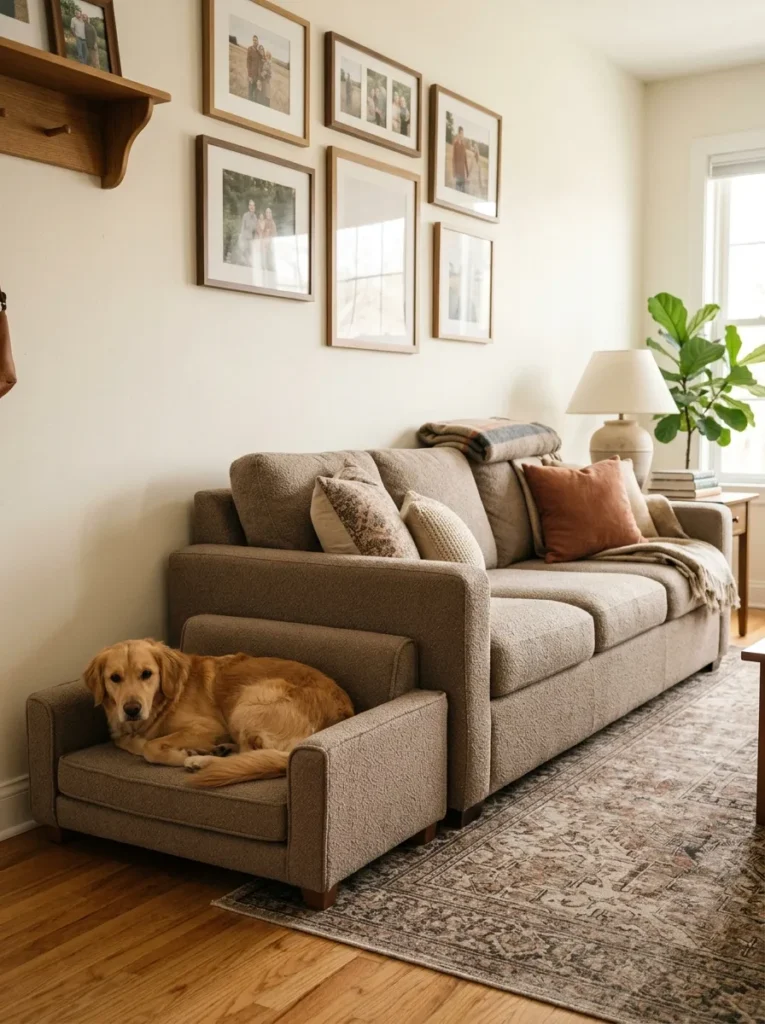
Vibe: Warm and considered — the dog sofa that makes every family photograph look like it was styled by someone who thought about every detail.
Why it works: A performance fabric dog sofa that matches the room’s primary sofa applies the design principle of scaled companion pieces — two objects that share material, color, and form vocabulary at different scales create a visual relationship of deliberate coordination that reads as the room’s most designed moment. The dog sofa format (armrests, back, and seat) is the dog bed that most obviously references human furniture design, and its presence beside a matching human sofa creates a space that communicates genuine family inclusion of the dog in the domestic design concept rather than pet accommodation as a compromise. Performance fabric is the specific material specification that makes this approach practically viable — performance fabric in Sunbrella or equivalent formulations can be hosed clean, is resistant to odors, and maintains its appearance through years of pet use in a way that standard upholstery fabric cannot.
How to get it: Source dog sofas from specialist pet furniture brands that offer performance fabric options — Orvis, Molly Mutt, and BarkBox have produced elevated dog sofa designs in quality fabrics. For the matching fabric approach, source a dog sofa in a neutral base form and have it recovered by a local upholsterer in the same fabric as the room’s primary sofa — this requires a sufficient quantity of the room’s fabric remaining from the original purchase or sourced from the same supplier.
| Product |
|---|
| Performance fabric dog sofa medium |
| Sunbrella performance fabric yard for recovering |
| Dog sofa replacement cover washable |
| Local upholsterer for custom recovering |
| High-density foam replacement for dog sofa |
12. Reclaimed Wood Platform Dog Bed
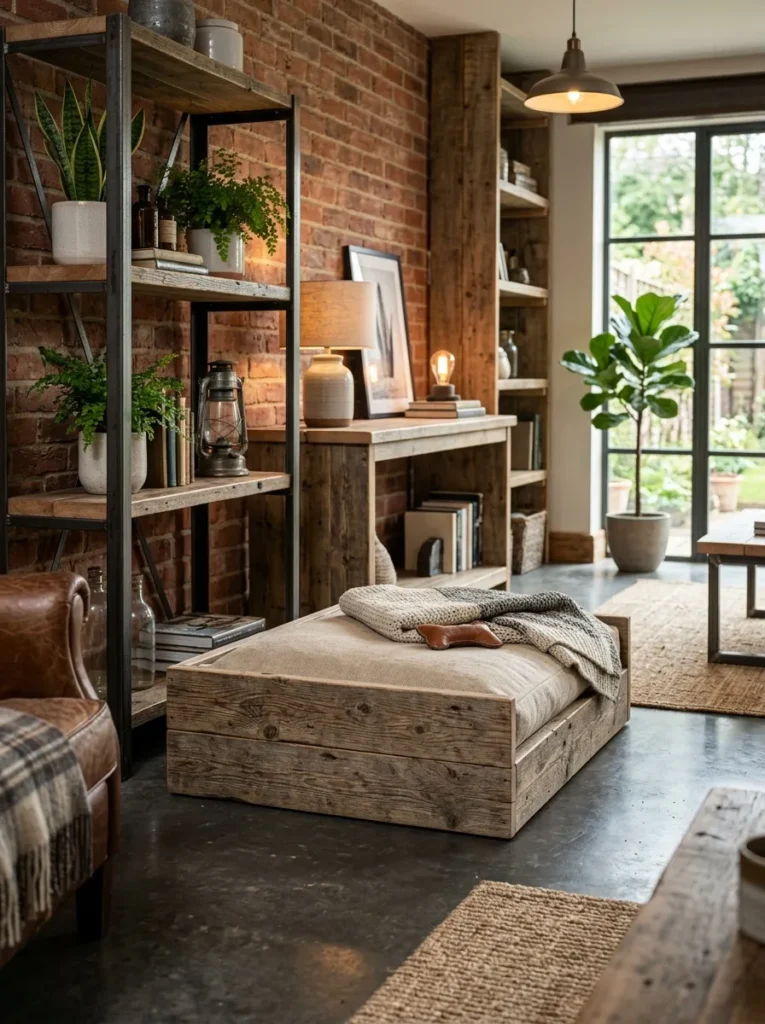
Vibe: Warm and industrial — the dog bed that belongs to the room’s reclaimed material story as honestly as the coffee table.
Why it works: A reclaimed timber platform dog bed in an industrial or farmhouse interior applies the design principle of material provenance as design quality — reclaimed timber’s visible history (weathering, old nail holes, grain variation, saw marks) gives it the specific aged character that no new wood can replicate, and this character is precisely what makes it the appropriate material for an industrial or farmhouse room where aged, authentic materials are the primary design vocabulary. A dog bed built from the same reclaimed timber as the room’s coffee table or shelving becomes part of the room’s material narrative — it reads as belonging to the space in the same way as every other reclaimed material element.
How to get it: Source reclaimed timber from architectural salvage dealers, old barn demolition, or reclaimed wood flooring suppliers — specify boards of consistent thickness (minimum 25mm for structural platform use) but encourage variation in width and surface character for the most authentic aesthetic. Construct the platform by face-screwing the reclaimed boards to a simple timber subframe — the visible screw heads add to the industrial aesthetic. Seal the timber with a penetrating wood oil (not polyurethane) to prevent splinters while maintaining the natural surface character. Fit a machine-washable canvas or cotton duck cushion cover in natural oatmeal or warm cream.
| Product |
|---|
| Reclaimed timber boards assorted |
| Natural penetrating wood oil sealer |
| Canvas fabric oatmeal for cushion cover |
| Timber subframe lumber for construction |
| Heavy-duty staple gun for cushion cover |
13. Velvet Dog Bed for the Maximalist or Jewel Tone Room
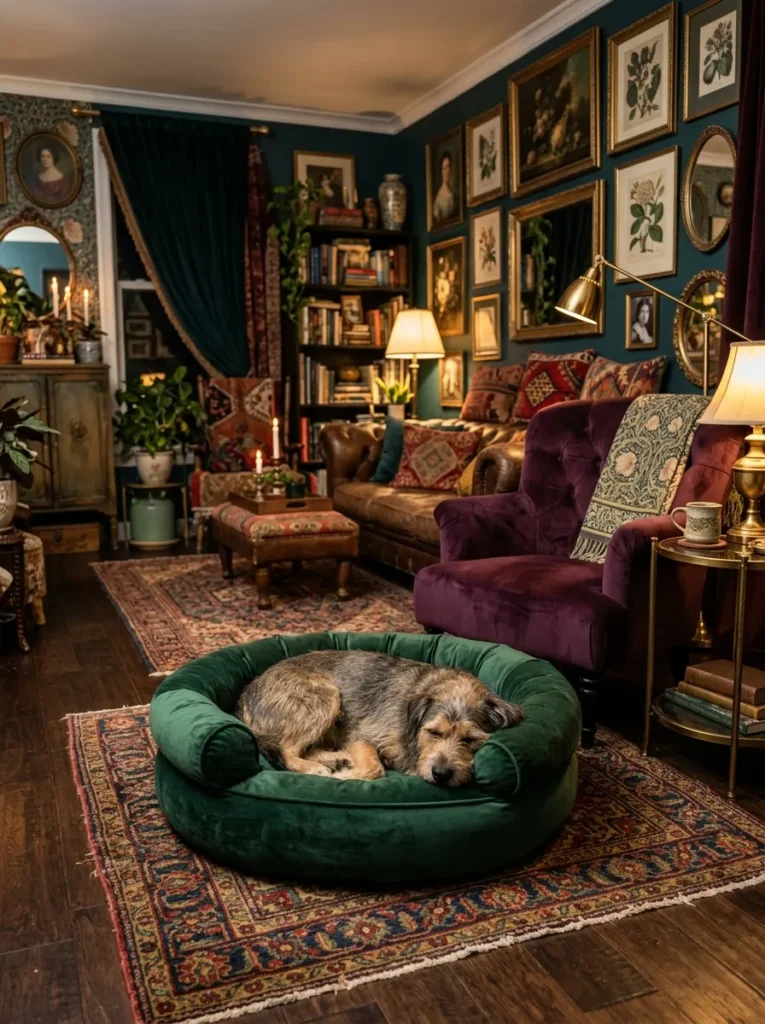
Vibe: Rich and considered — the dog bed that belongs in the maximalist room as much as the Persian rug and the tufted chair.
Why it works: A deep velvet dog bed in a jewel tone — forest green, deep plum, sapphire blue, or oxblood — applies the design principle of palette extension into the pet furniture category. Maximalist and jewel tone interiors are defined by the richness and variety of their color palette, and a dog bed in a complementary jewel tone extends that palette to the dog’s space rather than interrupting it with a neutral that reads as an apologetic compromise. Velvet is the specific fabric that makes a colored dog bed work in a rich interior because velvet’s depth of tone and light response are consistent with the room’s other richly textured surfaces — the Persian rug’s wool pile, the tufted chair’s velvet, the layered cushion covers. A forest green velvet dog bed on a warm Persian rug beside a plum tufted chair creates a considered trinitarian color relationship (green, rust, plum from the rug’s palette, extended into the three-dimensional objects of the room).
How to get it: Source a round velvet dog bed with a removable velvet cover from pet furniture specialists or independent fabric makers who produce dog beds in quality velvet — the cover must be machine washable, which requires a velvet with a tight enough weave to survive repeated machine washing without pile degradation. Deep jewel tones in velvet are available from small-batch pet bed makers who use furniture-grade velvet rather than the thin polyester velvet common in mass-market pet products.
| Product |
|---|
| Round velvet dog bed deep forest green |
| Jewel tone velvet dog bed cover removable |
| Velvet fabric yard deep color for DIY cover |
| Round dog bed foam insert high density |
| Persian rug small for bed positioning |
14. Dog Bed Integrated into Furniture — Sideboard Conversion
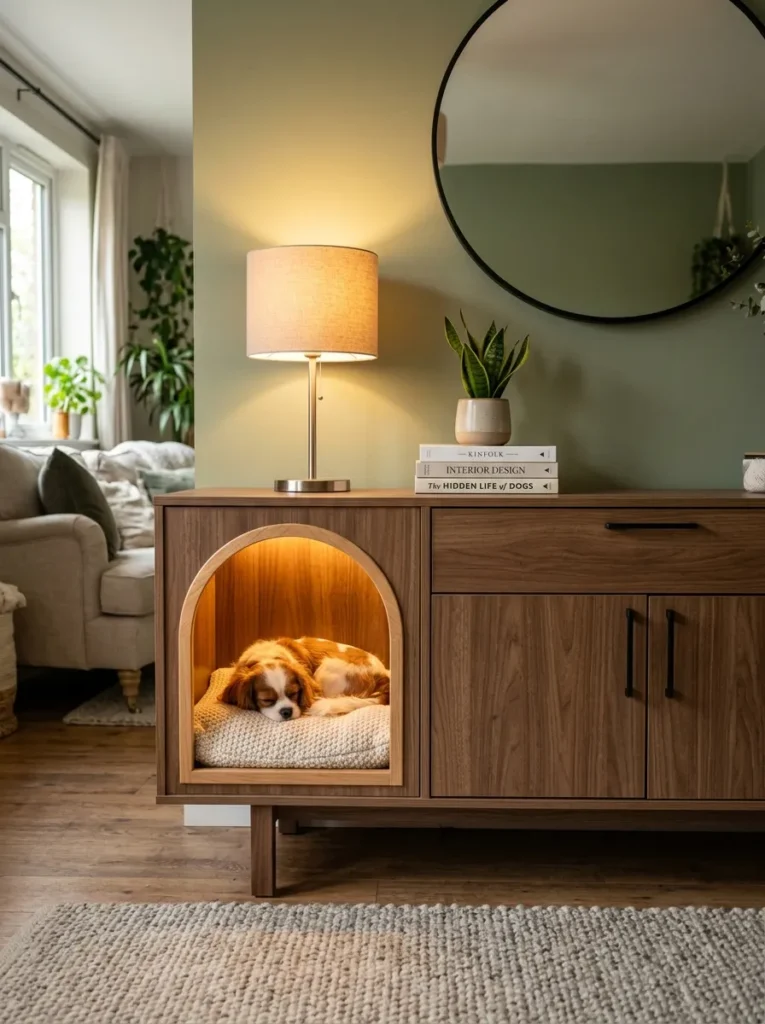
Vibe: Clever and warm — the furniture piece that solves two problems simultaneously and makes both solutions look like they were always the plan.
Why it works: An integrated dog house within a sideboard conversion applies the design principle of multi-function furniture as spatial efficiency — the sideboard performs its original storage and display function on most of its length while providing a dedicated, enclosed dog sleeping space within one section. This integration is the design solution that most completely resolves the visual tension between dog bed and interior design, because the dog bed is no longer a separate object competing for floor space and visual attention but an integrated element within a piece of furniture the room already required. The arched opening is the specific detail that distinguishes a considered conversion from an improvised one — the arch references historical furniture design elements (doorways, niches, architectural openings) in a way that reads as designed rather than modified.
How to get it: Source a low sideboard with at least three cabinet sections — one section (typically at the dog-accessible end) is converted to the dog space by removing the cabinet door and cutting an arched opening in the side panel using a jigsaw. Line the interior with cream or natural linen cushion material over a cut-to-fit foam insert. Install a small warm LED strip along the interior ceiling using a battery-powered strip that requires no wiring. Maintain the dog space section’s top surface as normal sideboard display area — the continuity of the top surface is what makes the integrated dog space read as furniture design rather than modification.
| Product |
|---|
| Low sideboard three section cabinet |
| Battery LED strip warm interior |
| Arch template for jigsaw cutting guide |
| Cream cushion foam insert cut to size |
| Linen fabric interior lining |
15. Seasonal Cover System — One Bed, Four Looks
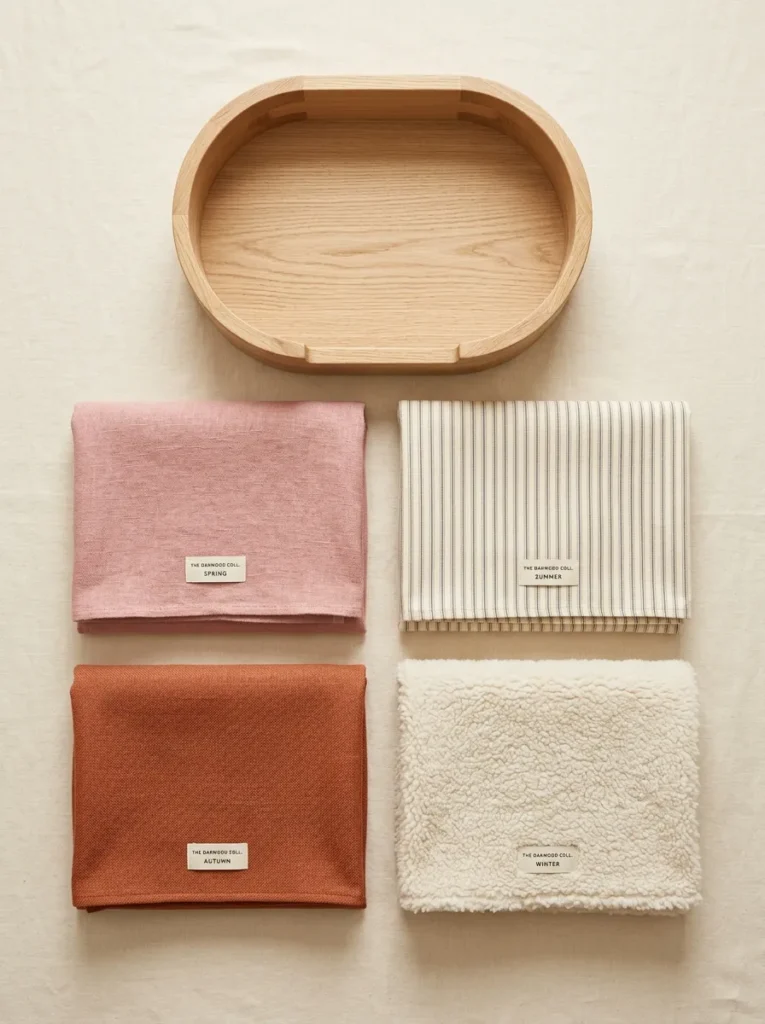
Vibe: Organized and considered — the dog bed system that evolves with the room through every seasonal decoration change.
Why it works: A seasonal cover system for a single quality dog bed frame applies the design principle of wardrobe thinking to pet furniture — just as rooms benefit from seasonal textile refreshes (changing throw pillow covers, window treatments, and throws between seasons), a dog bed with interchangeable covers can participate in the room’s seasonal evolution without requiring a new bed purchase for each design iteration. The four covers address the room’s seasonal palette shifts: dusty rose linen for spring freshness, cotton stripe for summer lightness, terracotta performance fabric for autumn warmth, and cream sherpa for winter cozy — each cover changing the dog bed’s seasonal relationship with the room while the underlying foam insert and structural frame remain constant.
How to get it: Invest in one quality high-density foam insert in the appropriate size and shape, covered in a durable base layer of cotton muslin for protection. Sew or commission four seasonal covers in the chosen fabrics — each cover made with a zipper or envelope closure for easy on-and-off changing. The covers should be sized with slight negative ease on the foam (approximately 1cm tighter than the foam dimensions in all directions) to ensure they fit snugly rather than sagging or shifting. Store off-season covers in a labeled linen bag or vacuum storage bag to maintain fabric quality between seasons.
| Product |
|---|
| Oval dog bed foam insert high density |
| Dusty rose linen fabric yard for spring cover |
| Cotton stripe fabric yard for summer cover |
| Terracotta performance fabric for autumn |
| Cream sherpa fabric yard for winter cover |
How to Start Your Dog Bed Design Integration
Start with color. Before sourcing any new dog bed or modifying an existing one, identify your room’s primary neutral — the color that appears most frequently across the largest surfaces (the sofa upholstery, the main rug, the curtains). A dog bed in this color or in a color from the same tonal family will integrate into the room with no further design effort required. This single decision — color alignment — is responsible for the majority of the visual improvement between a dog bed that clashes and a dog bed that belongs. A natural linen bed in a linen-palette room, a bouclé cream bed in a cream upholstery room, a deep green velvet bed in a jewel tone room — color alignment is the foundational integration principle from which every other decision follows.
The most common mistake people make when choosing a dog bed for a designed interior is prioritizing the dog bed’s design over its size — purchasing a beautiful but undersized bed because the larger size looked less refined, or choosing a low platform because it photographed better than a taller bolster. A dog bed that is too small for the dog will not be used consistently — dogs circle before lying down to find a position where their full body length is supported, and a bed that cannot accommodate their body length will be abandoned for the sofa, the rug, or the floor. Measure the dog’s body length from nose to tail base in their sleeping position before purchasing any bed, and select a bed whose interior sleeping area is at least 10cm longer and wider than this measurement. A beautiful bed that fits the dog is an integration success. A beautiful bed the dog refuses is a design failure regardless of its aesthetic quality.
Three items under $50 that make an immediate impact: A high-quality removable cover in the room’s primary fabric type for an existing dog bed ($18–$35) that immediately improves the bed’s integration without replacing the entire bed; a length of natural linen fabric ($12–$18 per meter) from which a custom cover can be sewn to fit any dog bed insert, in the exact color and weight of the room’s existing textiles; and a set of four foam mounting pads ($6–$10) placed under the corners of a flat dog bed to lift it 5cm off the floor, which immediately changes the bed’s visual status from floor object to furniture item.
Realistic expectations: A simple cover replacement or color upgrade to an existing dog bed takes one afternoon and costs $20–$40. A mid-level dog bed integration — selecting a quality pre-made bed in complementary fabric and placing it intentionally within the room — costs $80–$200 for a quality bed from a specialist maker and takes an afternoon of sourcing and placement decision-making. A fully integrated built-in dog space — under-stair den, sideboard conversion, or window seat dog section — represents a weekend DIY project or professional joinery commission costing $200–$800 depending on complexity and finish quality, and produces a permanent, architecturally integrated dog space that adds genuine design value to the room rather than compromising it.
Frequently Asked Questions About Dog Beds That Blend with Decor
What fabric is most practical for a dog bed that also looks beautiful?
Performance fabrics — specifically solution-dyed acrylic (Sunbrella) and tightly woven performance linen blends — are the most practical materials for dog beds in designed interiors because they combine the visual qualities of natural fabrics with the durability, moisture resistance, and washability that dog use demands. Standard natural linen, while beautiful, absorbs moisture rapidly and is difficult to clean of pet odors without professional laundering; performance linen blends (typically 50% polyester, 50% linen-look synthetic) maintain the visual warmth of natural linen while accepting spot cleaning and machine washing without degrading. For dog beds that will be machine washed frequently, a tight-weave performance cotton duck (360 gsm or heavier) provides both durability and visual quality. Velvet and bouclé dog bed covers are available in performance formulations from specialist pet furniture makers, and these performance versions maintain their pile quality through repeated machine washing where fashion-grade velvet and bouclé would not.
How do I keep a beautiful dog bed looking good with a muddy or shedding dog?
The practical system that maintains a beautifully designed dog bed through active pet use combines three elements: a machine-washable outer cover that is easy to remove (zipper or envelope closure), a waterproof inner liner beneath the outer cover (a fitted waterproof mattress protector cut to the bed size), and a regular cover-washing schedule (weekly for heavy shedders, bi-weekly for lighter shedders). The waterproof liner is the element most often omitted — it protects the foam insert from moisture and odor penetration that makes foam inserts unusable after months of pet contact. With a waterproof liner and a washable outer cover, even a white linen dog bed cover can remain genuinely usable with a muddy dog, because the cover is washed regularly and the insert is protected.
Where is the best position to place a dog bed in a living room so it does not disrupt the room’s design?
The positions that best integrate a dog bed into a living room without disrupting its design composition are: beside (not in front of) the primary sofa, so the dog bed occupies a floor zone adjacent to human seating rather than blocking the room’s primary sightlines; in an alcove, bay, or corner where the bed creates a defined dog zone within the room’s existing spatial structure; at the base of a bookshelf or beside a fireplace where the dog bed participates in an existing furniture vignette rather than standing alone; and under a console table or side table where the bed’s low profile reads as part of the table’s base rather than as a separate floor object. Positions that consistently disrupt room composition are: the center of a rug (blocks the rug’s visual presence and the room’s traffic flow), directly in front of the fireplace (blocks the fireplace as the room’s primary focal point), and in doorway zones (creates a visual obstacle at the threshold that makes the room feel smaller).
Is it worth investing in a premium dog bed for design integration reasons?
For dogs who are consistent, stable, long-term residents of the home — adult dogs past the destructive puppy phase — investing in a premium dog bed from a specialist maker ($120–$350 for quality mid-range options) consistently provides better value than purchasing successive budget beds ($30–$60 each) that degrade rapidly and require replacement every 6–18 months. The premium bed’s advantages are foam density (higher density foam maintains its shape and support through years of daily use rather than compressing to a flat, unsupportive layer), cover quality (machine-washable performance fabric covers that survive 200+ wash cycles versus mass-market covers that pill and degrade after 20 washes), and design quality (proportions, materials, and construction that genuinely integrate with designed interiors versus the visual compromises of pet retail products). For puppies or dogs in active destructive phases, a mid-range washable cover over a quality foam insert is the appropriate investment — reserving the premium integrated bed for the adult dog who has demonstrated stable sleeping behavior.
Can I make a dog bed that matches my home decor on a budget?
A DIY dog bed in matching fabric is achievable for $30–$60 in materials and produces a result that integrates with the home’s design better than most commercial alternatives at the same price point. The most accessible DIY approach is the envelope cover — cut two rectangles of the chosen fabric to the desired bed dimensions plus seam allowance, sew on three sides with a simple seam, fold a closure overlap on the fourth side rather than adding a zipper (the envelope overlap tucks under the foam insert to close), and fill with a high-density foam insert cut by a foam supplier to the finished cover dimensions. This approach requires only basic straight-line sewing and produces a removable, washable cover in the exact fabric, color, and weight of the room’s existing textiles. The foam insert is the main material cost ($20–$40 depending on size and density) — using the highest-density foam available ($30–$40 for a quality insert) ensures the finished bed maintains its shape and support for years of use.
Ready to Create Your Dream Dog Bed Integration?
These 15 ideas cover the complete range of what a thoughtfully designed dog bed can achieve — from the material elegance of a linen bolster bed in a minimalist room and the artisan quality of a handmade felted wool cave, to the architectural integration of an under-stair dog den and the clever efficiency of a sideboard dog house. Every dog bed integration begins with a single color decision — identifying the room’s primary neutral and finding or making a dog bed in that color — and builds from there with as much or as little additional investment of time, money, and design attention as the space and the dog deserve. Right now, measure your dog’s sleeping body length, identify your room’s primary fabric color, and ask whether any existing dog bed in your home meets both criteria — if it does not, that gap between the dog’s actual need and the room’s actual palette is where the integration project begins. Save the ideas that match your room’s design direction and your dog’s sleeping preferences, and start from that first color decision. Your room can be beautiful and your dog can be comfortable — and the best version of both is almost certainly achievable in the same bed.