DIY hamster decor refers to handmade enclosure enrichment, furniture, and habitat accessories crafted from safe, non-toxic materials that support a hamster’s physical health, psychological wellbeing, and natural behaviors — turning a basic cage or tank into a genuinely enriching environment that serves the animal rather than merely containing it. Here are 15 ideas for creating a hamster habitat that prioritizes welfare, natural behavior, and the specific needs of one of the world’s most behaviorally complex small pets.
A hamster’s enclosure is not decoration. It is the entirety of that animal’s world — the only environment it has access to, the space where every behavioral need must be met or go unmet. The difference between a hamster that thrives and one that paces, bar-chews, or stress-grooms is almost entirely a function of its environment. Getting this right requires understanding what hamsters actually need rather than what they look cute doing. Here are 15 ideas worth building — for the hamster’s sake first.
Why DIY Hamster Decor Matters So Much
What separates a genuinely enriching hamster habitat from a merely decorated one? A genuinely enriching hamster habitat applies principles from ethology (the science of animal behavior in natural contexts) and welfare science to the specific behavioral repertoire of the species — typically Syrian hamsters (Mesocricetus auratus) or dwarf hamster species (Phodopus campbelli, Phodopus sungorus, Cricetulus griseus). In their natural habitat, hamsters travel 5–10 km per night, maintain complex burrow systems, forage across varied terrain, and engage in extensive scent-marking and exploratory behavior. A habitat that does not provide meaningful opportunity for these behaviors is not simply suboptimal — it is a welfare failure, documented in research as a primary cause of stereotypic behaviors (repetitive, functionless movements) in captive hamsters.
Core welfare requirements that DIY decor must serve. The non-negotiable welfare requirements for any hamster habitat are: minimum floor space of 100×50 cm (with larger being significantly better — German animal welfare recommendations specify 775 cm² minimum, but research supports much larger), adequate burrowing depth (minimum 20–30 cm of substrate throughout the enclosure), a wheel of sufficient diameter (minimum 25 cm for Syrian hamsters, 20 cm for dwarf species — smaller wheels cause spinal injury through forced arching), sufficient foraging opportunity, safe nesting material, and visual complexity through varied terrain, multiple levels, and hide spaces. Every DIY decor idea in this list is evaluated against these requirements first.
Why DIY exceeds purchased hamster products for welfare. The commercial hamster product market is largely designed for visual appeal to human buyers rather than genuine welfare benefit to hamsters — wheels are frequently too small, tubes too narrow for comfortable passage, and cage floor areas dramatically inadequate. DIY hamster decor, created with species-appropriate dimensions and non-toxic materials in mind, consistently outperforms commercial products for actual welfare benefit, because the maker can prioritize the hamster’s needs over the visual appeal and commercial viability that drive commercial product design.
Safety is non-negotiable in DIY hamster decor. Every material used in a hamster enclosure must be evaluated for safety — hamsters chew everything they encounter, which means any toxic paint, glue, wood preservative, dye, or synthetic material becomes an ingested toxin. The safety standard for all DIY hamster decor is: if it cannot be confirmed as safe for hamster ingestion, it does not enter the enclosure.
Welfare at a Glance
| Element | Detail |
|---|---|
| Philosophy | Design for the hamster’s behavioral needs, not for human aesthetics |
| Non-Negotiables | Wheel size, burrowing depth, floor space, non-toxic materials only |
| Key Materials | Untreated wood, cork bark, food-grade clay, cardboard, natural fibers |
15 DIY Hamster Decor Ideas for Tiny Pet Homes
1. Deep Substrate Burrowing System with Tunnel Supports
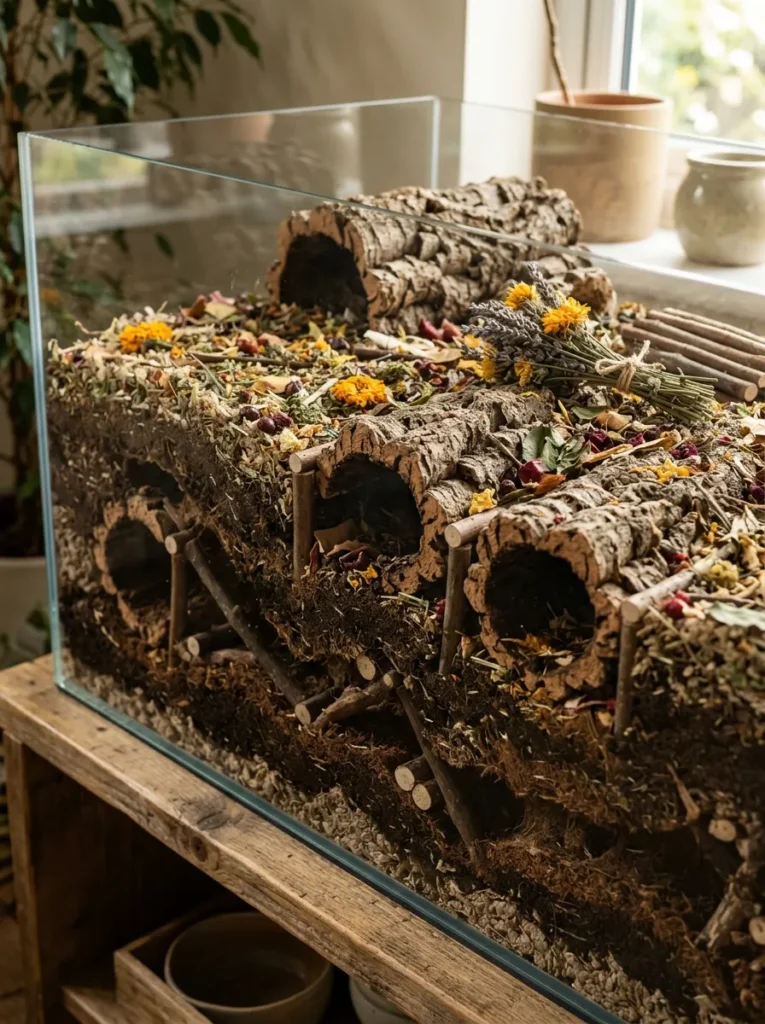
Vibe: A deep substrate burrowing system feels species-appropriately generous — the enclosure that treats tunneling as the behavioral necessity it is rather than an optional extra.
Why it works: Burrowing is the central behavioral expression of hamster natural history — in the wild, hamsters create complex multi-chambered burrow systems with separate sleeping chambers, food storage areas, and latrine zones. The design principle is behavioral priority as spatial hierarchy: in a hamster enclosure, burrowing depth is the single most welfare-significant dimension — more important than surface area decoration, more important than accessory variety, more important than any individual enrichment element. A minimum substrate depth of 30 cm throughout the enclosure (not just in one corner) allows the hamster to express the full complexity of its burrowing behavior, which is the primary welfare benefit available in captive housing.
How to get it: Use a glass tank (not a wire cage, which prevents adequate substrate depth) of minimum 120×60 cm floor area. Create a substrate mix that holds tunnel structure: 60% coconut fiber (coir), 20% organic peat or topsoil (pesticide-free), and 20% plain paper bedding or hemp bedding. Fill to minimum 30 cm depth — deeper is significantly better. Support tunnel entrances near the enclosure’s transparent wall using pieces of cork bark or small wooden blocks to create visible tunnel windows that allow observation without disturbing the burrow system. Scatter dried leaves, dried herbs, and small pieces of dried grass over the surface for additional natural texture.
Quick Win: Increasing substrate depth from the typical 5–10 cm seen in most enclosures to 30 cm is the single highest-welfare improvement available to any hamster owner — it costs only substrate material and produces immediate behavioral change, with hamsters typically beginning to dig within minutes of being introduced to adequate depth.
Shop The Look
| Product |
|---|
| Coconut fiber substrate block hamster |
| Hemp bedding small animal natural |
| Cork bark pieces natural hamster hide |
| Dried botanical herb mix hamster safe |
| Organic peat moss substrate hamster |
2. DIY Wooden Hideout from Untreated Wood Pieces
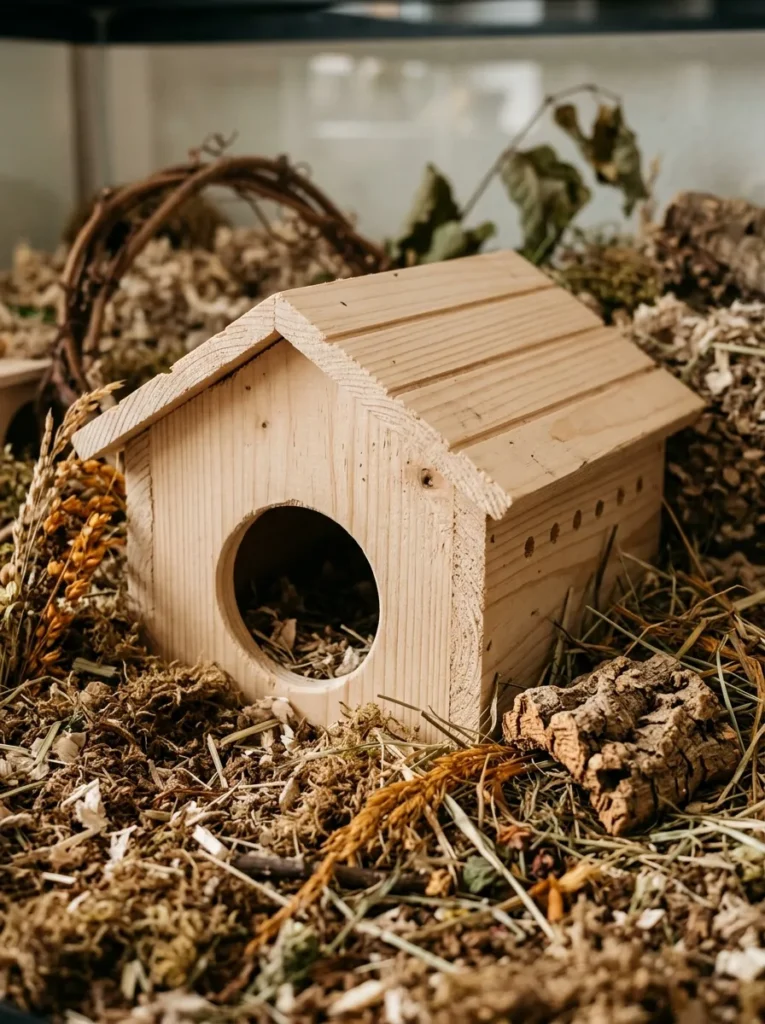
Vibe: A simple wooden hideout feels appropriately scaled — shelter designed for the animal’s actual size rather than for photographic cuteness.
Why it works: A hideout is the hamster’s surface-level resting shelter — the space where the animal sleeps, stores food, and retreats when feeling threatened or over-stimulated. The design principle is shelter adequacy over decorative elaboration: a hideout that is correctly sized (interior large enough for the hamster to turn around and curl fully, with one entrance and adequate ventilation), made from safe, chewable material, and positioned to allow partial burial in substrate serves the hamster’s shelter needs more completely than any decorative plastic house regardless of its visual appeal. Untreated softwood (pine, poplar, or balsa) is the safest and most chewable wood for hamster hideouts — it provides appropriate dental enrichment while posing no toxicity risk.
How to get it: Cut untreated pine boards (12mm thickness) into pieces for the four walls, floor, and two roof pieces. Join with small untreated wooden dowels or food-safe wood glue (PVA glue is food-safe when fully dried). Cut the entrance hole using a drill with a 50mm hole saw bit (for Syrian hamsters) or a 35mm bit (for dwarf hamsters). Sand all edges smooth with 220-grit sandpaper to prevent splinters. Apply no finish, stain, or paint — bare untreated wood is the only safe option for a chewable hamster hideout.
Shop The Look
| Product |
|---|
| Untreated pine board thin for cutting |
| PVA wood glue food safe when dry |
| Hole saw drill bit 50mm for entrance |
| Fine sandpaper 220 grit for edges |
| Small wood screw set for assembly |
3. Cork Bark Landscape with Tunnel and Platform Levels
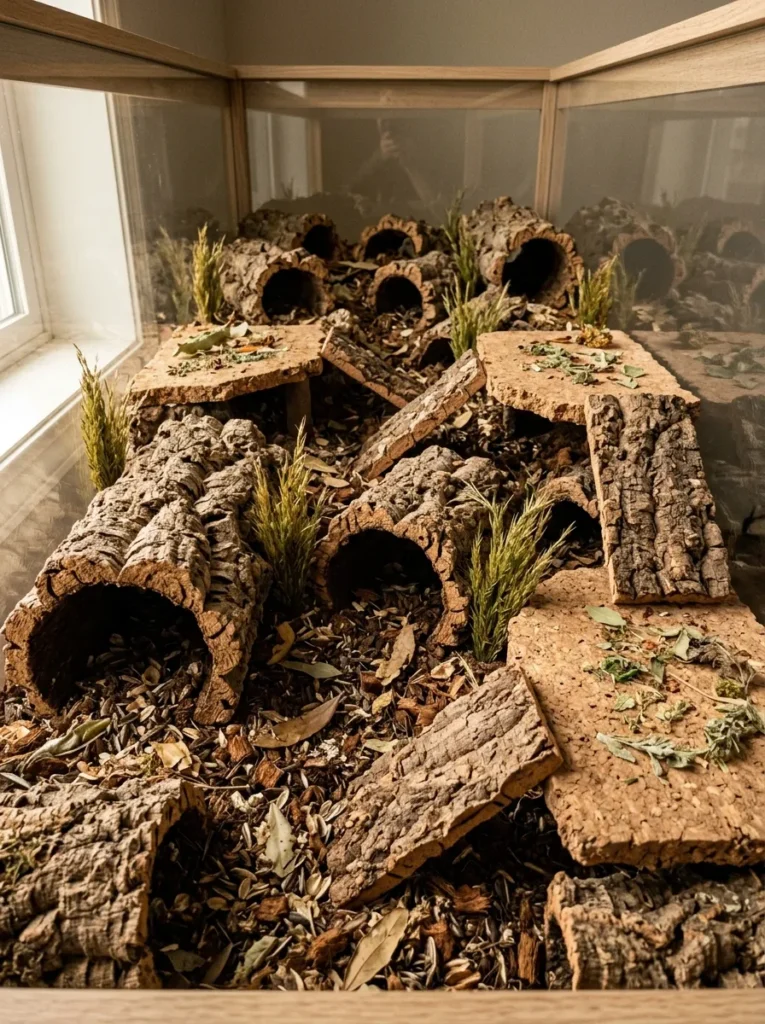
Vibe: A cork bark landscape feels genuinely naturalistic — terrain that suggests a hamster’s actual environment rather than a stylized version of it.
Why it works: Cork bark is the ideal DIY hamster landscape material because it is 100% safe, naturally antimicrobial, provides varied surface textures for sensory exploration, and can be arranged and rearranged without tools to create completely different terrain configurations as enrichment variety. The design principle is terrain complexity as behavioral enrichment: varied terrain (surfaces at different heights, tunnel passages, textured climbing surfaces, spaces to investigate) stimulates exploratory behavior and provides the physical and cognitive engagement that flat enclosure floors cannot. Cork bark used as tunnel forms, elevated platforms, and ramp connections creates a three-dimensional enclosure terrain that dramatically increases the hamster’s usable space beyond the enclosure’s floor area alone.
How to get it: Source natural cork bark from reptile and terrarium suppliers — it is widely available in varied sizes and forms (curved tube sections, flat panels, irregular chunks) and is consistently one of the most economical hamster habitat materials per square centimeter of surface created. Arrange cork bark pieces before introducing substrate — some pieces can be partially buried for stability and to create the partially concealed entrances that hamsters prefer for their hides. Refresh the arrangement every four to six weeks to provide the novelty that exploratory behavior requires.
Shop The Look
| Product |
|---|
| Natural cork bark tube section large |
| Cork bark flat panel pieces set |
| Cork bark small chunk variety pack |
| Natural cork bark curved tunnel form |
| Cork bark mixed set for habitat |
4. Foraging Scatter Setup with Food-Safe Containers
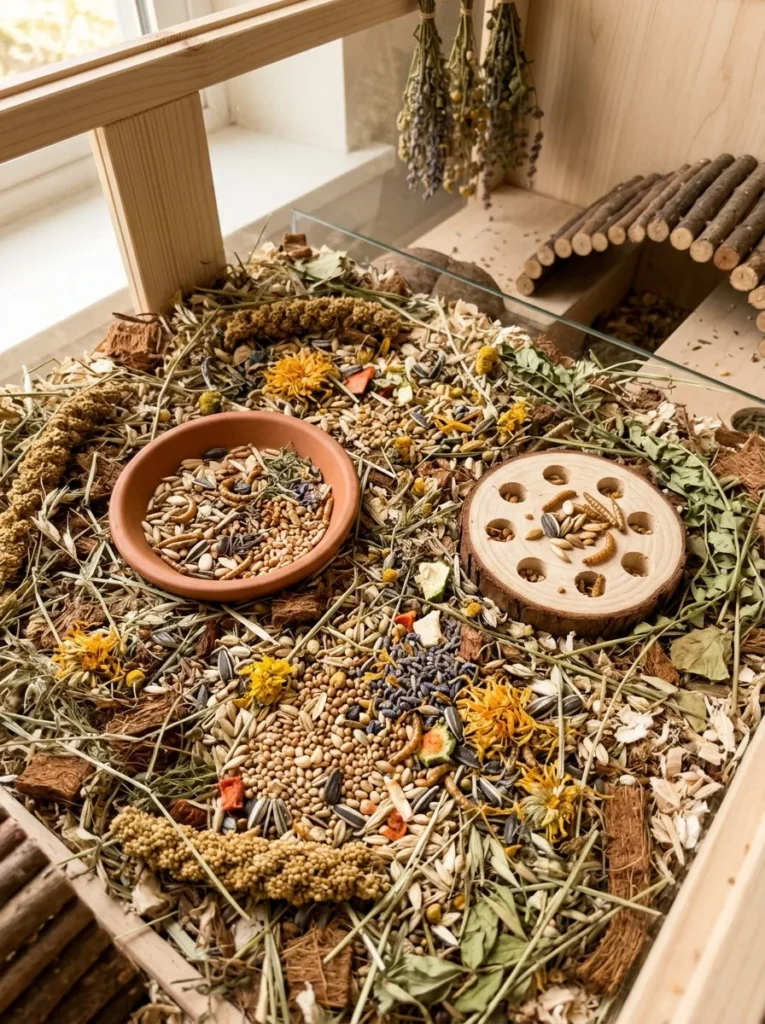
Vibe: A foraging scatter setup feels actively purposeful — the enclosure configuration that gives a hamster the night’s first meaningful task.
Why it works: Foraging is the behavioral drive that hamsters spend the majority of their active hours pursuing in the wild — they travel several kilometers nightly specifically to locate and collect food, which they carry in their cheek pouches back to their burrow’s food storage chamber. The design principle is natural feeding behavior activation as welfare intervention: scatter feeding (distributing food items across the substrate surface and at various burial depths rather than providing food in a bowl) directly activates the hamster’s foraging behavioral system, providing not just nutrition but the specific cognitive and physical engagement of the search behavior. A hamster that forages for its food is meaningfully occupied; a hamster that eats from a bowl is fed but not enriched.
How to get it: Replace the food bowl entirely (or supplement with a small amount in a bowl for medication or critical nutrition needs) with scatter feeding. Distribute the daily food ration across the full enclosure surface — seeds buried at 1–2 cm depth, larger food items placed on foraging discs or saucers, dried herbs scattered on the substrate surface. Create a dedicated foraging tray (a flat terracotta saucer or shallow wooden tray filled with sand or coir) where food items are buried for additional digging enrichment. Vary the foraging substrate between the enclosure area and the dedicated foraging tray to increase sensory variety.
Shop The Look
| Product |
|---|
| Small terracotta saucer dish hamster foraging |
| Wooden foraging disc natural hamster |
| Hamster safe seed mix for scatter |
| Dried herb mix hamster safe |
| Foraging sand natural fine for tray |
5. DIY Wooden Climbing Frame and Ladder
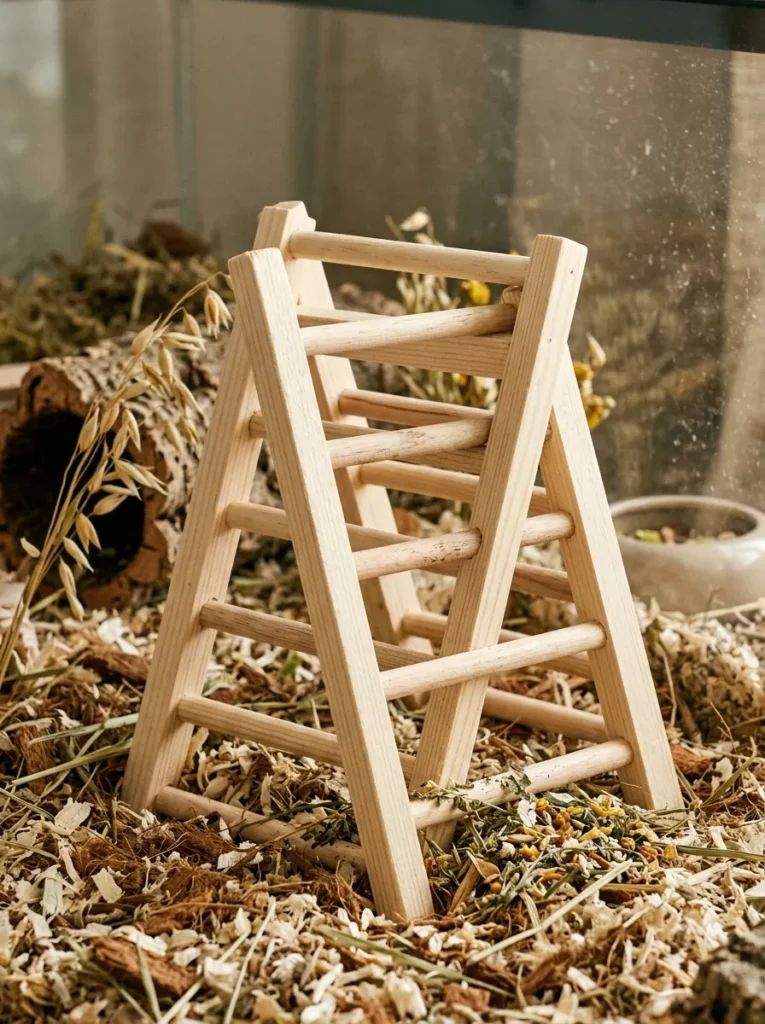
Vibe: A wooden climbing frame feels appropriately challenging — a physical structure that gives a hamster something worth investigating at 2am.
Why it works: Hamsters are natural climbers in many wild habitat contexts — rocky terrain, shrubby growth, and complex substrate surfaces all provide climbing opportunities in their native Central Asian and Middle Eastern environments. The design principle is physical complexity as locomotor enrichment: a climbing structure that requires coordinated limb movements and balance engagement provides the physical challenge that flat enclosure floors cannot. This is particularly relevant for hamsters in larger enclosures where the surface itself may be relatively flat — adding vertical complexity through climbing frames increases the physical and cognitive demands of the space. The climbing frame must be stable and at an appropriate height — falls from climbing structures are a significant injury risk for hamsters, and no structure should exceed 20 cm in height without a deep substrate landing below.
How to get it: Cut untreated pine dowels (8–10mm diameter) into equal-length rungs (approximately 12 cm for a ladder sized for a Syrian hamster). Drill corresponding holes in two flat pine uprights (12mm thick, 5cm wide, 15cm tall) spaced 2 cm apart vertically. Insert the dowel rungs into the holes with a dot of PVA glue at each end. Allow to fully cure before placing in the enclosure. Ensure the base is wide enough for stability — a spreading base of two perpendicular pieces prevents tipping. Maximum safe height: 15 cm for a Syrian hamster without a deep landing substrate below.
Shop The Look
| Product |
|---|
| Untreated wooden dowel 8mm hamster safe |
| Untreated pine flat board for uprights |
| PVA wood glue food safe |
| Drill bit set for dowel holes |
| Fine sandpaper for edge smoothing |
6. Sand Bath Station with Fine Natural Sand
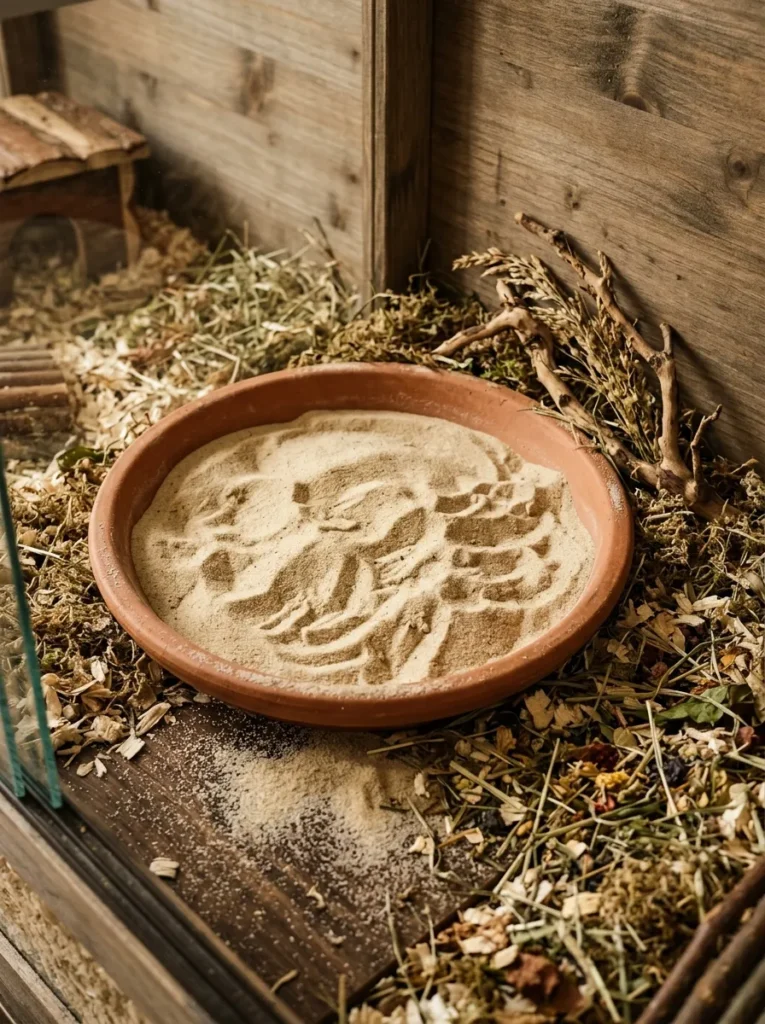
Vibe: A sand bath station feels species-specifically appropriate — the self-care provision that only hamsters get to use in exactly the way nature intended.
Why it works: Sand bathing is a natural hamster grooming behavior observed in wild populations — hamsters roll in fine desert sand to absorb excess oils and moisture from their coat, maintaining coat condition and contributing to territorial scent marking behavior. The design principle is natural behavioral opportunity through appropriate substrate provision: a dedicated sand bath area with fine natural sand provides both grooming enrichment and a distinct substrate zone that increases the sensory variety of the enclosure. It also serves as a natural latrine area for many hamsters, which simplifies enclosure hygiene by concentrating waste in a cleanable, removable container.
How to get it: Source fine natural chinchilla sand (not dust — dust can cause respiratory issues in hamsters) or sterilized children’s play sand. Fill a large shallow terracotta dish (minimum 20×15 cm for a Syrian hamster) or a small wooden sandbox to approximately 4–5 cm depth. Position in a corner of the enclosure where the hamster is likely to return to it consistently — hamsters tend to establish regular latrine and bathing spots. Replace sand every one to two weeks or more frequently if used as a latrine. Never use calcium-based sand or colored craft sand — these are unsafe for hamsters.
Shop The Look
| Product |
|---|
| Natural chinchilla sand fine for bath |
| Large shallow terracotta saucer for bath |
| Wooden sandbox DIY small for hamster |
| Small scoop for sand bath cleaning |
| Natural play sand sterilized fine |
7. Cardboard Foraging Tower with Hidden Food Chambers
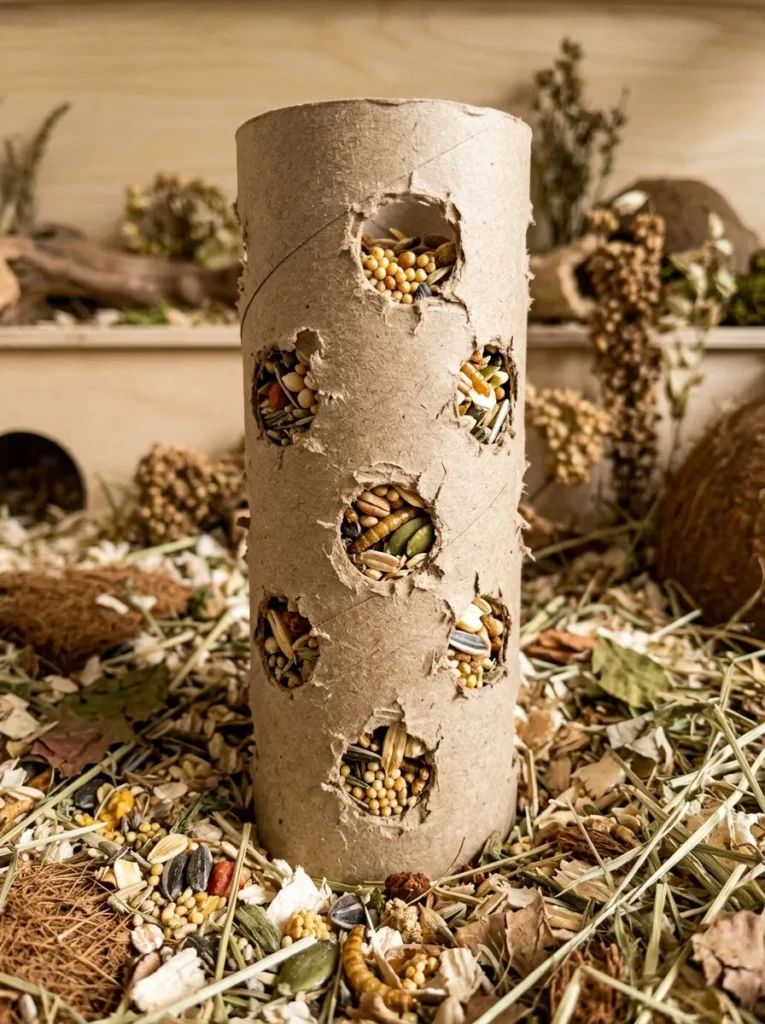
Vibe: A foraging tower feels problem-solving specific — the enrichment device that gives a hamster’s intelligence something genuinely worth engaging with.
Why it works: Problem-solving enrichment — challenges that require cognitive engagement to access food rewards — is one of the most welfare-positive enrichment categories available for captive hamsters. Research on rodent cognitive enrichment consistently documents that animals provided with problem-solving foraging challenges show reduced stereotypic behavior, lower stress indicators, and higher behavioral complexity than those fed from static food bowls. The design principle is cognitive reward as welfare provision: a foraging tower requires the hamster to investigate, reach, and sometimes problem-solve to extract food items, which activates the same neural pathways that navigate a complex natural foraging environment.
How to get it: Use a clean cardboard tube (a toilet paper roll, paper towel tube, or constructed cardboard cylinder) with a minimum 8 cm diameter for Syrian hamsters. Cut multiple holes (approximately 1.5 cm diameter) at different heights around the circumference using scissors or a craft knife. Fill with a mix of seeds, dried herbs, and small treats. Cap both ends with cardboard circles and tape closed (using paper tape only — no plastic or synthetic tape). Place standing upright in the enclosure. The hamster will chew the cardboard to access more food — this is expected and safe. Replace when significantly chewed down.
Shop The Look
| Product |
|---|
| Cardboard tube 8cm diameter natural |
| Paper tape natural unbleached |
| Hamster safe seed mix for tower filling |
| Dried herb mix for tower variety |
| Small scissors for hole cutting |
8. DIY Wooden Food Shelf and Platform
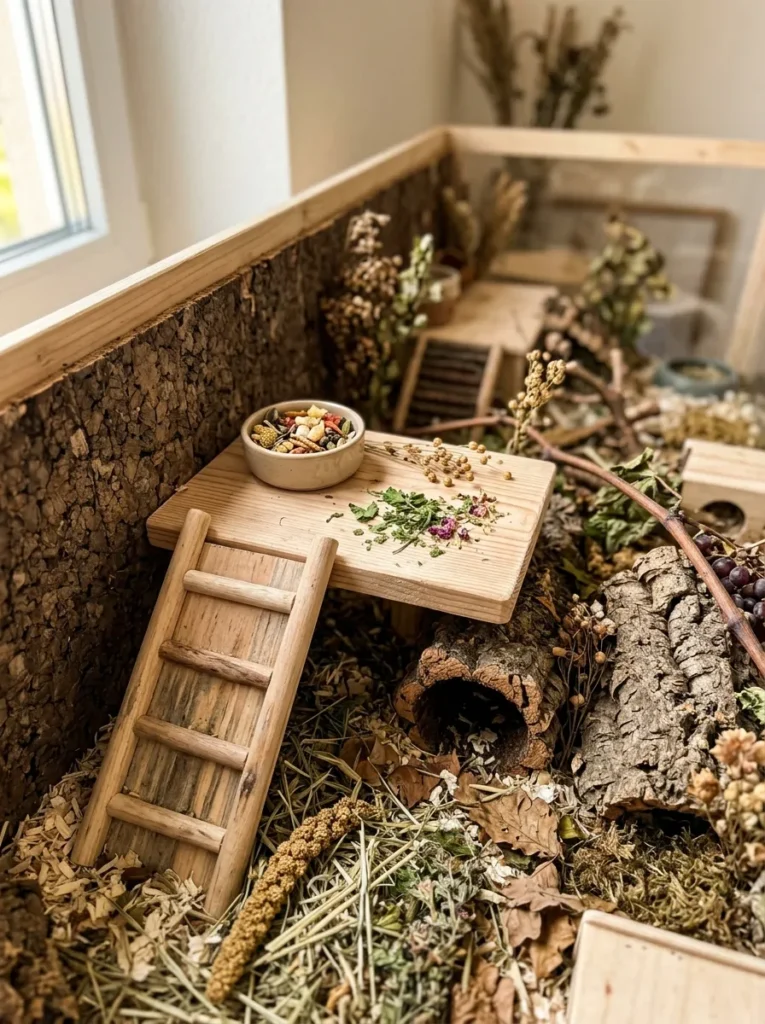
Vibe: A wooden platform shelf feels naturally layered — a habitat addition that uses vertical space and creates the varied terrain hamsters explore in rocky natural habitats.
Why it works: A raised platform shelf with a ramp access creates a distinct zone within the enclosure at a second level — providing physical climbing enrichment (the ramp), a new surface for food presentation, and the elevated vantage point that hamsters naturally seek in rocky terrain habitats. The design principle is vertical space activation as behavioral opportunity: an enclosure with only a floor surface provides one behavioral level; an enclosure with a raised platform and ramp provides physical complexity at two heights and the transition enrichment of the ramp traverse, which effectively increases the enclosure’s behavioral richness beyond its floor area footprint. The shelf is kept intentionally low (10–15 cm maximum) to minimize injury risk from falls.
How to get it: Cut an untreated pine board to 15×10 cm (for a Syrian hamster) or 10×8 cm (for dwarf hamsters). Drill two small holes for the ramp attachment points. Cut a ramp piece from pine board 5 cm wide and long enough to reach from the substrate level to the shelf edge at approximately 30 degrees. Attach ramp to shelf and support structure with PVA glue and small untreated wooden pegs. Support the shelf using two cork bark pieces or cut wooden legs of equal height. Mount or position at no more than 15 cm above the substrate surface. Sand all edges smooth.
Shop The Look
| Product |
|---|
| Untreated pine board for shelf cutting |
| Untreated wooden dowel peg for assembly |
| PVA wood glue food safe |
| Cork bark pieces for shelf support legs |
| Fine sandpaper for edge finishing |
9. Natural Dried Botanical Decoration and Enrichment
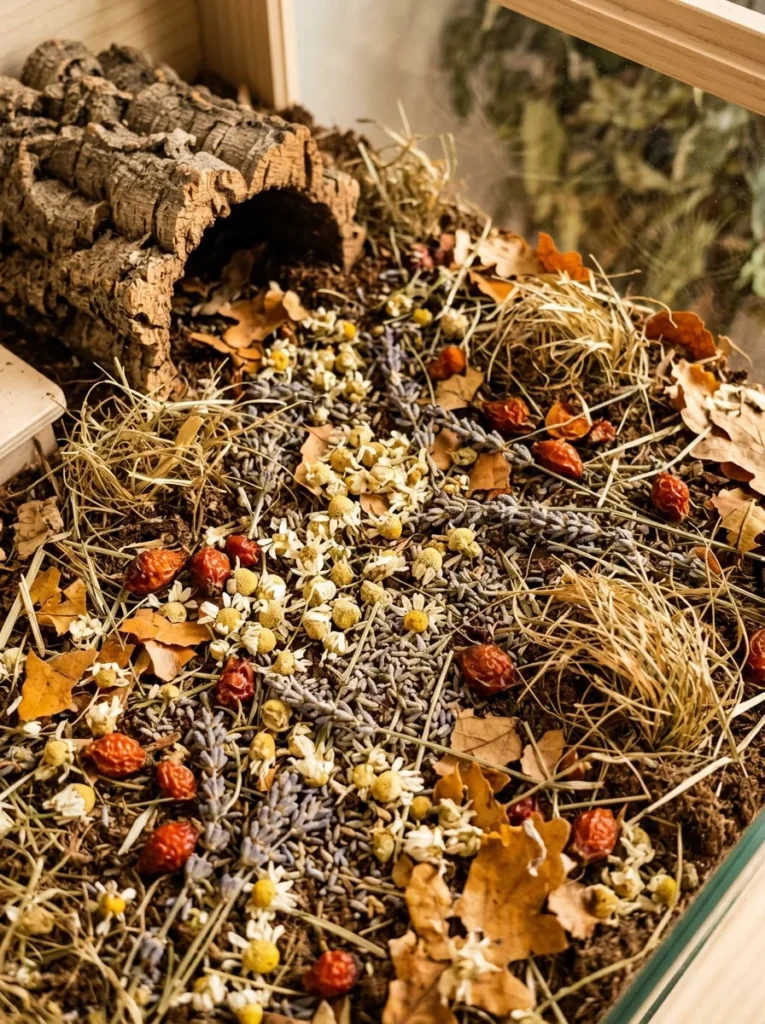
Vibe: Dried botanical enrichment feels naturally complex — the enclosure surface that smells, looks, and behaves like somewhere a wild hamster might actually be found.
Why it works: The surface layer of a hamster’s enclosure is the primary sensory environment for a foraging animal — what the substrate surface smells like, how it feels underfoot, and what it contains determines the quality of the hamster’s nightly exploration. A barren substrate surface (even if deep enough for burrowing) provides no surface enrichment; a surface layer of varied dried botanicals — different textures, different fragrances, different food items — provides the sensory complexity that activates exploratory and foraging behavior throughout the active period. The design principle is surface complexity as olfactory and physical environment: a hamster navigating a substrate surface scattered with chamomile flowers, rosehips, hay tufts, and dried leaves is cognitively engaged in a way that a hamster on a plain substrate surface simply is not.
How to get it: Source dried botanicals from specialist small animal suppliers or hamster-specific online retailers — ensuring all species are confirmed as hamster-safe before use. Hamster-safe botanicals include: dried chamomile flowers, dried rosehips, dried marigold, dried plantain leaves, dried dandelion, dried nettle (in small amounts), dried raspberry leaf, meadow hay, and dried oak leaves. Scatter across the substrate surface as part of the regular enclosure decoration refresh. Replace with fresh botanicals weekly or as they are eaten or scattered into the substrate.
Shop The Look
| Product |
|---|
| Dried chamomile flower hamster safe |
| Dried rosehip pieces small animal safe |
| Meadow hay natural for hamster |
| Dried botanical mix small animal specific |
| Dried oak leaf bag natural hamster |
10. DIY Toilet Roll Tube Tunnel Network
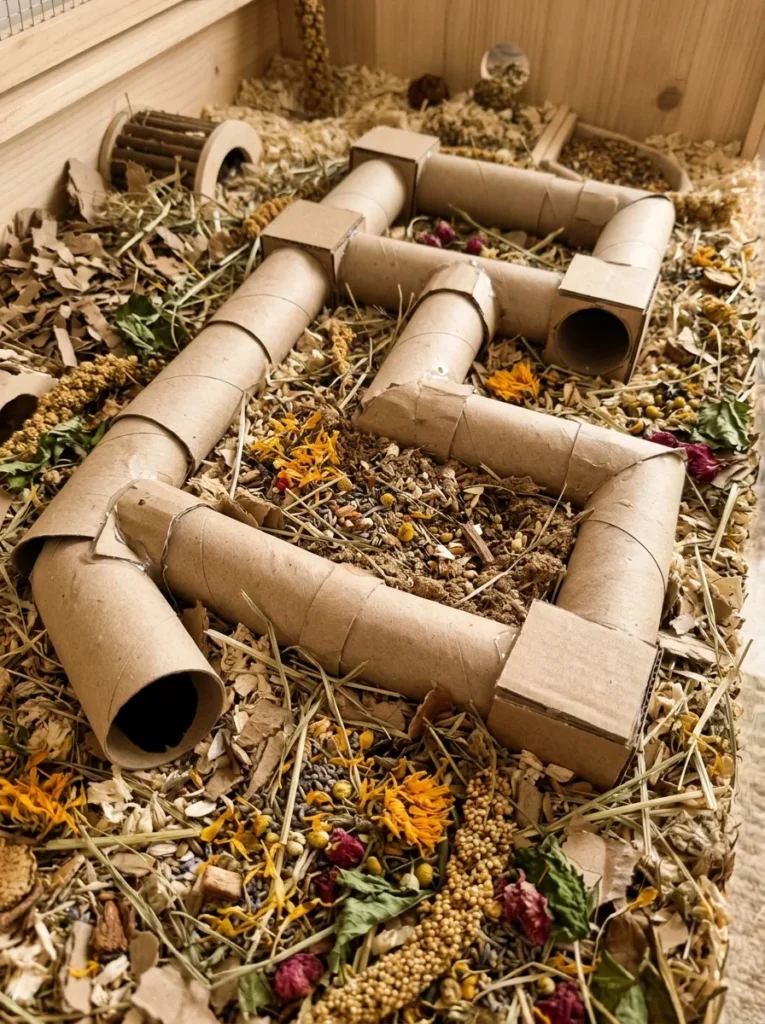
Vibe: A cardboard tunnel network feels ingenuously simple — the enrichment that costs nothing and provides exactly what expensive plastic tube systems attempt to replicate.
Why it works: Tunnels are fundamental hamster environmental requirements — they connect the behavioral spaces of the natural burrow system (sleeping chamber, food store, latrine, entrance) and provide the sense of concealed movement that the enclosed burrow environment gives. Cardboard toilet roll tubes are the most safe and most chewable tunnel material available: they are untreated, unchlorinated (if plain cardboard), non-toxic, biodegradable, and provide the incidental chewing enrichment that the hamster pursues in any case. The design principle is natural tunnel behavior activation through safe tunnel provision: a network of cardboard tubes partially buried in substrate simulates the connecting tunnels of a natural burrow system and activates the specific exploratory behavior associated with tunnel investigation.
How to get it: Use plain, unprinted, unbleached cardboard toilet roll tubes (avoid tubes with colored printing or scented paper). Connect tubes at right angles using small pieces of cardboard folded and inserted into the tube ends, or use a slightly smaller tube pushed into the end of a slightly larger tube. Create a network with at least two entrance holes, several connecting tunnels, and at least one larger-diameter section (made from a paper towel tube) for turning space. Partially bury the network in substrate, leaving entrance holes clear at the surface level. Replace when significantly chewed — typically every two to four weeks.
Shop The Look
| Product |
|---|
| Plain cardboard toilet roll tube natural |
| Paper towel tube natural wider diameter |
| Plain cardboard sheet for connectors |
| Paper tape natural unbleached |
| Small scissors for connector cutting |
11. DIY Seagrass and Sisal Nesting Material Station
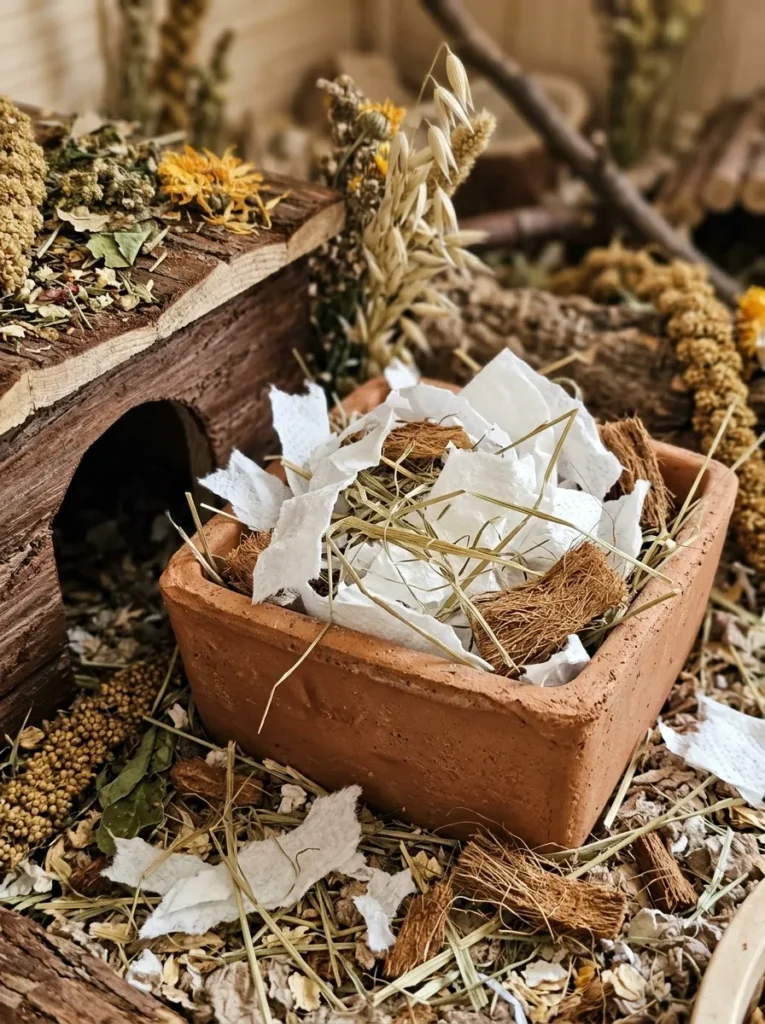
Vibe: A nesting material station feels quietly caring — the provision that acknowledges what a hamster does with its sleeping space and supports it properly.
Why it works: Nest building is one of the most fundamental hamster behaviors — in the wild, hamsters construct elaborate sleeping nests in their burrow’s sleeping chamber, carefully selecting and transporting nesting material to create a warm, insulated sleeping environment. The design principle is nesting behavior support as welfare provision: providing a dedicated nesting material station gives the hamster continuous access to fresh building material, which allows the hamster to maintain and rebuild its nest as it prefers — a behavioral opportunity that directly affects sleep quality and thermoregulatory wellbeing. The material type is critically important: only materials that are safe if swallowed (which the hamster will do in small amounts during transport) and that do not catch or wrap around limbs should be used.
How to get it: Safe nesting materials include: plain white unscented tissue paper (torn into strips), plain unbleached toilet paper (torn loose), meadow hay, coconut fiber, and dried grass. Unsafe materials to avoid include: cotton wool and synthetic fluff (choke and internal obstruction hazard), scented products, and any colored or printed paper with ink that may be toxic. Provide a container (small terracotta saucer or shallow wooden box) filled with a mix of two to three safe materials. Position near the primary hideout so the hamster can easily transport material to its nest.
Shop The Look
| Product |
|---|
| Plain white tissue paper unscented for nesting |
| Meadow hay natural for nesting material |
| Coconut fiber natural for nesting |
| Small wooden box for nesting station |
| Unbleached plain toilet paper for strips |
12. DIY Wooden Wheel Stand for Appropriate-Size Wheel
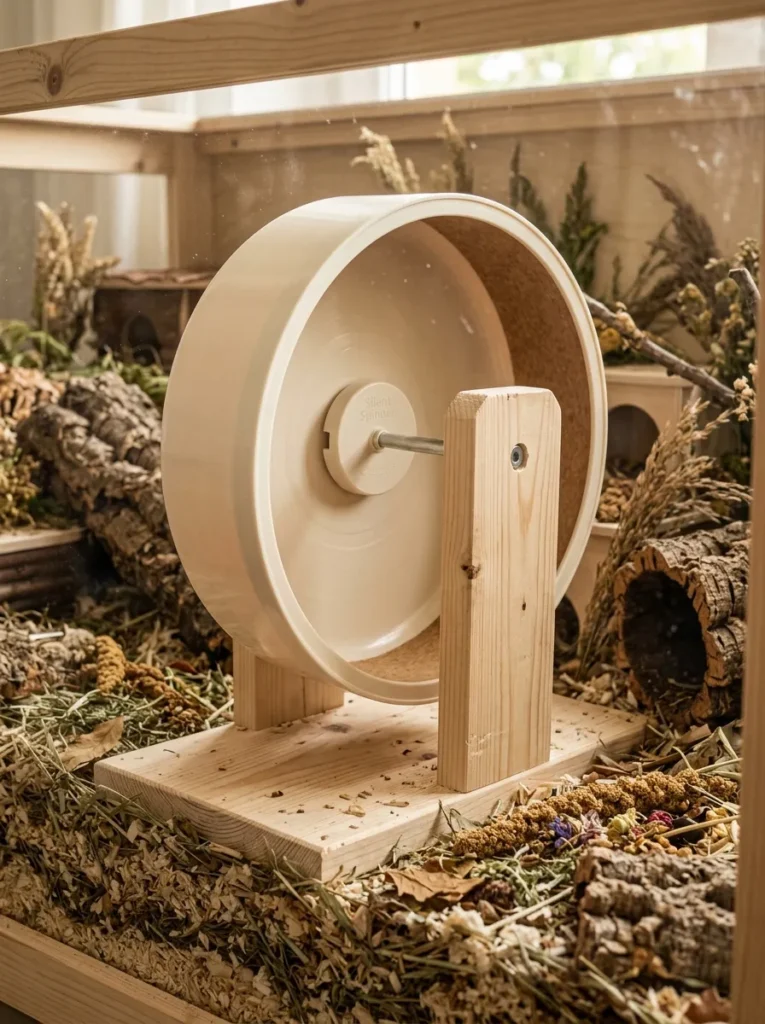
Vibe: An appropriately sized wheel on a stable DIY stand feels correctly scaled — the exercise provision that respects the animal’s spinal health.
Why it works: The wheel is the hamster’s primary aerobic exercise provision in captivity — replacing the 5–10 km of nightly travel that wild hamsters cover. Wheel size is the most critical welfare specification for any hamster wheel: a wheel that is too small forces the hamster to arch its spine during running, which causes chronic spinal damage over time. The minimum safe wheel diameter is 28 cm for Syrian hamsters and 20 cm for dwarf hamster species — wheels below these dimensions should not be used regardless of how they are marketed. The design principle is species-appropriate size as non-negotiable welfare requirement: a large-diameter wheel on a stable DIY stand provides the exercise provision that is among the most significant welfare contributions of any cage element.
How to get it: Purchase a quality silent spinner wheel at the correct diameter (28 cm minimum for Syrians — the Niteangel Giant Comfort Wheel or Wodent Wheel 11″ are widely recommended in the hamster welfare community). Build a simple wooden stand from untreated pine: two upright pieces with a central hole drilled at the wheel’s axle height, connected by a wide flat base for stability. The stand should position the wheel’s running surface 2–3 cm above the substrate level. Alternatively, position the wheel freestanding on the substrate if the wheel’s own base is sufficiently stable — many large wheels have adequate standalone bases.
Shop The Look
| Product |
|---|
| Large silent spinner wheel 28cm Syrian hamster |
| Untreated pine board for wheel stand |
| Drill bit for axle hole |
| PVA glue for stand assembly |
| Fine sandpaper for stand finishing |
13. Terracotta Pot Burrow Entry Decoration
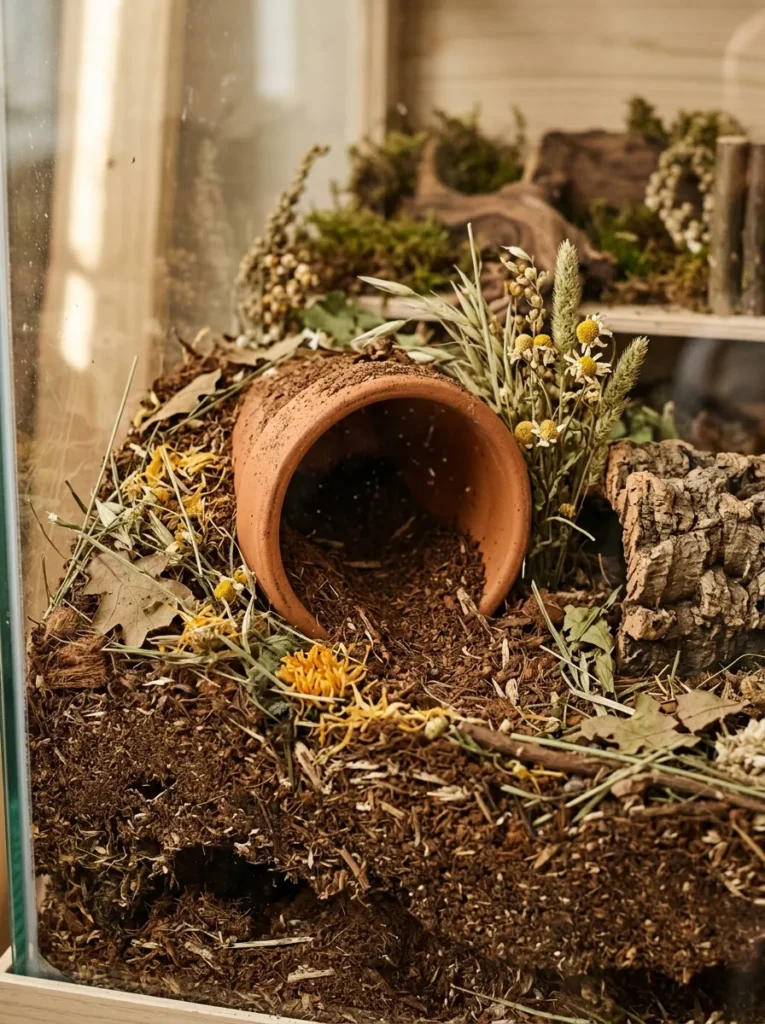
Vibe: A terracotta pot burrow entrance feels naturally anchored — the landscape element that makes the enclosure’s substrate look inhabited rather than merely filled.
Why it works: A terracotta pot laid on its side and partially buried in substrate serves as both a decorative landscape feature and a functional burrow entry support — it creates a stable, non-collapsing tunnel entrance that the hamster can use as the starting point for its own burrow excavation below. The design principle is burrow support structure as naturalistic landscape element: by framing a burrow entrance with a terracotta pot, the functional element (tunnel support) and the aesthetic element (naturalistic pot landscape feature) are the same object, which is the most integrated and authentic form of hamster enclosure enrichment. Terracotta is fully safe for hamsters — it is an unglazed, non-toxic ceramic material that the hamster can chew without risk and that provides a cool, slightly humid microenvironment in the partially buried chamber.
How to get it: Select an unglazed terracotta pot (not glazed, not painted, no drainage hole required) of appropriate diameter for the hamster species — 8 cm diameter for dwarf hamsters, 10–12 cm for Syrian hamsters. Place on its side in the enclosure before adding deep substrate. Pour and pack substrate around and partially over the pot, leaving the opening clear and facing toward the observation wall of the enclosure. The hamster will typically begin excavating through and around the pot within the first night. Replace if the pot becomes cracked or the hamster chews it into fragments.
Shop The Look
| Product |
|---|
| Small unglazed terracotta pot 8-10cm |
| Coconut fiber substrate for burrow support |
| Cork bark pieces for landscape around pot |
| Dried botanical mix for scatter |
| Meadow hay for surface layer |
14. DIY Wooden Food Bowl and Water Station
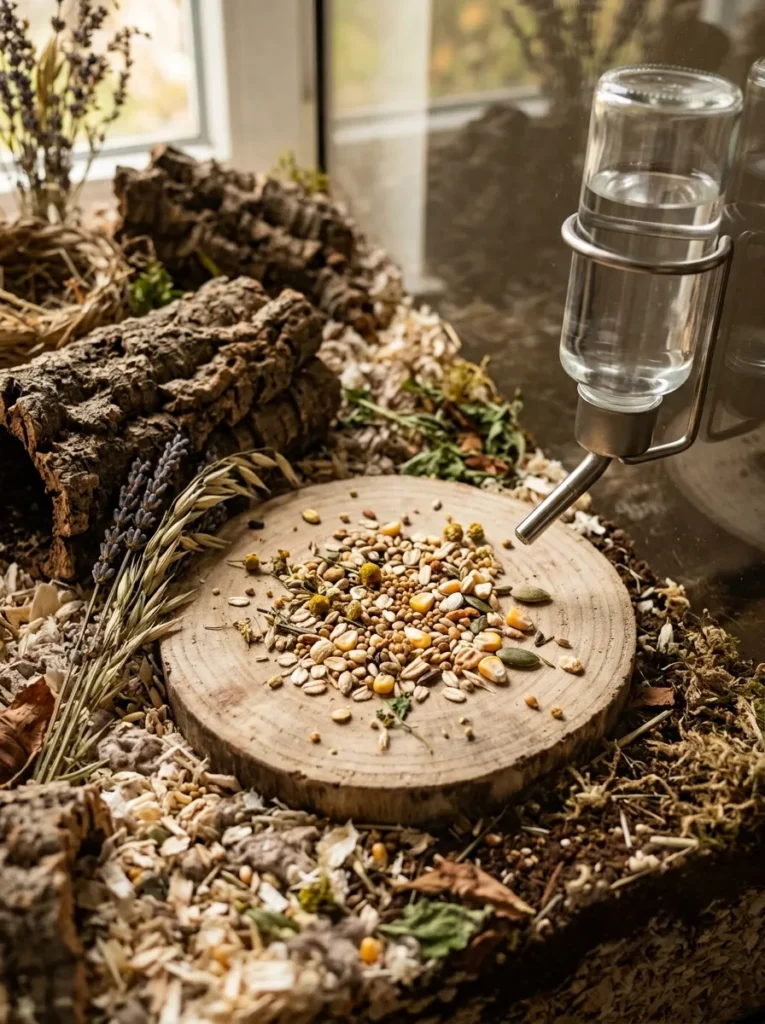
Vibe: A wooden food disc feels simply appropriate — a food presentation surface that integrates with the natural environment rather than imposing industrial form on it.
Why it works: A flat wooden disc as a food presentation surface (rather than a conventional bowl) keeps food items visible at substrate level, allows the hamster to approach from any angle, and can be scattered across rather than having to reach into — all of which better approximate the natural foraging position. The design principle is natural feeding posture as food station design: hamsters in the wild eat with their bodies at substrate level, moving constantly across a foraging area — a flat disc maintains this natural feeding posture while providing a defined food area for any portion of the diet that needs to be contained (wet food, medication, soft treats). Water provision through a bottle (rather than a bowl, which becomes contaminated with substrate and bedding within hours) ensures clean, hygienic water access at all times.
How to get it: Cut an untreated wooden disc from a pine or poplar board using a jigsaw or hole saw (10 cm diameter minimum). Sand smooth and apply no finish. Place directly on the substrate surface at the hamster’s level. For water, use a quality glass or BPA-free plastic water bottle with a ball-bearing sipper nozzle, mounted at the enclosure wall at a height the hamster can reach comfortably from a natural standing position (approximately 5–8 cm above the substrate surface level for a Syrian hamster). Check the sipper nozzle daily for blockages.
Shop The Look
| Product |
|---|
| Untreated pine round disc food surface |
| Quality water bottle glass hamster |
| Ball bearing sipper nozzle replacement |
| Jigsaw or hole saw for disc cutting |
| Fine sandpaper disc edge finishing |
15. Small-Space DIY Hamster Decor — Maximum Enrichment in Minimum Footprint
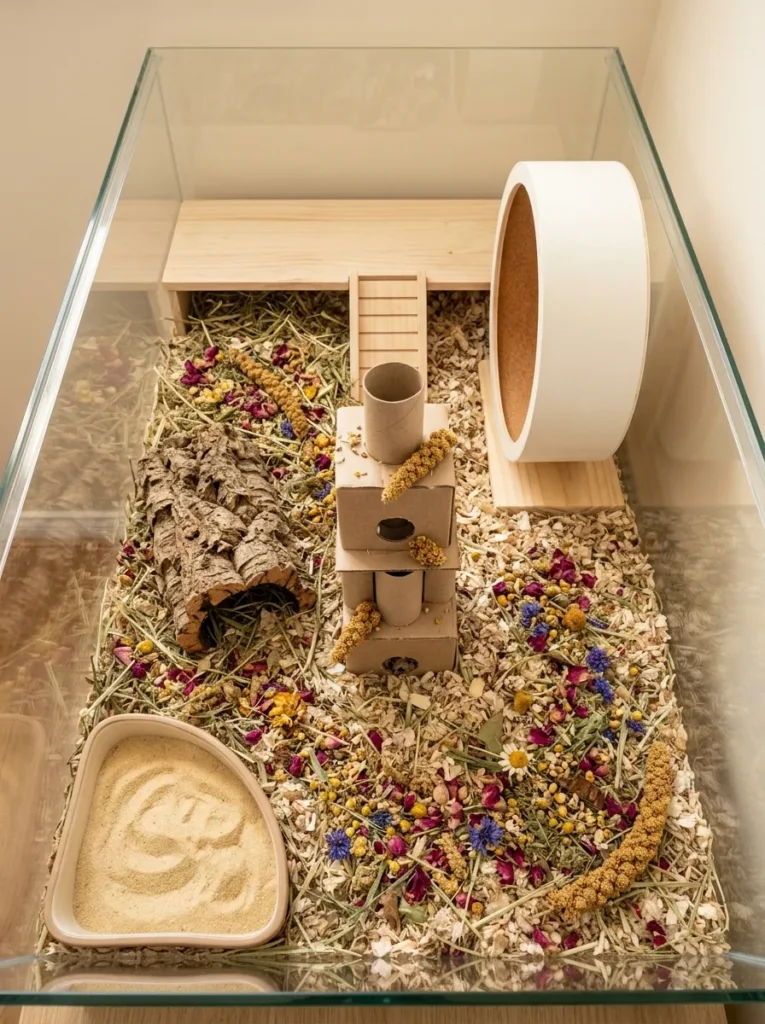
Vibe: A maximally enriched compact enclosure feels purposefully complete — every square centimeter serving a behavioral need rather than a decorative preference.
Why it works: The small-space hamster enclosure presents the same design challenge as any constrained environment — how to meet the maximum number of welfare requirements within the available footprint. The design principle is behavioral need hierarchy in constrained space: prioritize the elements with the highest welfare return per square centimeter, in order — substrate depth throughout the full floor area (burrowing behavior, the highest-priority welfare element), appropriately-sized wheel (aerobic exercise, the second-highest), sand bath corner (natural grooming, hygiene management), one primary hide (shelter need), and botanical surface scatter (sensory enrichment and foraging activation). Within 100×50 cm, these five elements together meet the most critical behavioral needs while leaving some open substrate surface for the hamster’s own burrow excavation decisions.
How to get it: In a 100×50 cm enclosure, allocate space as follows: position the wheel (28 cm diameter) at one short end, requiring approximately 30×30 cm of floor footprint at that end. Position the sand bath (minimum 20×15 cm dish) in one back corner. Place the primary hide (15×10 cm footprint) in the remaining corner. This leaves approximately 55×40 cm of open substrate for the hamster’s burrowing. Maintain 25 cm minimum substrate depth throughout. Scatter dried botanicals across the full substrate surface. This configuration provides the minimum welfare-acceptable enriched environment for a Syrian hamster in the minimum recommended footprint.
Shop The Look
| Product |
|---|
| Glass tank 100x50cm minimum hamster |
| Large silent spinner wheel 28cm |
| Natural chinchilla sand bath |
| Cork bark hide natural piece |
| Dried botanical mix hamster safe |
How to Start Your Hamster Habitat Transformation
The single first move for any hamster owner is to evaluate and correct the substrate depth in the current enclosure — specifically, to bring the substrate depth throughout the full enclosure floor area to a minimum of 25–30 cm using an appropriate substrate mix (60% coconut fiber, 20% peat or organic topsoil, 20% paper bedding). This single change has more positive impact on hamster welfare than every decorative addition in this list combined, because it addresses the hamster’s most fundamental behavioral need: the ability to burrow. A hamster with adequate substrate depth and nothing else in its enclosure is better off than a hamster with a full enclosure of enrichment items but only 5 cm of substrate — the burrowing behavior that the depth enables is the behavioral expression that the hamster’s entire neurobiology is organized around.
The most important welfare consideration before any DIY enclosure addition is material safety evaluation — every material entering a hamster enclosure will be chewed, and every chewed material will be ingested in small amounts. The safety standard is not “would a small amount harm a hamster” but “is this material safe for regular repeated ingestion in small amounts over the hamster’s lifetime.” This standard eliminates: all painted surfaces (even non-toxic paint should not be inside the enclosure), all varnished or sealed wood (unless the sealant is confirmed food-grade and fully cured), all dyed or scented materials, all synthetic fabrics (which cause intestinal blockage when ingested), and all materials with unconfirmed safety status. If the material’s safety for hamster ingestion cannot be confirmed, it does not enter the enclosure.
Three DIY additions that produce the most immediate welfare improvement: adequate substrate depth (as discussed above — the highest-priority welfare intervention at any budget), dried botanical scatter across the substrate surface (hamster-safe dried botanicals cost $5–$15 for a supply lasting several months and immediately activate foraging and exploratory behavior), and a correctly sized wheel (the most significant single equipment purchase for hamster welfare — a 28 cm silent spinner wheel costs $30–$60 and provides the aerobic exercise provision that is second only to burrowing in welfare significance). These three provisions together address the three most acutely unmet welfare needs in the majority of existing hamster enclosures.
Realistic expectations: a complete hamster enclosure transformation to welfare-positive standards — adequate substrate depth, appropriate wheel, sand bath, varied botanicals, cork bark hides, and foraging enrichment — is achievable for $50–$150 in total materials depending on the substrate quantity required for the enclosure size. The behavioral transformation is typically immediate and dramatic — hamsters transitioned from inadequate to welfare-positive enclosures typically begin burrow excavation within the first night, show significantly reduced or eliminated stereotypic behavior within the first week, and demonstrate the full range of natural behaviors (burrow maintenance, foraging, sand bathing, nest building, and extended wheel running) within the first two weeks.
Frequently Asked Questions About DIY Hamster Decor
What materials are safe to use for DIY hamster decor?
Safe DIY hamster materials are those confirmed as non-toxic for repeated ingestion in small amounts: untreated softwood (pine, poplar, balsa, willow — never cedar or pine shavings, which contain aromatic compounds toxic to respiratory systems), natural cork bark, unglazed terracotta, plain cardboard (unbleached, unprinted), natural fiber paper (plain white tissue, unbleached toilet paper), food-grade clay, coconut fiber, meadow hay, natural dried botanicals confirmed as hamster-safe, and glass. Unsafe materials include: all painted surfaces, all varnished wood, all synthetic fabrics (cotton wool, polyester fluff), all scented materials, all plastic not confirmed as BPA-free and food-safe, all glues except PVA (and only when fully dried), and all materials with unconfirmed species safety.
What is the minimum recommended enclosure size for a Syrian hamster?
Current welfare science and progressive hamster care standards recommend a minimum floor area of 100×50 cm (5,000 cm²) for Syrian hamsters, with substrate depth of minimum 25–30 cm throughout. German animal welfare law specifies a minimum of 775 cm² — widely considered inadequate by behavioral researchers — while the UK’s RSPCA recommends minimum 100×50 cm. Research by Clauss et al. (2010) and Hauzenberger et al. (2006) documents that stereotypic behavior (bar chewing, pacing) persists even at significantly larger enclosure sizes in environments lacking behavioral enrichment, which underscores the importance of enrichment quality alongside space quantity. Larger is always better — 120×60 cm and above dramatically improves welfare outcomes.
Can I use wood from my garden for DIY hamster decor?
Garden wood can be used if certain conditions are met: the species must be confirmed as non-toxic for hamsters (apple, pear, hazel, willow, and birch are safe; yew, cedar, oleander, and most ornamental trees are not), the wood must be completely free of pesticide or herbicide exposure, and it must be baked in an oven at 120°C for one hour to eliminate parasites and pathogens before entering the enclosure. Never use wood with bark that has an aromatic scent (cedar is a common garden tree that is toxic to small animals). When in doubt about species identification, do not use the wood — the safety standard is confirmation, not assumption.
How often should DIY hamster decor be cleaned or replaced?
The replacement frequency for DIY hamster decor items depends on the material and the hamster’s use pattern: cardboard items (foraging towers, tube tunnels) should be replaced when significantly chewed — typically every two to four weeks. Wooden items should be wiped with a plain damp cloth (no cleaners) monthly or when visibly soiled. Cork bark can be spot-cleaned with plain water and dried thoroughly before returning to the enclosure. Sand bath sand should be replaced weekly or more frequently if used as a latrine. Dried botanicals should be refreshed weekly. The substrate itself should be spot-cleaned of obvious waste weekly, with a full replacement on a schedule appropriate to the enclosure size — typically every four to eight weeks for a 100×50 cm enclosure with one hamster.
What hamster decor items should I avoid even if they are sold commercially?
Several commercially sold hamster products pose significant welfare risks and should be avoided regardless of their widespread availability: wheels below 25 cm diameter for Syrian hamsters (spinal injury risk from arching), wire mesh running wheels (foot and limb entrapment risk), transparent plastic tubes less than 6 cm diameter for Syrian hamsters (stuck and overheating risk), hamster balls (disorientation, limited oxygen, impact injury, and stress), sand with calcium or dye content (respiratory and digestive risk), cotton wool nesting material (intestinal obstruction when ingested), and enclosures with wire floors or bar spacing below 1 cm. The commercial availability of a hamster product does not constitute evidence of its welfare appropriateness — the hamster product market has historically prioritized visual appeal and marketability over species-appropriate welfare outcomes.
Ready to Build a Habitat Your Hamster Will Actually Thrive In?
These 15 DIY hamster decor ideas span the full spectrum of hamster welfare needs — from the foundational substrate depth system and burrow entry structures to the foraging enrichment tower, the botanical scatter enrichment, the appropriately scaled wheel stand, and the sand bath station — providing a complete welfare-focused habitat framework whether you are setting up a new enclosure or transforming an existing one. The most important thing to understand about hamster habitat design is that every decision is a welfare decision — the substrate depth, the wheel diameter, the nesting material type, the food presentation method all directly determine the quality of life of an animal that cannot advocate for itself beyond the behavioral signals of stereotypy, stress, and — when the environment is right — the complex, active, natural behavior of a genuinely thriving animal. Today, evaluate your hamster’s substrate depth, compare your wheel’s diameter against the welfare minimum, and make the one correction that would most immediately improve that animal’s daily experience. Share these ideas with any hamster owner you know who wants to do better by their pet — every enclosure that implements even one of these welfare principles houses its hamster more humanely than before.