Crochet pet bed ideas are handmade sleeping and resting spaces for cats and dogs created using yarn, a crochet hook, and straightforward construction techniques — producing pet beds that are softer, more customizable, more aesthetically considered, and frequently more durable than most commercially available alternatives, while allowing complete control over size, color, material, and style to suit both the pet’s comfort needs and the home’s interior aesthetic. This article gives you exactly 11 crochet pet bed ideas for stylish homes, spanning every skill level from confident beginner to experienced crocheter, with construction guidance, yarn recommendations, and curated product tables for every idea.
There is a particular pleasure in making something for a creature that cannot ask for what it wants but communicates its preferences with unmistakable clarity — the cat that chooses the smallest, most enclosed space in the house, the dog that gravitates to the softest surface in any room, the kitten that makes a nest from whatever is at hand. A handmade crochet pet bed is the maker’s attempt to answer those preferences directly, with full control over every dimension of material comfort and visual beauty. These ideas range from a beginner-friendly flat mat completed in an afternoon to a fully structured hooded cat cave that takes a weekend and produces a result worthy of any design-forward home. Here are 11 ideas worth making — and saving.
Why Crochet Pet Bed Ideas Work So Well
Handmade crochet pet beds occupy a specific and culturally significant position at the intersection of the maker movement and the contemporary pet care industry — an industry that has grown to reflect the same design consciousness that shapes how pet owners furnish, style, and photograph the rest of their homes. The commercial pet bed market has expanded to include premium, design-forward options in natural materials and sophisticated colorways, but even the most expensive commercial options lack the three qualities that only a handmade piece can provide: perfect size fit for a specific animal’s actual dimensions and sleeping preferences, complete material control over fiber content and texture, and the particular warmth of an object made specifically for one creature by someone who loves it.
The materials that produce the most successful, beautiful, and pet-appropriate crochet pet beds share specific characteristics: washability is the non-negotiable requirement, which makes superwash merino wool, cotton, acrylic, and cotton-acrylic blends the most appropriate yarn choices; durability under repeated machine washing and the physical demands of pet use (scratching, nesting behavior, repeated entry and exit) favors tightly twisted plied yarns over loosely spun singles; texture matters because cats in particular make nuanced choices about surface texture, often preferring the slight nap of brushed yarns or the tactile interest of textured stitch patterns; and weight matters because bulky and super-bulky yarns in simple stitches produce faster results and more substantial structures than worsted weight yarn in complex stitch patterns. Color palettes for home-integrated pet beds lean toward the warm neutral spectrum — warm ivory, natural oatmeal, dusty sage, warm terracotta, soft greige, and muted blush — allowing the pet bed to function as a considered home décor object rather than a brightly colored pet accessory that competes with the interior aesthetic.
Crochet pet beds are among the most consistently popular handmade pet projects across all major craft platforms — Pinterest, Ravelry, and YouTube — driven by the intersection of the handmade pet care movement and the broader shift toward considered, sustainable, and natural-material pet accessories. The ability to make a pet bed from undyed natural wool, organic cotton, or recycled fiber yarn places crochet pet beds at the intersection of the handmade and sustainability movements in a way that no commercial product can match.
Small homes and apartments benefit most from crochet pet beds because the complete control over dimensions allows the maker to size the bed exactly to the space available rather than choosing from the standard commercial sizes that may not fit a specific alcove, bookshelf, or corner. A cat bed crocheted to fit precisely inside a 35cm diameter rattan basket, or a dog mat sized to fit the exact dimensions of a specific crate floor, is a practical possibility for the maker that is simply unavailable commercially.
Style at a Glance
| Element | Trait 1 | Trait 2 |
|---|---|---|
| Philosophy | Made for one specific animal | Home-integrated aesthetics |
| Materials | Superwash merino, cotton, acrylic blend | Chunky weight, washable fiber |
| Color Palette | Warm ivory, oatmeal, dusty sage | Terracotta, soft greige, muted blush |
11 Crochet Pet Bed Ideas for Stylish Homes
1. Classic Round Cat Bed in Chunky Merino
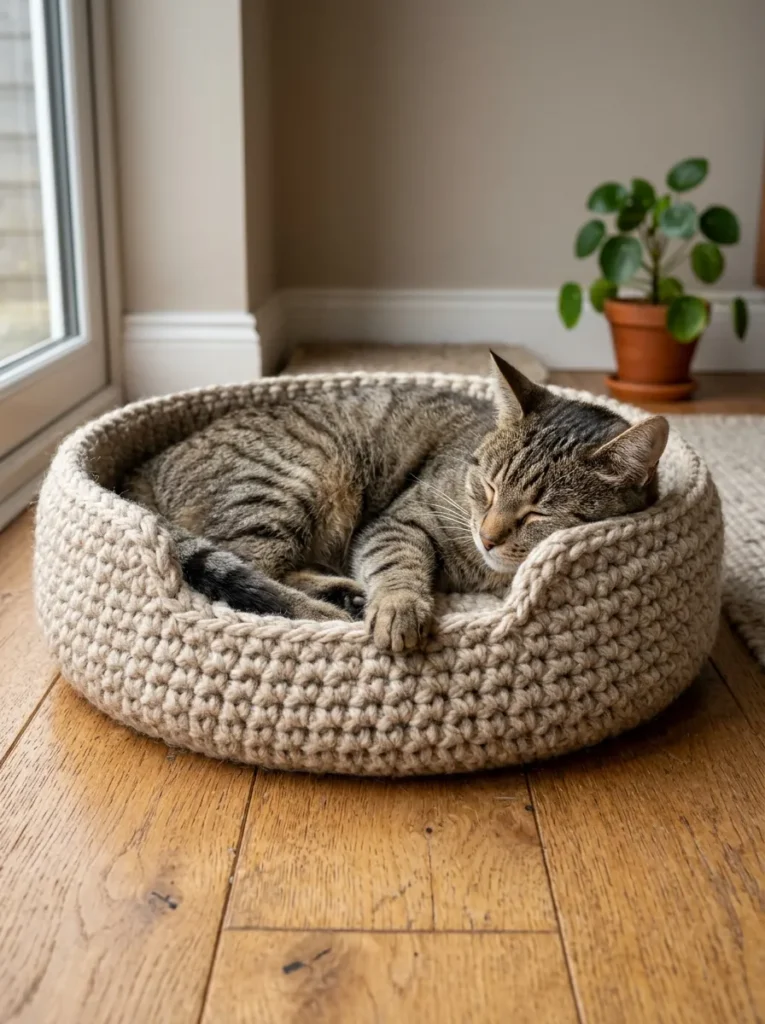
Vibe: The round cat bed feels warmly essential — the fundamental crochet pet bed form executed in the best possible material, producing an object of complete domestic rightness.
Why it works: The classic round cat bed is the foundational crochet pet bed construction because it mirrors the natural sleeping geometry of most cats — the curled circle that is the cat’s preferred sleeping posture fits perfectly within a circular bed with a raised rim, which also serves as a headrest and provides the enclosed feeling that most cats seek in a sleeping space. The chunky merino construction (using 6mm or larger hooks with bulky weight yarn) produces a bed of genuine structural substance in 3–4 hours of crocheting, compared to the 8–12 hours required for the same surface area in worsted weight. The natural oatmeal colorway is the most universally home-compatible choice — it reads as a neutral textile object that integrates with any interior palette rather than asserting itself as a brightly colored pet accessory.
How to get it: Begin with a magic ring and work single crochet in continuous rounds, increasing every round by 6 stitches (work 2 sc in every stitch in round 1, then increase every other stitch in round 2, then every third stitch in round 3, following the standard flat circle increase formula) until the base measures 40cm in diameter. At this point, work 8 rounds even (no increases) to build the rim wall — the transition from flat base increases to straight-up wall rounds automatically creates the raised rim without any structural change. The rim naturally turns upward rather than outward because of the fabric’s tension once increases stop.
Quick Win: Using arm-weight super-chunky yarn (roving weight, approximately 7mm suggested needle) with a 10mm hook produces a complete round cat bed base in under 90 minutes — the fastest possible construction time for a structurally sound cat bed, making this the most achievable first-time pet bed project.
Shop The Look
| Product |
|---|
| Chunky superwash merino yarn oatmeal natural |
| Crochet hook 6mm ergonomic handle comfort |
| Stitch marker set ring type assorted colors |
| Row counter digital crochet knitting small |
| Tapestry needle set blunt tip yarn finishing |
2. Hooded Cat Cave in Neutral Tones (SMALL SPACE / LAYOUT)
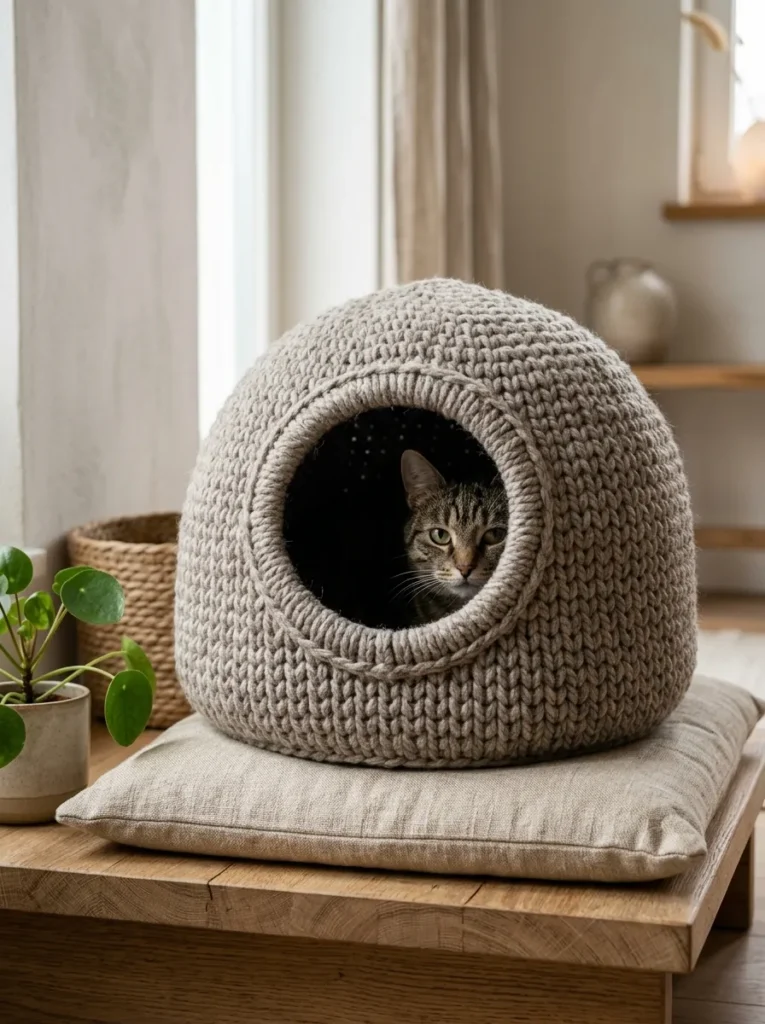
Vibe: The hooded cat cave feels architecturally considered and deeply cat-appropriate — an enclosed sleeping structure that satisfies the cat’s instinctive preference for hidden, enclosed spaces.
Why it works: A hooded cat cave is the most instinctively satisfying cat bed construction because it addresses the cat’s fundamental shelter-seeking behavior — most domestic cats prefer sleeping spaces that provide overhead cover and restricted entrance, which replicate the enclosed den-like spaces that wild felids use for resting. The crochet construction of a cave structure requires the maker to work in the round, building the dome from the base upward with gradual decreases (the reverse of the flat circle increase formula) — a structural logic that produces a naturally rounded dome shape when correct tension is maintained throughout. The reinforced circular entrance opening (worked with a round of slip stitches or backward single crochet for stability) prevents the entrance from stretching with repeated cat entry and exit.
How to get it: Work a flat circle base to 35cm diameter using the standard increase formula. Then work straight rounds (no increases) upward for approximately 20cm to build the cave walls. Begin decreasing in the final rounds — decrease every 6th stitch in the first decrease round, every 5th in the next, continuing until the opening is approximately 20cm diameter. Bind off and weave in ends. For the entrance: work a separate flat circle to 20cm diameter and seam it to the front wall of the cave at the correct height (approximately 10–12cm from the base for a standard cat), leaving the circle’s interior open as the entrance. Stiffen the entrance edge with a round of backward single crochet or a length of stiff cord crocheted over.
Shop The Look
| Product |
|---|
| Chunky yarn greige warm neutral superwash wool |
| Crochet hook 8mm ergonomic large size cave |
| Blocking mat foam square set cave structure |
| Stiffening spray fabric craft structure hold |
| Linen cushion natural insert 40cm square pet |
Also view: 14 Cozy Dog Boarding Ideas for Fall and Winter
3. Flat Rectangular Dog Mat in Cotton (MATERIAL)
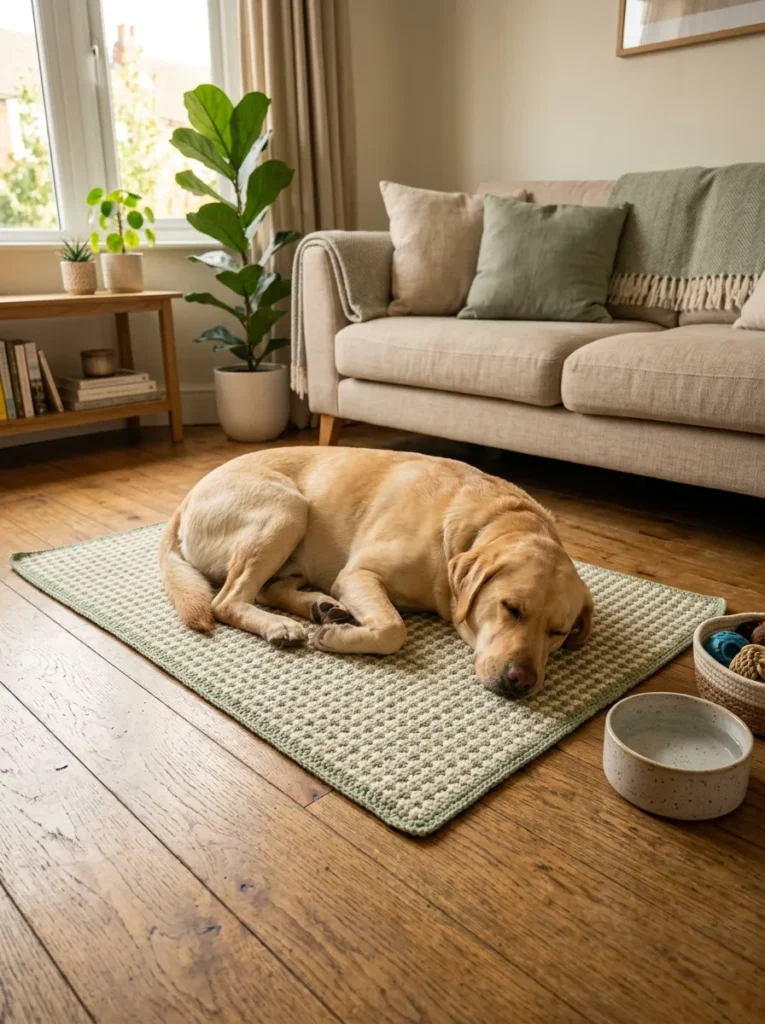
Vibe: The dog mat feels practically warm and home-integrated — a floor textile rather than a pet accessory, lying as naturally on the floor as any rug.
Why it works: A flat rectangular dog mat is the most practical crochet pet bed project for dogs because it matches the lying-flat sleeping preference of most dogs (who stretch out flat rather than curling) and is the simplest possible construction — worked in rows rather than rounds, requiring no shaping, no increases, no decreases, and no structural complexity beyond a consistent tension. Cotton yarn is the most appropriate material choice for dog mats because it is machine-washable at high temperatures (important for hygiene in dog bedding), breathable in warm weather, and durable under the physical demands of a dog repeatedly lying down, circling, and scratching before settling. The linen stitch or moss stitch pattern creates a flat, non-curling fabric in cotton that behaves better dimensionally than stockinette-tendency stitch patterns.
How to get it: Chain 91 (for a 90cm mat at approximately 10 chains per 10cm in worsted cotton with a 5mm hook — adjust chain count based on tension swatch). Work in linen stitch (sc, ch 1, skip 1, repeat) across each row, turning at the end of each row. The linen stitch’s built-in chain-space structure prevents the curling that single crochet worked in rows tends to produce, creating a fabric that lies naturally flat without blocking. For the two-color version, work alternate rows in each color, cutting yarn at the end of each color section and weaving in ends carefully — cotton ends have a tendency to work loose, so leave 15cm tails and weave in at least three direction changes.
Shop The Look
| Product |
|---|
| Worsted cotton yarn natural ivory 200g skein |
| Sage green cotton yarn worsted weight 200g |
| Crochet hook 5mm standard handle cotton |
| Non-slip rug pad underlay mat dog bed floor |
| Washing net bag large pet bedding machine wash |
4. Bobble Stitch Cat Cushion (ACCESSORIES / COLOR)
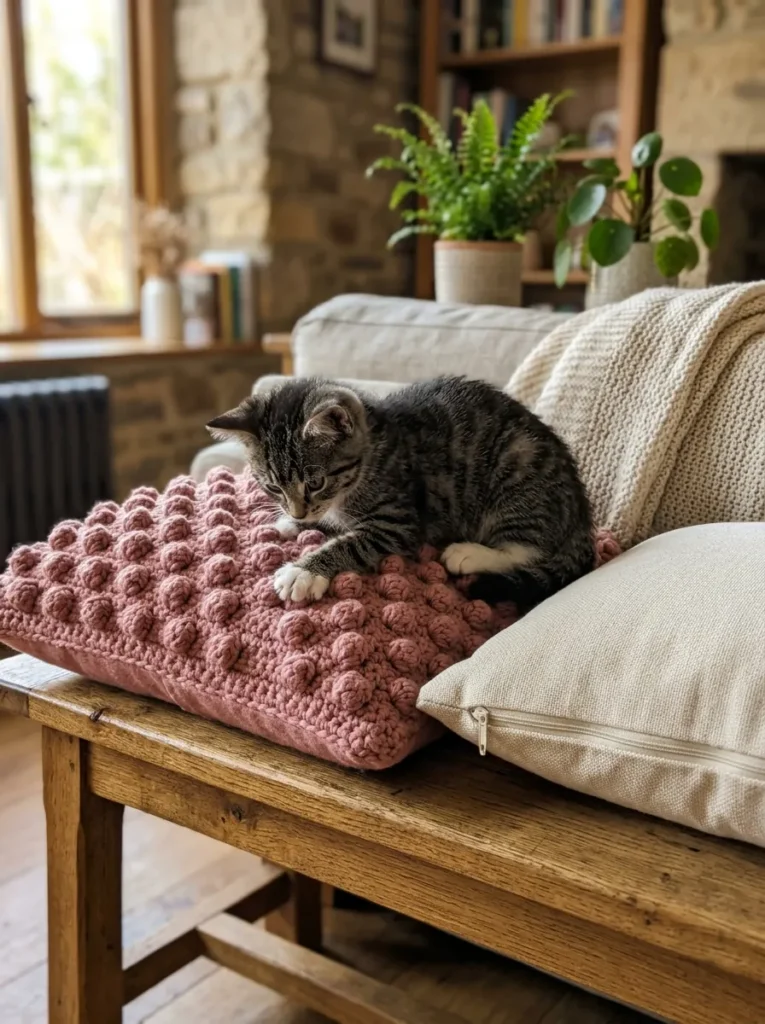
Vibe: The bobble stitch cushion feels richly textural and deliberately home-styled — a pet cushion that reads as an intentional interior accessory rather than an afterthought pet product.
Why it works: A bobble stitch crochet cat cushion is the pet bed project most likely to attract cat engagement before the maker has even finished it — the raised bobbles satisfy cats’ textural curiosity and kneading behavior, which is the feline equivalent of the comfort-seeking nest-making behavior observed in most cats before sleeping. The bobble stitch (five double crochets worked in the same stitch, closed together at the top) is one of the most tactilely interesting stitch patterns in crochet, producing a surface of genuine dimensional richness that photographs beautifully and holds its structure after repeated washing. The cushion format (worked flat as two squares, seamed on three sides, stuffed, and closed with a zipper or envelope back) is the most practical construction for a pet cushion because the removable cover allows the insert to be washed separately.
How to get it: Work two 40x40cm squares in double crochet as the base, then work the bobble pattern on the front square only — work the bobble stitch in every third stitch across, alternating the bobble position by one stitch in each subsequent row to create the staggered diagonal bobble arrangement that distributes the texture most evenly. Seam the front and back panels together on three sides using a mattress stitch for the most invisible join. Insert a 42x42cm cushion pad (slightly larger than the cover for a firm, plump finish) and close the fourth side with either a zipper or an envelope-style overlap closure in coordinating yarn.
Shop The Look
| Product |
|---|
| Chunky yarn dusty rose muted pink superwash |
| Cushion pad insert 42x42cm hypoallergenic |
| Invisible zipper 40cm matching color closure |
| Yarn needle set large eye blunt tip seaming |
| Crochet hook set 5mm 6mm 8mm project range |
5. Braided T-Shirt Yarn Dog Bed (MATERIAL / SMALL SPACE)
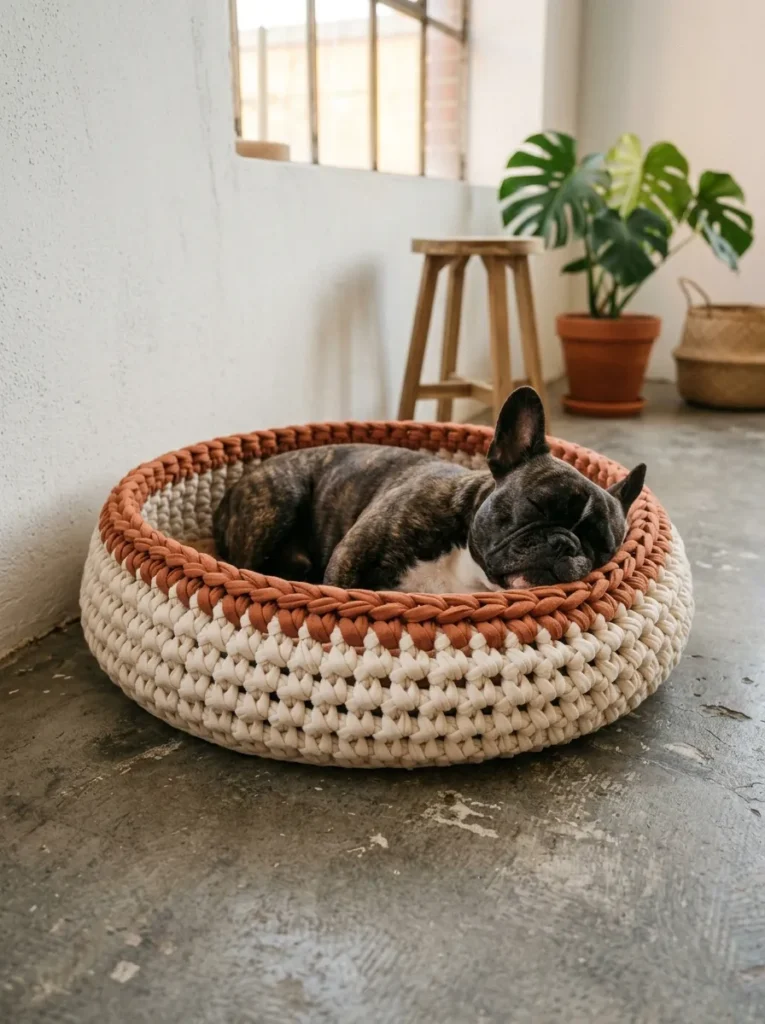
Vibe: The T-shirt yarn dog bed feels warm and modern — a pet bed with the material presence of a large textile object rather than a small craft project.
Why it works: T-shirt yarn (also known as zpagetti or ribbon yarn) is the crochet pet bed material with the best combination of practical and aesthetic properties: it is made from recycled cotton fabric strips, making it sustainable and skin-friendly; it is machine-washable and dries quickly; its wide, flat ribbon form creates a dense, compressed fabric in single crochet that has excellent cushioning properties without requiring stuffing; and its available color range — particularly the range of warm naturals and muted earth tones produced by the recycled fabric origin — includes the most home-compatible colorways available in any pet bed yarn. The large hook required (10mm–16mm) produces rapid results — a complete 55cm dog bed base can be crocheted in 2–3 hours.
How to get it: Work a magic ring with T-shirt yarn and a 12mm hook. Work 6 single crochets into the ring, pull tight. Continue in continuous rounds, increasing by 6 stitches in each round following the standard flat circle formula, until the base measures 55cm diameter. Work 8–10 rounds straight (no increases) for the rim wall. The T-shirt yarn’s inherent stiffness (from the woven fabric construction of the ribbon) provides natural structural stability that wool and acrylic yarns require more careful tension to achieve. Finish with a slip stitch round at the rim top and cut yarn, leaving a 30cm tail for weaving in — T-shirt yarn ends are best secured by knotting twice and tucking the tail back through 3–4 previous stitches.
Shop The Look
| Product |
|---|
| T-shirt yarn recycled cotton ribbon terracotta |
| Crochet hook 12mm large T-shirt yarn handle |
| T-shirt yarn natural white 500g roll |
| Rubber feet set anti-slip base pet bed |
| Storage basket natural seagrass bed storage |
6. Textured Basket Weave Pet Bed (MATERIAL)
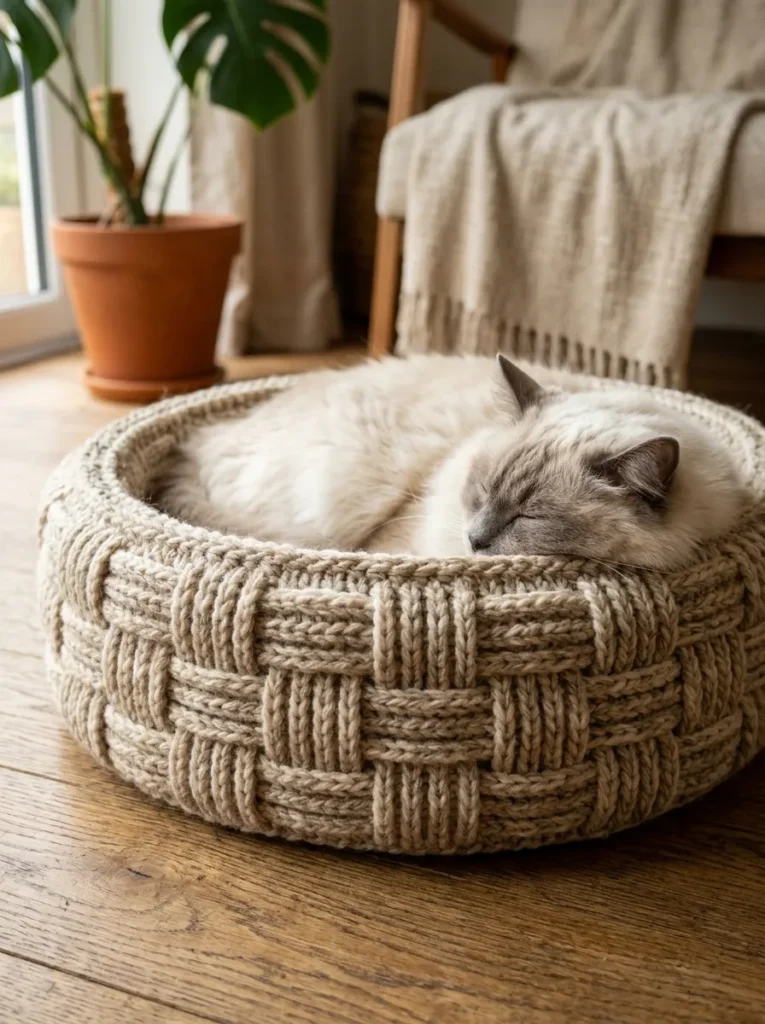
Vibe: The basket weave pet bed feels richly considered and warmly architectural — a stitch pattern so dimensional it makes the pet bed look like a piece of woven textile art.
Why it works: The basket weave stitch (alternating panels of front-post and back-post double crochet worked in groups of 2–4 stitches) produces the most visually sophisticated stitch texture available in crochet without requiring advanced skills — the front-post and back-post technique is mechanically simple but produces a dimensional, cable-like fabric that reads as considerably more complex than it is. For a pet bed, the basket weave has a specific practical advantage: the raised ribs provide additional surface texture that cats find engaging for kneading and scratching-adjacent behavior, while the compressed, dense fabric created by post stitches provides excellent cushioning without the need for internal stuffing. The basket weave pattern also obscures pet hair visually more effectively than smoother stitch patterns because the dimensional surface breaks up the visible hair accumulation.
How to get it: Work the pet bed base as a standard flat circle in double crochet to 40cm diameter. Switch to basket weave pattern at the rim transition point: work groups of 4 front-post double crochet (FPdc), then 4 back-post double crochet (BPdc), alternating around the rim. In the following round, reverse the groupings — work BPdc over the previous round’s FPdc and FPdc over BPdc — this creates the characteristic woven pattern. Continue for 8–10 rim rounds, maintaining the alternating grouping pattern consistently. The basket weave fabric’s inherent dimensional quality provides sufficient rim stiffness without additional structure.
Shop The Look
| Product |
|---|
| Chunky merino yarn oatmeal 200g superwash |
| Natural ivory chunky yarn contrast accent |
| Crochet hook 6.5mm double crochet post stitch |
| Front back post double crochet tutorial card |
| Cat bed liner removable washable insert pad |
7. Granny Square Pet Blanket and Bed (COLOR / ACCESSORIES)
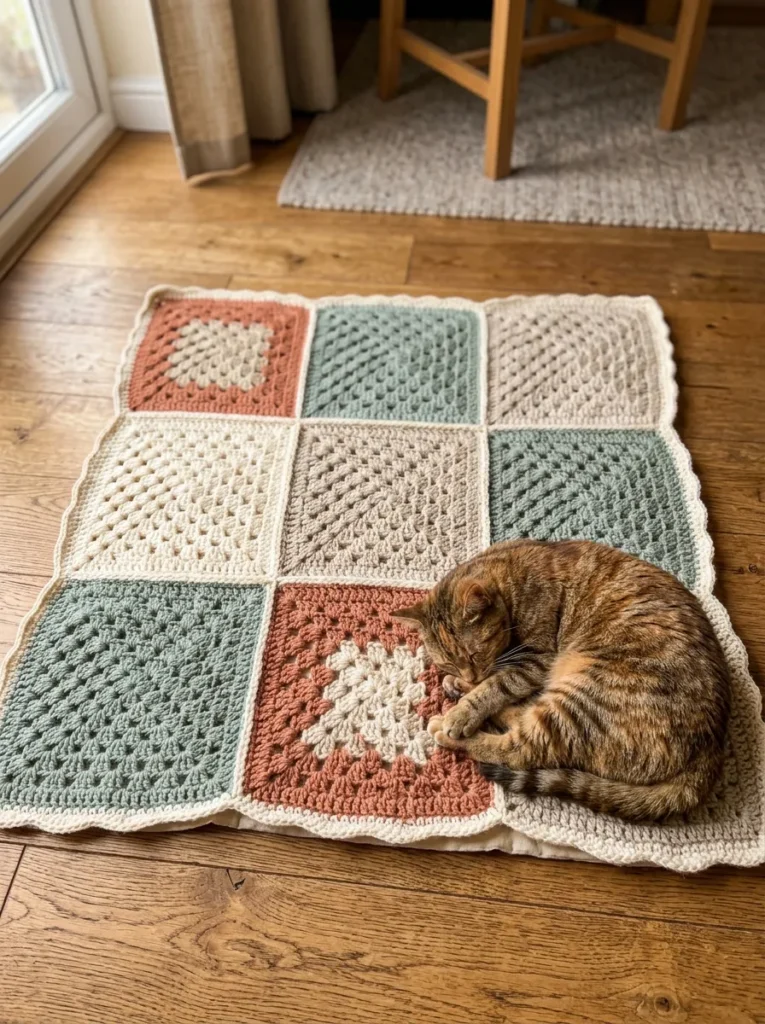
Vibe: The granny square pet blanket feels warm and collected — the classic crochet motif in a coordinated muted palette producing a pet bed of genuine textile beauty.
Why it works: A granny square pet blanket-bed is the most modular and most beginner-forgiving approach to crochet pet bed construction because it breaks the full project into nine small, identical units (each granny square taking 20–30 minutes to complete) that are satisfying individually and spectacular collectively. The design principle is modular accumulation: each square can be made in isolation — while watching television, during a lunch break, on a commute — and the full project assembles from these small sessions rather than requiring a sustained concentrated work period. The coordinated muted color palette (choosing four colors from the same warm neutral family rather than contrasting primaries) produces a finished blanket that reads as a considered textile design rather than a traditional multicolored craft project.
How to get it: Make nine identical granny squares in worsted weight superwash yarn using a 5mm hook — each square should measure exactly 20cm after blocking. For each square: magic ring, round 1 (clusters of 3 dc with ch-2 corner spaces), round 2 (continuing cluster pattern with ch-1 between clusters and ch-2 corners), round 3 (adding solid sc or dc rounds for density and a defined square edge). Block all nine squares to identical dimensions before joining — this is the step that makes the difference between a professional and an amateur-looking finished blanket. Join with slip stitch in the joining color using a flat join method, working along one edge at a time. Add a padded backing by hand-stitching a piece of fleece or batting to the wrong side.
Quick Win: Blocking all nine granny squares simultaneously on a foam mat with T-pins takes 20 minutes of active work and produces perfectly even, professional squares — the single technique that most dramatically improves granny square project quality.
Shop The Look
| Product |
|---|
| Worsted superwash yarn set muted palette 4 colors |
| Blocking mat foam set square T-pin compatible |
| T-pin set stainless steel blocking 50 piece |
| Fleece fabric backing pet blanket natural |
| Crochet hook 5mm standard worsted weight |
8. Raised Donut Pet Bed (LAYOUT / MATERIAL)
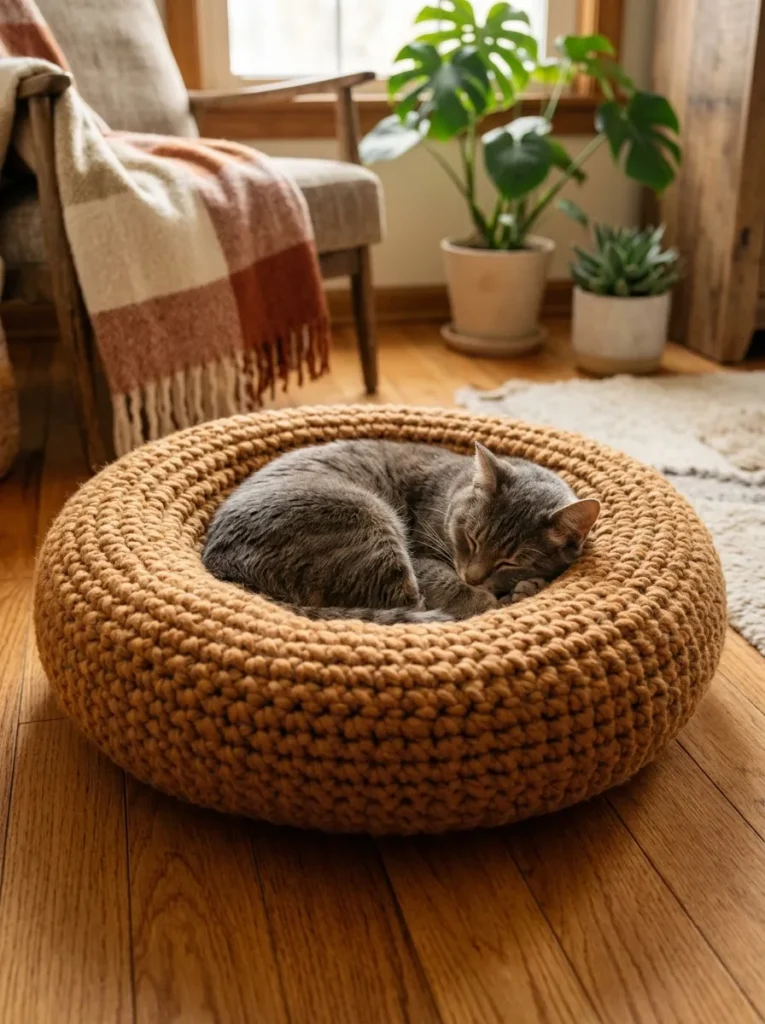
Vibe: The donut pet bed feels plump and enveloping — the wide stuffed bolster rim creating the most enclosed, protected sleeping experience available in a crochet pet bed.
Why it works: The raised donut bed format — a wide, plump, stuffed bolster rim surrounding a central sleeping well — addresses the specific preference of cats and small dogs that like to sleep pressed against a solid surface on all sides, providing circumferential contact that replicates the enclosed feeling of sleeping in a burrow or nest. The bolster’s internal polyester fiberfill stuffing (packed firmly enough to hold its circular shape independently) creates a sleeping rim that maintains its height and firmness through repeated washing and use, unlike unstuffed rims that gradually flatten. The construction approach — a crocheted tube of the appropriate circumference stuffed and seamed into a ring — is straightforward but requires accurate measurement of the tube length to ensure the final ring has the correct diameter.
How to get it: Calculate the desired bolster ring’s outer circumference (π × outer diameter = 3.14 × 50cm ≈ 157cm). Crochet a tube 157cm long and 15cm diameter — work in rounds using a 10cm-diameter circular start, building the tube walls until it reaches 157cm total length. Stuff the tube firmly with polyester fiberfill throughout its length, then seam the two tube ends together to form the ring. Crochet the central sleeping base as a flat circle of 30cm diameter and attach to the interior bottom of the ring. The result is a self-supporting donut structure with a plump rim and flat, dense sleeping surface.
Shop The Look
| Product |
|---|
| Chunky yarn warm caramel superwash 300g |
| Polyester fiberfill stuffing 500g bag |
| Crochet hook 8mm large chunky bolster |
| Measuring tape flexible fabric craft |
| Seaming needle large eye tapestry blunt |
9. Windowsill Cat Perch Pad (SMALL SPACE / LAYOUT)
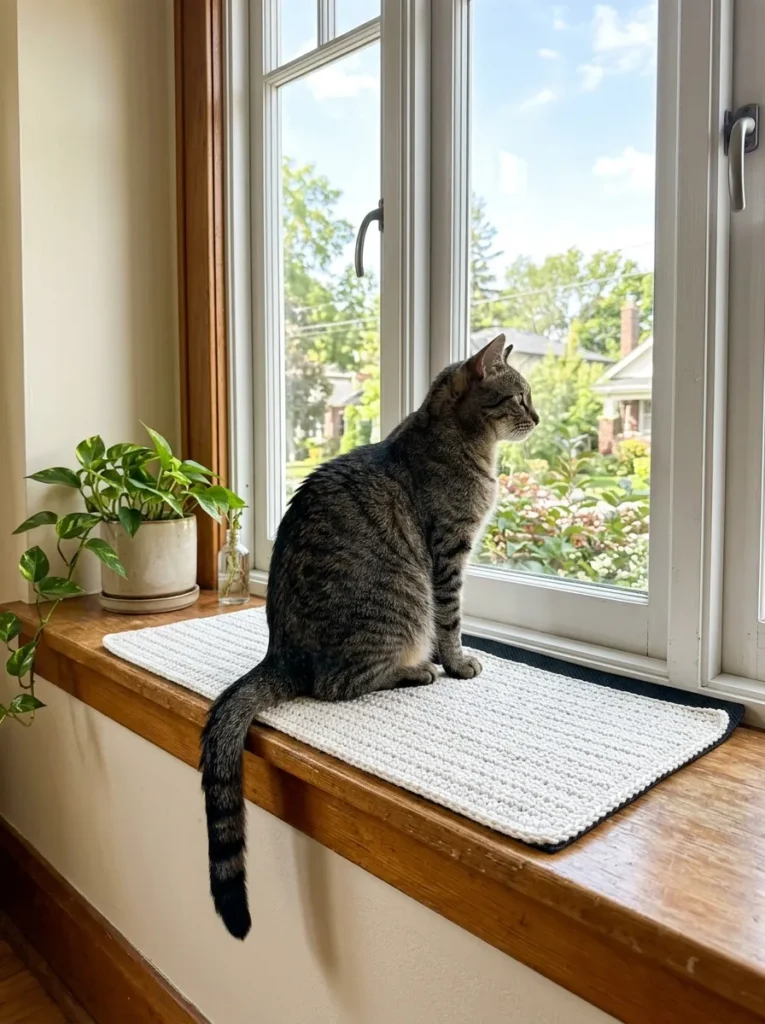
Vibe: The windowsill perch pad feels precisely functional — a pet bed made for the specific elevated sleeping spot that every cat in every home has already claimed.
Why it works: A windowsill cat perch pad is the crochet pet bed project most directly responsive to observed cat behavior — every cat owner knows that their cat has claimed at least one windowsill as a favored observation and sleeping spot, yet commercial windowsill cat beds are either too thick (preventing window use), too short (leaving the cat partially on the cold glass), or the wrong width for the specific windowsill. A crocheted windowsill pad, made to the exact dimensions of the specific window ledge in question, solves all three problems simultaneously while adding the padded comfort that makes the already-preferred spot even more attractive to the cat. The non-slip rubber backing — achieved by applying a layer of liquid non-slip coating or purchasing non-slip shelf liner to attach to the finished pad — prevents movement when the cat jumps on and off.
How to get it: Measure the windowsill precisely — length, width, and whether there is any curve or depth variation. Chain to the measured width plus 2cm for seam allowance and work in linen stitch (the flattest, most dimensionally stable crochet fabric) in rows to the measured length. The finished pad should fit the windowsill snugly — a pad that slides is less comfortable and potentially dangerous for a cat that jumps onto it. Attach non-slip shelf liner to the wrong side using fabric glue, trimming to match the pad’s exact dimensions. For a padded version, slip stitch a second identical panel together with a thin layer of polyester batting between the layers.
Shop The Look
| Product |
|---|
| Natural white cotton yarn worsted 200g |
| Non-slip shelf liner rubber backing mat |
| Fabric glue permanent flexible clear |
| Thin polyester batting sheet pad liner |
| Crochet hook 4.5mm cotton worsted weight |
10. Striped Boho Dog Bed (COLOR)
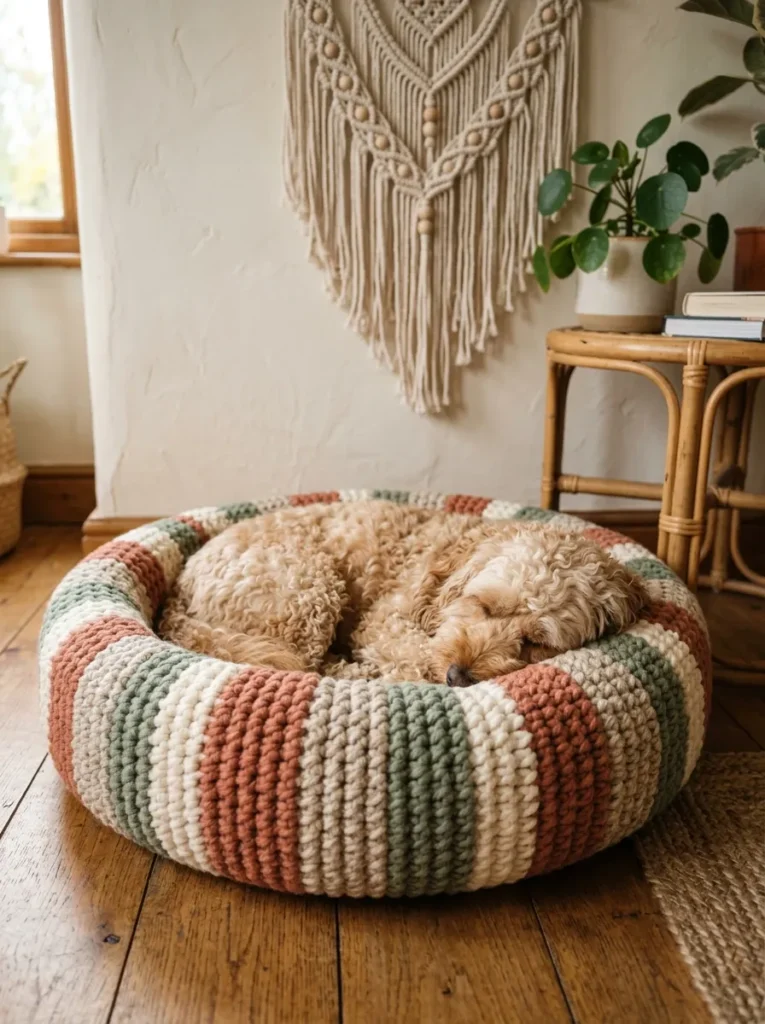
Vibe: The striped boho dog bed feels warmly graphic — a pet bed that doubles as a floor textile statement in a boho-styled room.
Why it works: Striped crochet construction is the most graphically impactful visual technique available in circular pet bed construction because the color change that occurs every four rounds as each stripe color is introduced creates a bold, regular pattern of concentric rings across the bed’s surface — a design quality that is simultaneously easy to achieve (color changes in continuous round crochet are straightforward) and visually sophisticated in the finished result. The boho color palette — warm ivory, dusty terracotta, sage green, natural oatmeal — creates the warm, earthy color story that integrates the pet bed into a boho interior as a deliberate design element rather than a pet accessory. Cutting yarn at each color change (rather than carrying it up the work) produces the cleanest stripe edges without visible yarn floats at the color change point.
How to get it: Work in continuous rounds using the standard flat circle increase formula in the first color until the base measures 25cm, then introduce the second color by cutting the first and joining with a slip stitch. Work four rounds in the second color, then cut and join the third, continuing through all four colors and repeating the sequence until the base reaches 60–65cm diameter. Continue the stripe sequence for the rim rounds (working straight, no increases) for 10cm total rim height. For clean color joins, always join new yarn at the same position in the round — at a consistent spot marked with a stitch marker — which places all color change tails at a single location that is easy to weave in neatly.
Shop The Look
| Product |
|---|
| Chunky yarn ivory terracotta sage oatmeal set |
| Crochet hook 7mm ergonomic chunky stripe |
| Yarn bobbin set color management stripe work |
| Locking stitch marker set color join position |
| Pet bed liner removable insert washable |
11. Amigurumi-Style Cat Bed with Ears (ACCESSORIES)
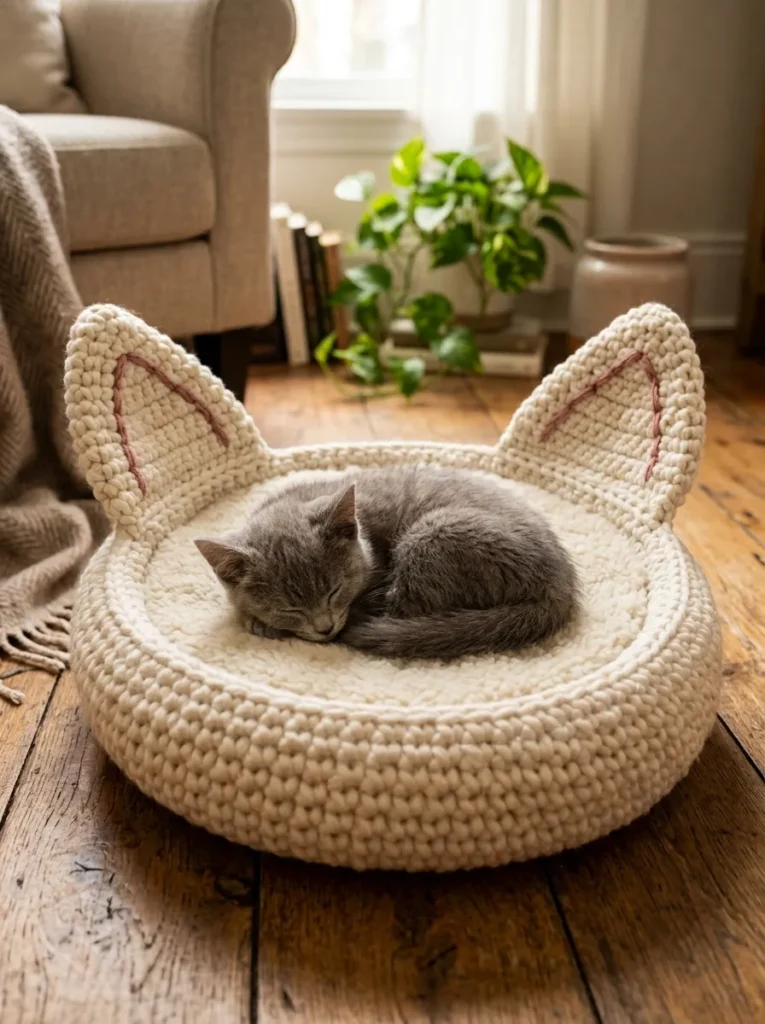
Vibe: The amigurumi cat bed feels playfully considered — a pet bed that reads as a design object with character, making the room corner it occupies feel intentionally styled.
Why it works: An amigurumi-style cat bed with crocheted ears is the pet bed project that most effectively uses the visual language of character design — the amigurumi tradition of creating three-dimensional plush character figures — to transform a functional sleeping surface into a decorative object with personality. The cat ear additions (two simple right triangles crocheted flat and attached to the rim at the correct positions) require only basic shaping skill (a simple decrease sequence to form the triangle) but produce a finished bed that reads as a complete, considered design rather than a circular mat with a rim. The irony of a cat sleeping inside a cat-shaped bed creates the specific visual delight that makes this project particularly popular on social media and as a gift for cat owners.
How to get it: Work the standard round cat bed base to 45cm diameter with a low, flat rim (4 rounds straight, no taller, to maintain the silhouette reading). For each ear: chain 15 (approximately 12cm), single crochet across, decrease by 1 stitch at each end of every row until 1 stitch remains, fasten off — this produces a triangle. Work a second identical triangle for the inner ear section in dusty rose yarn, making it approximately 30% smaller than the outer ear. Seam the inner ear to the outer ear surface, then attach both completed ear assemblies firmly to the rim at the 10 o’clock and 2 o’clock positions (approximately 30cm apart for a 45cm bed) using yarn and a tapestry needle, stitching through all layers of the rim for maximum attachment security.
Quick Win: Attaching the ears at a slight forward tilt (approximately 15 degrees toward the front of the bed) rather than perfectly vertical makes the bed read as more characterful and alert-looking — a single orientation decision that significantly improves the whimsical quality of the finished design.
Shop The Look
| Product |
|---|
| Chunky yarn warm ivory superwash merino |
| Dusty rose chunky yarn inner ear accent |
| Embroidery needle set large eye finishing |
| Tapestry needle set attachment seaming blunt |
| Cat ear template printable sizing guide |
How to Start Your Crochet Pet Bed Journey
Your single best first move is to make a tension swatch in the yarn and hook combination you plan to use before beginning any pet bed construction — not a small 10x10cm swatch, but a full 20cm diameter flat circle worked in the round as you will work the actual bed. This swatch teaches you three things simultaneously: your actual stitch gauge with this specific yarn-hook combination, the rate of increase needed for your tension to produce a flat rather than cupped or ruffled circle, and whether the fabric density is appropriate for a pet bed application (it should be dense enough that you cannot see light through the fabric when held up to a window). The 20 minutes this swatch takes prevents the most common and most frustrating pet bed failure — discovering at 30cm diameter that the base is cupping into a bowl shape rather than lying flat, requiring a complete restart.
The most common beginner mistake in crochet pet bed construction is using yarn that is not machine-washable — choosing a beautiful natural wool or alpaca that requires hand-washing, then discovering that a pet bed in daily use needs washing every 1–2 weeks, which hand-washing in a natural fiber is impractical to sustain. The consequence is a pet bed that either becomes unhygienic through insufficient washing or is damaged by machine washing in an attempt to maintain cleanliness. Fix this before purchasing any yarn by checking the yarn label for the machine-wash symbol — a tub symbol with a hand indicates hand-wash only; a plain tub symbol indicates machine-washable. Superwash merino, superwash wool blends, acrylic, cotton, and T-shirt yarn are all reliably machine-washable; standard (non-superwash) wool, mohair, alpaca, and angora are not.
Three specific items under $50 that make the greatest difference to crochet pet bed quality and durability: a 500g skein of superwash chunky merino in natural oatmeal ($22–$32) that is simultaneously the most aesthetically home-appropriate yarn color and the most practical pet bed material; a set of ergonomic crochet hooks with rubber-grip handles ($12–$18 for a full set of sizes 4mm–10mm) that prevent the hand fatigue that is the primary reason pet bed projects are abandoned before completion — chunky pet beds require 2–4 hours of sustained crocheting and standard aluminum hooks create significant hand strain over this period; and a large foam blocking mat set ($14–$20) that ensures the finished bed lies flat and maintains its shape after washing, which is the single finishing step that most dramatically improves the professional quality of any crochet textile.
A simple flat dog mat in cotton takes 3–4 hours and costs $15–$25 in materials. A standard round cat bed in chunky merino takes 4–6 hours and costs $25–$45. A hooded cat cave or raised donut bed takes 6–10 hours across a weekend and costs $30–$60. The amigurumi cat bed with ears and the basket weave pet bed — the two most visually distinctive projects — each take 6–8 hours and cost $35–$55 in premium superwash yarn. Every project in this list produces a finished pet bed with a useful life of 3–5 years with regular washing, representing a cost-per-use of under $0.05 per day — making handmade crochet pet beds not just more beautiful than commercial alternatives but genuinely more economical over their full useful life.
Frequently Asked Questions About Crochet Pet Bed Ideas
What yarn is best for a crochet pet bed that will be machine-washed frequently?
Superwash merino wool is the premium choice — it is soft enough for sensitive pet skin, warm without being hot in summer, available in beautiful natural colors, and machine-washable at 30°C (cold cycle) without felting or shrinking. For a more budget-friendly option, a cotton-acrylic blend (often marketed as dishcloth cotton or craft cotton) is fully machine-washable at higher temperatures, extremely durable, and available in the widest range of colors. Pure acrylic yarn is the most affordable option and the most machine-washable (tolerates high-temperature washing), but lacks the natural fiber softness and breathability of wool and cotton options. Avoid natural-fiber yarns without the superwash treatment — standard wool, alpaca, and mohair will felt irreversibly in a machine wash.
What hook size should I use for a pet bed that is dense enough not to be scratched through?
A hook approximately one to two sizes smaller than the yarn manufacturer’s recommended size produces the denser fabric appropriate for pet bed applications. For chunky yarn (recommended 6–7mm hook), use a 5–5.5mm hook; for worsted weight (recommended 5mm), use a 4–4.5mm hook. The resulting fabric should feel dense and slightly stiff when worked — individual stitches should not be visible as clear open spaces, and the fabric should not allow light through when held to a window. This density provides the durability required for repeated cat scratching and dog nesting behavior without the risk of claws catching in open stitches.
How do I make a crochet pet bed that lies flat rather than curling or cupping?
A cupping or curling crochet pet bed base is almost always caused by an incorrect increase rate — too few increases per round causes the fabric to cup upward like a bowl; too many causes it to ruffle like a lettuce leaf. The standard increase formula (adding 6 stitches per round, distributed evenly) produces a flat circle at average crochet tension. If your base cups despite correct increases, try going up one hook size; if it ruffles, go down one hook size. Blocking the finished bed flat on a foam mat with T-pins, misted with water and left to dry completely, resolves minor distortion and is the recommended finishing step for all crochet pet beds regardless of whether distortion is visible before blocking.
How do I size a crochet pet bed for my specific cat or dog?
Measure the pet’s sleeping length — from nose tip to tail base when the animal is lying in its preferred sleeping position (curled for most cats, stretched for most dogs). For a cat curled in the classic circle position, the bed diameter should be 1.5–2 times the cat’s curled diameter (measure the cat’s curled body circumference and divide by π to find the diameter). For a dog lying flat, the mat length should equal the nose-to-tail measurement plus 15–20cm for comfortable movement. For a raised rim bed, the interior sleeping well diameter should match the cat’s or small dog’s curled body diameter; the bolster rim adds 10–15cm to the total outer diameter. When in doubt, size up — a slightly too-large bed is always preferable to one the animal cannot comfortably turn around in.
Can I make a crochet pet bed as a complete beginner to crochet?
Yes — the flat rectangular dog mat (idea 3) and the flat windowsill perch pad (idea 9) require only a chain cast-on and single crochet worked in rows — the two most fundamental crochet techniques, both learnable in a single 30-minute practice session. The round cat bed (idea 1) adds working in continuous rounds and the magic ring technique — both achievable within a beginner’s first weekend of crochet practice. The granny square blanket-bed (idea 7) is the most beginner-appropriate multi-technique project because each individual square is small enough to be manageable and the full project can be abandoned after any number of squares if confidence falters — four squares joined in a 2×2 arrangement makes a small cat bed, nine makes the full-size version.
Ready to Make Your First Crochet Pet Bed?
These 11 ideas span the full range of crochet pet bed possibility — from the geometric simplicity of the classic round cat bed and the flat dog mat, through the architectural ambition of the hooded cat cave and the plump luxury of the raised donut bolster, to the graphic boldness of the striped boho bed, the tactile richness of the basket weave, and the whimsical character of the amigurumi cat bed with ears — covering every skill level, every pet size, every home aesthetic, and every construction approach available to the crochet maker. Begin with the project that matches your current skill level most closely rather than the most ambitious one — a completed simple round cat bed is infinitely more valuable to both the maker and the pet than an unfinished hooded cave abandoned halfway through the dome construction. Today’s specific action: measure your cat’s or dog’s preferred sleeping position right now, find that measurement in the sizing guidance for the project that appeals most, and wind a small tension swatch in whatever chunky yarn you already own — because the swatch is where every successful pet bed begins. When your cat curls into a bed you made specifically for it — choosing it over every other sleeping surface in the house, as cats invariably choose the handmade thing — you will understand exactly why crochet pet beds earn their permanent place at the top of every maker’s project list. Save your favorites now, especially the hooded cat cave and the amigurumi cat bed with ears — they are the two ideas that, once completed, make every subsequent pet bed project feel like a natural continuation of something genuinely worth making.