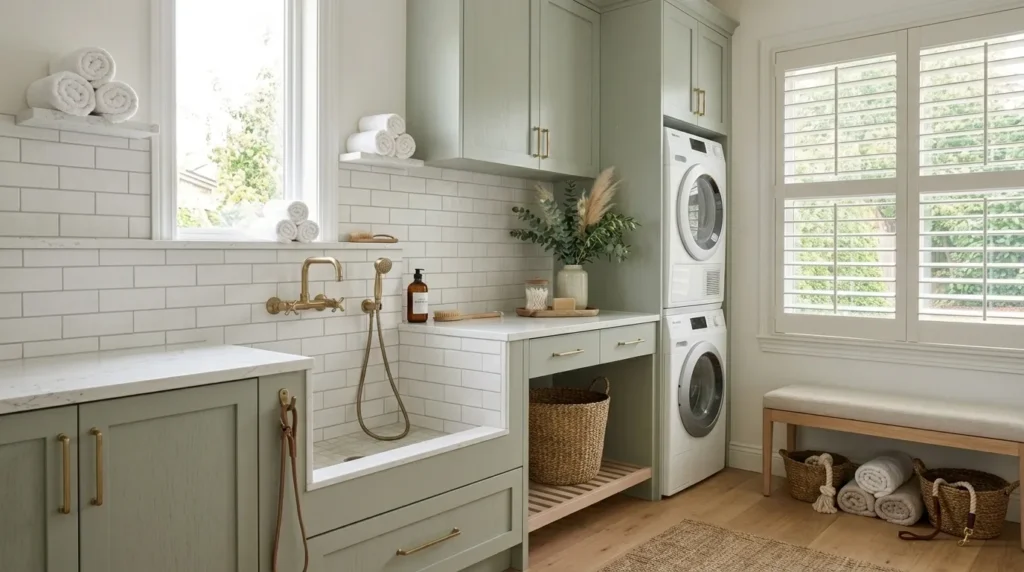
Dog closet ideas that blend style and function convert spare closets, built-in alcoves, under-stair spaces, and repurposed furniture into dedicated pet organization centers that contain food storage, leash hooks, grooming supplies, toy bins, and dog bedding within a single, closed or semi-closed unit — so that the dog’s domestic footprint disappears from view while remaining completely accessible for daily care. This article gives you exactly 16 ideas spanning full closet conversions, IKEA-based builds, built-in alcoves, mudroom integrations, and small-space adaptations so every home and every dog finds a style-forward organizational approach that genuinely works.
A dog closet done well solves the specific domestic problem of pet living: the leash that hangs on the door handle, the bag of kibble on the kitchen floor, the grooming brush on the bathroom shelf, the toys in a pile beside the sofa. It gives every dog-related object a designated, accessible, concealed home — and the room it frees from those objects is immediately, visibly more beautiful. Here are 16 ideas worth saving — and building.
Why Dog Closet Ideas That Blend Style and Function Work So Well
The organizational challenge of living with a dog is categorically different from standard domestic storage challenges because the dog’s objects combine several incompatible organizational properties simultaneously: they are used at high frequency (the leash multiple times daily, the food bowl twice daily, the grooming brush weekly), they vary dramatically in size (from the tiny nail clipper to the 15kg bag of kibble), they produce specific hygiene and odor management requirements (food storage requires airtight containers, grooming areas benefit from washable surfaces, wet-weather mudroom functions require water-resistant flooring), and they are visually incompatible with most domestic room aesthetics when displayed openly — a bag of dog food on a kitchen countertop reads as domestic incongruence in a way that a bag of coffee does not.
The dedicated dog closet addresses all of these challenges simultaneously by concentrating the entire dog-care ecosystem within a single enclosed or semi-enclosed space that is accessible, organized, and visually neutralized from the surrounding domestic environment when the door is closed. The organizational systems that work best within a dog closet share three design principles: height stratification (the heaviest and least frequently used items — bulk food bags, spare bedding — at floor level, the most frequently used items — leash, treats, poop bags — at waist-to-eye height, and seasonal or infrequently used items — travel bowls, bandanas, special-occasion accessories — at the highest accessible level), categorical separation (food and grooming supplies in separate zones, with feeding accessories near the closet’s food storage and grooming accessories near the grooming area), and washable surfaces throughout (the closet’s floor, the food storage area, and any grooming zone benefit from materials that can be wiped, mopped, or sprayed clean without damage).
The dog closet design category has shown strong growth in engagement across home organization and pet care media since approximately 2019, accelerated by the pandemic-era pet adoption surge and the parallel interest in domestic organization that accompanied the period of extended home occupation. The category’s Pinterest engagement is particularly strong in the crossover between pet care content and home organization content, where searches for “dog station closet,” “mudroom dog station,” and “pet organization closet” consistently generate high saves and clicks. The common aesthetic aspiration documented in this engagement is the same across all budget levels: the desire for a dog-care space that is functional enough for daily use with a dog but beautiful enough to coexist with a considered domestic interior.
The physical spaces most commonly converted into dog closets are: spare hall closets (the most common and most practical application, typically 60–120cm wide and 150–180cm tall with standard bifold or hinged doors), under-stair alcoves (which provide the triangular depth and varied height that suits bulk food storage at the deep end and leash organization near the opening), mudroom sections (where the dog closet function integrates with the human entry organization function), and repurposed furniture pieces (armoires, wardrobes, and large kitchen cabinets repurposed as freestanding dog stations that can move with the household). Each type of space has specific organizational requirements and opportunities that the ideas in this list address directly.
Style at a Glance
| Element | Functional Core | Style Edge |
|---|---|---|
| Philosophy | The dog’s life organized in one door | The rest of the house freed from pet clutter |
| Materials | MDF, plywood, stainless bowl, airtight bin | Shaker cabinet, brass hook, woven basket |
| Key Zones | Food storage, leash hang, grooming, toy bin |
16 Dog Closet Ideas That Blend Style and Function
1. Full Hall Closet Conversion with Built-In Food Station
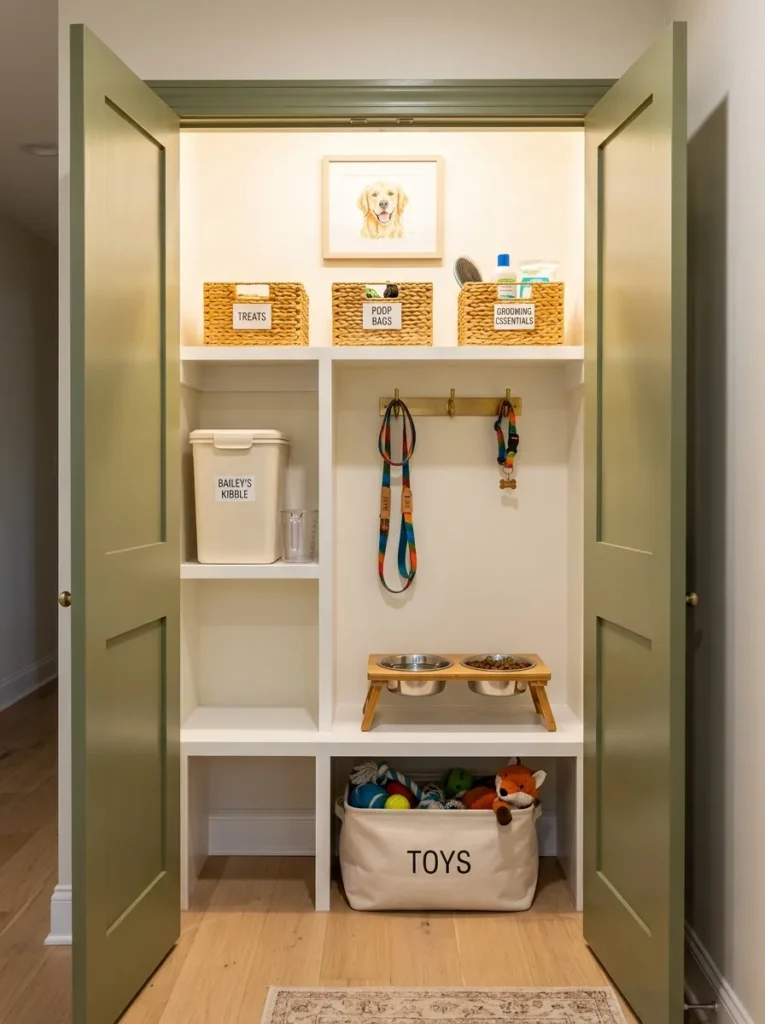
Vibe: The converted hall closet feels like a professional pet boutique installed inside a domestic home — the organization so complete that every dog-related object has its specific place.
Why it works: A full hall closet conversion to a dog station applies the single-system organization principle — rather than distributing dog-related objects across the kitchen (food), the hallway (leash), the bathroom (grooming), and the living room (toys), a single dedicated closet consolidates the entire dog-care ecosystem in one location. This consolidation has two design benefits: it removes dog-related visual noise from every other room in the home simultaneously, and it creates a single, highly organized reference point for all daily dog-care activities, reducing the time spent locating and retrieving what is needed for each task. A hall closet location is specifically optimal because it sits at the primary departure and arrival point for walks — the leash and treats are at the door where they are needed.
How to get it: Empty the existing hall closet entirely. Install adjustable shelf pin holes along both side walls for configurable shelf heights. Build a food storage platform at floor level (a simple plywood box elevated 10cm from the floor for easy mopping beneath it) sized to accommodate the household’s food storage container. Install a pegboard or hook rail at eye height (approximately 150–165cm from the floor) for leash, collar, and treat pouch storage. Add two to three adjustable shelves at varied heights above the hook level for woven basket storage of smaller items. Line the closet floor with a vinyl or rubber mat for easy cleaning. Install an LED strip light at the top interior edge for visibility.
Quick Win: Three matching woven baskets in the same color family ($8–15 each), labeled with chalk markers as TREATS, POOP BAGS, and GROOMING, installed on an existing shelf in any closet create the categorical organization core of a dog station immediately, for under $50 in total materials.
Shop The Look
| Product |
|---|
| Airtight dog food storage container large |
| Wall-mounted leash hook set brass |
| Stainless steel dog bowl set collapsible |
| Woven basket set labeled set 3 |
| LED strip light closet interior |
Also view: 16 Cat Grass Box Designs for Happy Indoor Cats
2. IKEA PAX Wardrobe Dog Closet
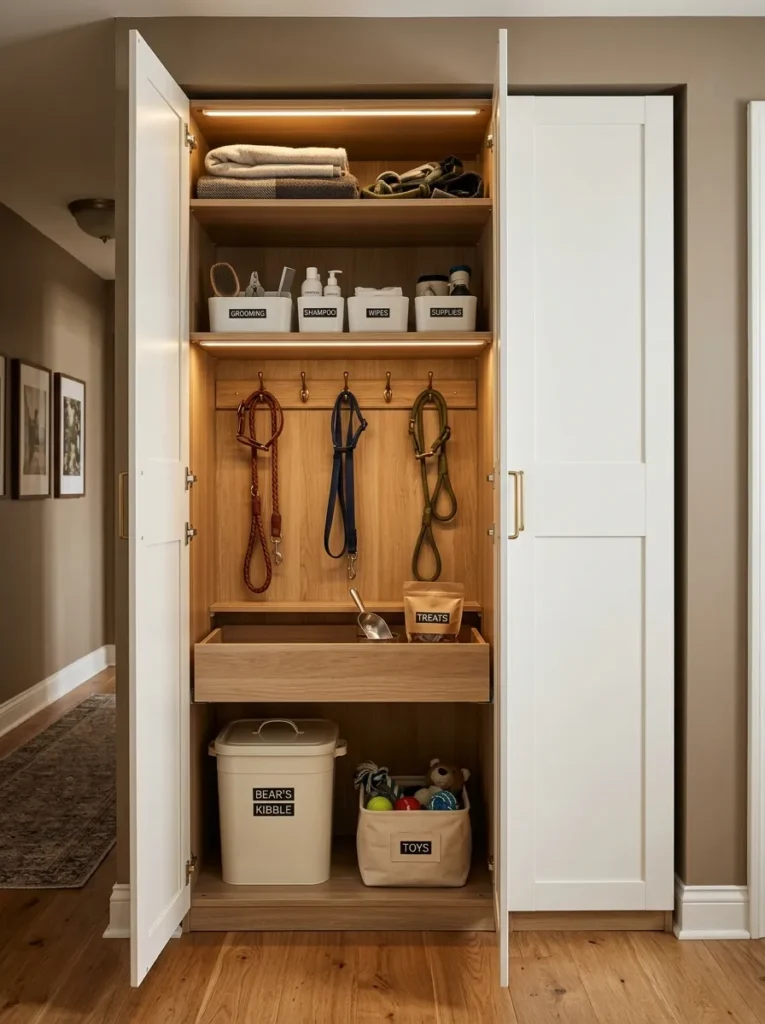
Vibe: The PAX dog closet feels like a secret — from the outside, a wardrobe; from the inside, the most organized pet station possible.
Why it works: An IKEA PAX wardrobe configured as a dog closet applies the furniture disguise principle — the PAX’s floor-to-ceiling configuration and door system makes it appear, from any exterior viewing angle, as standard bedroom or living room cabinetry rather than a pet storage system. This disguise is the specific advantage of a wardrobe-format dog station over open wall-mounted systems: the entire dog-care ecosystem disappears behind doors that match the room’s other furniture, leaving no visible evidence of the dog’s domestic presence when the doors are closed. The PAX’s interior fitting system (KOMPLEMENT shelves, pull-out trays, and accessories) provides the same organizational flexibility as a custom-built closet at a fraction of the cost.
How to get it: Configure the PAX with its interior organized around three functional zones: the base zone (floor to 50cm) for food storage — a freestanding airtight food bin, with a KOMPLEMENT pull-out tray above it for food accessories (scoop, measuring cup, supplements); the middle zone (50–130cm) for daily-use items — PAX hooks for leashes and collars, a small KOMPLEMENT basket or shelf for treats and poop bags; and the upper zone (130cm and above) for infrequent items — a shelf for seasonal accessories, travel gear, and backup supplies. Remove the standard hanging rail entirely and replace with custom-spaced KOMPLEMENT shelves at the heights that suit the specific items to be stored.
Shop The Look
| Product |
|---|
| IKEA PAX wardrobe frame double |
| KOMPLEMENT shelf set PAX |
| KOMPLEMENT pull-out tray PAX |
| Airtight dog food storage bin medium |
| PAX hooks set interior |
Also view: 14 Functional Cat Space Ideas for Rescue Homes
3. Under-Stair Dog Alcove with Crate and Storage Integration
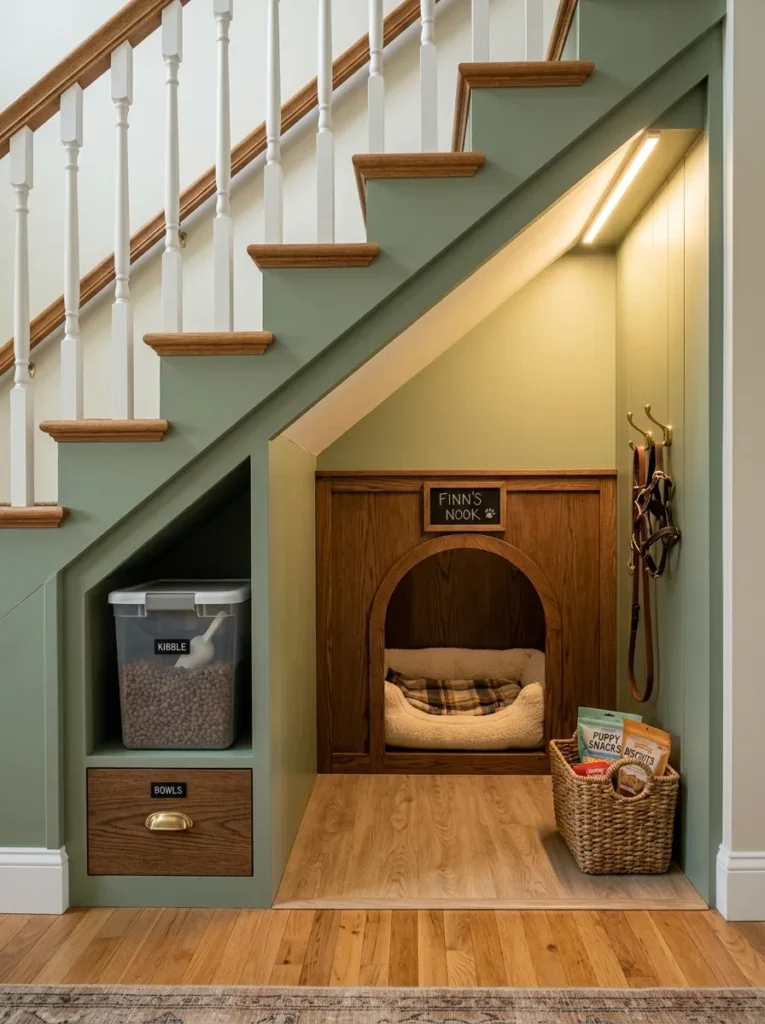
Vibe: The under-stair dog alcove feels like the house was always designed to have a dog — the alcove functioning as architecture rather than accommodation.
Why it works: An under-stair dog alcove applies the architectural integration principle — the triangular under-stair space is among the most awkward and least efficiently used domestic spaces in any home with a staircase, and its conversion to a dog station simultaneously solves two problems: the dead space problem (the alcove goes from wasted to productive) and the dog organization problem (the dog gains a dedicated, built-in space). The built-in crate at the alcove’s deep end uses the triangular depth variation intelligently — the crate is positioned where the ceiling height is adequate for the dog to stand (the front, highest section of the alcove), while the lower-clearance sections are used for food storage and horizontal surface storage of flat-stacked items.
How to get it: Assess the under-stair alcove’s dimensions: measure the height at multiple points along the depth (it decreases toward the back of the stair run) and the full width. Design the crate opening to face outward toward the hallway, with the crate’s interior at the section of the alcove with adequate height for the dog (typically the first 60–90cm of depth from the hallway). Build the crate frame from 18mm plywood with a decorative arch cut at the opening and a lockable gate. Install an LED strip light at the crate ceiling for visibility. Build the food storage section in the lower-clearance area at the back of the alcove — a built-in bin with a lift-off or hinged lid accessed from the front.
Shop The Look
| Product |
|---|
| Plywood sheet 18mm project |
| Arch router template crate opening |
| Crate gate dog safe lockable |
| LED strip light warm under-stair |
| Airtight food bin built-in lid |
4. Mudroom Dog Station with Paw-Wash Integration
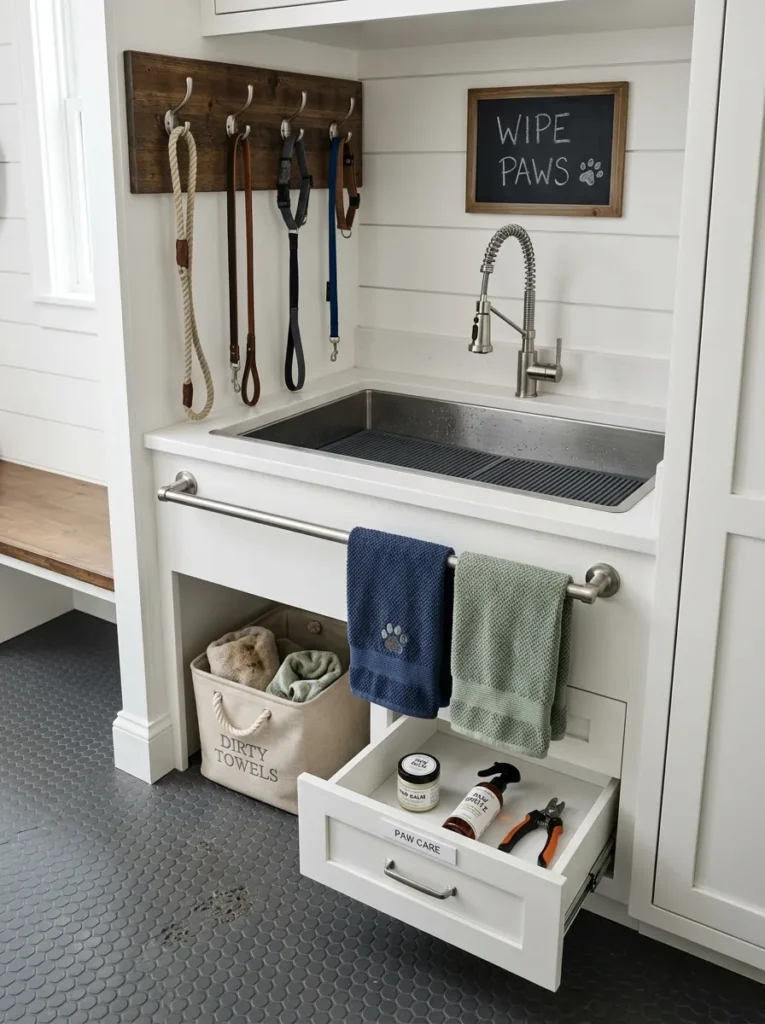
Vibe: The mudroom paw wash station feels like the most specific and therefore most satisfying organizational solution — every element designed for exactly the daily mud-management challenge that every dog owner knows.
Why it works: A mudroom dog station with paw-wash integration applies the entry-point containment principle — the specific problem of dogs entering the home after outdoor exercise (wet paws, muddy fur, contaminated surfaces) is entirely a threshold challenge: it occurs within the first two metres of the home’s interior, every time the dog returns from outside. A paw-washing station at this exact threshold converts the contamination from a whole-home problem (muddy paw prints tracked across the kitchen and living room) to a single-location management task (a 30-second wipe or rinse at the door). The stainless trough (sized for a single paw at a time) and the adjacent towel rail contain the entire paw-cleaning protocol in one compact station without requiring the dog to cross more of the home’s clean surfaces.
How to get it: Install a wall-mounted trough (a small stainless steel prep sink or a custom-fabricated shallow stainless tray, 30×20×8cm, available from catering supply companies) at a height appropriate for the dog — the dog’s paw should rest in the trough at approximately standing leg height without the dog needing to lift its leg uncomfortably. Install a mixer tap above the trough (a simple cold-only tap is sufficient for paw washing). Mount a towel rail with two dog-specific towels immediately beside the trough. Install a shallow drawer below the trough for paw-care products. Specify a rubber-studded or textured ceramic floor tile in the immediate area below the trough for grip and easy cleaning.
Shop The Look
| Product |
|---|
| Small stainless steel prep sink trough |
| Simple tap mixer cold water |
| Towel rail double small wall mount |
| Dog towel set absorbent navy |
| Paw balm and care kit dog |
5. Shaker Cabinet Dog Station with Integrated Feeding Drawer
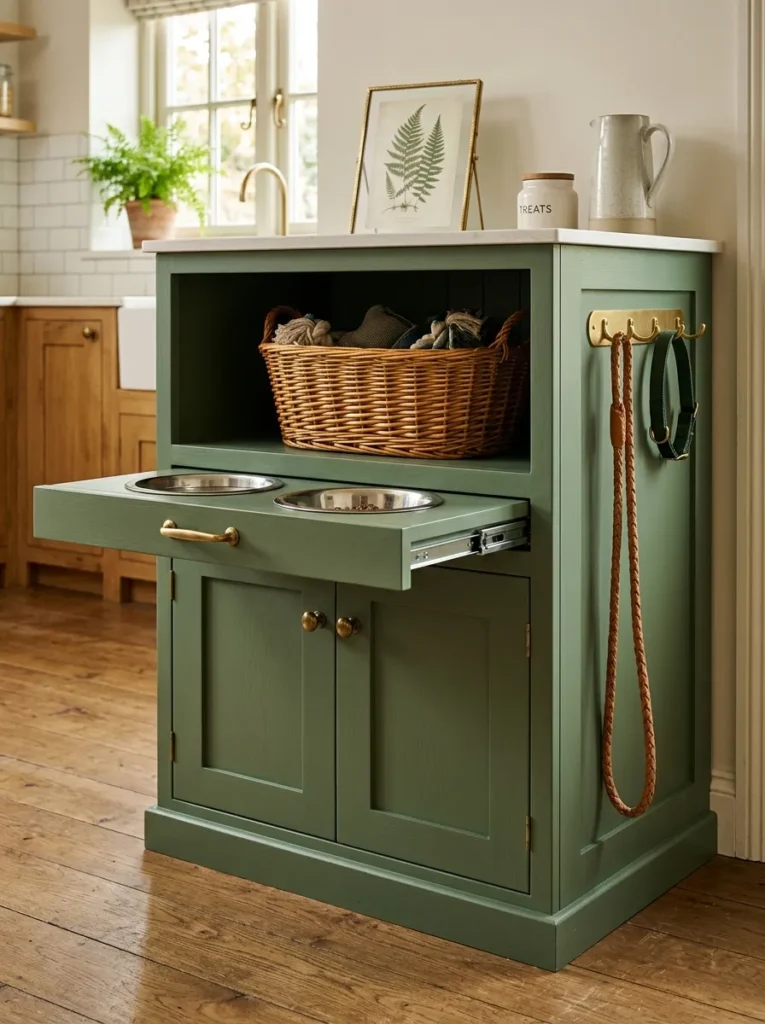
Vibe: The shaker cabinet dog station feels like a piece of bespoke kitchen furniture that happens to be entirely dedicated to the dog — the elevated design standard blending the pet station seamlessly with the home’s aesthetic.
Why it works: A shaker cabinet dog station applies the furniture integration principle — a dog station that reads as domestic furniture (rather than as a pet-industry product installed in a domestic setting) integrates into the home’s interior more successfully than any purpose-built pet product, because the domestic furniture aesthetic is consistent with the home’s existing design language. The shaker cabinet format (recessed panel doors, simple rail-and-stile construction, classic proportions) is the most widely appropriate furniture aesthetic across both traditional and contemporary interiors, making it the most versatile dog station format available. The pull-out bowl platform is the specifically clever functional detail — it conceals the feeding bowls within the cabinet’s clean exterior profile and deploys for feeding time in a single smooth motion.
How to get it: Source or commission a shaker cabinet in the appropriate width for the space (80–100cm suits most applications). Specify the lower cabinet section with full-width pull-out drawer hardware (full-extension soft-close slides rated for 25kg minimum) and a custom-built platform that holds two elevated stainless bowls at the correct height for the dog (elbow minus 6 inches is the standard guideline for elevated bowl height). Paint in the room’s primary accent color using a furniture-grade eggshell paint. Add aged brass knobs and a side-mounted hook rail in the same brass finish.
Shop The Look
| Product |
|---|
| Shaker cabinet base unit 90cm |
| Full-extension soft-close drawer slide |
| Elevated stainless steel bowl platform |
| Stainless steel bowl set 2 |
| Aged brass cabinet knob set |
6. KALLAX Dog Station with Custom Door Fronts
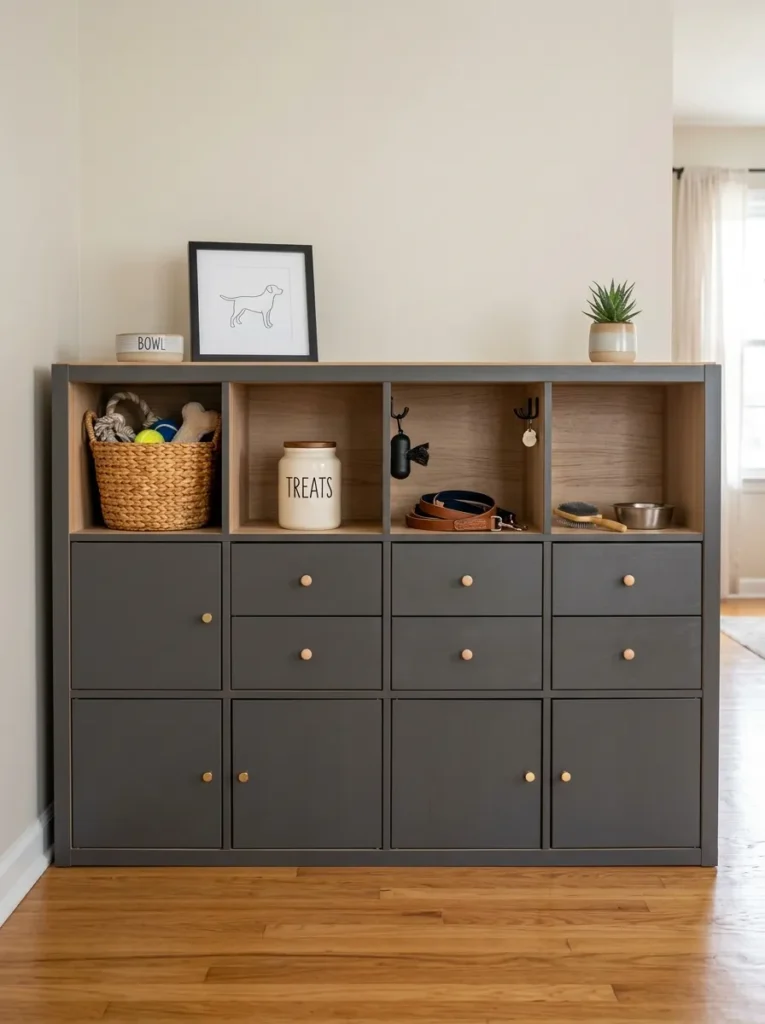
Vibe: The KALLAX dog station feels like a media unit that secretly runs the dog’s life — the familiar IKEA format concealing a comprehensive pet organization system behind its painted fronts.
Why it works: A KALLAX-based dog station applies the accessible luxury principle — the KALLAX’s modular format and extensive insert ecosystem (door inserts, drawer inserts, fabric bins) create a highly customizable storage unit at a fraction of the cost of custom cabinetry, while the paint upgrade and careful insert selection convert the flat-pack original into something that reads as significantly more considered. The horizontal 2×4 KALLAX at 42cm height works as a dog station specifically because its height suits the surface placement of a dog’s daily items at a human-usable standing level, while the depth (42cm) accommodates a standard food bin with space to spare for organization accessories.
How to get it: Paint an assembled horizontal 2×4 KALLAX in Zinsser BIN-primed furniture eggshell (the primer is essential — IKEA’s factory surface repels unprimed paint). Install KALLAX door inserts on the lower cubbies (painted to match) to conceal bulk food storage and cleaning products. Install KALLAX drawer inserts in two middle cubbies for grooming supplies organized in the drawers’ flat surfaces. Use fabric bins in the remaining open cubbies for toys and frequently accessed items. Mount three small brass hooks on the unit’s side panel for leash and collar storage. Add a ceramic treat jar to one open cubby as a visible daily-use accent.
Shop The Look
| Product |
|---|
| IKEA KALLAX 2×4 unit white |
| KALLAX door insert white |
| KALLAX drawer insert natural wood |
| Warm charcoal furniture paint eggshell |
| Small brass hook set side panel |
7. Walk-In Pantry Dog Section with Airtight Food System
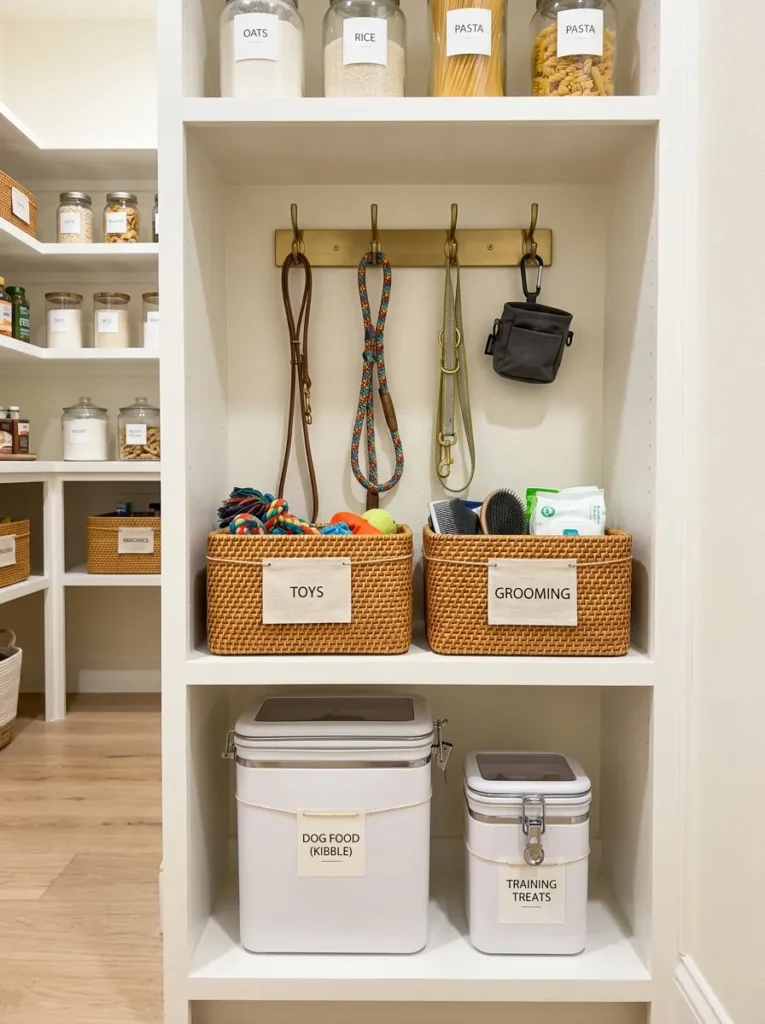
Vibe: The pantry dog section feels like the dog has been included in the household’s organizational system rather than accommodated as an afterthought — the matching labels and consistent containers integrating pet organization with household organization.
Why it works: A designated dog section within an existing walk-in pantry applies the integration-over-isolation principle — rather than requiring a separate dedicated dog closet, this approach integrates the dog’s organizational needs within the household’s existing storage infrastructure. This integration is particularly appropriate when the walk-in pantry is already centrally located near the kitchen (where feeding happens) and the home’s entry (where leash management happens). The visual consistency between the pantry’s human food organization and the dog section organization (matching basket types, consistent labeling, same airtight container family) communicates that the dog’s needs are a considered part of the household’s organization rather than an accommodation.
How to get it: Identify one full shelf section (minimum 80cm wide, three shelves vertically) in the walk-in pantry as the permanent dog zone. Assign the lowest shelf to food storage (the heaviest items) using airtight bins from the same range as any human food storage containers used elsewhere in the pantry. Assign the middle shelf to categorical baskets (one for toys, one for grooming supplies, one for accessories) in the same basket style used elsewhere in the pantry. Mount a small hook rail on the adjacent wall section at leash height. Apply consistent labels using the same label format used for all other pantry sections.
Shop The Look
| Product |
|---|
| Airtight food bin large matching set |
| Airtight food bin small treat size |
| Matching woven basket set labeled |
| Wall hook rail small brass |
| Label set coordinating pantry style |
8. Laundry Room Dog Corner with Grooming Station
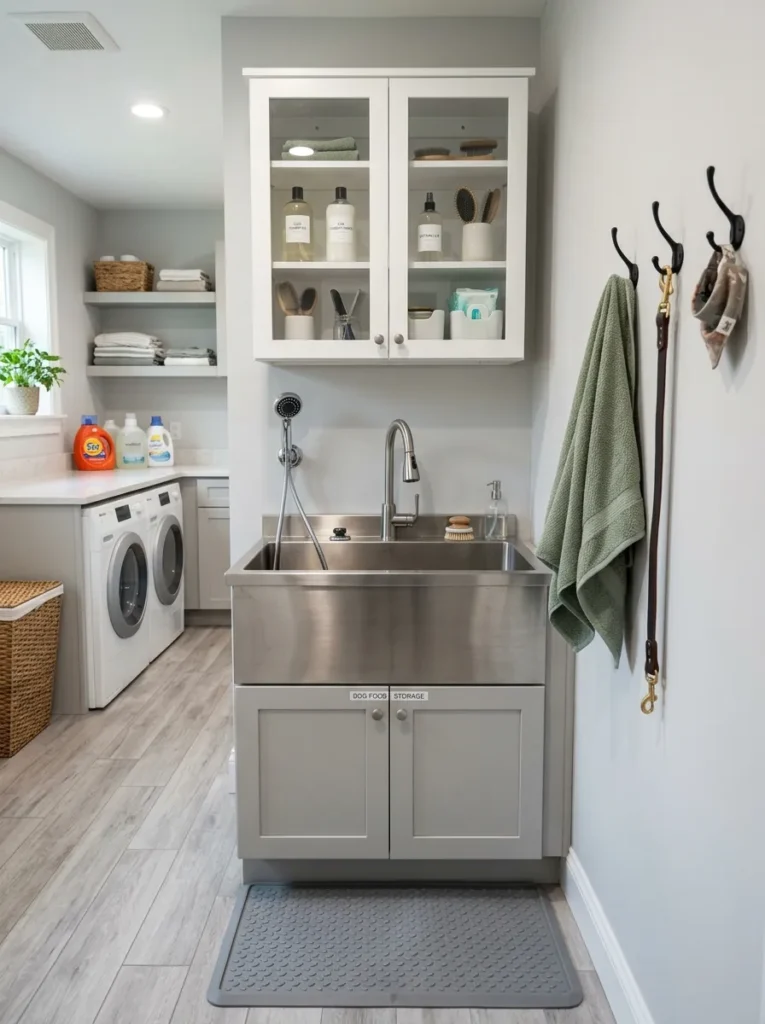
Vibe: The laundry room dog corner feels pragmatically joyful — the most functional possible approach to the least glamorous dog-care tasks, organized so well that the tasks themselves feel less onerous.
Why it works: A laundry room dog grooming corner applies the utility infrastructure co-location principle — the laundry room already has the infrastructure that dog grooming requires (water supply, drainage, waterproof flooring, a washing machine for the post-grooming towels and the dog’s bedding), making it the ideal location for a dog grooming station without requiring any new plumbing infrastructure beyond a handheld shower attachment to an existing utility sink. The glass-door cabinet above the sink is the specific storage decision that maintains the grooming station’s visual organization — grooming supplies in an open cabinet appear cluttered; in a closed opaque cabinet they disappear; in a glass-door cabinet they remain visible and accessible while appearing organized and intentional.
How to get it: Install a handheld shower head on a flexible hose to the utility sink’s existing faucet (no plumbing modification required — a simple diverter adapter connects the handheld hose to the standard faucet). Mount a two-door glass-fronted cabinet (IKEA’s FAKTUM or equivalent) at eye height above the sink. Organize grooming supplies in matching small containers on the cabinet’s shelves — one container per category (brush/comb, shampoo, nail clipper, ear cleaner). Hang three hooks on the wall beside the cabinet at leash and towel height. Place a rubber anti-slip mat on the floor in front of the sink during grooming sessions and hang it on a hook when not in use.
Shop The Look
| Product |
|---|
| Handheld shower head diverter adapter |
| Glass door wall cabinet small |
| Matching grooming supply container set |
| Anti-slip rubber mat floor bath |
| Dog grooming towel set absorbent |
9. Bedroom Closet Dog Zone with Crate Integration
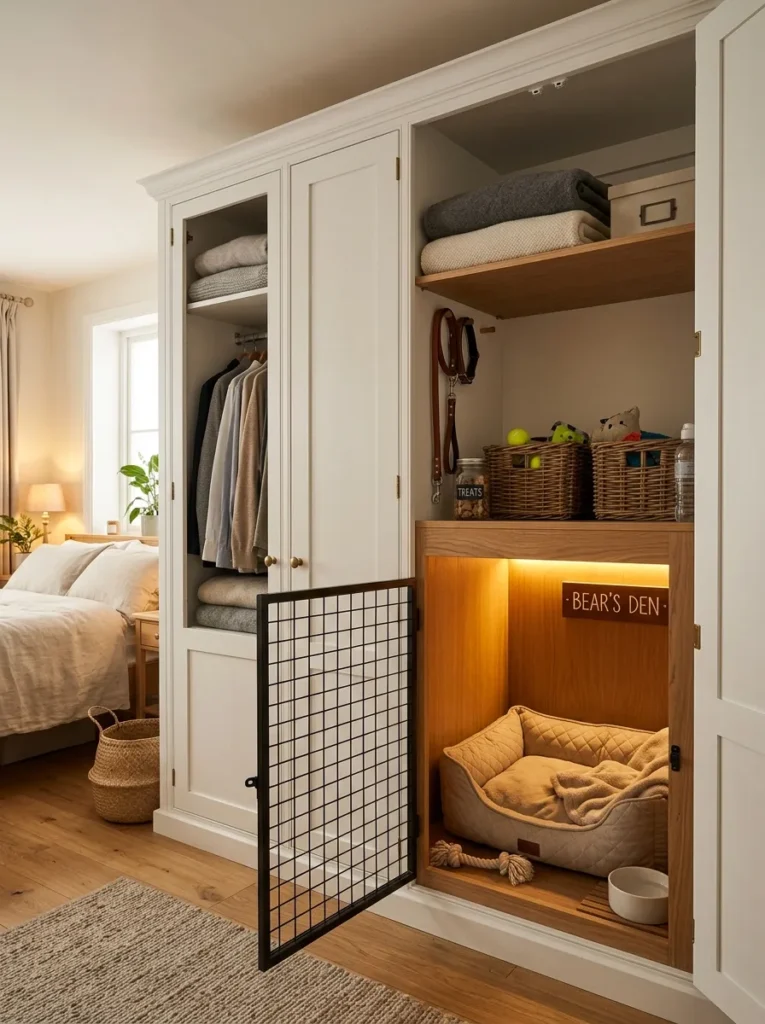
Vibe: The bedroom wardrobe dog zone feels like the most settled version of sleeping with a dog — the dog’s sleeping space permanent, defined, and architecturally integrated within the bedroom’s existing furniture.
Why it works: A bedroom wardrobe dog crate integration applies the den-instinct alignment principle — dogs instinctively seek enclosed, safe sleeping spaces, and a wardrobe section converted to a crate provides the three-sided enclosure that a standard open-sided dog bed does not. Integrating the crate within an existing wardrobe eliminates the floor space a freestanding crate would occupy, maintains the bedroom’s aesthetic coherence (the dog’s sleeping area disappears into the wardrobe’s visual frame rather than sitting as an incongruous wire cage in the room), and creates a semi-permanent den environment that supports the dog’s natural resting behavior. The small shelf above the crate section provides accessible overnight storage for the specific accessories needed during the sleeping hours.
How to get it: Remove the doors and interior fittings from the wardrobe’s designated dog section. Build a simple wooden frame that defines the crate interior within the section (a low front sill, two side walls to the wardrobe’s existing walls, and a ceiling panel if the wardrobe section is taller than needed for the dog). Install a dog-appropriate gate (a simple latch gate in powder-coated steel or wood) at the section’s front. Install a small LED strip light at the crate’s top edge. Add a small shelf at eye height above the crate section for overnight accessories. Leave the gate open during the day — the enclosed space will be used voluntarily as a den.
Shop The Look
| Product |
|---|
| Dog crate gate panel wood or metal |
| LED strip light warm small crate |
| Dog bed cushion oat washable |
| Small shelf above crate 30cm |
| Small basket overnight accessories |
10. Entryway Dog Station Cabinet — Freestanding Console Style
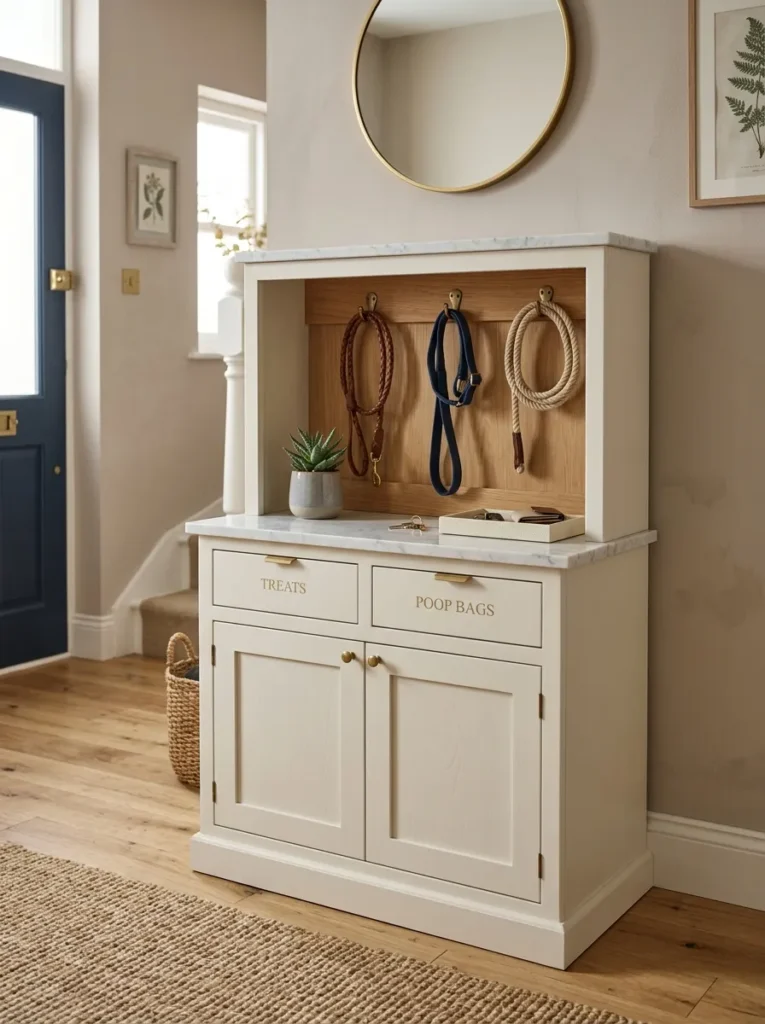
Vibe: The entryway dog console feels like the most sophisticated resolution to the daily dog chaos — a piece of furniture that the dog is entirely reliant on and that no guest would identify as pet furniture.
Why it works: A console-style dog station in the entryway applies the furniture disguise principle at the entryway scale — the entryway is the location where dog-related organizational needs are highest (leash management, treat access for training at departure, paw-cleaning on return) but also where the aesthetic standard is highest (the entryway is the first room guests see). A console-format dog station resolves this tension by meeting the organizational needs within a furniture form that reads as standard entryway decor rather than as pet equipment. The stone or marble top surface provides the aesthetic quality that signals domestic refinement, while the interior organization addresses every daily dog-care departure and arrival need.
How to get it: Source a console cabinet in the appropriate entryway width (80–100cm is optimal for most entryway widths between 90cm and 150cm) with at minimum two lower cabinet doors and two small upper drawers. Confirm interior dimensions can accommodate the household’s food storage container before purchasing. Add brass hooks to the open top section above the cabinet surface — three hooks provides adequate leash, collar, and lead storage for a single-dog household. Specify a marble or stone top (a cut-to-size marble remnant, a piece of honed slate, or a marble-effect porcelain slab) for the most domestically refined surface quality.
Shop The Look
| Product |
|---|
| Console cabinet 90cm entryway |
| Marble or stone top cut to size |
| Brass hook set three wall mount |
| Small plant pot entryway ceramic |
| Key tray small ceramic leather |
11. Craft Room Repurpose — Armoire as Dog Wardrobe
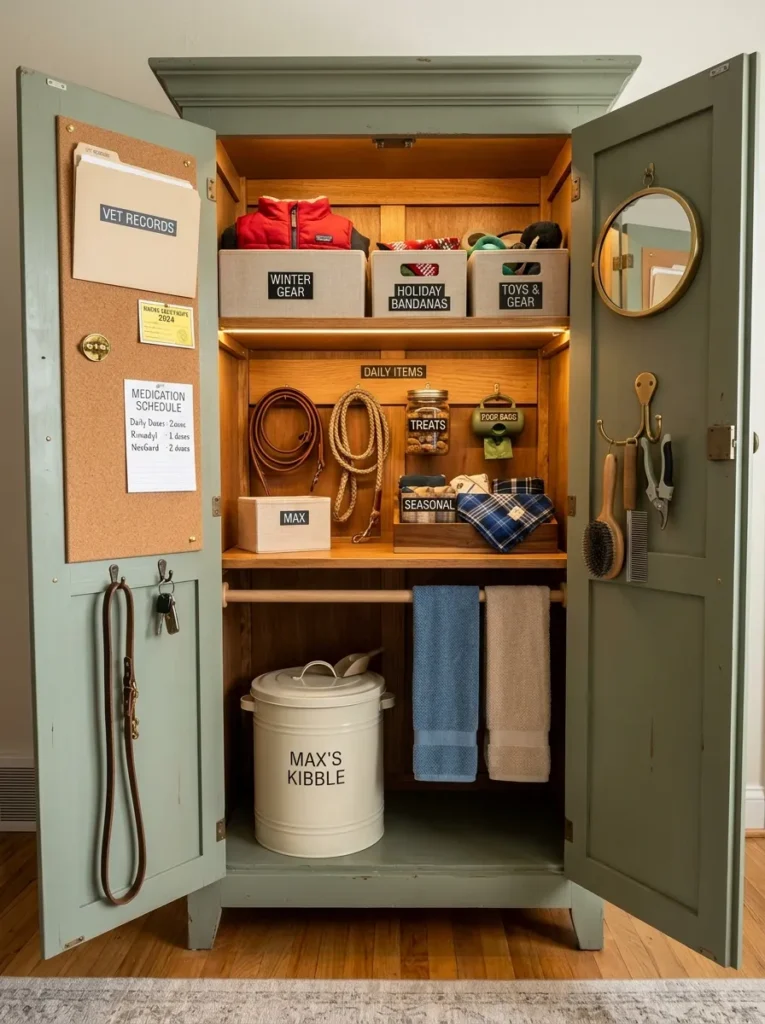
Vibe: The dog wardrobe armoire feels like the most complete possible single-furniture solution — the armoire containing not just the dog’s physical supplies but also the administrative record of the dog’s health and care.
Why it works: A repurposed armoire as a dog wardrobe applies the comprehensive single-unit organization principle — an armoire’s generous internal volume (typically 50–60cm deep, 80–120cm wide, 180–200cm tall) provides more organizational volume than any other single furniture piece that can be repurposed for dog storage, making it the appropriate solution for households with multiple dogs, large breeds requiring large food quantities, or comprehensive grooming setups. The specific innovation of using the door interiors as functional surfaces (corkboard for records, hooks and mirror for grooming) is the detail that converts adequate storage into comprehensive care infrastructure.
How to get it: Source a large secondhand armoire (charity shops, marketplace apps, and vintage furniture retailers regularly stock large armoires at accessible prices — $50–200 for a structurally sound example before painting). Remove the hanging rail and any existing shelving. Install three adjustable shelves at appropriate heights for the planned storage. Attach a self-adhesive corkboard tile to the interior face of the left door. Mount a small mirror (a IKEA LOTS mirror at 25cm diameter) and three small hooks to the right door’s interior face. Paint the exterior in the room’s color palette using furniture chalk paint over a shellac primer.
Shop The Look
| Product |
|---|
| Large secondhand armoire repurpose |
| Furniture chalk paint sage or white |
| Self-adhesive corkboard tile door |
| Small mirror door mount |
| Adjustable shelf pin hole set |
12. Narrow Niche Dog Station — Between Cabinets Build
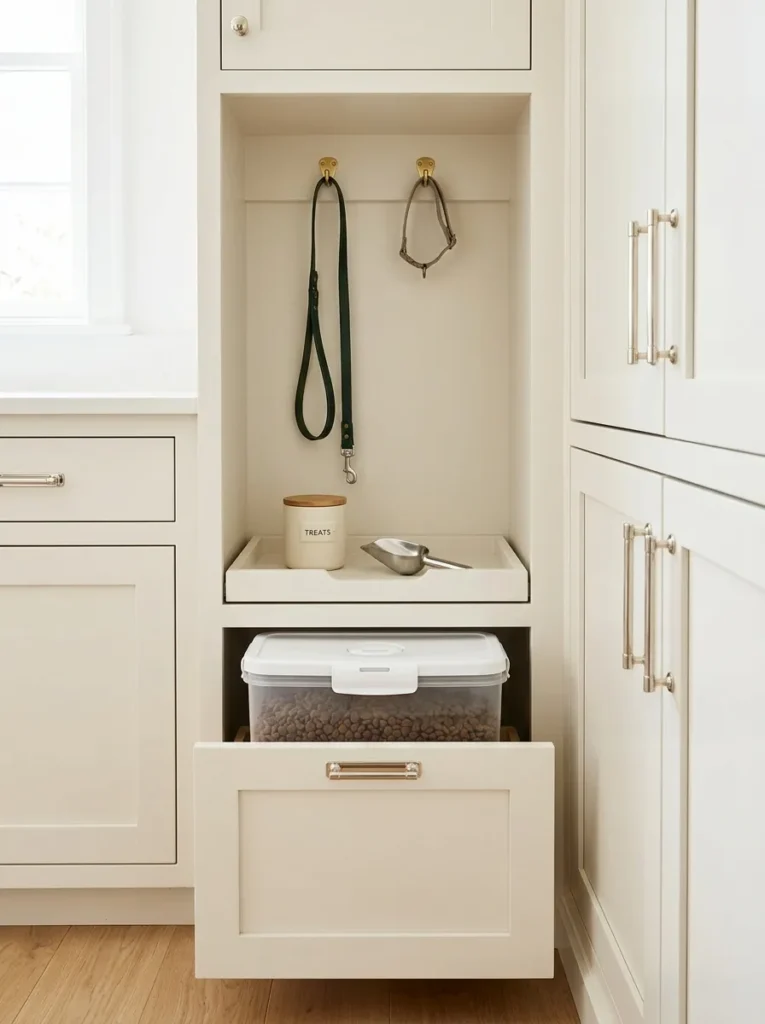
Vibe: The niche dog station feels like it was designed into the kitchen from the beginning — the narrow space between two cabinets becoming the most efficient dog organization point in the home.
Why it works: A narrow niche dog station between existing cabinets applies the gap utilization principle — the 20–50cm gaps that commonly exist between kitchen cabinets and walls, between refrigerators and adjacent cabinets, and between standalone furniture pieces are typically filled with narrow pullout units for small kitchen items; the same gap converted to a dog station vertical column provides a complete one-column dog organization solution without occupying any additional floor space or wall surface beyond the existing gap. Painting the niche interior to match the surrounding cabinet color makes it appear as a designed architectural element rather than an improvised use of available space.
How to get it: Measure the gap width precisely (typically 20–45cm, depending on the kitchen layout). Design the niche around three functional zones: hooks at the top (for leash, collar, and small accessories), a shallow pull-out shelf at middle height (for the food scoop, treat container, and daily-use small items), and a built-in or fitted food storage section at the bottom (using an airtight bin precisely sized to fit the gap width, with a lift-out system for refilling). Build the niche interior from 9mm MDF or 12mm plywood, painted to match the surrounding cabinet color and finish.
Shop The Look
| Product |
|---|
| Narrow niche MDF interior build |
| Small hook set two matching |
| Pull-out shelf mechanism narrow |
| Airtight food bin narrow width |
| Cabinet color matching paint small tin |
13. Kids’ Room Dog Corner with Toy Box Integration
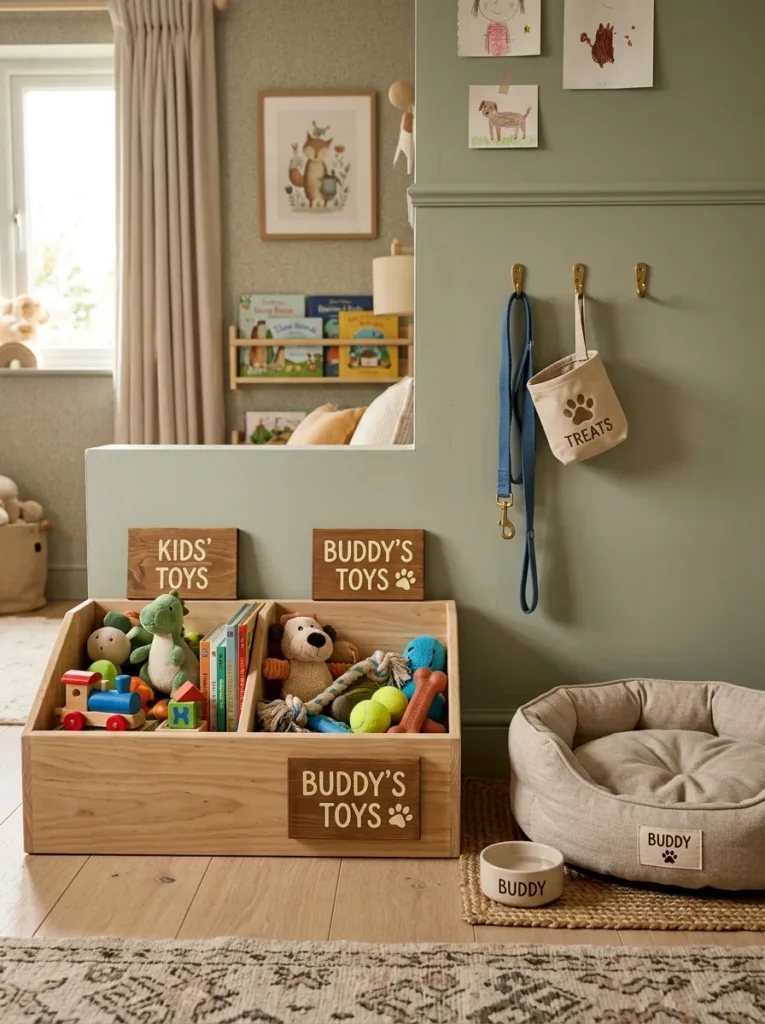
Vibe: The children’s room dog corner feels like it was designed to teach children that the dog is a member of the household with their own organized space — the shared toy box making the dog’s organization a natural extension of the child’s own.
Why it works: A children’s room dog corner with shared toy box integration applies the shared-responsibility design principle — in households where children are primary dog caregivers, organizing the dog’s items within the same furniture system as the child’s items reinforces the child’s engagement with dog care as a daily responsibility. The divided toy box (one compartment for child’s toys, one for dog’s toys) creates a physical boundary that children readily understand and maintain, while the shared furniture system communicates that the dog’s toys are organized with the same value as the child’s own possessions. The child-height hook for the leash and treat pouch specifically enables independent child-led dog walks and training, supporting both child development and dog care simultaneously.
How to get it: Source or build a wooden toy box with two equal compartments (an internal divider running the box’s length, creating two equal sections). Label each section clearly — the child’s name on the left, the dog’s name on the right (or a paw print label for the dog’s section for pre-reading children). Mount a single double hook at 90–100cm height (accessible to a child aged 5–10) above the toy box for the leash and treat pouch. Place the dog bed on a washable mat immediately beside the toy box, within the dog corner’s visual boundary.
Shop The Look
| Product |
|---|
| Wooden toy box with divider natural |
| Label set child and dog sections |
| Small double hook 90cm height child |
| Dog bed cushion oat washable small |
| Washable mat dog bed placement |
14. Outdoor Shed Dog Supply Section
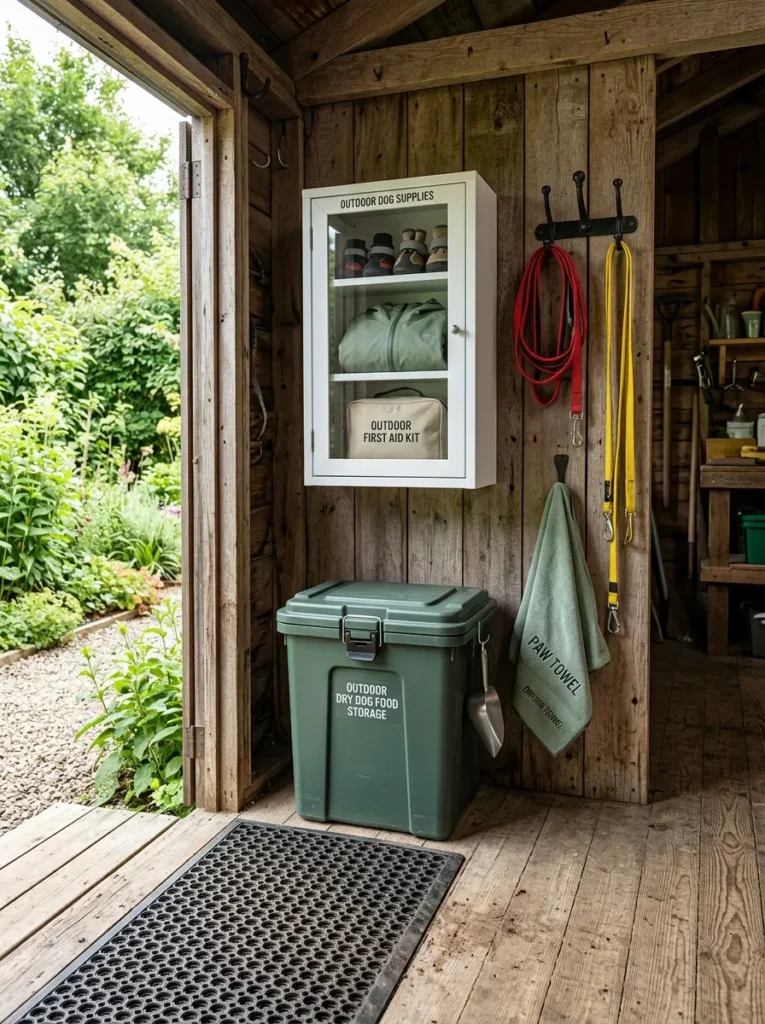
Vibe: The shed dog section feels like the most logical extension of the outdoor organization philosophy — the shed already organizing the garden tools, and the dog’s outdoor accessories organized within the same outdoor infrastructure.
Why it works: An outdoor shed dog supply section applies the activity-location alignment principle — a dog’s outdoor accessories (long lead for field exercise, booties for winter walks, rain jacket for wet weather, outdoor first aid kit) are used exclusively in outdoor contexts and benefit from outdoor storage rather than indoor closet storage. A shed section dedicated to outdoor dog supplies keeps the mud, the wet leads, and the weather-specific equipment outside the home entirely, which is the most radical and most effective solution to the indoor-cleanliness challenge that dogs in wet climates create. The weatherproof storage (closed cabinet plus weatherproof bin) ensures that outdoor storage does not compromise the longevity of the stored items.
How to get it: Designate one end section (approximately 90cm wide) of an existing shed for dog supplies. Mount a simple weather-resistant cabinet (a plastic outdoor storage cabinet or a timber cabinet with exterior-grade paint and weatherproof hinges) at eye height for accessories. Install a large weatherproof food bin at floor level — specify “weatherproof” or “outdoor-rated” rather than standard indoor food storage, as outdoor temperature and humidity variation will compromise standard airtight containers over time. Mount two heavy-duty hooks on the wall for leash and lead storage, and one small hook for the outdoor drying towel.
Shop The Look
| Product |
|---|
| Weather-resistant outdoor cabinet small |
| Weatherproof outdoor food storage bin |
| Heavy duty hook set outdoor wall |
| Outdoor rubber mat dog paws |
| Outdoor drying towel dog microfiber |
15. Rental-Friendly Dog Station — Freestanding No-Drill Version
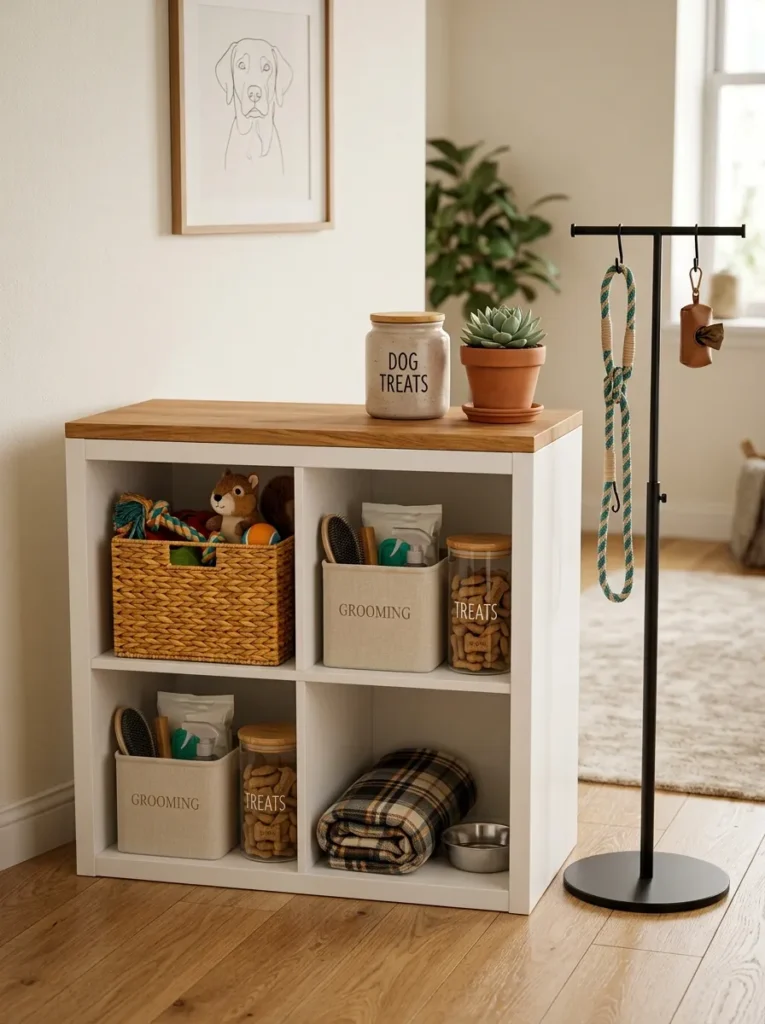
Vibe: The freestanding rental dog station feels like it could move with the owner to three different apartments and be equally effective in each one — completely independent of any specific wall or room configuration.
Why it works: A freestanding rental-friendly dog station applies the portability and damage-free design principle — renters who cannot drill walls, install permanent fixtures, or modify existing closets can achieve the same organizational outcome as built-in dog stations through a combination of freestanding furniture units and standalone organizational accessories. The KALLAX horizontal unit provides the categorical storage base; the freestanding leash stand (a simple multi-hook metal or wooden stand) provides the leash management function without wall mounting; and the wooden board top surface (a piece of butcher block or MDF resting on the KALLAX’s surface) provides the aesthetic finishing layer. The entire system can be disassembled and moved in under an hour.
How to get it: Purchase a horizontal 1×4 KALLAX as the primary storage base — its 42cm height is appropriate for a dog station in a living room or hallway context without towering over the surrounding furniture. Add accessories to the open cubbies: one woven basket for toys, one fabric bin for grooming supplies, one open cubby for the leash (not on the wall — simply coiled and resting in the open cubby when not in use), and one for a food bin. Add a small freestanding coat or hook stand immediately beside the KALLAX specifically for leash and collar hanging — this provides the one function that the KALLAX’s horizontal surface alone cannot perform cleanly.
Shop The Look
| Product |
|---|
| IKEA KALLAX 1×4 horizontal white |
| Woven basket KALLAX size |
| Fabric storage bin oat KALLAX |
| Freestanding hook stand small |
| Wooden board top surface butcher block |
16. The Complete Multi-Dog Station for Larger Households
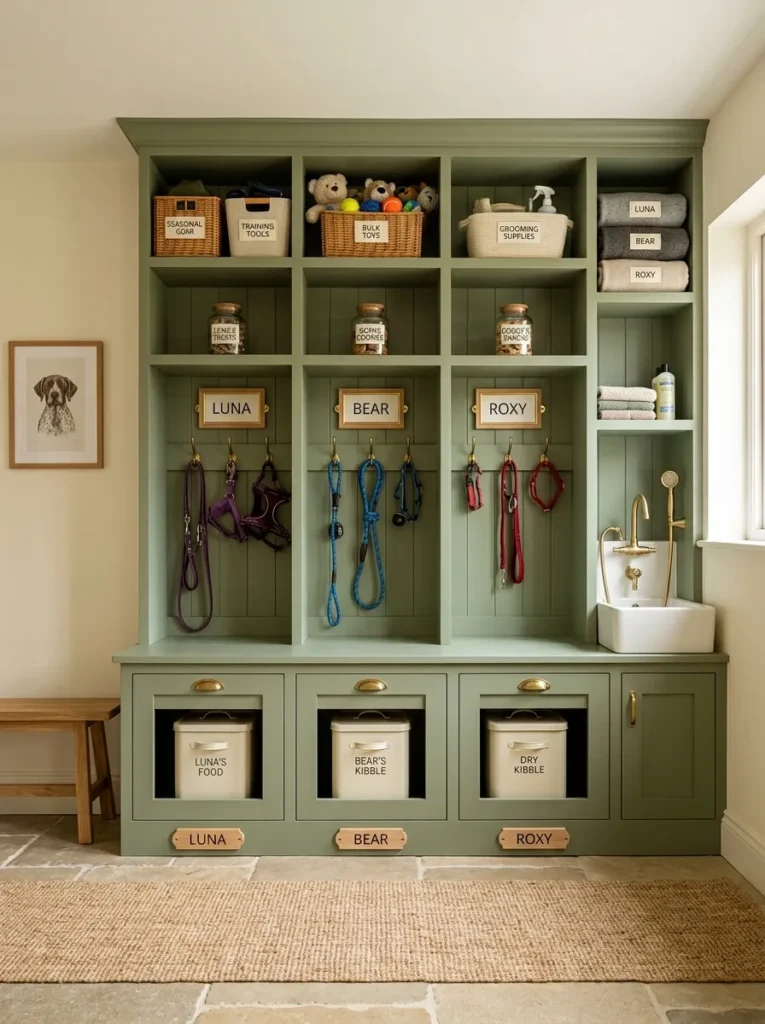
Vibe: The multi-dog station feels like a well-run professional kennel’s organizational system installed in a beautiful domestic home — the scale appropriate to the actual complexity of managing three dogs’ daily care needs.
Why it works: A comprehensive multi-dog station applies the individual-within-shared organization principle — multi-dog households share the organizational challenge that multi-child households face: shared resources (the closet, the shelf, the hook) become contested and disorganized when multiple individuals’ items are stored without individual designation. The specific solution is individual designation within a shared unit: each dog has their own named food bin, their own named hook section, their own treat container, and their own collar storage, all within the same continuous cabinet system. The individual naming (small framed name tags or engraved plates above each section) provides both the functional clarity (which food is which dog’s, which leash belongs to whom) and the emotional resonance that acknowledges each dog’s individual status within the household.
How to get it: Commission or build a continuous cabinet system from 18mm birch plywood or MDF in the available wall width. Design around the rule of three (three dogs, three sections within the shared system): divide the hook and treat section into three equal-width individual zones, each 60–70cm wide; install three separate food bins in the lower cabinet section (clearly sized and labeled for each dog’s specific food type and quantity); and install individual labeled shelf sections in the upper cabinet for each dog’s seasonal and occasional accessories. Build the paw-wash trough at one end as a plumbing-connected installation, or use a freestanding portable paw-washer cup as a non-plumbing alternative.
Shop The Look
| Product |
|---|
| Built-in cabinet commission or MDF build |
| Individual food bin set 3 labeled |
| Individual name tag set 3 engraved |
| Three-section hook bar set brass |
| Individual treat container set 3 ceramic |
How to Start Your Dog Closet Build
The single best first move before building or buying any dog closet system is conducting a dog-supply audit — gathering every dog-related object from every room in the home, placing them all in one visible space, and counting and categorizing them before deciding on any storage solution. This audit (which takes 30–45 minutes for a standard single-dog household) reveals the actual quantity and category of items requiring storage, which determines the appropriate system scale. Most people who conduct this audit discover that their dog’s supplies are more numerous and more varied than they imagined — and that the organizational challenge is primarily categorical (items from the same category are distributed across multiple rooms) rather than volumetric (there isn’t actually that much material by volume). The audit’s categorical revelation drives the design of the storage system far more accurately than any estimate made without it.
The most common mistake in dog closet design is allocating insufficient vertical space for leash and collar storage — the specific requirement of hanging leashes (which must hang vertically to avoid tangling and to drain after wet walks) means that the hook section of any dog station requires at least 40–50cm of clear vertical height from the hook point to the surface or shelf below. Dog stations designed without this clearance end up with leashes resting on a surface below the hook, which defeats the hanging function and recreates exactly the organizational problem the station was designed to solve. In any dog closet design, reserve the full vertical section from the hook height (typically 140–160cm) to the ceiling or the next shelf above for leash clearance.
Three specific items under $50 that create immediate dog organization improvement in any space: a set of three matching woven baskets in the same color family ($8–15 each, labeled TOYS, GROOMING, and ACCESSORIES, placed on any available shelf or in any available closet — the categorical separation alone produces an immediate organizational improvement); a stainless steel airtight food storage container with a scoop ($20–35, which solves the bulk food storage problem regardless of where it is placed and immediately eliminates the open bag of dog food from kitchen floors and countertops); and a four-hook wall-mounted hook bar in brass or matte black ($12–18, which provides leash, collar, treat pouch, and lead management from a single wall-mounted point accessible to everyone in the household). These three items combined for under $65 address the three most acute daily dog organizational challenges in any home regardless of whether a dedicated dog closet exists.
A simple dog organization setup (three baskets, a food bin, and a hook rail in an existing closet corner) is achievable in a single afternoon for $50–100 in materials. A mid-range dog station (KALLAX or PAX-based system with custom inserts, paint upgrade, and proper hook installation) takes a weekend and costs $150–350. A built-in custom dog closet (custom cabinet work, paw-wash integration, built-in food storage) represents a $500–1,500 investment in materials and labor for a professional result. The three-basket audit system is achievable today; the KALLAX or PAX conversion follows this weekend, and the built-in under-stair alcove and mudroom integration take their time and arrive when the renovation schedule allows.
Frequently Asked Questions About Dog Closet Organization
How much space do you need for a dog closet?
The minimum functional space for a dog closet is approximately 60cm wide and 45cm deep (the footprint of a single KALLAX unit or a small hall closet shelf section), which accommodates a food storage bin, two to three small baskets for categorical storage, and a hook for the leash. A comprehensive single-dog station that addresses food storage, leash management, grooming supplies, toy storage, and occasional accessories requires approximately 90–120cm of width and the standard closet depth of 55–60cm. A multi-dog household station benefits from 150–200cm of width with the same depth. Vertical height is as important as floor footprint: the leash hanging clearance requirement of 40–50cm below the hook point, combined with hook installation at 140–160cm, means a dog station’s functional height range of 100–160cm must be unobstructed by shelves.
How do you manage dog food storage in a closet without pest problems?
The most effective pest management for dog food stored in a closet is airtight container storage rather than bag storage — open or bag-clip-closed dog food bags emit the organic compounds that attract pantry moths, weevils, and rodents, while properly sealed airtight containers prevent this emission entirely. The specific container requirement is a genuine airtight seal (a gasket lid or a press-fit lid with rubber sealing), sized appropriately for the household’s purchase quantity (a 14-day supply maximum in any single container, as food quality degrades after opening regardless of storage method). Stainless steel, hard plastic, and ceramic airtight containers are all appropriate; fabric or woven containers are not appropriate for food storage regardless of how they close. Placing a small bay leaf at the base of the storage area (a traditional pantry-moth deterrent) adds a second layer of prevention.
What is the best way to contain dog smells in a dog closet?
The most effective dog closet odor management combines washable surfaces, a ventilation provision, and a regular cleaning schedule. All surfaces within the dog closet should be washable — vinyl flooring (not carpet), painted MDF or plywood shelves (not raw wood, which absorbs odor-generating bacteria), and washable fabric bins (not fixed fabric lining). A ventilation provision (even a small 8cm diameter passive vent grill in the closet’s back panel or door) allows air circulation that prevents the enclosed humidity and organic compound accumulation that creates persistent closet odor. A weekly wipe-down of all surfaces with a dog-safe enzymatic cleaner (which breaks down the organic compounds causing odor rather than masking them with fragrance) maintains the closet’s freshness without requiring deep cleaning.
How do you organize a dog closet for easy daily use?
The most useful framework for daily-use dog closet organization is frequency stratification: items used multiple times daily (leash, poop bags, treat pouch) at the most accessible height (waist to eye level, on hooks or in the front of the nearest shelf), items used daily but not multiple times (food scoop, food bin, water bowl) at comfortable reach height, and items used weekly or monthly (grooming supplies, nail clipper, bandanas) on shelves above or below the daily-use zone. Apply this framework regardless of the specific closet format — a hall closet, a PAX wardrobe, a KALLAX unit, or an armoire all benefit from the same frequency stratification logic. The most important single placement decision is the leash hook: it must be at comfortable single-hand reach height from the closet’s front edge, immediately accessible without stepping into the closet.
Can a dog closet include a feeding station?
Yes — a dog closet with an integrated feeding station combines the storage function (food bin, bowl storage, feeding accessories) with the feeding function (the bowls in use at meal times) in a single location. The most functional integrated feeding station design is a pull-out platform (a sliding drawer-style platform at the correct elevated bowl height for the dog) that deploys from below the food storage section and retracts when not in use. This pull-out design allows the feeding function to happen adjacent to the food storage (eliminating the bowl-retrieval and bowl-return steps) while hiding the empty bowls from view between meals. The pull-out platform should extend fully clear of the closet’s front edge during feeding to allow the dog to access the bowls comfortably without stepping inside the closet.
Ready to Build Your Dream Dog Closet?
These 16 ideas move through every dimension of what makes a dog closet genuinely functional and genuinely beautiful — from the architectural integration of under-stair alcoves and built-in mudroom stations, to the furniture-format solutions of PAX wardrobes and shaker cabinets, to the rental-friendly freestanding systems that require not a single wall anchor, to the comprehensive multi-dog cabinetry that treats a household of three dogs with the same organizational seriousness as a professional facility. Starting with the supply audit — collecting every dog-related object in the home and laying it out where you can see all of it simultaneously — is the act that makes every subsequent design and purchasing decision precise rather than approximate. It happens today, in thirty minutes, on the kitchen floor. From that moment, the dog closet project has the foundation it needs: a complete and accurate knowledge of what it must contain. Pin the ideas that match your space, your dog, and your household’s daily rhythm, and return to the built-in and mudroom plans when the renovation budget is ready. When the closet door closes and every dog-related object is inside it and the hallway is clear and the kitchen is free of the food bag and the sofa is free of the spare leash — the home will finally feel like it belongs equally to the humans and the dog who live in it.