A dog room is a dedicated space in your home — from a full spare room to a built-in nook — designed specifically for your pet’s sleeping, playing, and storage needs while blending seamlessly into your interior. Here are 13 dog room makeover ideas that balance your pup’s comfort with your home’s style, covering color, materials, lighting, furniture, accessories, layout, and small-space solutions.
There’s something grounding about a home that loves its dog without apology — a space where a leash hangs like sculpture and a dog bed looks like it was always meant to be there. The best dog room makeovers don’t shout “pet zone.” They whisper belonging. They carry the same warmth as the rest of your home, just a little lower to the ground, a little softer underfoot. Here are 13 ideas worth saving — and stealing.
Why a Dedicated Dog Room Works So Well
A purpose-designed dog room solves something most pet owners feel but rarely name: the low-grade friction of dog stuff that doesn’t fit anywhere. Leashes on doorknobs. Food bowls in the middle of the kitchen. Beds wedged under desks. Giving your dog a room — or even a well-defined corner — removes that friction and lets the rest of your home breathe again. It’s interior design as problem-solving, which is exactly what good design should be.
The materials that work best in a dog room are durable, cleanable, and still stylish enough to earn their place. Think: sealed concrete-look luxury vinyl plank flooring, performance-grade boucle or microfiber upholstery, powder-coated metal storage hooks, and solid white oak millwork. Color palettes lean toward warm neutrals — toasted linen, greige (a warm gray-beige), dusty sage, and matte black accents — tones that hide a moderate amount of fur while keeping the space looking intentional.
The trend is deeply tied to the post-pandemic shift in how we think about our homes. More than 23 million American households adopted a pet during 2020–2021, and that surge created a permanent new demand for interiors that accommodate pets without the visual chaos. Pinterest searches for “dog room ideas” have grown over 60% year-over-year, and the aesthetic has matured from purely functional into genuinely design-forward.
Small spaces can absolutely achieve a polished dog room aesthetic — in fact, a compact, well-executed dog nook often looks more intentional than a full room done carelessly. In tight spaces, prioritize vertical storage (wall-mounted hooks, floating shelves for food and supplies) and a single statement dog bed in a frame that doubles as furniture. Limit the palette to two or three tones to keep things cohesive.
Style at a Glance
| Element | Detail |
|---|---|
| Philosophy | Pet-friendly function that earns its place in a stylish home |
| Key Materials | Sealed LVP flooring, performance upholstery, powder-coated metal, solid oak |
| Key Colors | Greige, toasted linen, dusty sage, matte black, warm white |
1. The Built-In Dog Nook Under the Stairs

Vibe: This space feels found — like the house always meant to have it there.
Why it works: The under-stair nook transforms dead square footage into a defined zone using the design principle of enclosure — animals (and humans) instinctively feel safer in partially enclosed spaces. The arched or rectangular opening frames the nook like a piece of architecture, elevating it from “dog corner” to “dog room.” The visual weight is grounded by the shiplap interior, which adds texture without competing with the rest of the staircase’s clean lines.
How to get it: Commission a local carpenter to frame a simple opening with a flat or arched header, then line the interior in 3-inch primed shiplap panels (available at Home Depot for under $1.50/linear foot). Paint the interior a tone or two warmer than your wall color — Sherwin-Williams “Accessible Beige” SW 4800 or “Toasty” SW 6095 both read beautifully inside enclosed spaces.
Quick Win: A peel-and-stick shiplap panel (Amazon, ~$35/panel) applied to the back wall of an existing alcove gives the same architectural feel in one afternoon — no carpenter required.
Shop the Look
| Product |
|---|
| Round sherpa dog bed with removable cover large |
| Shiplap peel-and-stick wall panels white |
| Matte black wall-mounted coat and leash hook |
| Floating wood wall shelf with metal brackets |
| Ceramic pet water bowl matte white |
Also view: 14 Garage Dog Room Designs Every Pet Owner Needs
2. A Warm Neutral Color Palette That Hides Fur

Vibe: The room exhales — nothing sharp, nothing jarring, just layered warmth in every direction.
Why it works: Choosing a tonal palette — where walls, trim, and large furnishings sit within the same color family — is one of the most effective ways to make a dog room feel designed rather than merely functional. When everything reads in the greige-to-warm-linen range, golden retriever fur and light-colored dander essentially disappear into the background. The principle is intentional visual camouflage through tonal harmony.
How to get it: Paint walls and trim the same color in two different sheens — flat on walls, eggshell on trim — for a sophisticated tonal-monochrome effect. Benjamin Moore “Pale Oak” OC-20 is the gold standard for this approach: warm enough to feel inviting, neutral enough to work with wood tones, and a near-perfect match for light dog fur.
Shop the Look
| Product |
|---|
| Linen upholstered daybed full size neutral |
| Chunky jute area rug 5×8 natural |
| Rattan storage basket with lid large |
| Sheer linen curtain panels ivory grommet |
| Boucle throw blanket cream sofa |
3. The Dog Crate Disguised as Furniture

Vibe: You wouldn’t know it was a dog crate until the dog walked in.
Why it works: The wooden crate-as-console-table is a masterclass in dual-function furniture — a piece that passes as décor while serving as a secure, den-like sleeping space. The design principle at work is visual integration: when the crate shares materials and proportions with other furniture in the room (matching wood tone, same hardware finish), it reads as intentional millwork rather than a pet accessory. The dog benefits from the enclosed, den-like quality; you benefit from reclaimed floor space.
How to get it: Look for solid wood dog crate furniture in white oak or walnut finish with dovetail joinery — these hold up significantly better than MDF versions. Pair the hardware finish (matte black, brushed brass, or antique bronze) to your other cabinet hardware throughout the home for seamless integration.
Quick Win: Style the top of the crate like a real console table — a table lamp, a small trailing plant, and a tray with a candle makes it look like it was always planned.
Shop the Look
| Product |
|---|
| Wooden dog crate furniture console table white oak |
| Small ceramic table lamp neutral base linen shade |
| Trailing pothos plant in ceramic pot |
| Decorative tray wood and metal |
| Matte black cabinet knob hardware set |
4. Warm Pendant Lighting Over the Dog’s Feeding Station

Vibe: The feeding station feels deliberate — like the kitchen was designed around it.
Why it works: Pendant lighting above a dog’s feeding station does something most people underestimate: it creates a visual anchor that tells the eye “this area has a purpose.” The pendant’s downward light pools on the feeding zone, separating it architecturally from the rest of the floor without a single physical divider. A rattan or woven pendant adds warmth and texture, softening the utilitarian function of the space.
How to get it: Install a swag-style plug-in pendant (no electrician needed) directly above the feeding station — hang it at 60–66 inches from floor to shade bottom for proper scale. Rattan drum pendants in the 12–16 inch diameter range hit the right proportion for a feeding nook without overwhelming the space.
Shop the Look
| Product |
|---|
| Rattan woven pendant light plug-in swag |
| Pull-out cabinet dog bowl drawer insert double stainless |
| Elevated dog bowl stand bamboo double |
| Chalkboard adhesive label sticker set |
| Cabinet door white shaker style |
5. Performance Boucle Dog Bed Frame with Storage Drawer

Vibe: The bed looks like a piece of furniture you’d want for yourself.
Why it works: A framed dog bed — particularly one in solid white oak or walnut with a platform profile — borrows its authority from human furniture design. The proportions matter: a frame that sits 4–6 inches off the ground feels grounded and den-like for the dog, while the clean horizontal lines integrate with modern or Scandinavian interiors. The under-bed storage drawer solves the “where do I put the dog toys” problem with zero additional floor space.
How to get it: Look for dog bed frames with joinery-grade construction — mortise-and-tenon or dovetail corners signal a piece that will survive years of a dog climbing in and out. For the cushion, specify performance boucle (Crypton or Revolution Fabrics grade) which is both machine-washable and claw-resistant — a critical distinction from decorative boucle.
Shop the Look
| Product |
|---|
| Solid wood dog bed frame with storage drawer large |
| Performance boucle dog bed cushion replacement cover |
| Cotton rope dog toy set natural |
| Dog bandana set neutral linen print |
| Furniture leg cap felt pad set |
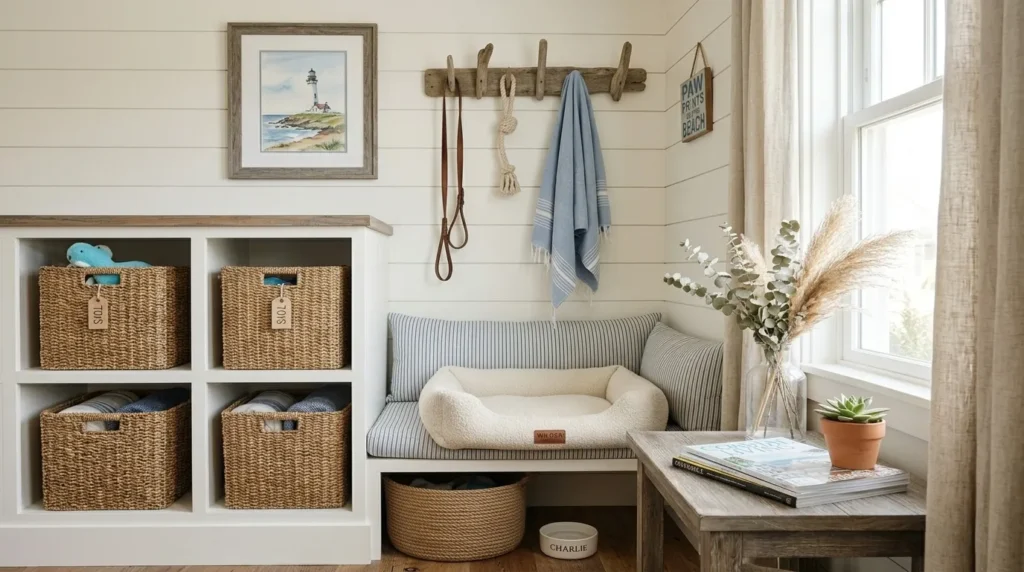
6. Wall-Mounted Leash and Gear Gallery Wall

Vibe: The entryway feels curated, like dog ownership is something to be proud of.
Why it works: Gallery-style entryway organization for dog gear applies the same principle as a well-styled mudroom: when everyday functional items are displayed with intention — at consistent heights, within a defined horizontal band on the wall — they read as décor rather than clutter. The visual trick is treating the leash and harness as textural accessories (leather, rope, woven cotton) rather than just tools.
How to get it: Install a Shaker-style peg rail (solid pine, $25–$45 at most hardware stores) at 60 inches from the floor and paint it the same color as your wall for a tonal, architectural look. Mix hook types — a J-hook, a flat peg, and a small shelf — to accommodate different item sizes without visual monotony.
Quick Win: Frame a $3 printable art print (“Good Dog,” “Stay,” or your dog’s name in a simple serif) in a black frame and hang it as part of the wall grouping — it instantly transforms a utility wall into a vignette.
Shop the Look
| Product |
|---|
| Shaker style wood peg rail wall organizer natural |
| Matte black wall hook set J-hooks |
| Leather dog leash braided tan |
| Dog name custom printable art print frame |
| Small wall shelf floating oak with lip |
7. Luxury Vinyl Plank Flooring in Concrete-Look Finish

Vibe: The floor is silent work — doing everything, demanding no attention.
Why it works: Luxury vinyl plank in a concrete or stone-look finish is currently the most practical and visually sophisticated flooring choice for a dog room. It scores high on every functional axis — 100% waterproof, scratch-resistant to a 12mil wear layer or higher, and softer underfoot than real tile — while delivering the visual coolness of polished concrete at a fraction of the cost. The large-format planks (8–10 inch wide) reduce the number of seams, which minimizes visual busyness in a smaller space.
How to get it: For dog rooms, specify LVP with a minimum 12mil wear layer and a waterproof core (SPC — stone plastic composite — is more dimensionally stable than WPC under temperature swings). Shaw Floors’ “Floorté” line and LifeProof at Home Depot both offer concrete-look options in the $2.50–$4/sq ft range that pass as designer material.
Shop the Look
| Product |
|---|
| Luxury vinyl plank flooring concrete look peel stick |
| Washable area rug machine washable 5×7 neutral |
| LVP floor transition strip matte silver |
| Floor buffer polishing pad set |
| Anti-fatigue foam mat dog feeding area |
8. Dusty Sage Accent Wall Behind the Dog Bed

Vibe: Still, earthy, and just a little unexpected.
Why it works: A single accent wall in dusty sage (think Benjamin Moore “Aganthus Green” HC-211 or Farrow & Ball “Mizzle” 266) uses color to define a zone without any physical boundaries — a powerful spatial trick in open-plan homes or shared rooms. Sage specifically works in dog spaces because its muted, clay-adjacent undertone reads as warm rather than clinical, and it pairs naturally with both warm wood tones and cool concrete floors. The arched molding detail at approximately $15 in primed MDF strips elevates the accent wall from painted rectangle to architectural moment.
How to get it: Cut thin MDF molding (1.5-inch width) into a simple arch shape using a jigsaw and mount it directly onto the painted accent wall with construction adhesive and finishing nails. Prime and paint the same color as the wall for an inset, tonal look that takes fewer than two hours and under $40 in materials.
Quick Win: Farrow & Ball offers 2.5L sample pots (~$15) — enough to paint a full accent wall in a small room. Test it before committing to a full gallon.
Shop the Look
| Product |
|---|
| Dusty sage green interior wall paint sample pot |
| MDF decorative wall molding primed arched |
| Stonewashed linen dog bed cover replacement |
| Terracotta plant pot with saucer small |
| Trailing plant pothos in nursery pot |
9. Dog Toy Storage as Décor — Woven Baskets on Open Shelving

Vibe: The storage looks intentional — like a well-styled shop display.
Why it works: Open shelving with woven baskets solves the dog toy problem through the decorator’s principle of contained chaos: individual items (squeaky toys, ropes, balls) are visually noisy, but grouped inside a basket with a consistent material language, they collapse into one calm, textured form. The key is variation in basket sizing — one large for bulky toys, one medium for smaller items, one small for treats or bandanas — creating visual rhythm on the shelf rather than uniform repetition.
How to get it: Mount floating shelves at 48-inch height for easy dog-owner access without requiring bending. Use leather-handled seagrass baskets in a consistent material (no mixing plastic bins with natural fiber), and label one basket with a small chalkboard tag for treats — the labeling detail signals “designed,” not “practical.”
Shop the Look
| Product |
|---|
| Seagrass storage basket set with leather handles |
| Floating wall shelf white oak with hairpin brackets |
| Ceramic treat canister dog paw lid |
| Chalkboard label stickers small oval |
| Air plant tillandsia set |
10. Minimalist Zone Defined by a Washable Rug

Vibe: The space feels like it was measured before anything was placed.
Why it works: A rug is the most budget-efficient zone-defining tool in interior design — it tells both the dog and the eye “this area belongs to something.” In a dog room, a washable flatweave rug (as opposed to a high-pile shag that traps fur) does this while remaining practical: most machine-washable cotton flatweaves survive a standard top-loader cycle at cold on a regular basis. The overhead composition of the zone — rug, centered bed, nothing else — uses negative space as a design element, letting the pattern and the furniture breathe.
How to get it: Size matters more than most people realize: the rug should extend at least 12–18 inches beyond the dog bed on all four sides to frame the zone properly. A 5×8 rug for a large dog or 4×6 for a medium dog hits the right proportion. Ruggable and Tumble both offer designer-grade washable options under $200 in geometric patterns that work in modern and transitional homes.
Quick Win: Layer a smaller jute rug on top of the washable base rug for added texture — when it gets too dirty, wash only the outer layer.
Shop the Look
| Product |
|---|
| Washable cotton flatweave area rug geometric cream terracotta |
| Non-slip rug pad for hardwood floors |
| Dog bed bolster pillow cover washable large |
| Rug grip tape double-sided |
| Lint roller set with refills pet hair |
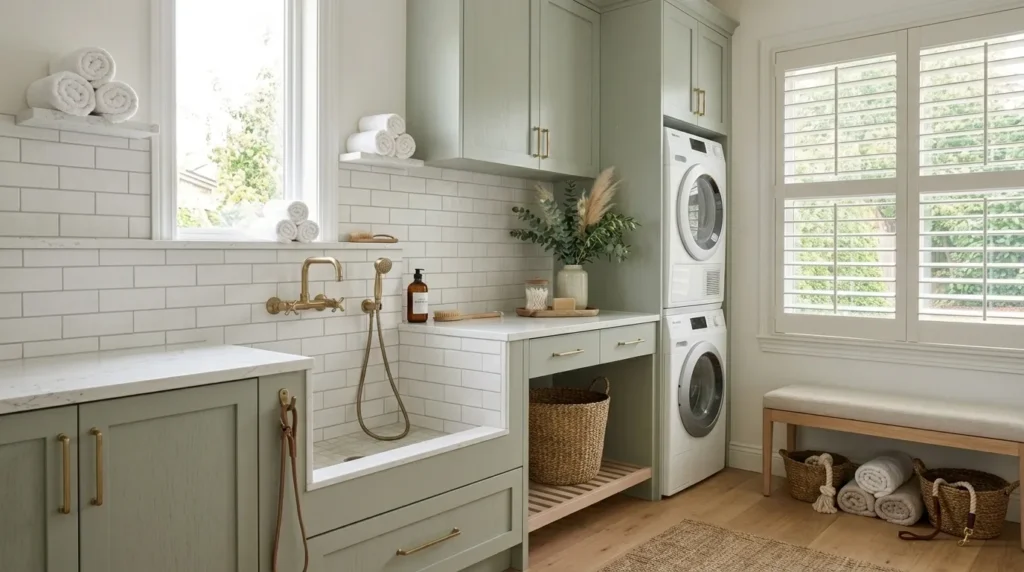
11. Dog Grooming Station in a Repurposed Laundry Closet

Vibe: The closet works harder than any other space in the house.
Why it works: A dedicated grooming station takes one of the messiest recurring dog-care tasks — the post-walk paw rinse, the monthly bath, the mat removal — and contains it architecturally. By repurposing a laundry closet or utility nook with a utility sink, pegboard tool storage, and a rubber anti-slip mat, the layout principle of task zoning ensures that mess stays in one contained zone rather than migrating to the bathroom. Pegboard is the visual workhorse here: it keeps brushes, nail clippers, and shampoos visible and reachable without adding a single piece of furniture.
How to get it: A freestanding stainless utility sink with legs (available at Wayfair for $150–$250) can be plumbed into an existing laundry closet cold water hookup with minimal renovation. Mount a 24×36 inch white-painted pegboard panel behind it for tool storage — use 1-inch spacer blocks between the wall and pegboard to allow hooks to function properly.
Shop the Look
| Product |
|---|
| White pegboard panel with hardware kit 24×36 |
| Pegboard hooks and bins accessory kit |
| Dog grooming brush set professional |
| Rubber mat non-slip utility sink |
| Dog shampoo and conditioner set natural |
12. Statement Mural or Wallpaper Accent in the Dog Room

Vibe: The wall earns its own Instagram caption.
Why it works: A botanical or geometric wallpaper accent wall does something no paint color can quite replicate: it adds scale, pattern, and narrative texture simultaneously. In a dog room — often a smaller or secondary space — a single wallpapered wall prevents the room from feeling like an afterthought. The design principle is focal point creation: the eye travels to the wallpaper, then settles on the dog bed in front of it, reading the composition as a whole rather than furniture dropped in a void.
How to get it: Peel-and-stick wallpaper (Chasing Paper, Tempaper, or Rifle Paper Co. for premium options) is the correct choice for dog rooms — it comes down cleanly when it’s time to repaint or restyle, and it goes up in under two hours with no paste and no professional installation. Botanical, abstract, or simple geometric prints in sage, dusty rose, or warm cream read best in this application.
Quick Win: A single 2-panel roll of peel-and-stick wallpaper (approximately $35–$60) covers an average accent wall — enough to transform the room’s character for the cost of one accent pillow.
Shop the Look
| Product |
|---|
| Peel-and-stick wallpaper botanical sage cream |
| Round cane dog bed frame large |
| Brass floor lamp with linen shade adjustable |
| Fringe throw pillow cover cream botanical |
| Terracotta pot with tall fiddle leaf fig plant |
13. Compact Dog Room Nook with Murphy Bed for Guests

Vibe: The room feels like it was designed by someone who thought about everything.
Why it works: The Murphy bed + dog room combination is the ultimate small-space integration solution, leveraging every square inch of a spare room that might otherwise serve just one purpose at a time. The design principle is temporal zoning: the room serves guests at night and functions as a dog room during the day, with both functions fully equipped and aesthetically integrated into a single wall unit. The critical detail is ensuring the dog’s crate is built into the cabinetry flush with the Murphy bed cabinet — visually, it reads as one piece of architectural furniture.
How to get it: Murphy bed kit companies (Wilding Wallbeds, Resource Furniture, or IKEA’s PAX hack community) offer customizable frame systems that can be designed with adjacent cabinetry — specify a crate-width opening (typically 30×24 inches for a large dog, 24×18 for medium) alongside the Murphy bed frame, and add rattan inset panels on the crate doors to keep the look warm rather than utilitarian.
Shop the Look
| Product |
|---|
| Murphy wall bed cabinet kit white oak finish |
| Cabinet rattan cane insert panel set |
| Dog crate metal frame foldable large |
| Small dog toy storage cabinet with door |
| Compact dog bed cushion crate size large |
How to Start Your Dog Room Transformation
Start with the floor. Before any furniture, any paint, any bed or basket — fix the floor. Install LVP in a concrete or warm wood look in at least an 8mil wear layer, sealed at the seams. The floor is the single element that touches everything else in the room. It sets the color temperature, determines how easy cleanup will be, and whether the rest of your design decisions feel grounded or arbitrary. Everything stacked on top of a well-chosen floor looks more intentional.
The most common mistake is choosing furniture that’s too small. This is especially true for dog beds: owners routinely buy a medium bed for a large dog, and the dog sleeps with limbs hanging off. The result looks sad and undesigned. Worse, it breaks the visual proportion of the room — an undersized bed in a frame that’s too small reads as clutter, not furniture. Measure your dog stretched out fully and add 12 inches in each direction. That is your minimum bed dimension.
Three items under $50 that create immediate impact: A matte black wall-mounted peg rail ($25–$35 at most hardware stores) for leash display. A seagrass basket with leather handles ($18–$28 on Amazon) for toy storage. A single 2.5L paint sample pot in dusty sage or warm greige ($12–$18) to test an accent wall before committing to a full gallon.
Realistically: A weekend and $150–$300 will get you a styled feeding station, a new rug, organized toy storage, and a painted accent wall. A full dog room transformation with new flooring, a crate-furniture piece, and custom built-ins runs $800–$3,500 depending on your market. Don’t rush the furniture phase — live with the rug and paint for a month before committing to larger pieces. The best dog rooms are built incrementally.
Frequently Asked Questions About Dog Room Makeovers
What is a dog room and how is it different from just a dog corner?
A dog room is a defined, designed space — whether a full room, a built-in nook, or a clearly zoned area — where your dog’s sleeping, eating, grooming, and play needs are accommodated with intention. A dog corner is reactive: a bed wedged between the couch and the wall. A dog room is proactive: architectural, organized, and visually integrated with the rest of your home. The distinction is mostly philosophical, but it changes the result entirely — dog rooms look designed, dog corners look managed.
What colors work best in a dog room that also hides fur?
Tonal neutrals in the greige-to-warm-linen range (Benjamin Moore “Pale Oak” OC-20 or Sherwin-Williams “Accessible Beige” SW 4800) are the most forgiving for mixed light and medium fur dogs. If you have a black dog, mid-tone grays hide their fur best; golden retriever owners will find warm oat and honey tones most forgiving. Avoid stark white walls and charcoal floors — both are unforgiving contrast traps that make any fur immediately visible.
How much does a dog room makeover cost?
A starter dog room makeover — new rug, toy storage baskets, an accent wall, and a wall organization system — can be achieved for $150–$400. A mid-range refresh that includes a furniture-grade crate, new flooring, and a dedicated feeding station typically runs $800–$1,800. A full custom build with Murphy bed integration, built-in cabinetry, and professional installation can reach $3,000–$8,000 depending on your city and the scope of millwork.
Can a dog room work in a rental apartment where you can’t paint or renovate?
Yes — and this is where peel-and-stick products genuinely earn their place. Peel-and-stick wallpaper (Tempaper or Chasing Paper, $35–$60/roll) adds a full accent wall with zero damage. Freestanding furniture-grade dog crates need no installation. Command hook strips hold a peg rail for leash storage at up to 7.5 lbs per hook. The one rental-specific priority: choose LVP or a washable rug over any existing carpet — protecting the landlord’s flooring protects your deposit.
What type of dog bed material is most durable for chewers or dogs with anxiety?
For chewers and high-anxiety dogs, look for ballistic nylon or Cordura-grade fabric — the same material used in military-grade backpacks — which resists tearing far better than decorative boucle or linen. Kuranda makes a chew-proof elevated cot-style bed with an aluminum frame ($60–$120 depending on size) that has essentially no soft surface to grab onto. If aesthetics matter, pair the utilitarian bed with a framed dog crate in a warmer material — the crate provides the visual warmth while the bed provides the durability.
Ready to Create Your Dream Dog Room?
From tonal color palettes that quietly hide fur to Murphy bed integrations that make every square foot earn its keep, these 13 dog room makeover ideas cover the full range of what a thoughtful pet space can look like — whether you’re starting with a coat of paint or rebuilding a whole room from the floor up. Transformation doesn’t require doing everything at once; the best interiors are built in layers, and a single well-chosen rug or a peg rail with a good leash hanging from it can shift the feeling of a whole corner immediately. This week, pick one idea from this list and order the one thing it needs to start. When the space is done, you’ll feel the difference every time you walk through the door — a home that accommodates your dog without apologizing for it, because it was designed that way on purpose. Save the ideas that stopped your scroll and come back to them — the ones with natural materials and warm neutrals have a way of looking even better in your space than they do on the page.