Stylish backyard dog area ideas for every home create dedicated outdoor zones for dogs that are simultaneously safe, enriching, durable, and beautiful — moving decisively beyond the chain-link pen and the mud-churned lawn toward designed landscape features that serve the dog’s behavioral and welfare needs while integrating into the home’s exterior aesthetic as considered garden elements. This article gives you exactly 14 ideas spanning ground surface design, planted borders, water features, shade structures, agility enrichment, fencing solutions, and the specific material and plant decisions that allow a dog area to read as a designed garden space rather than a utility installation.
A stylish backyard dog area done well does not look like a dog area from the garden gate — it looks like a considered landscape feature that happens to be loved by a dog. Here are 14 ideas worth designing.
Why Stylish Backyard Dog Area Ideas Work for Every Home
The design challenge of a dedicated backyard dog area is the same challenge that confronts every functional landscape installation: the requirement to serve a specific practical function completely (safe containment, adequate exercise space, appropriate surface materials, shade and water provision, behavioral enrichment) while remaining visually appropriate as part of the home’s exterior design language. The commercial dog pen fails this challenge because it is designed for the manufacturing requirement alone; the stylish dog area succeeds because it applies the same landscape design intelligence to the dog’s requirements as to any other garden feature.
The behavioral case for a dedicated dog area — as distinct from simply giving the dog access to the full yard — rests on several welfare and practical arguments: it protects the garden’s planted areas from digging and trampling, it provides a zone where the substrate, drainage, and surface materials are specifically chosen for dog use and dog hygiene rather than general garden aesthetics, it creates a defined territory whose boundaries the dog can learn and respect, and it concentrates the management of the dog’s outdoor time (waste removal, surface cleaning, enrichment provision) in a specific, designed zone rather than distributing it across the full garden. The dog area, well designed, benefits both the dog (a specifically enriched environment) and the garden (the remainder of the garden is protected from the specific impacts of dog use).
Style at a Glance
| Element | Dog Welfare Function | Landscape Design Edge |
|---|---|---|
| Philosophy | The dog area should look like it belongs to the garden | Every material and planting decision serves both dog and design |
| Materials | Artificial turf, rubber, natural stone, cedar, composite | Planted borders, shade structure, water feature |
| Key Zones | Surface, shade, water, enrichment, planting, boundary |
14 Stylish Backyard Dog Area Ideas for Every Home
1. Artificial Turf Dog Run with Planted Border — The Green Foundation
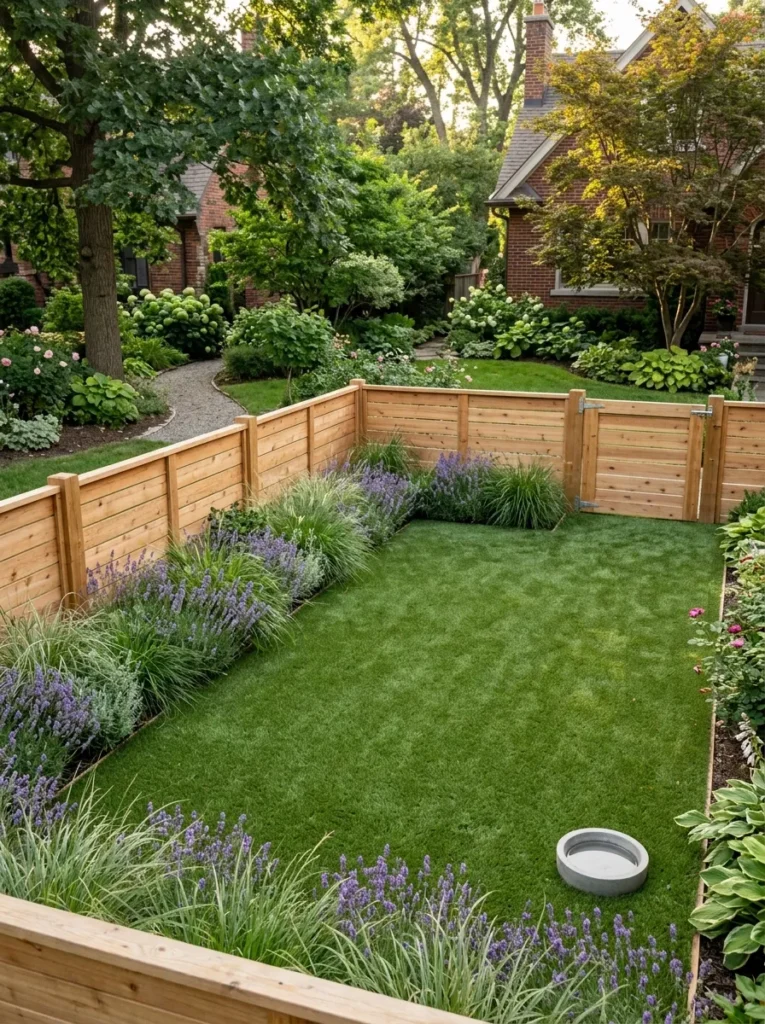
Vibe: The artificial turf dog area feels like a garden room that was designed first and happened to be perfect for a dog — the planted border and the cedar fence creating the landscape language that makes the dog area read as a considered garden feature.
Why it works: Pet-grade artificial turf with a planted border applies the genuine green aesthetic with practical substrate principle — artificial turf in a dog area provides the visual warmth and color of a lawn without the mud, bare patches, and grass-burn from urine that natural lawn in a dog zone consistently develops under regular use. Pet-grade artificial turf specifically (with a permeable backing that allows liquids to drain through rather than pooling on the surface) is a hygienic, durable, and visually resolved surface that reads as a green lawn from any garden viewing angle. The planted border on the exterior face of the bounding fence connects the dog area to the garden’s planting palette — the lavender and ornamental grasses used in the dog area border can continue throughout the wider garden, creating visual continuity.
Turf specification: Specify artificial turf with a pile height of 30–35mm (shorter than standard lawn turf for easier cleaning), a blade color with two or three tonal variations in the green range (single-color blades look obviously artificial), and a backing permeability of minimum 60 litres per square metre per minute to ensure adequate drainage during rain and after hosing. Anti-bacterial surface treatment is a valuable specification for dog areas — several pet-grade turf products include this.
Budget: Pet-grade turf for 4×6m area: $600–1,400. Cedar boundary fence: $800–1,800. Professional installation: $2,500–5,000.
Quick Win: A 2×2m section of pet-grade artificial turf in a shaded garden corner, defined by three small cedar boards on edge as a low border, provides the drainage-managed, hygiene-controlled dog toileting zone that protects the rest of the lawn from urine damage at a materials cost of under $200.
Shop The Look
| Product |
|---|
| Pet-grade artificial turf roll |
| Horizontal cedar board fence panel |
| Self-closing gate cedar match |
| Lavender border planting set |
| Ornamental grass border set |
Also view: 13 Dog Boarding Kennel Designs for Happy Pets
2. Flagstone and Gravel Dog Patio — The Low-Maintenance Hardscape
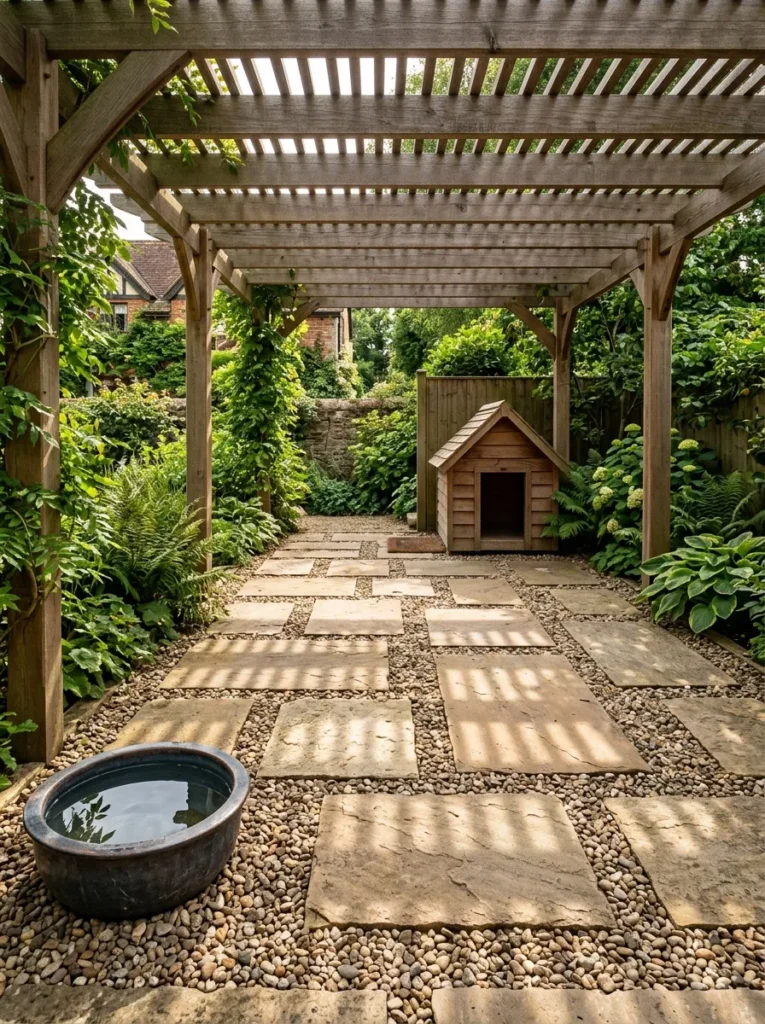
Vibe: The flagstone and gravel dog patio feels like an outdoor room that also happened to be designed for the dog who lives in it — the warm stone and dappled pergola light creating a garden space of genuine quality.
Why it works: A flagstone and pea gravel hardscape dog area applies the drainage-efficient material palette principle — the most persistent maintenance problem in any dog area is the management of urine, rainwater, and surface moisture. A hardscape surface of permeable gravel (which drains rapidly) combined with solid flagstone stepping areas (which are easy to clean with a hose and do not retain odors) addresses this problem more effectively than any single-substrate surface: the gravel drains and dilutes liquid waste, the flagstones provide clean, firm standing areas at entry and exit points and at the water bowl, and the combined palette reads as an elegant garden patio rather than a utility installation.
Gravel specification: Use washed pea gravel in 10–14mm diameter (large enough that the dog cannot easily swallow individual pebbles — a welfare safety consideration in any gravel dog area) at 70–100mm depth over a compacted hardcore base. Avoid decorative gravel types with sharp edges (flint, angular aggregate) that can damage paw pads.
Budget: Flagstone and gravel 3×4m area: $400–900. Cedar pergola addition: $600–1,500.
Shop The Look
| Product |
|---|
| Warm limestone flagstone 60×40cm |
| Pea gravel 10–14mm washed bag |
| Cedar pergola kit 3×4m |
| Dark glazed ceramic water bowl |
| Cedar dog house weatherproof |
3. Living Fence Dog Area — Hedge and Steel Hybrid
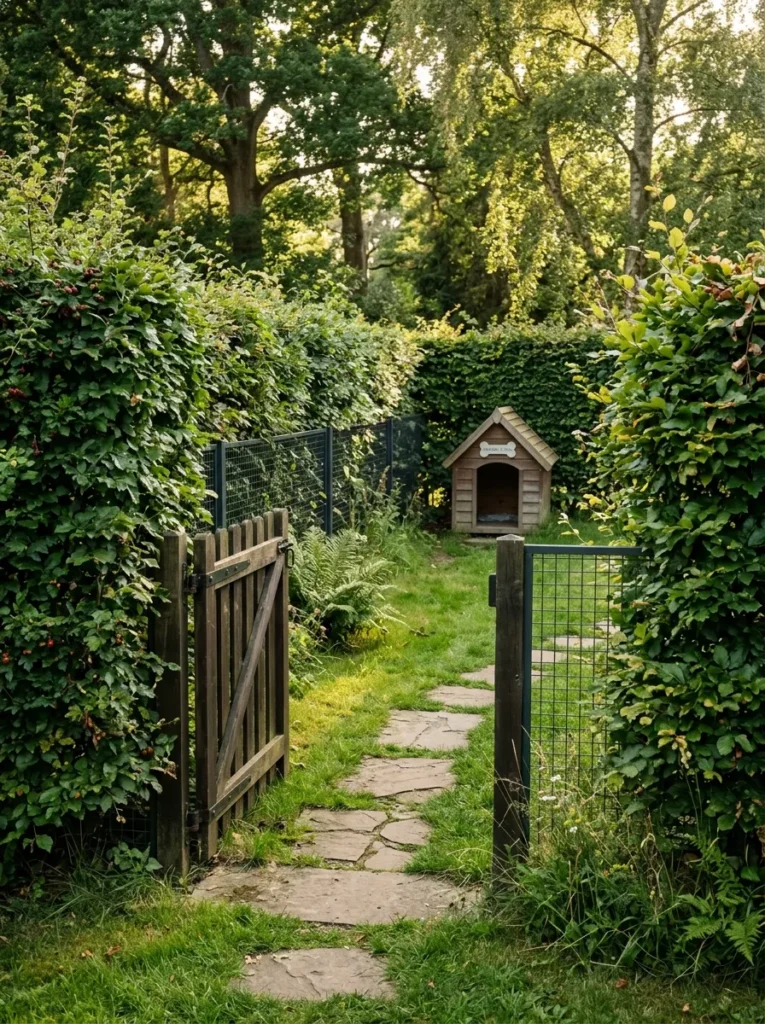
Vibe: The living fence dog area feels like the garden’s own boundary systems were extended to include a dog zone — the native hedge creating a boundary that reads as belonging to the landscape rather than imposed on it.
Why it works: A living hedge exterior with a welded steel mesh interior applies the ecological containment principle — as detailed in the outdoor dog kennel article, a native hedge provides simultaneous containment, visual screening, wildlife habitat, wind protection, and landscape integration that no manufactured fence achieves with comparable ecological benefit. The hedge’s exterior appearance reads as a genuine garden feature (a managed native hedge is one of the most ecologically valuable and most aesthetically integrated garden boundary types available) while the interior steel mesh provides the actual dog-containment security.
Hedge species for dog area boundaries: Hawthorn (Crataegus monogyna — fast-growing, wildlife-rich, thorned exterior discourages dog escape attempts), beech (Fagus sylvatica — retains dried leaves through winter for year-round visual screening, non-toxic), and hornbeam (Carpinus betulus — similar to beech in winter foliage retention, more tolerant of wet or clay soils). All three are non-toxic to dogs and provide significant wildlife habitat value.
Budget: Steel mesh interior fence for 4×6m area: $400–800. Native hedge planting: $150–400. Combined with 3–5 year establishment period before hedge provides effective screening.
Shop The Look
| Product |
|---|
| Welded steel mesh panel dark powder |
| Native hawthorn hedge plant set |
| Native beech hedge plant set |
| Hornbeam hedge plant set |
| Dark stain timber gate matching |
4. Shade Sail Dog Area — Sun Protection as Design
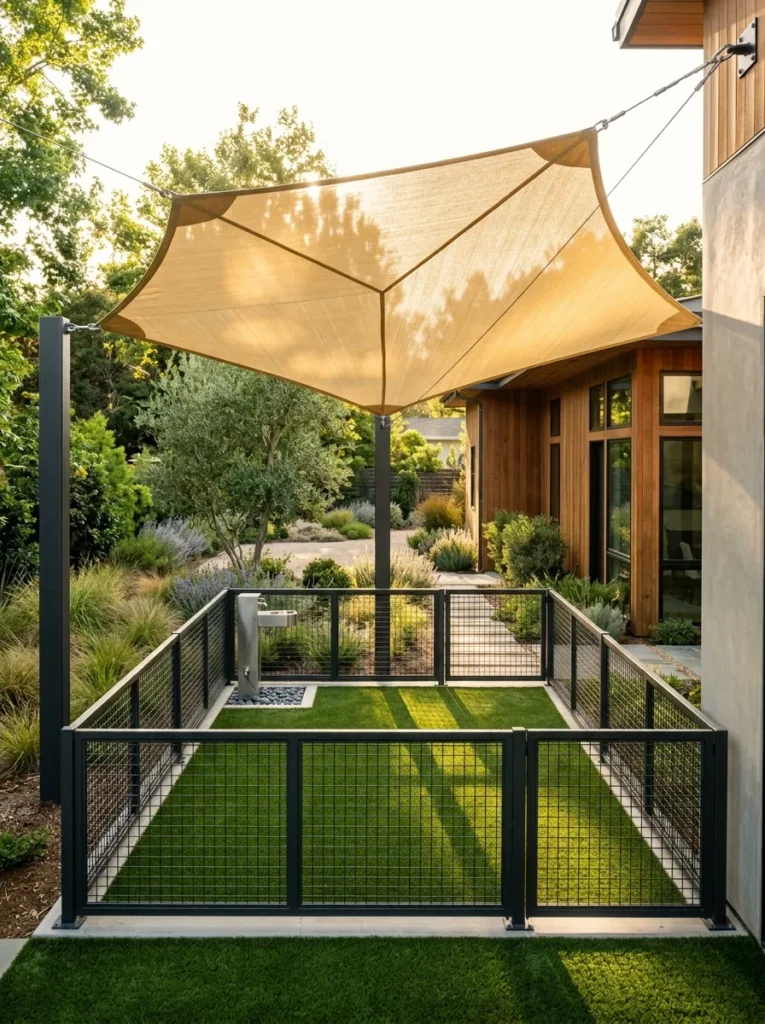
Vibe: The shade sail dog area feels like an architectural outdoor room that happens to be perfectly designed for a dog — the geometric sail form creating a strong overhead design statement that organizes the space beneath it.
Why it works: A large architectural shade sail over a dog area applies the sun protection as design principle — in hot climate zones or during summer months, the dog area without shade provision becomes thermally hostile within hours of peak sunlight, creating dangerous conditions for an enclosed dog. A shade sail specified at 70% coverage (the fabric blocks 70% of UV radiation while allowing air circulation — a fully enclosed roof creates a greenhouse effect more dangerous than no shade in some conditions) provides the balance of protection and ventilation that dog welfare requires. The specific architectural quality of a large hexagonal or triangular shade sail — its geometric form, its tensioned cable suspension, its relationship to the posts — creates an overhead design element that reads as a deliberate landscape installation rather than a practical afterthought.
Post specification: Shade sail posts must be set in concrete foundations sized for the sail’s wind load — a 5×4m sail in a moderately windy location requires minimum 200mm diameter concrete bases at 600mm depth per post. Use marine-grade galvanized or powder-coated steel posts for corrosion resistance.
Budget: Shade sail 5×4m with posts: $400–900. Modular panels and turf for 4×5m area: $800–1,800.
Shop The Look
| Product |
|---|
| Architectural shade sail cream 5×4m |
| Steel post shade sail set |
| Dark charcoal modular panel set |
| Pet-grade artificial turf roll |
| Stainless water station outdoor |
5. Sensory Planting Zone — The Dog’s Own Garden
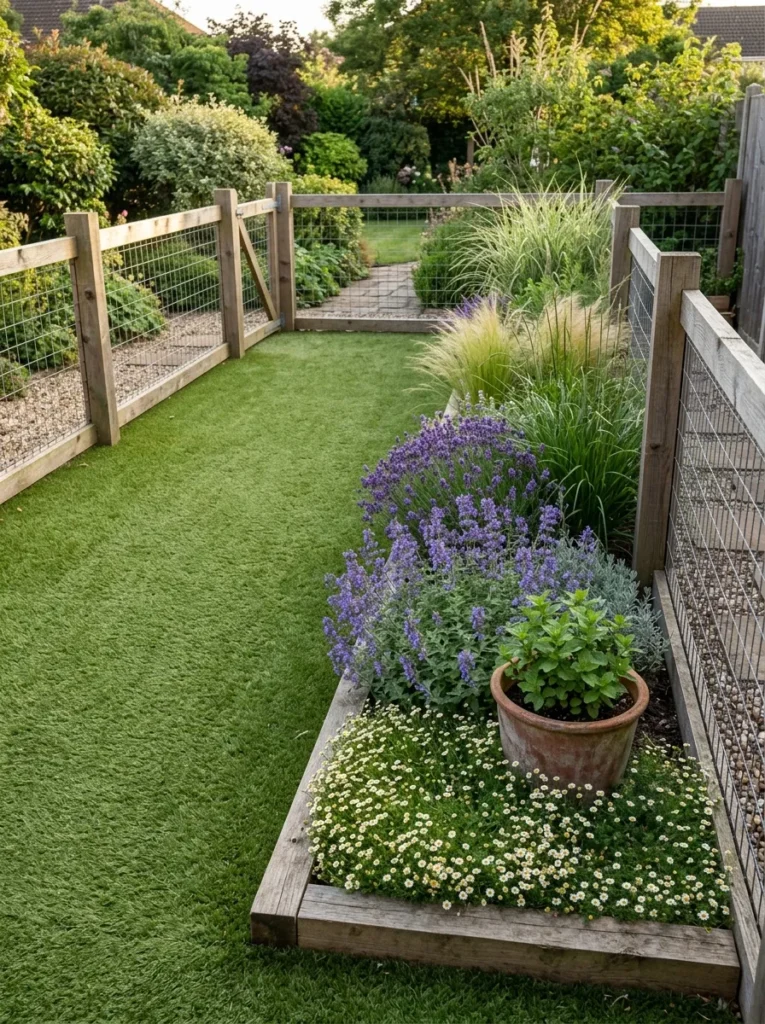
Vibe: The sensory planting strip feels like the dog area was given a garden of its own — the aromatic herbs and the textured plants creating a continuously changing olfactory and tactile environment that enriches the dog’s outdoor experience.
Why it works: An integrated sensory planting strip within a dog area applies the olfactory enrichment by design principle — as noted in behavioral research on canine environmental enrichment, the dog’s primary sense is olfactory (smell), and an environment with a rich, varied, continuously changing scent profile provides significantly more behavioral enrichment than an environment of uniform synthetic material. A planting strip of aromatic dog-safe herbs (chamomile, lavender, catnip, mint) provides this olfactory enrichment continuously, with the scent profiles changing through the day (strongest in warm afternoon sun), through the season (lavender peaks in summer, chamomile in spring), and with each rain event (which volatilizes and intensifies plant aromatic compounds).
Plant safety verification: All plants in a dog area planting strip must be verified as non-toxic using the ASPCA toxic plant database before planting. Chamomile, lavender, catnip, and ornamental grasses are all non-toxic. Mint is non-toxic but must be grown in a sunk container to prevent it from spreading and taking over the entire planted strip.
Budget: Sensory planting strip materials: $80–200. Integration with existing dog area: no additional structural cost.
Shop The Look
| Product |
|---|
| Chamomile plant dog-safe |
| Catnip Nepeta plant non-toxic |
| Lavender plant border |
| Mint plant contained pot sunk |
| Timber raised bed border edging |
6. Water Feature Splash Zone — Cooling and Play
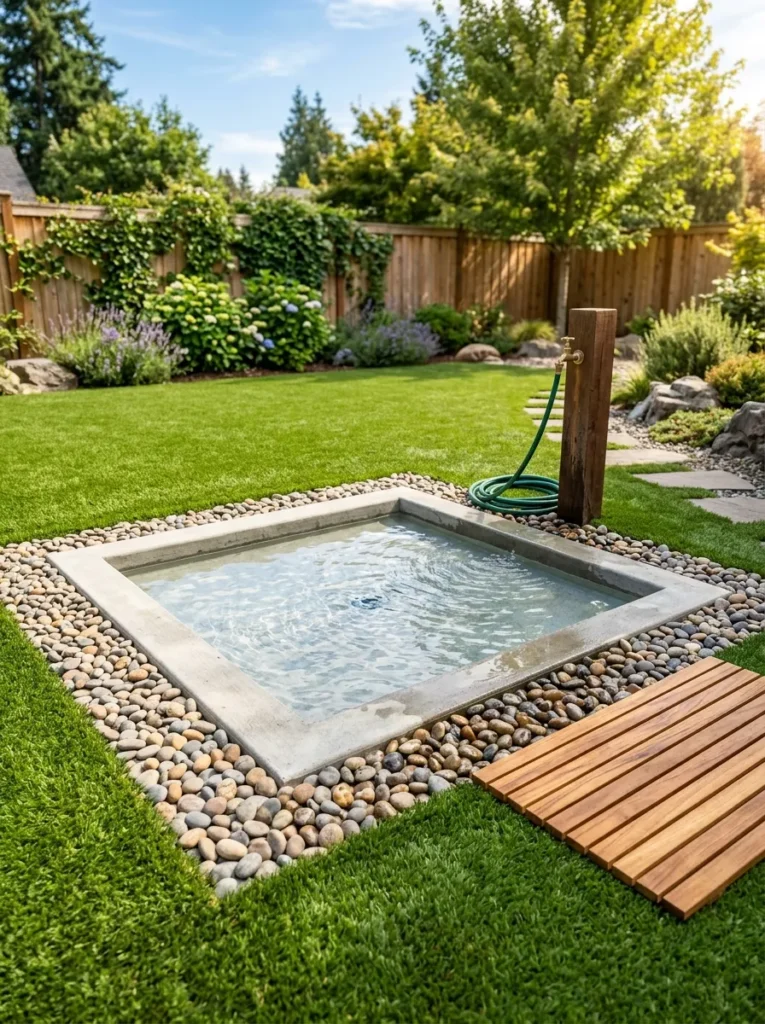
Vibe: The splash zone dog area feels like a designed cooling station for a summer garden — the shallow basin, the river pebble surround, and the teak mat creating a water element of genuine landscape quality.
Why it works: An integrated splash zone within a dog area applies the thermoregulatory design principle — as discussed in the outdoor dog pen article, access to a shallow water feature that allows a dog to stand in cool water and wet its coat provides active thermoregulation in summer heat that shade alone cannot provide. The specific design quality of a built-in concrete or fibreglass basin (as opposed to a portable plastic paddling pool) is its permanence and its landscape integration — the flush-set basin reads as a designed landscape water element, the river pebble surround reads as a considered material transition, and the teak mat provides the finished detail that converts a utilitarian installation into a composed design feature.
Drainage provision: The basin requires a drain connection to allow complete emptying for cleaning — a 40mm drain pipe connected to the existing garden drainage system, with a simple push-on drain cap that can be removed for draining. Change the water every two to three days during periods of active use to prevent bacterial and algae growth.
Budget: Concrete splash basin: $200–500. Fibreglass alternative: $150–350. Surrounding pebble and teak mat: $80–150.
Shop The Look
| Product |
|---|
| Shallow fibreglass splash basin |
| River pebble smooth 30cm surround |
| Garden tap connection outdoor |
| Teak slat mat waterproof |
| Drain cap push-on basin |
7. Agility Course Integration — Play Built into the Landscape
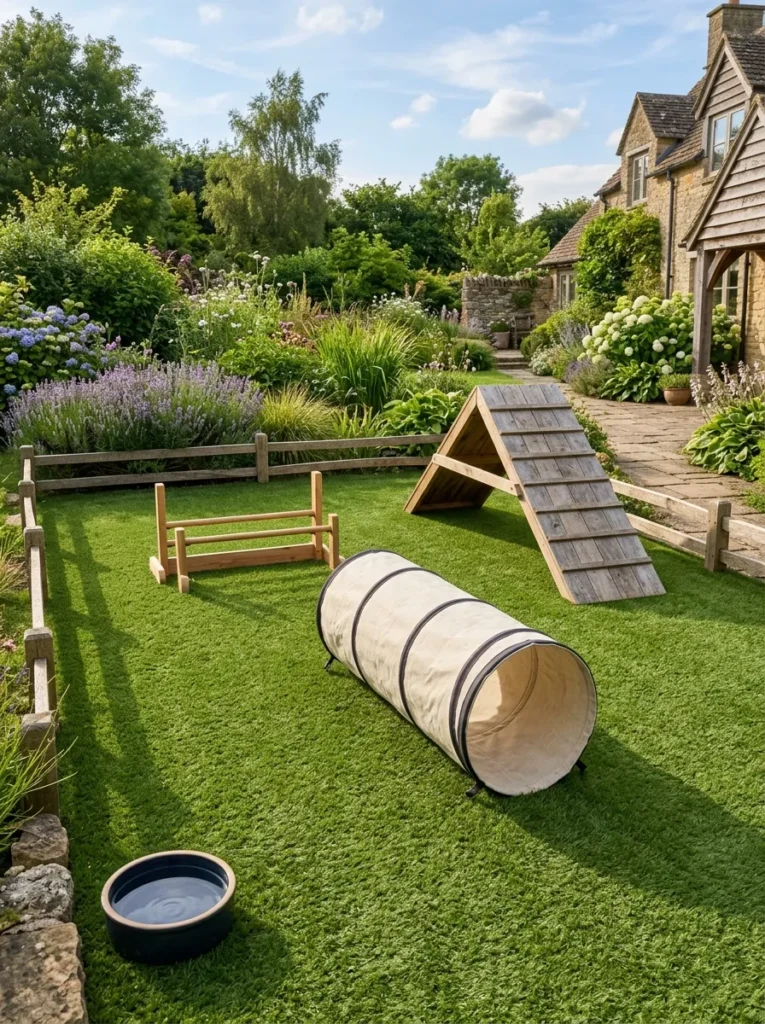
Vibe: The agility integrated dog area feels like a play garden designed for a species that is specifically built for physical challenge — the natural cedar and linen agility elements reading as designed garden structures rather than bright plastic commercial equipment.
Why it works: Integrated agility elements in natural materials apply the enrichment-by-landscape-design principle — commercial agility equipment in bright primary-color plastic reads as imported commercial equipment that conflicts with any garden design aesthetic; the same agility functions (the A-frame for climbing and descending, the tunnel for running through, the hurdle for jumping) constructed in natural cedar board and natural canvas read as designed landscape elements that happen to provide physical enrichment. The dog’s behavioral engagement with these structures (the proprioceptive challenge of the A-frame slope, the orientation experience of the tunnel, the stride adjustment of the hurdle) provides the cognitive and physical stimulation that prevents the boredom-related behaviors — pacing, barking, destructive digging — that develop in under-stimulated confined dogs.
Budget: Cedar A-frame: $80–200 in materials (self-build) or $150–350 purchased. Canvas tunnel: $40–80. Cedar hurdle pair: $30–80 in materials.
Shop The Look
| Product |
|---|
| Dog agility A-frame cedar natural |
| Fabric tunnel natural canvas |
| Cedar hurdle set low pair |
| Pet-grade artificial turf |
| Dog agility water bowl edge |
8. Contemporary Raised Dog Terrace — Level Change as Design
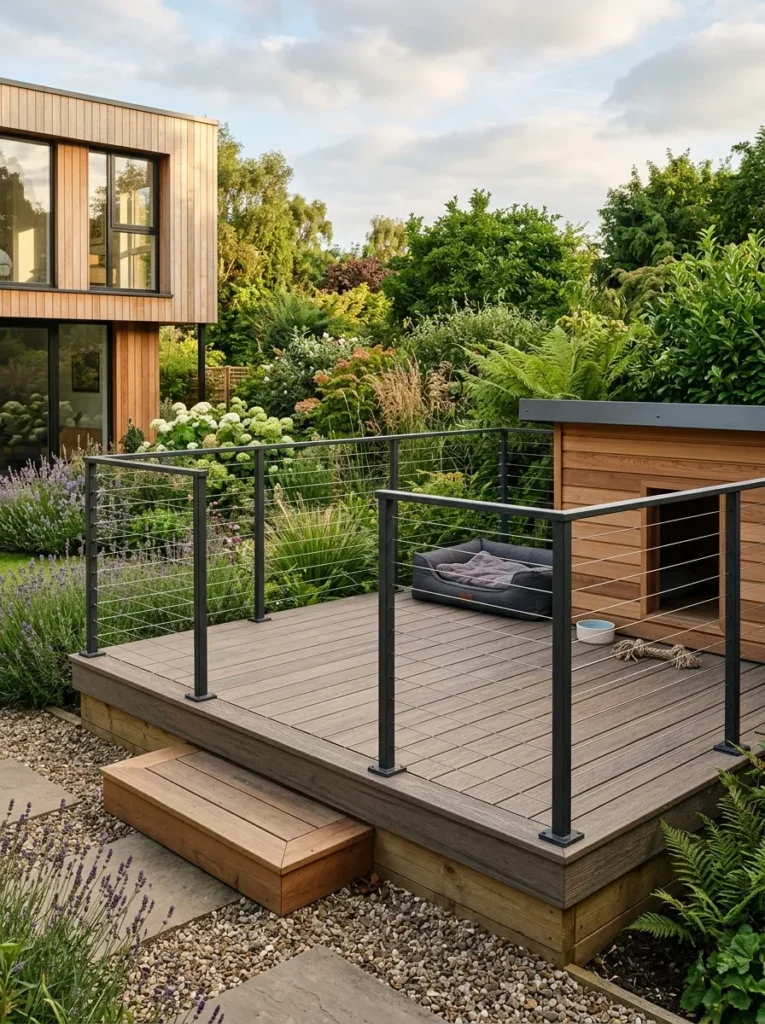
Vibe: The raised dog terrace feels like a viewing platform designed for a species that instinctively values elevated territory — the deck’s height giving the dog the specific sensory and territorial advantage that flat-grade areas cannot provide.
Why it works: A raised deck dog area with cable rail applies the elevated territory behavioral design principle — dogs instinctively prefer elevated positions for resting and observation, a behavioral heritage from the predator-prey dynamics of their evolutionary history where height provided both surveillance advantage and physical security. A raised deck dog area at 30–45cm above garden grade provides this elevation at a modest structural level change that reads as a contemporary landscape design feature — the cable rail system (which maintains visual connection between the dog on the raised platform and the surrounding garden, unlike solid panel fencing) creates the open sightline that the dog’s surveillance instinct requires while providing the containment the owner requires.
Budget: Raised deck platform 4×4m: $1,500–3,500 in materials. Professional build: $3,000–7,000.
Shop The Look
| Product |
|---|
| Composite deck board raised platform |
| Stainless cable rail system |
| Dark powder-coat post cable |
| Cedar dog house flat roof |
| Broad deck step single entry |
9. Cottage Garden Dog Area — The Planted Enclosure
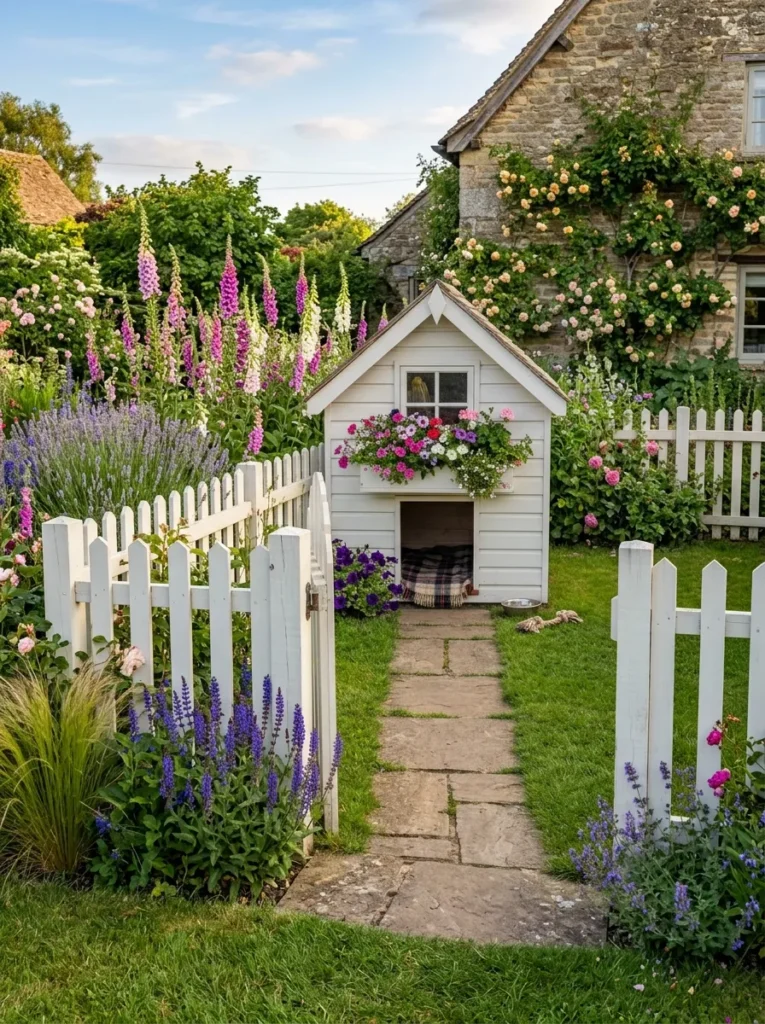
Vibe: The cottage garden dog area feels like the most charming garden room that a dog could inhabit — the white picket fence, the arched gate, and the cottage planting creating a scene that reads as an English garden feature regardless of its functional purpose.
Why it works: A white picket-fenced cottage garden dog area applies the vernacular aesthetic integration principle — as discussed in the outdoor kennel article, the picket fence is the most culturally legible domestic garden boundary in residential design, and a dog area constructed with this boundary reads as an intentional garden feature rather than a utility installation. The exterior cottage planting (lavender, salvia, ornamental grass positioned on the outer face of the fence where they are inaccessible to the dog) creates the planted context that integrates the dog area into the surrounding garden’s planting palette. Toxic cottage garden plants (foxglove, delphinium, lupin) must be positioned exclusively on the exterior of the fence, not within the dog’s accessible interior.
Budget: White picket fence and gate for 4×4m area: $400–900. Natural grass interior and flagstone path: $100–300.
Shop The Look
| Product |
|---|
| White picket fence set 120cm |
| Arched picket gate white |
| Lavender cottage planting exterior |
| Salvia exterior planting set |
| White painted timber dog house |
10. Dedicated Dog Potty Zone — The Functional Separation
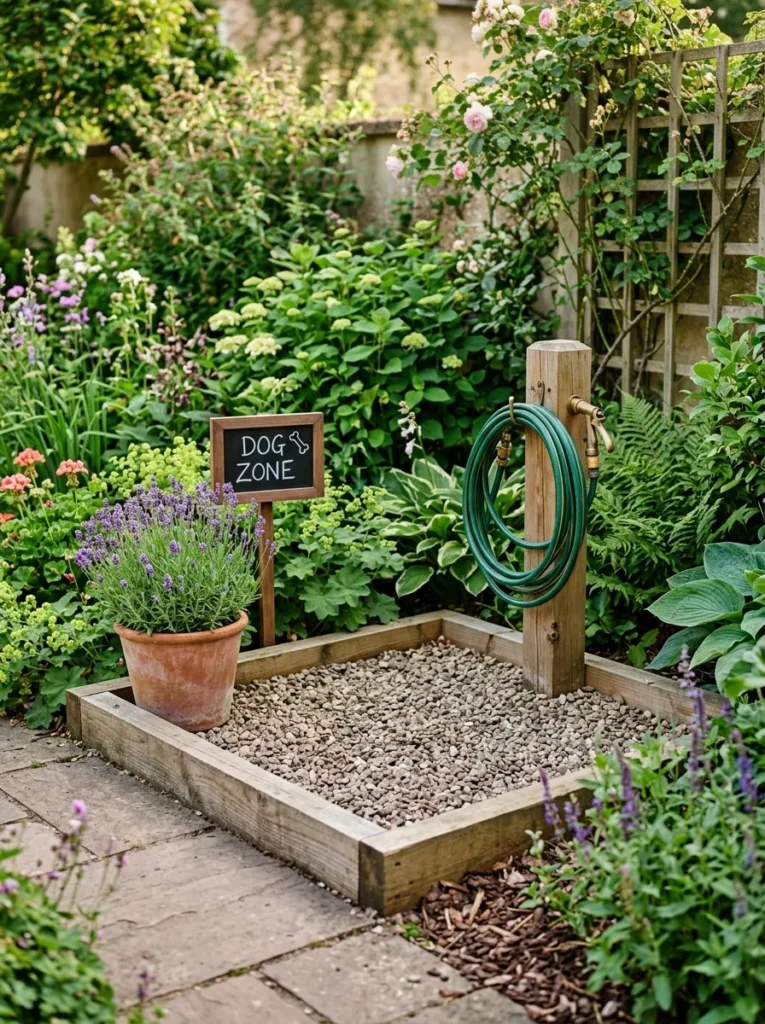
Vibe: The dedicated potty zone feels like the garden solved its most persistent management problem by designing around it — the clearly defined pea gravel zone creating a specific, easy-to-clean toileting area that protects the rest of the garden from damage.
Why it works: A dedicated dog potty zone with pea gravel substrate and flush connection applies the functional separation and management efficiency principle — a lawn that serves as a dog’s full toileting area develops urine-burn patches, persistent odors, and hygiene challenges that no amount of lawn care fully resolves. A dedicated 2×2m potty zone in pea gravel (which drains liquid waste immediately, does not develop urine burn, and can be hosed clean in 30 seconds using the mounted flush connection) concentrates the management of the dog’s toileting in a single, easily maintained zone, protecting the surrounding lawn from damage. Training a dog to use a dedicated potty zone takes approximately two to four weeks of consistent reward-based training.
Drainage specification: The pea gravel potty zone requires a permeable base (compacted hardcore at 100mm depth beneath 70mm of pea gravel) with a slight fall toward one corner for liquid drainage away from the zone. Hose the zone daily with the mounted flush hose and apply a pet-safe enzymatic cleaner weekly.
Budget: Materials for 2×2m potty zone: $80–180. Mounted hose post: $30–60.
Shop The Look
| Product |
|---|
| Pea gravel 10–14mm washed potty |
| Cedar board edging 15cm |
| Mounted hose connection post |
| Pet-safe enzymatic cleaner |
| Lavender terracotta pot |
11. Under-Tree Dog Lounge — The Natural Shade Zone
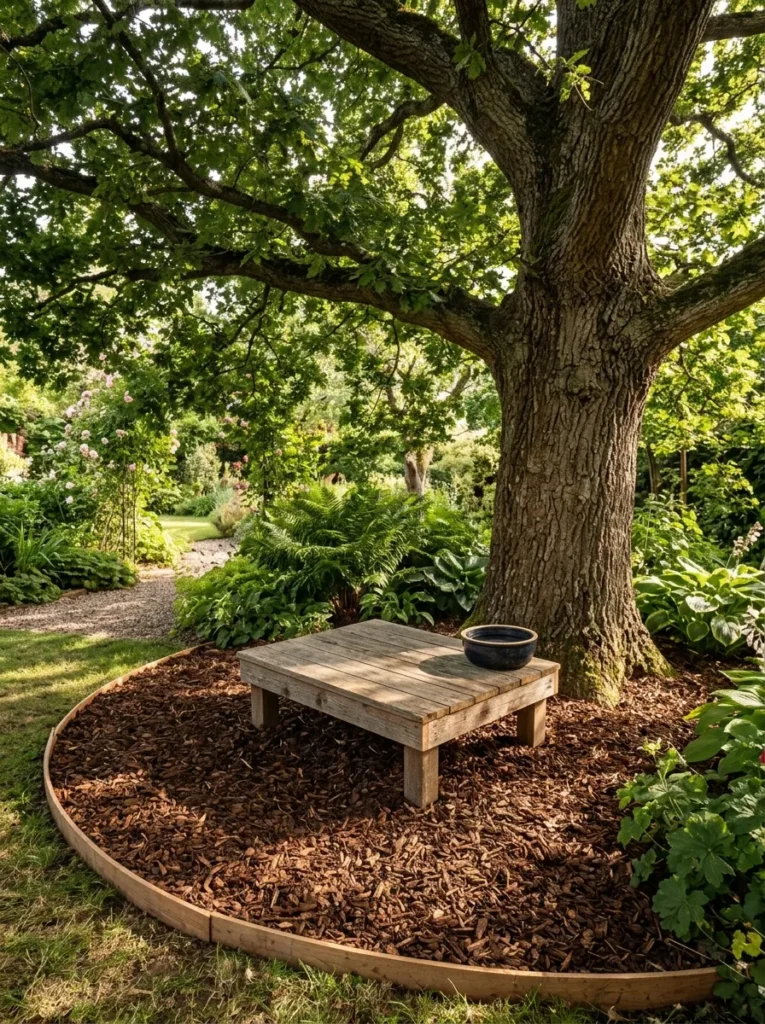
Vibe: The under-tree dog lounge feels like the best possible use of a mature tree’s specific gift to a garden — the natural canopy, the mulched floor, and the cedar platform creating a dog rest area of genuine natural quality.
Why it works: An under-tree dog lounge area applies the existing landscape feature utilization principle — a mature garden tree with a developed canopy provides the highest quality shade available in any garden: natural, biological, and dappled (allowing some solar warmth through gaps in the canopy while blocking the direct sun that creates dangerous surface temperatures). The area beneath a mature tree is frequently difficult to garden conventionally (the root competition and canopy shade prevent most ornamental planting), making it an ideal zone for a mulched dog rest area that the tree’s competitive root system does not affect. Hardwood chip mulch (shredded bark at 70–100mm depth) provides a soft, scented, drainage-efficient surface that is comfortable for a resting dog and suppresses weed growth beneath the canopy.
Tree species safety: Verify the tree species before creating a dog rest area beneath it. Trees with toxic fruit, seeds, or sap that are accessible to the dog at ground level should not be used as the canopy for a dog rest area: toxic species include yew (extremely toxic), laburnum (toxic), horse chestnut (toxic seeds), and walnut (toxic). Non-toxic species appropriate for under-tree dog areas include: oak (acorns mildly toxic in large quantities — clear fallen acorns regularly), apple (edible fruit), cherry (non-toxic ornamental varieties), and most ornamental prunus species.
Budget: Hardwood chip mulch for 1.2m radius area: $30–60. Cedar raised platform: $60–150.
Shop The Look
| Product |
|---|
| Hardwood chip mulch bark deep |
| Cedar raised dog platform 30cm |
| Curved cedar board edging circle |
| Ceramic water bowl outdoor |
| Enzymatic cleaner mulch zone |
12. Decorative Stone Dog Drinking Station — The Landscape Water Element
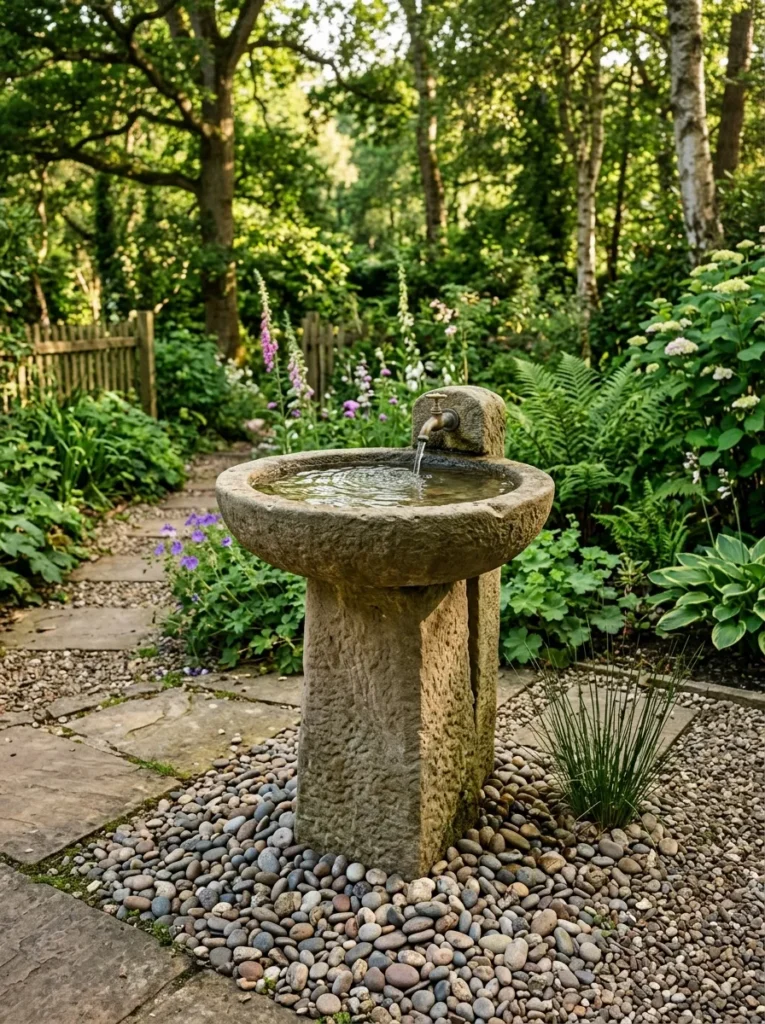
Vibe: The stone drinking station feels like a garden ornament that someone realized could also be a dog bowl — the natural stone pedestal reading as a designed landscape element whose water function is a secondary quality rather than its defining one.
Why it works: A stone pedestal dog drinking station at a garden path junction applies the landscape ornament dual-function principle — a standard plastic or stainless dog water bowl placed in a garden reads immediately and exclusively as pet equipment; a natural stone or concrete pedestal bowl at garden path level reads as a landscape ornament — a birdbath-adjacent feature — whose dog-watering function is incidental to its landscape quality. The recirculating pump (which keeps the water aerated and moving, preventing stagnation and attracting the dog’s interest through the sound of moving water) converts the stone bowl from a static ornament to an active water feature with both visual and auditory landscape presence.
Budget: Natural stone carved bowl: $150–400. Cast concrete alternative: $60–120. Recirculating pump: $25–50.
Shop The Look
| Product |
|---|
| Natural stone pedestal dog bowl |
| Cast concrete pedestal alternative |
| Small recirculating pump outdoor |
| River pebble base surround |
| Garden path junction position |
13. Raised Planter Divider — Garden and Dog Zone Separation
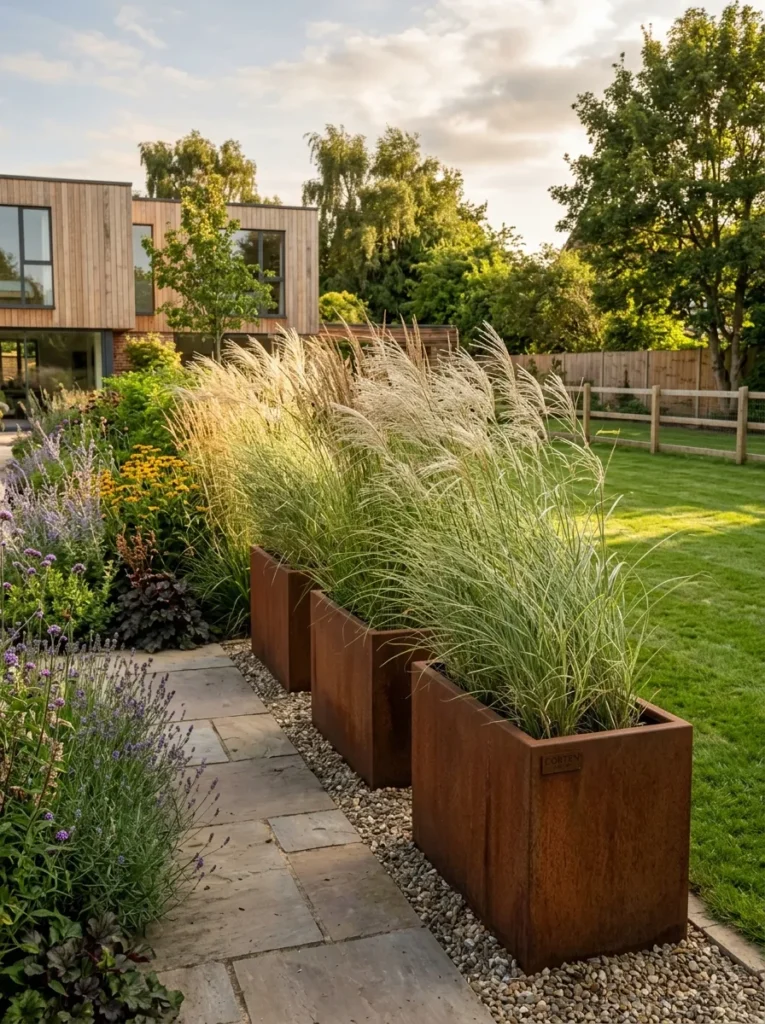
Vibe: The raised planter divider feels like the garden created its own intelligent boundary — the tall ornamental grasses in the Corten planters creating a living screen that is simultaneously the garden’s most beautiful structural element and the dog area’s most elegant boundary marker.
Why it works: Raised planter dividers with ornamental grass applies the soft boundary design principle — a hard fence between the garden zone and the dog zone creates a visual and physical separation that reads as a division; a row of large raised planters with tall ornamental grasses creates a soft, permeable, visually rich boundary that reads as a designed landscape feature organizing the garden into two distinct zones rather than containing one zone away from the other. The ornamental grass (Miscanthus at 150–200cm, or Calamagrostis at 120–150cm) creates a visual screen at head height for a standing adult while allowing sensory connection between the zones — the dog can see and hear and smell through the grass at its own level while the visual screen is effective from normal garden viewing positions.
Corten steel specification: Corten steel planters develop a warm rust-orange patina within the first two to three seasons of outdoor weathering, eventually stabilizing to a rich warm terracotta-brown surface that reads as a premium landscape material. The patination process drips rust-colored water initially — protect the surrounding paving from staining during the first season.
Budget: Three raised Corten planters: $600–1,200. Three raised timber planters alternative: $300–600. Ornamental grass planting: $80–200.
Shop The Look
| Product |
|---|
| Corten steel raised planter 80cm |
| Timber raised planter alternative |
| Miscanthus ornamental grass tall |
| Calamagrostis grass alternative |
| Planting compost raised bed mix |
14. Night-Lit Dog Area — Safe After-Dark Access
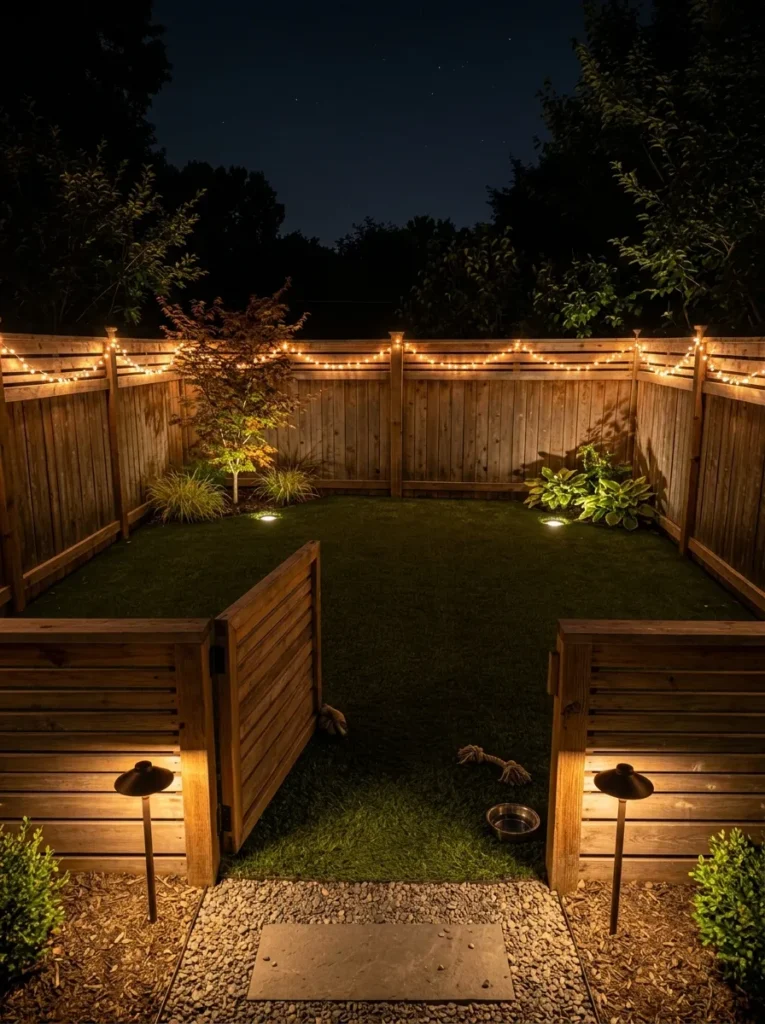
Vibe: The night-lit dog area feels like an outdoor room that was designed to be used after dark — the layered warm lighting creating an evening garden destination rather than an after-dark utility zone.
Why it works: Integrated landscape lighting in a dog area applies the after-dark extension principle — a dog area without lighting is unusable safely after dark (the owner cannot see what the dog is doing, cannot see where to step, and cannot perform waste collection). The dog area with designed landscape lighting extends its usable hours through the full late afternoon and evening period that autumn and winter compress into the household’s daily routine. The specific lighting approach — path lights at the entry for safe navigation, fairy lights along the fence rail for ambient warm light within the space, and uplights for architectural illumination of specimens or fence — replicates the landscape lighting design approach used in designed outdoor entertaining spaces, converting the dog area from a utility zone into an evening garden destination.
Solar versus wired: Solar-charged path lights and solar fairy lights (charged during daylight and automatically activated at dusk) require no electrical installation and are the most accessible and most affordable night lighting addition. Hardwired low-voltage garden lighting (12V transformer, professionally installed) provides more reliable, more controllable, and more powerful illumination at higher installation cost.
Budget: Solar path lights and fairy string: $40–90. Hardwired landscape lighting system: $300–800 professionally installed.
Shop The Look
| Product |
|---|
| Solar path light spike mount warm |
| Copper fairy string light solar |
| LED uplight flush mount dark housing |
| Low-voltage garden lighting transformer |
| Path light warm amber LED set |
How to Start Your Stylish Backyard Dog Area Project
The single best first move before designing or building any dedicated dog area is observing the dog’s existing outdoor behavior patterns in the current yard for one full week — specifically noting where the dog toilets (the specific corner or ground patch most consistently used), where the dog rests (the preferred shade position, the elevated vantage point if any, the spot nearest the house door), where the dog runs (the habitual patrol route along the fence line), and where the dog digs (if digging behavior is present, the specific location and direction of the digging attempts). This behavioral observation directly informs four critical design decisions: the potty zone position (place it where the dog already prefers to toilet rather than where it is most convenient for the owner), the shelter position (the dog will use a shelter most if it is positioned on the same aspect and in the same approximate location as the dog’s existing preferred resting spot), the surface treatment (a dog that patrols along the fence line requires a durable surface material at that patrol path, while a dog that rests primarily in the center requires surface comfort at the resting position), and the dig-prevention strategy (the position of the digging attempts determines where dig-deterrent ground treatment is most necessary).
The most common mistake in backyard dog area design is underspecifying the size. The minimum welfare-appropriate dog area for a medium dog (15–25kg) used for 2–4 hours of daily unsupervised access is 3×4 metres; for a large or active dog at the same use duration, 4×6 metres minimum. Designing a dog area smaller than these dimensions to reduce cost or material quantity produces a space that generates more stress-related behavior (pacing, barking, fence-running) than it prevents, because the confined space’s insufficient movement opportunity amplifies the dog’s anxiety of containment rather than providing the welfare-positive outdoor access that the area is designed to provide.
Three specific additions under $150 that most immediately improve any existing or new backyard dog area: a mounted flush hose connection at the area’s boundary (a simple outdoor tap splitter and a 1.5m hose with a jet nozzle fixed to the fence post — $25–45 — converting the daily cleanup from a bucket-and-mop task to a 30-second hose-rinse task and therefore making daily hygiene maintenance sustainable rather than effortful); a shade sail or shade cloth panel covering 50% of the dog area surface ($60–120 for a 3×3m sail — the most important welfare addition in any climate where summer temperatures exceed 25°C); and one piece of enrichment planting in a raised bed within or adjacent to the dog area ($20–50 for a lavender, chamomile, and ornamental grass combination in a small raised bed — providing the olfactory and sensory enrichment that the artificial or hardscape dog area surface cannot provide). These three additions combined for under $200 address hygiene management, thermal welfare, and behavioral enrichment — the three dimensions of dog area design most consistently overlooked by owners focused on the structural enclosure.
Frequently Asked Questions About Stylish Backyard Dog Areas
What surface material is best for a backyard dog area?
The best surface material for a dog area depends on the specific combination of the dog’s size and activity level, the climate, and the maintenance commitment available. Pet-grade artificial turf (the most popular choice) provides the visual warmth and comfort of a lawn without the mud, urine burn, and bare patches of natural grass; it requires hosing clean daily and a deeper clean weekly, and it replaces every 8–12 years. Pea gravel (10–14mm, washed) provides excellent drainage and easy liquid waste management but is less comfortable for extended lying and requires checking that the grade is too large for the specific dog to swallow. Rubber matting over a drainage base (for small areas or for covered zones) provides maximum comfort and easy cleaning but reads as industrial rather than designed. Natural concrete or natural stone pavers (with 10mm joints of pea gravel for drainage) provide a durable, cleanable, attractive hardscape appropriate for a dog area adjacent to a hardscape garden. A combination of two surfaces (pet turf for the primary area, flagstone or gravel at the entry and potty zone) often produces the best practical and aesthetic result.
How do you prevent a dog from digging under the fence of a dog area?
The three most reliable dig-prevention methods for a dog area boundary are the L-footer (welded wire mesh extended horizontally outward from the fence base at ground level, either buried to 5–10cm or pegged flat on the surface — when the dog digs at the fence base it encounters the horizontal mesh and cannot continue forward), the concrete perimeter strip (a 15cm wide strip of concrete poured flush with the ground surface along the fence base, providing a hard surface that prevents digging at the fence line), and the gravel trench (a 30cm deep by 30cm wide trench of compacted gravel along the fence base, which collapses back into the space as fast as the dog digs and discourages continued effort). For dogs that dig as a compulsive behavior rather than an escape attempt, providing a designated digging sandbox within the dog area (a 60×60cm area of soft loose soil or sand, marked with a border timber and initially seeded with treats buried at varying depths to encourage its use as the digging destination) redirects the digging behavior to a sanctioned location.
What plants are safe to use adjacent to or within a dog area?
The plant families that are non-toxic to dogs and appropriate for use adjacent to or within a dog area include: most ornamental grasses (Miscanthus, Calamagrostis, Pennisetum — all non-toxic), lavender (Lavandula — non-toxic, aromatic enrichment), rosemary (Rosmarinus — non-toxic, aromatic), chamomile (Matricaria — non-toxic, soft to walk on), most Nepeta species including catnip (non-toxic, mild calming olfactory effect in dogs), most Sedum species (non-toxic), and most Rudbeckia and Echinacea species (non-toxic). Plants to avoid within the dog’s accessible area: foxglove (Digitalis — highly toxic), rhododendron (highly toxic), yew (Taxus — extremely toxic), laburnum (toxic seeds and bark), sweet pea (Lathyrus — toxic), and lily species (toxic). Always verify any plant species against the ASPCA toxic plant database before planting within or directly adjacent to a dog’s outdoor area.
How do you keep a dog area smelling fresh?
Managing odor in a dog area requires addressing the primary source (waste accumulation) rather than masking it. Daily management is the most important factor: solid waste should be removed immediately after deposition (or at minimum once daily); liquid waste on artificial turf should be hosed off with water daily to dilute urine and prevent ammonia concentration; pea gravel surfaces should be raked and hosed weekly. Monthly deep cleaning with a pet-safe enzymatic cleaner (specifically formulated to break down the protein compounds in urine that conventional cleaners do not eliminate) applied to all surfaces, allowed to dwell for the specified contact time, and rinsed thoroughly addresses the accumulated odor that daily hosing does not fully resolve. Aromatic dog-safe plantings adjacent to the dog area (lavender, rosemary, chamomile) provide the olfactory context that makes a well-managed dog area smell like a garden rather than a kennel.
How do you train a dog to use a designated potty zone?
Training a dog to use a designated potty zone uses reward-based positive reinforcement applied consistently during the establishment period (typically two to four weeks). The training sequence: each time the dog needs to toilet (typically after waking, after eating, and after significant play), bring the dog on a lead directly to the designated potty zone surface and wait calmly. Do not prompt or command — simply wait in the zone. When the dog toilets in the zone, provide an immediate and enthusiastic reward (high-value treat and verbal praise) within two seconds of the toileting completion. If the dog begins to toilet elsewhere, interrupt calmly (no punishment — simply a redirecting noise) and guide to the potty zone before the toileting is complete. Consistency across all household members during the training period is essential — the dog must be taken to the potty zone every time, by every member, without exception, for the training association to establish reliably.
Ready to Design Your Stylish Dog Area?
These 14 ideas move through every dimension of what makes a backyard dog area genuinely stylish and genuinely functional — from the green-lawn visual warmth of a pet-turf and planted-border area and the hardscape elegance of a flagstone and pea gravel patio, through the ecological integration of a living hedge boundary and the architectural drama of a shade sail overhead, to the sensory richness of a herb planting strip, the cooling pleasure of an integrated splash zone, the natural quality of an under-tree mulched lounge, and the evening extension of a thoughtfully lit after-dark space. Starting with the behavioral observation week — watching the dog’s existing outdoor habits, preferences, and patterns before designing anything — is the beginning that makes every subsequent design decision serve the specific dog rather than the idealized generic dog. Observe first. Identify the preferred rest spot, the preferred patrol path, the preferred toileting zone. Design the dog area around those specific behavioral realities, and let the aesthetic decisions (the surface material, the boundary style, the planting palette, the shade structure) follow from the functional foundation that the behavioral observation provides. When the dog walks into the finished space and immediately settles in the shelter positioned where the dog already preferred to rest — that specific recognition is the design outcome that all 14 of these ideas are working toward.