Modern small dog houses are purpose-designed sleeping and resting structures for small breed dogs that combine genuine architectural and design consideration with appropriate scale, material quality, and functional comfort — creating dog houses that serve as genuinely beautiful home objects rather than afterthought pet products, suitable for both indoor placement as furniture-quality room additions and outdoor positioning as considered garden features. This article gives you exactly 15 modern small dog houses for indoor and outdoor use, spanning every design aesthetic from Japandi minimalism to coastal boho, every material from solid oak to concrete-look ceramic, and every functional requirement from weather-proof outdoor durability to luxury indoor comfort, with specific guidance and curated product tables for every design.
There is a particular quality of domestic completeness that comes from a home where every element has been considered — including the spaces designed for the animals who inhabit it alongside their humans. A well-designed modern small dog house communicates something important about how a household understands the relationship between design, comfort, and care: that beautiful things and functional things are not mutually exclusive, that a dog’s resting space can be as considered as the human furniture that surrounds it, and that the best pet products are those that earn their place in a room through genuine design quality rather than merely being tolerated as necessary concessions to pet ownership. These designs range from a DIY weekend build to a designer-quality object worthy of any interior. Here are 15 ideas worth building or buying — and saving.
Why Modern Small Dog Houses Work So Well
The modern pet furniture movement — which positions pet beds, houses, and accessories as genuine design objects subject to the same aesthetic standards as human furniture rather than as functional-only pet products — has its roots in the broader intersection of the design-conscious pet owner demographic and the premium pet care industry. This intersection has been building since the early 2000s but accelerated dramatically during and after the pandemic years, when record numbers of new dog owners — many of them design-literate millennials and Gen Z adults with strong aesthetic sensibilities and high expectations for the objects they allow into their homes — entered the pet market and found the existing commercial pet product aesthetic deeply misaligned with their interior design standards.
The materials and design approaches that define the most successful modern small dog houses share specific qualities: they use the same material vocabulary as contemporary human furniture (solid oak, walnut, rattan, concrete, natural linen, matte black steel) rather than the typically synthetic, primary-colored materials of commercial pet products; they are scaled and proportioned with genuine design consideration (correct scale for the breed, appropriate ceiling height, entry opening sized for comfort rather than just clearance); they integrate with their surrounding interior or garden context rather than contrasting awkwardly with it; and they provide genuine physical comfort for the dog through appropriate bedding depth, thermal properties, and natural material breathability. Color palettes for modern small dog houses align with contemporary interior design palettes — warm white, natural oak, warm greige, matte black, sage green, and natural linen — chosen for their compatibility with the widest range of home interior and garden aesthetic contexts.
The modern small dog house market and DIY category has grown substantially in cultural visibility, with the most design-forward examples appearing in mainstream interior design publications, design awards, and home décor content across Pinterest and Instagram alongside human furniture of equivalent quality. The critical shift is perceptual: a modern small dog house designed and finished to the same standard as a piece of human furniture is experienced as a room asset rather than a room compromise, making the design investment worthwhile for any household that values both their dog’s comfort and their home’s aesthetic integrity.
Small breed dogs — toy breeds, terriers, dachshunds, French bulldogs, Cavaliers, and all breeds under approximately 10kg — gain the most from purpose-designed modern small dog houses because their compact scale means a correctly sized house occupies minimal floor space while providing the full enclosure and comfort benefit that satisfies their specific behavioral preferences for den-like sleeping environments.
Style at a Glance
| Element | Trait 1 | Trait 2 |
|---|---|---|
| Philosophy | Design object first, pet product second | Comfort without aesthetic compromise |
| Materials | Solid oak, walnut, rattan, natural linen | Matte black steel, concrete-look, painted MDF |
| Color Palette | Warm white, natural oak, warm greige | Matte black, sage green, natural linen |
15 Modern Small Dog Houses for Indoor and Outdoor Use
1. Japandi Solid Oak Indoor Dog House
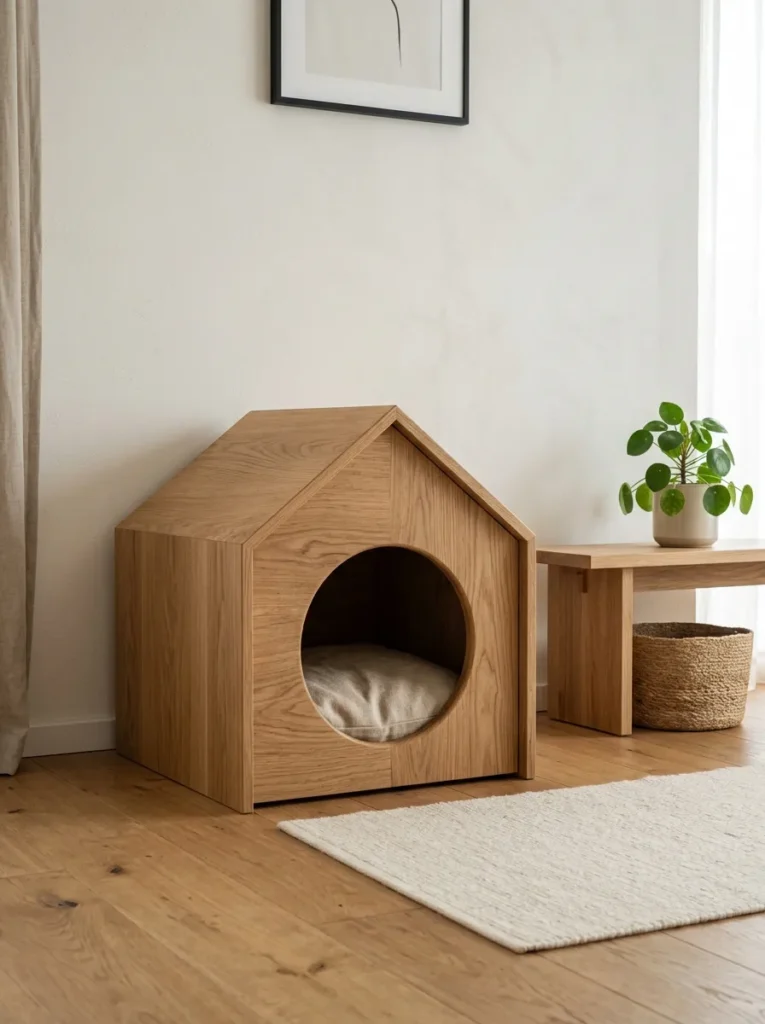
Vibe: The Japandi oak dog house feels warmly resolved — a piece of furniture that happens to be a dog house rather than a dog house that happens to be in a room.
Why it works: A solid oak Japandi dog house is the indoor dog house design that most completely achieves the goal of furniture-quality design because solid oak — the material most associated with premium Scandinavian and Japanese furniture design — carries an inherent design authority that positions the dog house within the furniture world rather than the pet product world. The design principle is material elevation: when a dog house is built from the same material as the human furniture in the room (solid oak, in a Japandi interior), it reads as part of the room’s furniture composition rather than an addition to it. The circular entry opening is the specific design detail that most elevates the dog house’s architectural quality — a simple arched or square opening reads as functional; a perfectly circular opening reads as considered design.
How to get it: Build from 18mm solid oak boards using butt joints reinforced with oak dowels and wood glue — no visible screws or nails for a furniture-quality finish. Cut the circular entry opening using a jigsaw with a circular guide, sanding the cut edge through 80–120–180–240 grit for a smooth, splinter-free finish. Apply two coats of Osmo hard-wax oil in natural clear — this penetrating finish protects the wood while maintaining the oak’s natural warmth and grain character, and is renewable when worn. Size the house to the dog’s specific dimensions: internal width at least 1.5 times shoulder width, internal height at least 1.3 times shoulder height, and internal depth at least 1.5 times body length from nose to tail base.
Quick Win: Applying a single coat of white-tinted hard-wax oil (rather than clear) to natural oak creates a whitewashed quality that makes the oak dog house coordinate with both warm white Japandi interiors and natural wood tones simultaneously — the most versatile single finish choice for a modern indoor dog house.
Shop The Look
| Product |
|---|
| Solid oak board 18mm furniture grade natural |
| Osmo hard wax oil clear natural wood finish |
| Oak wood dowel set 8mm joining furniture |
| Natural linen dog cushion washable cover |
| Small ceramic plant pot Japandi minimal |
Allso view: 14 Charming Rustic Dog Shed Ideas for Happy Pets
2. Painted MDF Modern Geometric Dog House (COLOR)
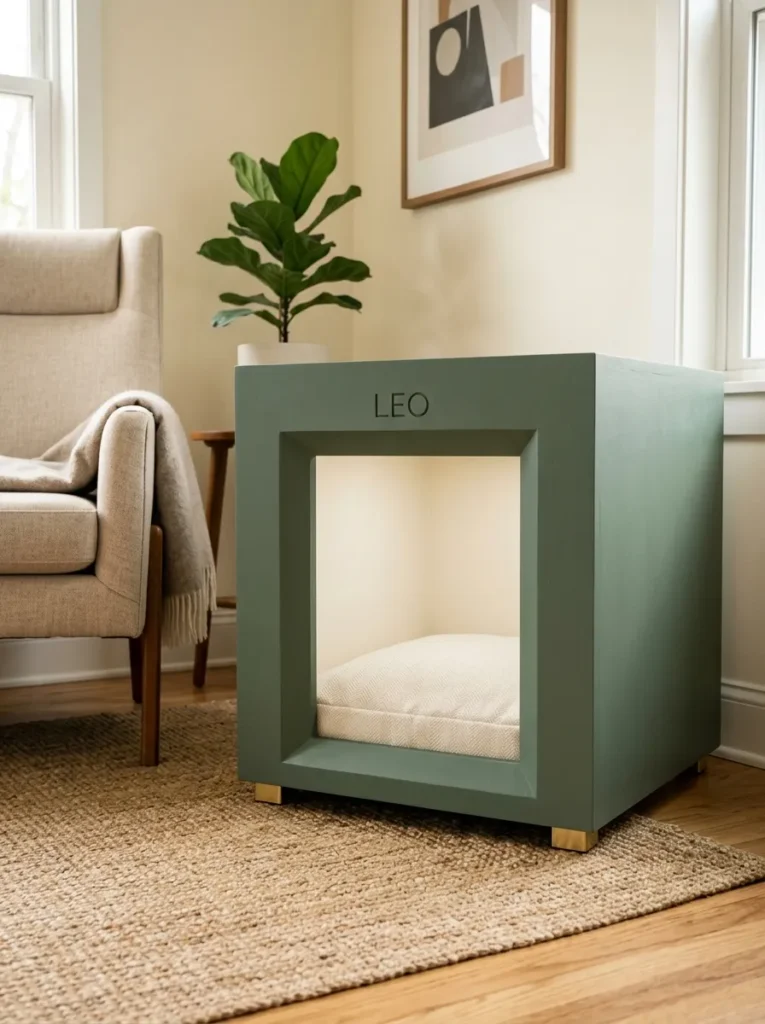
Vibe: The geometric sage dog house feels design-forward and considered — the pet furniture piece that makes design-literate guests ask where it came from.
Why it works: A painted MDF geometric dog house with a flat roof is the most accessible modern dog house design because it uses the most widely available material (MDF) in the most achievable construction form (flat-panel box construction with no curved elements) while achieving maximum design impact through color and proportion rather than material richness. The design principle is color as design: when a dog house is painted in a sophisticated interior paint color — the same deep sage green used on cabinet doors, accent walls, and designer furniture throughout contemporary interior design — it reads as a deliberate color choice within the room’s palette rather than a commercial pet product color. The brass feet are the specific detail that most elevates MDF construction to furniture quality — they lift the piece off the floor, create a visual connection to quality furniture conventions, and communicate that the design was genuinely considered.
How to get it: Cut all panels from 18mm MDF using a circular saw or jigsaw, sanding all cut edges through 120–180–240 grit for smooth paint-ready surfaces. Assemble with PVA glue and 40mm countersunk MDF screws — countersink all screws below the surface and fill with MDF filler before priming. Apply two coats of MDF primer, light sand between coats, then two coats of chalk paint in the chosen color. For the brass feet, source 30mm diameter brass furniture feet from a hardware or furniture supplier — attach with M6 threaded inserts pressed into the MDF base for a secure, removable fixing. Paint the interior white for the warm contrast that makes the dog house’s interior feel inviting.
Shop The Look
| Product |
|---|
| MDF sheet 18mm large panel furniture |
| Deep sage green chalk paint interior |
| MDF primer undercoat white smooth |
| Brass furniture foot set 4 piece 30mm |
| Ivory performance fabric dog cushion |
3. Rattan and Bamboo Boho Dog House (MATERIAL)
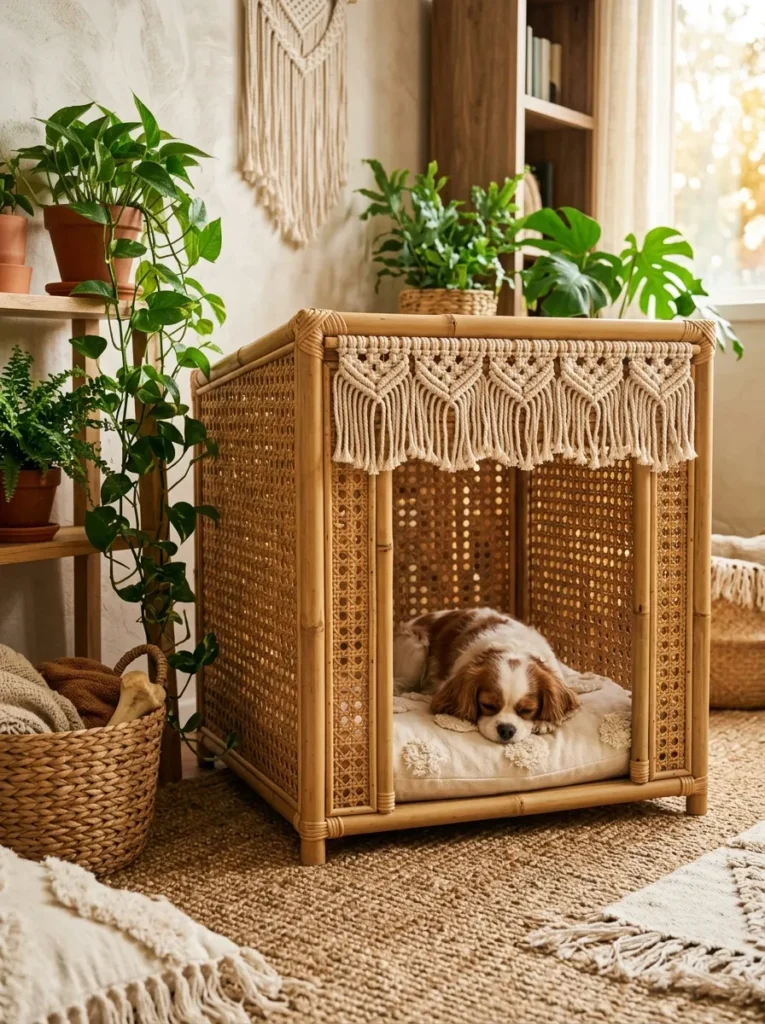
Vibe: The rattan boho dog house feels warmly textural and naturally beautiful — the pet furniture piece that looks equally at home in a boho living room and a tropical garden.
Why it works: A rattan and bamboo dog house is the pet furniture design that most effectively uses the boho material vocabulary — natural fiber, woven texture, organic form — in a dog house context, creating a sleeping structure that is simultaneously a boho decorative object and a genuine functional dog shelter. The open-front design (rather than a circular or rectangular enclosed entry opening) creates a more visually open structure that suits smaller dogs that prefer to be able to observe the room from their resting position, while the rattan’s natural ventilation quality makes the structure comfortable in warm weather without becoming oppressive. The design principle is material consistency: a rattan dog house in a rattan-furnished room reads as part of the room’s material composition rather than an introduced pet product, achieving the furniture-quality integration that modern dog house design aspires to.
How to get it: Source rattan wall panels (available as pre-woven sheets from cane and rattan suppliers) for the three panel walls, cutting to the required dimensions with sharp scissors or a Stanley knife. Build the bamboo structural frame from 20mm diameter bamboo poles joined with bamboo lashing cord at all joints — the traditional bamboo lashing technique (wrapping cord in a figure-eight pattern at each joint and tying off) requires no tools and produces joints of adequate strength for a small dog house. Attach the rattan panels to the inside face of the bamboo frame using cable ties or cord lashing. Add a macramé entry detail by tying 3mm natural cotton cord in a row of square knots across the entry opening’s upper edge.
Shop The Look
| Product |
|---|
| Natural rattan woven panel sheet furniture |
| Bamboo pole 20mm natural structural frame |
| Bamboo lashing cord natural craft joining |
| Natural cotton dog cushion tufted cover |
| Macramé cord 3mm natural entry detail |
4. Concrete-Look Indoor Dog Den (MATERIAL / COLOR)
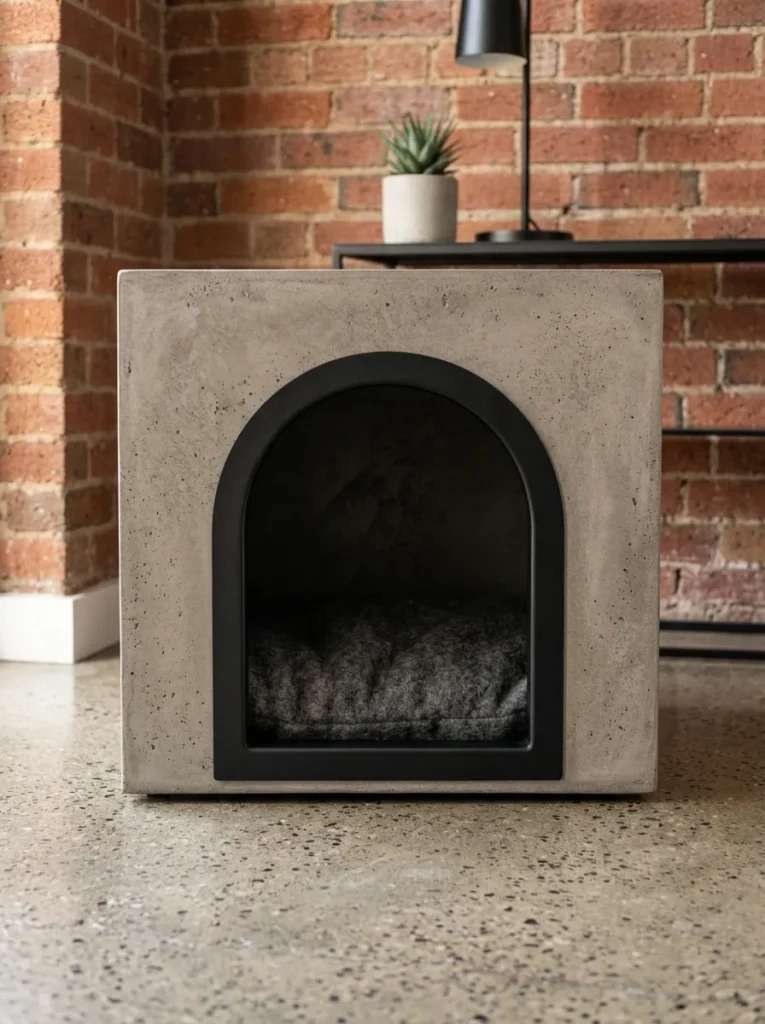
Vibe: The concrete-look dog den feels architecturally serious — the dog house that makes an industrial interior feel genuinely complete rather than pet-compromised.
Why it works: A concrete microtopping finish on a dog house structure is the surface treatment that most effectively creates an architectural, industrial quality at low material cost — the concrete microtopping (a 2–3mm skim of cementitious compound applied over an MDF or timber substrate) produces the visual quality of poured concrete at a fraction of the weight, cost, and structural complexity of genuine concrete construction. The design principle is surface authenticity: the concrete microtopping’s natural color variation, slight texture, and genuine mineral composition create a surface that reads as architecturally material rather than decoratively applied — the difference between a surface that looks like concrete because it is a concrete product and a surface that looks like concrete because it has been painted to appear so. The black powder-coated steel entry arch is the industrial hardware detail that anchors the concrete surface in the industrial design vocabulary.
How to get it: Build the MDF substrate box structure as for the geometric design (idea 2), but leave unpainted after priming. Apply the concrete microtopping in two layers: a scratch coat (textured application using a trowel to create the micro-aggregate quality) and a finish coat (smooth-ish application with a steel trowel) — total system depth 3mm maximum on MDF. Seal with three coats of water-based polyurethane floor sealer for durability and easy cleaning — the sealed concrete surface should be wipe-clean for a pet furniture application. Fabricate the entry arch from 3x3mm black powder-coated steel flat bar bent to shape and fixed to the front face with countersunk stainless screws.
Shop The Look
| Product |
|---|
| Concrete microtopping kit small application |
| Waterproof polyurethane sealer clear finish |
| Steel trowel small craft concrete smooth |
| Matte black spray paint powder coat effect |
| Charcoal wool dog cushion washable natural |
5. Scandinavian White and Pine Dog House (COLOR)
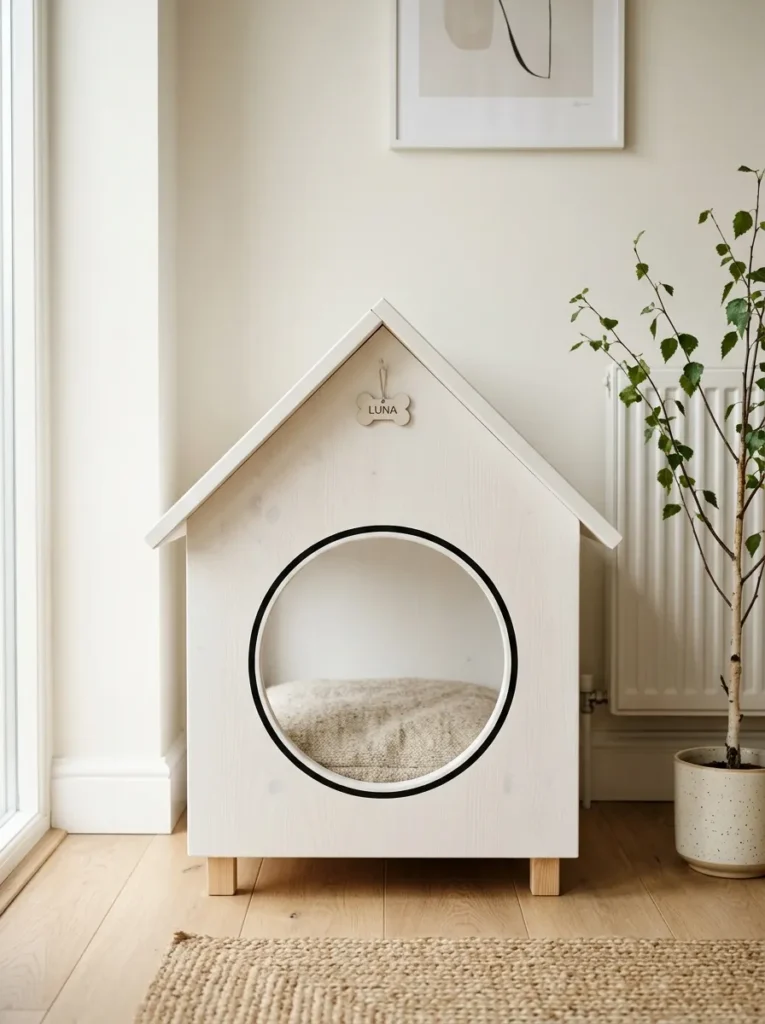
Vibe: The Scandinavian white dog house feels crisply cheerful — the design that proves a painted white dog house can look as considered as any unpainted natural wood version.
Why it works: A white-painted pine dog house with traditional A-frame proportions and a single graphic black circle detail is the Scandinavian dog house design that most clearly demonstrates the power of reduction — removing all decorative complexity and allowing clean form, good proportion, and a single graphic accent to carry the full design. The thin black circle painted around the entry opening is the design principle made visible: it is a single line that transforms a functional hole in a white box into a graphic design element with genuine visual sophistication. This technique — using a painted outline to create a visual relationship between the opening and the wall surface rather than simply cutting through the material — is borrowed from graphic design and typography, where drawn outlines create weight and definition that unoutlined shapes cannot achieve.
How to get it: Build from 18mm pine board, sanding all surfaces to 180 grit before priming. Apply two coats of white exterior primer and two coats of white satinwood or eggshell paint for a smooth, semi-durable finish. After the entry circle is cut and edges sanded smooth, paint a 3mm wide black circle outline around the entry using a fine brush and exterior black paint — use a compass or circle template for accuracy. Install four 50mm turned wooden furniture legs (available from furniture hardware suppliers) with M8 threaded inserts for a furniture-quality base. The white interior should be left in the same white as the exterior for visual coherence — add a natural oatmeal or undyed linen cushion as the single warm-tone element.
Shop The Look
| Product |
|---|
| Pine board 18mm furniture grade natural |
| White satinwood paint interior exterior |
| Turned wooden furniture leg set 4 piece |
| Oatmeal wool dog cushion natural undyed |
| Black exterior paint fine circle detail |
6. Outdoor Cedar Dog House with Green Roof (MATERIAL / ACCESSORIES)
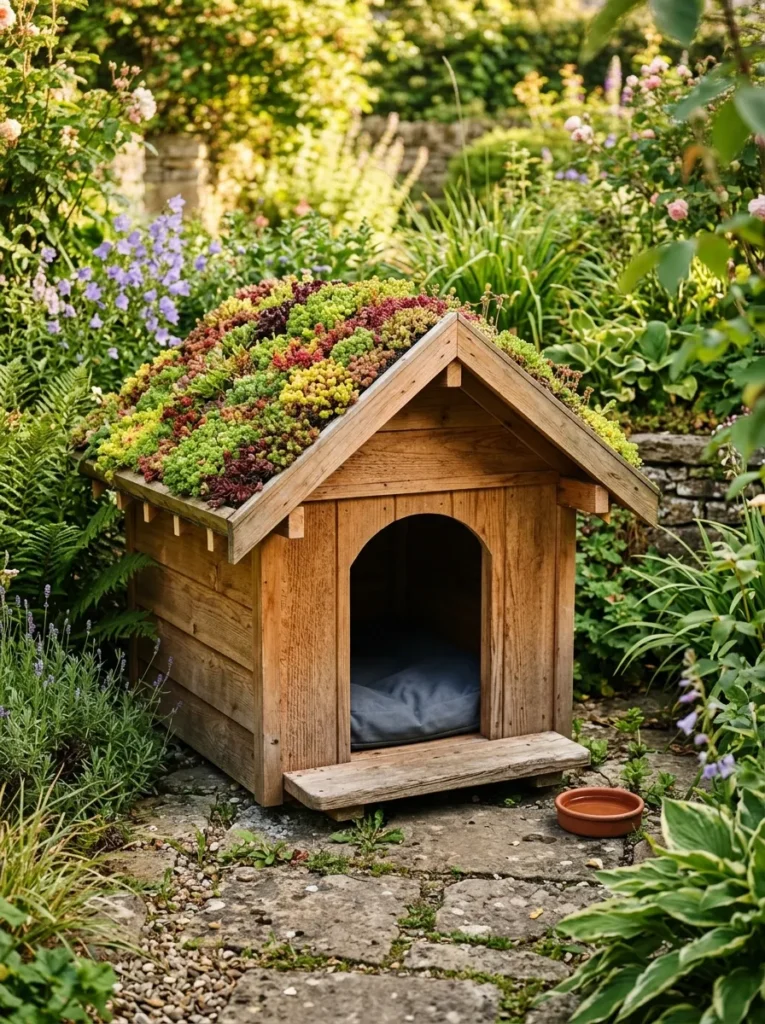
Vibe: The cedar green roof dog house feels naturally garden-integrated — a garden structure beautiful enough to be mistaken for a designed garden feature rather than identified as a dog house.
Why it works: A cedar dog house with a living sedum green roof is the outdoor dog house design that most effectively integrates with a considered garden aesthetic because the green roof’s plant coverage transforms the structure’s most visible surface — the roof — from a material object (timber, tile, or felt) into a garden element that belongs to the same botanical world as the surrounding planting. The design principle is material continuity with garden context: a living roof on a garden structure creates visual continuity between the structure and its garden setting, making the dog house read as part of the garden rather than an object placed in the garden. Cedar is the ideal outdoor dog house timber — its natural oils resist decay and insect damage without chemical treatment, it is soft enough to work with hand tools, and its warm reddish tone becomes a beautiful silver-grey with weathering over 2–3 seasons.
How to get it: Build the cedar structure with 19mm cedar tongue-and-groove boards for the walls — the interlocking boards eliminate gaps that would allow rain ingress and require no paint or caulk to weatherproof. For the living roof: install a waterproof membrane (EPDM rubber sheet) over the roof structure first, then add 75mm of drainage layer (lightweight gravel or drainage matting), 75mm of sedum growing medium (a low-nutrient, free-draining specific substrate), then plant sedum plug plants at 10–15cm centers. The sedum roof requires annual feeding and occasional watering in prolonged drought — all other maintenance is self-sustaining.
Shop The Look
| Product |
|---|
| Cedar tongue and groove board 19mm outdoor |
| EPDM rubber waterproof membrane roofing |
| Sedum green roof substrate growing medium |
| Sedum plug plant mixed variety green roof |
| Clear exterior cedar oil wood treatment |
7. Arch-Entry White Modern Dog House (SMALL SPACE / COLOR)
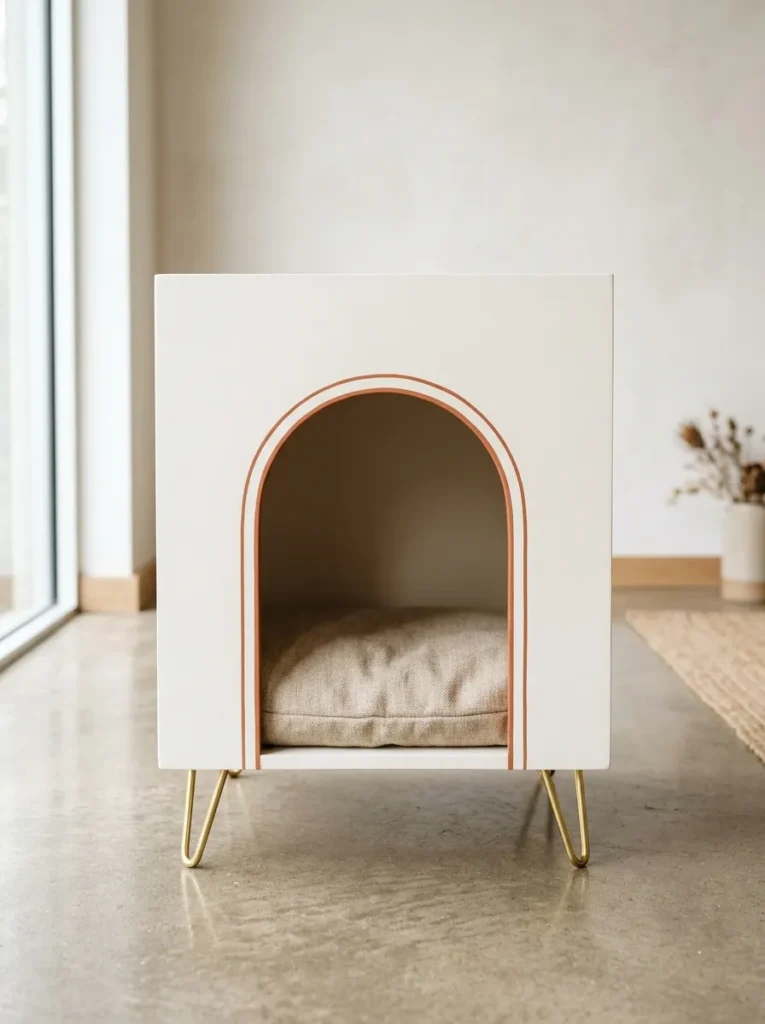
Vibe: The arch-entry dog house feels architecturally elegant — the arched opening giving the piece an immediate architectural quality that references garden follies and Mediterranean doorways simultaneously.
Why it works: A rounded arch entry opening is the single design detail that most immediately elevates a dog house from a box with a hole to a piece with genuine architectural character — the arch is one of the most culturally loaded architectural forms in human design history, associating the piece with doorways, pergolas, and garden structures of considerable aesthetic tradition. The design principle is borrowed architectural language: by using the arch (a form with deep architectural resonance) as the dog house’s primary design element, the maker creates a piece whose visual vocabulary references architecture rather than pet products, positioning it within a completely different perceptual category. The terracotta interior edge of the arch — a thin painted line on the inside face of the arch’s cut edge — is the graphic detail that reveals the design’s sophistication: it is the kind of detail that is invisible at a glance but unmissable on close inspection.
How to get it: Cut the arch opening using a jigsaw — draw the arch profile by finding the center point of the entry opening width and using a compass set to the arch radius to mark the curved top. The arch should be proportioned with the rise (height of the curve above the spring line) equal to approximately 40% of the span width for the most visually pleasing proportion. Sand the cut edge smooth and paint the interior face of the arch in terracotta before assembling the house — it is significantly easier to paint this detail on the flat panel before assembly than after. Source brass hairpin legs from furniture hardware suppliers — the single-pin hairpin leg in 100mm height is the most appropriate scale for a small dog house.
Shop The Look
| Product |
|---|
| MDF board 18mm arch entry dog house |
| Warm white chalk paint exterior finish |
| Terracotta chalk paint arch edge accent |
| Brass hairpin leg set 4 piece 100mm |
| Natural linen dog cushion arch interior |
8. Industrial Pipe Frame Outdoor Dog House (MATERIAL)
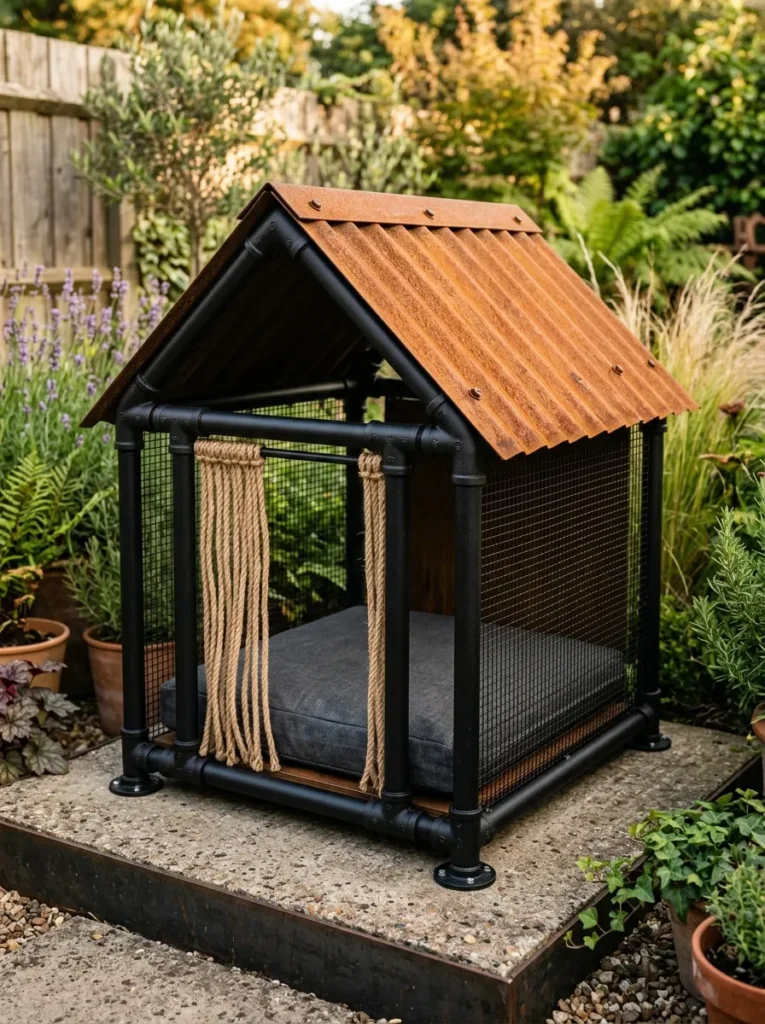
Vibe: The industrial pipe frame dog house feels boldly material — a dog house built from genuinely architectural materials that looks completely at home in an industrial or contemporary garden design.
Why it works: A black steel pipe frame outdoor dog house is the design that most honestly expresses the industrial design philosophy — structural elements used visibly and deliberately, with material honesty rather than concealment as the guiding aesthetic principle. The pipe flanges and bolted connections that join the frame are not hidden details but celebrated design features, and the Corten steel roof that develops a beautiful rust patina over the first two outdoor seasons is a material that gets better with age and weather rather than deteriorating. The design principle is material evolution: Corten steel and black steel pipe are materials that develop visual character through outdoor exposure rather than requiring maintenance to preserve their appearance, making them specifically appropriate for outdoor dog house use where minimal maintenance is a practical requirement.
How to get it: Source black steel pipe (20mm outer diameter, 2mm wall thickness) and matching pipe flanges from a plumbing or steel supplier — the bolted flange connection system requires only a wrench for assembly, making this design achievable without welding. Cut pipe sections to length using a pipe cutter or angle grinder. Source a small sheet of Corten steel (also known as weathering steel, available from steel stockholders) for the roof — cut to size and pre-age by wetting and drying repeatedly over 2–3 weeks for the orange-brown patina to develop. Fill the wall sections with black hardware cloth stapled to timber sub-frames fitted within the pipe frame.
Shop The Look
| Product |
|---|
| Black steel pipe 20mm 2mm wall section |
| Steel pipe flange 20mm black set |
| Corten weathering steel sheet small panel |
| Black hardware cloth 0.5 inch mesh roll |
| Natural rope curtain door outdoor rated |
9. Flat Pack Walnut Veneer Modern Dog House (MATERIAL / COLOR)
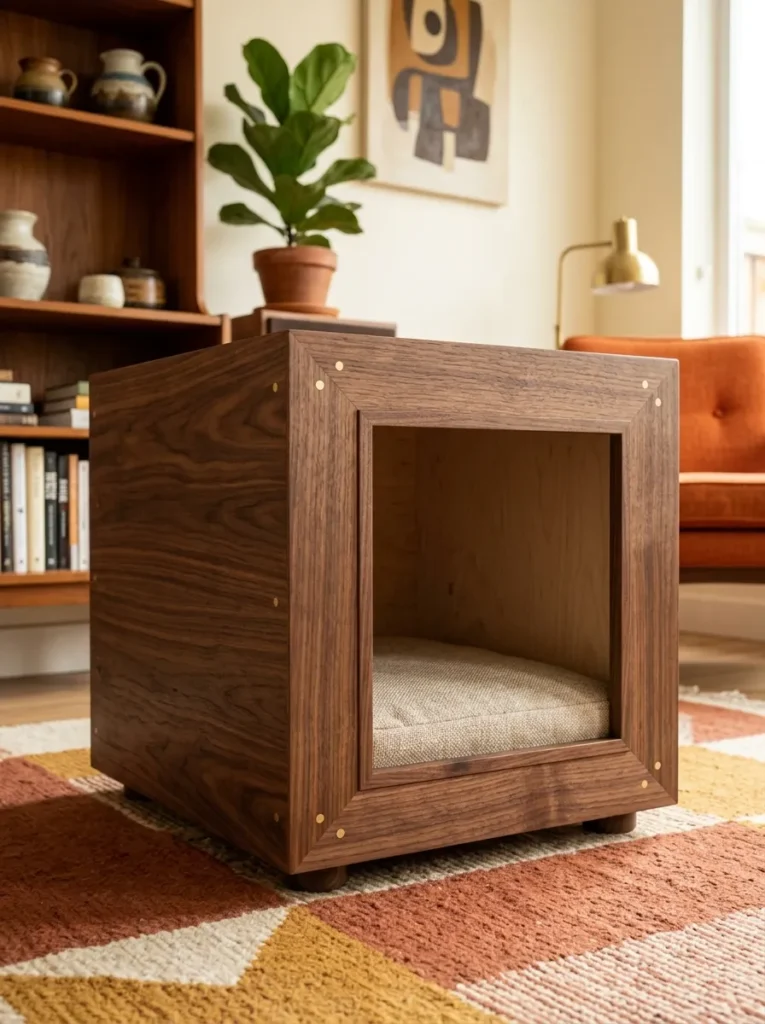
Vibe: The walnut veneer dog house feels mid-century warmly sophisticated — the pet furniture piece that fits in a mid-century modern living room as naturally as an Eames chair.
Why it works: A walnut-veneered dog house achieves the visual richness of solid walnut at a fraction of the weight and cost by using the same technique that defines mid-century modern furniture production — a thin sheet of beautiful wood grain applied to a stable engineered substrate. The design principle is surface richness through honest veneering: walnut veneer on birch plywood is not a deception but a legitimate furniture-making tradition that produces pieces of genuine beauty and structural stability, with the additional benefit that plywood’s dimensional stability is superior to solid timber for box construction. The pale birch plywood interior contrasting with the dark walnut exterior creates the same interior-exterior material contrast used in Scandinavian design furniture to communicate craftsmanship — the interior material is as considered as the exterior.
How to get it: Source walnut veneer sheets (0.6mm or 1mm thickness) and birch plywood (12mm for a small dog house) from a veneer supplier or timber merchant with a specialty wood section. Apply veneer to the plywood panels using contact adhesive — apply adhesive to both surfaces, allow to become touch-dry, then press together with a veneer roller for full adhesion. Cut veneered panels using a router or sharp hand saw with a veneer-cutting blade to prevent chipping the veneer at cut edges. Miter all corner joints at 45 degrees for the clean, frameless look — miter joints require accurate cutting but produce a significantly more furniture-quality appearance than butt joints.
Shop The Look
| Product |
|---|
| Walnut veneer sheet 0.6mm furniture craft |
| Birch plywood 12mm sheet furniture grade |
| Veneer contact adhesive furniture craft |
| Veneer roller hand application tool |
| Brass furniture pin set decorative corner |
10. Coastal Whitewash Beach House Dog House (COLOR / ACCESSORIES)
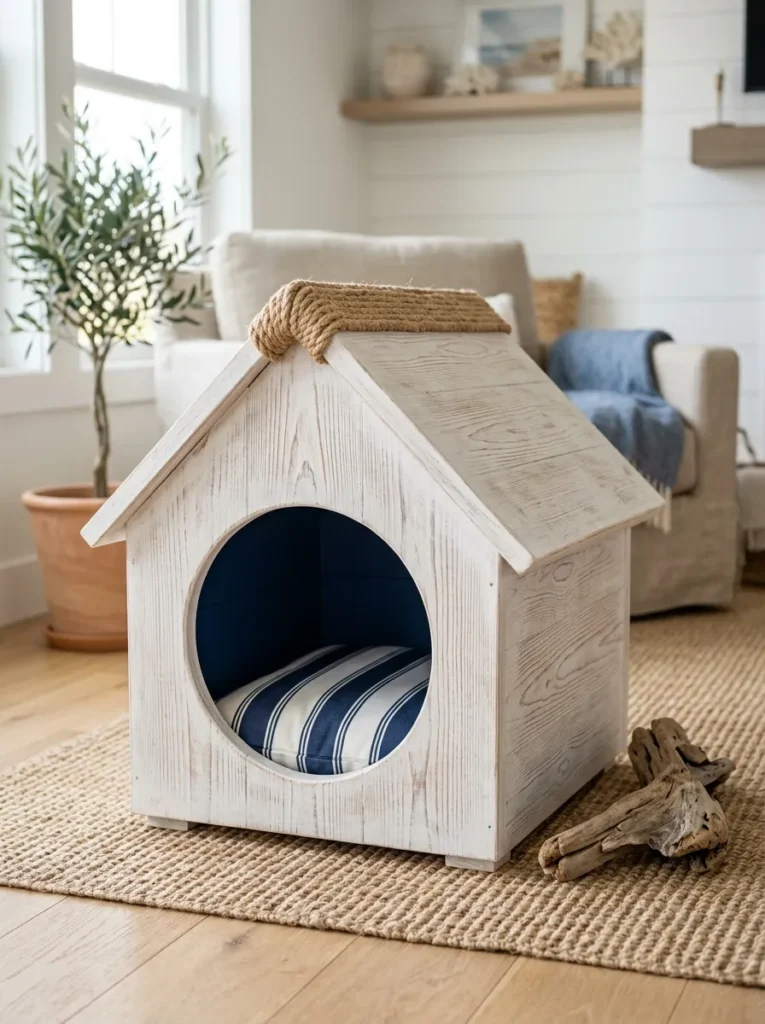
Vibe: The coastal beach house dog house feels warmly vacational — the dog furniture piece that makes any room feel like a beachside cottage regardless of its actual location.
Why it works: A whitewashed dog house in a traditional beach house form — gabled roof, circular entry, rope detail — is the coastal design interpretation that most completely captures the particular warmth of coastal living aesthetics while remaining a genuinely functional dog house. The whitewash technique (white paint diluted 1:1 with water and applied with a wide brush, then wiped back while wet to allow grain to show through) is specifically appropriate because it creates the sun-bleached, salt-washed quality of coastal timber architecture without opaque paint’s concealment of the wood’s natural character. The navy interior is the design decision that most signals the coastal aesthetic’s design sophistication — the navy-against-white contrast inside the dog house references the nautical color tradition with a restraint that prevents the piece from reading as novelty-themed.
How to get it: Build from pine board or cedar — both accept whitewash beautifully. Apply the whitewash by mixing one part white exterior paint with one part water and applying liberally with a wide brush across the grain direction, then immediately wiping with a cloth along the grain direction to remove the wash from the surface grain ridges while leaving it in the grain valleys. Allow to dry completely and repeat once more for a more opaque whitewash. Paint the interior with navy exterior paint in two coats. Attach a length of 12mm natural rope along the roof ridge using exterior adhesive as the ridge cap detail — the rope conceals the roof joint while adding the nautical textile element that completes the coastal material story.
Shop The Look
| Product |
|---|
| Pine board 18mm whitewash dog house |
| White exterior paint whitewash dilute |
| Navy blue exterior paint interior detail |
| Natural rope 12mm ridge cap detail |
| Navy stripe outdoor dog cushion coastal |
11. Minimalist Black Box Dog House (COLOR / SMALL SPACE)
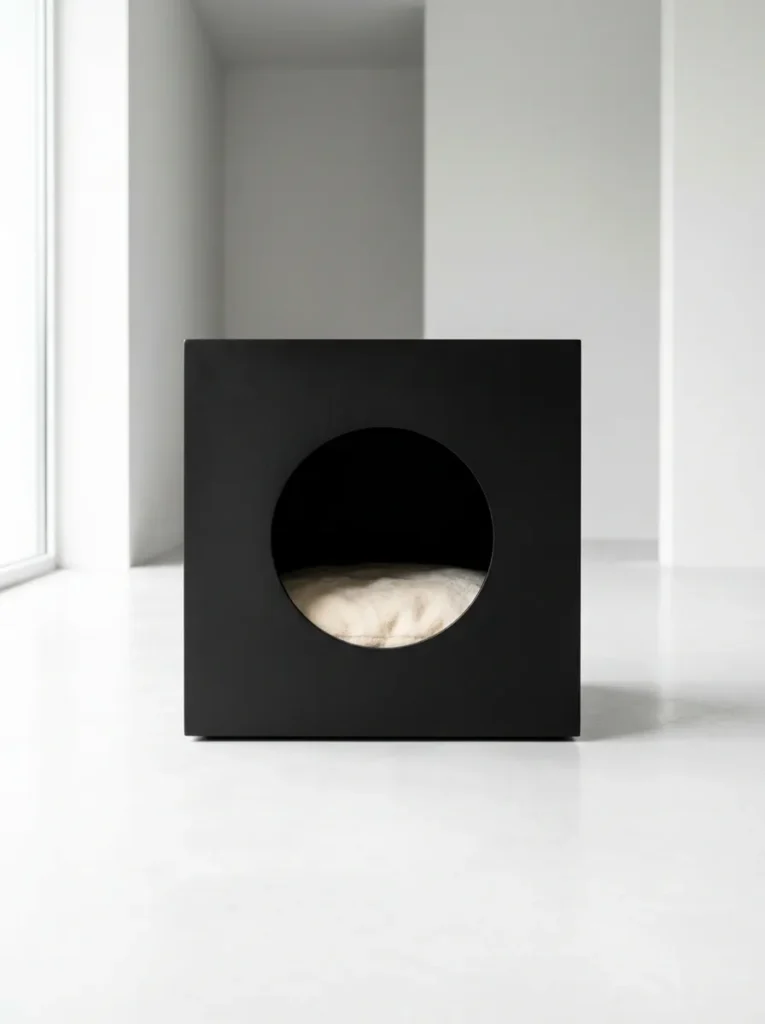
Vibe: The matte black box dog house feels dramatically sculptural — the dog house that a sculptor or architect would design for their own dog, refusing all decoration in favor of pure form.
Why it works: A matte black cube dog house with a single circular entry is the minimalist design that most powerfully demonstrates the principle that reduction to essential form creates more visual interest than elaboration — the perfect cube and the perfect circle are two of the most geometrically satisfying forms in design, and their combination creates an object of genuine visual authority through formal purity rather than material richness. The design principle is form as content: when all decoration is removed and the design reduces to the simplest possible geometric relationship (cube plus circle), the quality of that relationship becomes the entire design — the proportional relationship between the cube’s dimensions and the circle’s diameter, and the position of the circle on the cube face, are the only decisions that matter, and getting them right creates a piece of genuine design sophistication. The matte (rather than gloss) black finish is essential — gloss black would reflect light and introduce visual noise that undermines the form’s purity.
How to get it: Build from 18mm MDF with perfectly square all external dimensions — any variation from true square is immediately visible in a cube form and must be corrected in the cutting stage. Fill all corners with interior wood filler, sand smooth through 120–180–240 grit, then apply three coats of matte black exterior chalk paint for a perfectly smooth, non-reflective surface. The circular entry must be perfectly centered on the front face — measure from all four edges to confirm center position before cutting. Any visible joinery lines on the exterior should be filled with fine surface filler and sanded smooth before painting — the jointless black surface is the design’s defining quality.
Shop The Look
| Product |
|---|
| MDF sheet 18mm furniture grade perfect cut |
| Matte black chalk paint exterior finish |
| Fine surface filler smooth exterior joint |
| Ivory performance fabric dog cushion wash |
| MDF primer undercoat black coverage |
12. Rustic Log Cabin Outdoor Dog House (MATERIAL)
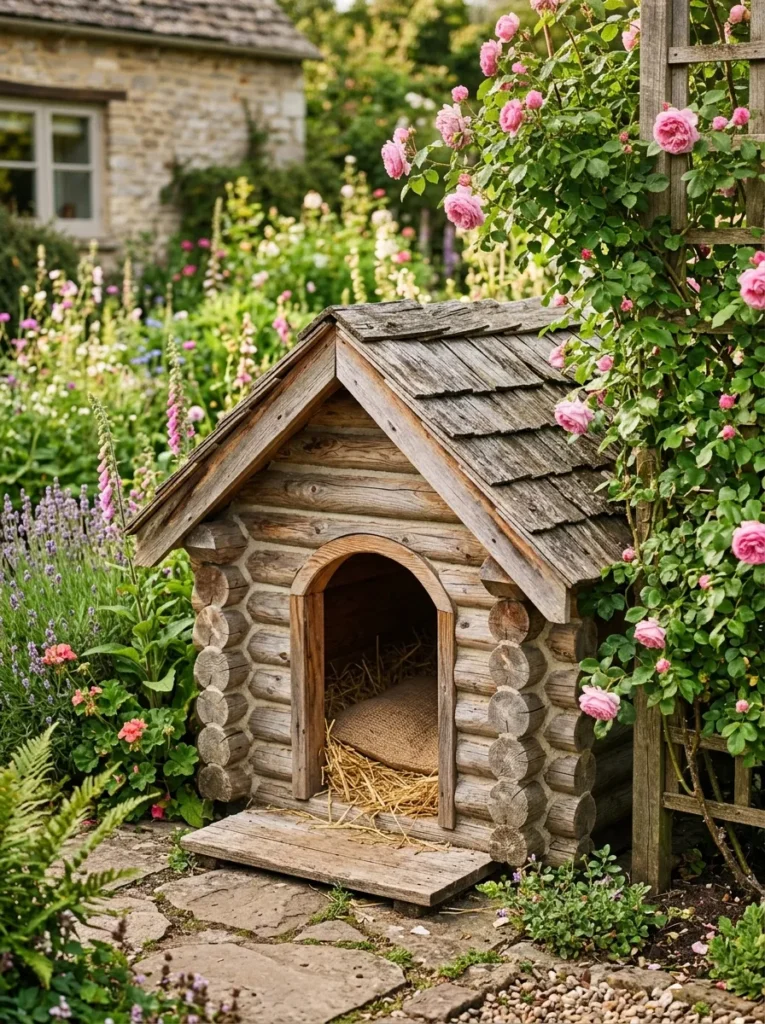
Vibe: The log cabin dog house feels warmly rustic and genuinely crafted — the garden structure that belongs in a cottage garden as naturally as a bird bath or herb bed.
Why it works: A log round wall dog house built from genuine small timber sections is the outdoor dog house design that most completely achieves material authenticity — the actual stacked log construction creates the visual and tactile quality of a genuine miniature cabin rather than a cabin-themed commercial product. The design principle is material genuineness: a dog house built from actual small log rounds stacked in the traditional log building technique produces a surface of natural variation, texture, and organic character that no manufactured or painted surface can approximate. The slightly varied diameter and natural color range of untreated log rounds creates the visual richness that defines the cottage and rural garden aesthetic at its most authentic.
How to get it: Source small-diameter log sections (50–80mm diameter) from a timber merchant, tree surgeon, or woodland supplier — ask for hazel, chestnut, or ash poles cut to 300mm lengths for the most appropriate scale and most natural rot resistance. Build an interior timber frame box from 45x45mm treated timber to serve as the structural substrate. Attach the log rounds to the exterior of the timber frame using exterior wood adhesive and 100mm screws through the log centers from inside the frame — stagger each layer for the authentic log construction appearance. Fill gaps between rounds with exterior clay-based lime mortar for weather resistance. Install cedar shake shingles (available from specialist suppliers) on the pitched roof over a waterproofing underlayer.
Shop The Look
| Product |
|---|
| Hazel pole round section 300mm natural |
| Cedar shake shingle pack natural roof |
| Exterior wood adhesive weatherproof outdoor |
| Natural lime mortar exterior weather fill |
| Cedar threshold plank entry natural |
13. Scandi Cabin Style Dog House with Porch (LAYOUT / ACCESSORIES)
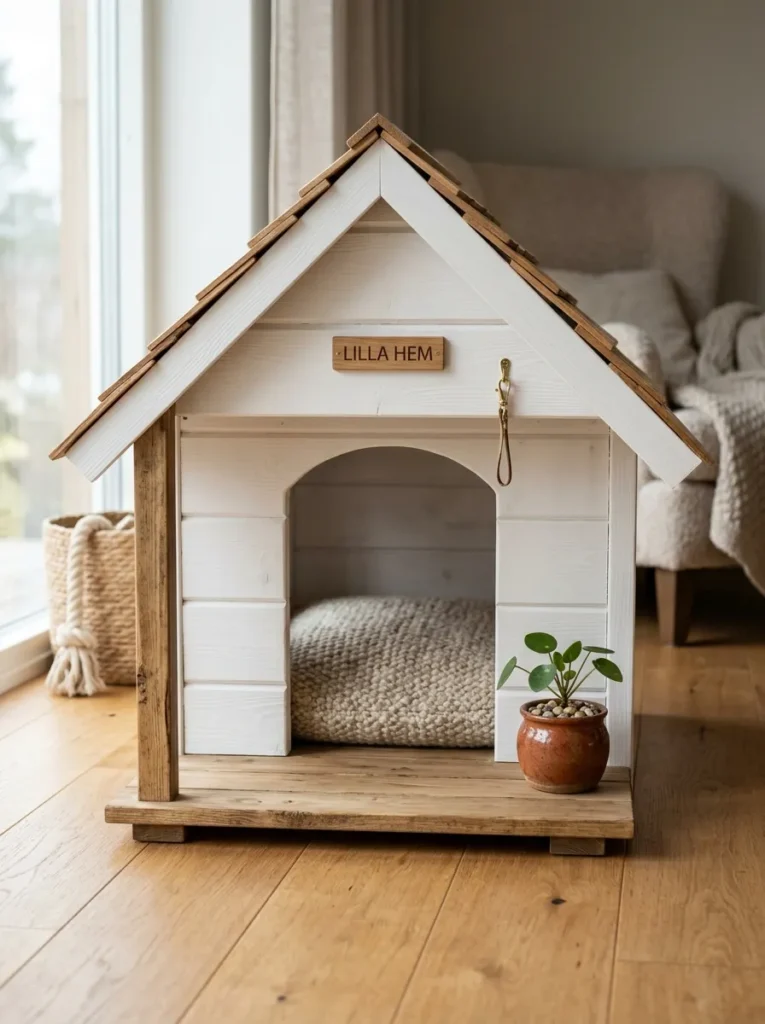
Vibe: The Scandi cabin dog house feels warmly miniature-architectural — the pet furniture piece that is so perfectly a miniature cabin that it makes adults want to move in.
Why it works: A Scandinavian cabin-style dog house with a small covered porch creates the most narratively complete miniature architecture of any design in this list — the porch element (a shallow covered extension of the main roof, creating a transitional space between inside and outside) is the architectural detail that most vividly suggests genuine habitation rather than mere shelter. The design principle is architectural narrative: the most visually engaging pet houses are those that tell a complete architectural story — entry zone, living space, roof shelter — rather than simply providing an enclosed space with an opening. The porch allows the dog to lie in a sheltered outdoor position watching the room without being fully inside or fully exposed, satisfying the behavioral preference for threshold positions that most dogs demonstrate.
How to get it: Build the main chamber from 18mm pine in the standard box construction with A-frame pitched roof. Extend the front face’s roof overhang by 150mm to create the porch roof — add two small 20mm square pine legs at the porch’s outer corners to support the extended roof section. Floor the porch area with 20mm thick pine decking strips running perpendicular to the entry for a classic porch floor aesthetic. Sand all surfaces to 180 grit and apply two coats of white exterior eggshell paint for a smooth, durable finish. The tiny ceramic plant pot at the porch edge is the design detail that most vividly suggests genuine habitation — choose a plant at the correct scale for the miniature architecture (a small succulent or tiny herb plant in a 6cm pot).
Shop The Look
| Product |
|---|
| Pine board 18mm white paint dog house |
| Pine decking strip 20mm porch floor |
| Small square pine leg 20mm porch support |
| White exterior eggshell paint smooth |
| Tiny ceramic plant pot 6cm succulent |
14. Fold-Flat Modern Travel Dog House (SMALL SPACE)
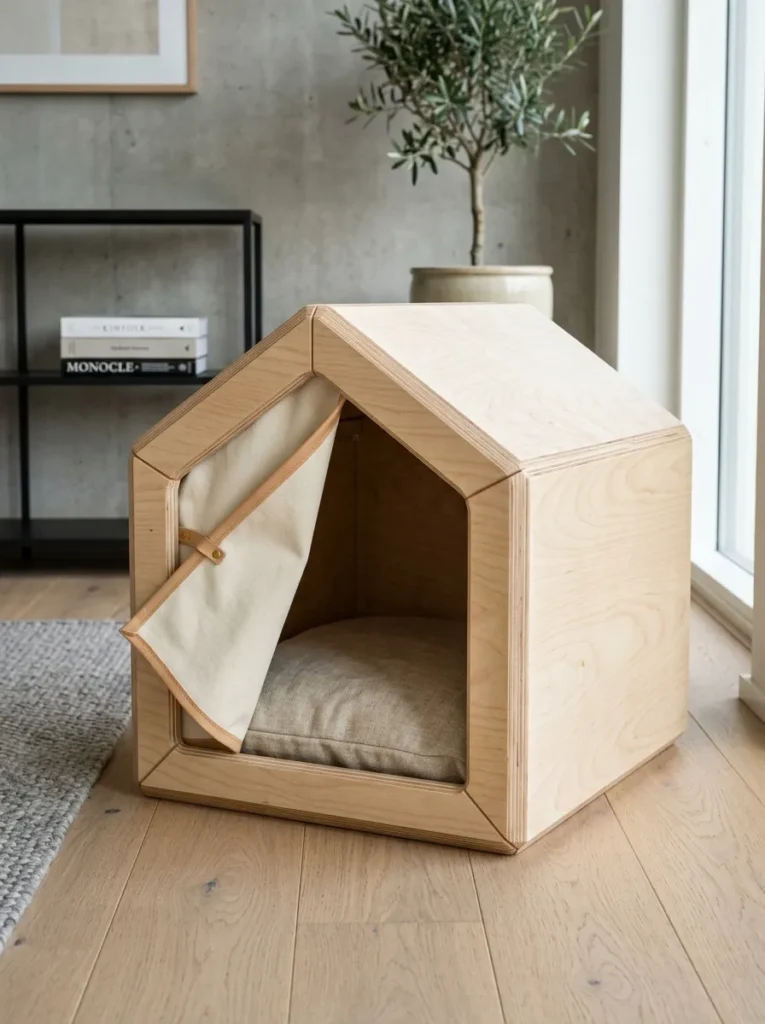
Vibe: The fold-flat dog house feels design-intelligently portable — the product that solves the travel dog house problem so elegantly that it makes the fixed alternatives seem overcommitted.
Why it works: A fold-flat modular dog house that assembles from five panels without tools is the dog house design that most directly addresses the practical reality of modern small dog ownership — the dog travels frequently with its owner, and commercial travel crates are either too industrial in appearance for hotel rooms and vacation rentals or too flimsy for genuine structural use. The design principle is intelligent portability: by designing the structure as a system of five panels that slot, clip, or magnetically connect at their edges, the maker creates a dog house that is genuinely furniture-quality when assembled and genuinely portable (5cm total stack thickness when disassembled) when not in use. The canvas entry panel — a heavy canvas rectangle attached at the top of the entry opening and weighted at the base — creates a flexible entry that collapses flat with the panels during transport.
How to get it: Cut the five panels (floor, two walls, front, and roof) from 12mm birch plywood with a CNC router or careful hand-cutting. Route a 45-degree chamfer on all panel edges that join other panels — the chamfer creates both the connection geometry and the distinctive aesthetic detail that reads as considered design. Connect panels using heavy-duty neodymium magnetic inserts pressed into routed pockets in the panel edges — the magnetic connections are strong enough for the structural requirements of a small dog house and allow tool-free assembly and disassembly. Attach the canvas entry panel using a piano hinge at the entry opening’s top edge.
Shop The Look
| Product |
|---|
| Birch plywood 12mm furniture grade natural |
| Neodymium magnetic insert set panel connect |
| Router chamfer bit 45 degree edge detail |
| Heavy canvas fabric natural entry panel |
| Piano hinge 300mm entry panel top attach |
15. Luxe Upholstered Indoor Dog House with Curtain (ACCESSORIES / COLOR)
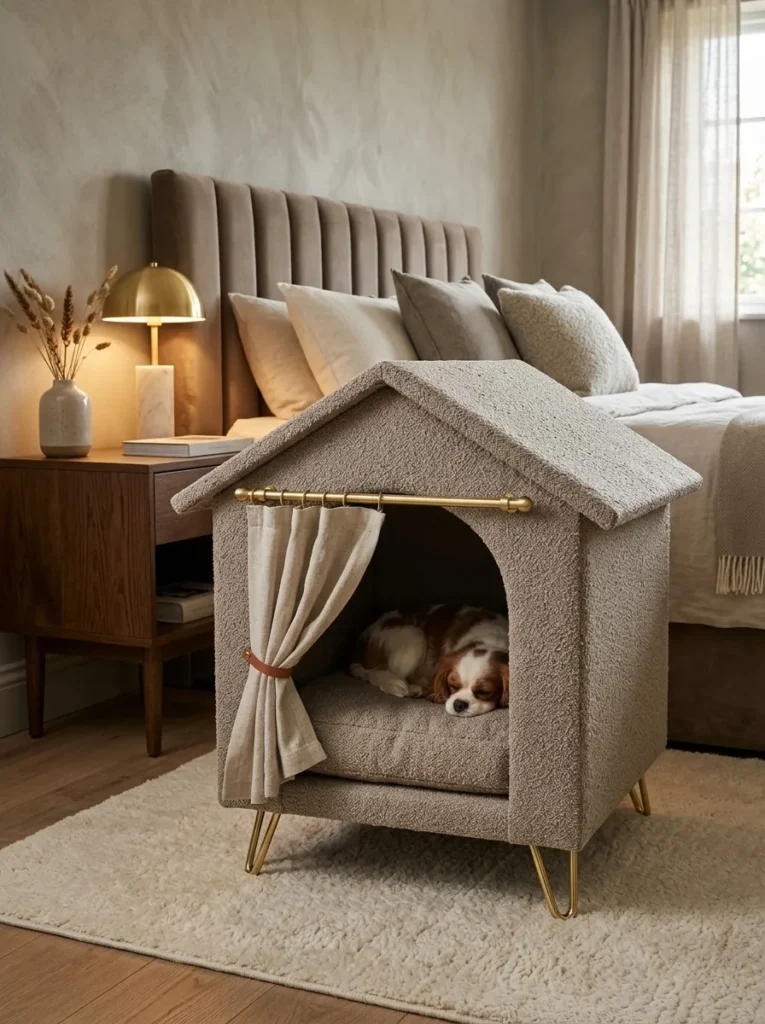
Vibe: The upholstered boucle dog house feels warmly indulgent — the dog house that belongs in a luxury interior as naturally and as deservedly as any human furniture of equivalent finish quality.
Why it works: A fully upholstered boucle dog house is the indoor dog house design that most completely dissolves the boundary between pet furniture and human furniture — because boucle upholstery applied to a dog house structure is the same material and technique used on human sofas, armchairs, and headboards, making the dog house read as an upholstered furniture piece rather than a dog product with fabric elements. The design principle is material parity: when the dog’s furniture is made from the same material as the human furniture in the same room, the dog house achieves complete aesthetic integration rather than merely tolerable visual compatibility. The linen curtain on a small brass rod at the entry opening is the detail that most reinforces the luxury interior reading — it references four-poster bed curtains and creates the sense of a specifically private, enclosed space for the dog within the larger room.
How to get it: Build the MDF substrate structure as for the geometric design (idea 2), with all corners rounded to a 5mm radius using a router — sharp corners create stress points in upholstery fabric that lead to premature wear. Cut the boucle upholstery fabric in panels sized to each exterior surface, allowing 75mm turnback on all edges. Apply fabric using a hot glue gun or upholstery staple gun at the turnback edges (concealed inside the structure) — work opposite edges alternately to maintain even fabric tension. Install a 10mm diameter brass curtain rod across the entry opening using small brass cup hooks screwed into each side panel, and hang a linen curtain panel trimmed to the entry dimensions.
Shop The Look
| Product |
|---|
| Greige boucle upholstery fabric by metre |
| Upholstery staple gun 8mm staples fabric |
| Small brass curtain rod 30cm entry detail |
| Natural linen curtain panel entry door |
| Thick orthopedic dog mattress luxury indoor |
How to Start Your Modern Small Dog House Project
Your single best first move is to measure your dog with genuine accuracy before designing or purchasing any dog house — not an estimate or a remembered approximation, but actual measurements taken while the dog is in its natural resting position. Record the dog’s shoulder height (from floor to top of shoulder), body length (from chest to tail base), and preferred curled sleeping diameter (the diameter of the circle the dog forms when sleeping in its natural curled position). These three measurements define the minimum internal dimensions of any dog house that will genuinely be used: internal height must be at least 1.3 times shoulder height, internal depth must be at least 1.5 times body length, and for dogs that sleep curled, the internal footprint must accommodate the curled diameter comfortably. A dog house built to these measurements will be used; a house built to visual proportion assumptions may be too small to be genuinely comfortable.
The most common mistake in modern dog house design and purchase is prioritizing the house’s appearance from the human viewing angle without adequately considering the dog’s experience from the inside. A dog house can be visually perfect from a room-design perspective but behaviorally inappropriate for the specific dog — too bright inside (some dogs prefer darker dens), too open (some dogs need a more fully enclosed space than an unobstructed entry opening provides), too elevated (some older or shorter-legged breeds struggle with raised dog houses), or too confined (some dogs with anxiety prefer a house with a view of the room rather than full enclosure). Fix this by observing your dog’s existing resting preferences — the places it chooses voluntarily when not directed — and designing the dog house to replicate the specific spatial qualities of those preferred resting positions.
Three specific items under $50 that immediately improve any dog house regardless of its design: a removable orthopedic dog mattress with a machine-washable cover ($18–$35) that adds genuine comfort and maintains hygiene through regular washing; a natural sisal or jute door mat placed at the entry threshold ($8–$15) that catches paw debris on entry and gives the dog a tactile signal of its territory’s boundary; and a small battery-operated warm LED light (2700K) placed inside the dog house ($6–$12) that makes the interior visible and welcoming from the human perspective while providing a subtle ambient warmth that most dogs find comforting in an otherwise dark interior.
A DIY MDF painted dog house takes one full day to build and costs $40–$80 in materials. A solid oak or cedar dog house takes a weekend and costs $120–$250 in materials depending on timber quality and size. A fully upholstered or professionally finished luxury indoor dog house costs $80–$200 in materials for a confident DIY builder, or $300–$800 purchased from specialist pet furniture makers. The most complex outdoor designs (living roof, log cabin walls, industrial pipe frame) take 2–3 weekends and cost $150–$400 in materials — producing an outdoor dog house of quality that adds genuine visual value to the garden as well as practical shelter quality for the dog.
Frequently Asked Questions About Modern Small Dog Houses
What size dog house does a small breed dog need?
The minimum internal dimensions for a comfortable small dog house depend on the specific breed and individual dog’s size and sleeping preference. As a general guide for common small breeds: for a dog up to 5kg (Chihuahua, Yorkshire Terrier, Toy Poodle), a minimum internal footprint of 40x35cm and internal height of 35cm is appropriate. For 5–10kg dogs (French Bulldog, Cavalier, Miniature Schnauzer, Dachshund), a minimum footprint of 55x45cm and internal height of 45cm is required. For dogs that sleep stretched rather than curled, add 20% to the depth dimension to accommodate the extended body comfortably. The entry opening should be sized to allow the dog to enter without ducking — approximately 75–80% of the dog’s shoulder height as the opening’s height, and 70–75% of the dog’s shoulder width as the opening’s width. Avoid oversizing a dog house significantly beyond these minimums — most dogs prefer a den that feels close and secure rather than spacious and exposed.
What materials are safe for a dog house interior?
The interior surfaces of a dog house must be free from toxic finishes, sharp edges or protrusions, and materials that deteriorate rapidly into potentially ingestible fragments. Safe interior finish options include: unfinished sanded timber (the safest option — no chemical finish, smooth surface, naturally antibacterial in cedar); water-based paint sealed with a water-based varnish after full curing (allow minimum 7 days after final coat before introducing the dog); hard-wax oil finishes (food-safe after curing, appropriate for timber interiors); and plain white interior latex paint fully cured. Unsafe interior options include: solvent-based paints and varnishes (off-gas for extended periods); lead-containing paints (older commercial pet products may contain lead — any vintage purchased dog house should have its paint tested before use); and sharp metal edges, staples, or exposed screw heads that could injure the dog during entry or resting.
Can a modern dog house be used both indoors and outdoors?
Most of the designs in this list are specifically designed for one environment — the solid oak, walnut veneer, boucle upholstered, and fold-flat designs are primarily indoor pieces unsuitable for exposure to rain and UV without rapid deterioration; while the cedar green roof, industrial pipe frame, log cabin, and corrugated steel designs are outdoor-specific structures. A genuinely dual-use dog house — appropriate for both indoor and outdoor placement — requires a construction from materials appropriate to both contexts: pressure-treated or naturally durable timber (cedar, larch) for the structure, a fully weatherproof exterior finish (exterior oil or paint), and interior bedding that is removable and washable. If dual use is the requirement, the cedar/pine painted designs with exterior-grade paint (ideas 6 and 10) are the most appropriate starting points, with interior bedding always stored indoors when the dog house is outdoors.
How do I introduce a dog to its new house?
Most dogs — particularly those that have not previously used a dog house — require a gradual introduction rather than an immediate expectation that the new structure will be used as a sleeping space. Place the dog house in the dog’s preferred existing resting area and leave it without expectation for the first week — allow the dog to investigate, sniff, and approach the house at its own pace. Feed the dog treats placed at the entry and eventually inside the house to create a positive association with the new structure. Place a worn piece of the owner’s clothing inside the dog house — familiar scent is the most effective inducement for a dog to voluntarily enter and rest in a new enclosed space. Never force or place the dog inside the house — this creates a negative association with the enclosed space that can persist. Most dogs that are given a patient, treats-based introduction to a correctly sized, appropriately positioned dog house will begin using it voluntarily within 1–3 weeks.
How do I keep a modern dog house clean?
The most practical maintenance routine for a modern dog house combines daily spot cleaning with weekly deep cleaning of the bedding and monthly cleaning of the structure itself. Remove and machine-wash the dog cushion or mattress cover weekly at 60°C minimum — this temperature kills the dust mites and bacteria that accumulate in pet bedding regardless of visible soiling. Clean the house interior monthly using a pet-safe disinfectant spray, wiping all surfaces and allowing to dry completely in fresh air before returning the bedding. For painted or varnished surfaces, use a slightly damp cloth with a drop of pet-safe dish soap rather than chemical cleaners that may damage the finish. Cedar houses benefit from their timber’s natural antimicrobial properties — cedar oil inhibits bacterial and mold growth within the wood, making the interior naturally self-cleaning to a degree that other timbers cannot match.
Ready to Create Your Dream Modern Small Dog House?
These 15 designs span the full range of modern small dog house possibility — from the meditative warmth of the solid oak Japandi piece and the dramatic purity of the matte black cube, through the botanical garden integration of the cedar green roof and the architectural rusticity of the log cabin, to the luxurious indulgence of the boucle upholstered interior and the intelligent portability of the fold-flat travel design, the coastal warmth of the whitewash beach house and the industrial authority of the Corten pipe frame — covering every aesthetic from Japandi to industrial, every material from solid oak to living sedum, every budget from an afternoon’s MDF build to a weekend’s cedar construction, and every use context from a luxury bedroom to a cottage garden. Begin with the measurement — your dog’s actual shoulder height, body length, and preferred sleeping position — because every other decision in modern small dog house design follows from those three numbers rather than from aesthetic preference. Today’s specific action: measure your dog, choose the design from this list that most directly suits both your dog’s behavioral preferences and your home’s aesthetic context, and source or plan the materials for the one detail that most defines that design’s quality — the circular entry for the Japandi oak piece, the concrete microtopping for the industrial den, the sedum plug plants for the green roof design. When your dog settles into its new house for the first time — choosing it voluntarily, curling into the correctly sized interior with the particular satisfaction of an animal whose spatial needs have been genuinely understood — you will understand exactly why modern small dog house design earns its devoted, growing community and the permanent place it holds at the top of every design-conscious pet owner’s home improvement list. Save your favorites now, especially the Japandi oak design and the cedar green roof — they are the two designs that, once built or purchased and positioned in the right room or garden, make every other element of the pet-home aesthetic feel like it is finally in the right company.