A rabbit room is a dedicated living space — a full room, a large room section, or a purpose-converted space — designed specifically for indoor rabbits with the intelligence, material quality, and organizational sophistication that allows rabbits to live as genuinely free-roaming house animals while keeping their environment safe, enrichment-rich, hygienic, and visually integrated into the human home. This article gives you 15 rabbit room design ideas across flooring, enclosure systems, hay and litter management, enrichment infrastructure, storage organization, feeding stations, aesthetic integration, and multi-rabbit configurations so every element of your rabbit room serves both the rabbits’ welfare and the design quality of your home.
A rabbit room that works well is not a room with a cage in it. It is a thoughtfully designed space where the rabbits’ behavioral needs — for burrowing, digging, foraging, jumping, hiding, running, and social interaction — are met through deliberate spatial and material design, and where the human management tasks of litter cleaning, hay provision, feeding, health monitoring, and enrichment rotation are made as efficient and as pleasant as the daily care of a genuinely loved companion animal should be. Here are 15 ideas worth saving — and designing.
Why Dedicated Rabbit Room Design Matters for Welfare and Livability
Rabbit room design draws from the convergence of exotic animal welfare science, interior design, and the practical experience of rabbit-savvy owners who have spent years developing the spatial and material intelligence that makes a rabbit-dedicated space genuinely functional. The welfare case for a purpose-designed rabbit space is both ethically compelling and practically important — rabbits are the third most common companion animal in many Western countries but also among the most commonly surrendered to shelters, with inadequate housing and enrichment being consistently identified as primary factors in behavioral problems that lead to surrender. A rabbit room designed with genuine welfare intelligence — providing space for speed runs, vertical enrichment, foraging opportunities, and genuine burrowing substrate — produces significantly better behavioral outcomes than conventional small-cage housing.
The physical requirements of a well-designed rabbit environment are specific and more demanding than most people realize when they acquire their first rabbit. A single standard-sized rabbit (New Zealand, Rex, Dutch, or similar mid-sized breeds) requires a minimum of 32 square feet of exercise space daily, with 8 hours minimum of free roaming time outside any enclosure. Two rabbits (which is the recommended minimum for rabbit welfare, as rabbits are a highly social species) require proportionally more space. These welfare requirements make the dedicated rabbit room — where all space within the room is rabbit-accessible — the most welfare-appropriate housing approach available for indoor rabbits, and the most practical for managing the rabbits’ genuine space requirements within a human home.
The design traditions most relevant to rabbit room creation are found not in pet industry product design (which has historically prioritized small, contained, commercially convenient housing) but in the growing rabbit welfare and rabbit-keeping communities that have developed the material and spatial vocabulary of the genuinely rabbit-appropriate indoor environment: the C&C (Cubes and Coroplast) grid panel enclosure systems that allow modular, customizable rabbit spaces; the hay feeder designs that address rabbits’ need for constant hay access while minimizing the hay scatter that is the primary housekeeping challenge of rabbit ownership; the tunneling and burrowing enrichment structures that allow natural behavior in an indoor environment; and the digging boxes that provide the substrate and behavioral outlet that rabbits seek.
Design at a Glance
| Element | Detail |
|---|---|
| Philosophy | Rabbit behavioral needs and human management efficiency as co-equal design priorities |
| Key Systems | Flooring protection, hay management, litter infrastructure, enrichment rotation, storage |
| Welfare Standard | Minimum 32 sq ft exercise space per rabbit, 8+ hours free roaming daily |
| Key Challenge | Hay scatter, litter hygiene, cable protection, chew-proofing all room elements |
15 Rabbit Room Designs with Smart Storage
1. Full Free-Roam Room with Modular C&C Enclosure Base
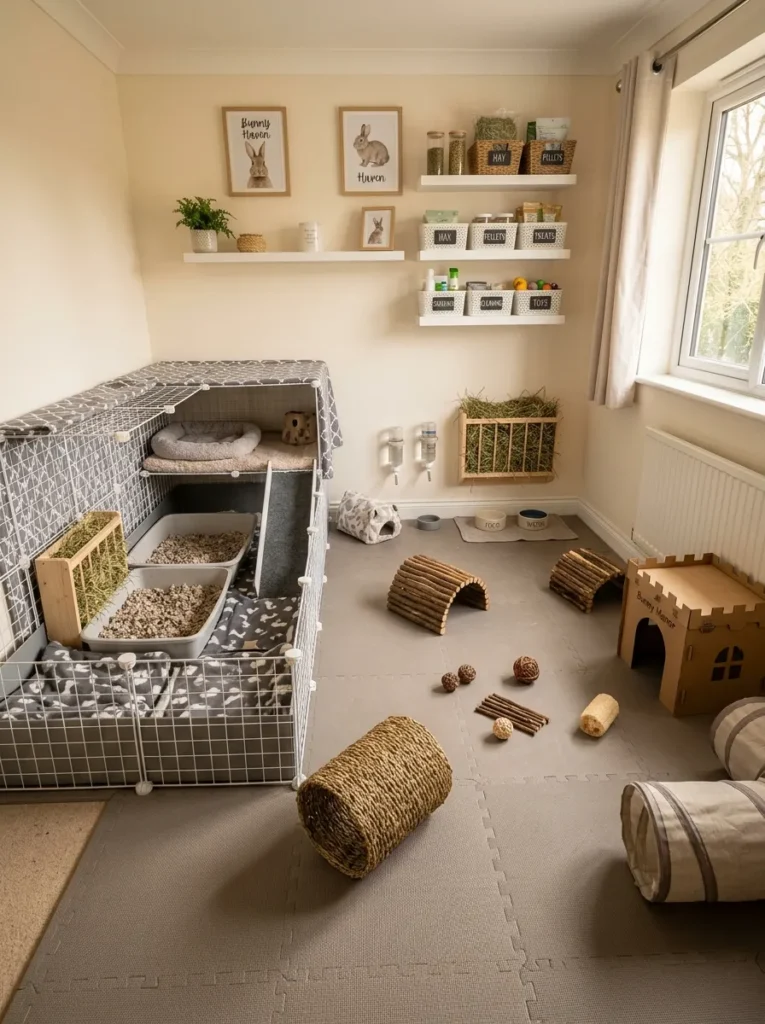
Vibe: The room is organized — a full free-roam rabbit room with a C&C enclosure serving as the sleeping and litter base zone within a fully rabbit-accessible room creates the most welfare-appropriate indoor rabbit environment available, where the rabbits have genuine free-roaming access to an entire room’s space while still having a defined home base for sleeping and litter.
Why it works: The C&C (Cubes and Coroplast) grid panel system is the rabbit welfare community’s most widely adopted enclosure format because it provides infinitely modular, customizable, and expandable rabbit housing at significantly lower cost and significantly greater flexibility than commercial cage systems. A 4×4 grid configuration (approximately 56×56 inches floor area) in one corner of the room provides the rabbit’s sleeping zone, litter area, and hay station as a defined home base, while the remainder of the room — protected by chew-proofing and covered with rabbit-safe flooring — extends the total living space to the full room area. The foam tile interlocking floor ($1–$2 per 2-foot square tile) provides the traction that rabbits need on hard floors (bare hardwood and tile are significant joint health risks for rabbits, who cannot stop safely on slippery surfaces) while protecting the room’s permanent floor from soiling and scratching.
How to get it: C&C grid panels ($40–$80 for a 23-pack covering a 4×4 configuration) are available from specialty pet retailers and Amazon. Coroplast sheeting ($15–$30 for a 4×8-foot sheet) creates the waterproof base tray. Interlocking foam tiles ($30–$60 for a full room of 120 square feet) provide the floor covering. Chew-proof the room’s baseboards and any exposed cable runs before allowing full free-roam access — cable management conduit ($8–$15 per pack) and cable cover raceways ($10–$20 per strip) are essential for any room with electronics.
Quick Win: A single roll of self-adhesive vinyl floor covering ($15–$25 for a 10-foot roll) applied over the room’s existing hard floor provides the traction surface that allows safe rabbit free-roaming without any permanent floor modification.
Shop The Look
- C&C grid panel set rabbit enclosure
- Coroplast sheet rabbit tray base
- Interlocking foam tile grey set
- Cable management conduit chew proof
- Modular enclosure connector set
Also view: 13 Cat Window Enclosure Designs That Look Amazing
2. Built-In Hay Station with Integrated Litter Zone
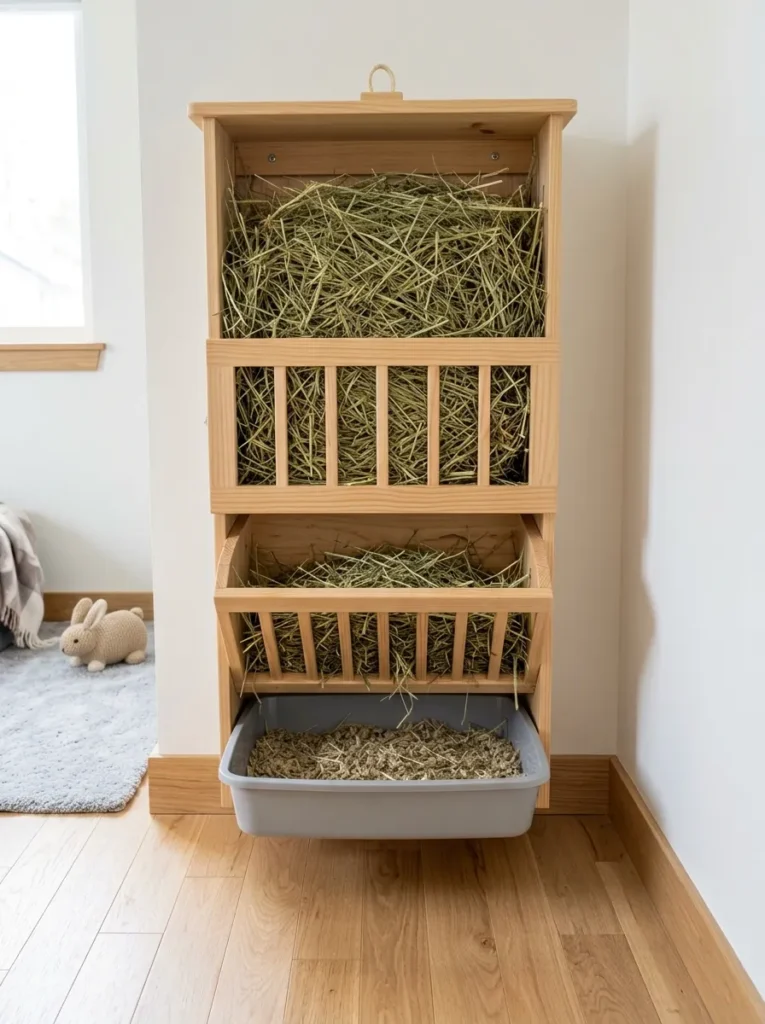
Vibe: The station is intelligent — a hay station that integrates hay storage, hay access, and a litter box in a single wall-mounted unit exploits rabbits’ natural cecotrophy behavior (eating hay while eliminating) to create the most hygienic and most hay-efficient feeding and litter system available.
Why it works: The integration of the hay access point directly above the litter box is the single most important design insight in rabbit room hygiene management — rabbits naturally eat hay and eliminate simultaneously, meaning that hay placed directly above a litter box results in dramatically less hay scatter throughout the room (the rabbit stays in the litter box eating hay rather than carrying hay to other locations) and dramatically more consistent litter box use (the comfortable hay-eating position in the litter box reinforces litter training). Most rabbit owners discover this behavioral reality through experience and then position a hay rack directly above the litter box; a purpose-built integrated unit formalizes this arrangement into a clean, contained, wall-mounted infrastructure element. The hay storage compartment above the access opening (holding a full week’s supply for one or two rabbits) eliminates the daily hay provision task in favor of a weekly hay restocking routine.
How to get it: Build the integrated unit from 3/4-inch plywood or MDF painted in a semi-gloss white for easy cleaning. The hay storage compartment should hold at least 1–2 pounds of hay per rabbit (approximately 4–6 liters volume per rabbit per week). The hay access opening should be sized to allow the rabbit to reach in and pull hay freely — approximately 8×10 inches for most breeds. A slanted drip-edge ($5–$10 in lumber and hardware) at the base of the opening directs falling hay into the litter box below. Position the litter box on a slide-out tray for easy cleaning access.
Shop The Look
- Large rabbit litter box corner style
- Timothy hay bale compressed bulk
- Plywood sheet 3/4 inch white paint
- Slide out drawer track rail set
- Hay manger hay feeder rabbit
3. Digging Box and Burrowing Zone for Natural Behavior
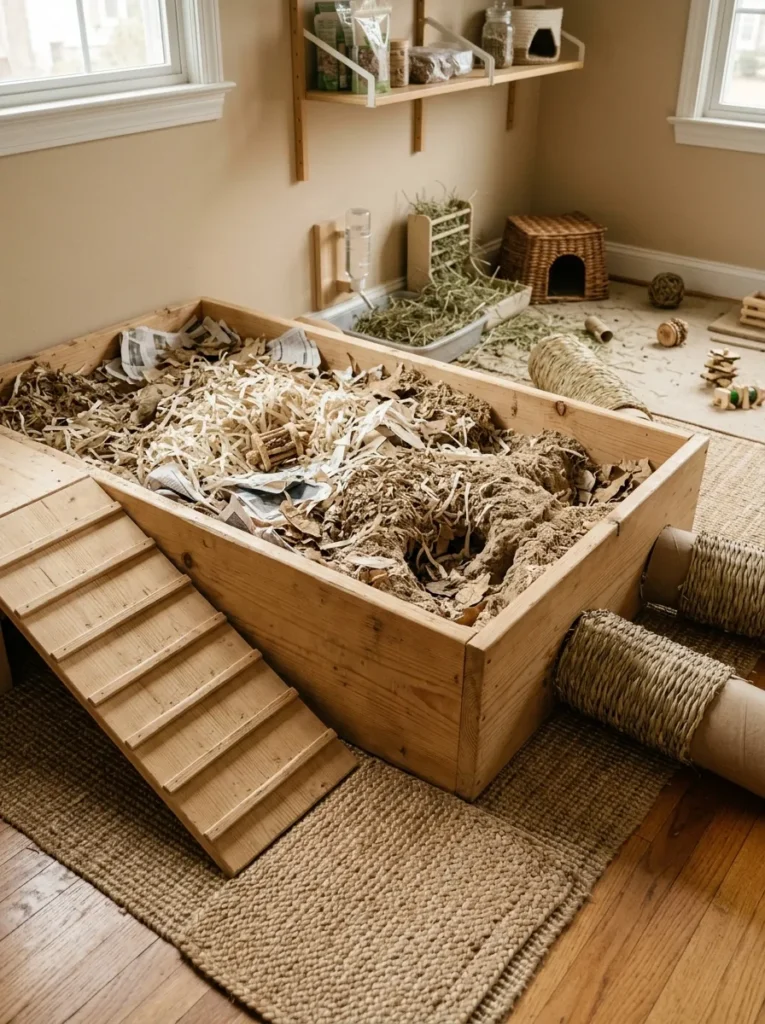
Vibe: The box is natural — a large digging box filled with safe substrate and connected to tunnel infrastructure provides the single most important behavioral enrichment available for indoor rabbits, allowing the full expression of the digging and burrowing behavior that is among the strongest and most persistent drives in the rabbit behavioral repertoire.
Why it works: Digging and burrowing are not optional enrichment activities for rabbits — they are hardwired behavioral needs that, when denied expression in the indoor environment, redirect into carpet destruction, furniture chewing, and persistent scratching at floors and walls. A rabbit that has access to an adequate digging box in its room is dramatically less likely to engage in destructive digging behavior elsewhere in the home because the behavioral drive is satisfied at the designated digging location. The digging box’s size matters significantly — a box of at least 4 feet in length allows the rabbit to fully extend and dig with the rotary motion that natural burrowing requires, while a small litter box substituted as a digging box provides insufficient space for satisfying digging behavior. The substrate depth (at least 8–12 inches) allows the rabbit to dig down rather than merely paddling at a shallow surface.
How to get it: Build the digging box from untreated 1×12-inch pine lumber ($20–$35 in materials for a 4×2-foot box) assembled with wood screws. Line the interior with a heavy plastic tray or pond liner to contain substrate moisture and facilitate cleaning. Fill with a rabbit-safe substrate: shredded plain paper (the most hygienic option), chemical-free topsoil (for the most naturalistic digging experience), or kiln-dried silver sand (the most play-appropriate option for a clean room). Build a gentle entry ramp (a 12-inch-wide board at 30-degree incline) for easy access. Connect to tunnel infrastructure ($15–$30 for fabric rabbit tunnels) leading from the box into the main room.
Shop The Look
- Rabbit fabric tunnel set connectable
- Kiln dried silver sand rabbit digging
- Plain shredded paper substrate bale
- Pine lumber untreated 1×12 box build
- Pond liner heavy plastic tray
4. Multi-Level Ramp and Platform System
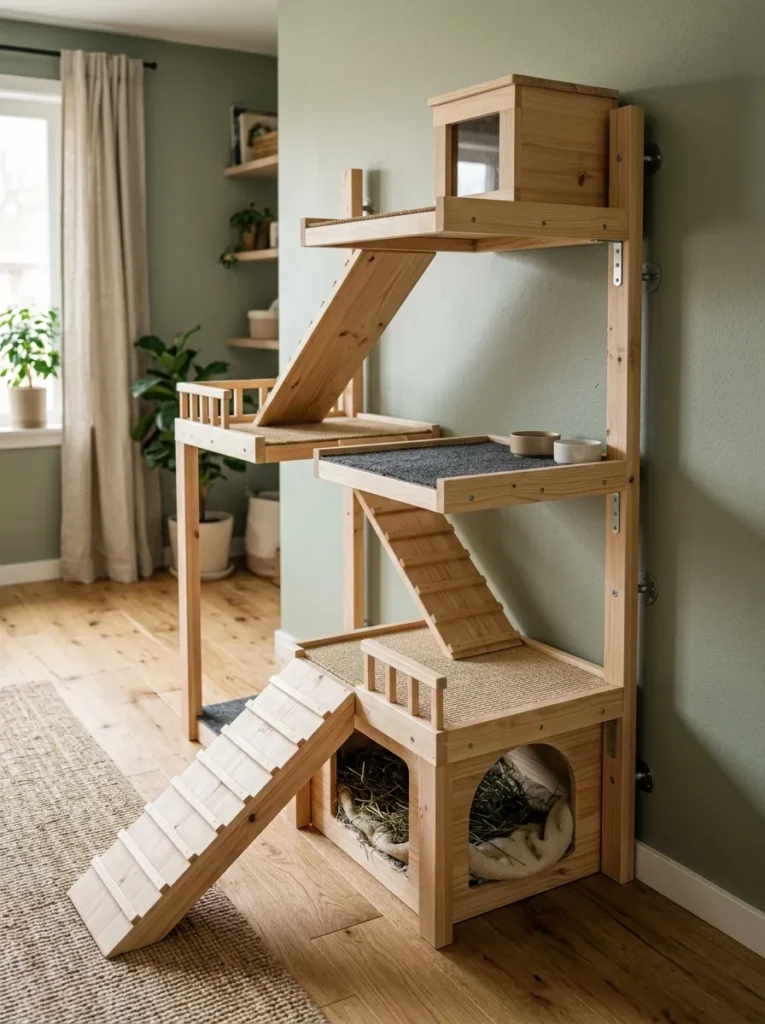
Vibe: The system is enriching — a multi-level ramp and platform system that allows rabbits to reach elevated positions provides the vertical dimension of enrichment that is critical for rabbit psychological wellbeing, where the ability to survey the room from elevation addresses the prey animal’s security instinct.
Why it works: Rabbits are not naturally flat-ground animals — in their natural environment, they use elevated terrain features (molehills, root systems, low banks) to survey their surroundings for predator threats and to assert social hierarchy within a warren group. Indoor rabbits denied vertical enrichment experience a persistent low-level spatial frustration that flat-floor-only environments create, and they frequently attempt to reach elevated positions (sofas, chairs, bed surfaces) by jumping rather than through provided ramps. A multi-level platform system that provides genuine elevated access — with stable footing, gentle gradient ramps, and platform space large enough for the rabbit to groom and rest at height — satisfies this vertical enrichment need and reduces the unauthorized furniture-climbing behavior that flat-room environments inevitably produce. The ramp gradient is critical for safety: any angle steeper than 40 degrees creates a fall risk for rabbits, whose hindquarters are significantly more powerful than their forelimbs and who can easily propel themselves off steep ramps.
How to get it: Build platforms from 3/4-inch plywood (minimum 24×24 inches per platform, larger for bigger breeds) mounted on adjustable shelf brackets anchored firmly into wall studs. Cover each platform with carpet tiles ($1–$3 per tile) or sisal mat ($8–$15 per roll) cut to fit — the textured surface prevents the paw slipping that smooth wood causes. Build ramps from 1×10-inch pine with 3/4-inch wood dowel cross-slats ($0.25–$0.50 each) glued at 2-inch intervals across the ramp width. Anchor the entire system to the wall with L-brackets at each platform level.
Shop The Look
- Carpet tile self adhesive rabbit platform
- Wood dowel cross slat ramp rabbit
- Adjustable shelf bracket wall mount
- Sisal mat roll natural rabbit surface
- L bracket wall anchor heavy duty
5. Smart Hay Storage System with Minimal Scatter
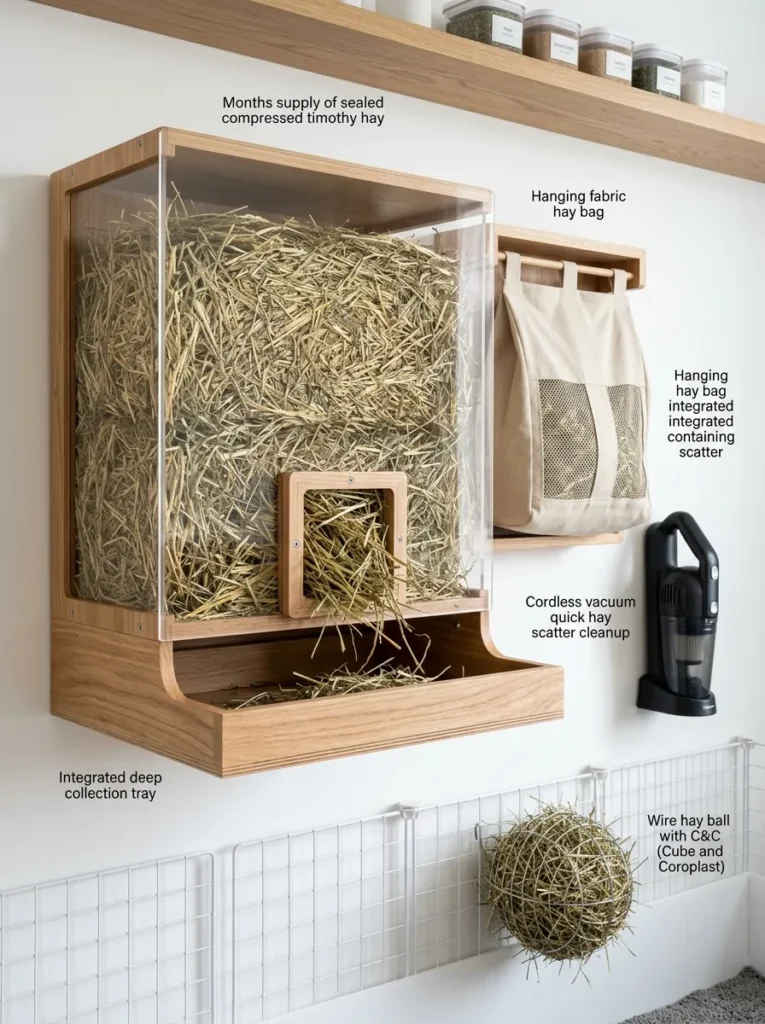
Vibe: The system is systematic — a complete hay management wall zone that addresses bulk storage, access, scatter containment, and cleanup infrastructure simultaneously creates the most operationally efficient hay management system for indoor rabbit keeping — the single most labor-intensive daily maintenance task resolved into a designed workflow.
Why it works: Hay scatter is consistently identified by rabbit owners as the most challenging daily maintenance issue in indoor rabbit keeping — a rabbit must eat its body size in hay daily (hay constitutes 80% of the rabbit diet), and the natural way rabbits access hay (pulling, sorting, and rejecting stems they do not want) inevitably scatters hay throughout the immediate environment. No single hay delivery method eliminates scatter entirely, but a systematic approach using different hay delivery methods (bulk storage to reduce provision frequency, mesh-sided hay bags to contain scatter better than open racks, hay positioned over litter boxes to catch falling hay in a contained zone) can reduce scatter to a manageable level. A wall-mounted small vacuum or dustbuster ($25–$60) provides the instant scatter cleanup tool that daily hay management requires.
How to get it: The most effective hay scatter reduction system combines three elements: a hay bag with mesh panels ($10–$20 from specialty rabbit supply retailers or DIY from canvas and mesh fabric) that allows hay access through the mesh while the solid sides contain scatter; positioning the hay bag directly over the litter box so falling hay lands in the litter rather than on the floor; and a bulk hay storage container ($20–$60 for a sealed storage bin of sufficient size) that holds a week or more of hay, reducing the daily provision frequency. A handheld vacuum mounted on a wall hook beside the hay station ($25–$60 for a quality handheld unit) provides the instant cleanup capability that any hay management system requires.
Shop The Look
- Mesh hay bag rabbit scatter reduce
- Bulk hay storage bin sealed large
- Handheld vacuum wall mount hook
- Hay feeder rack inside enclosure
- Compressed timothy hay bale bulk
6. Rabbit Room with Coordinated Aesthetic Integration
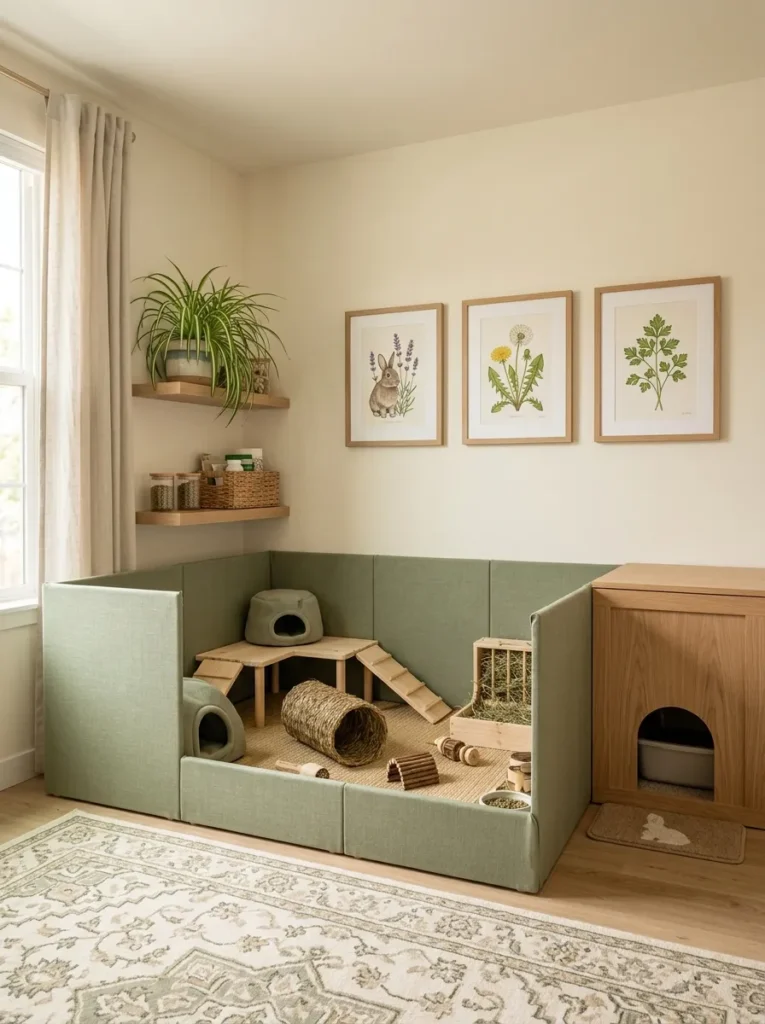
Vibe: The room is designed — a rabbit room that has been aesthetically integrated with fabric-covered enclosure panels, concealed litter infrastructure, coordinated enrichment, and botanical wall art creates a space that is simultaneously a genuinely welfare-appropriate rabbit environment and a room that a design-conscious owner is genuinely happy to have as part of their home.
Why it works: The aesthetic integration of a rabbit room — making it genuinely beautiful to be in rather than merely functional for the rabbits — is not a luxury consideration but a welfare one, because rabbit owners who find their rabbit room visually pleasant spend more time in it, interact more with their rabbits, notice behavioral and health changes more quickly, and are more motivated to maintain the room’s organization and cleanliness. The specific aesthetic decisions that most effectively integrate a rabbit room into a designed home are fabric panel covers for the C&C grid (which eliminates the raw grid appearance that reads as cage infrastructure) and wood frame concealment for the litter box (which eliminates the most visually challenging element of the rabbit room). Both interventions are simple and inexpensive ($10–$40 in materials) and have a dramatic visual impact on the room’s overall aesthetic quality.
How to get it: Sew or purchase fabric panel covers for the C&C grid panels in a coordinated color ($10–$20 per yard of fabric, with approximately 1 yard covering four standard grid panels). Build a simple wood frame litter box enclosure from 1/2-inch plywood with a cutout entry door ($20–$40 in materials) painted to match the room’s existing furniture. Source rabbit-safe plants (spider plant, boston fern, herbs including basil and parsley, and wheatgrass are all rabbit-safe and available from garden centers) for the supply shelf ceramic pot. Frame rabbit botanical illustrations or nature prints in simple matching frames for the wall art.
Shop The Look
- C&C panel fabric cover set sage
- Wood frame litter box concealment
- Rabbit safe plant spider fern herb
- Rabbit botanical print wall art
- Simple frame set natural wood
7. Chew-Proof Cable Management System
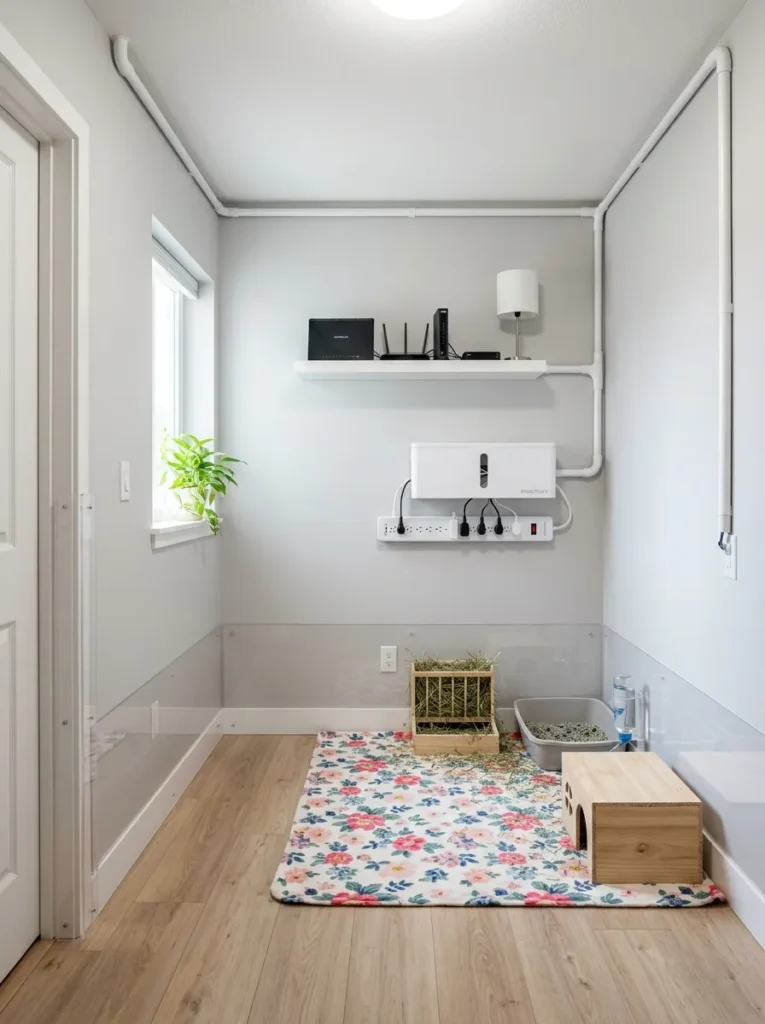
Vibe: The room is safe — a comprehensive chew-proof cable and baseboard management system that eliminates all rabbit-accessible electrical hazards is the rabbit room’s most critical safety infrastructure — the system that prevents the electrical burns and electrocution risk that make cable accessibility the most serious physical danger in any indoor rabbit environment.
Why it works: Cable chewing is among the most dangerous rabbit behaviors in an indoor environment — rabbits chew cables not from destructive intent but from the same exploratory chewing behavior they apply to all objects in their environment, and a rabbit that bites through an electrical cable can receive a potentially fatal electrical shock. Cable management in a rabbit room requires a higher standard than conventional cable management because it must address not just visual tidiness but genuine physical inaccessibility — a cable that is loosely bundled or partially covered is still accessible to a determined rabbit. The three-part approach (elevation above rabbit reach, rigid conduit enclosure for cables that must run at floor level, and clear acrylic baseboard protection for vulnerable wall surfaces) creates a room with zero electrical hazard at rabbit level.
How to get it: Elevate all cables to a minimum of 24 inches above the floor by routing through cable raceways attached at baseboard height ($10–$20 per 5-foot raceway section) or by routing cables along the wall at picture-rail height. Any cable that must run at floor level should be enclosed in rigid PVC conduit ($0.50–$1.00 per foot) or heavy-duty spiral cable wrap ($8–$15 per 10-foot roll). Protect baseboards with clear acrylic furniture leg guards ($15–$25 per pack) cut to baseboard height. Mount all power boards and surge protectors on the wall at 30-inch height. Seal all door frame gaps with clear acrylic corner guards.
Shop The Look
- Cable conduit rigid PVC white
- Cable raceway adhesive wall mount
- Clear acrylic baseboard guard set
- Wall mount power board surge protect
- Spiral cable wrap heavy duty
8. Litter Box Zone with Smart Storage and Cleaning Supplies
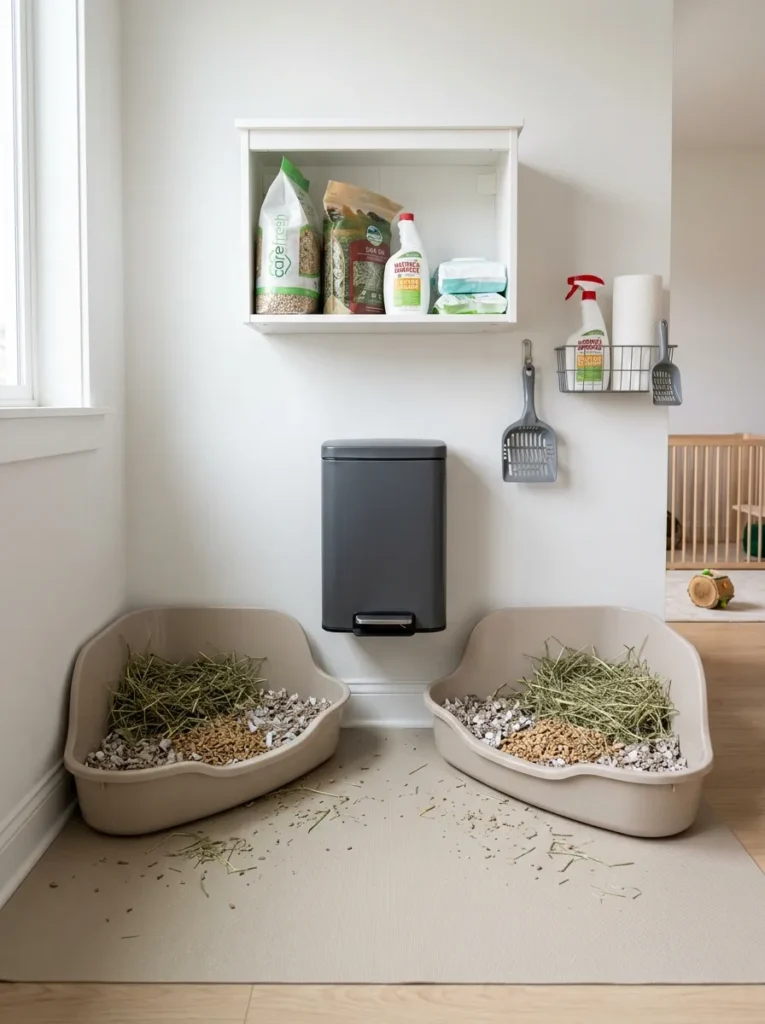
Vibe: The zone is hygienic — a dedicated litter management zone with all cleaning supplies mounted at the point of use, a step bin for waste disposal, and a vinyl mat containing scatter creates the most operationally efficient litter management workflow available for multi-rabbit indoor keeping.
Why it works: Litter management is the daily rabbit care task that most benefits from dedicated zone organization — having the litter scoop, replacement litter, enzyme cleaner, bin liners, and waste disposal bin all in the immediate vicinity of the litter boxes reduces the clean litter box task from a multi-room supply hunt to a single-location workflow of under three minutes. The enzyme cleaner is specifically important in rabbit litter management — enzymatic cleaners break down the uric acid compounds in rabbit urine that produce persistent odor if cleaned with standard detergents, which merely mask odor temporarily. The vinyl mat extending 12 inches beyond the litter box perimeter catches the substrate and litter that rabbits scatter when exiting the box, containing scatter to a defined and easily cleaned area.
How to get it: Two large corner litter boxes ($15–$25 each) positioned in a dedicated corner zone of the rabbit room provide the minimum litter infrastructure for one to two rabbits — rabbits perform better with multiple litter box options and tend to use all provided boxes if they are kept clean. Mount a small wall-mounted storage unit ($20–$40 from IKEA or similar) directly above the litter zone for all cleaning supplies. Install a step-pedal bin ($15–$30) for used litter disposal without requiring hand contact with the bin lid. Mount a scoop hook ($2–$5) at immediate reach beside the primary box.
Shop The Look
- Large corner litter box rabbit
- Enzyme cleaner rabbit urine odor
- Step bin foot pedal waste disposal
- Vinyl mat easy clean floor
- Wall mount storage unit cleaning
9. Foraging and Treat Enrichment Wall
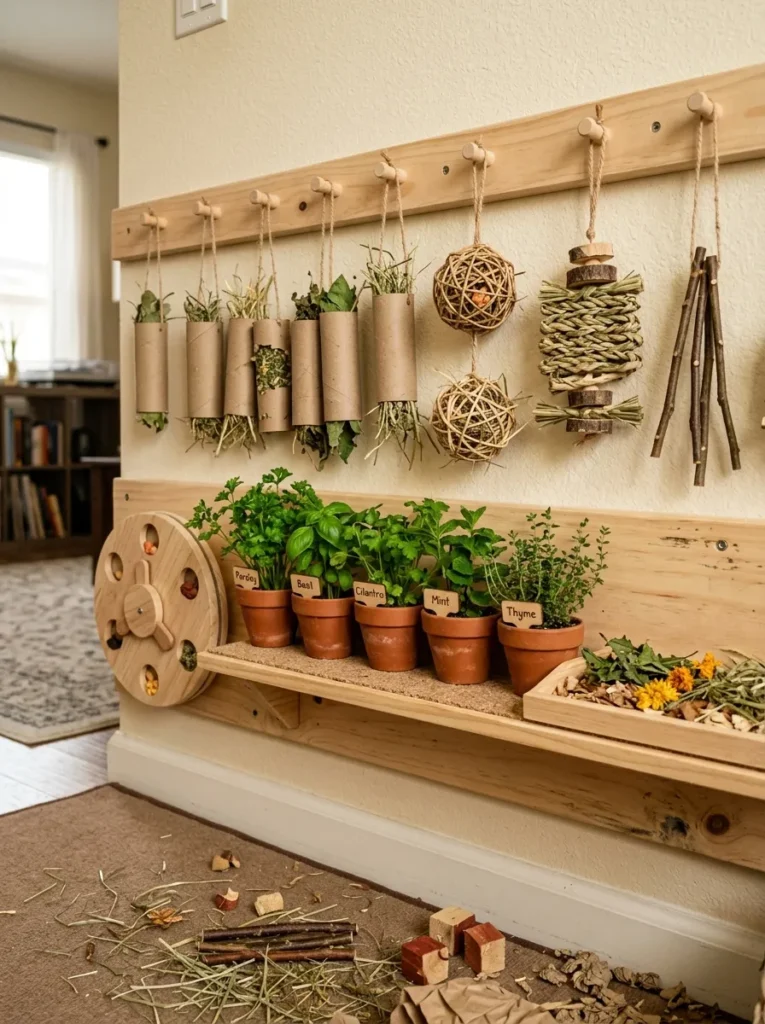
Vibe: The wall is engaging — a foraging enrichment wall with varied hanging toys, fresh herbs in terracotta pots, and treat dispensing puzzles provides the continuous cognitive engagement and natural foraging behavior expression that prevents the boredom-driven behaviors that under-stimulated rabbits develop in indoor environments.
Why it works: Foraging behavior — searching for, investigating, and extracting food from varied sources and locations — is one of the rabbit’s most persistent behavioral drives and accounts for the majority of a wild rabbit’s active hours. Indoor rabbits who receive all their food in a bowl have no behavioral outlet for this fundamental foraging drive, which redirects into territorial behavior, destructive chewing, and persistent pestering of the human keeper. A foraging enrichment wall that provides multiple simultaneous foraging opportunities (hanging toys requiring manipulation to extract hay or treats, growing herbs requiring grazing behavior, puzzle dispensers requiring problem-solving) addresses this behavioral need continuously throughout the rabbit’s active period. Fresh herbs in terracotta pots (rabbit-safe varieties including parsley, cilantro, basil, and dill) provide a continuously renewable foraging resource that requires no daily preparation.
How to get it: Mount a low wall-mounted rail or French cleat at 20–24-inch height for hanging foraging toy attachment. Purchase or make foraging toys from cardboard tubes (empty toilet paper tubes stuffed with hay and dried herbs, $0 to make), wicker balls ($2–$5 each from pet or craft stores), and natural grass woven toys ($3–$8 from rabbit supply retailers). Plant rabbit-safe herbs in terracotta pots on a low shelf ($2–$4 per pot, $2–$4 per herb plant from a garden center). Rotate foraging toys weekly to maintain novelty.
Shop The Look
- Wicker ball rabbit foraging toy set
- Grass woven rabbit toy natural
- Terracotta pot herb planting small
- Fresh herb plant rabbit safe parsley
- Cardboard tube toy rabbit DIY
10. Hideaway and Hiding Zone Infrastructure
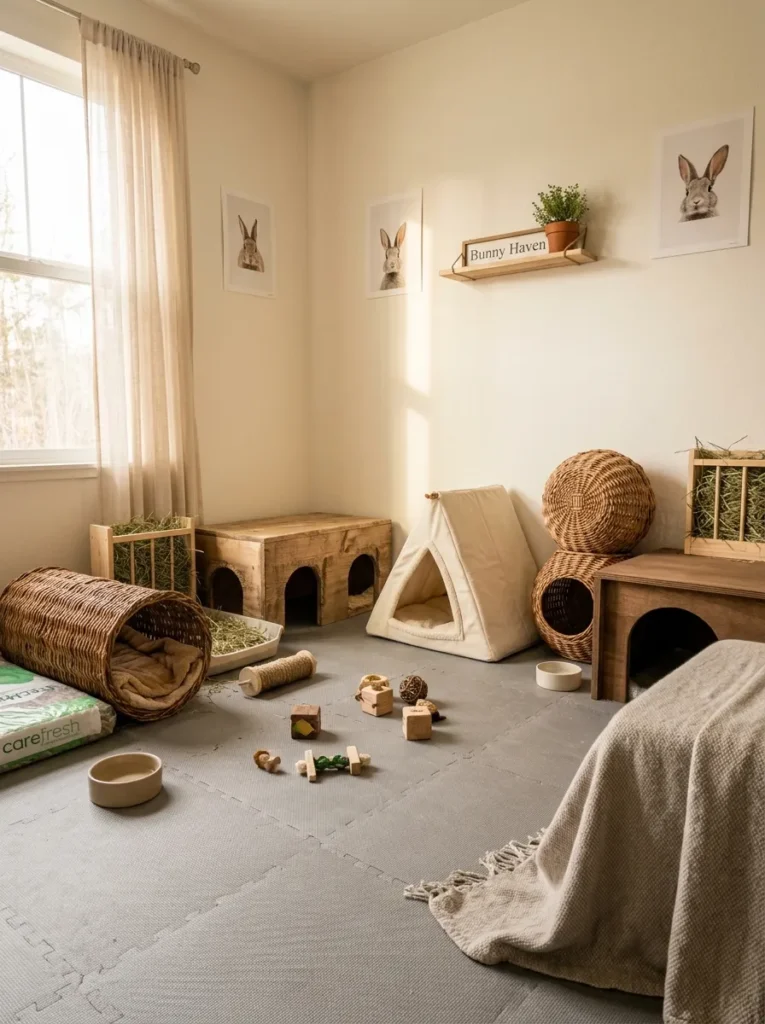
Vibe: The room is secure — a comprehensive hiding zone infrastructure with multiple distinct hiding options at every scale provides the psychological security that prey animals require in their resting environment, where the availability of multiple retreat options reduces chronic stress and allows rabbits to choose their preferred refuge for each behavioral context.
Why it works: Hiding and retreat behavior is among the most fundamental needs of prey animals in captivity — rabbits who lack adequate hiding opportunities in their environment show measurably elevated cortisol levels, reduced eating and grooming, and increased reactive aggression compared to rabbits with multiple retreat options. The critical design principle for rabbit hiding infrastructure is multiple distinct options (not just one hide per rabbit but at least two per rabbit in different locations and formats) because rabbits choose their hiding location based on the specific threat or disturbance they are responding to — a vacuum cleaner threat elicits retreat to a fully enclosed dark space, while a novel object elicits retreat to a partially visible location from which the object can be monitored. Different hiding formats (enclosed dark box, semi-open wicker structure, fabric-draped cave, tunnel) serve different behavioral functions and collectively provide the range of retreat options that adequate hiding infrastructure requires.
How to get it: Each rabbit in the room requires at minimum two distinct hiding options. Provide at least four hiding formats for a two-rabbit group: a wooden hide box with 2–3 entry holes ($20–$40 from rabbit supply retailers or built from untreated wood), a wicker or seagrass tunnel ($15–$30), a fabric-covered A-frame ($10–$20 from pet retailers), and a platform cave (a low shelf with a fabric drape). Distribute around the room perimeter rather than clustering — rabbits choose hiding locations based on proximity to specific threats and may use different hides throughout the day.
Shop The Look
- Wooden hide box rabbit entry holes
- Wicker tunnel rabbit cat large
- A-frame hideaway rabbit canvas
- Natural seagrass hide mat tunnel
- Platform hide fabric drape create
11. Smart Supply Storage System Above Rabbit Height
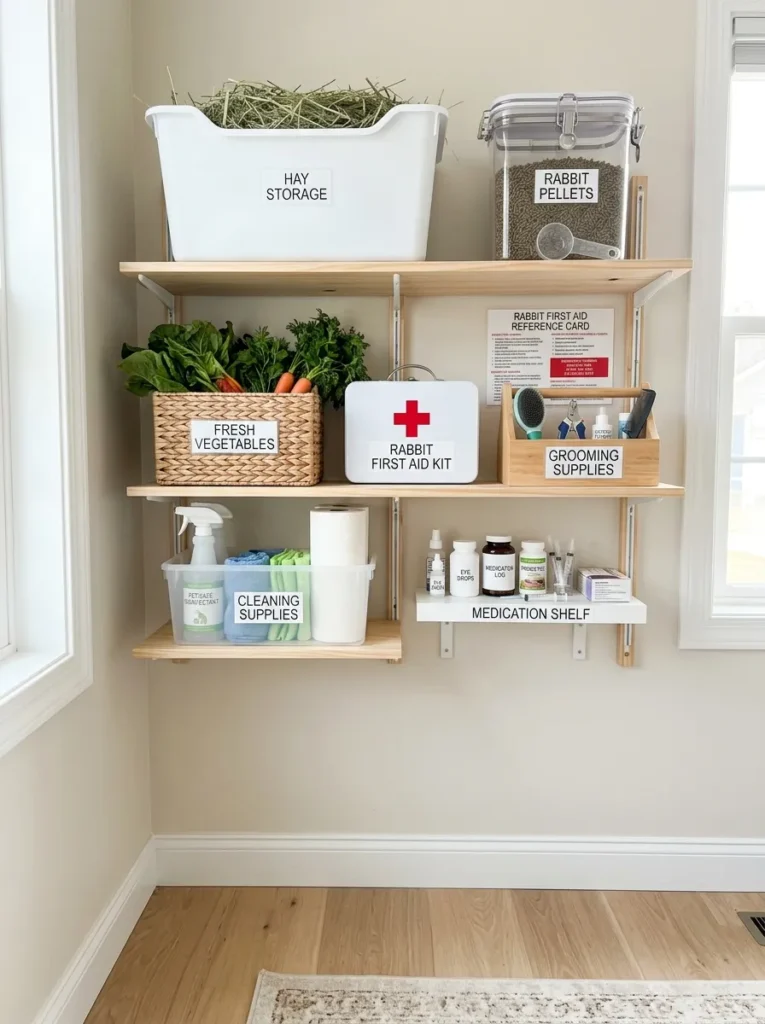
Vibe: The storage is complete — a fully organized rabbit supply wall mounted above rabbit height creates the single-location management system that makes daily rabbit care genuinely efficient, where every required supply is in its designated place within the dedicated room rather than distributed between the rabbit room, kitchen, and bathroom.
Why it works: Consolidated, well-organized supply storage in the rabbit room itself (rather than in the kitchen, bathroom, or a separate storage room) dramatically reduces the friction of daily rabbit care by eliminating the supply-search component of every care task. A rabbit keeper who must locate hay in the garage, pellets in the kitchen, grooming supplies in the bathroom, and cleaning products under the sink for each daily care session spends significantly more time in logistical overhead than one whose complete supply system is mounted on the wall of the rabbit room, organized by category, and immediately accessible at the beginning of each care session. The 36-inch minimum storage height (above the rabbit’s jump-and-reach zone) is essential for keeping all supplies safe from rabbit investigation — rabbits will chew packaging, spill containers, and investigate any accessible supply.
How to get it: Install floating shelves at 36-inch minimum height on wall studs ($15–$40 per shelf in natural pine or white MDF). Organize supply categories into clearly labeled bins or containers: hay storage (a sealed bin or bag for the week’s supply), pellets (an airtight container to maintain freshness), fresh vegetable supplies (a basket for the items brought from the refrigerator for that day), medical and first aid kit (a dedicated box with label for emergency supplies), grooming supplies (a caddy with brush, nail clippers, ear cleaner, and styptic powder), and cleaning supplies (a bin with enzyme cleaner, paper towels, and replacement litter). Label every container clearly.
Shop The Look
- Airtight pet food container pellet
- Labeled storage bin set rabbit supply
- Rabbit grooming kit nail clip brush
- First aid kit rabbit exotic animal
- Floating shelf pine natural 36 inch
12. Water Infrastructure with Multiple Hydration Points
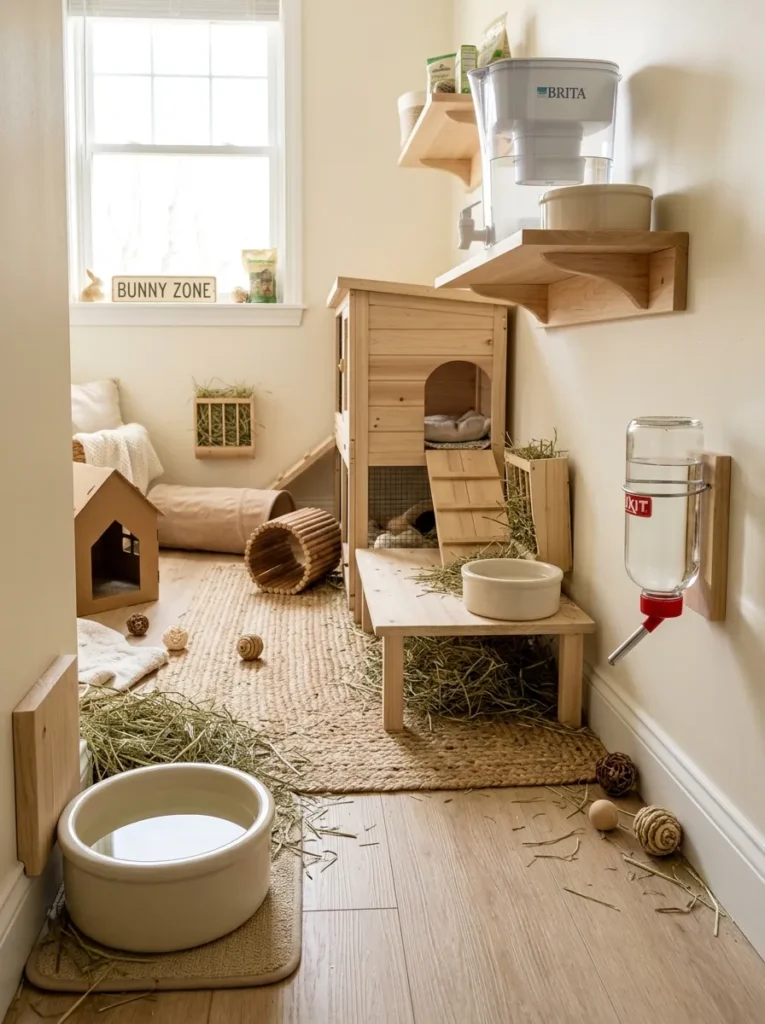
Vibe: The system is caring — multiple distributed water access points throughout the rabbit room ensure that no rabbit in any location within the room is more than a few hops from a water source, reflecting the welfare standard that adequate hydration is the most critical single daily health requirement for rabbits.
Why it works: Adequate water intake is the single most critical daily health variable for rabbits — dehydration is a primary factor in urinary sludge and bladder stone formation, a common and painful condition in domestic rabbits. Rabbits’ water intake is highly variable and influenced by location convenience — a rabbit that must cross the full room to access the single water source will drink significantly less than a rabbit with multiple water access points at varied room positions. Multiple small hydration points distributed around the room (a minimum of one per rabbit, positioned at different room locations) encourage consistent water intake by ensuring water is available wherever the rabbit currently is. Ceramic bowls are generally preferred to water bottles by most rabbits and allow higher water intake rates, but both should be provided to accommodate individual preference.
How to get it: Provide a minimum of one water point per rabbit plus one additional (three points for two rabbits). Use heavy ceramic bowls ($8–$15 each for quality non-tip bowls) as the primary water delivery system — the weight prevents tipping, the ceramic surface is easy to clean, and the bowl format allows natural head-down drinking position. Mount a water bottle ($8–$15) as a secondary water source for rabbits who prefer it or as a backup. Change all water daily and clean bowls every 2–3 days to prevent biofilm accumulation.
Shop The Look
- Ceramic rabbit water bowl heavy base
- Rabbit water bottle wall mount large
- Water filter pitcher for fresh supply
- Bowl stand elevated rabbit water
- Stainless steel water bowl backup
13. Exercise and Speed Run Zone for High-Energy Breeds
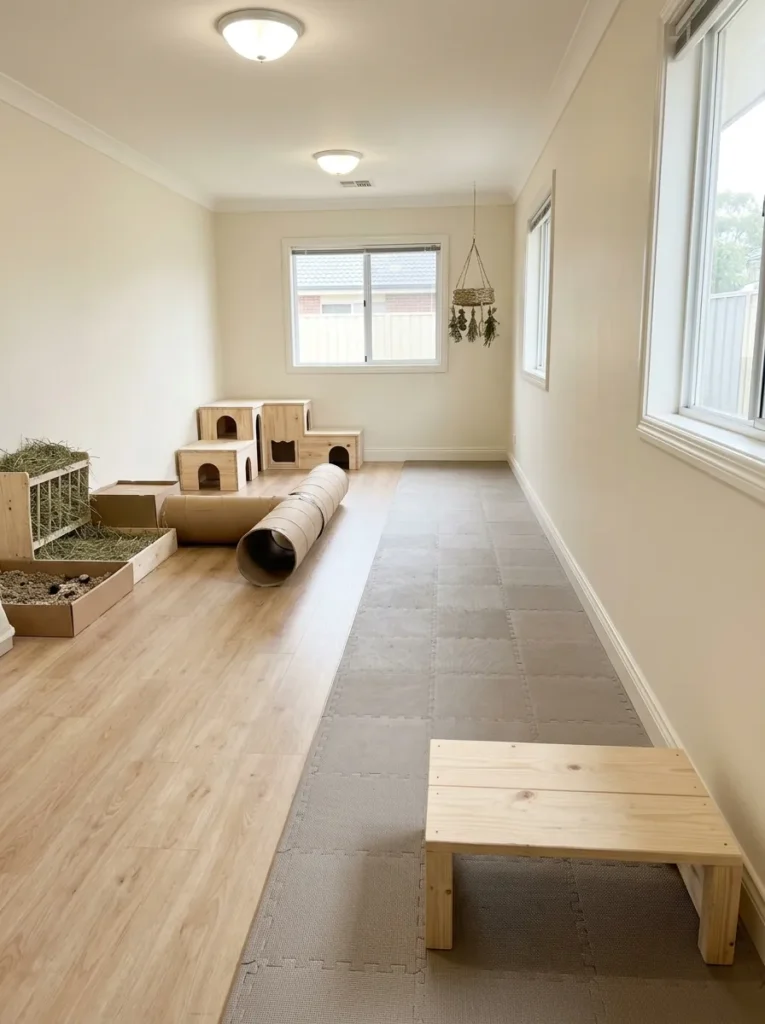
Vibe: The zone is active — a dedicated speed run corridor with a minimum 12-foot clear length allows the full expression of the binkying and sprinting behavior that represents a rabbit’s highest expression of joy and physical wellbeing, creating the most important single physical welfare element in the rabbit room layout.
Why it works: Binkying — the spontaneous leaping, twisting, and sprinting behavior that rabbits express when they are happy and feel safe — requires a minimum of 8–12 feet of unobstructed straight run to fully express at speed. A rabbit confined to a space without adequate straight running distance cannot binky at full expression and experiences the same physical frustration as a dog who cannot run — the behavioral drive is present but the spatial constraint prevents its expression. High-energy breeds (Rex, Mini Rex, Californian, and most young rabbits of any breed) specifically require the speed run space because their energy levels significantly exceed what shorter-distance binkying and jumping can fully satisfy. A room layout that designates the longest wall’s corridor as a clear run zone — placing all enrichment structures (hides, platforms, hay station) along the perimeter rather than in the center — maximizes the available run length for any given room size.
How to get it: Lay out the rabbit room furniture and enrichment items specifically to maximize the longest clear straight distance — this is a layout priority that should inform the placement of every other element in the room. In a standard 10×12-foot room, a 10-foot clear run along the longest wall is achievable when all enrichment structures are placed along the opposite wall. Cover the run corridor with foam tile or a long non-slip mat ($20–$40 for a 3×12-foot mat) for safe high-speed running. Place a jumping platform at one end and a foraging toy at the other to encourage the full run length.
Shop The Look
- Foam play mat tile non slip grey
- Rabbit jumping platform low wood
- Foraging toy hung speed run end
- Non slip mat long runner rabbit
- Room layout planning grid paper
14. Two-Rabbit Room with Separate and Shared Zones
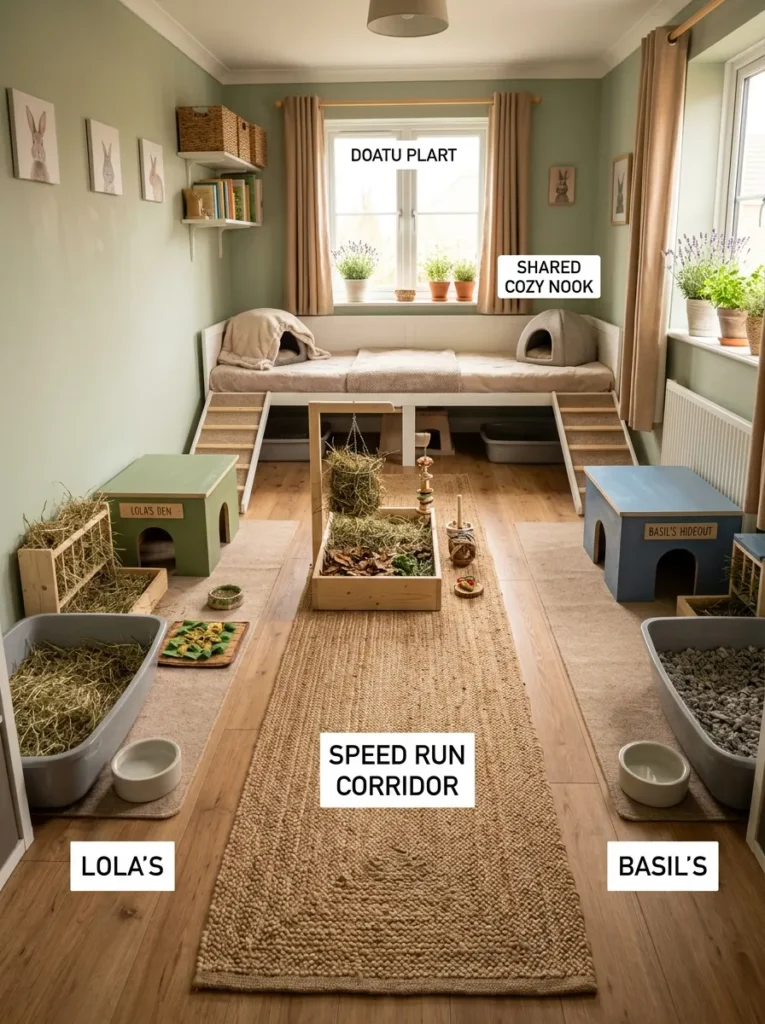
Vibe: The room is social — a two-rabbit room designed with individual resource zones for each rabbit and shared social spaces provides the most welfare-appropriate multi-rabbit configuration, preventing resource guarding conflict while facilitating the social interaction that rabbits require for genuine psychological wellbeing.
Why it works: Rabbits are social animals who thrive with a bonded companion, but the welfare requirements of multi-rabbit housing include one critical provision that most paired rabbit rooms fail to provide adequately: individual resource access points for each rabbit (separate litter boxes, separate water bowls, separate food dishes, separate hide boxes) to prevent the resource guarding behavior that is the primary source of conflict between bonded rabbits. A bonded pair that must share a single litter box or single food dish experiences ongoing low-level territorial competition that increases baseline stress even in otherwise well-bonded pairs. The two-zone design (each rabbit has their own resource zone with duplicate resources) eliminates this competition while the shared central space maintains the social contact and shared activity that bonded rabbits seek.
How to get it: Divide the room into two equal sides plus a shared central corridor, with each side containing: one litter box, one water bowl, one hay access point, and one primary hide. The shared central zone contains the speed run corridor, shared enrichment, and a communal sleeping platform sized for two rabbits (minimum 24×36 inches for average-sized breeds). The division is spatial rather than physical — there should be no barrier between the two sides, just a clear spatial distinction that each rabbit learns over time. Mark each rabbit’s zone with a subtle name sign ($2–$5 from craft stores) for human management clarity.
Shop The Look
- Second litter box matching set pair
- Second water bowl matching pair
- Communal sleeping platform two rabbit
- Name sign individual zone small
- Duplicate hide box second rabbit
15. Seasonal and Rotating Enrichment Storage System
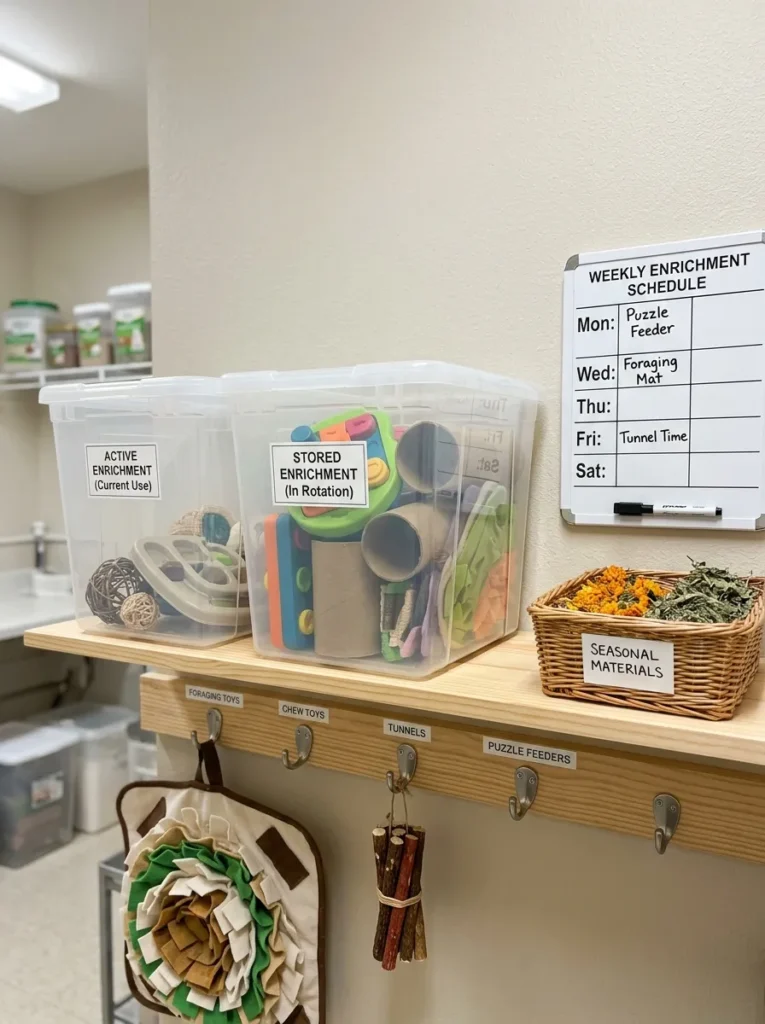
Vibe: The system is thoughtful — an organized enrichment rotation storage system with a weekly schedule and categorized storage creates the management infrastructure that makes consistent enrichment delivery reliable rather than dependent on daily inspiration, ensuring that rabbits receive the novelty and cognitive stimulation they require as a scheduled welfare commitment.
Why it works: Enrichment novelty is the most important variable in its behavioral effectiveness — a foraging toy that a rabbit encounters for the first time produces 20–30 minutes of engaged investigation and foraging behavior; the same toy left permanently in the room produces no behavioral engagement after 48–72 hours. This novelty-dependency of enrichment means that an effective enrichment program requires active rotation — removing enrichment items from the room after 3–5 days and replacing them with fresh or previously stored items — rather than static provision of permanent enrichment items. A rotation system with clearly divided “active” and “stored” categories, a weekly schedule, and organized per-category storage makes this rotation practice genuinely manageable rather than requiring either constant purchasing of new items or complex mental tracking of rotation timing.
How to get it: Divide the enrichment supply into two equal collections — active and stored — rotating the full collection every 5–7 days. Mount labeled bins for each collection on the supply shelf above rabbit height. Create a simple weekly enrichment schedule on a small whiteboard ($8–$15) posted beside the bins, listing which items to rotate each day of the week. Expand the seasonal basket with items specific to each season: fresh flowers and fresh herbs in spring, dried grasses and dried fruit in summer, dried leaves and dried gourds in autumn, and pine cones and untreated twigs in winter — all of which provide novel olfactory and tactile enrichment at $0 from the garden or $5–$15 from craft and garden supplies.
Shop The Look
- Enrichment rotation bin set labeled
- Small whiteboard weekly schedule
- Seasonal dried botanical set rabbit
- Category hook set wall mount
- Foraging toy rotation set rabbit
How to Start Your Rabbit Room Design
The single most important first decision in any rabbit room design project is flooring — specifically, addressing the slippery floor problem before any rabbit is allowed access to the space. Rabbits on bare hardwood, tile, laminate, or concrete floors cannot stop safely when running, cannot turn sharply when binkying, and cannot sit comfortably for extended periods — the inability to control their movement on slippery surfaces creates both acute injury risk (fractures and dislocations from slipping falls are among the most common rabbit emergency injuries) and chronic joint stress that contributes to arthritis in older rabbits. The floor covering decision should be the first installation in any rabbit room project, before any enclosure, enrichment, or storage infrastructure is addressed. Interlocking foam tiles provide the fastest and most affordable solution; fitted carpet or vinyl flooring provides the most permanent and most aesthetically integrated solution.
The most common rabbit room design mistake is insufficient space — specifically, underestimating the minimum space requirements for rabbit welfare and designing a room that meets the owner’s perception of adequate rabbit space rather than the documented behavioral and welfare standard. The 32-square-foot minimum exercise space per rabbit is not a recommendation but a welfare floor — the minimum below which behavioral and health problems consistently emerge. A rabbit room that provides 32 square feet of floor space for two rabbits (16 square feet each) is providing the absolute minimum, and a room that provides 50–80 square feet per rabbit produces measurably better behavioral outcomes. If the designated room cannot provide the minimum space, it is better to identify a larger space than to proceed with inadequate square footage.
Three rabbit room improvements under $50 that create immediate, significant welfare and management benefit: installing interlocking foam tiles ($30–$50 for a 100 square foot room) that immediately addresses the slippery floor hazard that is the most common acute injury risk in rabbit rooms; adding a second litter box in a different room zone ($15–$25 for a quality large corner litter box) that immediately improves litter training reliability through multiple access point provision; and mounting all cables in visible PVC conduit or elevating them to 30-inch height ($10–$20 in conduit and fittings) that immediately eliminates the most serious physical safety hazard in any rabbit room that shares space with electronics.
A complete rabbit room — full foam tile flooring, C&C enclosure base, integrated hay and litter station, digging box, multi-level platform system, comprehensive hiding infrastructure, chew-proof cable management, organized supply storage, foraging enrichment wall, and multiple water points — is achievable over one weekend of focused installation work with total material investment ranging from $200–$600 for a complete first installation to $100–$200 for converting an existing basic rabbit space. The return on this investment — in the rabbits’ behavioral wellbeing, in the reduction of destructive behavior in the home, in the prevention of common welfare-related health issues, and in the daily quality of the human-rabbit relationship — represents one of the highest welfare returns available per dollar invested in companion animal care.
Frequently Asked Questions About Rabbit Room Design
What is the minimum room size for a rabbit room?
The minimum room size for a single rabbit’s dedicated room is approximately 80–100 square feet of usable floor area — equivalent to a very small bedroom or a large walk-in closet. This minimum provides the 32 square feet of exercise space that welfare standards require while allowing for the room’s fixed elements (hay station, litter zone, supply storage, enrichment infrastructure) which typically occupy 30–40 square feet. For two rabbits (the recommended minimum for rabbit welfare), the minimum room size increases to 120–150 square feet of usable floor area. These are genuine minimums rather than comfortable provision standards — most rabbit welfare organizations and experienced rabbit keepers recommend significantly more space, and the behavioral outcomes improve measurably with every additional square foot of accessible space.
How do I rabbit-proof a room without major renovation?
Rabbit-proofing a room without major renovation requires addressing four main vulnerability categories: cables (elevate all to 30-inch minimum height using cable raceways and conduit), baseboards (protect with clear acrylic or plastic baseboard guards adhered at floor level), door gaps (fill with door draft excluders or flexible door seals), and any houseplants (remove all plants from rabbit-accessible zones — many common houseplants are toxic to rabbits). These four interventions are fully reversible and require no permanent modification to the room’s structure, making them appropriate for rental properties. The materials cost for a complete rabbit-proofing of a standard bedroom: $40–$80 depending on the room’s cable density and baseboard length.
How do I manage hay odor in a rabbit room?
Hay odor in a rabbit room is managed through four complementary approaches: ventilation (maintain adequate air exchange in the room through a window or ceiling fan to prevent hay dust and odor accumulation), containment (use enclosed hay storage rather than open bags or bales, and enclosed hay feeders that contain hay within a mesh boundary), enzymatic cleaning (use enzyme-based cleaners on litter boxes and any soiled surfaces — enzymatic cleaners neutralize odor compounds rather than masking them), and frequency (clean litter boxes daily and change fully every 2–3 days — the primary source of odor in a rabbit room is the litter box rather than the hay itself). A room with daily litter box cleaning, enclosed hay storage, adequate ventilation, and enzymatic cleaning products is typically odor-free to visitors.
What rabbit-safe plants can I include in the rabbit room?
Rabbit-safe plants that can be grown in the rabbit room and grazed by free-roaming rabbits include: culinary herbs (parsley, cilantro, dill, basil, mint — all palatable to rabbits and safe in normal quantities), wheatgrass and oat grass (specifically grown for rabbit grazing, widely available from pet stores), marigolds (edible flowers that rabbits enjoy and that are safe in moderate quantities), and pansy flowers (edible for rabbits and non-toxic). Plants to specifically avoid in any rabbit-accessible zone include: lily species (all parts highly toxic), azalea, rhododendron, foxglove, rhubarb, tomato plants, and most flowering houseplants — when uncertain, consult the House Rabbit Society’s comprehensive toxic plant list (rabbit.org) before introducing any plant.
How do I bond two rabbits and introduce them to a shared rabbit room?
Rabbit bonding — the process of introducing two unacquainted rabbits and establishing a stable, positive social relationship — is a process that must be completed before the rabbits are placed in a shared room together. Attempting to place two unbonded rabbits in a shared room creates a territorial conflict that can result in serious injury. Bonding requires a series of neutral-territory introductions (a space neither rabbit has previously occupied) in short sessions (10–20 minutes), gradually increasing in duration and proximity over 2–8 weeks depending on the individual rabbits. Once the pair is fully bonded (showing mutual grooming, sleeping together, and no aggressive behavior during extended neutral-territory sessions), they can be moved to the shared rabbit room simultaneously rather than sequentially — both rabbits entering the new space at the same time prevents either from claiming territorial dominance. The rabbit room should be cleaned thoroughly before the bonded pair’s first entry so that neither rabbit’s established scent marks are present in the new space.
Ready to Design Your Rabbit Room?
These 15 ideas cover the full spectrum of what a genuinely well-designed rabbit room can achieve — from the foundational welfare infrastructure of a full free-roam C&C enclosure system and a chew-proof cable management installation, to the behavioral enrichment depth of a digging box, a foraging wall, and a comprehensive hiding zone, from the operational efficiency of an integrated hay and litter station and a smart supply storage system, to the social intelligence of a two-rabbit room with individual resource zones and shared social spaces, from the physical wellbeing support of a multi-level platform system and a dedicated speed run corridor to the organizational discipline of a seasonal enrichment rotation schedule. You do not need all 15 to create a rabbit room of genuine welfare quality — you need the flooring, the space, the litter infrastructure, the chew-proofing, and the hiding provision as the non-negotiable welfare foundation, and then the enrichment, storage, and aesthetic elements that transform the functional space into a genuinely designed and genuinely loved room. Start with the floor: measure the space, calculate the foam tile quantity needed, and order it today. A rabbit room that is safe to run on is the first rabbit room — everything else is the design that builds on that foundation. Pin the ideas that named what your rabbit room is currently missing — those are the ones worth building first.