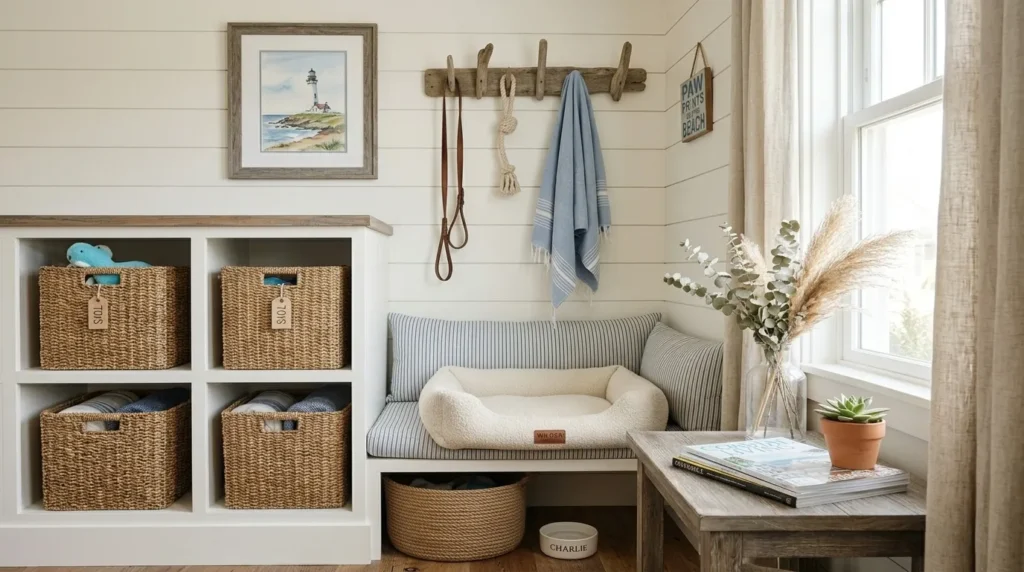
A dog corner is a purpose-designed or purpose-styled domestic space within a room — a defined area with its own dedicated furniture, bedding, storage, and visual identity — that serves the dog’s behavioral needs for rest, security, and territorial belonging while reading as a considered interior design decision rather than a pet concession imposed on an otherwise resolved room. This article gives you 15 genuinely creative, buildable dog corner ideas that serve your dog’s comfort and instinctive needs completely while remaining visually cohesive with the surrounding interior design of the room they inhabit.
Most dog corners default to the obvious — a dog bed pushed into the least convenient corner, a plastic crate positioned wherever it fits, a collection of toys and accessories that accumulates without any design logic. The homes in this list make a different choice: they treat the dog’s space with the same design seriousness as every other area of the room, creating corners that guests notice for their beauty before they recognize them as pet spaces. Here are 15 ideas worth saving — and designing.
Why Designed Dog Corners Work So Well
The designed dog corner as a serious interior design category has its origins in the broader pet humanization movement that has characterized consumer culture since the early 2000s — the cultural shift in which companion animals have moved from working or outdoor roles into the center of domestic life, occupying living rooms, bedrooms, and family spaces in ways that previous generations of pet ownership did not normalize. This shift has created a genuine design problem that most interiors have not adequately solved: how to accommodate a dog’s physical and behavioral requirements within a designed domestic environment without the dog’s space undermining the design quality of the room that contains it.
The behavioral requirements that a dog corner must satisfy are specific and documentable. Dogs seek enclosed, den-like spaces for sleeping because their wolf ancestry encoded a preference for sheltered, bounded rest positions that provide security and temperature regulation simultaneously — a dog that sleeps in an open, exposed position is a dog that has not been given a space that satisfies its instinctive shelter-seeking behavior. Dogs also require a consistent territorial marker — a space that smells of their own body chemistry and that signals to them (and to other animals in the household) that this specific location is theirs. The designed dog corner satisfies both requirements when it provides a sufficiently enclosed sleeping space (whether a covered bed, a built-in niche, or a furniture piece with defined sides) and maintains a consistent location rather than moving the dog’s bed to accommodate furniture arrangement changes.
The materials that define a beautiful dog corner are those that satisfy both the dog’s practical requirements and the human’s aesthetic preferences simultaneously. Natural linen and cotton canvas are the dog bedding materials that most convincingly read as interior textiles rather than pet products — they wash well, age gracefully, and coordinate with the same material palette as human soft furnishings in the room. Timber — in its various forms from painted MDF to solid oak — provides the structural quality that makes a dog furniture piece read as furniture rather than pet equipment. Warm neutral tones (natural linen, warm greige, dusty sage, terracotta) are the color choices that most successfully allow a dog’s space to blend into a room’s existing design palette rather than competing with it.
Small apartments and compact living rooms benefit specifically from a designed dog corner because a thoughtfully resolved dog space in a small room reads as evidence of careful planning and design intelligence, while an unresolved dog space in a small room dominates and clutters in a way that is disproportionate to its physical footprint. A small apartment with one beautifully designed dog corner reads as more considered than a large house where the dog’s possessions are scattered throughout without spatial logic.
Style at a Glance
| Element | Detail |
|---|---|
| Philosophy | The dog corner is a designed interior space, not a pet concession — it serves the dog’s behavioral needs with the same design intention that a reading nook or a window seat serves human needs |
| Key Materials | Natural linen, cotton canvas, solid timber, painted MDF, rattan, woven basket, natural wool, velvet |
| Design Principles | Enclosure for security, consistent location, material coherence with surrounding interior, storage for accessories |
15 Dog Corner Ideas
1. Built-In Alcove Dog Niche with Custom Bed and Monogram
Vibe: Warm and considered — the dog niche that makes guests ask who the interior designer was before they realize it is a dog bed.
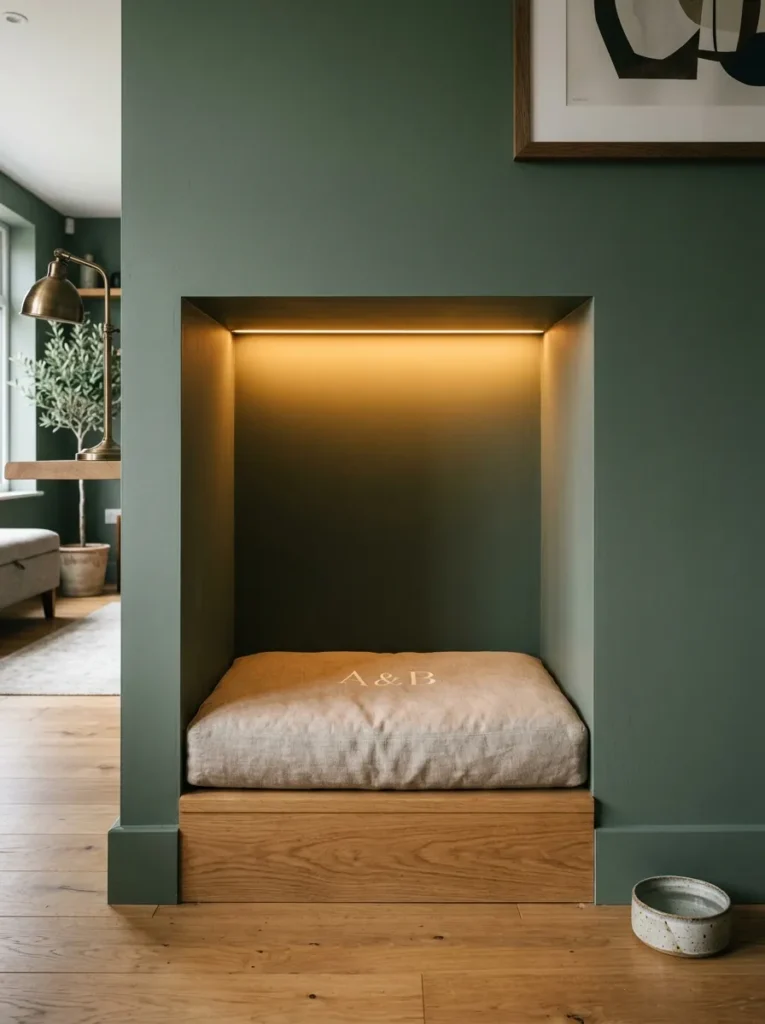
Why it works: The built-in alcove dog niche is the dog corner idea that most completely achieves architectural integration — by recessing the dog’s sleeping space into the wall plane rather than placing a piece of furniture in front of it, the niche becomes part of the room’s architecture rather than an addition to its furniture arrangement. The paint continuity between the niche interior and the surrounding wall is the specific design detail that creates this architectural reading: when the niche is painted the same color as the wall that contains it, the eye reads the niche as a designed void within the architecture rather than a separate applied element. The custom linen mattress with hand-embroidered monogram is the finishing detail that elevates the niche from a practical provision to a considered object — the monogram specifically transforms the dog bed from an anonymous pet product into a personalized domestic object with the same status as a monogrammed linen pillow.
How to get it: Build the alcove niche from 18mm MDF framed into an existing wall cavity or built out from a flat wall surface — the niche does not need to be genuinely recessed into the wall structure to read as a built-in: a shallow 200–300mm box frame built out from the wall surface and painted in continuity with the surrounding wall reads as architecturally integrated rather than applied. The raised timber threshold at the niche opening serves both aesthetic and practical functions — aesthetically it frames the niche entrance and visually defines the dog’s space within the room; practically it contains the bedding and any dog hair within the niche interior.
Quick Win: Painting the interior of any existing alcove, shelving recess, or under-stair space in the same color as the surrounding wall and adding a custom-cut linen mattress immediately creates a dog niche reading — the paint continuity is the single design decision that transforms a utilitarian recess into a designed dog space, at the cost of a paint brush and a cushion.
Shop the Look
| Product |
|---|
| Natural linen dog mattress custom |
| LED strip warm white adhesive |
| Deep sage green interior paint |
| Ceramic dog water bowl |
| Embroidery thread ivory |
Also view: 11 Crochet Pet Bed Ideas for Stylish Homes
2. Under-Stair Dog Den with Timber Door and Window
Vibe: Warm and playful — the under-stair space that makes everyone who sees it wish they were small enough to sleep in it.
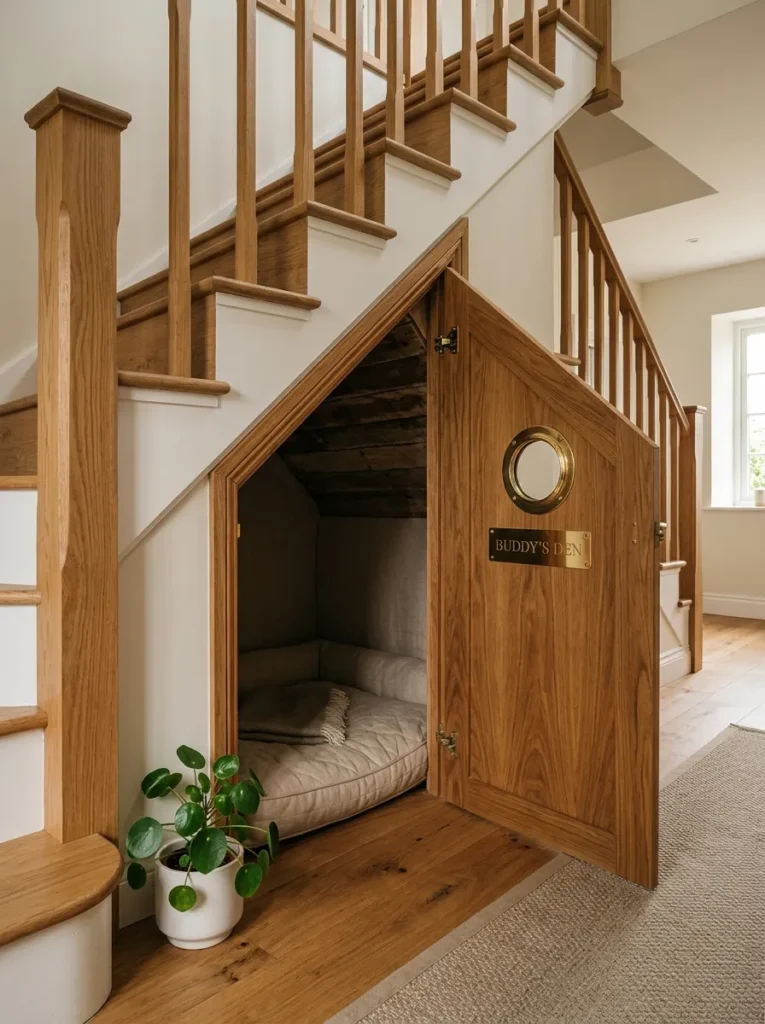
Why it works: The under-stair dog den is the dog corner idea that most intelligently converts a universally underutilized domestic space into a designed pet habitat — the triangular under-stair volume exists in every two-story home and is typically used for general storage at its most organized or left as dead space at its least. Converting this volume into a dog den satisfies both the practical requirement (a dedicated, enclosed sleeping space for the dog) and the spatial design requirement (the under-stair volume is used purposefully rather than incidentally) simultaneously. The porthole window in the timber door is the specific design detail that makes the dog den read as a designed feature rather than a storage cupboard repurposed for pet use — the porthole gives the space a nautical, playful character that communicates deliberate design intention.
How to get it: Frame the under-stair opening with a standard door frame and hang a solid timber door cut to the triangular profile of the under-stair opening — the door should be hinged at the full-height side of the triangle. Install a porthole-style circular window (available from marine supply specialists at $30–80) in the door panel at the dog’s eye height when seated. Line the interior with a washable painted finish and add a custom-cut linen or cotton canvas mattress to fit the triangular floor plan precisely. The brass nameplate on the exterior door face — engraved with the dog’s name — is the personalizing detail that most firmly establishes the den as a designed, dedicated space rather than a repurposed cupboard.
Shop the Look
| Product |
|---|
| Porthole window circular marine |
| Solid timber door custom cut |
| Brass nameplate engraved |
| Under stair linen mattress |
| Brass door handle small |
3. Rattan Dog Bed Styled as Living Room Furniture
Vibe: Warm and bohemian — the dog bed that looks like a considered furniture purchase rather than a pet accessory that arrived in the room.
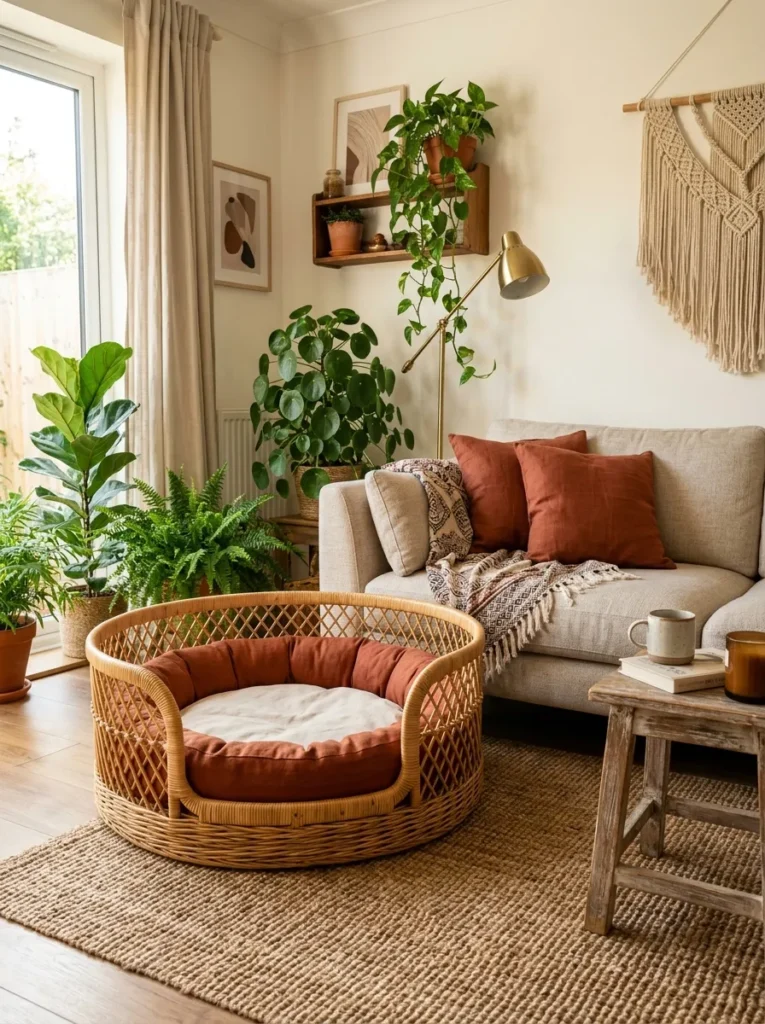
Why it works: The oversized rattan dog bed styled as living room furniture is the dog corner idea that most convincingly collapses the distinction between pet furniture and human furniture — a deep round rattan bed with a well-chosen linen cushion reads as a piece of bohemian interior furniture (a floor cushion, a woven accent piece) before it reads as a dog bed, because its material language (natural rattan, organic form, earth-toned textile) belongs entirely to the interior design vocabulary of a considered bohemian or Japandi room rather than to the pet product aesthetic. The coordination of the dog bed’s cushion color with the sofa’s cushion color is the styling detail most responsible for this integration reading — when the dog’s bedding shares the same textile tone as the human seating beside it, both read as part of the same designed composition.
How to get it: Source a large rattan dog bed (minimum 70cm diameter for a medium dog, 90cm for a large dog) from specialist pet furniture retailers or home goods retailers whose rattan range includes pet-appropriate deep basin forms. The critical specification is the interior cushion — replace the standard cushion supplied with most rattan beds with a custom-cut cushion covered in a linen, canvas, or cotton textile in a color that coordinates specifically with the room’s existing textile palette. Wash the replacement cushion cover regularly — a consistently clean, coordinated cushion cover is the maintenance practice that keeps the rattan dog bed reading as interior furniture rather than pet equipment.
Shop the Look
| Product |
|---|
| Large rattan round dog bed |
| Terracotta linen cushion cover |
| Jute rug natural large |
| Dog cushion insert washable |
| Rattan honey finish care oil |
4. Velvet Tufted Dog Bed Matching the Sofa Upholstery
Vibe: Warm and design-forward — the dog bed that reads as a deliberate extension of the room’s upholstery program rather than a pet accessory.
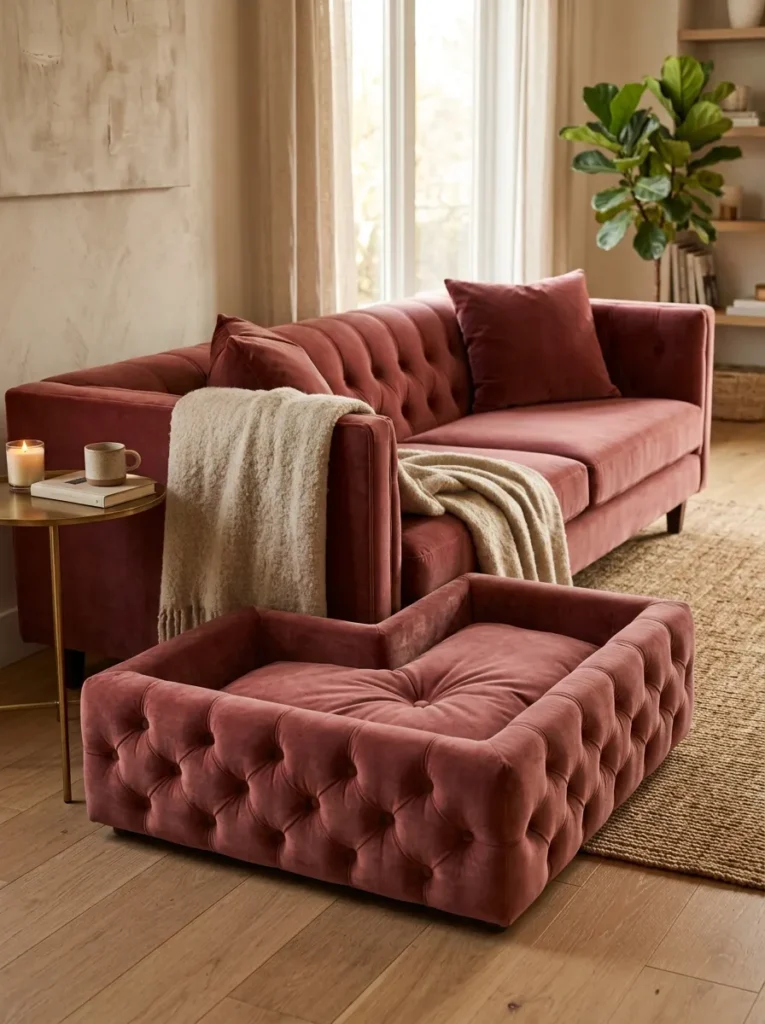
Why it works: The tufted velvet dog bed in a color and fabric that matches the sofa is the dog corner idea that most directly applies the principle of material coherence to pet furniture — by specifying the dog bed in the same or closely matched velvet as the primary sofa, the bed reads as part of the room’s upholstery family rather than as a separately purchased pet product. The tufting detail on the dog bed is the specific design element that establishes its connection to the sofa’s own tufting program — when both the sofa and the dog bed share the same tufting button detail, they read as belonging to the same design language and the same design brief. This coordination is the design decision that most elevates the dog corner from a pet provision to a designed composition.
How to get it: Most dog beds in a tufted format are available from specialist pet furniture brands (Harry Barker, Molly Mutt, and PetFusion all produce upholstered dog beds in quality fabrics). For the exact fabric match to an existing sofa, contact the sofa’s manufacturer or a local upholstery workshop who can produce a tufted dog bed cover in the same fabric sample — the cost of custom covering an existing dog bed base in a matching velvet is typically $80–200, which produces a more precise color and fabric match than any off-the-shelf alternative. Performance velvet (Crypton or similar) is the practical specification — it maintains the visual quality of standard velvet while resisting the staining and crushing that a dog’s regular use would cause to standard upholstery velvet.
Shop the Look
| Product |
|---|
| Tufted velvet dog bed dusty rose |
| Performance velvet fabric sample |
| Dog bed insert washable |
| Dusty rose velvet cushion |
| Slim brass side table |
5. Floating Shelf Dog Bed for Small Breeds
Vibe: Clean and space-saving — the dog corner for a small apartment that adds floor space by moving the dog’s sleeping area to the wall.
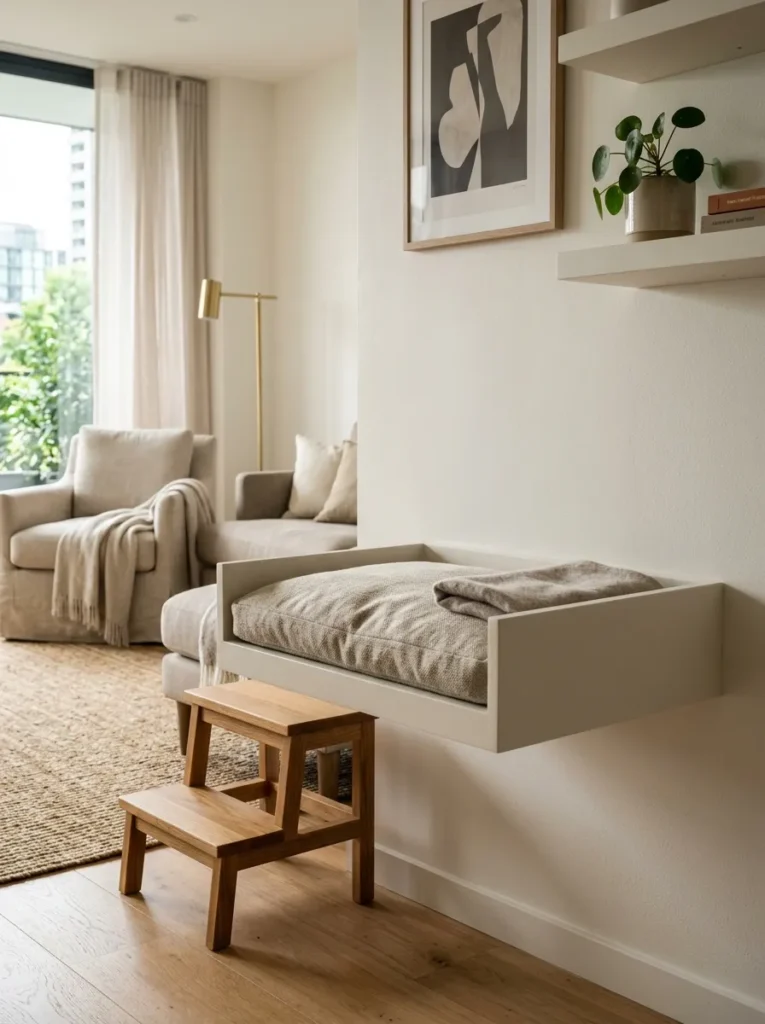
Why it works: The wall-mounted floating shelf dog bed is the dog corner idea that most creatively solves the small apartment’s primary design constraint — the limited floor plan that a floor-level dog bed would consume. By mounting the dog’s sleeping platform on the wall at a height that is accessible via a small step stool, the floating shelf dog bed recovers the floor area beneath it for circulation or other use while providing the dog with an elevated sleeping position that many small and medium breeds prefer, as the elevated position provides the territorial overview that the wolf-ancestry preference for high sleeping positions reflects. The wall paint continuity — the shelf painted the same color as the wall — creates the same architectural integration reading as the built-in alcove niche: the shelf reads as part of the wall’s architecture rather than furniture placed against it.
How to get it: Build the floating shelf from 18mm MDF on heavy-duty concealed shelf brackets rated for minimum 30kg (the combined weight of the dog and the cushion plus a safety factor). The raised lip on three sides should be 80–100mm high — sufficient to contain the cushion and prevent it from sliding off the shelf during the dog’s settling and turning behavior. Install a small timber step stool (a single-step stool in a coordinating timber tone) beside the shelf to allow the dog to mount and dismount safely without jumping from full height — the landing impact of repeated jumping from a 400mm height can cause joint stress in small dogs over time.
Shop the Look
| Product |
|---|
| Heavy duty floating shelf bracket |
| MDF shelf board 18mm |
| Linen cushion small custom |
| Small timber step stool |
| White paint wall match |
6. Converted IKEA Cabinet Dog Crate with Cushion and Curtain
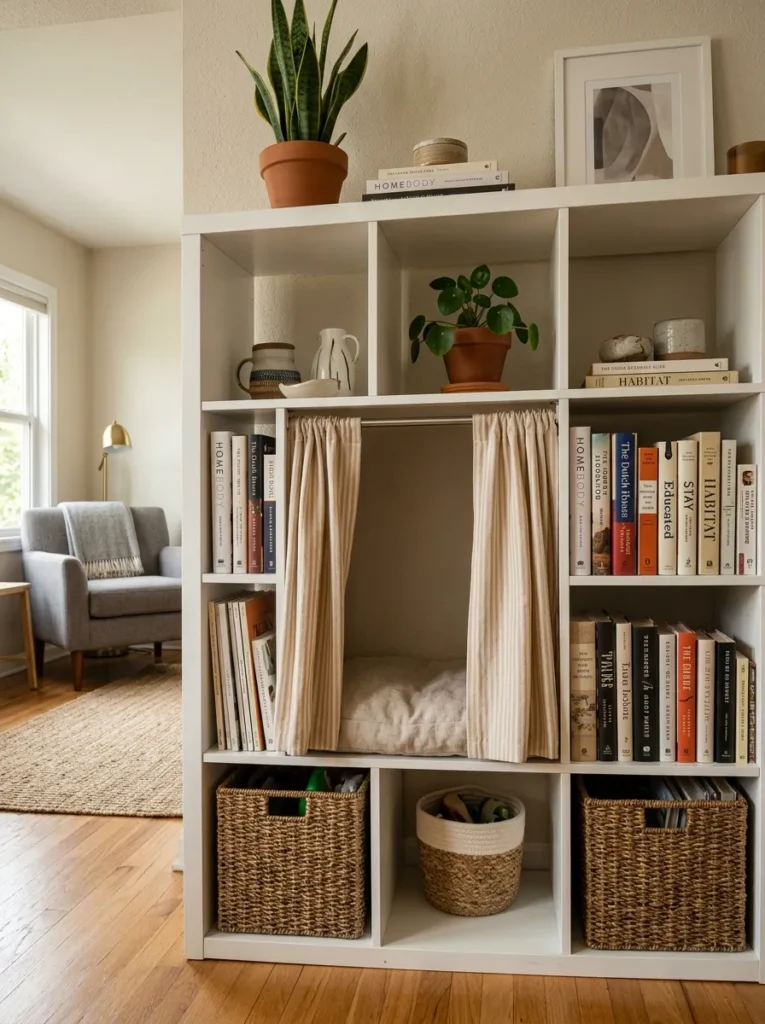
Vibe: Organized and integrated — the dog crate that disappears into the living room shelving system so completely that guests look twice before finding it.
Why it works: The converted IKEA cube shelving dog crate is the dog corner idea that most effectively integrates the crate function — which many dogs need for the security and den-like enclosure that a crate provides — into the room’s existing furniture program rather than introducing a separate, visually distinct crate structure that reads as a containment device. The linen curtain closure is the design detail that transforms the dog’s cube from an open shelf section into a den-like enclosed space: the curtain provides the visual privacy and partial enclosure that satisfies the dog’s instinctive preference for a sheltered sleeping position while reading, when drawn, as a simple fabric detail within the shelving system’s visual composition. The surrounding cubes used as standard storage complete the integration — the dog’s cube is one component of a unified storage wall rather than a separate element that interrupts the wall’s organizational logic.
How to get it: Select the IKEA KALLAX cube (or equivalent) at the correct size for the dog — a standard KALLAX square opening (330mm × 330mm) accommodates small breeds comfortably; for medium and large breeds, use a 2×1 configuration of a modular shelving system that provides a wider opening. Install a simple tension curtain rod within the cube opening and hang a linen curtain in a stripe or solid tone that coordinates with the room’s textile palette. Add a custom-cut washable cushion in natural canvas or linen that fits the cube’s floor dimensions precisely.
Shop the Look
| Product |
|---|
| IKEA KALLAX shelving unit |
| Tension curtain rod small |
| Linen stripe curtain panel |
| Washable cushion canvas cover |
| Woven storage basket set |
7. Dog Corner with Dedicated Gallery Wall and Name Sign
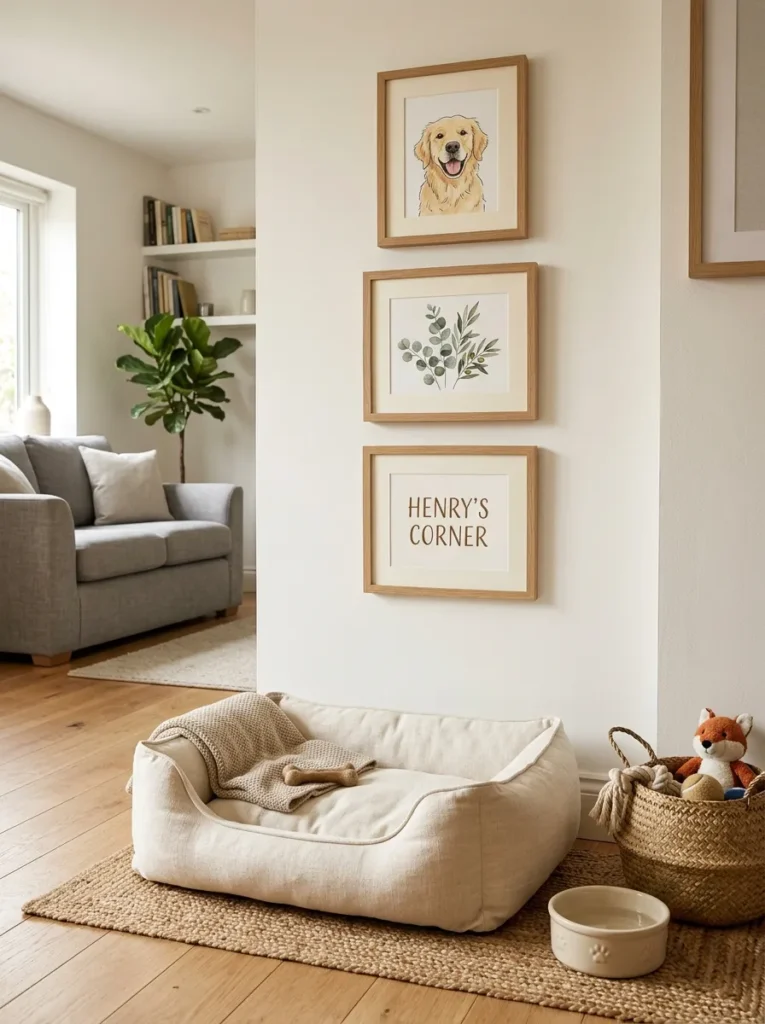
Vibe: Warm and personal — the dog corner that communicates genuine affection through the same design language used everywhere else in the room.
Why it works: The dog corner with a dedicated gallery wall is the dog corner idea that most directly communicates the design principle at the heart of this entire list — that the dog’s space deserves the same design intention and the same personal investment as every other area of the home. A gallery wall above the dog’s bed applies the same compositional logic as a gallery wall above a sofa or a desk: it creates a designed focal point on the wall, it introduces personal and meaningful imagery into the space, and it signals that the corner was considered and curated rather than incidentally occupied. The dog portrait illustration is the artwork choice that most naturally belongs in the dog corner’s gallery — a commissioned or printed illustration of the specific dog in a consistent artistic style with the rest of the room’s framed prints creates the most genuinely personal and most design-forward version of the dog corner gallery wall.
How to get it: Commission a custom dog portrait illustration from an illustrator on Etsy or through a specialist pet portrait artist — most offer digital prints that can be printed locally at standard frame sizes ($30–150 for a digital portrait in a botanical or line-art style). Frame all gallery pieces in the same frame profile and finish (natural timber or matte black, in the same size or in graduated sizes) to create the compositional unity that makes the gallery read as designed rather than assembled. Space the gallery pieces at consistent 50–80mm gaps, with the lowest piece positioned approximately 200mm above the dog bed’s top surface.
Shop the Look
| Product |
|---|
| Custom dog portrait illustration print |
| Natural timber picture frame set |
| Linen dog bed ivory |
| Ceramic dog water bowl |
| Woven toy basket natural |
8. Mudroom Dog Corner with Built-In Wash Station
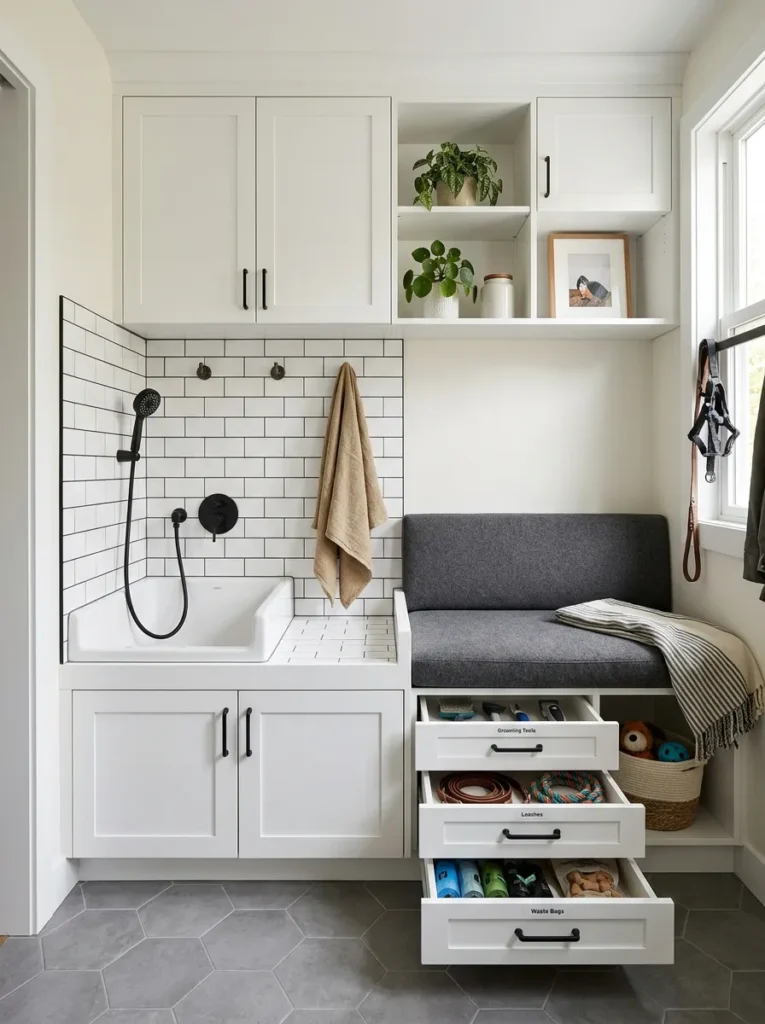
Vibe: Organized and functional — the mudroom corner that makes dog ownership feel like a completely solved design problem.
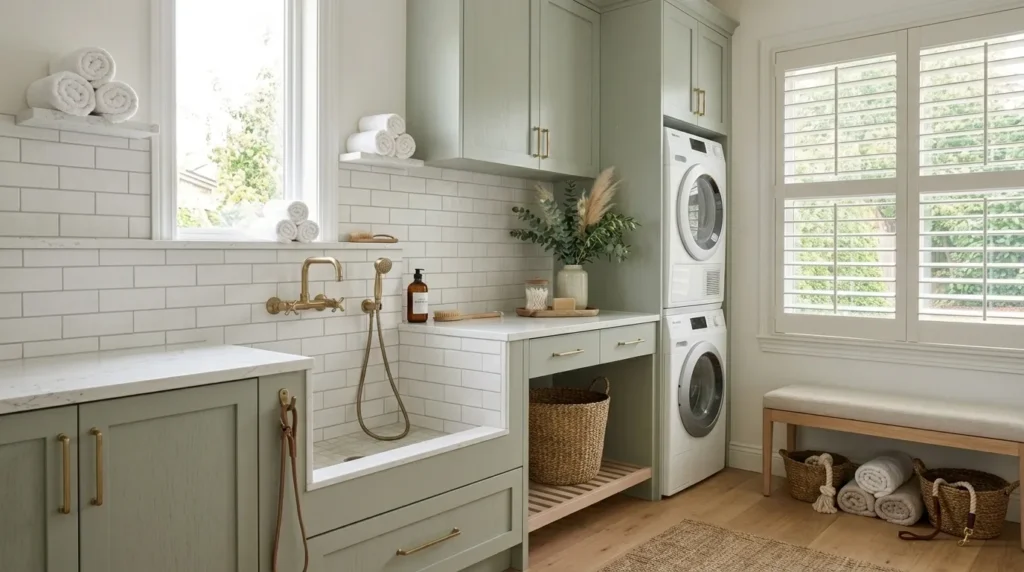
Why it works: The mudroom dog corner with an integrated wash station is the dog corner idea that most completely addresses the practical friction of dog ownership — the mud, the wet coats, the post-walk decontamination that is a daily reality for any dog owner — by building the solution into the home’s architecture rather than managing it with improvised solutions (the backyard hose, the shared bathtub, the towel-on-the-floor approach). The low-profile dog wash basin at 350mm height — designed for a dog to step into at ground level rather than be lifted into a standard-height basin — is the specific practical detail that makes the wash station genuinely usable as a daily tool rather than as an occasional-use convenience. Integrating all dog-related storage (leashes, grooming tools, waste bags, towels) into the same cabinetry system as the wash station creates a complete, dedicated dog management zone that concentrates all pet-related activity in one designed location.
How to get it: The dog wash basin can be specified as a custom-cut stone or acrylic basin at 350mm height (approximately knee height for an adult, step-in height for most dogs) plumbed into the mudroom’s wet area infrastructure. The cabinetry around the wash station should be in the same finish as the rest of the mudroom cabinetry — integration is the design goal, and cabinetry that matches reads as a designed feature rather than a retrofitted pet addition.
Shop the Look
| Product |
|---|
| Dog wash basin low profile |
| Handheld shower attachment |
| Matte black tapware set |
| Below bench drawer set |
| Dog towel hook set |
9. Bedroom Dog Corner with Matching Bed Linen
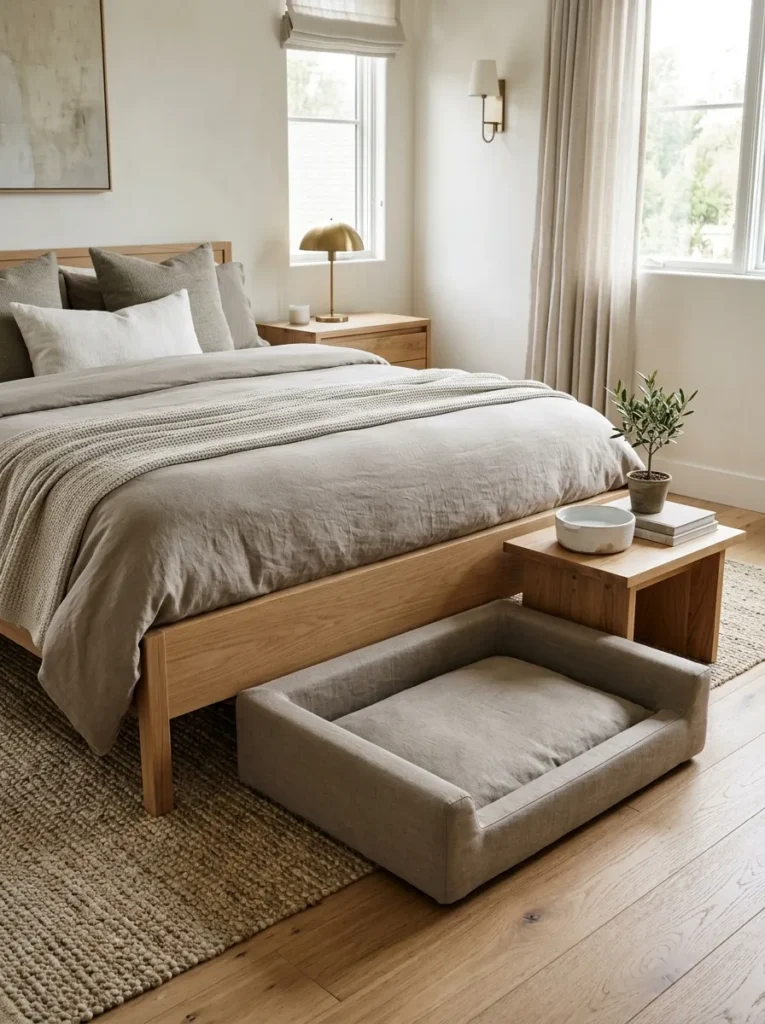
Vibe: Serene and integrated — the bedroom dog corner that makes the dog’s sleeping space feel like a natural continuation of the bedroom’s designed sleeping environment.
Why it works: The bedroom dog corner at the foot of the bed with matching linen is the dog corner idea that most gracefully integrates the dog’s sleeping position — which for many dogs is naturally at the foot of their owner’s bed, satisfying the pack-sleeping instinct — with the bedroom’s design scheme. The matching linen between the human bed and the dog bed is the single design decision that most powerfully creates this integration: when the dog bed cover and the duvet cover share the same fabric, color, and textile character, both read as part of the same bedroom linen program rather than as a bed and a separately purchased pet accessory. The small timber table beside the dog bed is the detail that most completely establishes the dog corner as a designed space — it is the dog’s own bedside table, scaled for the dog’s bed rather than the human’s, and its presence communicates that the dog’s corner was designed rather than improvised.
How to get it: Source the dog bed cover in the same or closely matched linen as the bedroom’s duvet cover — most quality linen bedding brands produce dog bed covers in the same fabric and color range as their human bedding (Cultiver, Quince, and French Flax Linen all produce coordinating ranges). A small side table in the same timber species as the bedroom’s other furniture — scaled to approximately 400mm height and 300mm diameter, which is proportionate to a medium-sized dog bed — can be sourced from homewares retailers or produced custom by a furniture maker.
Shop the Look
| Product |
|---|
| Linen dog bed cover greige |
| Matching linen duvet cover |
| Small timber side table 400mm |
| Ceramic dog water bowl |
| Linen dog cushion insert |
10. Dog Corner Cabinet with Hidden Crate and Display Shelves Above
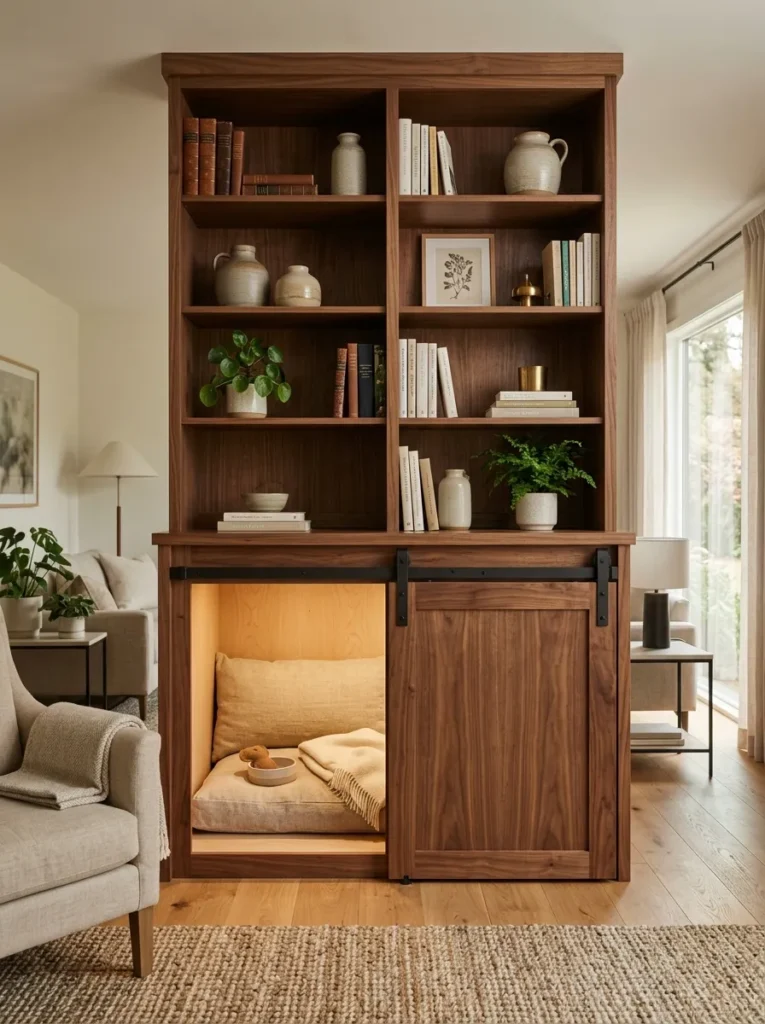
Vibe: Integrated and custom — the living room cabinet that solves the dog crate aesthetic problem so completely that it stops being a problem.
Why it works: The dog corner cabinet with a hidden crate is the dog corner idea that most definitively resolves the tension between the dog’s crate need and the room’s design quality — by integrating the crate into the lower section of a purpose-designed cabinetry piece whose upper section serves as a display shelving unit, the crate becomes architecturally invisible within the room’s furniture program. The dog crate is the domestic pet provision that most consistently and most significantly disrupts a room’s visual quality in its standard form — a metal wire crate positioned in a living room reads as containment infrastructure regardless of its practical function. Built into the lower section of a timber cabinetry piece, the same crate function is completely absorbed into the furniture’s design logic, reading as a designed compartment rather than a cage.
How to get it: Commission the cabinet from a local cabinet maker or fitted furniture specialist — the design requires integration of the crate opening dimensions (which must be sized to allow the specific dog to enter, turn around, and lie down comfortably) with the aesthetic proportions of the cabinetry system. The minimum crate opening width and height should be 1.5 times the dog’s shoulder height and 1.5 times the dog’s body length — this provides the comfortable interior dimensions that make a crate a genuinely restful den rather than a confined cage.
Shop the Look
| Product |
|---|
| Custom cabinetry dog cabinet |
| Sliding timber door hardware |
| Linen crate cushion |
| Display shelf timber |
| Cabinet maker consultation |
11. Outdoor Dog Corner on the Patio with Weather-Resistant Furniture
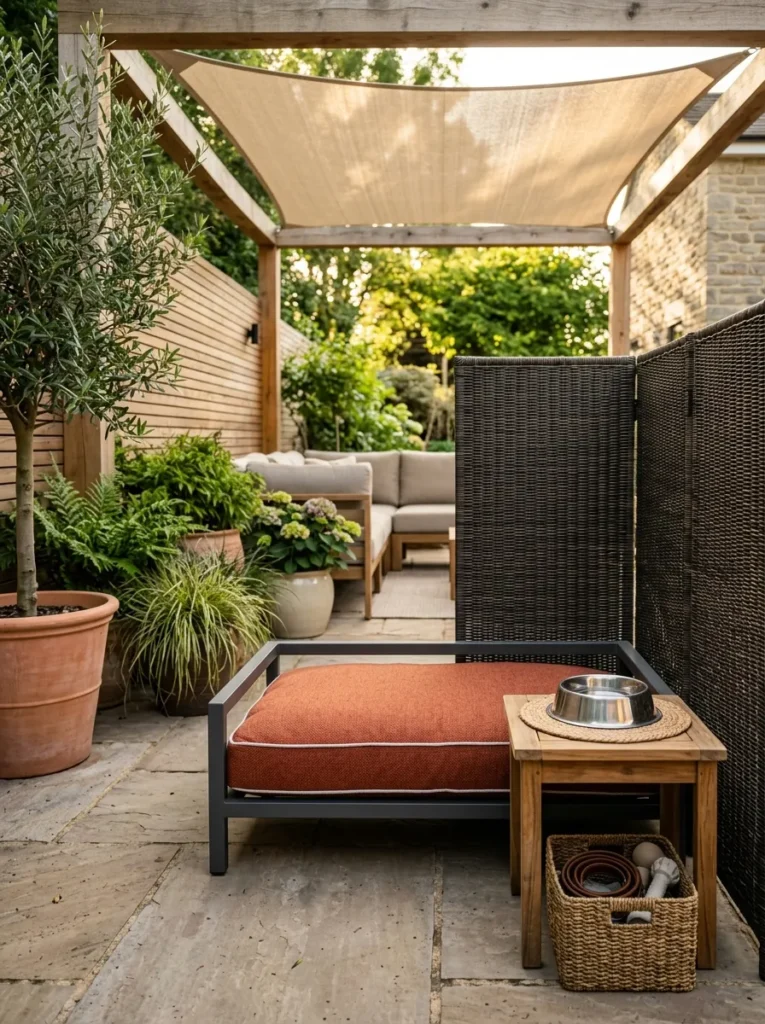
Vibe: Warm and outdoor — the patio dog corner that makes the garden feel designed for the whole household rather than just the humans who entertain in it.
Why it works: The outdoor dog corner on the patio is the dog corner idea that most naturally extends the indoor dog corner design principles into the outdoor living environment — creating a defined, enclosed, weather-resistant sleeping and resting space for the dog in the patio or garden zone where the dog spends significant daytime hours. Dogs in outdoor environments seek the same shelter and enclosure qualities as they do indoors — a partially enclosed outdoor space with overhead shade and a raised sleeping surface satisfies the dog’s instinctive preference for a defensible, sheltered position with a view of the surrounding environment. The powder-coated steel bed frame with a UV-resistant cushion is the material specification that maintains the outdoor dog corner’s designed quality across years of exposure to weather, UV, and the mechanical stress of a dog’s use.
How to get it: Specify all materials in outdoor-rated specifications — UV-resistant outdoor fabric for the cushion cover (Sunbrella or equivalent), powder-coated steel for the frame (minimum 2mm wall thickness for structural rigidity), and stainless steel for the water bowl (to prevent the rust and bacterial growth that occurs in standard steel bowls in outdoor humidity). The wicker screen enclosure should be from a weather-resistant synthetic rattan rather than natural rattan, which deteriorates rapidly in UV exposure and moisture cycling.
Shop the Look
| Product |
|---|
| Powder coated steel dog bed frame |
| Sunbrella outdoor fabric terracotta |
| Stainless steel dog water bowl |
| Synthetic rattan screen panel |
| Outdoor shade sail UV rated |
12. Farmhouse Dog Corner with Barrel Bed and Chalkboard Name Sign
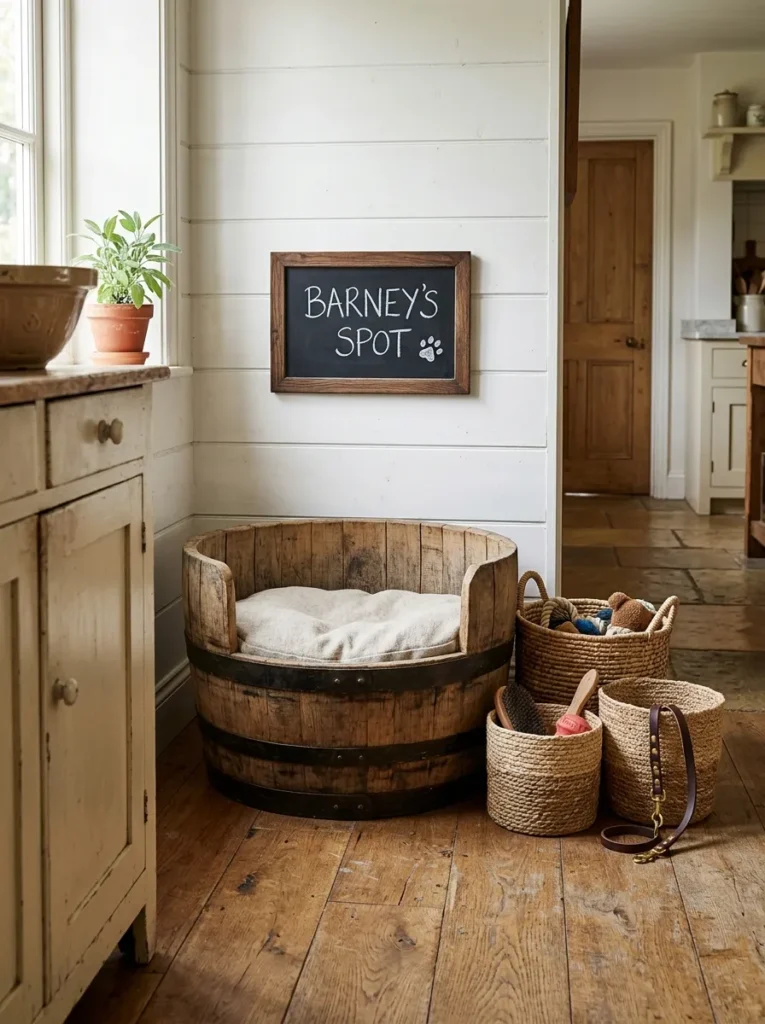
Vibe: Warm and farmhouse — the dog corner that makes the kitchen feel like a complete family room rather than just a cooking space.
Why it works: The barrel bed dog corner is the farmhouse dog corner that most authentically references the agricultural material culture that defines the farmhouse interior aesthetic — the timber barrel is a genuine farmhouse object whose repurposing as a dog bed references the working farm tradition of providing dogs with barrel shelters as outdoor kennels, while its interior placement and linen cushion lining elevates it from a utilitarian provision to a designed domestic object. The chalkboard name sign above the barrel applies the same material language as the kitchen’s chalkboard menu boards and recipe walls that define farmhouse kitchen design — connecting the dog’s space to the room’s existing decorative vocabulary through a shared material (chalkboard) and a shared graphic approach (chalk script typography).
How to get it: Source a vintage oak or pine barrel from antique dealers, winery supply specialists, or agricultural suppliers — vintage barrels have the material aging and patina that makes the barrel bed read as genuinely farmhouse rather than as a prop. Cut the barrel lengthways on its horizontal axis to create a stable, flat-floored sleeping space — the cut should be made with a circular saw and the interior sanded smooth before adding the linen cushion lining. Alternatively, specialist dog bed makers produce barrel-form dog beds in new timber that achieve the same aesthetic at lower cost than a genuine antique barrel modification.
Shop the Look
| Product |
|---|
| Timber barrel dog bed |
| Thick linen cushion barrel size |
| Small chalkboard sign wall mount |
| Chalk pen white |
| Woven basket toy storage set |
13. Dog Corner with Storage Ottoman Integration
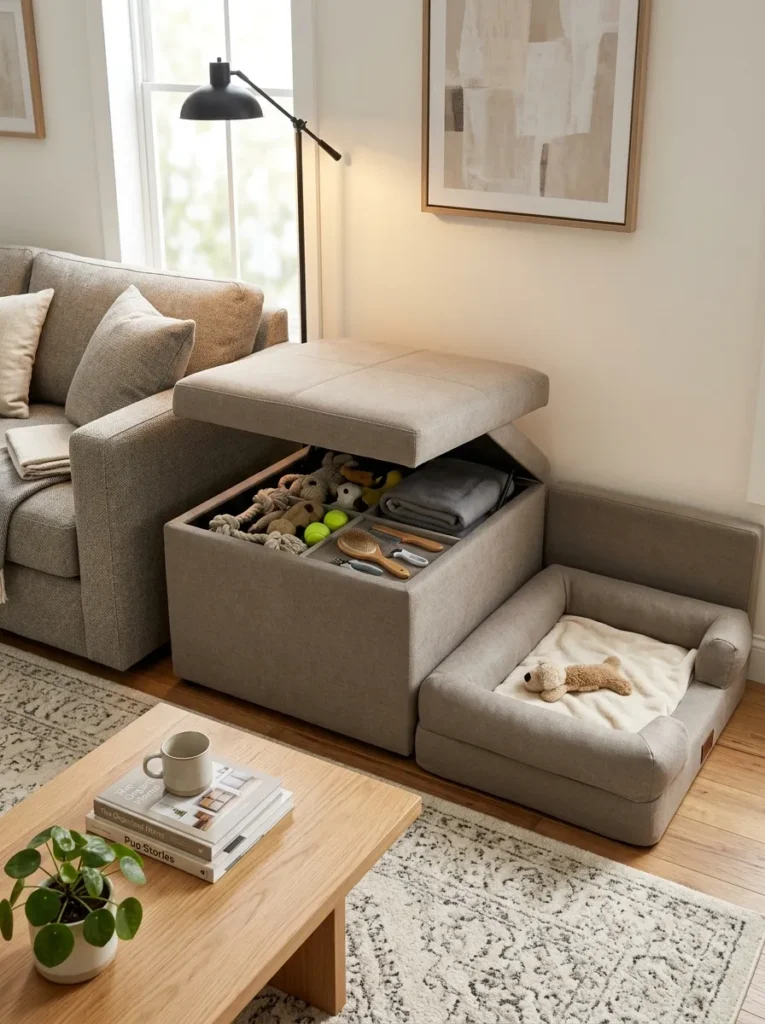
Vibe: Organized and considered — the living room corner that solves storage, seating, and dog accommodation in a single coherent furniture arrangement.
Why it works: The dog corner integrated with a storage ottoman is the dog corner idea that most efficiently uses the living room’s spatial resources — the ottoman functions simultaneously as additional seating for humans, as a storage vessel for the dog’s accessories (which would otherwise be scattered in baskets or visible in bags), and as one side of a partial enclosure for the adjacent dog bed (the dog bed positioned against the ottoman’s side uses the ottoman as a backing wall that creates the enclosed, supported sleeping position many dogs prefer). The matching fabric between the ottoman and the dog bed is the material coherence decision that makes both read as part of the same designed furniture arrangement rather than independent pieces placed in proximity.
How to get it: Choose the ottoman first in a performance fabric appropriate for a room with a dog — Crypton, Revolution, or similar stain-resistant performance fabrics in a warm greige or neutral tone coordinate with the widest range of dog bed options. Select the dog bed in the closest available fabric match to the ottoman, or commission a custom dog bed cover in the same performance fabric as the ottoman. Position the dog bed with one side flush against the ottoman’s long face — this creates the enclosed, supported position without requiring a built-in structure.
Shop the Look
| Product |
|---|
| Storage ottoman performance fabric |
| Dog bed cover matching fabric |
| Dog toy basket for ottoman interior |
| Grooming tool storage set |
| Performance fabric care kit |
14. Dog Corner with Herb Basket and Calming Plant Display
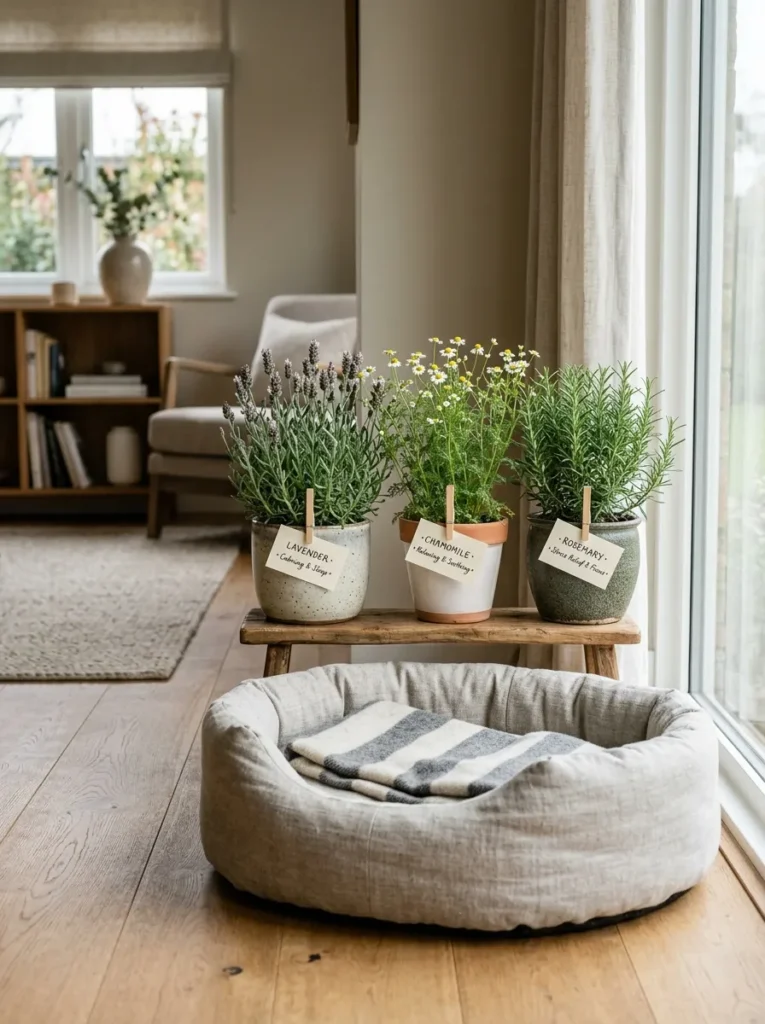
Vibe: Calm and botanical — the dog corner that treats the dog’s rest environment with the same holistic intention that a good bedroom design applies to the human sleeping environment.
Why it works: The dog corner with calming plant display is the dog corner idea that most thoughtfully applies the biophilic design principle — the documented benefit of living plant material in domestic environments — to the dog’s specific rest space. Lavender has been documented in animal behavior research to have mild anxiolytic effects on dogs when the scent is present at low concentrations in the resting environment, and the visual presence of botanical plant material provides the same organic, nature-connected quality to the dog’s corner that indoor plants provide to any domestic space. The handwritten plant label cards are the design detail that most clearly communicates the intentionality of the arrangement — they transform the plant display from a decorative grouping to an informed, purposeful wellness design.
How to get it: Confirm that all plants in the dog corner display are genuinely safe for dogs before positioning them — lavender, rosemary, and chamomile are all confirmed non-toxic to dogs by the ASPCA in the quantities present in a small pot display. Position the plant pots at a height that prevents the dog from eating the plants directly (on a small raised shelf or on a surface 400mm above the dog’s head height) while maintaining their visual presence within the dog corner composition. The handwritten label cards can be written on small kraft paper cards with a fine-tip pen — the handwritten format reads as more personal and more considered than printed labels.
Shop the Look
| Product |
|---|
| Lavender pot small established |
| Rosemary pot established |
| Chamomile plant pot |
| Small ceramic pot set white |
| Kraft paper label card set |
15. Luxury Dog Corner with Cashmere Throw and Designer Bed
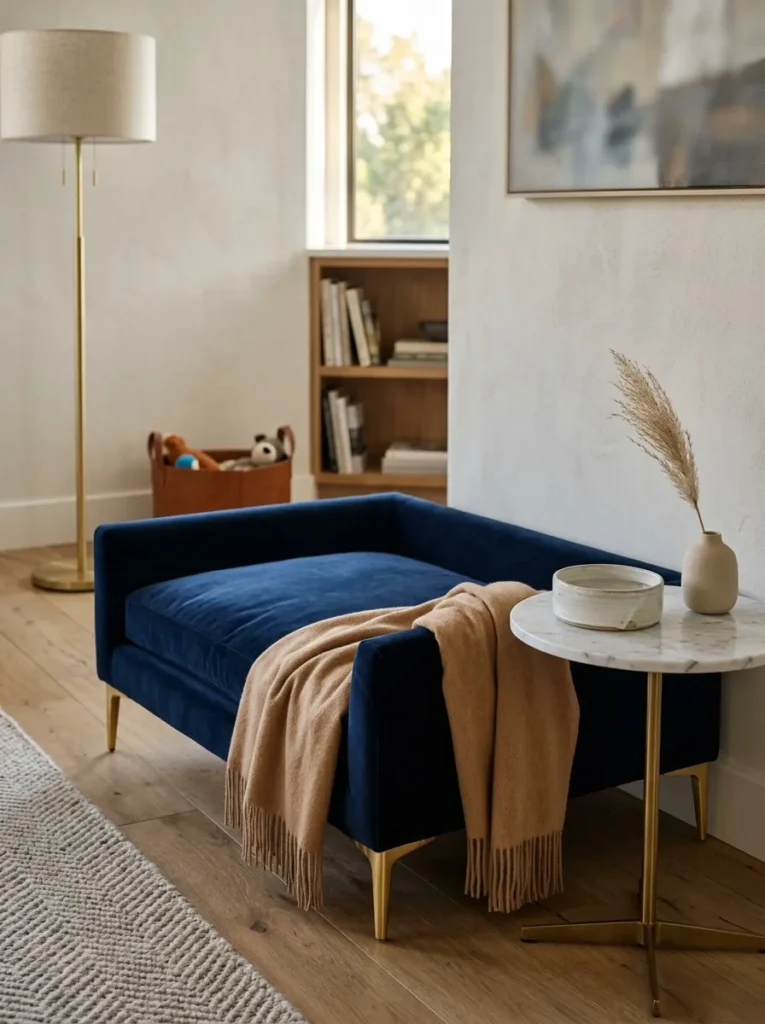
Vibe: Warm and maximally considered — the dog corner that makes every other design decision in the room look more intentional simply by existing.
Why it works: The luxury dog corner with a cashmere throw and a designer dog bed is the dog corner idea that most completely abandons the distinction between pet furniture and luxury interior design — it applies the exact same material investment, compositional intention, and accessory quality to the dog’s corner as to any other vignette in the room, creating a corner whose beauty and material richness are perceived immediately and whose function as a dog space is recognized only on closer examination. The cashmere throw draped over the corner of the dog bed is the specific styling detail that most powerfully communicates luxury — cashmere in any domestic context reads as the highest-quality textile investment available, and its presence in the dog’s corner communicates an aesthetic commitment that goes far beyond functional pet provision. The marble side table is the compositional device that establishes the dog’s corner as a fully designed vignette with the same spatial logic as a human reading corner — a surface beside the resting position, a light source at the correct position, a decorative object that adds botanical interest.
How to get it: Source a designer dog bed from specialist luxury pet furniture brands — Miacara, Hundhund, and Molly Mutt all produce dog beds whose design quality is genuinely competitive with premium human furniture. The cashmere throw can be an authentic luxury cashmere from a quality knitwear brand (a worn or slightly pilled cashmere throw that has been retired from human use is both practically appropriate and aesthetically authentic). The marble side table should be the smallest available in the room’s existing marble or stone material palette — a 200mm diameter marble coaster elevated on a slim base is sufficient to hold the water bowl and a small vase.
Shop the Look
| Product |
|---|
| Designer velvet dog bed navy |
| Cashmere throw camel |
| Marble side table small |
| Ceramic dog water bowl |
| Slim brass floor lamp |
How to Start Your Dog Corner Transformation
Your single first move is to observe where your dog already chooses to rest when given complete freedom of movement throughout your home — because the location your dog self-selects for sleeping and resting reveals the specific behavioral preferences (proximity to the pack, light level, traffic level, temperature zone, degree of enclosure) that should inform the placement of the designed dog corner. A dog that consistently sleeps at the foot of the bed will not use a dog corner placed in the living room regardless of its design quality. A dog that prefers to sleep in the kitchen where household activity is highest will not voluntarily use a quiet bedroom corner. A dog that seeks the darkest, most enclosed spot in every room needs an enclosed, den-like dog corner rather than an open platform bed regardless of how beautiful the open bed is. The observation of the dog’s self-selected resting behavior is the design brief that determines everything else — placement, enclosure degree, proximity to human activity — before any design or purchase decision is made.
The most common dog corner design mistake is prioritizing the dog corner’s visual appeal over its behavioral appropriateness — purchasing or building a beautiful dog space that the dog refuses to use because it fails to satisfy the instinctive behavioral requirements that the dog is communicating through its existing resting behavior. A designed dog corner that the dog avoids completely fails its primary design brief regardless of how beautifully it reads in the room. The solution is to identify the behavioral requirements first (enclosure degree, location, proximity to human activity, temperature zone) and then design within those requirements rather than designing a beautiful corner first and hoping the dog’s behavior will adapt to it.
Three specific investments under $80 that create immediate dog corner design quality: (1) A custom linen cushion cover in a color that coordinates with the room’s existing textile palette ($25–55 from specialty fabric shops or Etsy textile makers) applied to any existing dog bed immediately transforms the dog bed from a generic pet product into a textile that belongs to the room’s designed interior — the cover is the single highest-return dog corner upgrade available at any budget level. (2) A small ceramic water bowl in a color and form that complements the dog corner’s material palette ($15–30 from any homewares retailer) replaces the standard plastic or stainless bowl that reads as pet equipment with an object that reads as domestic pottery — the water bowl is the most-observed daily-use object in the dog corner and its design quality is noticed at the intimate distance of regular daily interaction. (3) A simple framed print positioned above the dog bed — a botanical illustration, a breed portrait, or a typographic name piece in a frame that matches the room’s existing gallery frames ($15–35 printed and framed) — creates the gallery wall gesture that most clearly communicates design intention above the dog’s space and signals that the corner was designed rather than improvised.
Realistically, a complete designed dog corner — a custom-built niche or cabinet, a quality dog bed in coordinated textiles, a small side table, a dedicated water bowl, and an above-bed gallery arrangement — costs $300–1,200 depending on the complexity of the built-in element and the quality of the furniture pieces. A focused three-element dog corner transformation — a coordinated linen dog bed cover, a ceramic water bowl, and a framed print above the bed — costs $55–120 and produces a dog corner that reads as genuinely considered from across the room without any structural work or furniture purchase. Most dog owners begin with the textile coordination (the linen cover) and the ceramic bowl, observe how these two changes transform the dog corner’s visual quality, and invest in the more structural elements (the built-in niche, the dedicated side table, the gallery wall) as the corner’s design identity becomes clearer through the lived experience of inhabiting the improved space alongside the dog who uses it.
Frequently Asked Questions About Dog Corner Design
What makes a dog corner blend with the interior design of a room?
The three qualities that most reliably make a dog corner blend with its surrounding room are material coherence (the dog bed’s fabric, color, and texture belong to the same material family as the room’s existing upholstery and textiles), positional intentionality (the dog corner is positioned in a location that reads as chosen rather than defaulted to — in an alcove, at the foot of a sofa, in a purpose-designed niche), and accessory coordination (any accessories in the dog corner — water bowl, toy storage, name sign — are in materials and finishes that coordinate with the room’s existing hardware and decorative objects). The single most important of these three is material coherence: a dog bed in a color and fabric that matches the room’s existing textiles blends into the room from the moment it is placed, while a dog bed in a contrasting or uncoordinated material reads as a separate, imported element regardless of its individual quality.
What is the best material for a dog bed that also looks good in a living room?
Natural linen is the dog bed material that most consistently reads as an interior textile rather than a pet product — its natural fiber variation, its characteristic slight texture, and its warm neutral tones are the same visual qualities that make linen the most popular soft furnishing fabric in contemporary interior design, and these qualities read as just as appropriate in a dog bed as in a sofa cushion or a window treatment. Linen also has the practical quality of being washable at temperatures that genuinely sanitize (60°C) without the significant shrinkage or quality loss that other natural fabrics experience, making it the most practical choice for a regularly washed dog bed cover. Cotton canvas is the most durable alternative, providing a slightly heavier, more structured appearance than linen while sharing linen’s capacity for regular high-temperature washing.
How do I create a dog corner in a small apartment without taking up too much space?
The small apartment dog corner requires spatial efficiency as its primary design constraint, which points toward three specific approaches: the wall-mounted floating shelf bed (which removes the dog’s sleeping area from the floor plan entirely), the IKEA cube integration (which incorporates the dog’s space into an existing storage wall without adding any additional furniture footprint), and the storage ottoman integration (which uses a piece of furniture with an existing floor plan role to simultaneously anchor the dog’s corner). All three approaches accommodate a dog’s sleeping requirements without adding significant floor area — the floating shelf adds no floor footprint at all, the cube integration uses existing shelving area, and the storage ottoman’s footprint serves double duty as seating and as the dog corner’s anchor. The ottoman integration is the most accessible of the three for most renters, as it requires no installation and no modification to existing furniture.
How do I keep the dog corner looking clean and designed rather than messy?
The dog corner’s cleanliness and designed quality is maintained through four daily and weekly practices: daily removal of any toys or accessories that have migrated out of the designated storage into the dog corner’s floor area (toys on the floor around the dog bed read as clutter within minutes of the dog moving them), weekly washing of the dog bed cover (a clean dog bed cover maintains the textile quality that blurs the distinction between pet furniture and interior textile), a ceramic or stone water bowl that is washed daily and replaced with fresh water (a clean water bowl in a beautiful material reads as a domestic object; a stained or encrusted standard bowl reads as pet equipment), and a consistent toy storage system (a single woven basket or a dedicated compartment within a storage ottoman that contains all toys when not in active use prevents the visual scatter that most disrupts a dog corner’s designed quality).
Can I create a dog corner in a rental apartment without making permanent changes?
Yes — all of the highest-impact dog corner design approaches require no permanent modifications to the rental property. The IKEA cube integration, the rattan round dog bed, the velvet tufted bed matching the sofa upholstery, the bedroom foot-of-bed arrangement, the storage ottoman integration, and the gallery wall arrangement above the dog bed are all completely removable and leave no trace in the rental when the tenancy ends. The only approaches in this list that require permanent work are the built-in alcove niche, the under-stair dog den, the mudroom wash station, and the custom dog cabinet — all of which require structural modifications that are only appropriate in an owned property. For renters, the rattan round dog bed with a coordinated linen cover and a small framed print above it positioned in the dog’s self-selected resting location produces the most significant visual improvement within the rental-appropriate constraint of zero permanent modification.
Ready to Design Your Dog’s Perfect Corner?
These 15 ideas span the full range of what a designed dog corner can be — from a built-in alcove niche painted in continuity with the surrounding wall that makes the dog’s space architecturally invisible, and a luxury navy velvet bed with a cashmere throw that makes the dog’s corner the room’s most admired design vignette, to a farmhouse barrel bed with a chalkboard name sign, a mudroom wash station that solves the practicalities of dog ownership at the architectural level, and a calming botanical corner that applies biophilic design principles to the dog’s rest environment — so whether you are designing for a toy breed in a studio apartment or a large breed in a family home, whether your design aesthetic is minimalist Japandi or maximalist bohemian or considered farmhouse, there is a genuinely achievable, genuinely beautiful dog corner here for your specific space, your specific dog, and the specific quality of domestic life you are creating together. The design begins with observation — with the three days of watching where the dog already chooses to rest and what the specific qualities of that self-selected position reveal about the behavioral brief — and continues with the textile decision that makes the dog corner belong to the room rather than apologize for its presence within it. Today’s specific action: identify the corner or location where your dog already most frequently rests, measure that space, and find one linen or cotton canvas dog bed cover in a color that belongs to the room’s existing textile palette. Place the covered bed in the observed resting location. Observe the transformation. Everything else in this list follows from that first textile decision — and from the moment you recognize that your dog’s space, designed with the same intention as every other area of your home, makes the whole room feel more considered, more generous, and more genuinely lived in by everyone who calls it home.