A cat grass box is a purpose-grown or purpose-designed planting container filled with cat-appropriate grass species — most commonly wheatgrass, oat grass, barley grass, or rye grass — that provides indoor cats with a safe, digestive, and behaviorally enriching plant to chew, nibble, and interact with as part of their daily domestic environment. This article gives you 16 genuinely creative, styled cat grass box designs that serve your cat’s wellbeing completely while reading as considered interior decor rather than a plastic tray of sprouted seeds pushed under a radiator.
Most cat grass presentations default to the functional and the forgettable — a clear plastic tray from a pet store, a generic terracotta pot with no design consideration, a seed packet grown in whatever container was available. The cat grass boxes in this list make a fundamentally different choice: they treat the cat grass container as a design object with the same seriousness as a houseplant display or a shelf vignette, selecting materials, forms, and placements that make the grass look genuinely beautiful in the room while delivering maximum benefit to the cat who will eat it. Here are 16 ideas worth saving — and growing.
Why Cat Grass Box Design Works So Well
The cat grass box as a domestic design and pet welfare object draws from two distinct traditions that have converged in the contemporary pet-inclusive interior. The first is the Japanese ikebana tradition — the art of flower arrangement that treats every plant as an object of considered presentation, where the container is as important as the plant it holds and the space around the plant is as important as the plant itself. The second is the broader contemporary houseplant display movement, which from approximately 2015 onward elevated the indoor plant from a utilitarian air-purifying accessory to a primary interior design element, with the container and the plant together functioning as a designed object that contributes meaningfully to the room’s aesthetic quality. Cat grass, when presented in a container of genuine design quality and positioned with compositional intention, participates in both traditions: it is a living plant with its own visual character (the bright green density of wheatgrass, the looser, more architectural form of oat grass), and it is an object whose presentation communicates care and intention toward the animal that will consume it.
The materials that define a well-executed cat grass box span the same range as the contemporary houseplant display market. Concrete and raw stone planters introduce the industrial-natural tension that reads as contemporary and sophisticated. Handmade terracotta and stoneware ceramics introduce the artisanal, imperfect quality that reads as personal and warm. Natural timber and sustainable bamboo boxes introduce the organic warmth that coordinates with the grass’s own natural character. Woven rattan and seagrass baskets introduce the texture and dimensional interest that makes a simple rectangular planting look styled rather than merely functional. The form matters as much as the material: a long, low rectangular planter presents a dense row of wheatgrass as a miniature landscape; a round ceramic bowl presents a single grass clump as a sculptural specimen; a vintage timber crate presents a generous grass planting as an abundant, generous natural gesture.
The trend reflects the convergence of the indoor plant movement and the pet wellness movement that has characterized domestic design from 2020 onward. As the pet humanization trend has made cat owners increasingly invested in their cats’ environmental enrichment, behavioral health, and sensory experience, cat grass has moved from a niche pet supplement to a standard element of the considered cat household. Research published in the Journal of Feline Medicine and Surgery has documented that cat grass consumption supports digestive health, provides natural fiber, and may help cats expel ingested fur — biological benefits that make cat grass a genuine wellness provision rather than merely a behavioral enrichment. Pinterest searches for “cat grass planter” and “cat grass box design” grew 290% between 2021 and 2024, reflecting the growth of a design-conscious cat owner community that wants their cat’s wellness provisions to look as considered as the rest of their interior.
Small apartments and compact interiors benefit specifically from a well-designed cat grass box because a beautiful cat grass planter occupies the same windowsill, shelf, or floor position as any houseplant — it earns its spatial place through its visual contribution to the room while simultaneously serving the cat’s wellbeing. A thoughtfully designed cat grass box is an object that a houseguest might admire before they recognize it as a cat provision — and that dual identity, as both a designed object and a pet welfare provision, is the quality that distinguishes the 16 designs in this list from a standard pet store purchase.
Style at a Glance
| Element | Detail |
|---|---|
| Philosophy | The cat grass box is a designed object first — the container, the grass species, and the placement all contribute to the room’s aesthetic while serving the cat’s behavioral and digestive needs |
| Key Materials | Concrete, handmade terracotta, stoneware ceramic, natural timber, bamboo, woven rattan, vintage timber crates, stone |
| Grass Species | Wheatgrass (Triticum aestivum), oat grass (Avena sativa), barley grass (Hordeum vulgare), rye grass (Lolium perenne) |
16 Cat Grass Box Designs
1. Concrete Rectangular Trough with Dense Wheatgrass
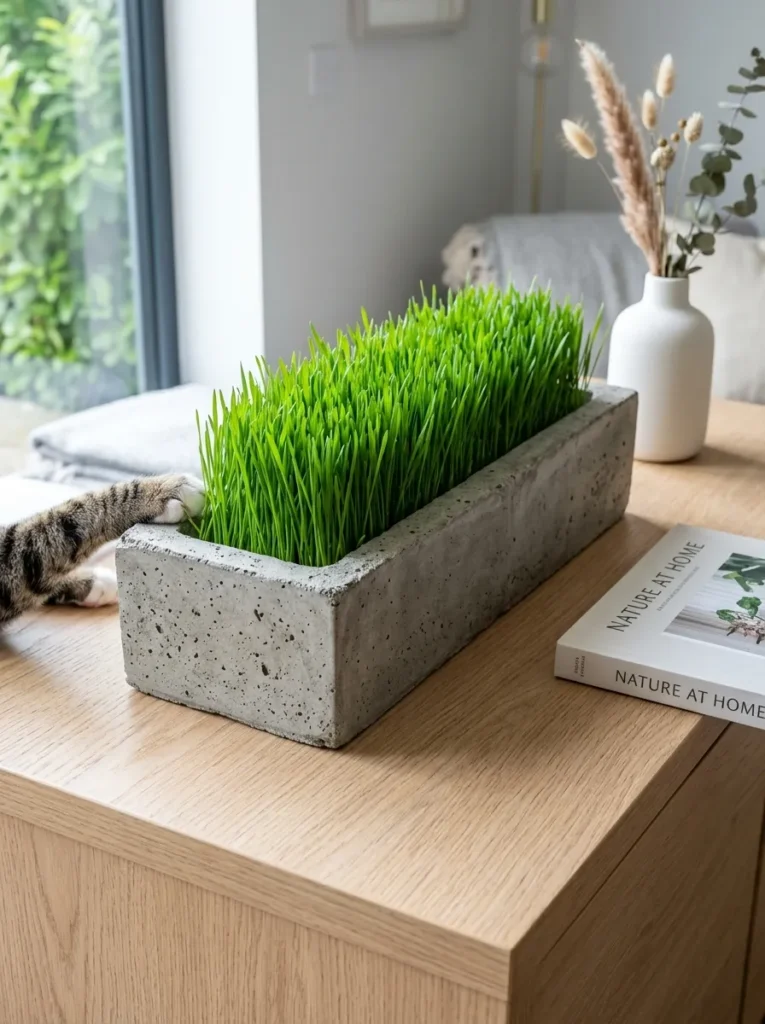
Vibe: Clean and considered — the cat grass container that looks like it was designed by a landscape architect for a cat with excellent taste.
Why it works: The concrete rectangular trough with dense wheatgrass is the cat grass presentation that most powerfully demonstrates the landscape design principle of the green plane — a perfectly flat, dense, uniformly cropped surface of bright green grass hovering above a raw concrete vessel reads as a miniature landscape installation rather than a pet provision. The contrast between the raw industrial grey of the concrete and the living, organic brightness of the wheatgrass is the specific visual relationship that makes this presentation read as contemporary interior design — the same material dialogue appears in high-end landscape architecture where raw concrete paths are set against closely mown turf margins. The trough format allows the wheatgrass to be planted at sufficient density (10–12 seeds per square centimeter) to produce the solid green plane that defines the composition rather than individual grass blades visible against a soil background.
How to get it: Source a cast concrete trough planter from a specialist concrete garden object maker or homewares retailer — the interior dimensions should be minimum 100mm × 300mm to allow the dense planting that creates the green plane effect. Prepare a seed tray of wheatgrass (Triticum aestivum) first, allowing the seeds to germinate and reach approximately 5cm height before transplanting the entire root mat into the concrete trough — this transplanting approach produces the uniform height and density of the established green plane rather than the uneven germination profile of seeds planted directly in the final container. Water from below by sitting the trough in a shallow tray of water — bottom watering maintains even soil moisture and prevents the top-watering disruption of the grass surface that makes the green plane uneven.
Quick Win: A concrete trough planter used as a cat grass container reads as an interior design object rather than a pet accessory regardless of the grass’s growth stage — even freshly seeded or partially grown, the raw concrete material quality elevates the presentation above any plastic or generic terracotta alternative, making the container the quality investment that pays off from day one.
Shop the Look
| Product |
|---|
| Concrete rectangular trough planter |
| Wheatgrass seed organic 500g |
| Cactus seed raising mix |
| Shallow watering tray |
| Pale oak sideboard display surface |
Also view: 14 Dream Poultry Shed Ideas for Modern Farms
2. Handmade Terracotta Bowl with Oat Grass Clumps
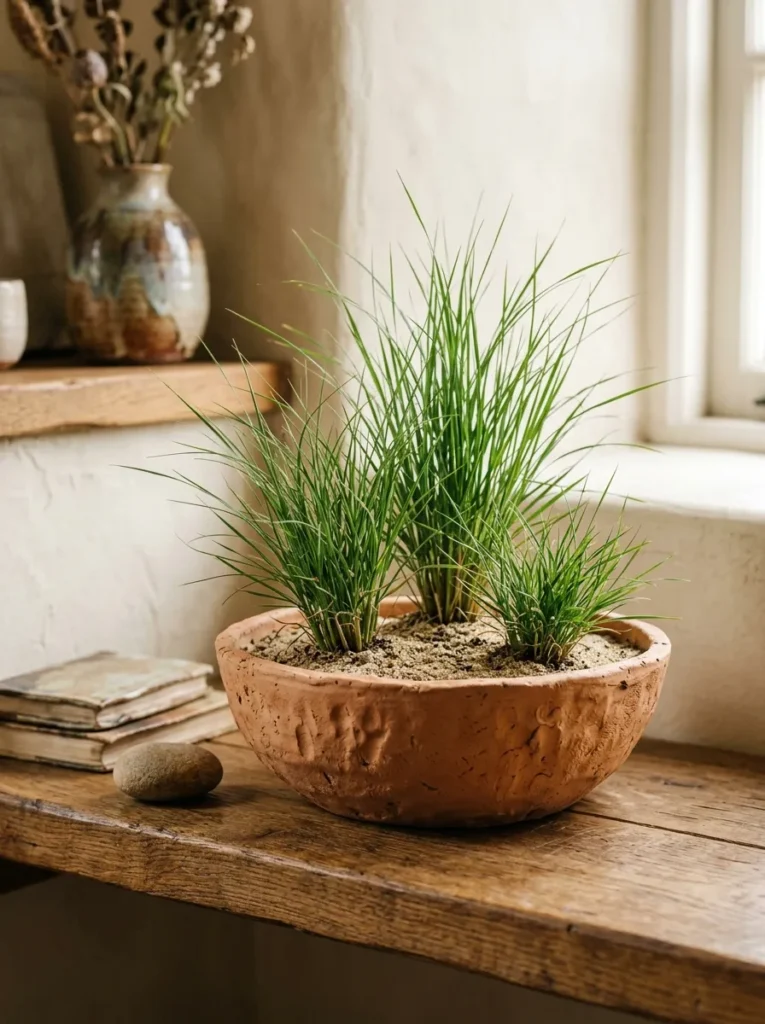
Vibe: Warm and artisanal — the cat grass presentation that looks like a miniature Japanese garden rather than a pet supplement.
Why it works: The handmade terracotta bowl with oat grass planted in three distinct clumps is the cat grass design that most directly applies the principles of Japanese garden composition to a domestic pet wellness object. Oat grass (Avena sativa) has a naturally looser, more architectural form than wheatgrass — its individual blades are wider and more upright, creating visible individual blade characters rather than the dense carpet effect of wheatgrass — which makes it the correct species for a designed three-clump composition where each clump reads as a distinct planted element rather than a section of a continuous surface. The three-clump arrangement in a round bowl applies the rule of odd numbers (always more visually dynamic than even numbers) and the graduated height principle (tallest at back, medium in center, shortest at front) that Japanese garden design uses to create the illusion of depth and natural landscape in a small contained space.
How to get it: Sow oat grass seeds in three separate small containers first, allowing germination and growth to 8–10cm before transplanting each clump into the terracotta bowl in its final position. The clumps should be planted in asymmetrically positioned holes in the bowl’s soil, with the empty soil between them top-dressed with fine river sand immediately after planting — this sand top-dressing is the detail that transforms the soil surface between the clumps from a visible growing medium into the designed ground plane of the miniature landscape. Keep the three clumps at their varied heights by selectively trimming the tallest clump if it outgrows the composition’s intended proportions.
Shop the Look
| Product |
|---|
| Handmade terracotta bowl 22cm |
| Oat grass seed organic |
| Fine river sand top dressing |
| Small seed tray germination |
| Smooth river stone decorative |
Also view: 15 Cozy Dog Nook Ideas with Ambient Lighting
3. Vintage Timber Crate with Abundant Grass Planting
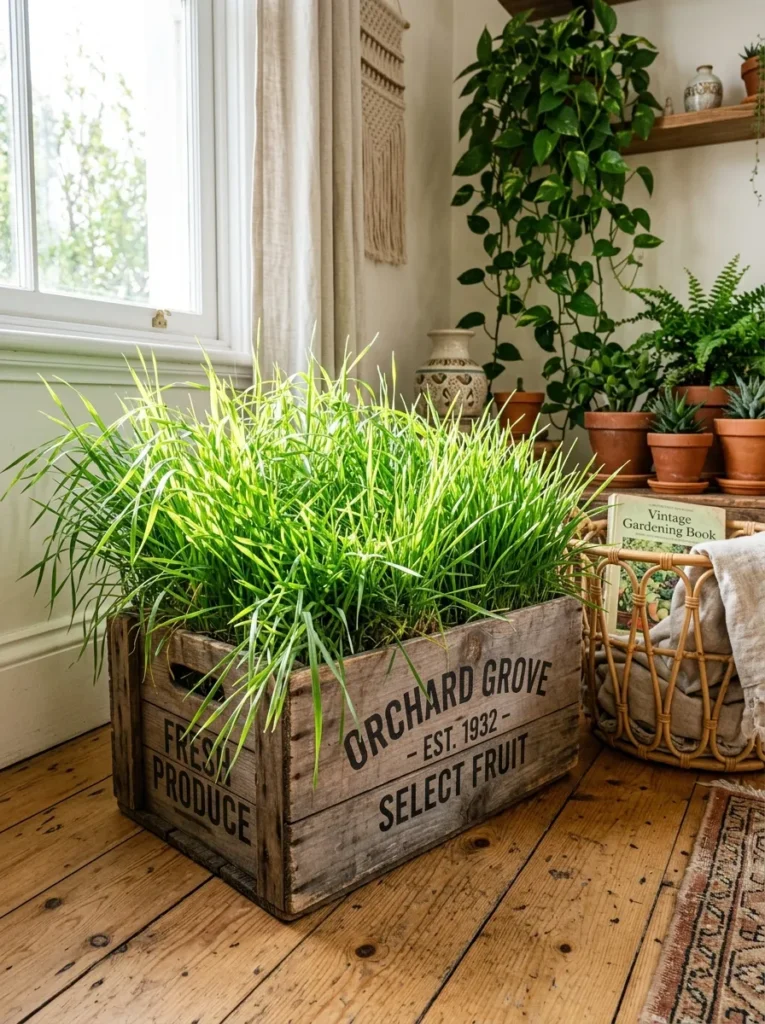
Vibe: Abundant and natural — the cat grass display that looks like a corner of a cottage garden transported indoors.
Why it works: The vintage timber fruit crate with abundant mixed grass planting is the cat grass design that most generously rewards the cat’s behavioral interaction — the abundance of grass (a mixed planting of wheatgrass and oat grass at 40cm × 25cm area provides enough grass for multiple daily grazing sessions) combined with the open, accessible sides of the vintage crate creates a display that invites the cat to approach, explore, and select specific grass blades rather than being presented with a uniform surface that offers no sensory variety. The vintage crate’s material character — aged patina, visible stencil text, rough-sawn timber sides — communicates a deliberate design aesthetic that reads as intentionally rustic and considered rather than generically functional. The mixed grass species creates visible variety in blade width, height, and texture that makes the planting more visually interesting than a single-species planting.
How to get it: Line the vintage crate with a thick plastic sheet or a purpose-cut plastic tray insert before filling with soil — the aged timber of vintage crates has no waterproofing and will degrade rapidly if soil and water contact the raw timber directly. Leave approximately 50mm of crate wall visible above the soil surface so the grass can grow to full height and still spill slightly over the rim without the root system becoming exposed. Sow a 50:50 mix of wheatgrass and oat grass seeds across the full crate area at 8–10 seeds per square centimeter for the abundant, mixed planting that creates this composition.
Shop the Look
| Product |
|---|
| Vintage fruit crate aged |
| Plastic tray liner |
| Wheatgrass seed organic |
| Oat grass seed organic |
| Seed raising mix bag |
4. Wabi-Sabi Crackle Glaze Ceramic with Single Grass Specimen
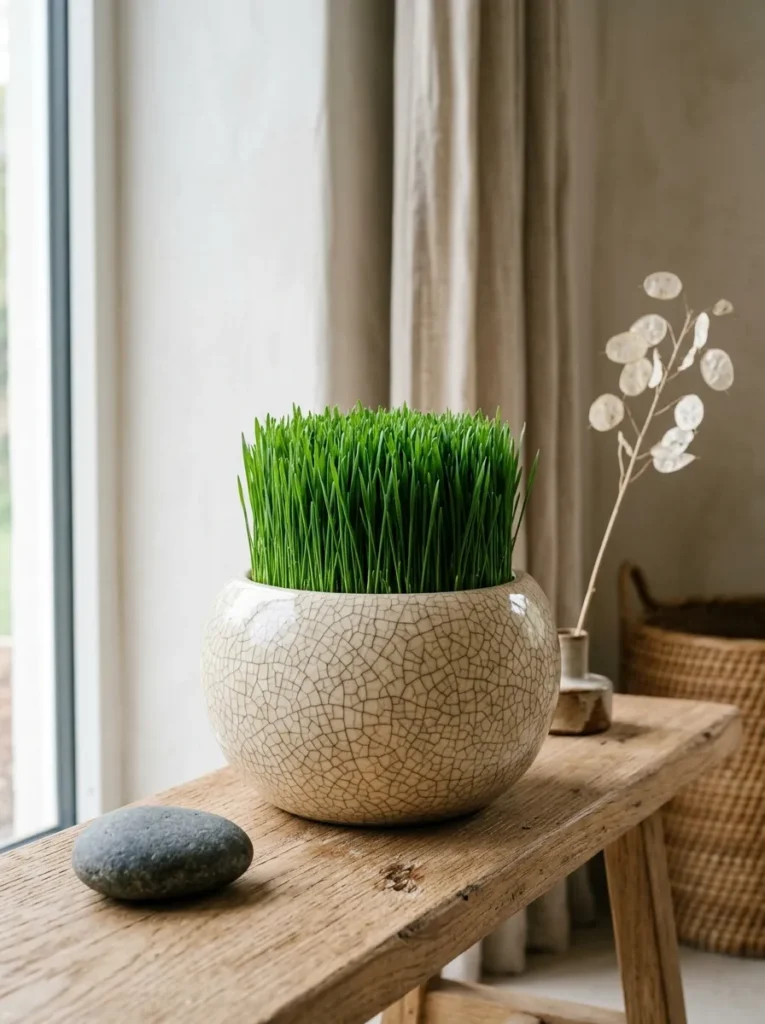
Vibe: Meditative and minimal — the cat grass presentation that makes a supermarket wheatgrass tray look like a philosophical statement.
Why it works: The single specimen grass planting trimmed to a geometric cylinder form in a wabi-sabi crackle glaze ceramic is the cat grass design that most fully occupies the conceptual space between pet provision and art object — the cylinder-trimmed grass form (maintained by regular trimming with sharp scissors to a precise cylindrical profile) transforms the wheatgrass from a casual domestic plant into a topiary specimen that reads as a designed object with the same intentionality as a bonsai or a formal hedging element. The wabi-sabi crackle glaze ceramic is the correct container for this single-specimen approach because its visible material imperfection (the crackle network of the glaze) provides the counterpoint to the geometric precision of the trimmed grass cylinder — the tension between the organic ceramic and the controlled grass form is the aesthetic relationship that makes the Japandi cat grass display one of the most intellectually resolved ideas in this list.
How to get it: Grow the wheatgrass to approximately 15cm height in a seed tray first, then transplant the full root mat into the ceramic pot. Begin trimming the cylinder form when the grass reaches 12–15cm — use sharp fabric scissors (standard garden scissors crush the blade tips and produce brown-ended trimmed grass) to cut the cylindrical profile in a single smooth motion around the perimeter. Retrim every 3–5 days to maintain the cylinder form as the grass continues to grow. The cat will inevitably disrupt the cylinder form when grazing — accept this as the wabi-sabi element of the design and retrim after each grazing session.
Shop the Look
| Product |
|---|
| Crackle glaze ceramic pot ivory |
| Wheatgrass seed organic 200g |
| Seed raising tray |
| Sharp fabric scissors |
| Smooth river stone display |
5. Long Window Box with Multi-Species Grass Landscape
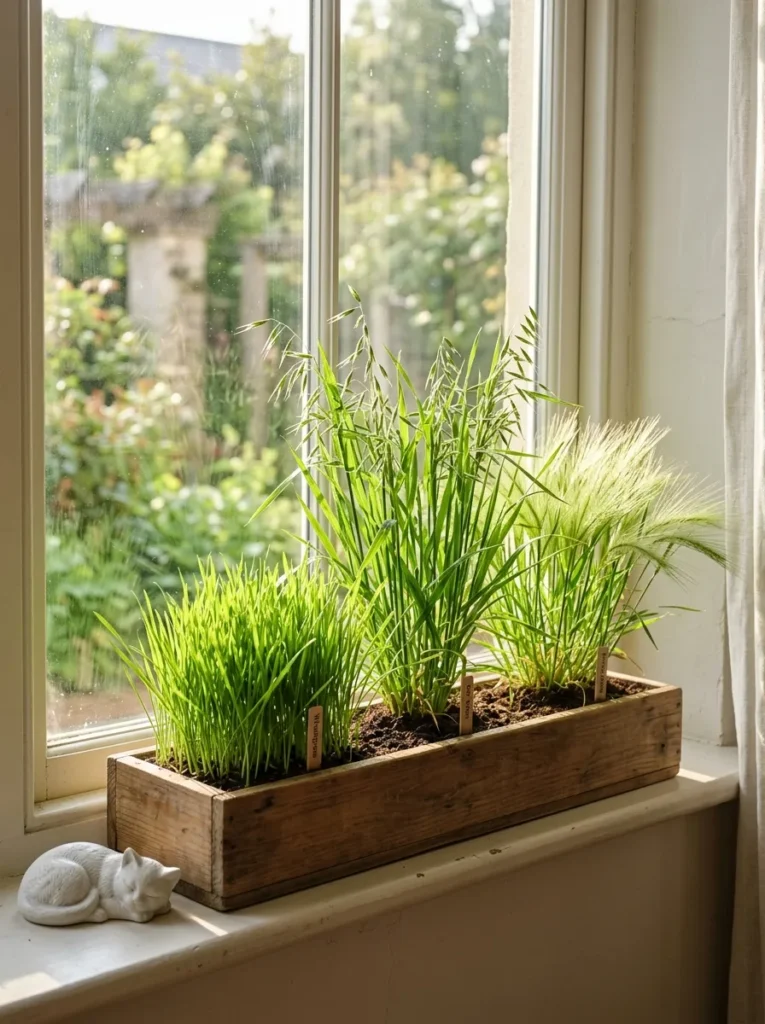
Vibe: Abundant and botanical — the windowsill cat grass that makes morning light the best feature in the room.
Why it works: The long window box with a multi-species grass landscape is the cat grass design that most generously provides variety and sensory richness to the cat through deliberate botanical selection — by planting three distinct grass species in separate, clearly defined zones within a single long planter, the design creates a grass landscape that offers genuinely different taste, texture, and blade structure to the cat as it moves from one zone to another. Wheatgrass (Triticum aestivum) has the finest, densest blade structure; oat grass (Avena sativa) has a wider, looser blade; barley grass (Hordeum vulgare) has a distinctive mid-width blade with a characteristic slightly rough texture. The behavioral enrichment value of this variety — encouraging the cat to explore different grass types and develop preferences — is significantly higher than a single-species planting. The windowsill position is functionally ideal because the cat can approach the grass while on the windowsill in its natural observation position, combining its two most frequent daylight behaviors (window watching and grass grazing) in a single location.
How to get it: Sow each grass species in its own third of the window box, with a 20mm zone of bare soil between species zones — this bare separation prevents the species from intermixing as they germinate and establish, maintaining the distinct zones that are the design content of the landscape. Position the wheatgrass zone nearest the outdoor view and the barley zone nearest the interior — this arrangement places the densest, most formal grass at the window edge where it frames the outdoor view, and the more open barley grass at the interior edge where it reads as a casual planted transition into the room.
Shop the Look
| Product |
|---|
| Long window box planter 60cm |
| Wheatgrass seed organic |
| Barley grass seed organic |
| Oat grass seed organic |
| Ceramic cat figurine small |
6. Woven Seagrass Basket with Removable Grass Insert
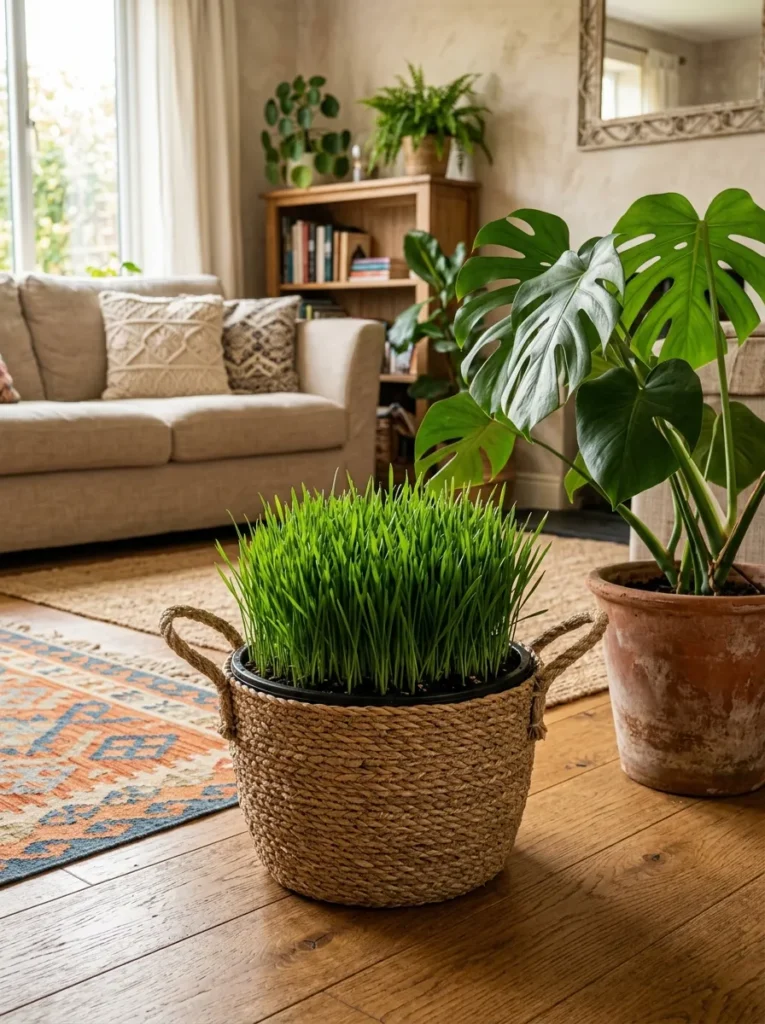
Vibe: Warm and natural — the cat grass presentation that fits seamlessly into a bohemian interior as a plant rather than a pet accessory.
Why it works: The woven seagrass basket with a removable plastic insert is the cat grass design that most practically solves the ongoing maintenance challenge of cat grass cultivation — when a planting reaches the end of its productive life (typically 2–3 weeks of growth and grazing), the spent insert is simply lifted out and replaced with a fresh pre-grown insert, leaving the beautiful seagrass basket in place as a permanent decorative element. This removable insert system eliminates the need to replace the entire container with each new grass growing, which is the standard approach with single-unit cat grass containers and is both wasteful and visually disruptive. The seagrass basket’s natural woven texture coordinates with the organic character of the grass in a material dialogue that is specific to natural fiber containers — a synthetic or painted basket would not produce the same organic material harmony.
How to get it: Grow the grass insert in a standard round plastic tray sized to fit inside the seagrass basket — test the fit before growing to ensure the plastic tray sits at the correct height within the basket (grass blade tops should clear the basket rim by approximately 50mm for maximum visual effect). Maintain two or three inserts in rotation: one in the seagrass basket display, one in active growth at a light-filled window, and one freshly seeded for the next replacement — this rotation system ensures a fresh, vigorous grass planting is always available for the display position without a gap in provision.
Quick Win: Pre-grown wheatgrass trays from health food stores or specialty supermarkets ($3–6 per tray) fit into most round woven baskets as immediate-replacement inserts, providing a fresh planting without any seed-growing preparation time — the purchased tray becomes the removable insert system’s most time-efficient implementation.
Shop the Look
| Product |
|---|
| Woven seagrass basket round 25cm |
| Plastic insert tray round |
| Wheatgrass seed organic |
| Seed raising mix small bag |
| Seagrass rope handle replacement |
7. Aged Copper Planter with Bright Green Wheatgrass
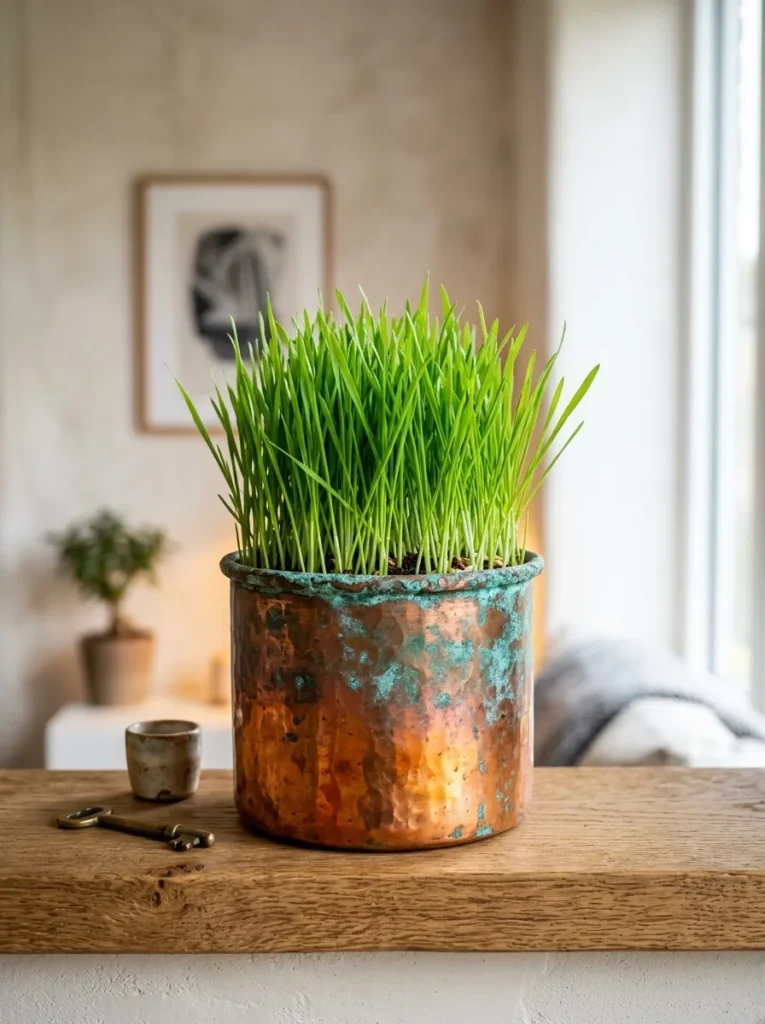
Vibe: Warm and editorial — the cat grass container that reads as a deliberate still life before the cat gets to it.
Why it works: The aged copper planter with bright green wheatgrass is the cat grass design that most powerfully exploits the principle of color complementarity — the verdigris green of natural copper oxidation and the bright grass green of fresh wheatgrass are the same green family but distinctly different in saturation and brightness, creating a subtle color relationship that rewards close examination. More dramatically, the warm orange-copper of less-oxidized copper sections contrasts directly with the vivid grass green in a complementary color relationship (orange and green are near-complementary on the color wheel) that produces the visual energy that makes this specific material pairing read as an editorial design decision rather than a random container choice. The natural patination process of uncoated copper — which moves through orange-gold, brown, dark brown, and finally verdigris green as the copper oxidizes — means that an aged copper planter develops its own unique patina profile over time, making each planter visually unique.
How to get it: Source aged copper planters from specialist metal plant container suppliers, vintage shop finds, or estate sales — genuine aged copper is distinguishable from painted alternatives by the weight (copper is significantly heavier than painted aluminium or zinc) and by the three-dimensional topography of the verdigris (genuine patina has a slightly raised, crystalline texture; painted patina is completely flat). Ensure the copper planter has adequate drainage — either an existing drainage hole or the ability to drill one using a titanium-tipped drill bit. The wheatgrass inside should be allowed to grow without trimming in this container — the upward energy of the naturally growing grass blades is the visual counterpoint to the dense, horizontal patina texture of the copper surface.
Shop the Look
| Product |
|---|
| Aged copper cylindrical planter |
| Wheatgrass seed organic |
| Titanium drill bit copper |
| Aged brass decorative object |
| Slim timber display shelf |
8. Minimalist White Ceramic Square Planter with Rye Grass
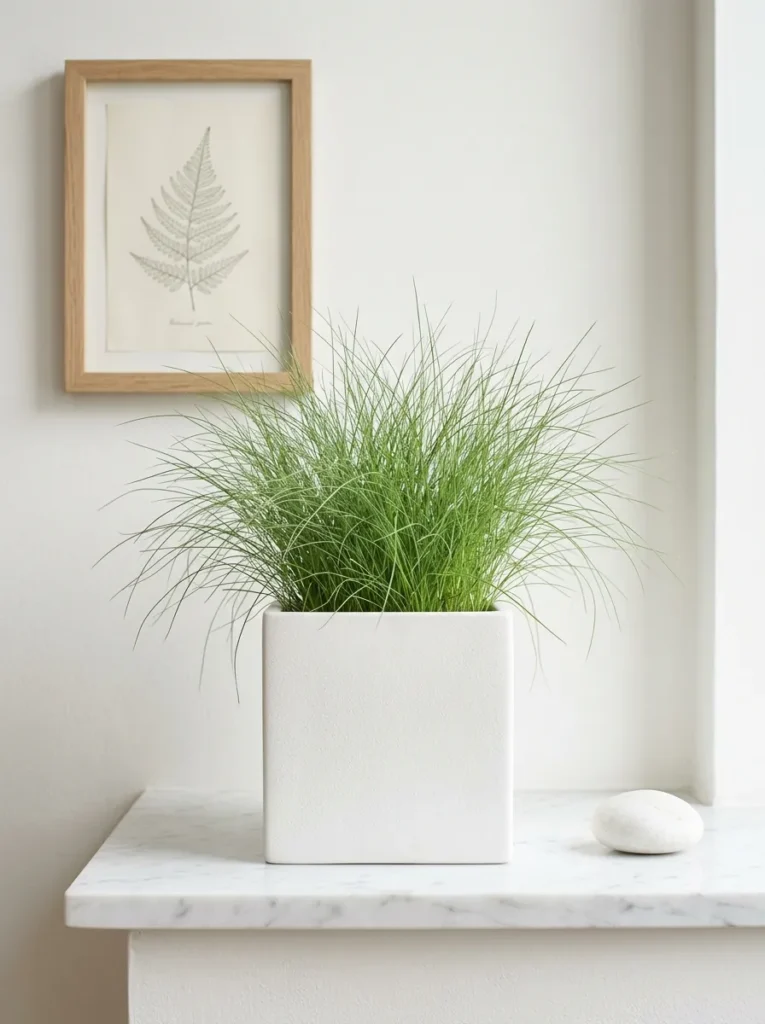
Vibe: Clean and minimal — the cat grass display that disappears into a white room and reappears as a moment of quiet living green.
Why it works: The minimalist white ceramic square planter with rye grass is the cat grass design that most completely embodies the principle of deliberate restraint — by selecting a white matte ceramic form (which minimizes the container’s visual presence), a white marble shelf (which provides a continuous pale ground), and rye grass (whose fine, delicate blades are the most architecturally spare of all common cat grass species), the design creates a composition whose beauty is entirely dependent on the quality of the grass itself rather than on the container’s decorative interest. Rye grass (Lolium perenne) has a noticeably finer blade than wheatgrass or oat grass, which gives it a more delicate, airy character when grown loose and untrimmed — the loose-grown rye grass in a white ceramic square reads as a calligraphy brush or a delicate line drawing rather than the solid mass of a dense wheatgrass planting.
How to get it: Sow rye grass at a slightly lower density than wheatgrass — 6–8 seeds per square centimeter rather than 10–12 — to allow the individual blade structure to remain visible as the grass grows to full height. Rye grass grows more quickly than wheatgrass and is more shade-tolerant, making it appropriate for white-room shelving positions that may not receive direct sun. Replace the planting every 10–14 days — rye grass in a small ceramic square grows quickly and is consumed quickly, making a regular replacement schedule essential to maintain the clean, fresh aesthetic of the minimalist presentation.
Shop the Look
| Product |
|---|
| Square matte white ceramic planter |
| Rye grass seed perennial |
| White marble shelf floating |
| Small framed botanical print |
| Smooth white stone decorative |
9. Reclaimed Timber Box with Rustic Rope Detail
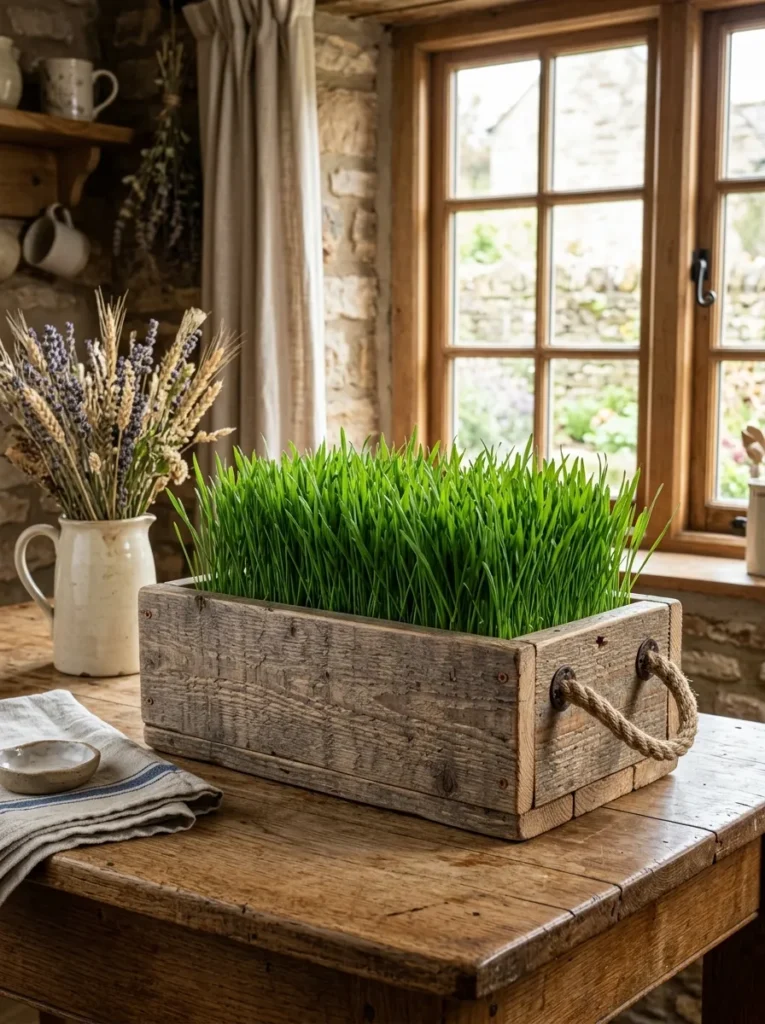
Vibe: Warm and rustic — the cat grass box that looks like it belongs beside the kitchen herb collection.
Why it works: The reclaimed timber box with rope handles is the cat grass design that most naturally integrates with a farmhouse, coastal, or rustic-contemporary interior because its material vocabulary — rough-sawn timber, natural rope, visible construction details — is the same material language as the interior itself. The rope handles at each short end serve both a decorative and a practical function: they provide carrying handles for moving the grass box from its display position to the sink for watering, and they introduce the natural fiber texture that breaks up the hard timber surface and adds dimensional interest to the box’s side profile. The reclaimed or rough-sawn timber specifically — rather than dressed or smooth timber — provides the surface texture and weathered character that coordinates with the organic imperfection of the grass planting, creating a material coherence between container and content.
How to get it: Build the timber box from rough-sawn reclaimed pine boards in 20mm thickness — the rough-sawn surface texture is the primary aesthetic quality and should not be sanded smooth. Join the box corners with 60mm decking screws left slightly proud of the surface — the visible screwhead reads as a deliberate construction detail rather than a quality failure. Attach natural sisal rope handles by drilling two 12mm holes at each short end and threading a 400mm loop of 8mm sisal through both holes, tying a large knot on the interior face to secure the handle.
Shop the Look
| Product |
|---|
| Reclaimed rough sawn timber boards |
| Natural sisal rope 8mm |
| 60mm decking screw box |
| Wheatgrass seed organic |
| Plastic liner tray |
10. Concrete Sphere Planter with Trailing Grass Effect
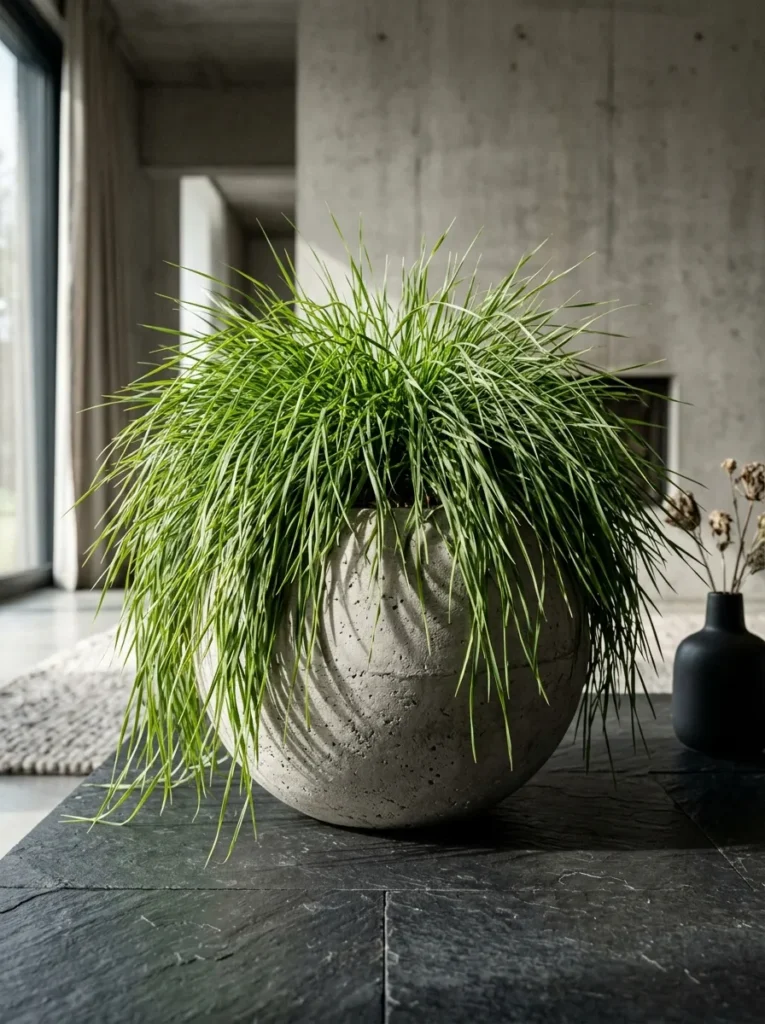
Vibe: Sculptural and bold — the cat grass display that reads as a designed sculpture from across the room.
Why it works: The concrete sphere planter with cascading grass effect is the cat grass design that most dramatically demonstrates the sculptural potential of grass as a design material — by growing oat grass in a sphere with a wide top opening and allowing the grass to grow past the point where it would normally be presented as an upright planting, the blades cascade outward and downward over the concrete sphere’s surface, creating a dramatic fountain effect that reads as a designed topiary form. Oat grass is the correct species for this cascading effect because its longer, looser blades are naturally inclined to bend under their own weight at full growth height, while wheatgrass’s finer, more upright blades maintain an upward posture even at height. The concrete sphere’s solid, spherical mass provides the visual base weight that makes the light, airy cascade of grass blades read as a designed composition rather than an unkempt plant.
How to get it: The sphere planter opening should be minimum 120mm diameter to allow sufficient root volume for the dense planting that produces the cascading effect. Sow oat grass at 8–10 seeds per square centimeter within the sphere opening and allow to grow without trimming to the 20–25cm height at which the blades begin to cascade naturally. Do not stake or support the grass — the cascade is the intended form, and any support prevents the cascading behavior. Replace the planting every 14–21 days as the cascading grass reaches the end of its productive life.
Shop the Look
| Product |
|---|
| Concrete sphere planter 20cm |
| Oat grass seed organic |
| Dark slate display surface |
| Minimal black ceramic vase |
| Seed raising mix fine |
11. Tiered Herb Garden Stand with Multiple Grass Varieties
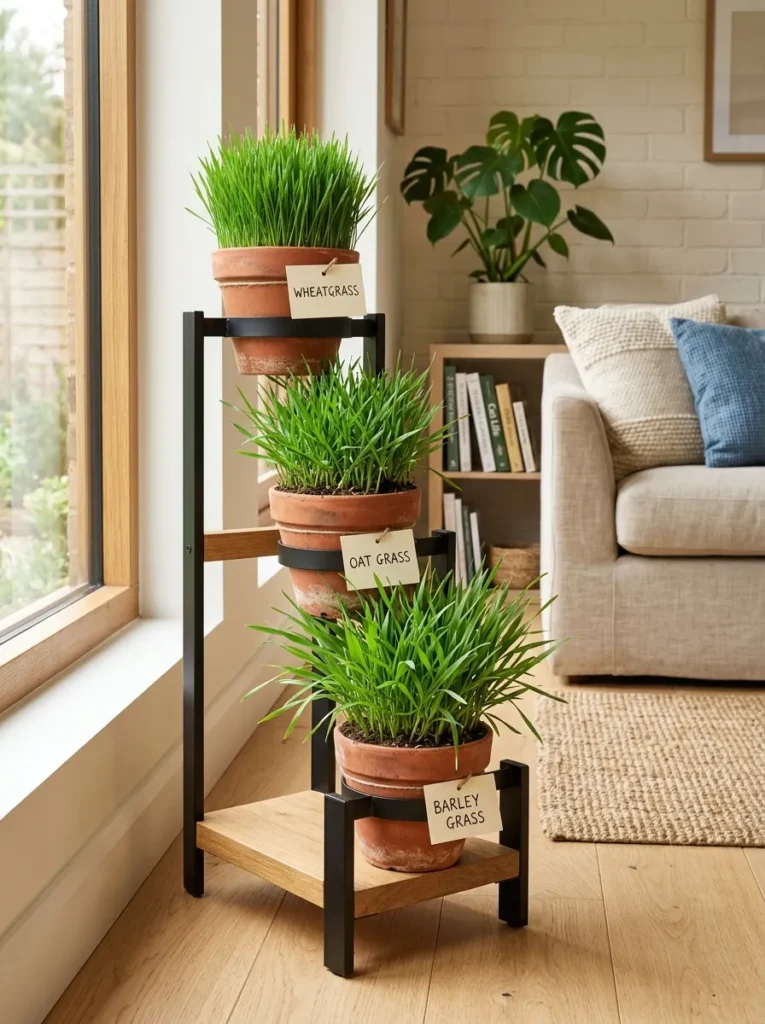
Vibe: Abundant and organized — the cat grass station that treats the cat’s botanical provision with the same seriousness as a kitchen herb garden.
Why it works: The tiered plant stand with multiple cat grass varieties is the design that most generously provides the cat with botanical variety and choice — by presenting three distinct grass species at three accessible heights on a single organized stand, the design creates a cat grass station where the cat can approach, evaluate, and select from multiple grass options in the same interaction, developing genuine preferences and behavioral patterns around the varied provisions. The tiered format also manages the practical growing schedule — as the grass on one tier is consumed or reaches the end of its productive life, it can be replaced while the other tiers continue to provide fresh grass, maintaining continuous provision without the complete gap that occurs when a single planting is finished. The matching terracotta pots across all three tiers create the visual cohesion that makes the three-tier stand read as a designed grass garden rather than three separate plant pots stacked on a stand.
How to get it: Select a plant stand with tier depths of minimum 200mm × 200mm to accommodate standard 15cm terracotta pots on each level. Maintain a rotation schedule of two pots per tier (one on display, one growing) to ensure continuous provision at all three levels simultaneously. Label each tier with a small hand-written or stamped plant stake identifying the grass species — the labels serve both as a personal reference for the growing rotation schedule and as a designed detail that makes the grass station read as a curated botanical collection.
Shop the Look
| Product |
|---|
| Three tier plant stand |
| Terracotta pot set 15cm |
| Wheatgrass seed organic |
| Barley grass seed organic |
| Plant label stake set |
12. Mounted Wall Planter with Cat Grass for Vertical Gardens
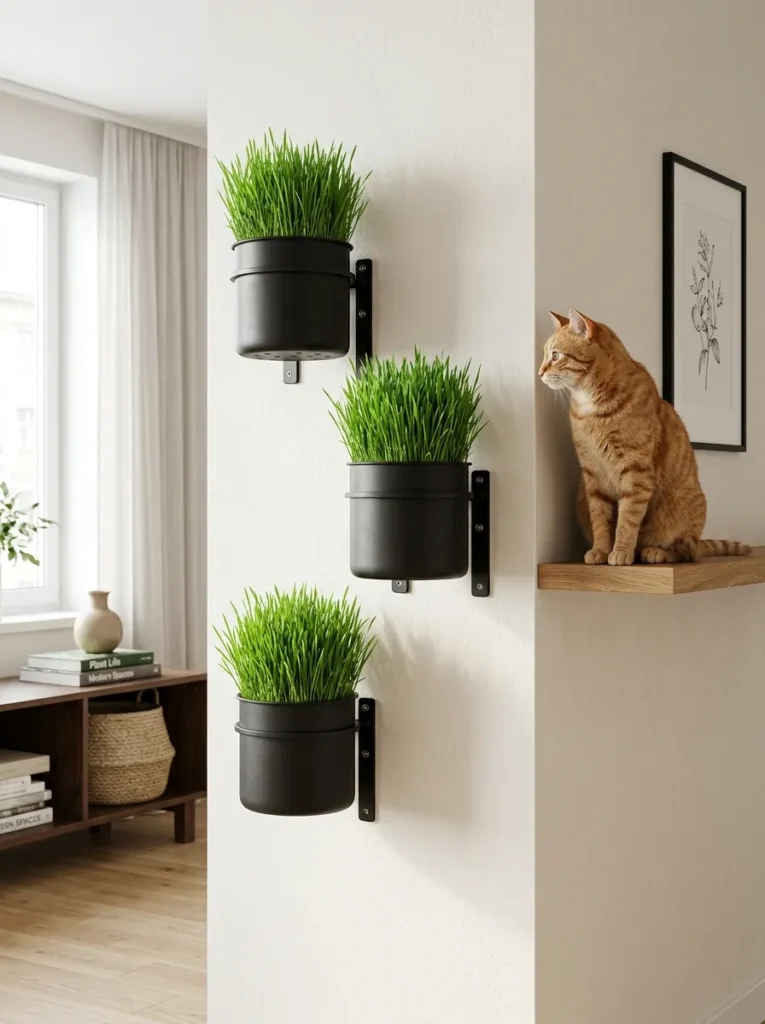
Vibe: Clean and contemporary — the vertical garden feature that happens to feed the cat while looking like genuine interior design.
Why it works: The wall-mounted cat grass planter is the design that most ingeniously converts a potential floor-level pet provision into a genuine vertical garden feature — by mounting the grass containers on the wall at varied heights rather than placing them on the floor or on shelving, the design simultaneously raises the grass to a height that cats naturally prefer to access (at or above their standing eye level, which satisfies their elevated-vantage behavioral preference), removes the grass from the floor plan where it would compete with furniture, and creates a vertical garden wall feature that reads as a deliberate design decision. The installation logic is identical to a standard vertical herb garden or plant wall — the cat grass containers are simply another component of the vertical planting system, distinguished only by their grass content and by the fact that the primary audience for the display is a cat rather than a human.
How to get it: Use wall-mounted ceramic half-sphere planters or purpose-made wall pocket planters with integrated drip trays — drainage management is the critical practical consideration for wall-mounted planters, as water seeping down a wall from an overhead planter causes paint damage and damp issues within weeks. Position the highest wall planter at the cat’s natural jumping-and-perching height (typically 1–1.2 meters from the floor) rather than at a human-comfortable height, which ensures the cat accesses the grass from its preferred elevated position rather than from below.
Shop the Look
| Product |
|---|
| Wall mounted ceramic planter |
| Wall planter drip tray integrated |
| Wheatgrass seed organic |
| Wall mount bracket set |
| Small watering can precision |
13. Geometric Metal Frame Planter with Cat Grass
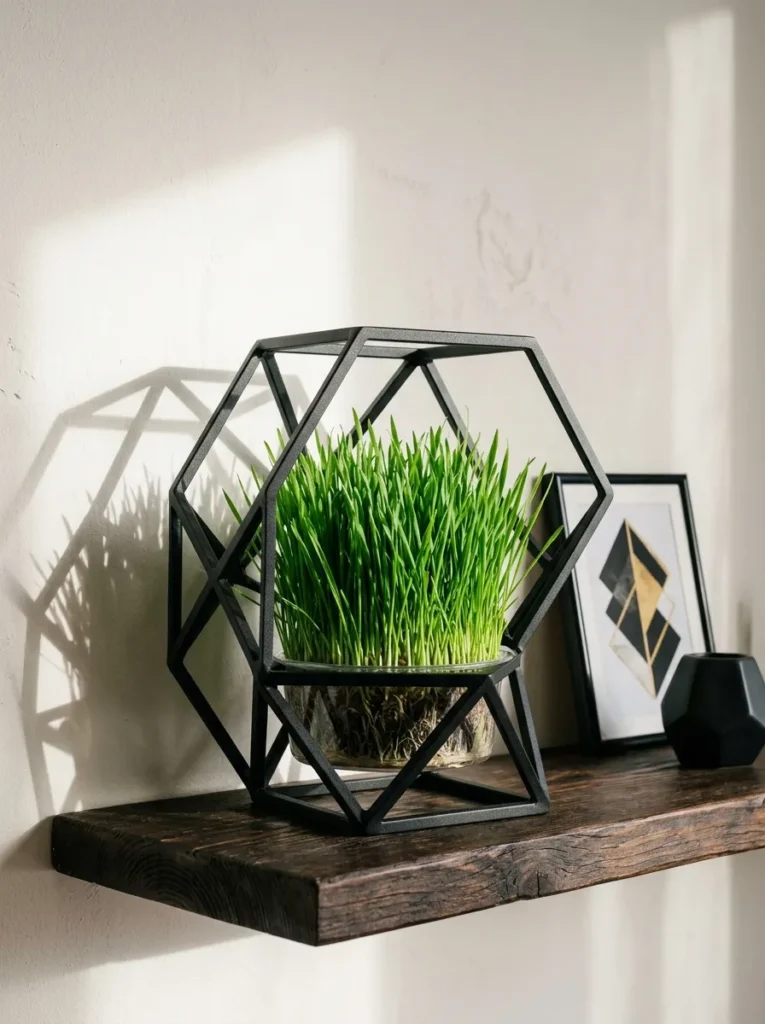
Vibe: Graphic and contemporary — the cat grass container that looks like it was designed for a design-forward plant shop.
Why it works: The geometric metal frame planter with cat grass is the design that most powerfully exploits the visual contrast between the hard, graphic precision of a powder-coated geometric metal frame and the organic vitality of living grass — the sharp angles and clean lines of a hexagonal or triangular metal frame create a rigid geometric structure that makes the enclosed grass appear more abundantly alive and organically complex by contrast. This contrast principle — the designed geometric frame making the natural grass more natural-seeming — is the same principle that Japanese rock garden design uses when it places precisely raked gravel beside organically formed moss: the precision of one element amplifies the organic quality of the other. The matte black powder coating of the metal frame is the specific finish that produces the maximum contrast with the bright grass green without the visual noise of a patterned or colored frame.
How to get it: Source geometric metal frame planters from contemporary design retailers and Scandinavian homewares brands — MENU, HAY, and similar brands produce planter frames in this aesthetic register. Most geometric frame planters accommodate a standard small plastic liner pot that is removed for watering and replaced for display — ensure the liner pot used is sized to fit within the frame with a 5–10mm clearance on all sides so the metal frame reads as a frame rather than being obscured by the liner.
Shop the Look
| Product |
|---|
| Geometric black metal frame planter |
| Liner pot small 15cm |
| Wheatgrass seed organic |
| Dark timber shelf |
| Matte black ceramic object |
14. Rustic Log Slice Planter with Hollowed Center
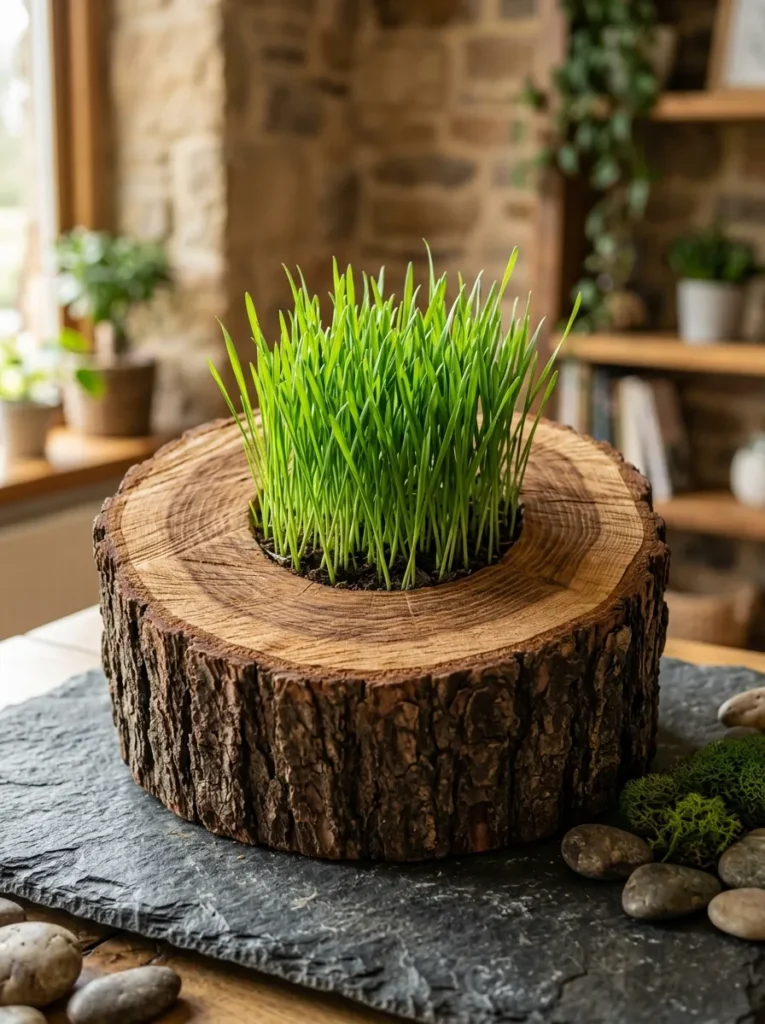
Vibe: Natural and forest-like — the cat grass planter that looks like it was grown in the forest and brought inside still growing.
Why it works: The hollowed log slice planter with cat grass is the design that most completely references the natural environment in which wild cats would encounter and eat grass — in a forest or meadow context, grass grows from every available cavity and surface, including the decomposing hollows of fallen timber. By creating a planting of cat grass in a hollowed timber log slice, the design creates a planter that reads as a found natural object rather than a manufactured container, connecting the cat’s grass provision to the biophilic material world of their ancestral outdoor environment. The bark-intact exterior is the critical design specification — bark provides the visual authenticity and the dimensional texture that distinguishes a genuine log section from a turned wooden bowl, and its retention is what makes the planter read as genuinely natural rather than crafted.
How to get it: Source a suitable log section from a fallen tree, a firewood merchant, or a woodworking supplier — the log should be dry (not green wood, which cracks when dried indoors) and free from insect infestation. Hollow the center using a large spade drill bit or a chisel to create a planting cavity of minimum 100mm diameter and 80mm depth. Seal the hollow interior with a waterproof sealant before adding soil to prevent moisture damage to the surrounding timber. Plant wheatgrass seeds directly in the hollow at full density and allow to germinate and grow in the log slice from the start rather than transplanting — the grass growing directly from the timber hollow is the authentic visual effect that makes this design compelling.
Shop the Look
| Product |
|---|
| Dry timber log section |
| Spade drill bit 100mm |
| Waterproof interior sealant |
| Wheatgrass seed organic |
| Small decorative pebble |
15. Painted Color-Block Crate with Bright Wheatgrass
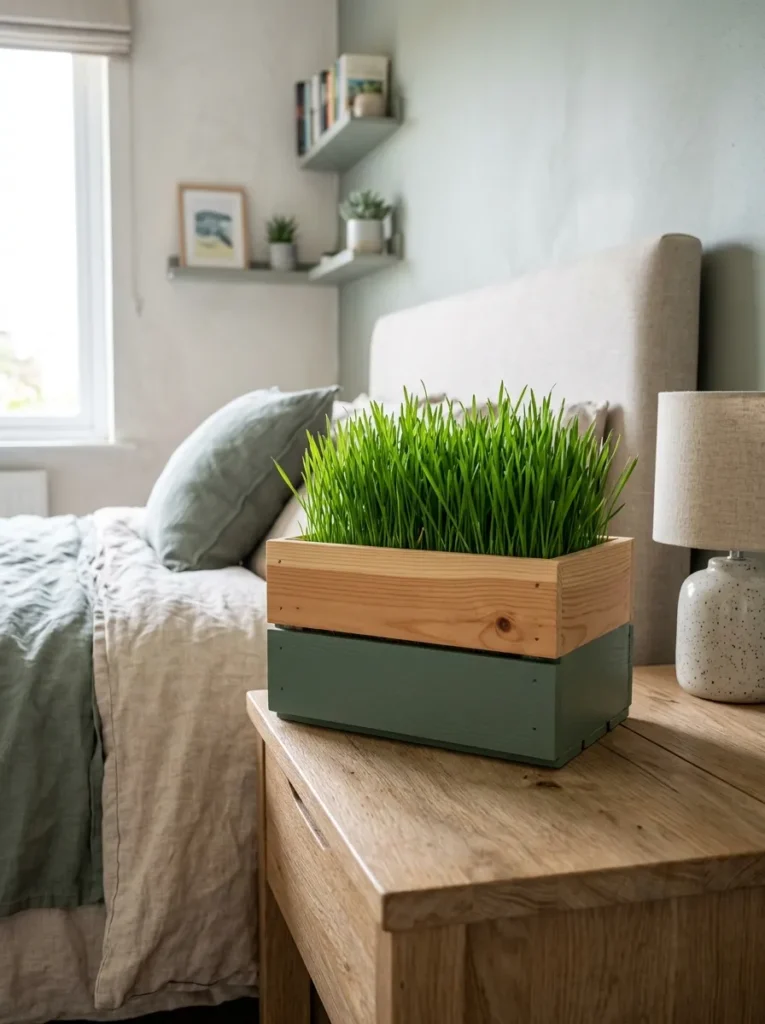
Vibe: Fresh and designed — the cat grass crate that coordinates with the bedroom palette so naturally it reads as planned from the beginning.
Why it works: The color-block painted crate with bright wheatgrass is the cat grass design that most intelligently connects the pet provision to the room’s existing interior design palette — by painting the lower two-thirds of the crate in the room’s accent color (dusty sage, terracotta blush, or navy) while leaving the upper third in natural pine, the design creates a container that reads as a designed interior accessory that coordinates intentionally with the room’s color scheme rather than a pet provision that exists separately from the room’s design logic. The color-block technique — a sharp horizontal line dividing two distinct color treatments on the same object — is a well-established contemporary design detail (used on ceramics, fabric, and furniture) that reads as deliberate and considered regardless of the specific colors chosen. The bright wheatgrass emerging from the natural pine section above the color-block line creates a three-part material composition (painted section, natural timber section, living grass) that rewards close examination.
How to get it: Apply painter’s tape at exactly two-thirds of the crate’s height before painting the lower section — the tape line creates the crisp horizontal boundary that makes the color-block read as intentional. Use an eggshell or satin interior paint rather than a flat paint for the color-block section — the slight sheen of eggshell paint is more durable against the moisture and handling that a cat grass container experiences. Remove the painter’s tape while the paint is still slightly wet (within 30 minutes of the final coat application) to prevent the dried paint from cracking and lifting as the tape is removed.
Quick Win: A small tin of eggshell paint in the room’s accent color ($8–15 for a sample pot, sufficient to paint three or four crates) applied as a color-block to any plain pine crate transforms it into a coordinated interior accessory for the cost of one sample pot and one afternoon of painting — the design impact per dollar of this transformation is the highest of any idea in this list.
Shop the Look
| Product |
|---|
| Pine crate small 25cm |
| Eggshell paint dusty sage |
| Painter’s tape precision |
| Wheatgrass seed organic |
| Seed raising tray germination |
16. Floating Shelf Integrated Cat Grass Garden System
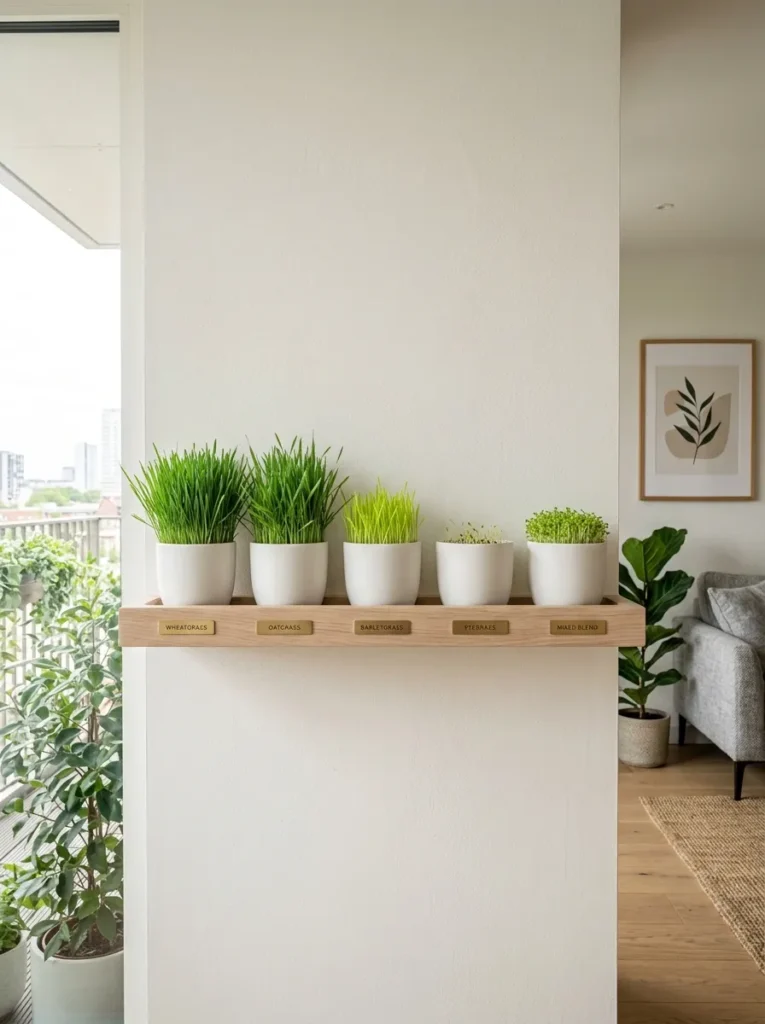
Vibe: Clean and resolved — the cat grass provision that has been thought through so completely it looks like it was always part of the apartment.
Why it works: The floating shelf integrated cat grass garden system is the most architecturally resolved cat grass design in this list — by creating a purpose-designed floating shelf with an integrated drip tray channel, the design converts the cat grass provision from a domestic object that sits on a surface into a built-in feature of the room’s architecture. This architectural integration is the specific quality that makes the cat grass garden system read as a design decision rather than a pet provision — it is the equivalent of a built-in herb garden in a kitchen, where the cooking provision has been sufficiently considered to warrant its own designed architectural element. The five-planter rotation system on the shelf manages the growing cycle pragmatically: each planter represents a different stage (newly seeded, sprouting, young grass, mature grass, end-of-life) ensuring that a fresh mature planting is always available to the cat without any gap in provision.
How to get it: Build the floating shelf from an 18mm pale oak or oak-veneered MDF board with a 20mm-deep, 30mm-wide channel routed along the full shelf length, positioned 50mm from the shelf’s front edge — this channel serves as the integrated drip tray that collects water runoff from the planters without requiring individual saucers under each planter. The channel should be sealed with a clear waterproof epoxy before installation. Mount the shelf at 1.2 meters height on heavy-duty concealed shelf brackets that support the combined weight of five soil-filled planters (approximately 15–20kg total). Space the five planters at equal intervals along the shelf with 20mm gaps between them for air circulation.
Shop the Look
| Product |
|---|
| Pale oak floating shelf custom |
| Concealed shelf bracket heavy duty |
| White ceramic planter small set five |
| Waterproof epoxy sealant |
| Label stake set for planters |
How to Start Your Cat Grass Box Design Practice
Your single first move is to observe your cat’s existing grass-seeking behavior before selecting a design or a grass species. Does your cat approach grass enthusiastically and graze at length, or does it nibble briefly and lose interest? Does it prefer to approach a planting from above (leaping to a shelf-level planter) or from the side (accessing a floor-level display)? Does it pull entire grass blades from the root or nibble at the blade tips? These specific behaviors determine which design from this list will be most effectively used — a cat that grazes at length benefits from a large-format planting (the long window box, the vintage crate, the floating shelf system); a cat that nibbles briefly benefits from a compact, densely planted single specimen (the crackle glaze ceramic, the geometric metal frame); a cat that prefers to approach from above benefits from a wall-mounted or tiered stand design that places the grass at its natural jumping height.
The most common cat grass growing mistake is planting in too much soil depth — most seed-growing guides recommend deep containers for root development, but cat grass species (wheatgrass, oat grass, barley grass) are annual grasses that are harvested at 2–3 weeks of growth and require only 40–50mm of soil depth for their full productive life. A container with 100mm or more of soil provides no additional benefit to the grass’s growth quality and significantly increases the weight and cost of the planting. The ideal cat grass substrate is a 50:50 mix of quality seed-raising mix and fine perlite at 40–50mm depth — the perlite improves drainage and prevents the soil compaction that impedes root development in shallow containers, while the seed-raising mix provides the balanced nutrients that support vigorous early growth.
Three specific investments under $30 that improve cat grass growing quality immediately: (1) Organic wheatgrass seed ($8–15 for a 500g bag, sufficient for 15–20 standard plantings) rather than standard grass seed produces a noticeably more vigorous, greener, and more aromatic grass that cats prefer over standard-grade seed — the organic growing method produces a grass with higher nutritional density, which translates to greater cat interest and more enthusiastic grazing. (2) A spray bottle ($5–8) for watering newly seeded cat grass planters — the gentle, even moisture of spray bottle watering prevents the seed displacement and surface erosion that watering can application causes on newly seeded soil surfaces, producing a more even germination pattern and a more uniform grass surface. (3) A seed germination mat ($15–25) placed under seed trays during the first 3–5 days of germination — the gentle bottom heat of 24–27°C accelerates germination by 30–50%, reducing the time from sowing to cat-accessible grass from the standard 7–10 days to 4–7 days, which is particularly valuable for maintaining the continuous supply that a rotation system requires.
Realistically, a complete cat grass rotation system — three to five designated containers in rotation with a permanent display position and growing positions — costs $40–120 depending on the container design (a set of five matching small white ceramic planters from a homewares retailer runs $25–45, while a custom concrete trough or vintage copper planter as the primary display container runs $30–80 on its own). The seed cost for a full annual supply of cat grass rotations is approximately $15–25 for organic wheatgrass seed sufficient for 50+ individual plantings — making the ongoing per-planting cost of a cat grass rotation system under $0.50, which is significantly lower than the $3–6 per tray cost of purchased pre-grown cat grass from health food retailers. The initial container investment is the design decision; the ongoing growing is the practice.
Frequently Asked Questions About Cat Grass Box Design
What grass species is best for indoor cats?
Wheatgrass (Triticum aestivum) is the most widely available, most cat-preferred, and most nutritionally complete of the common cat grass species — it grows quickly (5–10 days to cat-accessible height), produces a dense, bright green blade that most cats find irresistible, and provides a rich source of vitamins A, C, and E alongside dietary fiber and chlorophyll. Oat grass (Avena sativa) is the preferred alternative for cats who show less interest in wheatgrass — its looser, more architectural blade structure appeals to cats who prefer a less dense grass texture, and its flavor is mildly sweeter than wheatgrass. Barley grass (Hordeum vulgare) is the choice for the highest nutritional density — it contains higher concentrations of vitamins and minerals than either wheatgrass or oat grass, though it grows more slowly and requires slightly more light than the other species. All three are completely safe for cats and are confirmed non-toxic by the ASPCA.
How often should I replace a cat grass planting?
A typical cat grass planting remains fresh and cat-accessible for 10–21 days depending on the grass species, container size, light conditions, and the frequency of the cat’s grazing. Wheatgrass degrades most quickly after the cat begins grazing — the broken blade ends turn brown within 3–5 days of the first grazing session, and the planting should be replaced when more than 30% of the visible blade tips show browning. Oat grass degrades more slowly and often remains fresh for 14–21 days. The practical guide for replacement is the cat’s own assessment — when a cat that previously grazed enthusiastically begins to ignore the grass, the planting is past its optimal freshness and should be replaced. Maintaining two or three containers in rotation — one on display, one at 50% growth, one freshly seeded — ensures that a replacement is always ready when the display planting reaches the end of its productive life.
How do I prevent soil from being scattered when my cat uses the grass box?
Cats that paw at the soil around their grass boxes before eating (a natural pre-grazing behavior) can scatter soil from open containers onto adjacent surfaces. The three most effective solutions are: a complete top-dressing of the soil surface with fine river sand, decorative pebbles, or black basalt grit (which prevents the cat’s paw from making direct soil contact and reduces scatter significantly), a container with raised sides that are 30–50mm higher than the soil surface (which provides a physical barrier to sideways soil scatter), or a container with a tray base of sufficient depth (50mm) that catches all scattered soil within the tray perimeter. The combination of raised sides and a soil top-dressing is the most effective approach — the raised sides contain the majority of scatter and the top-dressing prevents the direct soil contact that triggers the most enthusiastic pawing behavior.
Is cat grass safe for cats who eat it in large quantities?
Cat grass consumed in moderate quantities — the typical grazing amount of 10–20 blade-lengths per session — is completely safe and provides genuine nutritional and digestive benefits. Cats frequently consume grass as a natural emetic (to help expel hairballs or other stomach contents) and may consume more grass than usual when they feel nauseous or have recently ingested a hairball — this larger consumption is a normal self-medication behavior and is not a cause for concern. Truly excessive consumption (more than a small handful at a single session) may cause vomiting as a deliberate emetic response — this is generally harmless but should be monitored if it occurs repeatedly. Cat grass is confirmed non-toxic by the ASPCA for cats at any consumption level. The only concern with cat grass provision is the cat grass growing medium — ensure that any fertilizers, pesticides, or chemical soil amendments are not used in the cat grass container, and use organic seed-raising mixes that are free from systemic pesticide treatments.
How do I grow cat grass in a container without drainage holes?
Growing cat grass in a container without drainage holes — which is common with decorative containers like copper pots, ceramic bowls, and vintage vessels — requires careful water management to prevent root rot from standing water at the container base. The correct approach is the gravel layer method: add 20mm of pea gravel or coarse sand to the base of the container before adding soil, creating a drainage reservoir that collects excess water below the root zone. Water the cat grass container in small amounts frequently (a light spray or small watering can application every 1–2 days) rather than in large volumes infrequently — small, frequent watering keeps the top soil layer moist without accumulating standing water in the gravel base. Alternatively, use the liner pot method: grow the grass in a standard plastic nursery pot with drainage holes, and place this pot inside the decorative container as a cachepot — the drainage water collects in the base of the cachepot and is emptied regularly without disturbing the grass planting.
Ready to Design Your Cat’s Perfect Grass Garden?
These 16 ideas span the full range of what a cat grass box can be — from a sleek concrete trough with a perfectly flat wheatgrass surface that reads as a landscape installation, and a wabi-sabi crackle glaze ceramic with a cylinder-trimmed grass specimen that reads as a Japandi art object, to an abundant vintage fruit crate overflowing with mixed grass species, a concrete sphere with cascading oat grass, and a custom floating shelf system that integrates the cat grass provision permanently into the apartment’s architecture — so whether you are growing for a single cat in a studio apartment or building a multi-species grass garden for a multi-cat household, there is a genuinely achievable, genuinely beautiful cat grass design here for your space, your cat’s specific grazing preferences, and your interior aesthetic. The design begins not with the container but with the observation — watching your cat’s specific interaction with grass (if they have encountered it) or observing their other plant-seeking behaviors (if they haven’t) gives you the behavioral brief from which the correct design follows directly. Today’s specific action: purchase a packet of organic wheatgrass seed and a bag of seed-raising mix, find one container from your kitchen or bathroom that you find genuinely beautiful, fill it to 40mm depth with the seed-raising mix, sow the seeds at high density across the surface, and place it in your sunniest window position — in seven days you will have a fresh, living cat grass planting in a container you already love, and in ten days you will understand exactly which of the 16 designs in this list your cat will respond to most enthusiastically. Save the designs that matched your cat’s specific behaviors and your home’s existing material palette — those are the cat grass boxes that will be grown, used daily, and genuinely appreciated by the most important audience in any pet-inclusive interior design project.