A dog bed corner in a farmhouse kitchen is a dedicated, designed sleeping and resting space for a dog — built into or styled within the kitchen environment using natural materials, warm textures, and honest craftsmanship so the dog’s area becomes part of the room’s character rather than an interruption of it. This article gives you 14 dog bed corner ideas across built-in nooks, freestanding setups, repurposed furniture, material layering, small-space solutions, and seasonal styling so your dog has a genuinely beautiful place to rest in the most-used room of the house.
There is something deeply right about a dog in a farmhouse kitchen. The warmth of the room, the smells of cooking, the activity and return of family — a farmhouse kitchen is where a dog wants to be, and a dog bed corner done well acknowledges that this is true and designs for it with the same care given to the rest of the room. A worn linen cushion in a low pine cubby, a basket piled with a wool blanket beside a range, a reclaimed wood platform under a window — these are the details that make a farmhouse kitchen feel genuinely lived in rather than merely styled. Here are 14 ideas worth saving — and stealing.
Why Farmhouse Kitchen Dog Corners Work So Well
The farmhouse kitchen dog corner draws from a long tradition of working animals integrated into domestic spaces — the farm dog sleeping near the hearth, the shepherd’s dog with a straw bed by the kitchen door, the household dog whose place in the room was as established as the table or the range. In these traditions, the animal’s resting place was not hidden or minimized — it was incorporated into the kitchen’s functional and social life as an acknowledgment that the animal was a member of the household and that the kitchen was the household’s center. The contemporary farmhouse kitchen dog corner continues this tradition in design terms: the dog’s space is made of the same honest materials as the rest of the room and sits in the room with the same quiet confidence.
The material palette that works for farmhouse kitchen dog corners is specific and consistent with farmhouse design principles broadly. Reclaimed and solid pine, oak, and cedar are the correct lumber choices — their grain warmth, slight imperfection, and honest joinery read as farmhouse authenticity. Linen, canvas, and wool are the correct textile choices for dog bed cushions and covers — they are washable, durable, and warm in tone in ways that synthetic fabrics are not. Galvanized metal, wrought iron, and blackened steel hardware add the utilitarian material note that farmhouse spaces require. Natural basket materials — seagrass, wicker, rattan — provide organic warmth as bed vessel forms. The palette stays within the warm neutral spectrum: aged linen cream, warm wool oat, galvanized silver-grey, pine honey amber, weathered oak grey-brown.
The trend is firmly established and culturally resonant. Pet ownership has become increasingly integrated with interior design rather than in tension with it — the idea that a home must choose between looking good and accommodating a pet has been replaced by the recognition that pet furniture and pet spaces, when thoughtfully designed, can be among the most character-rich elements in a room. Farmhouse kitchens, with their emphasis on natural materials, honest craftsmanship, and lived-in warmth, are the domestic environment most naturally suited to integrating a dog’s space gracefully.
Small farmhouse kitchens respond particularly well to dedicated dog corners because defining the dog’s space prevents the alternative — the dog choosing its own location (typically in the middle of the kitchen traffic path) and the resulting friction of dog and human circulation in the same undesignated zone. A well-placed dog corner with a genuinely comfortable bed creates a voluntary anchor point that keeps the dog comfortable and the kitchen functional.
Style at a Glance
| Element | Detail |
|---|---|
| Philosophy | The dog’s space as part of the room’s character — honest materials, warm textures, designed intention |
| Key Materials | Reclaimed pine, solid oak, linen, wool, wicker, galvanized metal, seagrass |
| Key Colors | Aged linen cream, warm wool oat, honey pine amber, weathered grey, galvanized silver |
1. Built-In Pine Cubby Under the Kitchen Island

Vibe: The cubby is character-rich — a built-in pine sleeping nook under a kitchen island with an arched opening and a name plate above it is the farmhouse kitchen detail that guests always remark on and dogs always choose over every other surface in the house.
Why it works: The under-island location exploits kitchen dead space — the lower section of a kitchen island base is typically either enclosed with doors (for storage) or left as open knee space, and a dedicated dog cubby uses this volume without reducing the island’s kitchen function. The arch-top opening mimics the doorway form that dogs instinctively prefer for sleeping dens — the curved overhead creates the sense of enclosure and protection that a straight-sided rectangular opening partially lacks. Pine construction with visible grain is the correct material for a farmhouse kitchen built-in because it reads as part of the kitchen’s cabinetry language while retaining the warmth and slight imperfection that distinguish farmhouse from modern cabinetry.
How to get it: If building new, frame the cubby opening from 3/4-inch pine plywood during island construction, cutting the arch with a jigsaw and finishing with solid pine trim. If retrofitting an existing island, remove one base panel and install a simple pine frame with arched opening inside the existing cabinet space. Line the floor of the cubby with a non-slip rubber mat before adding the cushion. A custom name plate ($15–$30 from Etsy woodworkers) above the arch completes the character.
Quick Win: An existing kitchen island with a lower open shelf or cabinet space can be converted to a dog cubby in one afternoon by adding a linen cushion cut to fit, a non-slip mat underneath, and a small hook beside the opening for a leash — no construction required for the basic version.
Shop The Look
- Deep linen dog cushion washable cover cream
- Non slip rubber mat cut to size
- Pine wood trim molding arch detail
- Personalized dog name sign wooden carved
- Wall mounted leash hook brushed nickel
Also view: 15 Secret Kitten Hideouts Built Into Your Home’s Walls and Corners
2. Wicker Basket Bed Lined with Wool Blanket

Vibe: The basket is rustic — a large wicker basket piled with a wool blanket in a warm kitchen corner is the most elemental farmhouse dog bed possible, and its simplicity is exactly what makes it look right in the room.
Why it works: Large wicker baskets function as ideal farmhouse dog beds because their curved walls provide the partial enclosure dogs prefer for sleeping security while the open top allows the dog to see the kitchen activity — the combination satisfies both the security instinct (enclosed sides) and the watchfulness instinct (open observation) simultaneously. Natural wicker’s warm honey-tan color exists within the farmhouse kitchen’s material palette without requiring any visual justification — it reads as naturally belonging beside galvanized metal, pine shelving, and linen textiles. The wool blanket piled inside adds a layer of warmth and softness that the wicker alone does not provide, and its casual, unprecise arrangement reads as genuinely used rather than staged.
How to get it: Source large round wicker or seagrass baskets (minimum 24-inch diameter for medium to large dogs, 30-inch for large breeds) from home decor stores or online retailers ($30–$60). Line the basket interior with a non-slip mat cut to the basket’s interior base diameter. Add a round dog bed cushion or a folded wool blanket as the sleeping surface. The basket’s natural fiber construction means it is not machine washable, but the liner and blanket can be removed and washed weekly.
Shop The Look
- Large round wicker dog basket natural 28 inch
- Oat wool blanket dog washable throw
- Cream linen dog cushion round washable
- Non slip mat round cut to basket size
- Galvanized metal dog water bowl small
3. Repurposed Vintage Farmhouse Crate as Dog Bed Base

Vibe: The crate is vintage — a repurposed wooden shipping crate as a dog bed base is the farmhouse kitchen detail that reads as found rather than purchased, and that quality of apparent discovery is exactly what farmhouse style values most.
Why it works: Vintage wooden crates carry the visual language of agricultural commerce — the stenciled text, the slatted construction, the rope handles — that is foundational to farmhouse aesthetic. Repurposed as a dog bed, the crate’s slatted sides provide ventilation for warm kitchens, its depth provides the enclosure dogs prefer, and its low profile keeps the sleeping surface at a comfortable floor-level height for dogs of any age. The vintage lettering or stamping on the exterior (original or added with a stencil) gives the piece the narrative quality — implying a previous life and a history — that new pet furniture always lacks.
How to get it: Source large vintage wooden crates from antique markets, estate sales, or online marketplace ($15–$60 depending on size and condition). Sand any rough or splintered interior surfaces to 220-grit. Apply a coat of non-toxic linseed oil to all interior surfaces. Cut a non-slip mat to the crate’s interior base dimensions and add a cushion. If creating a vintage look on a new crate, apply a stencil with dark grey or black chalk paint and a stippling brush for the aged text appearance.
Shop The Look
- Large vintage wood crate farmhouse display
- Linseed oil wood finish natural non toxic
- Linen dog cushion rectangular washable
- Stencil set vintage farmhouse lettering
- Chalk paint dark grey small pot
4. Reclaimed Wood Platform Bed Under the Kitchen Window

Vibe: The platform is architectural — a thick reclaimed wood slab on short iron legs under a kitchen window is the dog bed that reads as furniture rather than pet accessory, and its material integrity gives the kitchen corner genuine character.
Why it works: Under-window placement exploits the warmth and light that accumulates at a south or east-facing kitchen window throughout the morning — dogs instinctively seek warm, light-filled resting spots, making a window-positioned bed a voluntary destination that eliminates the behavioral challenge of keeping a dog in a designated spot. Reclaimed wood’s natural aging — nail holes, grain variation, weathering marks — provides the visual texture and material honesty that new lumber cannot replicate, and these qualities are amplified rather than diminished by the bedroom use context. The platform height (4–6 inches) provides the thermal break between cold floor and sleeping surface that benefits dogs in kitchens with tile or stone flooring.
How to get it: Source a reclaimed barn wood or oak board (2–3 inches thick, cut to desired bed dimensions) from an architectural salvage dealer or lumber yard specializing in reclaimed materials ($3–$8 per board foot). Set on four low block legs — turned wood legs ($12–$20 for a set of four) or forged iron bracket legs ($20–$40) — secured with wood screws from below. Finish the top surface with a food-safe beeswax or hardwax oil to seal the wood without introducing VOCs. Add a fitted linen cushion cut to the platform’s exact dimensions.
Quick Win: A single thick pine or oak board ($15–$25 from a hardware store) on four furniture feet ($8–$15 for a set) creates a functional reclaimed-style platform bed in one afternoon — stain with a dark walnut gel stain ($10) and add a linen cushion for a complete farmhouse dog platform for under $60.
Shop The Look
- Reclaimed barn wood board thick plank
- Short furniture block leg set 4 inch dark
- Beeswax wood finish food safe natural
- Fitted linen dog cushion cover cream
- Forged iron furniture leg set four pack
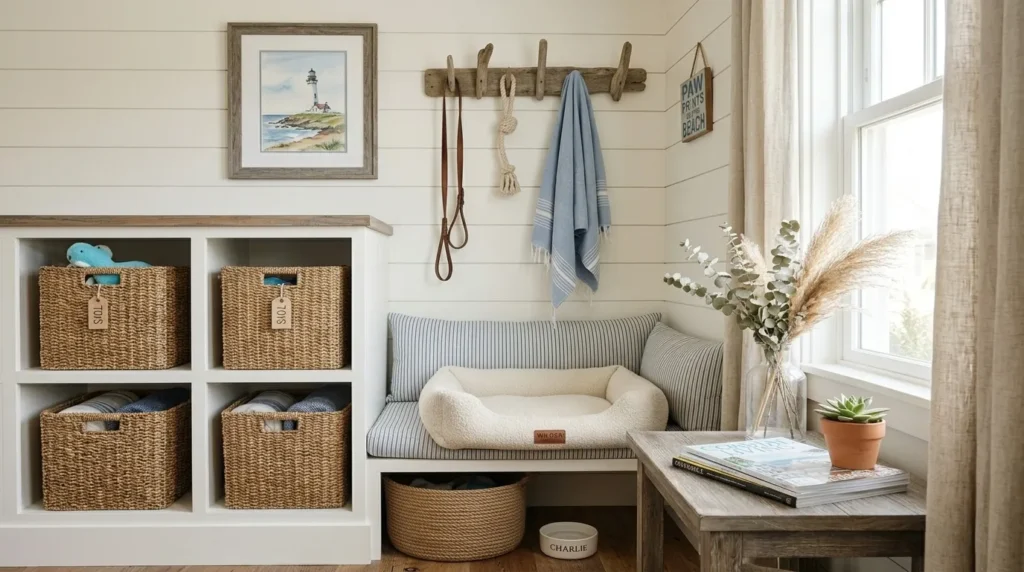
5. Mudroom-to-Kitchen Transition Dog Nook with Hooks Above

Vibe: The zone is organized — a dog nook in the mudroom-to-kitchen transition area with hooks above for human outerwear creates the most logical possible arrangement: the dog’s equipment (bed, toys, leash) and the humans’ equipment (coats, bags, boots) all in the same zone where both arrive from outside.
Why it works: The mudroom-to-kitchen transition zone is the dog’s natural activity hub — it is where outdoor walks begin and end, where food and water are typically located, and where the household enters and exits. A dog bed positioned in this zone exploits the animal’s existing behavioral patterns rather than fighting them: the dog wants to be near the entry, and a designated comfortable bed at the entry makes that desire an asset rather than an obstruction. The hooks above the dog space complete a functional wall that serves both species simultaneously — human coats and bags at the top, dog bed and tub at the bottom — in a layered system that maximizes the wall’s functional density.
How to get it: Build a simple low platform (12–14 inches high, bench height) from 3/4-inch plywood with a face frame of pine boards. Add a linen cushion on top. Mount a shiplap or beadboard panel on the wall above, then install coat hooks at 66–72 inches from the floor (human reach height) across the full width. Mount a small name board at the transition between the hooks zone and the dog bed zone. Add a galvanized metal tub ($12–$20) beside the bed for toy storage.
Shop The Look
- Matte black coat hook set wall mount
- Shiplap wall panel kit peel stick
- Galvanized metal tub small storage
- Linen bench cushion farmhouse dog
- Personalized pet name sign painted wood
6. Farmhouse Dog Bed Corner with Plaid Flannel Blanket Layering

Vibe: The corner is cozy — layered plaid flannel and knitted wool over a linen cushion base creates the kind of dog bed that humans immediately want to curl up in themselves, and the visual richness of layered textiles gives the corner a warmth that no single-layer dog bed achieves.
Why it works: Textile layering in a dog bed corner works on the same visual principle as textile layering in any well-dressed bed — multiple materials at different textures and weights create visual depth and the impression of warmth that flat single-layer arrangements lack. For dogs specifically, layered textiles also have behavioral benefits: dogs knead and rearrange their bedding as a nesting behavior, and a bed with multiple movable layers allows this behavior more satisfyingly than a single flat cushion. The plaid flannel blanket is the material choice that most directly references farmhouse kitchen tradition — plaid flannel appears in farmhouse interiors as kitchen table cloths, curtain fabric, and throw blankets, and its appearance in the dog corner integrates the pet space into the room’s textile language.
How to get it: Begin with a firm base cushion in cream or oat linen (washable cover essential). Fold a plaid flannel blanket ($15–$30, available from any general merchandise store in red-cream or navy-cream plaid) in thirds lengthwise and drape over the front half of the cushion. Tuck a small knitted wool or fleece throw into the back corner of the bed for depth. Replace and wash textiles weekly — all pieces should be machine washable on a gentle cycle.
Shop The Look
- Red cream plaid flannel throw blanket washable
- Firm dog cushion bed cream linen washable
- Oat knitted wool throw small pet size
- Farmhouse cotton blanket plaid pattern
- Waterproof mattress liner dog bed insert
7. Cedar Wood Dog House Inside the Kitchen Corner

Vibe: The dog house is architectural — a small cedar indoor dog house with a pitched roof and an arched doorway in a kitchen corner reads as a piece of domestic architecture at dog scale, and its presence gives the kitchen corner the same narrative charm as a miniature outbuilding in a garden.
Why it works: An indoor dog house creates the strongest possible den enclosure for dogs who prefer fully enclosed sleeping spaces — the four walls, roof, and single small doorway create a microenvironment of warmth and security that open beds and baskets cannot provide. Cedar is specifically appropriate for indoor dog housing because cedar’s natural aromatic oils (the same oils that give cedar chests their characteristic scent) have mild insect-repellent properties that reduce flea and pest attraction — a genuine functional benefit in addition to the aesthetic one. The pitched roof form at kitchen corner scale references the house-within-a-house idea that is both functionally accurate (it is the dog’s house, inside the human house) and visually charming.
How to get it: Purchase a pre-built indoor cedar dog house ($80–$180 for small to medium dog sizes) or build from a simple plan using 1×6 cedar fence boards for the walls and roof. Sand all interior surfaces to 220-grit to prevent splinters. Finish the exterior with a clear natural oil to deepen the cedar color while allowing it to breathe. Add a non-slip mat and linen cushion inside. For the kitchen corner placement, ensure the dog house dimensions allow easy access for weekly cleaning.
Shop The Look
- Indoor cedar dog house natural finish small
- Cedar fence board 1×6 natural pack
- Clear natural wood oil finish interior
- Small round linen cushion dog house insert
- Non slip rubber mat interior dog house
8. Open Pine Shelving Unit with Dedicated Dog Level

Vibe: The shelving is charming — a dedicated dog level at the base of an open kitchen shelving unit integrates the pet space into the kitchen’s storage architecture so completely that the dog’s presence in the room feels designed rather than accommodated.
Why it works: Incorporating the dog’s sleeping space into a kitchen shelving unit works because the lowest shelf of a tall open unit is typically the least useful for human kitchen storage — it is too low for comfortable retrieval of daily-use items and too exposed to be used for display. Converting this functionally marginal shelf into a dog sleeping space is a zero-loss trade: the dog gains a sheltered, elevated sleeping position within the kitchen’s architectural system, and the kitchen gains a more resolved use of every vertical level of the shelving unit. The dog’s integration into the shelving system also means their space is maintained at the same standard of order as the rest of the shelves — a functional pressure toward keeping the dog bed clean and tidy.
How to get it: If building new open shelving, designate the lowest shelf bay (at least 16 inches tall clear interior dimension) as the dog space during construction. If retrofitting existing shelving, clear the lowest shelf and add a non-slip mat and cushion. The shelf’s existing structural rails become the sides of the dog’s sleeping enclosure — add a simple painted plank across the front opening at half height ($5 in lumber) to create a more den-like entry without fully enclosing the space.
Shop The Look
- Open pine shelving unit kitchen farmhouse
- Linen dog cushion fitted rectangular
- Small brass name tag pet personalized
- Non slip shelf liner mat dog level
- Kitchen ceramic jar set open shelf display
9. Farmhouse Dog Corner with Chalkboard Name Wall

Vibe: The corner is handcrafted — a chalkboard name wall above a dog bed with hand-lettered name and botanical illustrations is the kitchen detail that tells every visitor exactly whose corner this is and that someone cared enough to make it beautiful.
Why it works: The chalkboard wall panel behind a dog corner functions as a permanent name plate elevated to wall art scale — the dog’s name in chalk lettering with a small drawn illustration reads as a deliberate design decision rather than a label, giving the corner a personal character that purchased signage cannot match. The pine frame around the chalkboard section integrates the chalkboard into the kitchen’s material language (pine is consistent with farmhouse cabinetry and shelving) while defining the chalkboard’s boundaries clearly against the surrounding wall. The ability to re-letter the chalkboard seasonally — a spring botanical for Easter season, a holly sprig for Christmas — gives the corner continuous seasonal relevance.
How to get it: Apply two coats of chalkboard paint (available in spray or brush-on formulas, $6–$12) to a defined wall section (approximately 16×20 inches works well) between tape lines. Frame the painted section with simple pine trim molding mitered at the corners, painted or stained to match the kitchen’s cabinetry tone. Season the chalkboard surface (rub full white chalk over the surface, then erase) before lettering. Hand-letter with a chalk marker for crisp lines, or use raw chalk for a softer more handcrafted appearance.
Quick Win: A section of chalkboard paint on the wall behind any existing dog bed, framed with simple pine molding and hand-lettered with the dog’s name, takes one afternoon and costs under $20 — it transforms any dog corner into a named, designed space.
Shop The Look
- Chalkboard paint brush on black quart
- Pine trim molding corner frame pack
- Chalk marker white fine tip set
- Raw chalk stick set white drawing
- Dog bed frame simple pine low profile
10. Repurposed Dresser Drawer Stack as Dog Bed Base

Vibe: The dresser stack is creative — repurposed vintage dresser drawers as a dog bed base and storage unit is the kind of thrift-store-to-kitchen transformation that farmhouse design celebrates, where the unexpected repurpose of an ordinary object creates something more interesting than anything purpose-built could achieve.
Why it works: Repurposed dresser drawers work as dog bed bases because their existing interior depth (typically 16–20 inches interior depth, 8–12 inches interior height) is nearly ideal for a dog sleeping space — deep enough for a quality cushion, low enough to be a comfortable climbing height for most dogs. The stacked offset arrangement converts what would be a single flat object into a stepped structure with visual interest and functional variation — the lowest open drawer serves as the sleeping space, the closed upper drawers serve as storage for dog supplies (bandanas, treats, medications, toys) that a kitchen dog corner typically needs to house. Chalk paint applied over the original finish unifies the assembled unit while the visible wood grain beneath the paint maintains the farmhouse authentic quality.
How to get it: Source two or three matching or complementary dresser drawers from the same thrift store piece or from different pieces in similar wood tones ($10–$30 for a full dresser, use what you need). Clean and sand lightly. Apply two coats of chalk paint in cream or warm white. Stack with the largest drawer on the bottom (open face forward as the sleeping space), medium drawer above offset slightly, and smallest on top as storage. Secure the stack with furniture straps or L-brackets between drawers for stability.
Shop The Look
- Chalk paint cream white quart Annie Sloan
- Vintage dresser thrift store repurpose
- Linen dog cushion fitted drawer size
- Furniture strap safety anchor set
- Dog bandana set seasonal cotton
11. Farmhouse Kitchen Dog Corner with Galvanized Feeding Station

Vibe: The corner is organized — a complete dog zone with a coordinated bed and elevated feeding station on a shared jute mat reads as a designed domestic space rather than pet equipment stored in the kitchen, and the coordination of materials (pine, galvanized metal, linen, jute) across both elements creates visual coherence.
Why it works: A unified dog zone — bed and feeding station sharing the same floor mat, same material palette, and same design register — is significantly more visually resolved than bed and feeding station placed separately around the kitchen as individual objects. The jute mat serves as the organizing element that defines the zone’s boundaries and visually connects the two functional pieces. Galvanized metal for the elevated feeding station is the correct material choice for a farmhouse kitchen dog corner because it belongs to the same material family as galvanized kitchen accessories (canisters, buckets, baskets) that appear throughout farmhouse kitchen design — the feeding station reads as part of the room rather than an addition to it.
How to get it: Build or purchase a low pine platform dog bed (see Idea 4). Source an elevated galvanized metal dog feeding station ($25–$60 for a double-bowl raised feeder) — the elevation height should bring the bowl rims to elbow height for the specific dog, which reduces neck strain during eating. Position both elements on a large worn jute mat ($20–$40 for a 3×5 foot size) that extends under both pieces, defining the zone. Add a small chalkboard sign ($8–$15) beside the water bowl that can be used to note refill times or special dietary notes.
Shop The Look
- Galvanized elevated dog feeding station double bowl
- Stainless steel dog bowl set replacement
- Worn jute area rug 3×5 natural farmhouse
- Low pine platform dog bed kit
- Small chalkboard sign with stand
12. Seasonal Holiday Dog Corner with Farmhouse Christmas Styling

Vibe: The corner is festive — a dog bed corner dressed for Christmas with a cedar garland, dried orange slice accents, and a “Merry Woofmas” chalkboard sign is the kitchen detail that makes holiday visitors laugh and makes the room feel genuinely inhabited by the whole family.
Why it works: Seasonal styling of a dog corner works because it integrates the pet space into the household’s holiday decoration program — the dog corner receives the same decorating attention as the mantel or the kitchen table, communicating that the animal is a full member of the household whose space is included in the celebration. Cedar garland is the correct natural material for a dog corner holiday decoration because it is non-toxic to dogs (unlike many common holiday plants including holly, poinsettia, and mistletoe), fragrant, and visually consistent with the farmhouse kitchen’s natural material palette. The small chalkboard sign with a dog-themed holiday message adds the warmth of wit to the decoration — a genuine character detail.
How to get it: Dress the existing dog bed with a seasonal plaid blanket in red-cream tones. Mount a small shelf or picture rail hook above the dog corner and hang a 24-inch section of fresh or preserved cedar garland ($8–$15) decorated with natural pinecones and dried orange slices (oven-dried at 200°F for 3–4 hours). Write a seasonal message on the corner’s chalkboard panel or add a small standalone chalkboard sign. Place a small wrapped empty box beside the bed as a prop — a festive visual that costs nothing beyond wrapping paper.
Shop The Look
- Fresh cedar garland natural 24 inch section
- Dried orange slice bag natural decor
- Natural pinecone bag small decorative
- Red cream plaid flannel blanket holiday
- Small chalkboard sign dog holiday
13. Low Bookshelf Alcove Converted to Dog Sleeping Nook

Vibe: The nook is clever — a low bookshelf with its bottom section converted into a dog sleeping alcove is the kitchen dog corner solution that makes the room more organized, gives the dog a sheltered sleeping space, and requires so little construction that it reads as something the shelf was always designed to do.
Why it works: A low bookshelf’s bottom section conversion works because most kitchen bookshelves and open storage units have a bottom shelf that is too low for comfortable human access and therefore underused — the trade-off between human storage and dog sleeping space is effectively zero cost. The half-plank added across the lower section’s front opening (a single board attached with two screws to the interior shelf sides) creates the partial enclosure that dogs prefer without fully blocking the entry — dogs can step over the low plank threshold, which actually reads as an invitation rather than a barrier because the physical threshold of stepping in is a signal to the dog that this is a specifically designated space. The upper shelves continue to function for kitchen storage.
How to get it: Measure the interior dimensions of the target bookshelf’s lowest section. Cut a plank to the section’s width at approximately 8–10 inches height (the step-over threshold). Sand all edges smooth. Secure inside the lower section with two screws per side — the plank can be removed without damage for cleaning. Add a non-slip mat and cushion inside the nook. Paint or stain the plank to match the bookshelf finish.
Shop The Look
- Low wide bookshelf kitchen farmhouse pine
- Linen dog cushion fitted rectangular nook
- Pine shelf board 1×10 plank threshold
- Non slip mat cut to fit shelf interior
- Recipe book set kitchen display natural
14. Corner Dog Bed with Framed Family Photo Wall Above

Vibe: The corner is personal — a dog bed corner with a family photo gallery above it that includes the dog’s own portrait is the farmhouse kitchen detail that transforms a pet sleeping space into a declaration of family membership, and that declaration gives the whole corner an emotional warmth that designed decor alone cannot produce.
Why it works: A photo gallery above a dog bed corner works by extending the visual field of the dog’s space upward into the human range of vision — the gallery makes the dog’s corner a destination for human eyes as well as dog bodies, integrating the pet space into the room’s conversational and decorative life rather than keeping it at floor level where it might be overlooked. Including the dog’s own portrait in the gallery — a proper framed portrait, not a casual snap in a phone frame — treats the animal as a family member worthy of the same commemorative treatment given to human family members. This is both a genuine warmth (most dog owners feel this is exactly right) and a design decision that gives the corner its own narrative.
How to get it: Mount a low pine platform dog bed with a linen cushion in the chosen corner. Arrange a gallery of 5–7 simple frames (natural pine or painted white, all in the same frame family for visual cohesion) on the wall above, centered on the dog bed below. Include at minimum one proper dog portrait (a studio-quality photograph, or a framed printed portrait from a quality online print service, $15–$30 for an 8×10 print in a frame) among family photographs and small botanical prints. Mount gallery with Command strips for a damage-free installation.
Shop The Look
- Natural pine picture frame set 5×7 and 8×10
- Professional dog portrait print service
- Command strip picture hang strips large
- Gallery wall layout template paper kit
- Low pine dog bed platform frame kit
How to Start Your Farmhouse Kitchen Dog Corner
The single most important first decision in creating a farmhouse kitchen dog corner is location, not materials or style. The correct location is where the dog already wants to be — identified by observing where the dog naturally rests in the kitchen when given free choice, which is almost always beside the range, near the primary entry point, or against the wall that receives the most foot traffic. Designing the dog corner at that location works with the dog’s existing instinct rather than against it, which means the designated space will actually be used rather than ignored in favor of the middle of the kitchen floor.
The most common beginner mistake in farmhouse kitchen dog corners is prioritizing aesthetics over comfort, producing a beautiful corner that the dog avoids because the bed is too firm, too thin, too small, or positioned in a drafty or cold floor location. The fix requires a specific correction: the cushion or mattress insert must have a minimum depth of 3 inches of supportive fill (memory foam or high-density polyfoam, not polyfill which compresses to near-nothing within weeks), the cover must be washable in a standard washing machine, and the base must be elevated at least 2 inches from the floor if the kitchen has tile or stone that remains cold in winter.
Three farmhouse kitchen dog corner upgrades under $50 that make an immediate difference: a set of washable linen cushion covers in oat or cream ($18–$28 for two, allowing one in use and one in the wash) that transform any existing dog bed into something that reads as farmhouse-designed; a worn jute mat ($20–$35 for a 2×3 foot size) placed under the dog bed that defines the corner’s zone and introduces the natural material texture that integrates the space into the kitchen; and a hand-lettered chalkboard sign or small name board ($8–$15) above the dog bed that makes the corner a named, designated space rather than a dog bed pushed into a corner.
A complete farmhouse kitchen dog corner — platform or frame, cushion, jute mat, and one decorative element — is a realistic single weekend project for most kitchens. Total material budget for a designed, complete corner ranges from $60–$120 for a freestanding setup (basket or crate base, quality cushion, mat) to $150–$300 for a built-in or constructed element (pine cubby, reclaimed wood platform, custom-built shelving integration). The investment in a genuinely designed dog corner pays dividends in kitchen functionality (a dog who is comfortable in a designated space is a dog who is not underfoot) and in the room’s character — a farmhouse kitchen with a beautiful, named dog corner has a warmth and humanity that no amount of styling can manufacture.
Frequently Asked Questions About Dog Bed Corners in Farmhouse Kitchens
What is the best location for a dog bed corner in a farmhouse kitchen?
The best location balances the dog’s behavioral preferences with the kitchen’s functional requirements. Dogs prefer to rest where they can observe the main activity zone (typically the range and prep area) while not being directly underfoot in the primary traffic path. The three locations that consistently satisfy both criteria are: beside the kitchen island base where the dog has a view of the cook without being in the work triangle; against the wall beside the entry from the mudroom or back door where the dog can monitor arrivals and departures; and under a kitchen window where natural warmth and light make the space voluntarily attractive. Avoid positioning a dog bed directly in front of the range (heat and spatter risk), in a high-traffic corridor (creates constant disruption), or in an isolated corner where the dog cannot see the kitchen activity (dogs will abandon this location consistently in favor of proximity).
What materials are safest and most practical for a farmhouse kitchen dog cushion?
The practical hierarchy for farmhouse kitchen dog cushion materials prioritizes washability, durability, and non-toxicity over aesthetics, with the best materials meeting all criteria simultaneously. Natural linen is the optimal outer cover material — it is machine washable, extremely durable (linen actually strengthens with washing), naturally antibacterial, and aesthetically consistent with farmhouse design. Canvas is a close second — equally durable and washable, slightly less refined in appearance. Avoid wool as an outer cover (not machine washable, attracts and holds hair and dander) though wool is excellent as a top-layer blanket that can be removed and washed separately. For fill, high-density polyfoam (2–3 lb density) maintains shape through years of use and can be cleaned with a damp cloth; memory foam provides superior joint support for older dogs but is more expensive. Avoid polyfill entirely — it compresses to a flat, unsupportive layer within weeks of use.
How do I keep a dog corner in a kitchen looking clean and smelling fresh?
A three-part maintenance routine keeps a farmhouse kitchen dog corner fresh with minimal effort. First, choose all-washable components — a linen cushion cover, a wool or cotton blanket, and a washable mat — that can be machine washed weekly on a hot cycle (60°C) that kills bacteria and dust mites. Second, vacuum the bed and surrounding floor area every 2–3 days to remove hair and dander before they accumulate — a handheld vacuum kept near the dog corner eliminates the friction of this task. Third, treat the bed base (wooden platform, wicker basket, or built-in frame) monthly with a spray of diluted white vinegar (1:4 vinegar to water) wiped with a clean cloth — white vinegar is non-toxic, naturally deodorizing, and safe for all natural materials including wood and wicker when used in dilute form. Replace the cushion fill entirely every 12–18 months regardless of appearance, as bacteria and allergens accumulate in the fill over time beyond what surface cleaning can address.
Can a farmhouse kitchen dog corner work for multiple dogs?
Yes, with two specific design adjustments. First, size matters more than number — most dogs, given adequate space, are willing to share a single large bed (a 36×48 inch rectangular cushion platform accommodates two medium-sized dogs comfortably). The preference for proximity is a genuine behavioral tendency; dogs that live together often choose to sleep in contact or near-contact rather than in separate beds. Second, resource guarding — where one dog possesses a sleeping space and prevents the other from using it — is resolved most reliably not by adding a second separate bed but by providing two beds in the same corner zone at the same level and quality, so no single bed reads as more desirable than the other. Two identical wicker baskets side by side, or two linen cushions on a wide platform, resolve most multi-dog sleeping dynamics without requiring separate corners.
How do I integrate a farmhouse dog corner without it looking like “pet furniture in a kitchen”?
The integration of a dog corner into a farmhouse kitchen so it reads as part of the room requires three specific design choices made in alignment. First, material consistency — the dog corner’s primary materials (wood type, textile tone, metal finish) must match or complement the kitchen’s existing material palette rather than introducing new materials. A pine kitchen integrates with a pine dog platform; a white-painted kitchen integrates with a cream-painted dog nook; a galvanized-accessory kitchen integrates with a galvanized feeding station. Second, zone definition — the dog corner must be a deliberately designated zone (defined by a mat, a built-in structure, or an alcove) rather than a dog bed placed casually in a corner. A defined zone reads as an intentional design decision; a casual placement reads as a pet accessory stored in the kitchen. Third, scale — the dog bed or corner element must be appropriately sized for the corner it occupies: too small reads as insufficient, too large reads as an afterthought that couldn’t find a better home. A correctly scaled, correctly materialed, clearly defined dog corner reads not as pet furniture in a kitchen but as the kitchen’s dog corner — a distinction that makes all the visual difference.
Ready to Build Your Farmhouse Kitchen Dog Corner?
These 14 ideas cover the full range of what a farmhouse kitchen dog corner can be — from the architectural permanence of a built-in pine cubby under an island and the material integrity of a reclaimed wood platform under a window, to the creative repurposing of vintage crates and dresser drawers, the textile warmth of layered plaid flannel and wool, and the personal warmth of a photo gallery that includes the dog as a named family member. You do not need to build all 14 — the most successful farmhouse kitchen dog corners are built from one well-chosen structural idea (the base and form), one quality textile choice (a washable linen cushion and a seasonal blanket), and one personalizing detail (a name board, a chalkboard sign, or a portrait). Start this weekend by observing where your dog already rests in the kitchen — that location is the answer to your first question, and everything else follows from it. A farmhouse kitchen with a well-designed dog corner is a kitchen that tells the truth about who lives there — and a dog who has a genuinely beautiful place of their own in the warmest room of the house is a dog who knows exactly where home is. Pin the ideas that made you picture your specific dog in that specific corner — those are the ones worth building.