Cat room ideas for indoor cats are design-led approaches to creating dedicated spaces — from a single styled corner to a fully fitted room — that provide indoor cats with the environmental enrichment, behavioral outlets, physical exercise, and psychological security they need to thrive while simultaneously creating beautiful, home-integrated spaces that their human companions are genuinely pleased to inhabit and share. This article gives you exactly 14 magical cat room ideas for indoor cats, spanning every home size, every budget, and every aesthetic from Japandi minimalism to maximalist cat paradise, with specific design guidance and curated product tables for every idea.
There is a particular quality of domestic completeness that comes from a home where the cat has been genuinely considered — not merely accommodated with a scratching post pushed into a corner, but given a space designed with the same intentionality applied to every other area of the house. Indoor cats are entirely dependent on their environment for stimulation, exercise, and behavioral satisfaction, and the quality of that environment directly determines the quality of their daily experience. A well-designed cat room or cat-integrated living space is simultaneously the most meaningful welfare gift a cat owner can give and, when done with genuine design consideration, one of the most visually interesting and personally expressive areas in the home. Here are 14 ideas worth creating — and saving.
Why Cat Room Ideas for Indoor Cats Work So Well
The concept of intentionally designed indoor cat environments has evolved from the basic cat tree — a 1970s invention that represented the first widespread acknowledgment that indoor cats needed vertical space — through the custom-built catio of the 1990s and 2000s, to the contemporary cat room movement that treats dedicated or cat-integrated living spaces as genuine interior design projects deserving the same aesthetic consideration applied to any other room in the home. This evolution has been driven by the intersection of three significant forces: the indoor cat movement, which recognizes the safety and ecological arguments for keeping domestic cats fully indoors and creates the need for rich, stimulating indoor environments to compensate for the loss of outdoor access; the design-conscious pet owner demographic, which refuses to accept a false choice between beautiful interiors and genuinely enriched pet environments; and the maker movement and social media ecosystem, which have demonstrated globally that extraordinary cat room installations are achievable at every budget level by anyone with design intention and basic making skills.
The materials and design approaches that define the most successful cat room ideas combine behavioral science (understanding of cats’ actual physical and psychological needs) with genuine design consideration. Cats are obligate vertical climbers who seek elevated resting positions for security and observation — this means any successful cat room must use the full vertical height of the room rather than concentrating enrichment at floor level. Cats are crepuscular hunters with a strong drive for stalking, pouncing, and catching — interactive elements, varied textures, and opportunities for hiding and ambushing must be incorporated. Cats are territory-conscious animals who need both social spaces (where they can be with their human) and private retreat spaces (where they can be alone and unobserved). And cats have strong material preferences for warm, enclosed, slightly elevated resting spaces that replicate the den-like security of natural shelter.
The specific materials that produce the most cat-appropriate and home-beautiful cat room environments include solid timber (untreated natural wood for cat-contact surfaces, finished timber for structural elements), natural sisal for scratching surfaces (the most appropriate material for nail maintenance and stretching), cotton rope and natural fiber for climbing and play elements, plush or sherpa fabric for resting surfaces, and cat-safe plants (cat grass, catnip, valerian, spider plant, Boston fern) for olfactory enrichment and botanical visual interest.
Small apartments and studio flats gain the most from cat room ideas because vertical design solutions — wall-mounted climbing systems, ceiling-height cat trees, wall shelf networks — transform underutilized wall and ceiling space into rich, three-dimensional cat environments without consuming any additional floor area in already-compact living spaces.
Style at a Glance
| Element | Trait 1 | Trait 2 |
|---|---|---|
| Philosophy | Behavioral needs met through design | Beautiful enrichment over functional utility |
| Materials | Natural timber, sisal, cotton rope, plush | Cat-safe plants, natural stone, woven basket |
| Color Palette | Natural wood warm, warm white, sage green | Warm grey, terracotta, natural linen |
14 Magical Cat Room Ideas for Indoor Cats
1. Floor-to-Ceiling Wall-Mounted Cat Highway
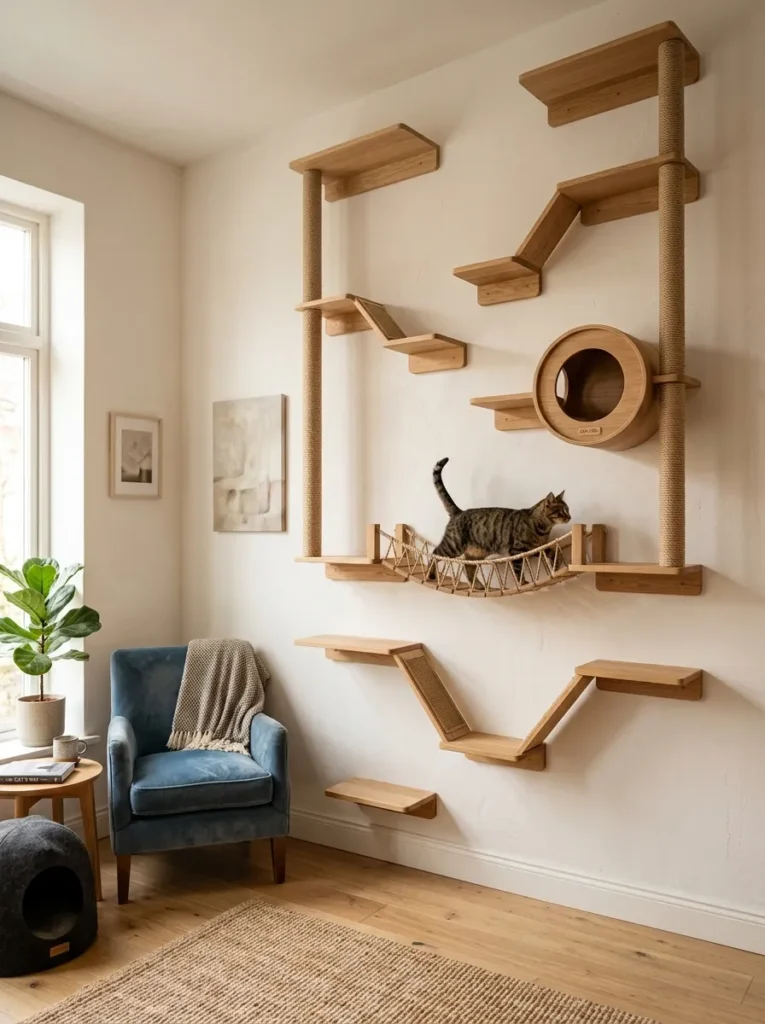
Vibe: The wall-mounted cat highway feels architecturally integrated and genuinely enriching — a cat climbing system that reads as a considered wall installation rather than pet equipment placed against a wall.
Why it works: A floor-to-ceiling wall-mounted cat highway is the single most behaviorally effective cat enrichment installation because it uses the full vertical dimension of the room — the dimension that cats instinctively seek to master — and provides multiple routes and destinations rather than a single linear path. The design principle is behavioral completeness: a well-designed cat highway addresses every key behavioral need simultaneously — the floor-level den provides security and retreat, the mid-level shelves provide activity and movement opportunity, the upper pod provides the elevated resting position that cats seek for security, and the rope bridge and sisal poles provide exercise and scratch opportunity at every height. Wall-mounting the system rather than using a freestanding cat tree creates the architectural integration that makes the installation look designed rather than placed.
How to get it: Install solid oak shelf brackets (12mm thick, rated to 20kg minimum) into wall studs or masonry anchors at the planned shelf positions — stud-finding and correct anchor selection is the most critical technical step, as the full weight of a cat landing on a shelf generates impact force significantly exceeding the cat’s body weight. Space shelves at 35–40cm vertical intervals for comfortable cat movement between levels. Wrap vertical poles (90x90mm timber posts) in sisal rope using waterproof adhesive and tight spiral wrapping. Construct the enclosed upper pod from 18mm plywood with a circular entry opening, fitted with a sherpa cushion interior. Install the floor-level den from the same plywood, sized to the cat’s body dimensions plus 30% for comfortable turning.
Quick Win: A single wall-mounted natural oak shelf at 160cm height with a soft sherpa cushion placed on it takes 30 minutes to install and costs $25–$45, immediately provides the elevated resting position that satisfies cats’ most fundamental height preference, and reads as a considered design element rather than pet equipment.
Shop The Look
| Product |
|---|
| Natural oak floating shelf 40cm deep wall |
| Heavy duty shelf bracket set rated 20kg |
| Sisal rope 10mm wrapping pole natural |
| Sherpa cushion cat shelf resting natural |
| Wall-mounted enclosed cat pod natural wood |
Also view: 15 Outdoor Dog House Ideas for Multiple Pets
2. Dedicated Cat Room with Full Enrichment Setup (LAYOUT)
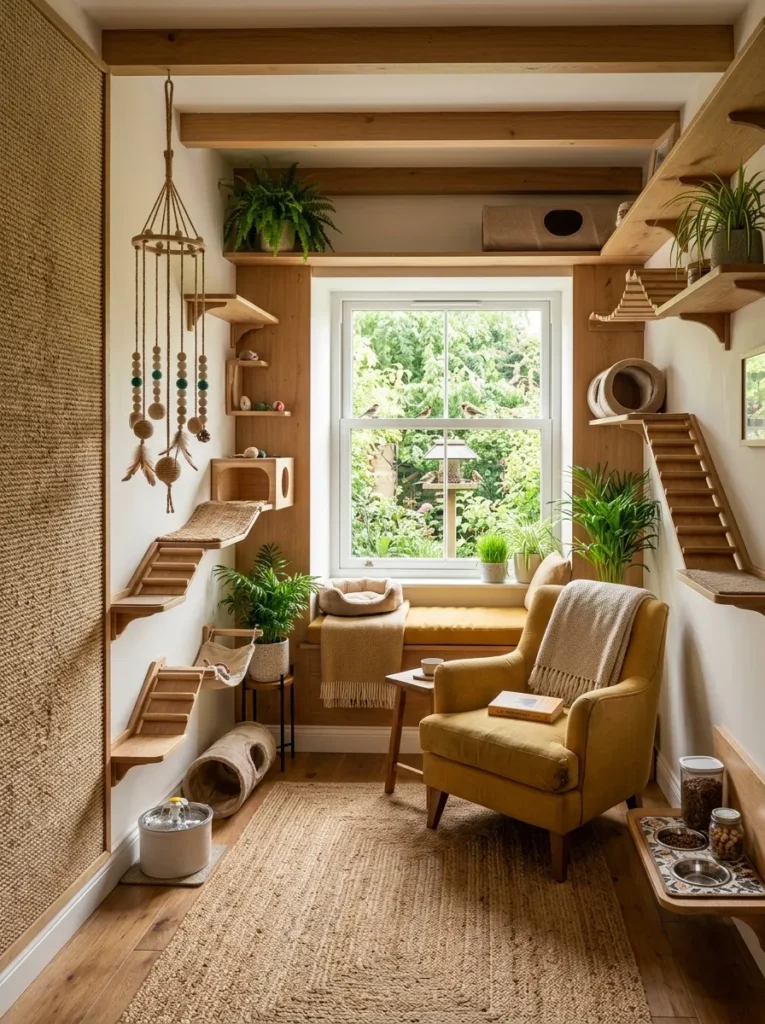
Vibe: The dedicated cat room feels abundantly enriched and warmly considered — the room that makes every cat behavioralist nod with satisfaction and every design-conscious cat owner feel genuinely inspired.
Why it works: A fully dedicated cat room is the most comprehensive behavioral enrichment available to an indoor cat because it provides unlimited, unsupervised access to a complete range of behavioral outlets — climbing, scratching, hiding, hunting-play, social contact, environmental observation, and private retreat — within a space specifically designed around cat needs rather than a compromise between human and cat requirements. The inclusion of a human chair is the design detail that most distinguishes a well-considered cat room from a mere cat storage space — cats are social animals whose wellbeing is directly linked to human companionship, and a comfortable seat for the human companion makes the cat room a place where genuine social interaction happens rather than simply a space where the cat is kept.
How to get it: Begin the dedicated cat room design by planning the window position — the window is the room’s most valuable cat enrichment feature, providing environmental observation, natural light, and bird-watching opportunity. Install an external bird feeder at the window’s viewing distance to animate the outdoor view. Design the wall highway on the two walls adjacent to the window rather than the window wall itself — this positions the climbing system where cats travel to and from the window rather than competing with it. The sisal wall panel (sisal sheeting stapled to a wall section, approximately 120x90cm) provides an appropriate horizontal scratching surface at cat reach height — position at 30–70cm from the floor where cats naturally scratch.
Shop The Look
| Product |
|---|
| Sisal sheet panel scratching wall cat |
| Window bird feeder suction cup external |
| Cat water fountain ceramic filtered |
| Cat-safe plant set catnip valerian grass |
| Comfortable armchair human cat room |
3. Japandi Minimalist Cat Corner (COLOR / MATERIAL)
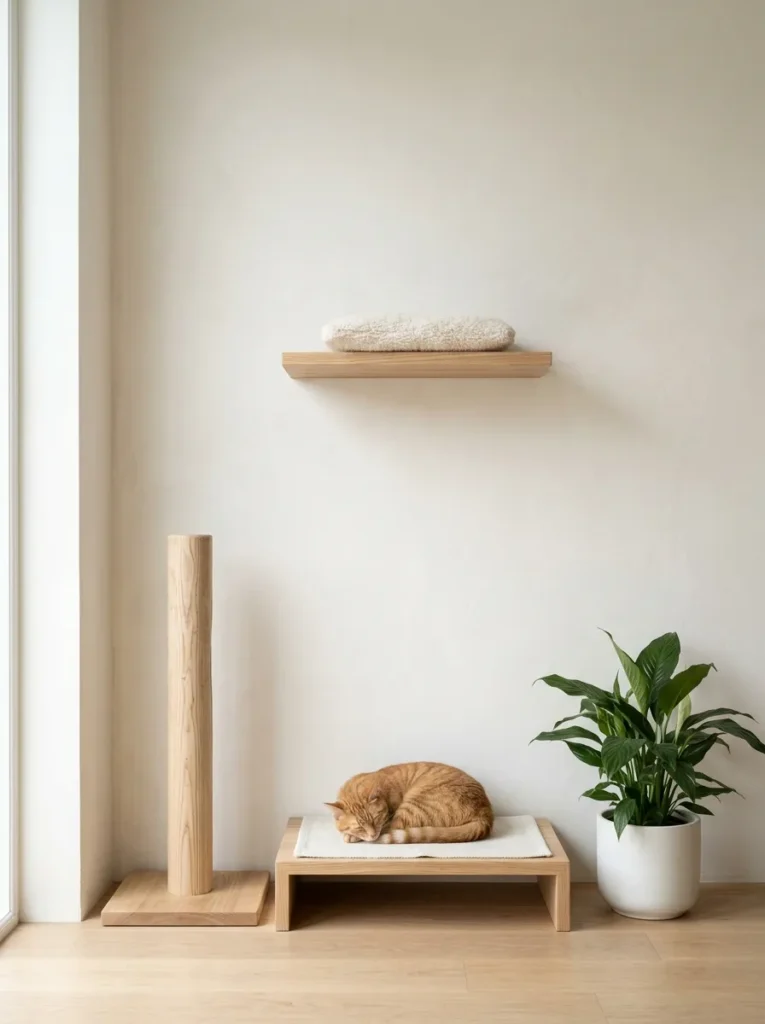
Vibe: The Japandi cat corner feels meditative and resolved — the cat enrichment installation that proves behavioral adequacy and aesthetic restraint are not mutually exclusive.
Why it works: A Japandi minimalist cat corner applies the design discipline of Japanese and Scandinavian minimalism — maximum meaning through minimum elements — to cat enrichment, creating a corner that provides the essential behavioral needs (a low sleeping platform, a scratching post, an elevated resting shelf) without any aesthetic excess. The design principle is functional reduction: by identifying the three most important behavioral needs of a specific cat and providing only those three elements at the highest possible material quality, the Japandi cat corner creates a more considered and more genuinely functional enrichment space than a complex, multi-element cat room that addresses every possible behavioral need simultaneously. The consistent use of warm ash wood throughout creates material unity that makes the three elements read as a designed composition rather than three separate pet products.
How to get it: Build the sleeping platform from 40mm thick solid ash with four short block legs at 20mm height — the low elevation is specifically Japandi-appropriate and also suits older cats and kittens who prefer a minimal jump height. Source a natural ash scratching post without the synthetic covering typically found on commercial cat trees — wrap in natural sisal rope starting from the base and working upward in tight spirals secured with waterproof adhesive. Mount the shelf from the same ash timber as the platform using a concealed bracket for the furniture-quality floating appearance. Choose a single cat-safe plant of architectural simplicity — a Japanese peace lily, a small Boston fern, or a single stem of cat grass in a white ceramic pot.
Shop The Look
| Product |
|---|
| Solid ash platform base 40mm natural |
| Natural sisal rope 10mm post wrapping |
| Ash floating shelf wall mount concealed |
| Sherpa cushion small shelf platform |
| Japanese peace lily cat safe plant pot |
4. Boho Cat Sanctuary with Hanging Elements (MATERIAL / ACCESSORIES)
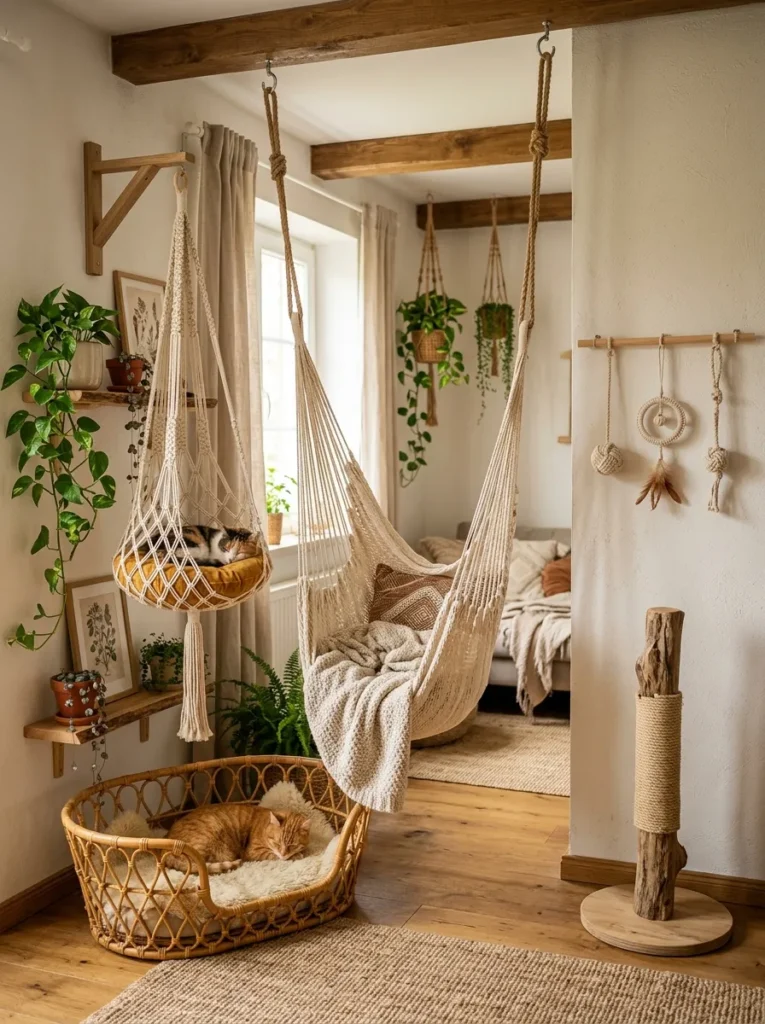
Vibe: The boho cat sanctuary feels warmly abundant and textural — a hanging, layered space that satisfies every cat’s desire for varied textures, heights, and swinging elements.
Why it works: A boho cat sanctuary with multiple hanging elements creates the most varied and most behaviorally stimulating cat environment of any design approach because the hanging, swinging quality of ropes, hammocks, and macramé introduces movement-based enrichment that static shelf systems cannot provide — a hanging element that moves when touched satisfies the cat’s predatory hunting drive in a way that stationary platforms cannot. The design principle is multi-modal enrichment: the boho cat sanctuary provides enrichment through five distinct behavioral channels simultaneously — the hammock provides swinging rest, the macramé bed provides enclosed rest, the hanging toys provide interactive play, the rattan floor bed provides ground-level rest, and the driftwood scratching post provides scratching and climbing. The natural material palette (cotton, rattan, sisal, driftwood) creates material richness that is simultaneously tactilely appropriate for cats and visually appropriate for a boho interior aesthetic.
How to get it: Install two heavy-duty ceiling hooks rated to 50kg minimum (significantly above the cat’s weight to account for dynamic swinging load) for the cotton rope hammock — the ceiling hooks must go into joists or use appropriate ceiling anchors. Position the hammock at 60–80cm from the floor for the most cat-appropriate height — too low reduces the swing quality, too high makes access difficult. Source or make the macramé cat bed from 5mm natural cotton macramé cord using a simple knotted hammock pattern — a macramé cat bed requires approximately 20 meters of cord and 2–3 hours of basic knotting.
Shop The Look
| Product |
|---|
| Natural cotton rope hammock cat large |
| Ceiling hook heavy duty 50kg rated |
| Rattan cat bed large floor natural |
| Macramé hanging cat bed natural cotton |
| Driftwood scratching post natural large |
5. Window Cat Perch and Bird-Watching Station (SMALL SPACE / ACCESSORIES)
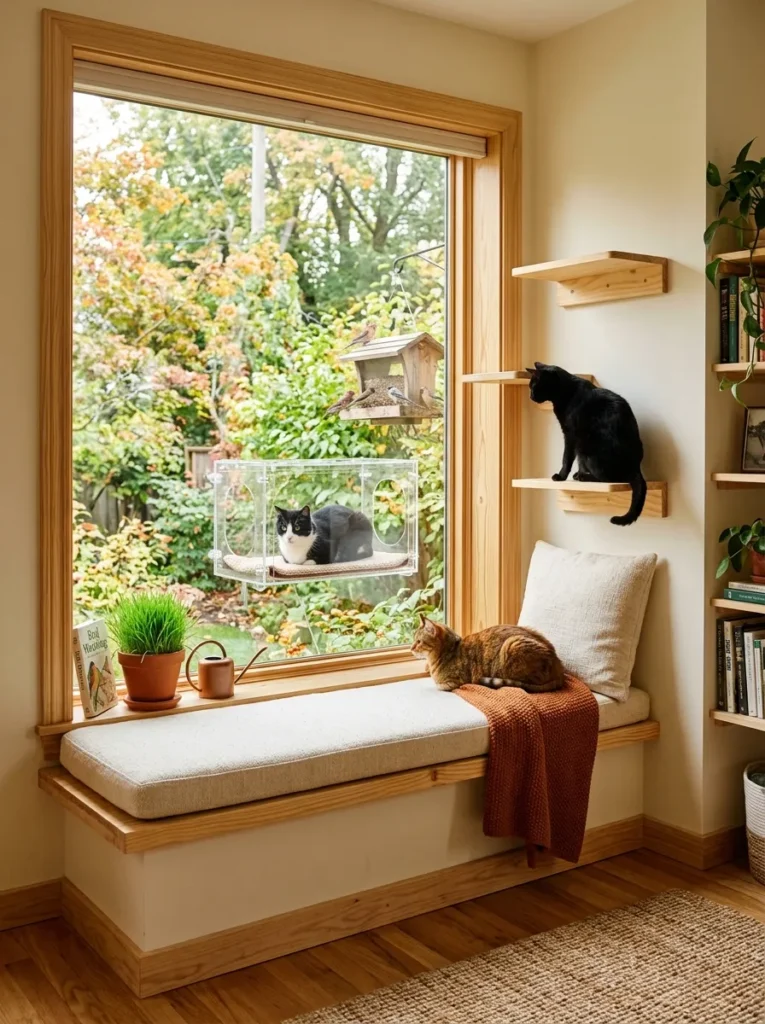
Vibe: The window bird-watching station feels naturally stimulating and position-perfect — the indoor cat enrichment installation that uses the outside world as the most interesting enrichment resource available.
Why it works: A window bird-watching station is the indoor cat enrichment installation with the highest sustained daily stimulation return because it leverages the most inherently stimulating visual content available to an indoor cat — live birds at close range — and provides it at the cat’s preferred observational position (elevated, comfortable, and thermally warm from the window sun exposure). The design principle is environmental borrowing: by positioning enrichment elements at the window and supplementing them with external bird feeders that animate the outdoor view, the designer effectively makes the entire garden or outdoor space part of the cat’s enrichment environment without requiring actual outdoor access. Research in feline behavioral science consistently shows that window access with animated outdoor views is among the most effective stress-reduction and enrichment interventions available for indoor cats.
How to get it: Build the window seat from 18mm pine, sizing it to cover the full window width and extend 50cm deep from the sill edge into the room. Top with a 75mm outdoor-rated foam cushion in performance fabric that can be cleaned easily — window seat cushions for cats require regular washing. Install flanking approach shelves at 60cm and 110cm height on the adjacent walls, providing multiple approach routes to the window seat for multi-cat households where access negotiation is important. Mount the external bird feeder on a bracket extending 40–60cm from the window frame — the distance from the glass prevents birds from striking the window when startled and provides the optimal viewing distance for cat observation.
Shop The Look
| Product |
|---|
| External window bird feeder bracket mount |
| Window seat cushion performance fabric |
| Pine board window seat natural 18mm |
| Cat grass seed kit terracotta pot sill |
| Wall shelf approach route 15cm deep |
6. Tunnel Network and Hide System (LAYOUT / MATERIAL)
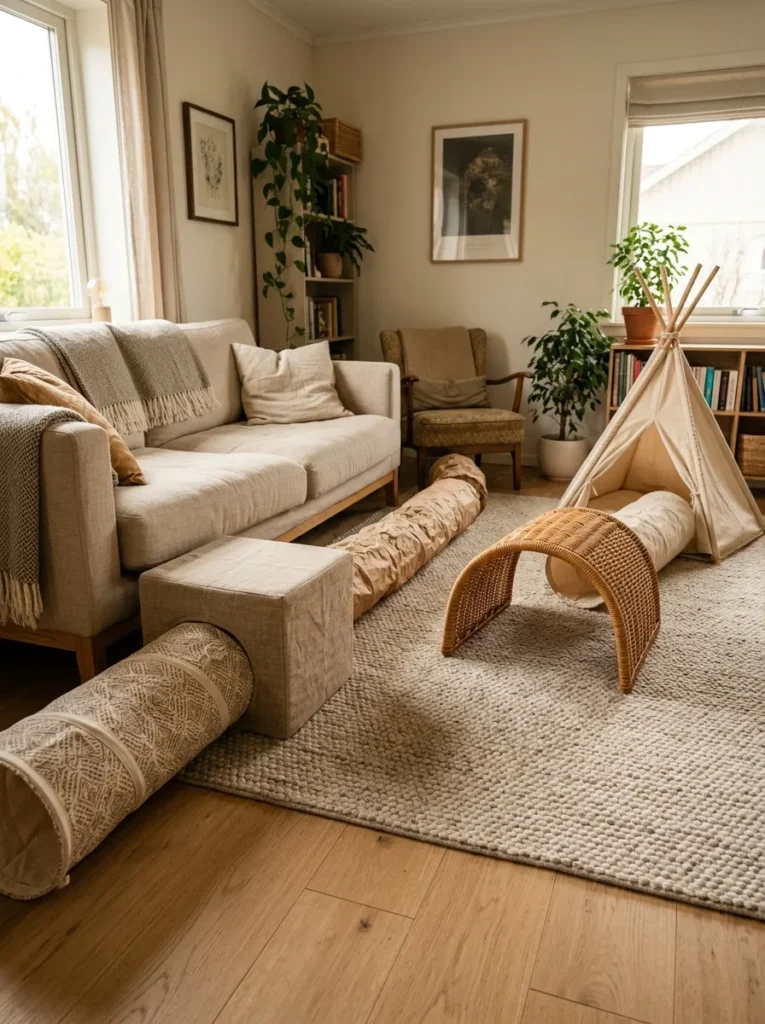
Vibe: The tunnel and hide system feels playfully secretive — a floor-level exploration network that satisfies the cat’s instinctive hunting and hiding behaviors in the spaces humans don’t usually think to design.
Why it works: A floor-level tunnel network and hide system addresses the behavioral needs that height-focused cat enrichment consistently overlooks — cats spend significant time at ground level in stalking, hiding, and ambushing behaviors that require enclosed spaces, constricted passages, and varied entrances and exits rather than elevation. The design principle is behavioral completeness through floor level attention: a cat room or cat-integrated living space that provides excellent vertical enrichment but ignores floor-level behavioral needs addresses only half of the cat’s full behavioral range. Tunnels satisfy the stalking and pouncing drive; enclosed hides satisfy the need for private, unobserved retreat; and the network quality (multiple tunnels connecting multiple hides) satisfies the exploratory drive that makes cats investigate every new environment thoroughly.
How to get it: Begin with the sofa hide — measure the under-sofa clearance and fit a simple linen-covered MDF box of appropriate dimensions in the most sheltered position under the sofa, leaving a circular entry opening facing the room. Source a cotton canvas teepee hide (available from children’s toy suppliers and used without the intended purpose) for the corner position — the teepee format provides excellent ventilation, which cats prefer over fully enclosed spaces for extended rest. Connect hides with crinkle-paper tunnels (stimulating auditory enrichment from the rustling sound), fabric tunnels, and a natural wicker tunnel arch that provides both passage and scratching surfaces.
Shop The Look
| Product |
|---|
| Natural cotton canvas teepee hide birch pole |
| Crinkle paper cat tunnel natural fabric |
| Wicker tunnel arch cat natural rattan |
| Linen fabric sofa hide cover natural |
| MDF enclosure board sofa hide base |
7. Cat-Safe Botanical Garden Room (COLOR / ACCESSORIES)
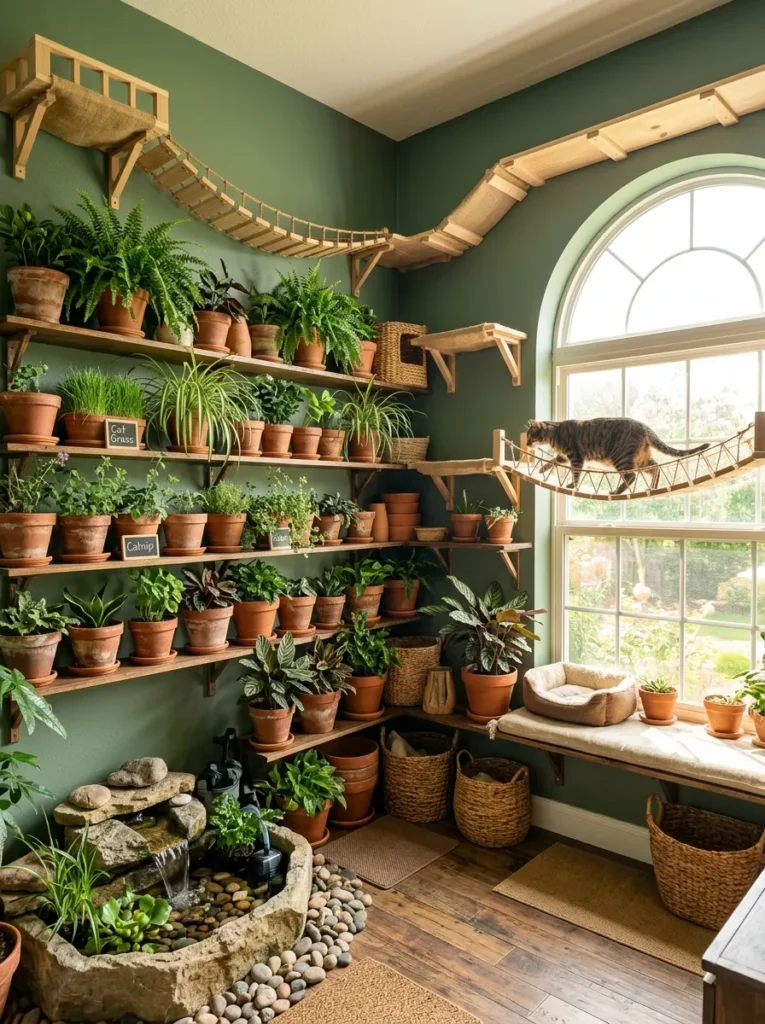
Vibe: The botanical garden cat room feels lushly restorative — the indoor environment that most powerfully satisfies a cat’s instinctive connection to the natural world through olfactory, visual, and tactile botanical richness.
Why it works: A cat-safe botanical garden room provides the richest possible olfactory enrichment environment because plants release varied aromatic compounds that engage the cat’s highly sensitive olfactory system — catnip and valerian in particular produce strong behavioral responses in most cats, while the varied green scents of multiple plant species create an olfactory landscape of genuine complexity. The design principle is sensory environmental richness: research in feline behavioral science shows that olfactory enrichment is among the most effective stress-reduction interventions for indoor cats, as scent provides the primary information channel through which cats read their environment. The deep sage green wall color is the specific design choice that creates the indoor garden atmosphere — it reads as foliage rather than paint, making the room’s botanical content feel naturally embedded in the color of the walls rather than displayed against them.
How to get it: Research cat toxicity for every plant species before installation — the list of toxic plants is extensive, and the cat-safe category requires specific plant identification rather than general assumptions. Verified cat-safe plants for botanical room use include: catnip (Nepeta cataria), cat grass (Dactylis glomerata), valerian (Valeriana officinalis), spider plant (Chlorophytum comosum), Boston fern (Nephrolepis exaltata), and calathea species. Install heavy-duty shelving rated for the combined weight of multiple terracotta pots with wet soil — each 15cm terracotta pot with wet soil weighs approximately 2–3kg, and a full shelf of eight pots requires brackets rated to 25kg minimum.
Shop The Look
| Product |
|---|
| Catnip plant Nepeta cataria live pot |
| Boston fern plant cat safe indoor |
| Spider plant cat safe hanging pot |
| Small recirculating water feature pump |
| Terracotta pot set 10 piece varied sizes |
8. Industrial Loft Cat Room (MATERIAL / COLOR)
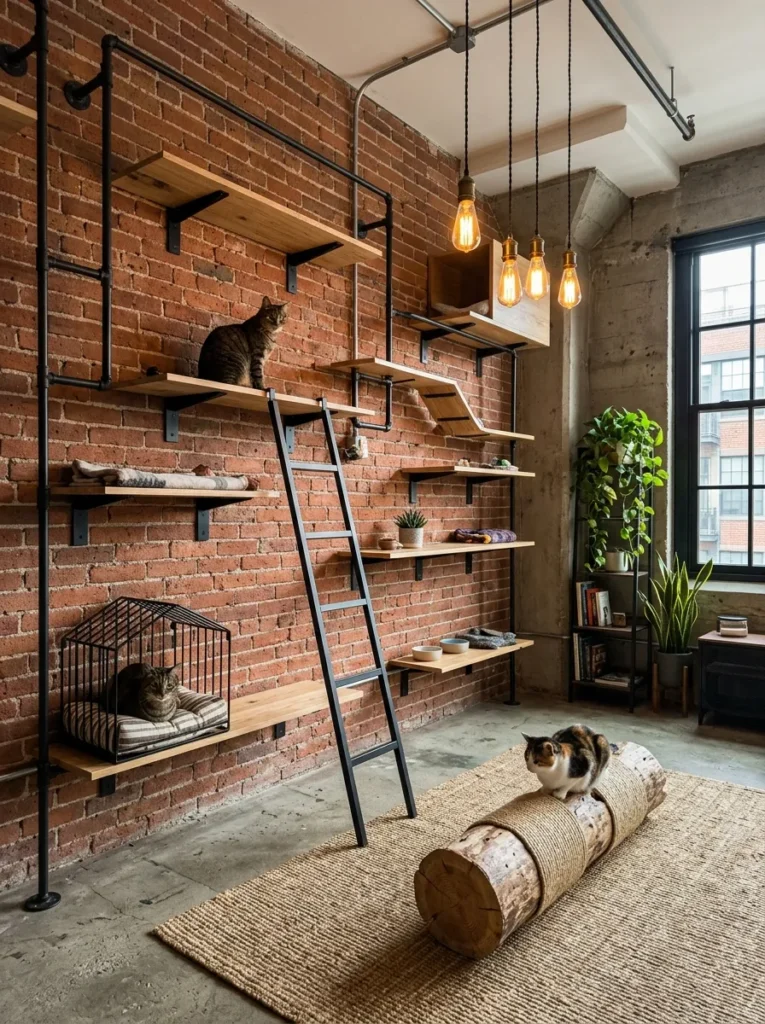
Vibe: The industrial cat room feels warmly bold — a space that celebrates the aesthetic authority of raw materials while providing a cat with a genuinely stimulating, multi-level environment.
Why it works: An industrial loft cat room applies the raw material aesthetic of industrial interior design to cat enrichment, creating a cat space that is completely coherent with its surrounding environment rather than inserting conventional pet product aesthetics into an industrial interior. The design principle is environmental consistency: cat room elements built from the same material vocabulary (black steel, natural wood, concrete, exposed brick) as the surrounding human spaces read as designed components of the home rather than pet equipment placed within it. The black powder-coated steel pipe shelving — essentially the same system used for industrial-style human shelving — serves the cat’s climbing and resting needs while reading as part of the room’s architectural language rather than a pet installation.
How to get it: Build cat-accessible pipe shelves using 20mm black steel pipe and floor flanges mounted to the exposed brick with masonry anchors — the same installation method as industrial pipe shelving for human use, simply configured with cat-appropriate depth (25–30cm) and spacing (35–40cm vertical intervals). Top each shelf with a natural wood plank of appropriate cat-comfortable thickness (25mm minimum) for surface rigidity under cat impact. The cat ladder between shelf heights is a simple steel tube (20mm diameter) with 20mm natural wood rungs at 15cm intervals, mounted at a 60–70 degree angle for comfortable cat access.
Shop The Look
| Product |
|---|
| Black steel pipe 20mm industrial shelf |
| Steel pipe flange black wall mount |
| Natural wood plank 25mm shelf surface |
| Black metal cat bed cage style low shelf |
| Raw wood scratching log natural large |
9. Cat-Integrated Bookshelf Library Wall (LAYOUT / SMALL SPACE)
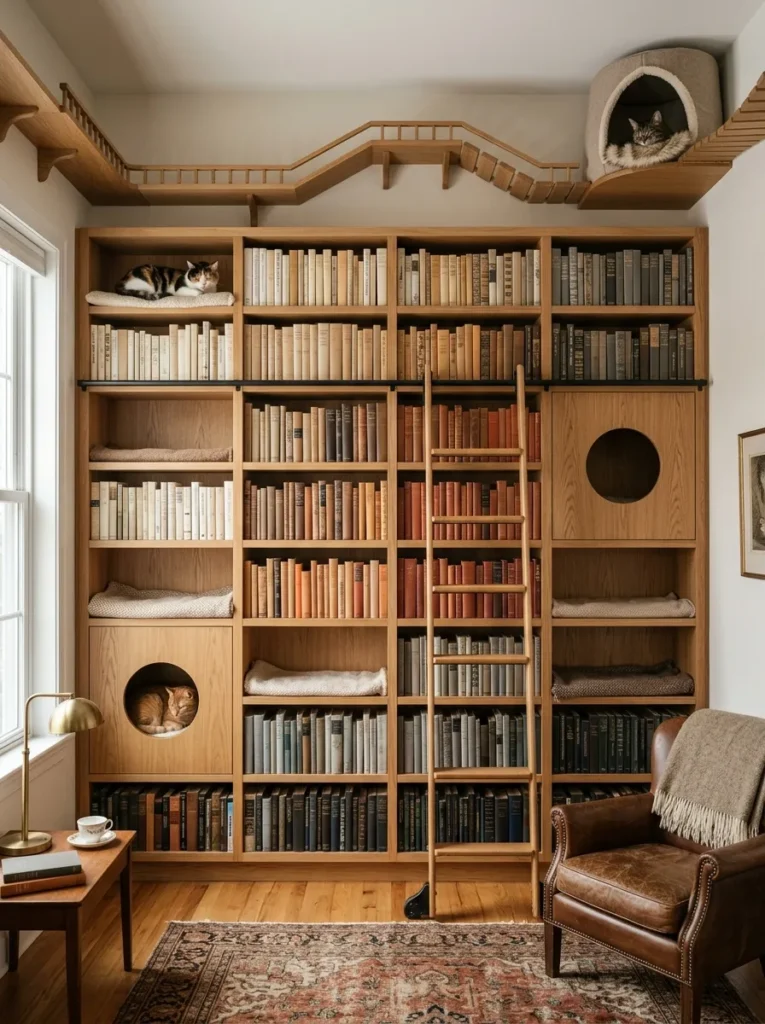
Vibe: The cat-integrated library wall feels warmly literary and architecturally clever — the bookcase that proves cat integration and beautiful books are not merely compatible but genuinely enhanced by each other.
Why it works: Integrating cat spaces into a floor-to-ceiling bookshelf wall is the cat room idea that most efficiently uses existing furniture as enrichment infrastructure — converting the bookcase from a purely human storage and display object into a dual-purpose structure that serves the cat’s behavioral needs (elevated resting platforms, enclosed den spaces, vertical navigation) while continuing to serve its book storage and display function. The design principle is dual-function design: the most elegant cat room solutions are those that serve human functional needs and cat behavioral needs from the same structure rather than adding cat-specific elements alongside human elements, which creates visual competition and spatial crowding.
How to get it: Plan the cat spaces before purchasing or building the bookshelf — identify which shelf positions will serve as cat platforms (typically alternate shelves at every other height level) and which book arrangements will frame rather than conflict with those positions. Cut circular or arched cave openings (20cm diameter minimum) in the solid side panels of the bookshelf unit using a jigsaw — sand and paint the cut edges smooth for cat safety. Line the cave interior with sherpa fabric for comfort. Install the wall-mounted cat highway extension above the bookcase using the same shelf bracket system as the bookcase for visual continuity.
Shop The Look
| Product |
|---|
| Floor to ceiling bookcase natural modular |
| Sherpa fabric cave den lining soft |
| Cat platform cushion shelf bookcase |
| Wall highway shelf extension above case |
| Jigsaw tool curved cut cave opening |
10. Outdoor Catio with Luxurious Indoor Access (SMALL SPACE / LAYOUT)
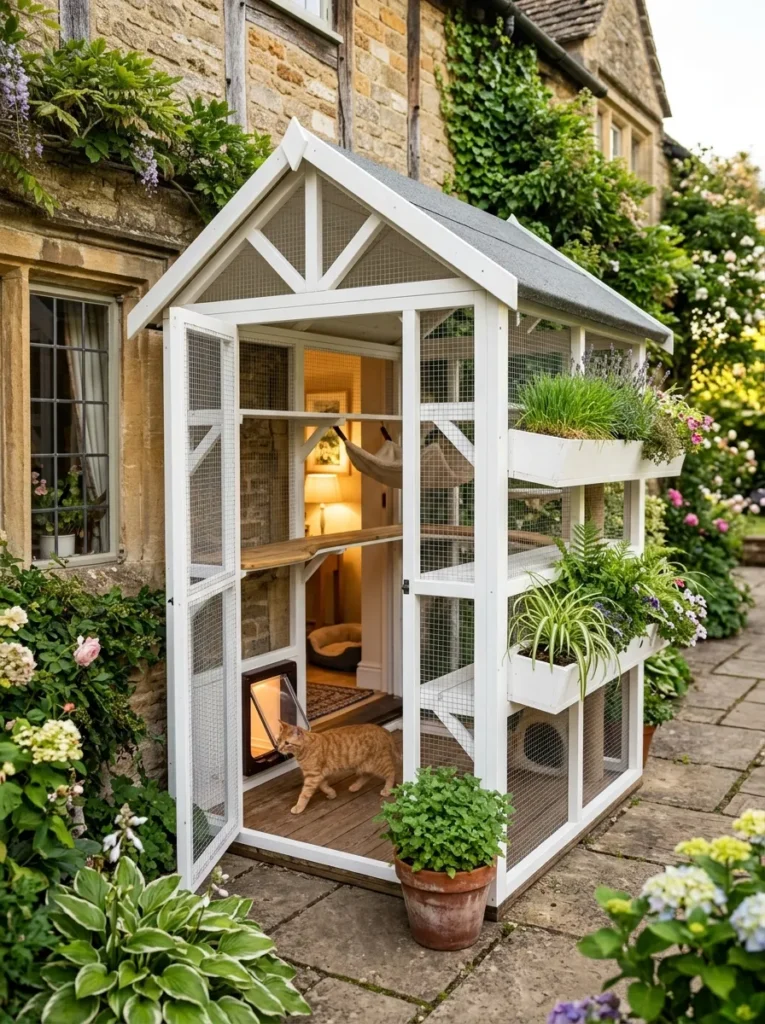
Vibe: The catio with indoor access feels seamlessly generous — the installation that dissolves the boundary between indoor and outdoor enrichment into one continuous cat environment.
Why it works: A catio connected seamlessly to an interior cat highway system creates the most complete and most experientially rich cat enrichment environment because it provides the full behavioral range from protected outdoor access (fresh air, natural light, bird sounds, natural scents) to vertical indoor climbing to ground-level exploration — all within a single connected system that the cat navigates continuously throughout the day. The design principle is environmental continuity: the most behaviorally rich cat environments are those where the cat experiences a continuous environmental journey rather than discrete, unconnected enrichment stations. The cat flap is the connection point that makes the catio an extension of the indoor environment rather than a separate destination.
How to get it: Site the catio directly adjacent to the connection window or wall opening for the most seamless indoor-outdoor transition. Install a cat flap large enough for the specific breed — measure the cat’s shoulder width and height and add 20% for a comfortable passage. Frame the cat flap opening in the same timber as the indoor highway system for visual continuity. Design the catio’s internal enrichment elements (climbing shelves, hammock, scratching surface) at consistent heights and spacing with the indoor highway system so that the cat’s traversal from indoors to outdoors is a continuous movement experience rather than a jarring transition between different enrichment systems.
Shop The Look
| Product |
|---|
| Cat flap large breed outdoor wall install |
| Cedar timber catio building natural |
| Window box planter exterior cat safe |
| Catnip plant terracotta pot catio |
| Cat hammock shelf catio inside mount |
11. Pastel Maximalist Cat Paradise (COLOR / ACCESSORIES)
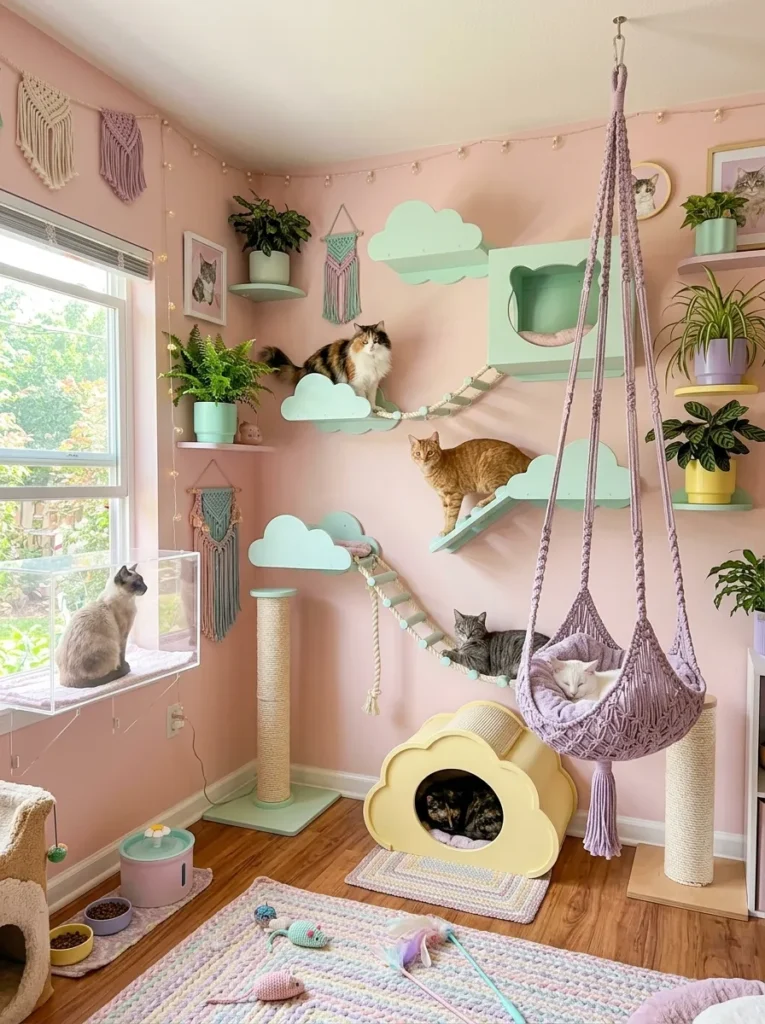
Vibe: The pastel maximalist cat paradise feels joyfully abundant and unabashedly playful — the cat room that fully commits to the logic that if cats deserve dedicated space, they deserve genuinely beautiful, joyfully designed dedicated space.
Why it works: A maximalist pastel cat paradise is the cat room design that most fully embraces the logic of genuine design commitment — if a room is being dedicated to a cat’s enrichment, then designing it with the same color consideration, pattern interest, and decorative richness applied to any other designed room produces a genuinely better outcome than a utilitarian approach. The design principle is joyful commitment: maximalism in a cat room context succeeds for the same reasons it succeeds in any room — the consistent application of a specific color palette (here, harmonious pastels) prevents abundance from reading as chaos, while the variety of textures, heights, and element types creates the visual richness that rewards continuous engagement. The cloud-shaped shelves are the specific design choice that most clearly communicates that this is a joyfully designed space — organic, non-rectangular shelf forms create the visual playfulness that distinguishes a genuinely designed cat room from a merely well-equipped one.
How to get it: Paint the walls before installing any cat elements — pastel paint is the lowest-cost investment with the highest atmospheric return in any room transformation. Source or DIY cloud-shaped shelves by cutting MDF in organic, rounded shapes using a jigsaw, sanding all edges smooth, and painting in mint green before mounting on concealed brackets. The dusty lilac hammock should be cat-specific (rated to 5kg minimum) rather than a standard fabric hammock not designed for cat weight distribution. Position the pastel yellow floor pod in the warmest, most sun-exposed position in the room — the pod provides an enclosed, private retreat space that contrasts with the open climbing system.
Shop The Look
| Product |
|---|
| Pastel interior paint set blush mint lilac |
| Cloud shaped shelf MDF cut natural |
| Dusty lilac cat hammock hanging rated |
| Pastel ceramic plant pot set varied |
| Pastel yellow enclosed cat pod floor |
12. Cosy Reading Nook Cat Room Integration (SMALL SPACE / MATERIAL)
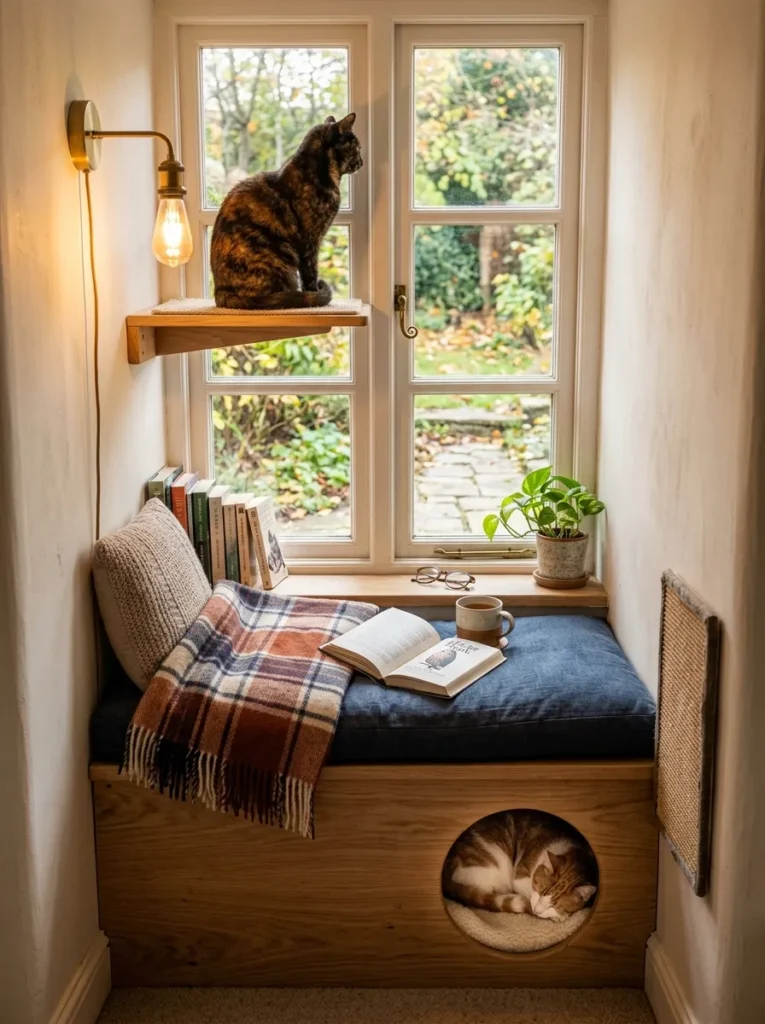
Vibe: The reading nook integration feels warmly co-habitational — the space where human reading pleasure and cat contentment exist in genuine, unhurried proximity.
Why it works: Integrating cat spaces into a human reading nook creates the most genuinely co-habitational cat room design because it acknowledges and designs around the most common real pattern of human-cat domestic life — cats consistently seek proximity to their human companions during sedentary human activities, and a reading session in a comfortable nook is exactly the kind of calm, extended human activity that cats prefer to share. The design principle is proximity design: rather than separating cat and human spaces into dedicated zones, the reading nook integration creates a shared space where both can be genuinely comfortable simultaneously — the human in the deep reading seat, the cat in the nook base’s enclosed sleeping space or on the approach shelf at window height.
How to get it: Build the reading seat from 18mm pine at 450mm height (standard seat height) with the base section divided between storage drawers on one side and the cat sleeping nook on the other side. The cat nook should be 50x40x35cm minimum with a 22cm diameter circular entry opening at one end. Line the nook interior with removable sherpa cushion for easy washing. Mount the approach shelf at 160cm (above the reading seat back, reachable by the cat from the seat arm) using a wall-mounted bracket of sufficient depth for comfortable cat resting — 25cm minimum. Apply the sisal panel to the alcove’s side wall surface at 30–70cm height using staples and timber battens.
Shop The Look
| Product |
|---|
| Pine timber board 18mm reading seat build |
| Sherpa cushion cat nook removable wash |
| Sisal scratching panel self adhesive |
| Reading lamp warm amber plug in |
| Circular entry template jigsaw guide |
13. Multi-Cat Household Territorial Design (LAYOUT)
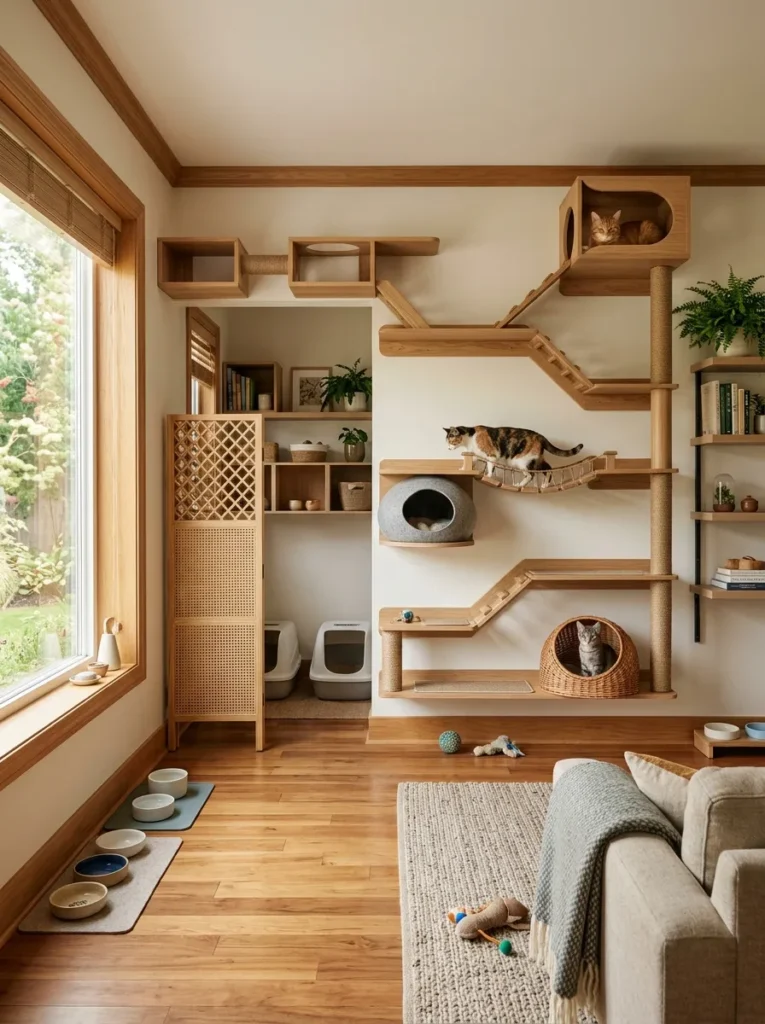
Vibe: The multi-cat territorial design feels thoughtfully orchestrated — a space that reduces feline social tension through deliberate resource separation and height zone differentiation.
Why it works: Multi-cat household cat room design requires applying feline social behavioral science rather than simply scaling up single-cat enrichment, because the primary cause of stress and conflict in multi-cat households is resource competition — competition for resting spots, food stations, litter boxes, and human attention. The design principle is resource multiplication and separation: in a well-designed multi-cat room, every key resource (food, water, litter, high resting spots, enclosed sleeping spaces) is provided in number at least equal to the number of cats plus one, and positioned so that no single cat can simultaneously block access to two resources. The three-zone height system is the most important single design decision for multi-cat households — cats in multi-cat groups naturally establish a social hierarchy with preferred height positions, and designing the vertical system to provide adequate high-height destinations for the dominant cat prevents resource guarding of the entire vertical system.
How to get it: Plan the feeding station positions first — they should be on opposite sides of the room at minimum, with clear sightlines between stations so no cat can be ambushed at a food bowl. Position litter boxes in the room’s quietest corner behind a decorative screen — three litter boxes for a two-cat household, four for three cats, using the N+1 rule. Design the climbing wall with explicit access to the upper zone from at least two different directions — this prevents the dominant cat from blocking the single access route and preventing other cats from reaching upper positions.
Shop The Look
| Product |
|---|
| Cat feeding station elevated set 3 |
| Decorative litter box screen natural |
| Multiple enclosed cat pod set 2 heights |
| Cat water fountain set 2 separated rooms |
| Multi-cat vertical highway extension shelf |
14. DIY Cat Room Weekend Transformation (ACCESSORIES)
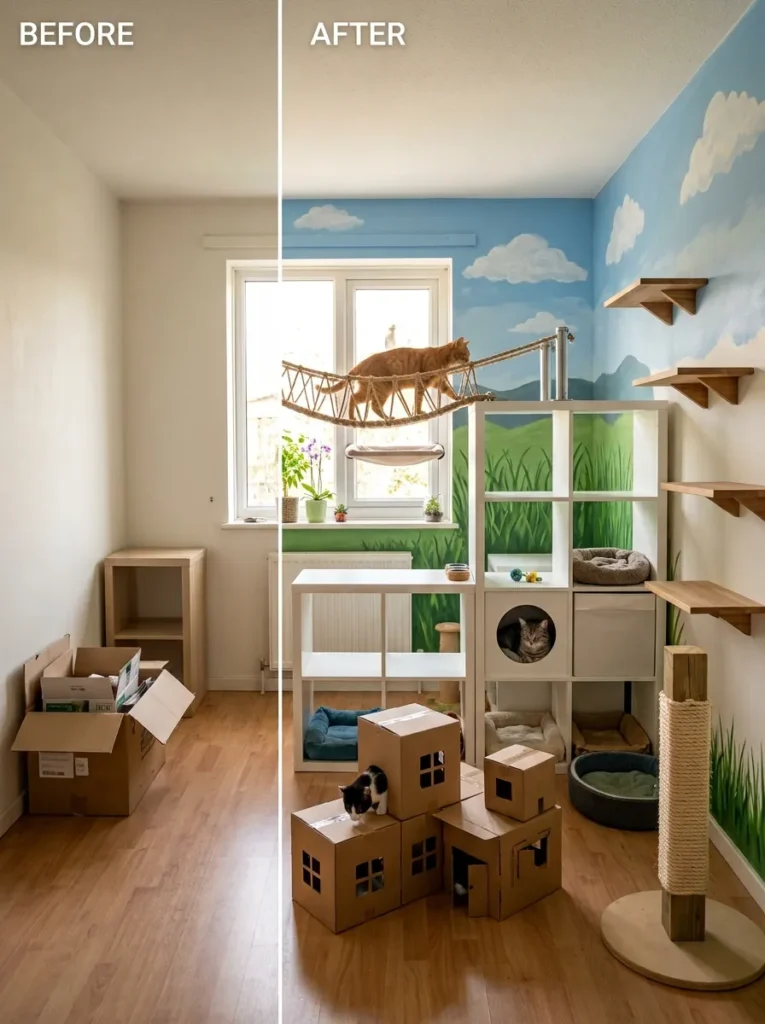
Vibe: The DIY weekend cat room feels achievably inspiring — the transformation that proves a genuinely enriching, genuinely beautiful cat room is within reach of any motivated person with basic DIY skills and a spare weekend.
Why it works: A DIY cat room weekend transformation using repurposed furniture and affordable materials demonstrates the most important principle in cat room design — that behavioral adequacy and aesthetic quality are primarily functions of design intelligence rather than material expense. The design principle is creative resourcefulness: KALLAX units with cat-entry holes cut into their panels provide enclosed den spaces of genuine quality; a simple rope bridge between two units provides the swinging, tactile experience of much more expensive rope bridge systems; a fence post wrapped in sisal provides scratching surface quality equivalent to commercial scratching posts at 20% of the cost. The hand-painted wall mural is the single design touch that most clearly transforms the room from a cat storage space into a genuinely designed cat environment — it communicates that creative intention was invested, which is the quality that distinguishes a genuinely enriching environment from a merely adequate one.
How to get it: Begin the KALLAX conversion by cutting a 22cm diameter circular opening in the panel of one cube using a jigsaw — this creates the enclosed den space that is the most valuable single enrichment element in the room. Wrap the fence post (90x90mm timber, 180cm length) in sisal rope from the base upward using waterproof adhesive for the first 10cm to anchor the rope, then continuous tight wrapping secured by weaving the rope end back through the previous three rows. Paint the wall mural using exterior acrylic paint in grass green and sky blue — a simple grass horizon line with a sun and clouds painted at the cat’s eye level on the wall requires no artistic skill beyond the ability to draw a curved line.
Shop The Look
| Product |
|---|
| KALLAX shelf unit white repurpose cat |
| Rope bridge natural cotton cat connect |
| Fence post timber 90x90mm sisal base |
| Sisal rope 10mm DIY post wrapping |
| Exterior acrylic paint wall mural cat |
How to Start Your Cat Room Design
Your single best first move is to observe your specific cat’s behavioral preferences for one full week before making any design or purchasing decisions — noting where in the home it chooses to rest at different times of day, whether it gravitates toward high or low positions, whether it prefers enclosed or open resting spaces, how much time it spends at windows, whether it scratches vertically or horizontally, and how it responds to play stimuli. These seven days of behavioral observation constitute the design brief that no cat room idea, however comprehensive, can substitute for — because every cat has individual behavioral preferences that determine which enrichment elements will be used enthusiastically and which will be ignored regardless of their quality or expense.
The most common mistake in cat room design is installing enrichment elements that look impressive but are never used because they fail to match the specific cat’s behavioral preferences — a floor-level cardboard box city for a cat that exclusively seeks elevation, or an elaborate height-focused climbing system for a cat that prefers ground-level exploration and tunnel hunting. Fix this by identifying the top three behavioral motivations from the observation week (height-seeking, window-watching, tunnel-exploring, play-hunting, etc.) and selecting enrichment elements that specifically address those motivations rather than providing a comprehensive but generic set of enrichment stations.
Three specific items under $50 that create the most immediate, most universally effective indoor cat enrichment: a window bird feeder mounted at the primary window ($15–$22) that activates the most important environmental stimulus available to an indoor cat; a simple cardboard box with a circular entry hole cut in each end ($0 in materials, 5 minutes to make) that provides the enclosed hunting-hide space most cats instinctively seek; and a growing pot of catnip or cat grass ($8–$12 from a garden center) that provides daily olfactory enrichment at a level that no synthetic toy can approach.
A basic cat room enrichment setup — a wall-mounted shelf at window height, a simple sisal scratching post, and a cardboard tunnel system — takes one weekend and costs $60–$120. A mid-level dedicated cat room with a full wall highway, window station, and hide system costs $300–$600 in materials for a DIY build. A comprehensive professionally designed cat room with custom-built elements throughout costs $1,500–$5,000 — but the behavioral science is clear that a thoughtfully designed $300 cat room using the correct behavioral principles will provide more genuine enrichment than a $5,000 installation that looks impressive but doesn’t match the specific cat’s behavioral needs.
Frequently Asked Questions About Cat Room Ideas for Indoor Cats
What are the most important behavioral needs to address in a cat room design?
Feline behavioral science identifies five primary behavioral needs that any genuinely effective cat room must address: elevated resting positions (cats require access to the highest available resting spots for security and observation, making vertical design the non-negotiable foundation of any cat enrichment space); scratching surfaces (cats scratch for nail maintenance, stretching, and territory marking — vertical sisal surfaces at full stretch height and horizontal surfaces at floor level both serve distinct functions); hiding and retreat spaces (enclosed, private spaces where the cat cannot be observed are essential for stress management, particularly in multi-person households and multi-pet homes); hunting and play stimulation (interactive play elements that satisfy the stalking-pouncing-catching behavioral sequence are essential for psychological wellbeing); and environmental observation (window access with animated outdoor views — birds, movement, weather — is the most effective single enrichment element for sustained daily stimulation). A cat room that addresses all five needs adequately will serve an indoor cat’s welfare more effectively than one that addresses three of the five needs at a higher standard.
How much space does an indoor cat room need to be effective?
A genuinely enriching indoor cat room can be created within any footprint from a single wall section (2 meters wide, floor-to-ceiling height) upward — the critical dimension is vertical height rather than floor area. A single living room wall fitted with a floor-to-ceiling cat highway, an enclosed pod at upper height, and a floor-level sleeping den provides more meaningful enrichment than a large, open floor-level play area with no vertical element. In studio apartments and small homes where a dedicated cat room is impractical, the most effective approach is vertical integration into existing rooms — wall-mounted shelves, window seats, and furniture-integrated dens serve the cat’s behavioral needs while consuming minimal additional floor space.
What plants are safe to include in a cat room?
The list of cat-safe plants suitable for a cat room includes: catnip (Nepeta cataria) — the most enriching cat plant, producing euphoric behavioral responses in most cats; cat grass (Dactylis glomerata, Triticum aestivum) — provides digestive fiber and natural grazing behavior; valerian (Valeriana officinalis) — produces catnip-like response, particularly in cats that don’t respond to catnip; spider plant (Chlorophytum comosum) — mildly hallucinogenic to cats in large quantities but safe in normal household amounts; Boston fern (Nephrolepis exaltata) — cat-safe and humidity-loving; calathea species — cat-safe with beautiful patterned foliage; and air plants (Tillandsia) — completely cat-safe and requiring no soil. Avoid all lily species (highly toxic), pothos (mildly toxic despite widespread inclusion in cat-friendly plant lists), and sago palm (extremely toxic). Always verify any plant’s cat-safety status with the ASPCA toxic plant database before installation.
How do I manage the hygiene of a dedicated cat room?
Cat room hygiene requires a systematic daily and weekly maintenance routine that keeps the space genuinely clean rather than simply tidy. Daily maintenance: remove waste from litter boxes (in a dedicated cat room, litter boxes should be cleaned twice daily for the most hygienic environment), wipe down food and water stations, and remove any hair accumulation from high-traffic shelf surfaces and tunnels. Weekly maintenance: wash all cushion covers and sherpa pads on a hot wash (60°C minimum for effective parasite control), disinfect litter box trays, wipe all hard surfaces with a pet-safe disinfectant, and vacuum all fabric elements. Monthly maintenance: deep-clean the litter box enclosures, wash curtains or wall textiles if present, and check all sisal wrapping on scratching posts for wear that might expose underlying materials. Cedar elements in the cat room provide natural antimicrobial properties that reduce bacterial accumulation between cleaning sessions.
What is the minimum cat enrichment needed for a healthy indoor cat?
The minimum enrichment standard for a healthy indoor cat consists of four non-negotiable elements: one elevated resting position accessible to the cat at all times (a minimum height of 120cm from the floor); one vertical scratching surface at the cat’s full stretch height (minimum 60cm tall, sisal-wrapped) and one horizontal scratching surface; daily interactive play sessions of minimum 2×15 minutes using a wand toy that allows the full stalking-pouncing-catching behavioral sequence; and window access with an outdoor view that includes some movement stimulation (birds, weather, garden activity) for a minimum of 4 hours daily. The indoor cat room ideas in this article all far exceed this minimum standard — the minimum is provided as a baseline for households where dedicated cat rooms are not possible, to ensure that every indoor cat receives the behavioral needs that prevent stress-related behavioral problems.
Ready to Create Your Cat’s Dream Room?
These 14 ideas span the full range of cat room design possibility — from the meditative restraint of the Japandi minimalist corner and the seamless human-cat integration of the reading nook, through the lush botanical abundance of the plant garden room and the joyful maximalism of the pastel paradise, to the architectural seriousness of the industrial loft cat room and the behavioral sophistication of the multi-cat territorial design, the boho warmth of the hanging sanctuary and the achievable inspiration of the DIY weekend transformation — covering every home size from a single shelf section to a dedicated room, every budget from free cardboard boxes to custom-built installations, every aesthetic from Japandi to maximalist, and every behavioral need from solitary meditation to multi-cat social navigation. Begin with the observation week — seven days of genuinely watching your specific cat’s specific behavioral preferences rather than designing for a generic cat — because the cat room that responds to what your cat actually does and actually seeks will be used joyfully every hour of every day, while the cat room designed for a theoretical cat may impress human visitors while the actual resident chooses the sofa instead. Today’s specific action: identify the one position in your home where your cat currently spends the most time resting, identify what quality of that position it seeks (elevation, enclosure, window proximity, warmth, human closeness), and choose the idea from this list that most directly enhances and expands that quality into a designed enrichment experience. When your cat uses its new space with the particular contentment of an animal whose environment genuinely meets its needs — not just tolerating indoor life but actively inhabiting a space designed for it — you will understand exactly why cat room design earns its devoted, passionate community and the permanent place it holds at the top of every thoughtful cat owner’s home improvement list. Save your favorites now, especially the floor-to-ceiling wall highway and the window bird-watching station — they are the two ideas that, once installed, produce the most visible, most sustained improvement in an indoor cat’s daily quality of life.