Free knitting patterns for dog sweaters and coats are downloadable or printable pattern instructions — available from yarn company websites, independent designer blogs, and knitting community platforms — that provide row-by-row instructions for knitting garments sized for dogs, typically including stitch counts, needle size recommendations, yarn weight specifications, and finishing instructions, all at no cost to the knitter. This article gives you 14 free knitting pattern ideas for dog sweaters and coats that span every skill level from absolute beginner to confident intermediate knitter, every yarn weight from bulky to fingering, and every dog size from chihuahua to Great Dane — plus guidance on finding, sizing, and adapting patterns for your specific dog.
Picture a January afternoon where you are knitting a deep rust-colored sweater for a small dog who shivers on every winter walk, casting on from a free pattern you found in twenty minutes online, using yarn left over from last season’s project, producing something warm, well-fitted, and genuinely handmade that costs less than any equivalent pet store purchase and fits the specific dog in your house in a way that no commercial garment ever quite manages. Knitting for dogs is one of the most immediately satisfying applications of knitting skill — the projects are small, the results are functional and adorable, and the recipient is invariably enthusiastic about wearing them during cold-weather walks. Here are 14 pattern ideas worth saving — and knitting.
Why Free Dog Knitting Patterns Work So Well
Free dog sweater and coat knitting patterns succeed as a resource category because the dog knitting pattern design community is genuinely generous — major yarn companies (Lion Brand, Paintbox, Drops Design, and many others) produce and freely distribute high-quality pattern ranges as promotional material for their yarn lines, and independent knitwear designers publish free patterns regularly as portfolio demonstrations and community contributions. The result is a free pattern landscape that competes favorably with paid patterns in design quality, instruction clarity, and construction sophistication.
The specific appeal of knitting dog garments for hand knitters is the project scale — a dog sweater for a small or medium dog is a one-to-three evening project in bulky or chunky yarn, a weekend project in worsted weight, and a two-to-three week project in DK or sport weight. This scale makes dog sweaters the ideal project category for knitters who want the satisfaction of a finished, functional item without the month-long commitment of a human sweater, who want to use yarn leftovers from larger projects, or who are learning new construction techniques (seamed, seamless, top-down, bottom-up) in a low-stakes, small-scale format before applying them to human garments.
Dog sweater and coat knitting also provides a meaningful functional outcome for the dogs themselves — short-coated breeds (greyhounds, whippets, chihuahuas, miniature pinschers, Italian greyhounds), dogs with very short hair (boxers, bull terriers, basset hounds), elderly dogs with reduced thermoregulation, and small dogs whose surface-area-to-volume ratio makes them lose heat faster than larger breeds all genuinely benefit from wearing a well-fitted knitted garment in cold weather. The knitted garment’s specific advantage over commercial pet clothing is the quality of fit achievable through custom sizing — a sweater knitted to a specific dog’s actual measurements fits the chest, length, and leg openings correctly in a way that standardized commercial sizes cannot guarantee.
Pattern Guide at a Glance
| Element | Trait 1 | Trait 2 |
|---|---|---|
| Philosophy | Free patterns as genuine resources — major designers and yarn companies provide professional-quality patterns at no cost | Custom sizing as the knitter’s advantage — fitting to actual dog measurements rather than commercial size approximations |
| Yarn Weights | Bulky/chunky for beginners and fast projects | Worsted for standard projects, DK/sport for fine-detail work |
| Key Platforms | Ravelry, Lion Brand, Drops Design, LoveCrafts, Paintbox Yarns, designer blogs |
Essential Measurements Before You Begin
Every dog sweater pattern requires the same three core measurements. Take these with a soft tape measure on a calm dog standing in a natural position: Back length — from the base of the neck (where a collar sits) to the base of the tail; Chest girth — the widest measurement around the chest, typically just behind the front legs; Neck girth — around the base of the neck where a collar sits. Many patterns also use leg depth (the distance from the spine to the point where the front leg meets the body) for leg opening placement. Always measure your specific dog and compare to the pattern’s schematic measurements — sizing a dog sweater to measurements rather than to breed descriptions produces significantly better results because individual dogs of the same breed vary enormously in body proportion.
1. Simple Ribbed Dog Sweater (Beginner, Bulky Yarn)
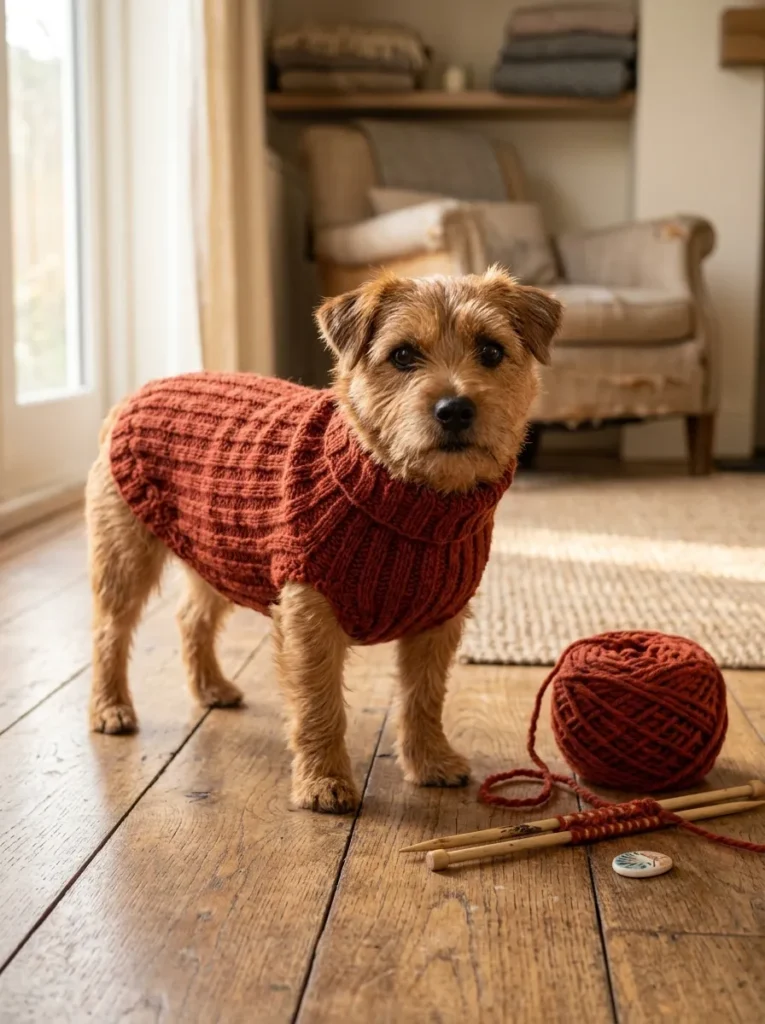
Vibe: Warm and handmade — the sweater that looks like exactly what it is and is better for it.
Why it works: A simple ribbed dog sweater in bulky yarn is the ideal first dog knitting project because the construction is a single rectangle of ribbing knitted flat on straight needles, seamed at the back, with leg holes created by simply leaving a section of the side seams open rather than shaped and worked separately. The 2×2 rib pattern (knit 2, purl 2 alternating across all rows) creates natural elasticity that accommodates the slight variation between dog measurements and knitted dimensions, making it more forgiving of sizing imprecision than stockinette stitch. The bulky yarn produces a fabric that is appropriately warm, knits at 3–4 stitches per inch which means visible row-by-row progress, and completes in 2–4 hours depending on the dog’s size.
Pattern structure: Cast on the number of stitches corresponding to the dog’s chest girth in 2×2 rib. Knit in rib for the body length from collar to base of tail. Seam the long edges together, leaving leg openings at the appropriate measurement from the cast-on edge (leg depth measurement from the pattern schematic). Pick up stitches around the neck opening and work a short ribbed collar. Block and seam.
Where to find it free: Search “simple ribbed dog sweater free pattern” on Ravelry, Lion Brand’s free pattern library, or LoveCrafts’ free section. Lion Brand’s “Dog Sweater” pattern and Paintbox Yarns’ “Simple Dog Jumper” are both free, well-written, and sized from XS to XL.
Yarn suggestion: Lion Brand Pound of Love, Paintbox Yarns Simply Super Chunky, or Drops Andes in a warm rust, camel, or forest green.
| Product |
|---|
| Bulky weight yarn rust or warm tone |
| Straight knitting needles 9mm US 13 |
| Soft tape measure for dog sizing |
| Tapestry needle for seaming |
| Stitch marker set |
Also view: 15 Outdoor Dog House Ideas for Multiple Pets
2. Top-Down Seamless Dog Sweater (Beginner-Intermediate)
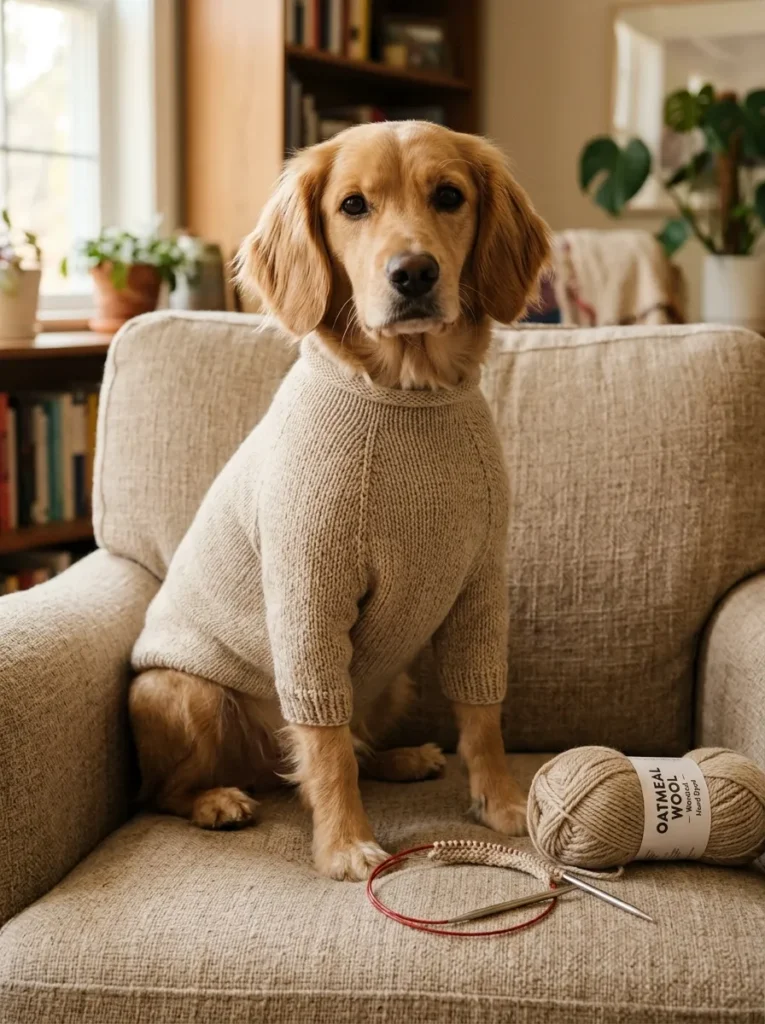
Vibe: Considered and neat — the sweater that fits like it was tailored because it essentially was.
Why it works: A top-down seamless dog sweater knitted on circular needles produces the most professional-looking, best-fitting result available in any dog sweater construction method because it is shaped from the neck downward with short rows at the back neck to accommodate the dog’s spine curvature and worked in the round so the body is a seamless tube with leg holes placed precisely at the measured position. The top-down construction allows the knitter to try the sweater on the dog as they work — placing the needles or a waste yarn holder on the stitches, fitting the partial sweater to the dog, and adjusting the length before continuing — which produces a fit that no pattern-following-without-fitting approach can guarantee.
Pattern structure: Cast on the neck girth stitches, join in the round, work short rows at the back to raise the back neck height, establish raglan-style increases at four raglan markers, increase until the chest width is reached, then continue the body tube to the tail. Leg holes are worked by placing body stitches on hold and working short sections back and forth. Work the leg edging by picking up around each hole. Finish at the tail with a ribbed or rolled hem.
Where to find it free: Search “top-down dog sweater free pattern” on Ravelry — Yarnover Truck’s “Top-Down Dog Sweater” is one of the most-downloaded free dog patterns on the platform with extensive size range and clear construction notes.
Yarn suggestion: Cascade 220 Superwash, Paintbox Yarns Simply DK, or Drops Lima in soft oatmeal, sage green, or warm camel.
| Product |
|---|
| Worsted weight yarn oatmeal or sage |
| Circular knitting needles 4.5mm 60cm |
| Stitch holder or waste yarn |
| Tapestry needle finishing |
| Row counter for tracking |
3. Cabled Dog Sweater (Intermediate)
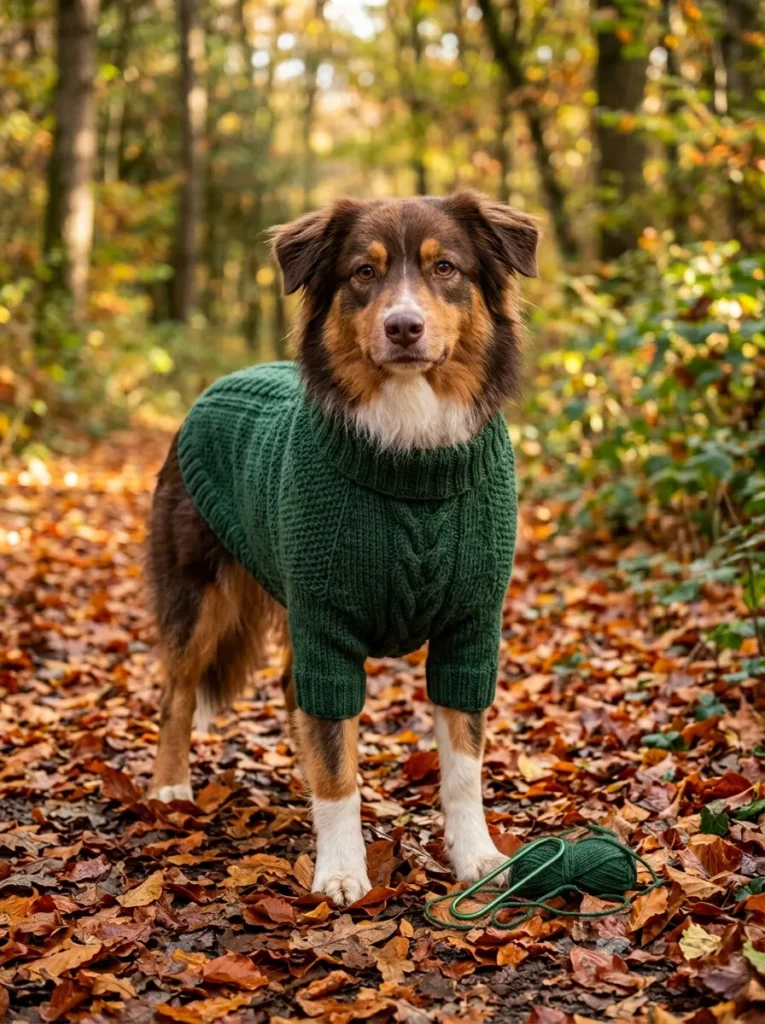
Vibe: Classic and refined — the dog sweater that looks like a miniature version of a properly designed human sweater.
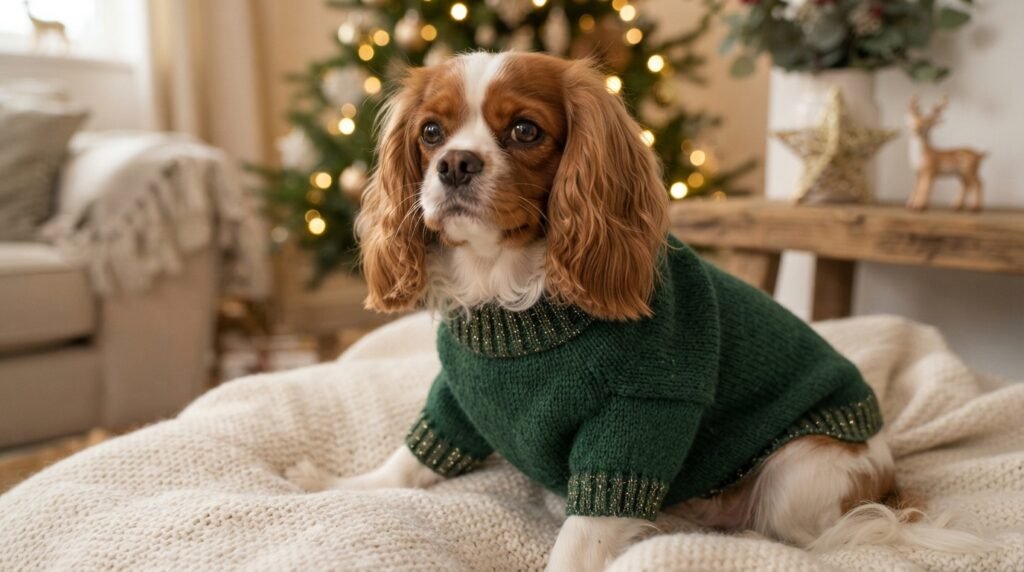
Why it works: A cabled dog sweater applies the technique escalation principle — introducing cable pattern work on a small, fast-to-knit project allows the knitter to practice cable crossing technique, reading a cable chart, and maintaining pattern tension across a full project without the commitment of a full-size human sweater. A single central cable panel (typically a 6-stitch or 8-stitch cable crossing every 4th or 6th row) provides enough visual complexity to read as a designed garment from any distance while being simple enough to track without a row counter. Forest green is the sweater color that most consistently reads as “properly made” rather than cute — it positions the dog sweater in the wardrobe category rather than the novelty category.
Pattern structure: Cast on in rib for the collar, establish the cable pattern at the center of the work flanked by reverse stockinette panels, work the body in cable-and-reverse-stockinette pattern to the required length, shape leg openings using short rows or held stitches, finish with a ribbed hem.
Where to find it free: Search “cable dog sweater free pattern” on Ravelry or LoveCrafts. Drops Design offers several free cabled dog sweater patterns in their extensive free pattern library, including “Dog Coat With Cables” available at garnstudio.com.
Yarn suggestion: Drops Lima, Rowan Pure Wool Superwash DK, or Cascade 220 in deep forest green, warm navy, or burgundy.
| Product |
|---|
| DK weight yarn forest green |
| Knitting needles 3.75mm DK size |
| Cable needle short |
| Stitch marker set for cable tracking |
| Cable chart holder or pattern stand |
4. Striped Dog Coat with Garter Stitch (Beginner)
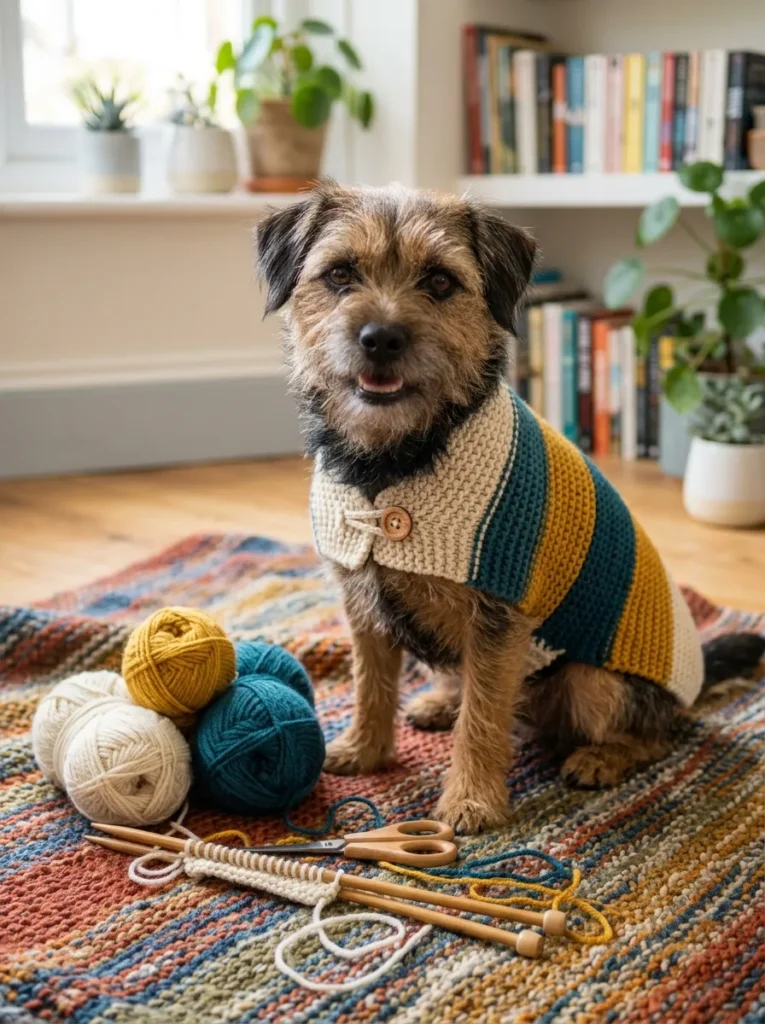
Vibe: Cheerful and colorful — the striped coat that makes every walk look like a deliberate color-coordinated decision.
Why it works: A striped garter stitch dog coat is the most beginner-accessible dog knitting project because garter stitch (knit every row on straight needles) requires only the knit stitch, produces a fabric that lies flat without curling (eliminating the need for border treatments), and creates a fabric whose ridged texture is forgiving of uneven tension in a way that smooth stockinette is not. Stripes are introduced by simply changing yarn at the beginning of a new row — no complicated color management required. The coat format (a flat rectangular panel that drapes over the dog’s back and fastens beneath) requires no shaping, no decreases, and no picking up stitches, making it the construction type with the absolute lowest technical barrier.
Pattern structure: Calculate the number of stitches for the dog’s back width. Cast on, work in garter stitch, changing colors every 4 rows for the stripe pattern. Work to the required back length. Add fastenings (snap tape, buttons, or Velcro) along both long edges for the belly closure.
Where to find it free: Search “striped dog coat garter stitch free pattern” on Ravelry. Lion Brand’s “Easy Garter Stitch Dog Coat” is free, well-sized, and uses only the knit stitch throughout.
Yarn suggestion: Lion Brand Vanna’s Choice, Paintbox Yarns Simply Aran, or Drops Karisma in any three-color stripe combination.
| Product |
|---|
| Worsted aran yarn set three colors |
| Straight knitting needles 5mm |
| Snap tape set for belly closure |
| Tapestry needle finishing |
| Small ruler for stripe measurement |
5. Nordic Fair Isle Dog Sweater (Intermediate)
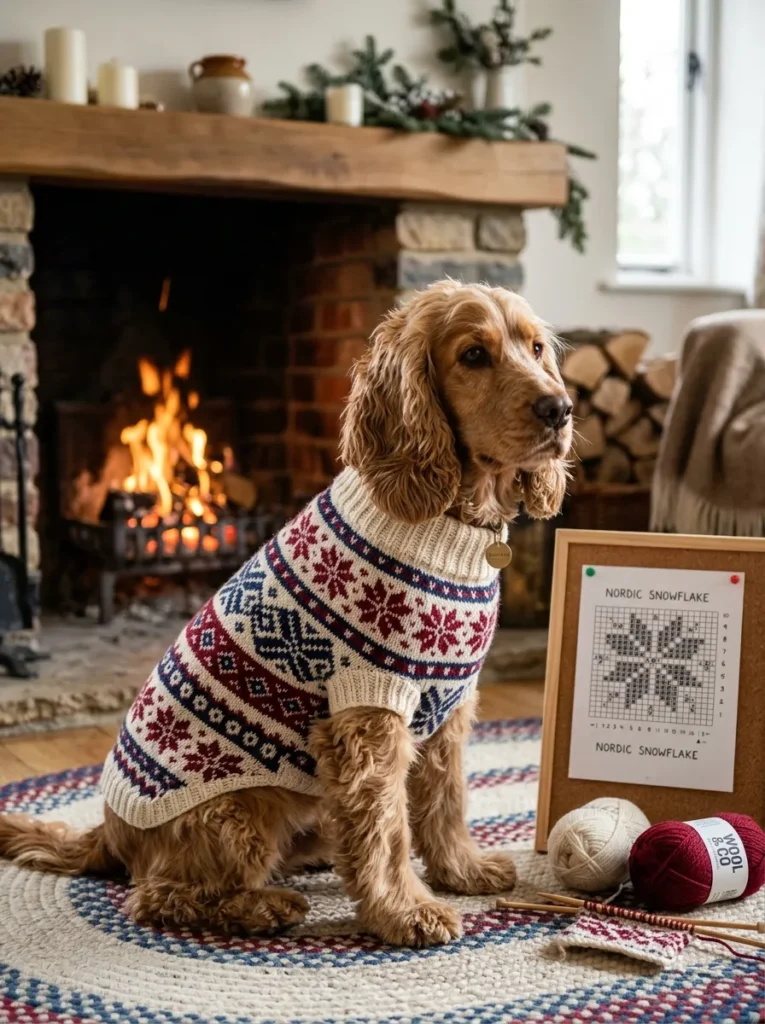
Vibe: Cozy and patterned — the Fair Isle dog sweater that makes the living room feel like a Nordic winter lodge.
Why it works: A Fair Isle dog sweater is the ideal project for introducing stranded colorwork knitting because the small scale of a dog sweater (relative to a human sweater) means the two-color stranded section is completed in a fraction of the rows a human sweater would require, allowing the knitter to develop their colorwork tension and yarn management technique through a complete project at a manageable scale. A dog sweater Fair Isle chart with a simple 8-stitch repeat snowflake and border motifs requires managing a maximum of 5 stitches of float between color changes — within the 5-stitch float maximum recommended for stranded knitting without tangling or pulling.
Pattern structure: Cast on in the main color for the collar ribbing. Join a second color and work the Fair Isle chart in the round for the body. The chart should be worked on the main body section only — the collar and hem remain in the main color ribbing to keep the pattern focused on the most visible section of the sweater.
Where to find it free: Search “Fair Isle dog sweater free pattern” on Ravelry. Paintbox Yarns and Drops Design both offer stranded colorwork dog patterns in their free libraries. The Drops pattern “Nordic Dog Coat” is a popular free option.
Yarn suggestion: Drops Karisma, Rowan Pure Wool Superwash DK, or Jamieson’s Shetland Spindrift in cream, deep red, and deep navy.
| Product |
|---|
| DK yarn set cream deep red deep navy |
| DK circular needles 3.75mm |
| Colorwork chart holder magnetic |
| Bobbins for second color management |
| Blocking mat and pins for finishing |
6. Greyhound and Whippet Coat Pattern (Intermediate)
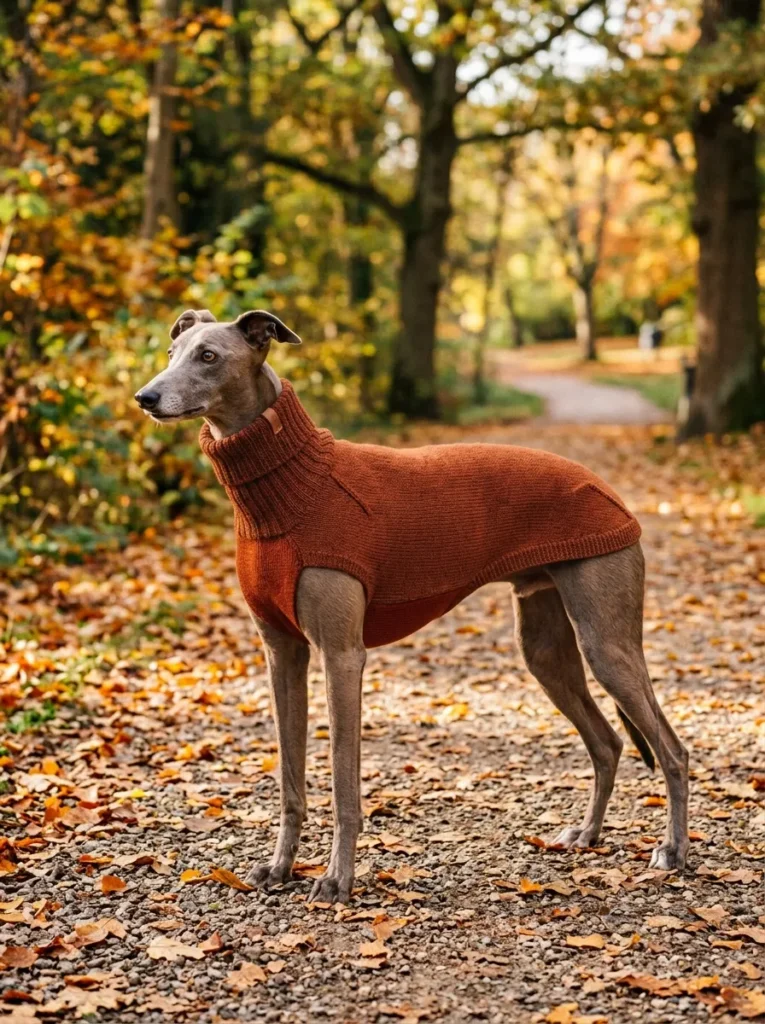
Vibe: Functional and elegant — the sighthound coat that acknowledges the specific body a specific breed actually has.
Why it works: Greyhounds, whippets, Italian greyhounds, and similar sighthound breeds have a body proportion that standard dog sweater patterns cannot accommodate — the extremely deep chest, tucked waist, narrow hips, and long legs create a silhouette where a standard cylindrical sweater body would fit neither the chest nor the waist correctly. Sighthound-specific patterns address this through dart shaping at the waist to reduce the body tube’s circumference from chest to waist and through belly coverage (sighthounds have almost no body fat and lose heat rapidly through the underside) that standard pullover-style sweaters do not provide. If you own a sighthound breed, this is the most important sizing consideration in pattern selection.
Pattern structure: Sighthound patterns typically begin at the neck, work a high collar (sighthounds have thin necks prone to cold), shape the body with increases at the chest and decreases at the waist, include a belly panel that buttons or snaps under the body, and extend further toward the tail than standard patterns.
Where to find it free: Search “greyhound coat free knitting pattern” on Ravelry — there are several sighthound-specific patterns from dedicated greyhound rescue organizations who make their patterns freely available. The “Greyhound Pajama Pattern” available from several rescue organizations is a well-designed free resource.
Yarn suggestion: Drops Merino Extra Fine, Cascade 220 Superwash, or any DK-weight machine-washable wool in warm, non-abrasive colors.
| Product |
|---|
| Worsted DK yarn rust or warm tone |
| Circular needles 4mm for body |
| Shaping markers for dart placement |
| Snap fasteners for belly panel |
| Sighthound measurement tape |
7. Chunky Turtleneck Dog Sweater (Beginner)
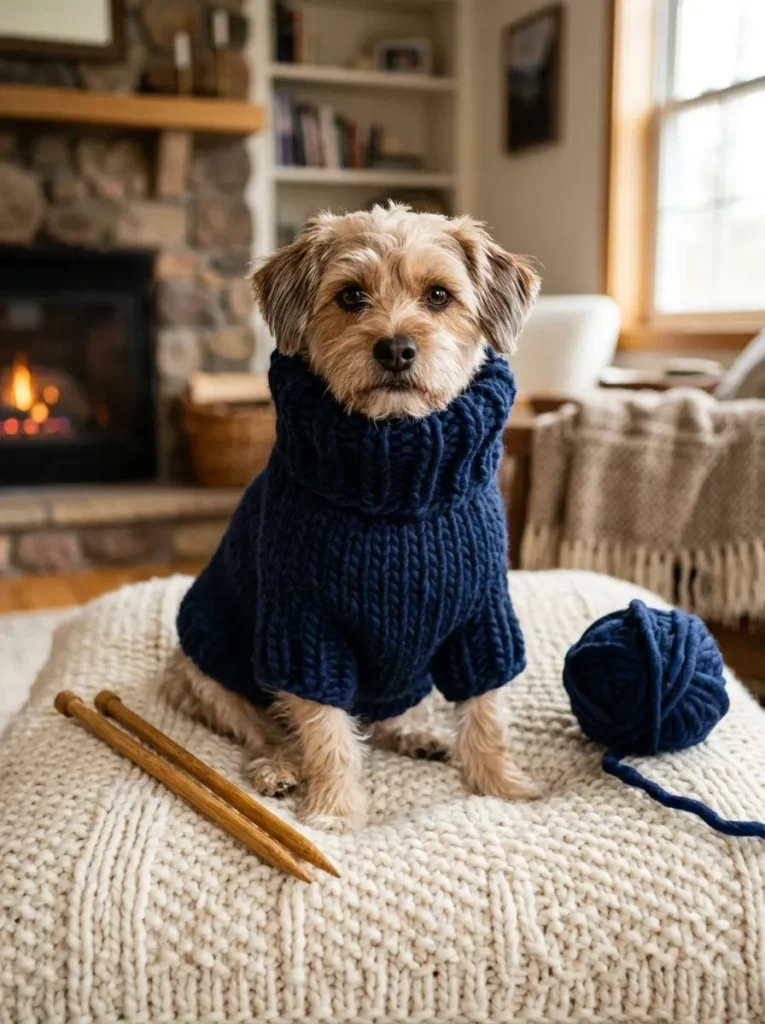
Vibe: Cozy and fashion-forward — the turtleneck that makes a small dog look like they belong in a Scandinavian design catalog.
Why it works: A chunky turtleneck dog sweater in super bulky yarn applies the current knitwear fashion trend of oversized, chunky turtleneck silhouettes to dog proportions — the tall, folded-over turtleneck collar is both the most practical cold-weather feature (protecting the neck and chest from wind) and the most visually distinctive design element available in a simple construction. Super bulky yarn (10mm or 12mm needles, 1–1.5 stitches per inch) produces a complete small dog sweater in under two hours of knitting, making it the fastest possible finished-object project category in hand knitting. The slightly oversized proportion that reads as fashionable in contemporary human knitwear translates well to dog proportions when the body length is correct — let the turtleneck run slightly deeper than the collar measurement for the folded-over effect.
Pattern structure: Cast on neck girth stitches in 2×2 rib. Work the collar section in rib for twice the desired folded collar height (the collar folds over on itself). Continue in stockinette for the body length. Work a short ribbed hem to finish. Seam or work in the round according to the pattern’s construction method.
Where to find it free: Search “chunky turtleneck dog sweater free pattern” on Lion Brand’s website — their “Cozy Dog Turtleneck” is a free pattern available in multiple sizes using their super bulky yarn range.
Yarn suggestion: Lion Brand Wool-Ease Thick and Quick, Paintbox Yarns Simply Super Chunky, or Drops Andes in deep navy, forest green, or warm cream.
| Product |
|---|
| Super bulky yarn deep navy |
| Knitting needles 10mm or 12mm straight |
| Row counter wrist-mounted |
| Tapestry needle bulky yarn |
| Seaming pins blocking |
8. Intarsia Color Block Dog Sweater (Intermediate)
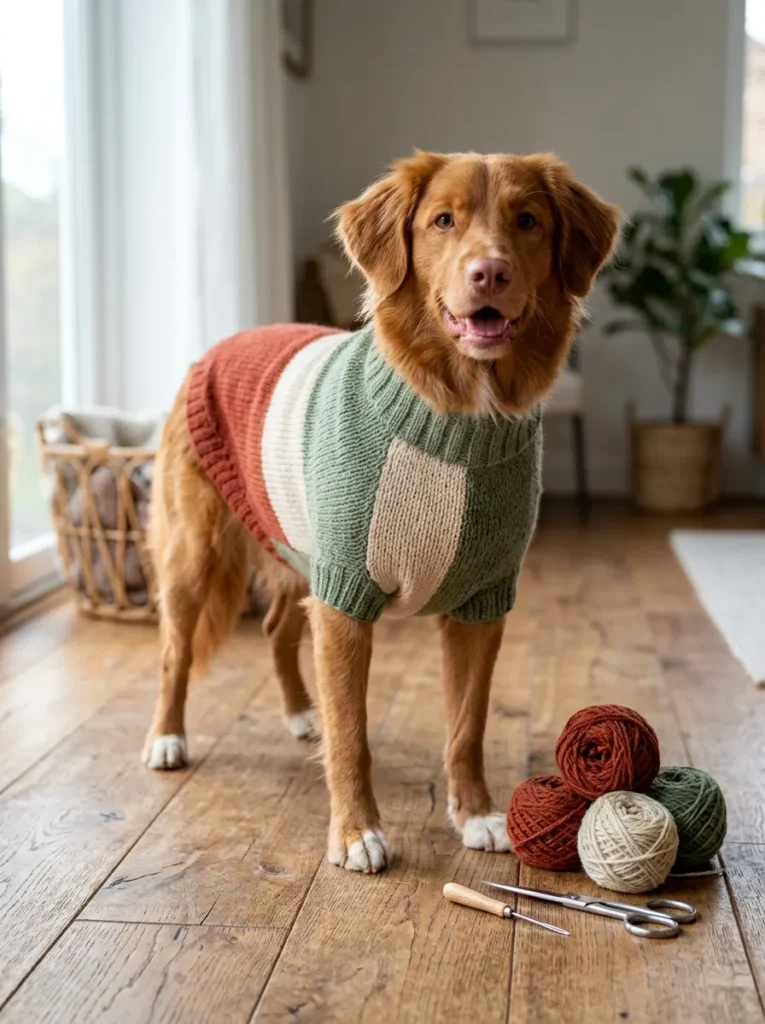
Vibe: Modern and bold — the color block sweater that looks like contemporary knitwear design at toy scale.
Why it works: An intarsia color block dog sweater introduces the intarsia colorwork technique — working separate yarn blocks for different color sections of a knitted piece rather than carrying both yarns across every row as in stranded colorwork — at a scale where the technique is learnable and achievable. A three-block vertical color design requires managing only three separate yarn sources (one per color block) and making only two color joins per row (where each block meets its neighbor), which is the minimum complexity needed to learn intarsia while producing a visually sophisticated finished piece. The vertical color block format is specifically suited to intarsia technique because vertical color changes require intarsia’s approach while horizontal stripes require simple yarn changes — using the right technique for the design produces the cleanest color joins.
Pattern structure: Establish the three color block sections at the pattern’s cast-on, dividing the total chest stitch count into three equal sections. Work with separate yarn sources for each section, twisting the yarns at each color join on every row to prevent holes at the joins. Continue in stockinette for each color block section for the full body length.
Where to find it free: Search “color block dog sweater free pattern” or “intarsia dog sweater free pattern” on Ravelry. Several independent designers offer free color block dog patterns on their websites.
Yarn suggestion: Paintbox Yarns Simply DK, Scheepjes Catona DK, or Cascade 220 Superwash in terracotta, cream, and sage — all with consistent colorways across the range for reliable color matching.
| Product |
|---|
| DK yarn set three complementary colors |
| DK knitting needles 4mm |
| Bobbins for separate yarn management |
| Tapestry needle color join finishing |
| Pattern clipboard for knitting reference |
9. Seed Stitch Dog Vest (Beginner-Intermediate)
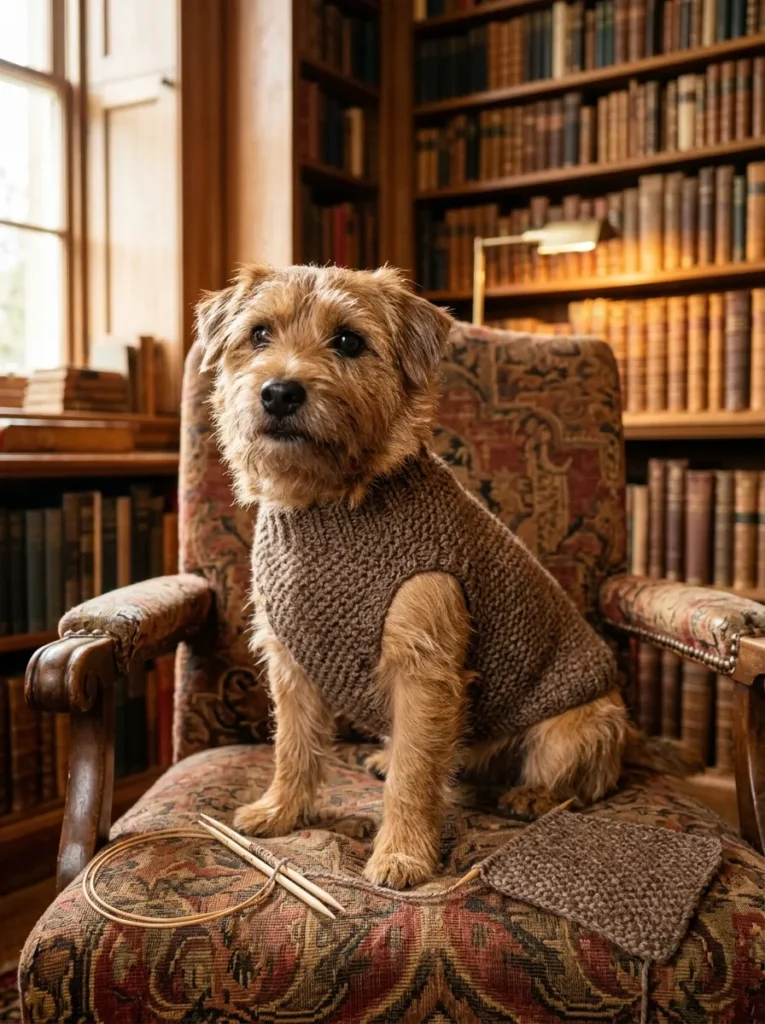
Vibe: Classic and textural — the vest that makes a dog look like they should be in a study reading the newspaper.
Why it works: A seed stitch dog vest introduces the seed stitch pattern (alternating knit and purl stitches on every row, with the stitches offset row to row so knits are above purls and purls are above knits) at a scale where the pattern’s behavior is fully observable and learnable. Seed stitch produces a fabric that lies completely flat (unlike stockinette which curls), has natural texture from both sides (making the vest reversible and eliminating the need for collar or hem borders), and creates a fabric that is denser and warmer than stockinette at the same yarn weight. The vest format (no sleeves, just body and neck and armhole openings) is a simpler construction than a sweater while producing genuine cold-weather protection for the dog’s core.
Pattern structure: Cast on in seed stitch for the body circumference. Work in seed stitch in the round to the armhole position. Work back and forth on the front and back sections to create the armhole openings. Shape the neckline at the front and join at the shoulders. Work any edging in seed stitch to maintain fabric consistency.
Where to find it free: Search “seed stitch dog vest free pattern” on Ravelry or LoveCrafts. Several free vest patterns are available in the Ravelry dog pattern section filtered by construction type.
Yarn suggestion: Malabrigo Rios, Cascade 220 Superwash, or Drops Karisma in heathered brown, warm camel, or deep teal.
| Product |
|---|
| Worsted yarn heathered warm tone |
| Circular needles 4.5mm 40cm |
| Stitch markers for round tracking |
| Tapestry needle for any seaming |
| Sample swatch needle for gauge |
10. Ribbed Leg-Warmer Dog Coat (Beginner)
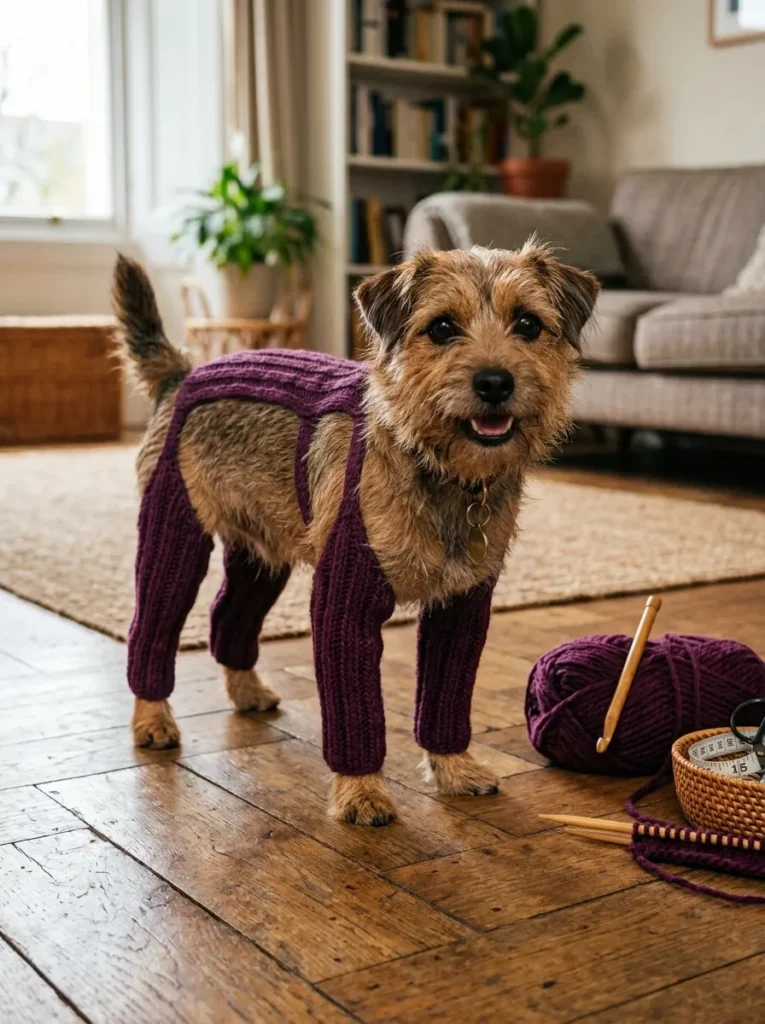
Vibe: Quirky and considered — the leg warmer coat that makes a dog look impossibly put-together on a muddy winter walk.
Why it works: A four-tube ribbed leg warmer coat is the dog knitting pattern that most practically solves the specific winter challenge of short-coated dogs in cold, wet, muddy conditions — by covering all four legs in knitted ribbed tubes connected at the back, the garment provides warmth at the extremities where small dogs lose heat most rapidly (the legs and paws) while keeping the belly and chest areas free and reducing the mud and water collected during walks compared to standard sweater formats. The construction is four identical small tubes worked on double-pointed needles joined by a flat back panel — the small tube diameter (working on four DPNs for a leg circumference of 8–15cm) introduces double-pointed needle technique at the most beginner-accessible scale available.
Pattern structure: Measure each leg circumference and knit four identical tubes in 2×2 rib on DPNs to the required leg length (from paw to elbow or paw to shoulder depending on coverage preference). Knit the back panel flat in 2×2 rib to the required width and length. Attach the four leg tubes at the back panel’s corners using mattress stitch seaming.
Where to find it free: Search “dog leg warmer coat free pattern” or “four-leg dog coat free pattern” on Ravelry. Several free versions of this construction exist in the Ravelry dog pattern database.
Yarn suggestion: Rowan Pure Wool Superwash Worsted, Drops Lima, or Lion Brand Fishermen’s Wool in deep plum, burgundy, or forest green.
| Product |
|---|
| Bulky yarn deep plum or rich color |
| Double-pointed needles 5mm set of 5 |
| DPN holder for tube knitting |
| Stitch marker set for round tracking |
| Mattress stitch tutorial for seaming |
11. Lace Border Dog Coat (Intermediate)
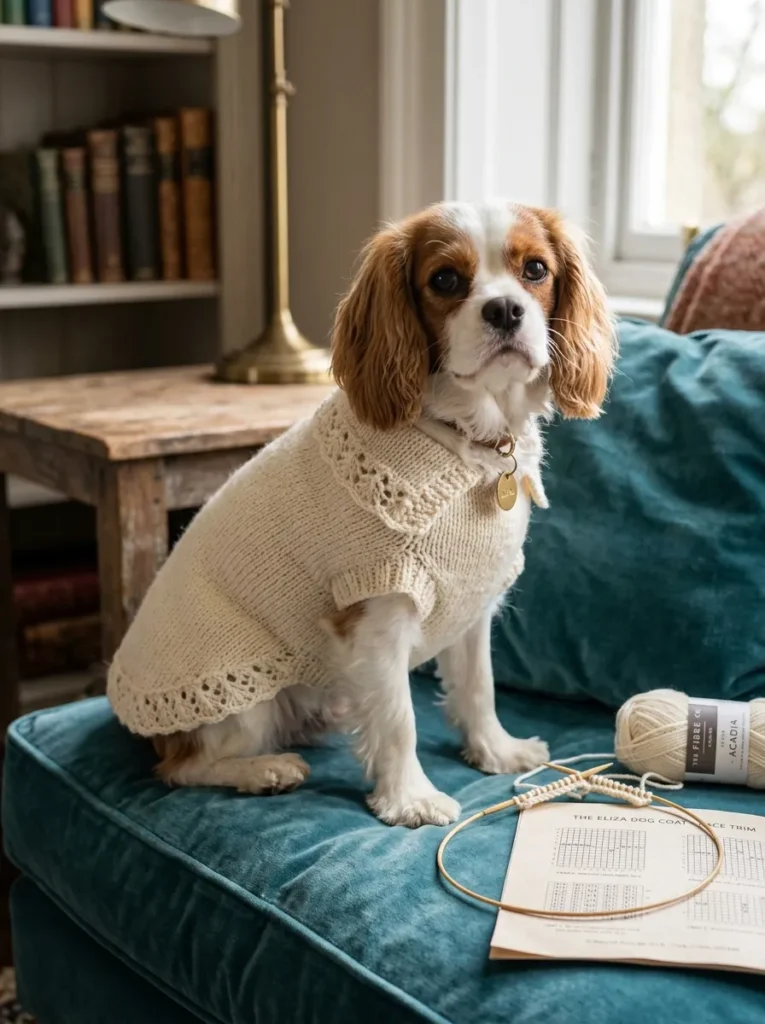
Vibe: Refined and delicate — the knitted coat that belongs on a small dog in a drawing room rather than a muddy field.
Why it works: A lace border dog coat introduces lace knitting technique — specifically the use of yarn-over increases paired with k2tog decreases to create decorative eyelet holes in the knitted fabric — at the most accessible scale: a simple one-row or two-row eyelet border worked around the finished edges of an otherwise straightforward stockinette coat. Working the lace as a border rather than throughout the fabric means the technical complexity is limited to a small number of rows, the error recovery is easy (the lace section is short enough to rip back without losing significant work), and the decorative impact relative to the technical investment is high. This is the appropriate first lace project for a knitter who has mastered basic knit and purl stitches and is ready for their first yarn-over experience.
Pattern structure: Work the coat body in stockinette to the required dimensions. On the final rows at each edge (collar, hem, leg openings), work a simple eyelet row: yo, k2tog across the row, creating a row of uniform eyelets. Work one or two plain rows, then bind off. The yo creates a hole; the k2tog compensates for the added stitch, maintaining the stitch count.
Where to find it free: Search “dog coat with lace border free pattern” on Ravelry or LoveCrafts. Several patterns combining a simple body with decorative lace borders are available in the free pattern section.
Yarn suggestion: Drops Cotton Merino, Paintbox Yarns Cotton DK, or Rowan Cotton Glace in warm cream, blush pink, or pale sage for the most effective lace visibility.
| Product |
|---|
| DK cotton merino blend cream yarn |
| DK knitting needles 3.75mm |
| Lace knitting safety pin stitch holder |
| Row counter for lace pattern tracking |
| Blocking wire set for lace finishing |
12. Large Dog Blanket Coat (Beginner)
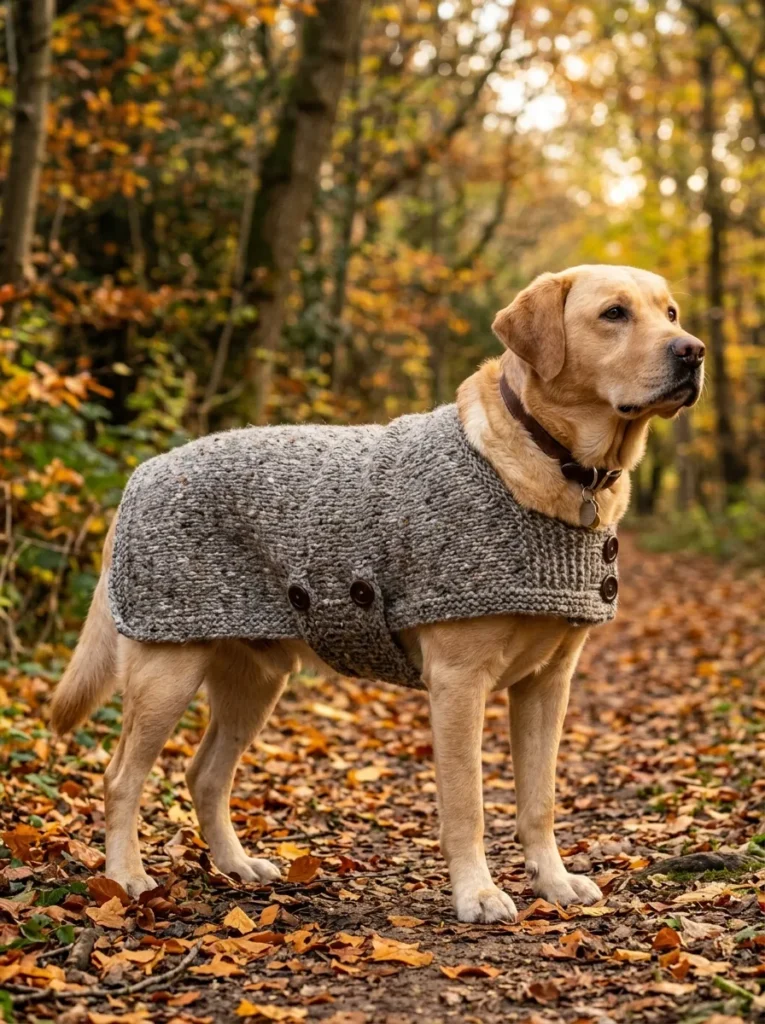
Vibe: Practical and handsome — the large dog coat that acknowledges that large dogs get cold too and deserve a properly made garment.
Why it works: A large dog blanket coat in chunky yarn addresses the specific challenge of knitting for large breeds — a standard constructed dog sweater for a 30–40kg dog requires an enormous number of stitches and many hours of knitting, while a rectangular blanket coat in chunky or super-bulky yarn can be completed in an evening and provides equivalent warmth through its generous coverage. The blanket coat construction (a wide flat rectangle that drapes over the back and fastens beneath the belly) is genuinely suited to large dogs whose barrel chests and broad backs make the fitted tube construction of a standard sweater difficult to size correctly. Large flat buttons fastening through buttonholes or button loops are the most practical closure for a large dog coat because they are easy to fasten and unfasten with cold hands on winter walks.
Pattern structure: Calculate the coat width as the dog’s back width plus 5cm on each side for drape. Cast on this width in chunky yarn. Work a garter stitch border row at each short end. Work the coat body in any stitch pattern (garter, seed, or simple rib) to the required back length. Add buttonhole rows at each long edge for the belly fastening at the measured belly band positions.
Where to find it free: Search “large dog blanket coat free pattern” on Ravelry or Lion Brand’s pattern library. Lion Brand offers several large dog coat patterns scaled up to XL and XXL breed sizes.
Yarn suggestion: Lion Brand Wool-Ease Thick and Quick, Drops Andes, or Paintbox Yarns Simply Super Chunky in heathered gray, warm camel, or deep forest green.
| Product |
|---|
| Super chunky yarn heathered gray |
| Knitting needles 10mm or 12mm straight |
| Large leather-look button set |
| Darning needle for button attachment |
| Garter stitch tutorial reference |
13. Dog Hoodie with Kangaroo Pocket (Intermediate)
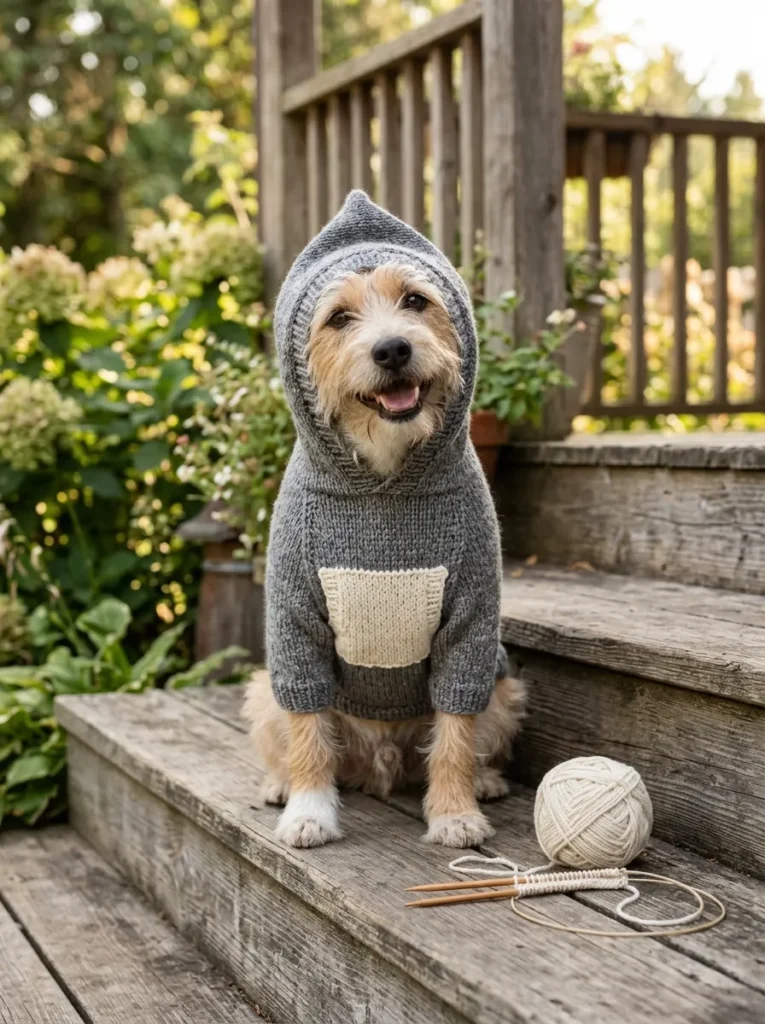
Vibe: Playful and detailed — the knitted hoodie that requires technical investment and produces a genuinely impressive result.
Why it works: A dog hoodie with a knitted hood and kangaroo pocket introduces two intermediate construction techniques — hood construction (shaping a three-dimensional pointed hood from a flat panel by working short rows or seaming a top seam) and pocket construction (working the kangaroo pocket as a separate piece or as an integrated pick-up section from the body) — both of which transfer directly to human garment knitting. The hood is the single element that most clearly distinguishes this pattern from any commercially available dog garment and makes it a genuinely impressive handknit that cannot be replicated by a purchased alternative. The kangaroo pocket adds both visual interest and a practical warm-hands resting place for the owner.
Pattern structure: Knit the body sweater first to the neck. Pick up stitches around the neck opening and work the hood upward, increasing to the required head circumference and shaping the pointed top with two-stitch decreases at the center front. Seam the top hood seam. Work the kangaroo pocket as a separate rectangle, seam the sides and bottom to the body, leaving the top open.
Where to find it free: Search “dog hoodie knitting pattern free” on Ravelry or LoveCrafts. Several independent designers offer free hoodie patterns — search specifically for “dog hoodie with hood” to filter for genuine hood construction rather than simple cowl-neck patterns.
Yarn suggestion: Cascade 220 Superwash, Drops Lima, or Paintbox Yarns Simply Aran in heathered gray and cream contrast.
| Product |
|---|
| Worsted yarn heathered gray main color |
| Worsted yarn cream contrast pocket |
| Circular needles 4.5mm 60cm |
| Short circular 40cm for hood |
| Hood shaping tutorial reference |
14. Colorwork Advent Dog Sweater (Intermediate)
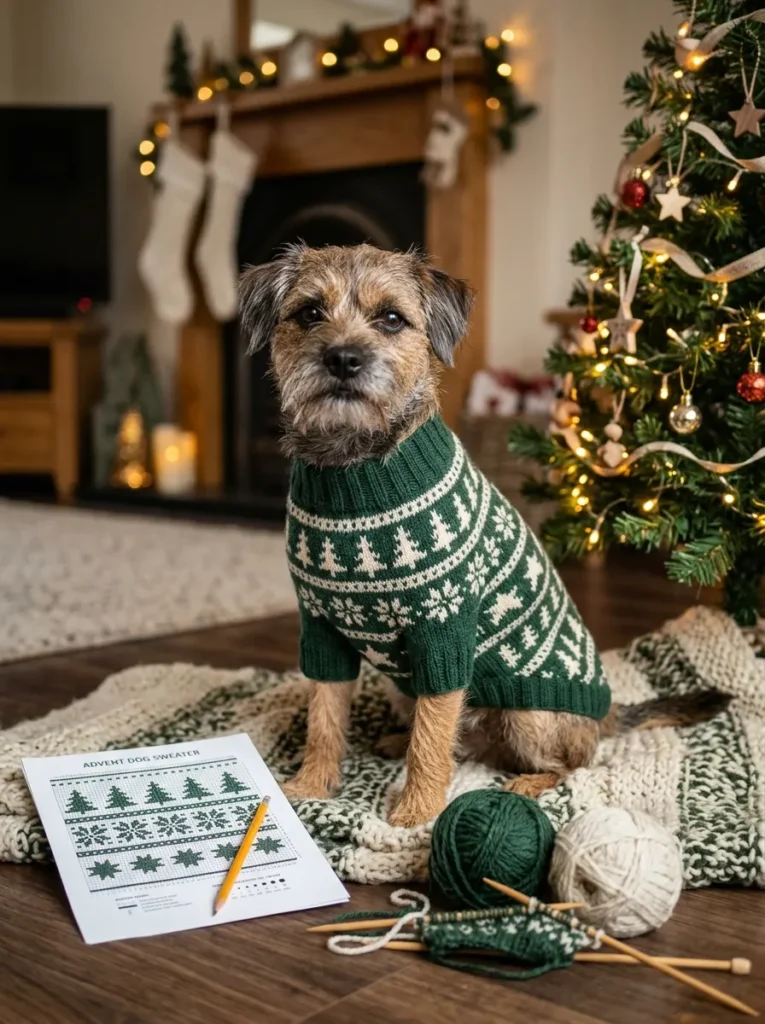
Vibe: Festive and detailed — the colorwork dog sweater that makes the holiday season photograph beautifully for the next decade.
Why it works: A colorwork advent dog sweater is the annual dog knitting project par excellence — a pattern worked seasonally each November for wearing through December, making it the knitting project with the most regular return on skill investment. Working a festive colorwork chart (small repeating motifs of trees, snowflakes, and stars are the most traditional and most widely available chart formats) on a dog sweater scale means the chart repeats complete quickly — a full colorwork round on a small dog sweater is 60–80 stitches, which takes under three minutes to work — allowing the knitter to see pattern progress and color motifs emerging at a satisfying pace. This is also the pattern that benefits from being started in November as a dedicated seasonal project with a clear completion deadline.
Pattern structure: Cast on in the main forest green color for the neck rib. Establish the colorwork chart rounds at the body section, working the two-color stranded pattern in the round. The chart bands (trees, then snowflake border, then star repeat) each occupy a defined number of rows specified in the pattern. Finish with a hem rib in the main color.
Where to find it free: Search “Christmas dog sweater colorwork free pattern” on Ravelry — several seasonal colorwork dog patterns are available as free downloads, particularly around the autumn and early winter seasons when designers publish festive patterns. The search term “Nordic dog sweater free” also returns several festive colorwork options.
Yarn suggestion: Drops Karisma, Rowan Pure Wool Superwash DK, or Jamieson’s Shetland Spindrift in forest green and cream — two-color work requires both colors to be identical in fiber content and weight for consistent tension.
| Product |
|---|
| DK yarn forest green main color |
| DK yarn cream contrast color |
| Circular needles 3.75mm for colorwork |
| Magnetic chart holder for colorwork |
| Festive button set for any closures |
How to Start Your Dog Knitting Practice
Start with the garter stitch striped coat. Before attempting any other dog knitting pattern, make the simplest possible construction — a striped garter stitch rectangular coat — in three colors of worsted weight yarn on straight needles. This project teaches the one skill that underlies all other dog knitting: measuring the dog correctly and using those measurements to calculate cast-on numbers at the pattern’s stated gauge. If the garter stitch coat fits the dog well — covers the back from collar to tail, falls comfortably on the sides without sliding off — every subsequent pattern’s sizing calculation will benefit from the knowledge of how the dog’s measurements translate to knitted fabric at that gauge. If the coat does not fit, the garter stitch fabric is so simple to rip back and reknit that the fit adjustment becomes a learning exercise rather than a frustrating failure.
The most common mistake dog sweater knitters make is skipping the gauge swatch — the small test sample of knitting that reveals how many stitches per inch the specific knitter, with the specific yarn, on the specific needles, produces. A pattern states its gauge (for example, “20 stitches = 10cm in stockinette on 4.5mm needles”) and calculates all its stitch counts from this number. If the knitter works at 22 stitches per 10cm rather than 20, the finished sweater will be significantly narrower than the stated size. This is the single most reliable cause of dog sweaters that do not fit — not measuring the dog incorrectly but failing to verify that the knitter’s own stitch gauge matches the pattern’s stated gauge. Knit a 15x15cm swatch in the pattern stitch, block it, and count the stitches over 10cm before casting on for any dog garment.
Three items under $30 that make every dog knitting project better: A soft tape measure ($3–$5) used specifically for measuring the dog in the three critical dimensions before every pattern purchase or download; a set of stitch markers in three colors ($5–$8) that differentiate between beginning-of-round markers, shaping markers, and pattern repeat markers when multiple marker types are needed simultaneously; and a ball winder or yarn swift (second-hand or basic models $8–$20) that prevents center-pull yarn cakes from collapsing and tangling mid-project — tangled yarn mid-project is the most reliably creative-momentum-killing experience in knitting and is entirely preventable.
Realistic expectations: A garter stitch striped coat for a small dog takes 2–4 hours in worsted weight yarn. A simple ribbed sweater for a medium dog takes 4–8 hours in worsted weight. A cabled sweater or Fair Isle colorwork sweater takes 8–16 hours in DK weight. The fitting process — pausing to try the partially knit garment on the dog, checking measurement correspondence, and adjusting as needed — should be considered part of the project time and is the practice that most reliably produces good-fitting finished garments. A well-fitted dog sweater knitted in 12 hours is a better outcome than a poorly fitted one completed in 8 hours.
Frequently Asked Questions About Free Knitting Patterns for Dog Sweaters
Where is the best place to find free dog knitting patterns online?
Ravelry is the most comprehensive resource for free dog knitting patterns — the platform’s search function allows filtering by construction type (top-down, seamless, seamed), yarn weight (bulky, worsted, DK), skill level, and dog size, and returns both independent designer patterns and patterns from major yarn brands. Among the major yarn companies, Lion Brand’s free pattern library, Drops Design (garnstudio.com), and Paintbox Yarns all offer substantial collections of free dog knitting patterns that are professionally designed and thoroughly test-knitted. LoveCrafts maintains a free pattern section that includes a curated dog category. The search term “free dog sweater knitting pattern [your dog’s weight or size]” in any search engine also returns independent designer blog patterns that do not appear on knitting platforms.
How do I adapt a pattern written for a different dog size to fit my dog?
The most reliable method for adapting a dog pattern to a different size is to use the pattern’s stated gauge to calculate new stitch counts from your dog’s actual measurements. If the pattern states “20 stitches per 10cm” and your dog’s chest girth is 45cm, you need 90 stitches for the chest section regardless of which size the pattern’s chart specifies. For patterns that provide multiple sizes (XS to XL), find the measurement whose chest girth most closely matches your dog’s actual chest measurement and follow that size’s instructions — the fit will be more accurate than selecting by breed or body weight. Length adjustments are typically easier than circumference adjustments — most patterns can be lengthened or shortened by working more or fewer rows in the straight body section between the shaping sections.
What yarn fiber is best for dog sweaters?
Superwash-treated wool is the most practical fiber for dog sweaters because it provides the warmth, elasticity, and comfort of natural wool without the felting risk of untreated wool — a superwash dog sweater can be machine washed on a cool cycle when it inevitably gets muddy or wet. Avoid untreated wool unless the sweater will always be hand washed, avoid 100% acrylic for cold-climate use as it provides significantly less warmth than wool at equivalent weight, and avoid cotton for outdoor garments as cotton absorbs moisture and stays damp. For dogs with skin sensitivities, merino wool (specifically Mulesing-free certified merino) is the softest natural option and rarely causes irritation. For the collar and any section in direct contact with the dog’s neck, a fiber with some elasticity (wool, wool-synthetic blend) is more comfortable than a non-stretchy fiber like cotton.
How do I get a dog to tolerate wearing a knitted sweater?
The most effective method for sweater-training a dog who initially resists wearing garments is gradual desensitization over three to five sessions rather than attempting complete sweater wear immediately. Session 1: show the dog the sweater and treat any investigation with food rewards. Session 2: drape the sweater briefly over the dog’s back without fastening it, reward with treats, remove after 30 seconds. Session 3: put the sweater on and fasten it, give continuous high-value treats for 60 seconds, then remove. Session 4: put the sweater on and go for a short walk — the movement and outdoor stimulation redirects the dog’s attention from the garment. A well-fitted sweater that does not restrict movement or rub at the armpits is significantly better tolerated than an ill-fitting one, which is the most practical argument for knitting a custom-fitted garment rather than purchasing a commercial size approximation.
Can I sell dog sweaters I knit from free patterns?
The sale of items made from free knitting patterns depends on the pattern’s specific copyright terms — there is no universal rule that applies across all free patterns. Many free patterns from independent designers specify “for personal use only” in their terms, which means selling items made from those patterns is not permitted regardless of whether the pattern itself is freely available. Other patterns (particularly those published by yarn companies as promotional material) permit selling finished objects. Always read the copyright statement on any pattern before selling items made from it, and when in doubt, contact the designer directly to ask for permission. Selling dog sweaters made from original self-designed patterns (even if those patterns were inspired by free patterns) is generally acceptable, as the copyright belongs to the specific pattern instructions rather than the general concept of a dog sweater.
Ready to Knit Your Dog’s Dream Sweater?
These 14 pattern ideas cover the complete range of what dog sweater knitting can become — from the simplest garter stitch coat that teaches sizing fundamentals in a single afternoon, to the sophisticated Fair Isle colorwork that develops a complete technical skill set over a focused weekend, to the seasonal advent colorwork that becomes an annual tradition reaching across years of cold winter mornings. Every dog knitting practice begins with the same first action — measuring the dog in those three essential dimensions, finding a free pattern at the appropriate skill level, swatching to confirm gauge, and casting on. The sweater you finish will fit better than anything purchased, cost less than any commercial equivalent, and carry the specific warmth of something made for a specific dog by someone who cared enough to spend their evenings making it. Start with the free pattern libraries, trust your gauge swatch, and begin from the simplest version of the pattern that interests you most — the technical confidence for every subsequent project is built in the completion of that first one.