Creative dog sweater ideas for happy pups use knitting, crochet, sewing, upcycling, and surface decoration techniques to create functional cold-weather garments that fit a dog’s specific body measurements, suit the household’s aesthetic sensibility, and communicate the genuine affection between owner and animal in the specific form of a handmade wearable object. This article gives you exactly 13 ideas spanning beginner knitting and crochet patterns, sewing construction approaches, upcycled garment conversions, embellished commercial bases, and the specific fitting, material, and finishing decisions that distinguish a dog sweater that a dog actually wears comfortably from one that sits in a drawer after the first unhappy wearing.
A dog sweater made well is not a costume — it is a functional garment designed for a specific animal’s specific measurements, constructed in materials appropriate to that animal’s coat type and activity level, and finished to a quality that makes it comfortable, durable, and genuinely warm. Here are 13 ideas worth making.
Why Creative Dog Sweater Ideas Matter for Happy Pups
The welfare case for dog sweaters is species- and individual-specific rather than universal: not all dogs benefit from additional insulation, and a well-meaning but poorly fitting garment can create physical discomfort, movement restriction, and the anxiety of wearing an unfamiliar covering that interferes with the dog’s ability to communicate through body language. The dogs most genuinely benefiting from cold-weather insulation are those with minimal body fat reserves (sighthounds — greyhounds, whippets, Italian greyhounds, salukis — whose lean, muscular physiology provides minimal thermal buffer), those with short, thin, or single-layer coats (Chihuahuas, Miniature Pinschers, Dobermans, Boxers, French Bulldogs), those recovering from illness or surgery whose thermoregulatory capacity is temporarily reduced, very small dogs whose surface-area-to-volume ratio creates faster heat loss than larger breeds, and senior dogs whose reduced metabolic rate and thinner skin make cold more impactful.
The fitting challenge of a dog sweater is specifically more demanding than a human garment because the canine body has a fundamentally different proportion than the human body: the neck-to-shoulder-to-chest dimension requires a garment that accommodates a deep chest (particularly in barrel-chested breeds), a relatively short back (compared to the chest circumference), and the specific movement pattern of four-legged locomotion (the shoulder blades move significantly backward and forward during walking, and any garment that restricts this movement will be resisted by the dog). The three measurements that every dog sweater pattern must accommodate are: the chest circumference (measured at the widest point of the chest, immediately behind the front legs), the neck circumference (measured snugly where the collar sits), and the back length (measured from the base of the neck to the base of the tail). A sweater made to these three measurements in the correct proportional relationship will fit and be worn comfortably; a sweater that ignores any one of these dimensions will not.
Style at a Glance
| Element | Welfare Function | Creative Design Edge |
|---|---|---|
| Philosophy | Fit and comfort first, aesthetic second | The best dog sweater is the one the dog wears willingly |
| Materials | Wool, acrylic, cotton blend, fleece | Non-itch machine washable easy-care |
| Key Measurements | Chest circumference, neck circumference, back length |
13 Creative Dog Sweater Ideas for Happy Pups
1. Classic Ribbed Turtleneck — The Beginner Knit
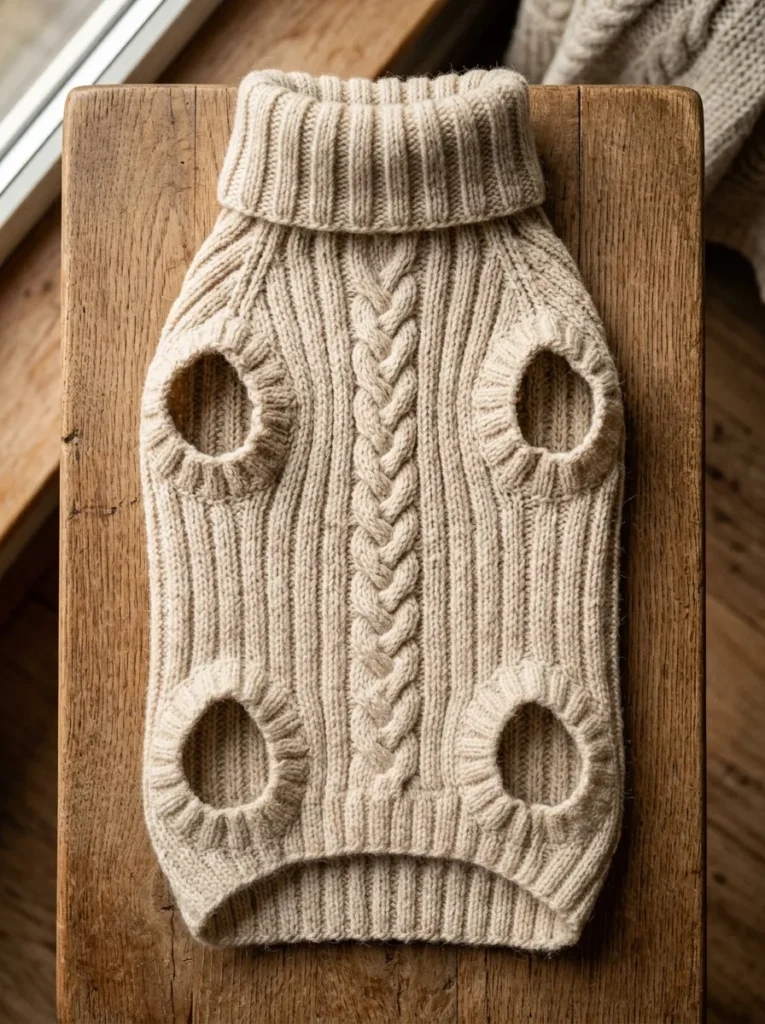
Vibe: The ribbed turtleneck feels like the most direct possible translation of “I made this because you get cold” into knitwear — the generous rib and the turtleneck fold communicating practical warmth with the aesthetic restraint of a classic wardrobe garment.
Why it works: A 2×2 ribbed turtleneck dog sweater applies the stretch-to-fit principle — the 2×2 rib stitch (alternating two knit and two purl columns) produces a naturally stretchy, form-fitting fabric that accommodates the varied body proportions of dogs more forgivingly than any flat stockinette or garter stitch. The rib’s inherent elasticity means that a sweater knitted to the dog’s chest measurement will pull on over the head and settle snugly against the body without requiring precise fit at every dimension. This forgiveness is specifically valuable in a dog sweater where the maker may not have access to a perfectly still dog for repeated fittings.
Yarn selection: Use a wool-acrylic blend (80% acrylic, 20% wool, or 70%/30%) rather than 100% wool — pure wool can felt if the dog gets wet and should not be machine-washed, while the acrylic blend washes easily, dries quickly, and does not felt. Avoid novelty yarns with long fibers (eyelash yarn, mohair) that the dog can ingest by chewing at the sweater.
Making time: 6–12 hours for a medium dog sweater (chest circumference 45–55cm).
Quick Win: A simple neck warmer (a ribbed tube in 2×2 rib, knitted in the round at the correct neck circumference) takes under two hours and provides the primary warmth benefit — most heat loss in short-coated small dogs occurs from the exposed neck and chest area.
Shop The Look
| Product |
|---|
| Wool-acrylic blend yarn oat |
| Circular knitting needles 4mm |
| Dog sweater pattern beginner knit |
| Stitch marker set knitting |
| Yarn needle finishing ends |
Also view: 15 Dreamy Dog Nook Ideas for Comfortable Pets
2. Fair Isle Pattern Sweater — Nordic Heritage Warmth
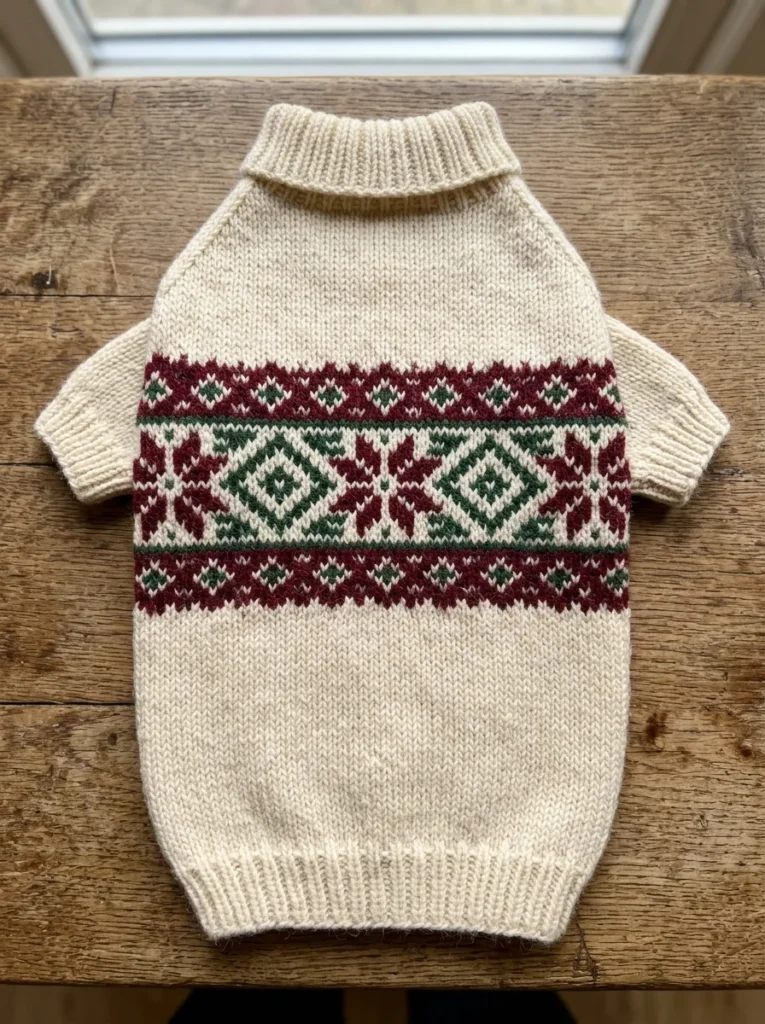
Vibe: The Fair Isle dog sweater feels like a miniature version of the Nordic knitwear tradition applied to the smallest possible household member — the geometric colorwork communicating genuine making skill and genuine aesthetic consideration.
Why it works: A Fair Isle colorwork dog sweater applies the knitting skill showcase principle — Fair Isle colorwork (carrying two colors simultaneously across each row, working each color in its designated position in the repeating pattern) is the technique most recognizable as advanced hand knitting, and a dog sweater in this technique communicates a level of making investment that a plain stockinette sweater cannot. The practical advantage of Fair Isle for dog sweaters is the fabric’s additional warmth — the carried float strands on the garment’s interior (the unused color is carried across the back of the work at each pattern change) create a double-layer quality at the colorwork section that provides additional insulation precisely where the dog’s chest — the area most exposed to wind — is covered.
Technical approach: Work the Fair Isle band using stranded colorwork technique — hold one color in each hand (continental and English hold simultaneously) or use a single hand, picking up and dropping each color at the pattern change. Keep floats loose (no tighter than the relaxed stitch gauge) to prevent the garment from puckering and restricting the dog’s movement. A 6cm pattern band is achievable for beginners who have never worked colorwork before — it is narrow enough to be manageable but wide enough to create a complete visual impression.
Making time: 12–20 hours for a medium dog sweater with colorwork band.
Shop The Look
| Product |
|---|
| Cream wool-acrylic yarn main color |
| Burgundy yarn Fair Isle color |
| Forest green yarn Fair Isle color |
| Fair Isle dog sweater pattern |
| Colorwork knitting guide reference |
3. Crocheted Cable Sweater — Textured Warmth
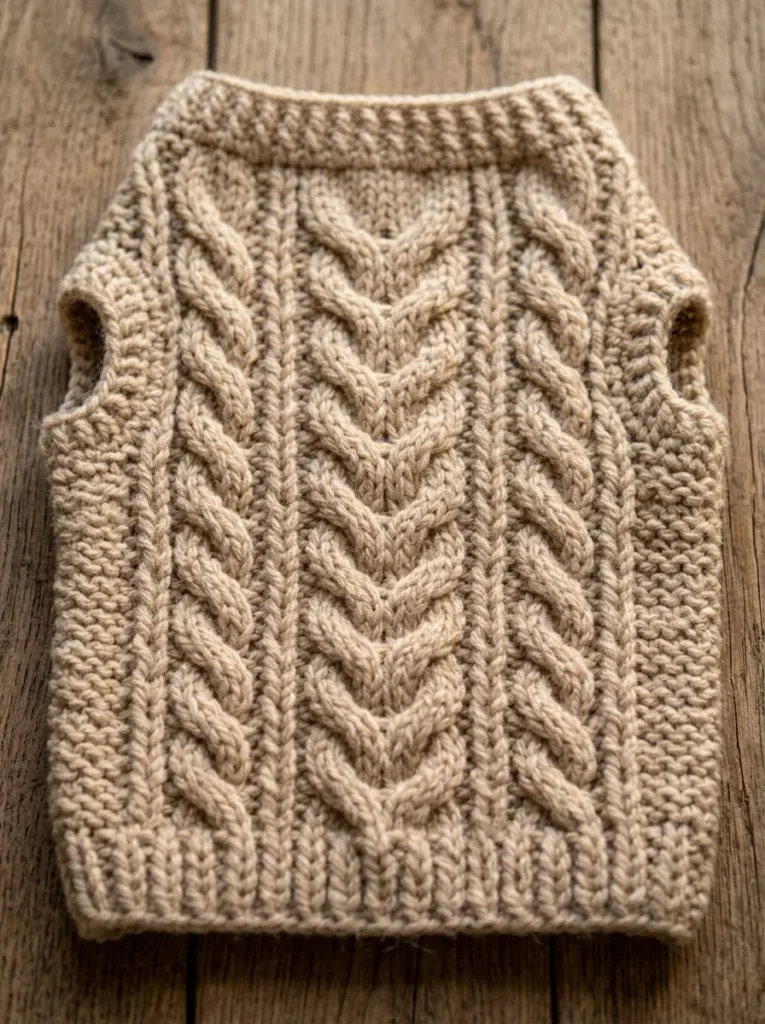
Vibe: The crocheted cable sweater feels like warmth you can see before you touch it — the deeply textured post-stitch cables creating a surface that reads as insulating even from across a room.
Why it works: A crocheted cable sweater for dogs applies the alternative cable technique principle — crochet naturally produces a denser, more insulating fabric than knitting at the same yarn weight because each stitch is locked (rather than looped as in knitting) and the fabric has minimal stretch in the horizontal direction. This density makes crochet particularly suitable for dog sweaters where durability and structure are more important than the precision fit that knitting’s stretch provides. The post-stitch cable pattern (worked using front post double crochet — wrapping the hook around the stitch post from front to back — and back post double crochet in alternating column pairs) creates raised vertical ridges that visually replicate the appearance of knitted cables in a technique that many makers find faster and more intuitive than knitting.
Crochet advantage for beginners: Crochet requires only one hook rather than two needles and the fabric is worked from a single working stitch at a time rather than from a full row of live stitches — if you drop a stitch in crochet, you lose only one stitch rather than risking an entire unraveling row. This specific advantage makes crochet the recommended technique for makers who are new to fiber craft and want to make a dog sweater as a first project.
Making time: 4–8 hours for a medium dog sweater in chunky yarn.
Shop The Look
| Product |
|---|
| Chunky acrylic yarn soft gray |
| Crochet hook 6mm set |
| Crocheted dog sweater cable pattern |
| Stitch marker set crochet |
| Yarn needle crochet finishing |
4. Upcycled Human Sweater Conversion — Zero-Waste Warmth
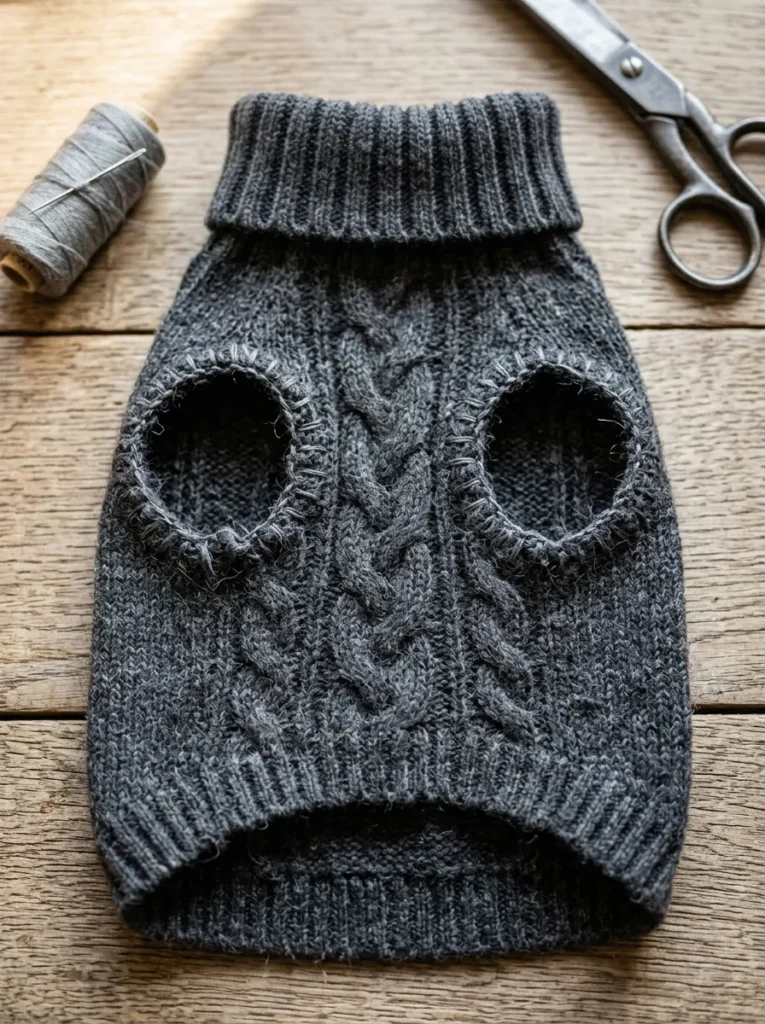
Vibe: The upcycled sleeve sweater feels like the most resourceful version of a making decision — the repurposed cable-knit sleeve bringing its own texture history to the new garment without requiring a single gram of new yarn.
Why it works: A dog sweater converted from a human sweater sleeve applies the zero-waste conversion principle — a large human sweater sleeve (from a size L or XL adult sweater) provides sufficient knitted fabric for a complete medium dog sweater with minimal additional cutting or sewing. The sleeve’s existing construction (a ribbed cuff at the wrist end that becomes the dog’s neckline, the wider upper sleeve section providing the body, and the shaped sleeve head that can be adapted to the back end or cut straight for a simpler finish) does much of the pattern work before any modification is made. The only modifications required are: cutting leg hole openings on each side of the sleeve body (finished with a simple turned and hand-stitched edge), and closing or tapering the upper sleeve end to create the body’s back hem.
Material sourcing: Charity shops and secondhand markets are excellent sources for suitable donor sweaters — look for 100% wool or wool-blend sweaters (which will be warmer than acrylic) in sizes L or XL for medium and large dogs, and in size M or S for small dogs. Cashmere sweaters (frequently available at charity shops at very low prices due to minor damage) make extraordinarily warm and soft dog sweaters from their intact sleeves.
Making time: 30–60 minutes for the basic conversion.
Shop The Look
| Product |
|---|
| Secondhand cable-knit sweater L |
| Sharp fabric scissors conversion |
| Hand sewing needle set |
| Matching yarn edge finish |
| Seam ripper sleeve removal |
5. Fleece Sewn Dog Sweater — The No-Knit Option
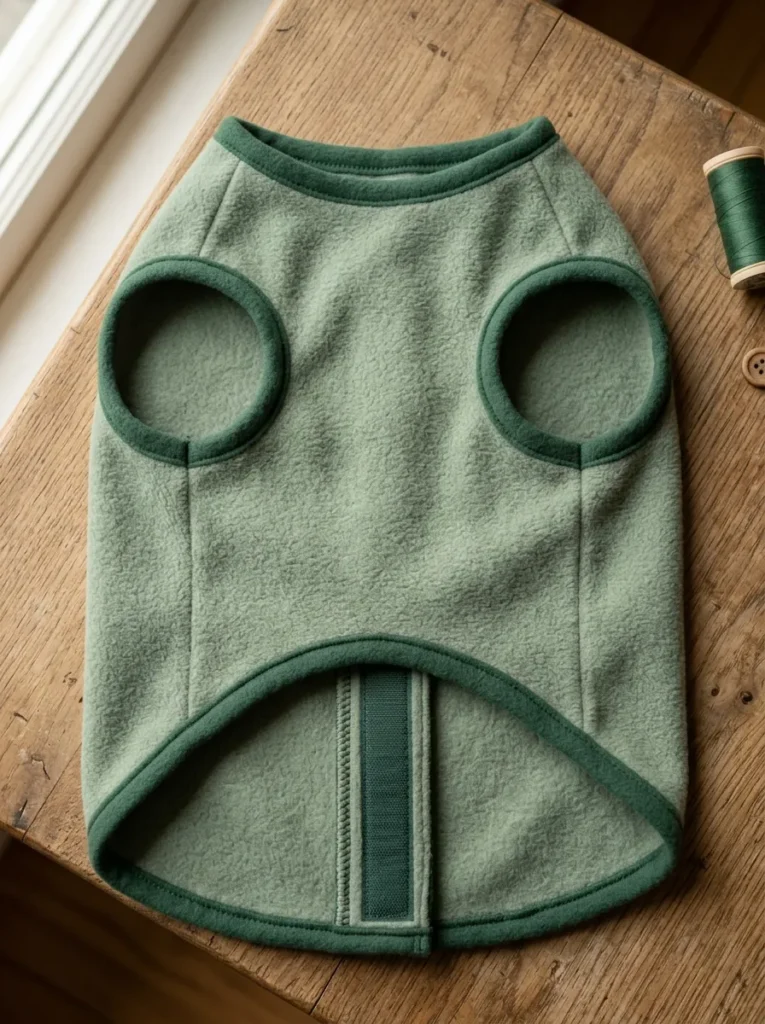
Vibe: The sewn fleece sweater feels like the most achievable version of a handmade dog garment — the clean construction and the tonal edge finish communicating the same care and intention as a knitted equivalent at a fraction of the technical difficulty.
Why it works: A sewn anti-pill fleece dog sweater applies the no-knit warmth principle — anti-pill fleece (a polyester brushed fabric available from most fabric retailers at $6–12 per metre) is the most accessible material for a non-knitting maker to construct a functional, warm, washable dog sweater. The fleece’s most important property for this application is its cut edge — unlike woven fabrics, fleece does not fray when cut, meaning that all cut edges of the garment (leg holes, neck opening, back hem) can be left raw or turned and glued rather than requiring serging or hemming. This eliminates the primary construction challenge of sewing dog garments in woven fabric while producing a garment with genuinely adequate warmth for most cold-weather applications.
Pattern construction: The simplest fleece dog sweater uses a T-shape pattern (one rectangular piece the length of the dog’s back, wide enough to wrap around the chest circumference plus seam allowance, with a neck hole cut at one end and a belly opening either cut open or closed with Velcro). Cut the pattern from newspaper using the dog’s actual measurements and test-fit before cutting the fleece — adjustments to a paper pattern are free, and adjustments to cut fleece are not.
Making time: 30–90 minutes depending on sewing machine confidence.
Shop The Look
| Product |
|---|
| Anti-pill fleece sage green |
| Contrast fleece forest green edge |
| Velcro strip set sewing |
| Dog sweater sewing pattern |
| Fabric marking pen pattern |
6. Fair Isle Leg Warmers Companion Set — The Matching Accessory
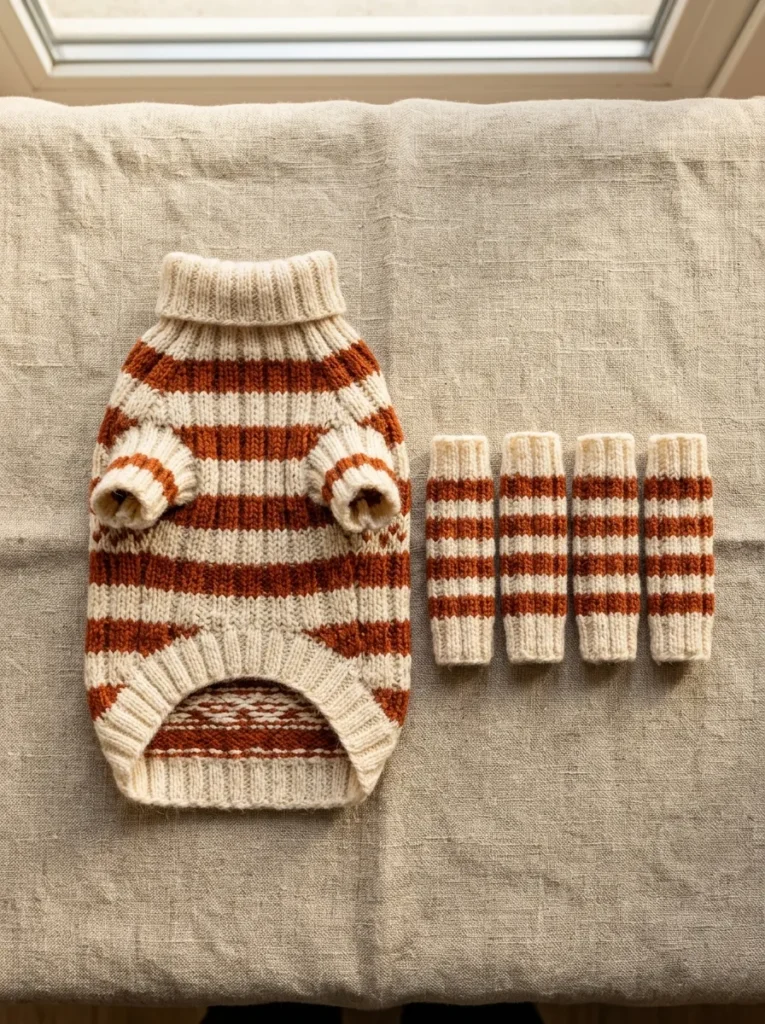
Vibe: The matching sweater and leg warmer set feels like a complete cold-weather outfit designed specifically for the species that has four legs and therefore genuinely needs four leg warmers — the matching set communicating the thoughtfulness of a complete system rather than a single garment.
Why it works: A dog sweater and matching leg warmer set applies the complete cold-weather system principle — dogs with very fine, short legs (Whippets, Italian Greyhounds, Dachshunds, Chihuahuas) experience significant heat loss from their exposed lower legs, which are covered by the thinnest skin and the least muscle mass of any body part. Leg warmers (simple ribbed tubes that slide over the lower leg) address this specific welfare need while completing the aesthetic logic of a matched knitted set. Each leg warmer is the simplest possible knitted object — a ribbed tube worked in the round on double-pointed needles — making this a genuinely beginner-accessible project even for makers who have never worked in the round before.
Leg warmer construction: Cast on the required number of stitches for the dog’s lower leg circumference (typically 16–24 stitches for small dogs at 3.5–4mm needles) on 4 double-pointed needles. Work in 2×2 rib for the required length (8–12cm for most small dogs). Bind off loosely. The tube should be snug enough to stay in position while the dog walks but loose enough to slide on and off easily without distressing the dog.
Making time: 30 minutes per leg warmer; 2 hours for all four plus the sweater body.
Shop The Look
| Product |
|---|
| Cream yarn main color small weight |
| Rust orange yarn accent color |
| Double-pointed needles 3.5–4mm |
| Leg warmer dog pattern small |
| Ribbed tube knitting guide |
7. Embellished Commercial Sweater — The Decorated Base
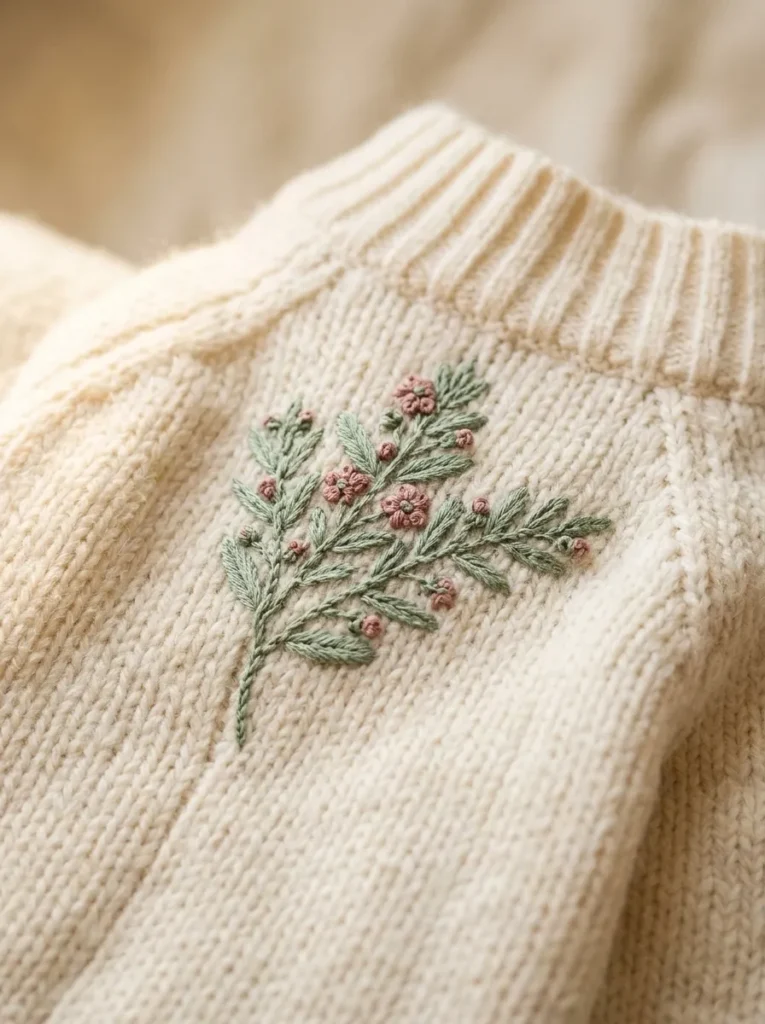
Vibe: The embellished commercial sweater feels like a purchased garment that was made personal by the specific care of someone who sat down and embroidered it for a specific dog — the handwork converting a generic product into a unique object.
Why it works: Embellishing a commercial dog sweater with hand embroidery applies the personalisation-through-craft principle — for makers who are not yet confident in constructing a complete garment from scratch, beginning with a commercial plain base and adding hand embroidery allows the making contribution to be the decorative personalisation rather than the structural construction. The commercial base provides the fitting accuracy and construction quality of an industrially-produced garment; the embroidery provides the specific handmade quality that transforms it from generic to personal. A 5×5cm embroidered botanical motif at the shoulder area takes 30–60 minutes of embroidery work and is achievable by anyone who has basic embroidery stitch knowledge.
Embroidery thread selection: Use stranded embroidery thread (standard 6-strand embroidery floss) split to 2 or 3 strands for fine work on a knitted fabric base. Work through both the surface and the fabric structure (not just surfacing on the front face) to ensure the embroidery is anchored to the sweater rather than sitting loosely on the fabric surface. Begin and end embroidery threads with secure knots or weave the tail ends through the existing fabric structure for 3–4cm.
Making time: 30–60 minutes embroidery on a purchased base.
Shop The Look
| Product |
|---|
| Plain cream commercial dog sweater |
| Embroidery thread set botanical |
| Embroidery needle set fabric |
| Botanical dog embroidery pattern |
| Embroidery hoop small |
8. Entrelac Pattern Sweater — Advanced Technique
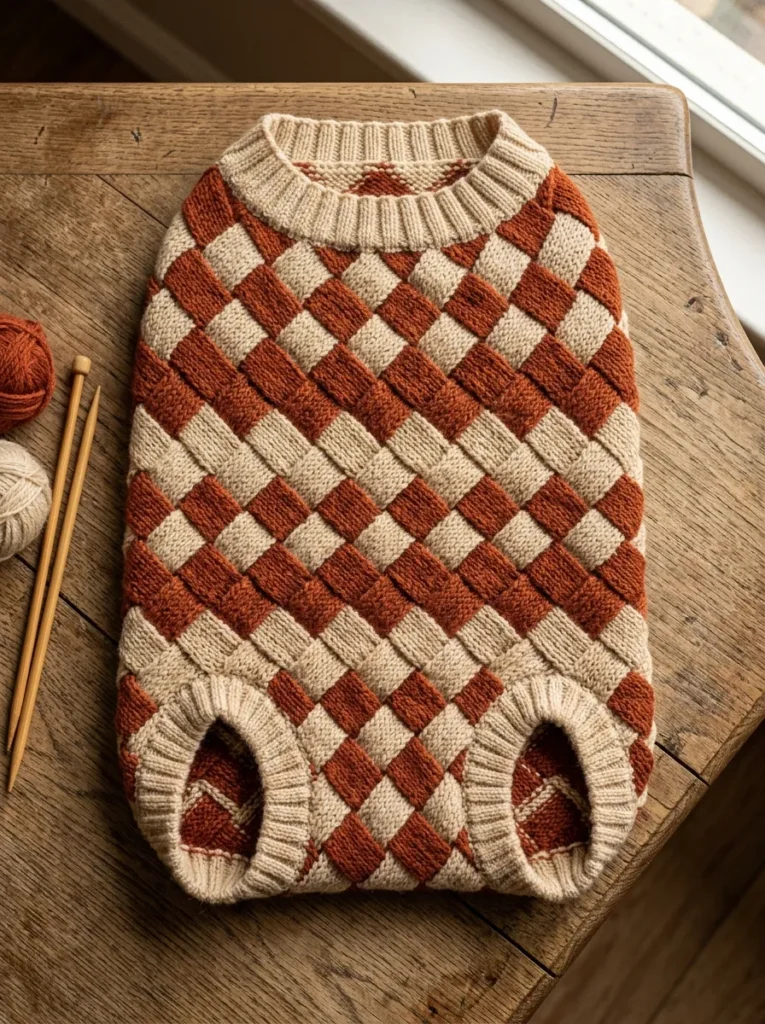
Vibe: The entrelac sweater feels like the most technically ambitious version of a dog sweater that anyone would recognize as handmade at first glance — the interlocked diamond pattern communicating a level of knitting investment that only a very committed maker would make for a dog.
Why it works: An entrelac pattern dog sweater applies the advanced technique showcase principle — entrelac (a technique of knitting small individual squares or rectangles in alternating diagonal rows, picking up stitches from the edge of the previous square to create an interlocked surface) produces one of the most visually distinctive surfaces in knitting, immediately recognizable as technically demanding from viewing distance. A dog sweater in entrelac technique is simultaneously a making achievement and a functional garment, and its specific surface quality — the raised diagonal squares creating a deeply textured fabric — provides genuine thermal insulation through the fabric’s additional thickness and air-trapping structure.
Technical note: Entrelac is more time-consuming than standard knitting at the equivalent stitch count because each small square requires its own cast on, working, and bind-off sequence rather than continuous rows. However, each individual square is simple (any beginner knitter can work a 10-stitch stockinette square), and the technique’s modularity means that mistakes are contained to a single square rather than affecting the whole garment.
Making time: 20–35 hours for a medium dog sweater — this is a project for dedicated makers.
Shop The Look
| Product |
|---|
| Deep rust yarn medium weight |
| Warm oat yarn complementary |
| Entrelac knitting guide pattern |
| Straight needles 4mm set |
| Blocking mat sweater finish |
9. Striped Mohair-Look Sweater — Cozy Texture
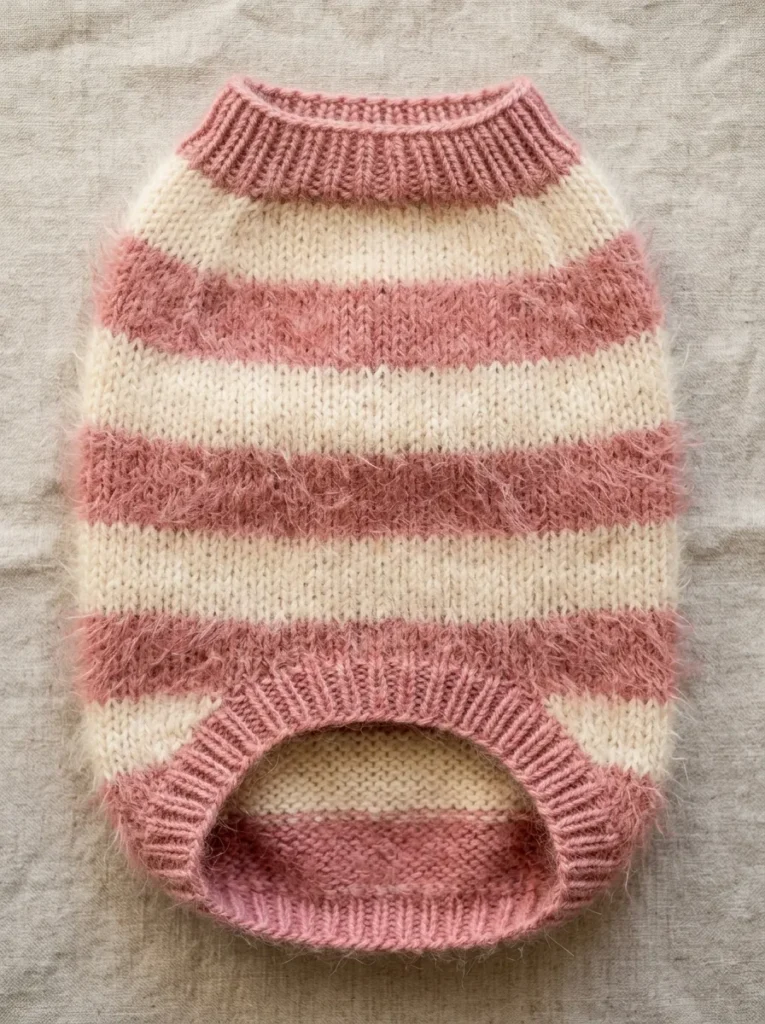
Vibe: The mohair-look striped sweater feels like the softest possible version of a dog garment — the fluffy yarn halo creating the specific visual warmth that only this texture family provides.
Why it works: A striped dog sweater in a mohair-look acrylic yarn applies the texture-through-material principle — a simple stockinette construction (knit every stitch on right-side rows, purl every stitch on wrong-side rows) produces an otherwise plain surface, but the specific choice of a fluffy mohair-look yarn converts this plain construction into a textured, warm-reading garment through the material’s own fiber quality rather than through any structural technique. This material-led approach to texture is specifically appropriate for a maker who wants to produce a beautiful handmade dog sweater without advanced technique knowledge — the mohair-look yarn does the visual work that technique would otherwise provide.
Safety note: True mohair yarn (from Angora goats) is not recommended for dog sweaters because the long, fine fibers can be ingested by the dog chewing at the sweater and can cause gastrointestinal problems. Use a mohair-look acrylic or a plant-based mohair-effect yarn (several manufacturers produce the fluffy halo effect in acrylic or cotton-acrylic blends that are safe for dog use) rather than genuine mohair or Angora.
Making time: 4–8 hours for a medium dog sweater.
Shop The Look
| Product |
|---|
| Mohair-look acrylic yarn dusty pink |
| Mohair-look acrylic yarn cream |
| Circular needle 4.5mm mohair |
| Simple stripe dog sweater pattern |
| Smooth acrylic ribbing yarn match |
10. Personalized Name Sweater — The Ultimate Gift
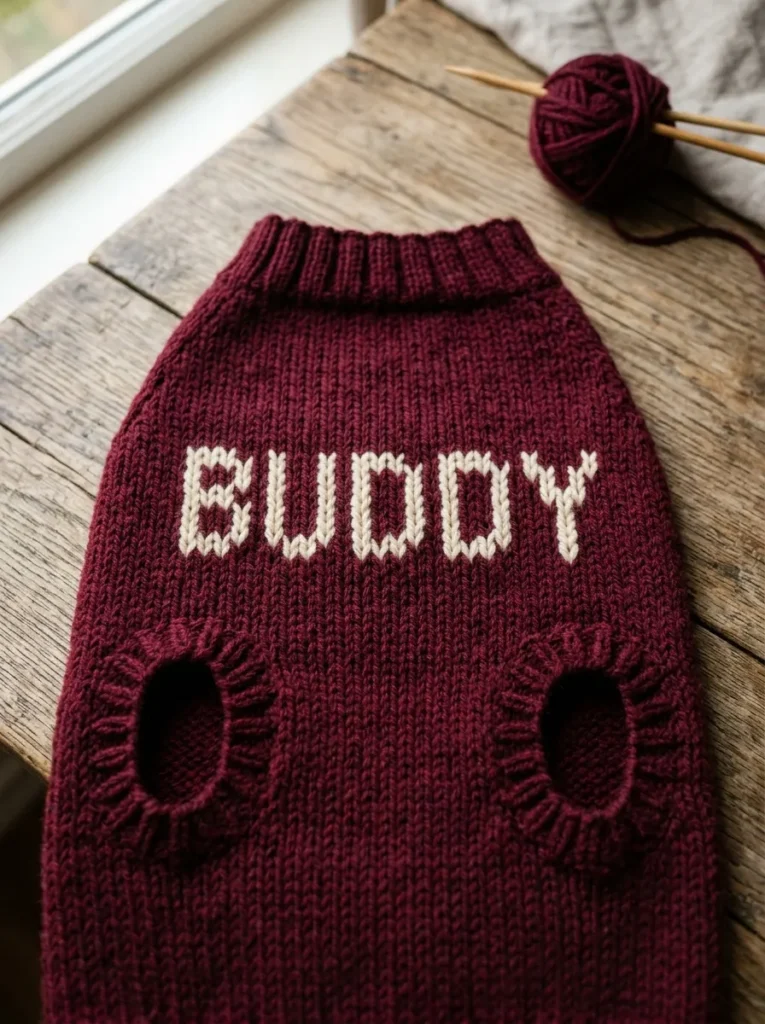
Vibe: The personalized name sweater feels like the most specific possible dog garment — the dog’s actual name on the actual sweater made for the actual dog converting a generic knitted object into an irreplaceable personal one.
Why it works: A personalized dog name sweater applies the named-object principle — a garment with the dog’s name on it cannot be mistaken for anything other than what it is: a sweater made for one specific dog, by someone who knew that dog’s name and cared enough to put it in the knitting. The name also serves a practical function (if the dog is lost or removed from the household’s possession, the name on the garment is immediate identification), but its primary function is emotional — the sweater with the dog’s name says, in the most visible possible way, that this garment was made with this specific animal in mind.
Letter technique: Duplicate stitch (embroidering over existing stitches with a contrasting yarn to create the letter forms on a completed stockinette fabric) is simpler to execute than intarsia (which requires working the letter colors into the original knitting) and allows the name to be added after the sweater is complete. Use a charted alphabet (available free from knitting websites) to map the letters onto the sweater’s stitch grid and work the duplicate stitch letters using a tapestry needle and the contrast yarn.
Making time: 6–10 hours including the duplicate stitch lettering.
Shop The Look
| Product |
|---|
| Deep burgundy acrylic yarn |
| Cream yarn name contrast color |
| Duplicate stitch alphabet chart |
| Tapestry needle lettering |
| Dog sweater plain back pattern |
11. Pom-Pom Trim Sweater — The Festive Detail
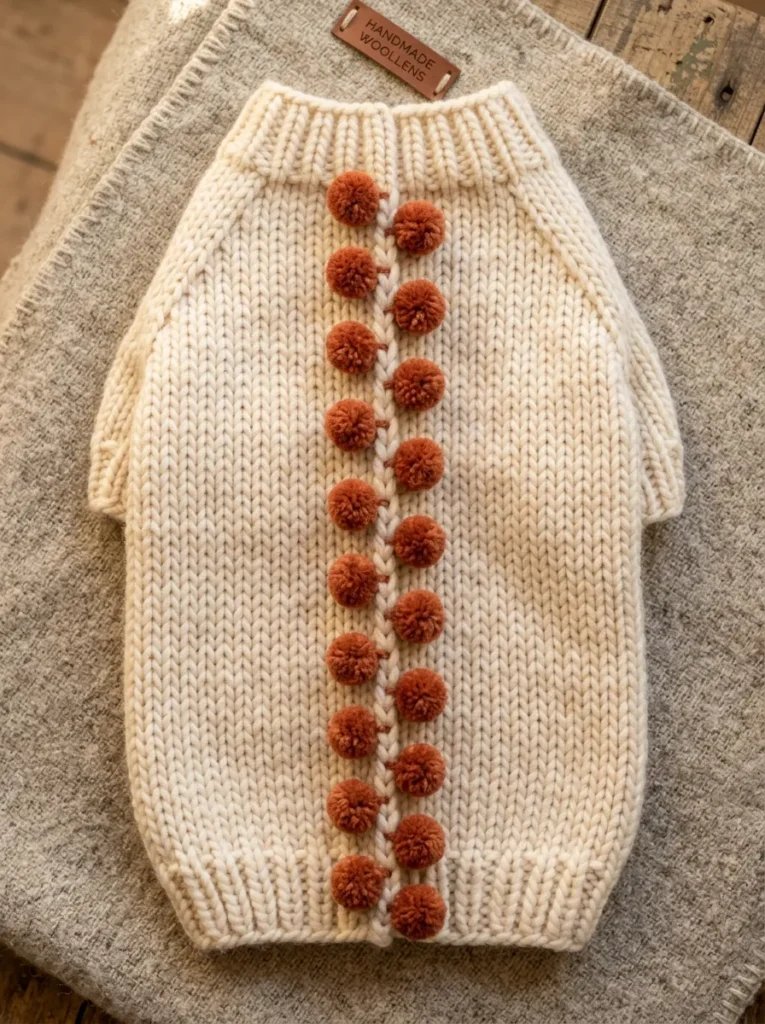
Vibe: The pom-pom trim sweater feels like the most cheerful version of a dog garment — the row of small pom-poms along the spine converting a functional sweater into something genuinely festive without being costumy.
Why it works: A pom-pom trim detail on a simple sweater base applies the single statement embellishment principle — a simple, plain sweater body (plain stockinette or plain fleece) with one highly specific embellishment (the row of small pom-poms along the spine) creates a more visually resolved garment than a sweater with multiple competing details, because the single embellishment reads as a design decision while multiple embellishments read as accumulation. The pom-pom’s specific quality — its round, dimensional form, its fluffy texture, its bounce — provides a visual interest that no flat trim or surface embroidery achieves with the same playful quality.
Pom-pom construction: Make each pom-pom using a pom-pom maker (available from craft retailers in sizes from 1–10cm — use the 2cm maker for this application) or by winding yarn around two card rings and cutting through the outer edge. For 2cm pom-poms, use approximately 30 wraps of medium-weight yarn per pom-pom. Secure the center tightly with a separate yarn length, leaving two long tails for sewing the pom-pom to the sweater. Attach each pom-pom by threading the tail yarn through the tapestry needle and making two or three secure stitches through the sweater’s seam at the attachment point.
Making time: 20 minutes per pom-pom; 30–45 minutes for a full spine trim.
Shop The Look
| Product |
|---|
| Simple sweater base cream or gray |
| Terracotta yarn pom-pom trim |
| Pom-pom maker 2cm size |
| Tapestry needle pom-pom attach |
| Sharp scissors pom-pom trim |
12. Reversible Two-Look Sweater — Double Function
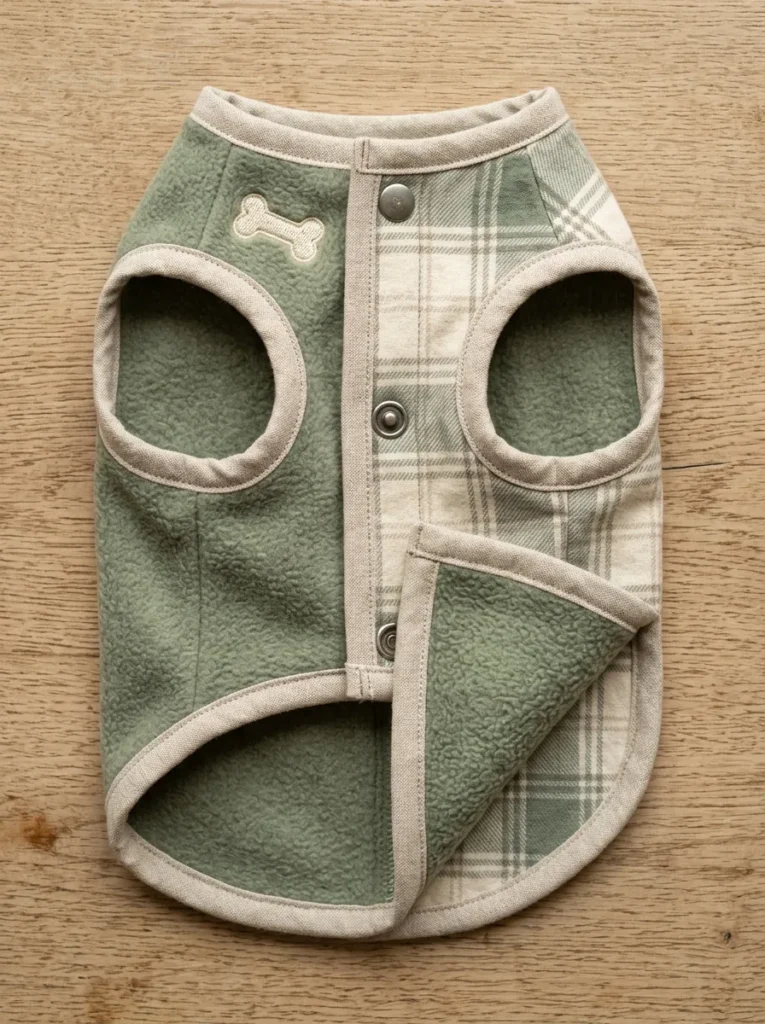
Vibe: The reversible sweater feels like getting two sweaters from one making session — the two distinct faces providing genuine variety from a single garment construction.
Why it works: A reversible dog sweater applies the double-value construction principle — a sewn sweater constructed with two layers of fleece (one layer in each fabric choice) joined at all edges with a bias tape binding creates a finished garment whose both faces are equally clean and complete, allowing the dog to wear either side outward. The reversible construction requires slightly more sewing than a single-layer garment (each panel must be cut in both fabrics and joined with care at all seams) but produces twice the visual variety from the same pattern and fitting work. The bias tape edge binding (applied last, covering the raw edges of both fabric layers) is the specific construction detail that makes the reversible garment work — it creates a clean, matched edge on both faces simultaneously.
Making time: 2–3 hours for a reversible fleece sweater.
Shop The Look
| Product |
|---|
| Sage green anti-pill fleece |
| Cream sage plaid fleece pattern |
| Natural linen bias tape 2cm |
| Snap closure set both sides |
| Reversible dog sweater pattern |
13. Breed-Specific Silhouette Sweater — Personalized Profile
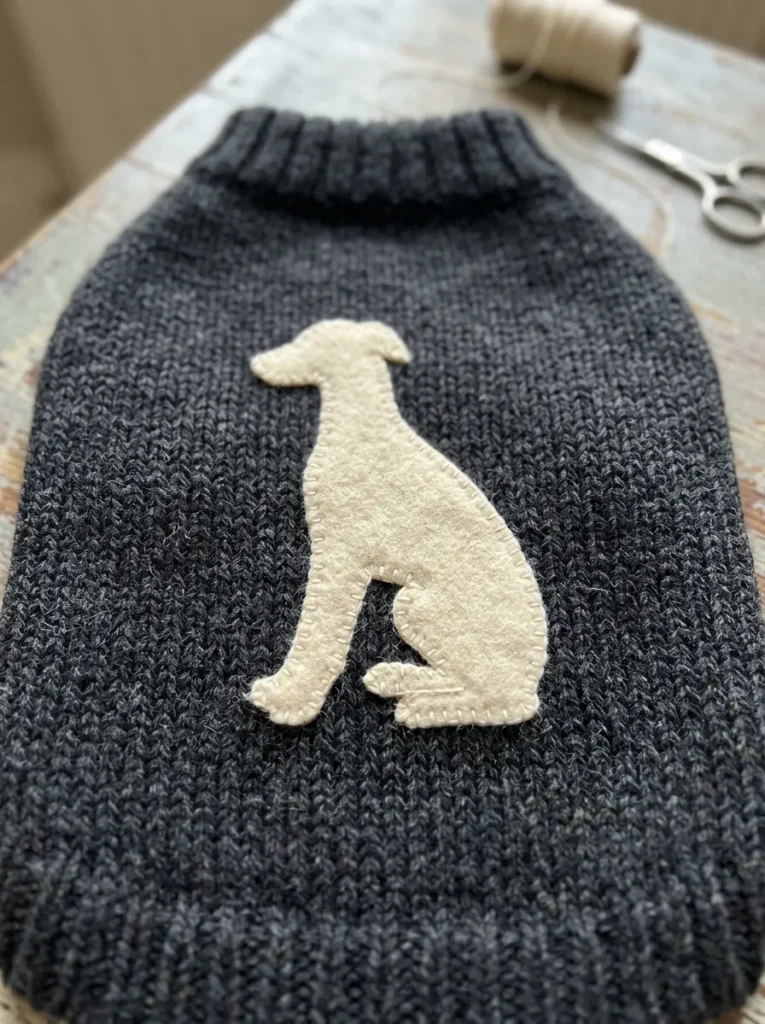
Vibe: The breed silhouette sweater feels like the garment was made by someone who looked at their specific dog’s shape and decided that shape was worth putting on the sweater — the breed-specific silhouette creating an immediate personal reference that transcends the generic “dog sweater” category.
Why it works: A breed-specific silhouette on a dog sweater applies the specific-reference personalisation principle — a silhouette of the specific breed (not a generic dog outline but the specific long-bodied dachshund, the deep-chested whippet, the wide-hipped corgi viewed from behind) creates an immediate personal reference between the sweater and its wearer that no generic decoration achieves. The silhouette’s simplicity (a single-color outline or filled form) is the design decision that makes it more resolved than a realistic illustration — a simplified silhouette communicates the breed’s most characteristic proportions and posture in the minimum visual information, creating a design element of genuine graphic quality.
Silhouette creation: Photograph the dog in a characteristic posture (sitting side-on for most breeds, from behind for corgi, from the front for flat-faced breeds). Print the photograph, trace the outline, simplify to the most characteristic proportions, and transfer to the felt or the sweater surface. For felt appliqué: cut the simplified silhouette from 2mm felt, position on the sweater back, and attach with blanket stitch (a decorative edge stitch worked through both felt and sweater fabric) using a contrasting or matching thread.
Making time: 30–45 minutes for the silhouette appliqué or embroidery on a purchased or completed sweater base.
Shop The Look
| Product |
|---|
| Navy or charcoal sweater base |
| Cream felt 2mm sheet |
| Breed silhouette template set |
| Embroidery thread cream white |
| Blanket stitch guide needle |
How to Start Your Dog Sweater Making Practice
The single most important first move before beginning any dog sweater project is taking the three essential measurements from the specific dog that the sweater is intended for — and not from a breed size chart or a “standard small dog” template, which will fit a specific individual dog accurately only by chance. The three measurements are: chest circumference (measured with a fabric tape measure around the widest part of the dog’s chest, immediately behind the front legs — add 3–5cm ease to this measurement for a comfortable fit); neck circumference (measured snugly where the collar sits — add 1–2cm ease); and back length (measured from the base of the neck — where the collar sits — to the base of the tail, following the line of the spine). These three numbers, taken from the actual dog in a relaxed standing position with the tape measure firm but not tight, are the specific information that every pattern in this list requires to produce a sweater that the dog will wear rather than resist.
The most common mistake in making a dog sweater is ignoring the dog’s response to wearing and continuing to insist on the garment despite clear signs of distress. A dog that freezes, refuses to walk, tries to remove the sweater, or shows flattened ears and tail tucking in response to wearing a sweater is a dog that is not comfortable in the garment — and the making and the wearing of a garment that causes anxiety is not an act of care regardless of the maker’s intention. If a dog is genuinely uncomfortable wearing clothing, the appropriate response is to discontinue the garment rather than to wait for habituation. Most dogs that resist garments do so because the garment restricts movement (too tight at the shoulder, too long in the body, too heavy in the fabric) rather than because they categorically reject wearing — and a correctly fitted, lightweight sweater in a non-restrictive design is accepted by the vast majority of dogs that genuinely need additional warmth.
Three specific items under $30 that enable the widest range of dog sweater making from this list: a fabric tape measure ($2–4, essential for taking all three dog measurements accurately and for gauge-checking knitting swatches before beginning a pattern); a ball of 100g worsted-weight wool-acrylic blend yarn in a neutral color ($8–15, providing enough yarn to knit a complete small or medium dog sweater and to swatch and practice the technique before committing to the final garment); and a set of four double-pointed needles in 4mm and 4.5mm ($5–12, enabling the ribbed tubes of leg warmers and the seamless circular constructions that produce the most comfortable dog garments). These three items combined for under $30 provide the core toolkit for beginning any of the knitted or crocheted ideas in this list.
Frequently Asked Questions About Creative Dog Sweaters
What dogs actually benefit from wearing a sweater?
Dogs that genuinely benefit from sweaters are those with insufficient natural insulation for the temperature conditions they are exposed to. The breeds most reliably benefiting from sweater insulation are: sighthounds with minimal body fat (greyhounds, whippets, Italian greyhounds, salukis — their lean physique provides almost no thermal buffer), short-coated small breeds in cold climates (Chihuahuas, Miniature Pinschers, Toy Manchester Terriers), hairless breeds (Chinese Crested, Xoloitzcuintli, American Hairless Terrier), very elderly dogs whose thermoregulatory capacity is reduced, dogs recovering from illness or surgery, and dogs that have been recently groomed and lost significant coat insulation. Dogs that rarely benefit from sweaters are: double-coated northern breeds (Huskies, Malamutes, Samoyeds — whose thick double coat is specifically evolved for cold), medium and large-sized dogs with adequate body fat reserves, and dogs that are consistently active outdoors (vigorous exercise generates body heat that makes additional insulation counterproductive).
What yarn is safest for a dog sweater?
The safest yarns for dog sweaters are smooth, machine-washable, non-toxic fibers without long loose fibers that can be ingested. The most recommended: superwash wool (treated to be machine-washable, warm, comfortable against skin), wool-acrylic blends (combining wool’s warmth with acrylic’s machine-washability and durability), and plain acrylic (fully machine-washable, non-felting, widely available). Yarns to avoid: true mohair and Angora (long fine fibers ingested by a chewing dog can cause gastrointestinal blockage), novelty yarns with long eyelash fibers (same ingestion risk), and 100% untreated wool (felts irreversibly in a machine wash and becomes unwearable after the first wet wearing).
How do you get a dog’s measurements accurately for a pattern?
For an accurate dog measurement, the dog must be standing on all four feet in a natural relaxed posture — a sitting dog will have a compressed chest measurement, and a tense or stretched dog will have distorted measurements in either direction. Use a soft fabric tape measure (not a rigid measuring tape) and hold it firmly against the body without compressing the coat. For the chest measurement: position the tape at the widest point of the chest immediately behind the front legs, encircling the body completely. For the neck: position the tape where the collar sits normally. For the back length: hold the tape at the base of the neck (where the collar sits) and measure to the base of the tail (where the tail joins the body). If the dog is reluctant to stand still, enlist a helper to offer treats while you measure, or take the measurement in two or three stages.
How do you make a dog sweater machine-washable?
A dog sweater is machine-washable when it is made from machine-washable materials — superwash wool, wool-acrylic blend, plain acrylic, or polyester fleece. The construction must also be appropriate for machine washing: all seams should be sewn or secured with a machine seam rather than hand-knitted joins that may come undone under agitation, all decorative elements (pom-poms, appliqués, embroidery) should be secured with machine or hand stitching rather than glue, and all trim and edging should be in the same washable material as the body. Wash dog sweaters on a gentle or wool cycle at 30°C with a mild detergent — avoid high-temperature washing even with acrylic fibers, as heat can distort or felt some yarn types. Air dry rather than tumble dry to maintain the garment’s shape.
How do you know if a dog sweater fits correctly?
A correctly fitting dog sweater should: allow the dog to walk freely without any hitching, bunching, or restricted movement at the shoulder (the single most important fit criterion — any restriction at the shoulder will cause the dog to resist the garment); cover the back from the base of the neck to approximately 2cm before the base of the tail without extending beyond this point (a sweater that extends over the tail base area prevents the dog from lifting its tail freely and restricts its primary communication mechanism); allow the front leg holes to provide free, unrestricted leg movement in all gaits (the leg holes should be large enough for the dog to step freely but small enough not to slide over the leg during movement); and sit snugly around the neck and chest without being tight enough to cause any visible constriction or discomfort. A well-fitting sweater should be barely noticeable to the dog during normal activity — if the dog’s gait changes, the dog stops moving, or the dog attempts to remove the garment, the fit requires adjustment.
Ready to Make Your Dog’s First Sweater?
These 13 ideas move through every level of making skill and every creative approach available in the dog sweater category — from the beginner-accessible ribbed turtleneck and the no-knit fleece sewn sweater, through the intermediate satisfaction of the Fair Isle colorwork band and the crocheted cable texture, to the advanced commitment of the entrelac pattern and the artisan quality of the breed silhouette appliqué, to the resourceful ingenuity of the upcycled sleeve conversion. Starting with the three measurements — chest circumference, neck circumference, back length — taken from the specific dog, on a relaxed standing day when the dog will hold still for the tape measure, is the beginning that makes every pattern decision specific rather than approximate. Write the three numbers down. Choose the pattern that matches those numbers and your current making skill level. Gather the yarn and the tools. Begin with the swatch (a small test knit at the pattern’s specified gauge that confirms the stitch count produces the correct dimensions before beginning the full garment). When the sweater is complete and fitted and the dog walks into a cold morning wearing it willingly — tail up, gait unchanged, comfortable — that specific moment is the return on the making investment that no purchased sweater can provide in quite the same way.