A dog fence is a physical or visual boundary system installed in a residential yard to contain a dog safely within a defined outdoor area while simultaneously contributing to — rather than detracting from — the yard’s overall landscape design and aesthetic quality. This article gives you 14 genuinely creative, buildable dog fence ideas that serve your dog’s safety and behavioral needs completely while remaining considered, visually intentional additions to the outdoor spaces they define.
Most dog fences default to the functional and the forgettable — a length of chain-link installed with utility and without thought, a standard timber paling that sits in the landscape like a problem solved rather than a decision made. The yards in this list make a different choice: they treat the dog fence as a landscape design element with the same design intention as a garden wall, a timber pergola, or a planted boundary hedge. Here are 14 ideas worth saving — and building.
Why Beautiful Dog Fence Design Works So Well
The dog fence as a serious residential landscape design element has a design tradition that predates the contemporary pet-inclusive design movement by centuries — the ha-ha, the English landscape garden’s recessed boundary wall that contained livestock while preserving the visual continuity of the pastoral view, is arguably the earliest and most elegant resolution of the problem that dog fencing still solves today: how to contain animals within a defined area without interrupting the visual quality of the landscape. The contemporary dog fence design challenge differs from the ha-ha primarily in scale and context — suburban and urban residential yards rather than English country estates — but the fundamental design problem is identical: create a secure boundary that reads as a designed landscape element rather than a containment infrastructure.
The materials that define beautiful dog fence design are those that balance structural security with visual lightness and landscape integration. Powder-coated steel and aluminium provide the structural integrity that a dog fence requires — the ability to resist the pressure, jumping, and digging behavior of dogs at any weight and activity level — while maintaining a visual lightness through their slender profile and dark tone that reads as graphic element rather than solid barrier. Natural timber in its varied forms (rough-sawn hardwood, treated pine, cedar, horizontal slat, vertical picket) provides warmth and material honesty that connects the fence to the organic character of the surrounding garden. Living boundary hedges in dog-safe species (box, pittosporum, photinia) provide the most naturalistic resolution of the containment problem, embedding the boundary in the garden’s own plant material rather than introducing a manufactured structure. Stone and rendered masonry provide the most permanent and most spatially defined boundary, reading as garden architecture rather than fencing.
The trend reflects the same post-pandemic investment in residential outdoor space that has driven growth in garden design, outdoor furniture, and pool installation throughout the 2020s. According to the American Pet Products Association, 44% of US dog-owning households identified the quality of their yard as a primary factor in housing decisions in 2023, and landscape designers across Australia, the UK, and North America report increasing requests for dog-specific landscape design briefs that treat pet infrastructure as a primary design consideration rather than an afterthought. The dog fence is no longer a concession to pet ownership that diminishes the garden — it is increasingly a central element of a garden design brief that integrates safety, behavior management, and aesthetic quality into a single resolved design outcome.
Small yards benefit specifically from the beautiful dog fence approach because the contained scale of a small yard makes every element more visible and more impactful on the overall aesthetic quality — a poorly designed dog fence in a small yard dominates the space; a beautifully designed one becomes its best architectural feature. The ideas in this list are scaled and proportioned for the full range of residential yard sizes, from compact urban courtyards to generous suburban backyards.
Style at a Glance
| Element | Detail |
|---|---|
| Philosophy | The dog fence is a landscape design element first and a containment structure second — it should improve the yard’s visual quality rather than apologize for its presence |
| Key Materials | Powder-coated steel, treated hardwood, cedar, aluminium, living hedge, rendered masonry, cor-ten steel, bamboo |
| Design Principles | Visual lightness, landscape integration, material coherence with existing garden, adequate height without visual bulk |
14 Dog Fence Ideas
1. Black Powder-Coated Steel Rod Fence with Garden Integration
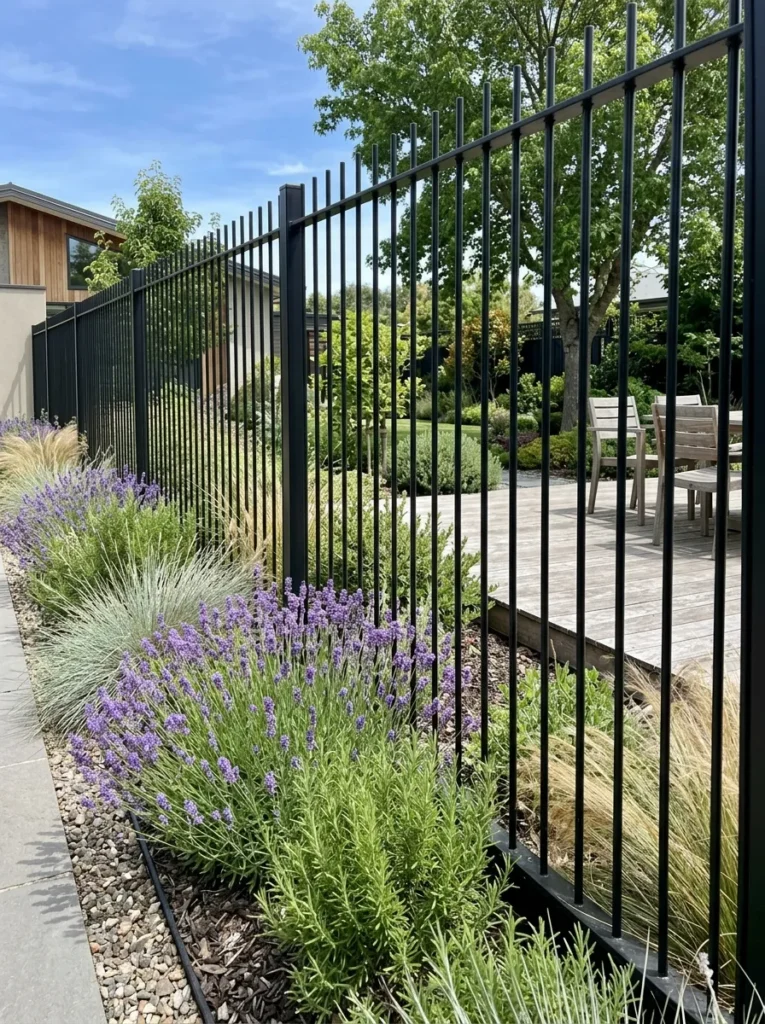
Vibe: Clean and designed — the dog fence that makes the garden look more resolved from both inside and outside.
Why it works: The black powder-coated steel rod fence is the dog fence format with the highest design sophistication-to-structural-performance ratio available — its slender 12mm rod elements create a boundary that is visually transparent (the garden beyond the fence remains fully visible through the rod spacing) while being structurally impenetrable to any domestic dog breed, and its powder-coated black finish introduces the same graphic, contemporary design language as the black-framed windows and black steel pergola elements that define contemporary landscape architecture. The visual transparency of the rod fence is its specific design advantage over solid fence formats: it allows the garden to read as a continuous space with a defined boundary rather than as a series of enclosed compartments separated by visual walls. The planting at the fence base — lavender, rosemary, ornamental grasses — provides the naturalistic transition between the manufactured fence material and the organic garden context that softens the fence’s presence and connects it to the landscape it defines.
How to get it: Specify steel rod fence panels at 1.2–1.8 meters height depending on the dog’s size and jumping ability — most standard domestic breeds are contained by 1.2 meters, while larger or more athletic breeds require 1.5–1.8 meters. The 100mm rod spacing is the maximum safe spacing for most dog breeds — wider spacing allows dogs to push their heads through or for puppies to escape. Order from a steel fabrication workshop or specialist fence supplier as welded panels in standard widths (typically 1.8–2.4 meters panel width) for efficiency and structural integrity.
Quick Win: A planting bed of lavender at 200mm centers along the base of any dog fence immediately softens the fence’s visual presence in the garden, connecting the manufactured boundary to the organic plant world of the garden and creating a sensory layer of fragrance that makes the fence boundary a garden feature rather than a containment infrastructure.
Shop the Look
| Product |
|---|
| Powder coated steel rod fence panel |
| Lavender plant established |
| Ornamental grass pot established |
| Steel post ground anchor |
| Black fence post cap |
2. Horizontal Hardwood Slat Fence with Wide Gaps
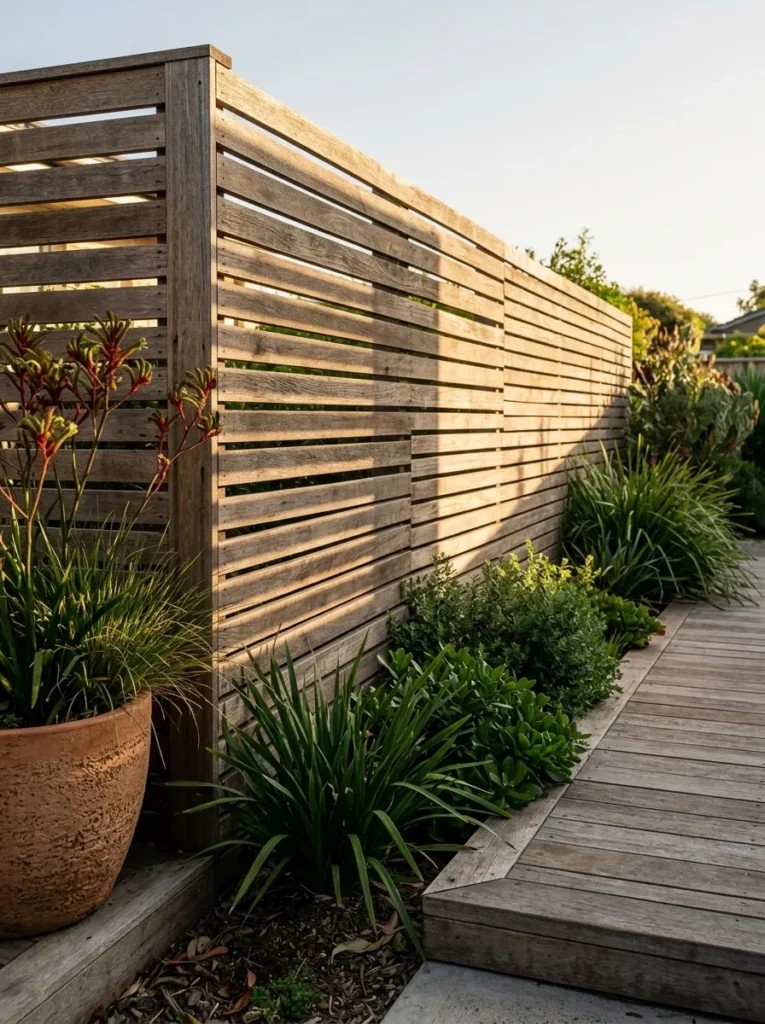
Vibe: Warm and contemporary — the boundary that makes the garden feel like it was designed by an architect who spent time in California.
Why it works: The horizontal hardwood slat fence with carefully proportioned gaps is the timber fence format that most powerfully creates the contemporary Australian and Californian residential landscape aesthetic — the horizontal emphasis of the slats creates a visual rhythm that reads as architectural and considered rather than utilitarian, and the carefully proportioned gap-to-slat ratio (30mm gap to 90mm slat in this case) produces the correct visual balance between transparency (the garden beyond remains partially visible through the gaps) and privacy (the occupants of the garden are not fully visible from beyond the fence). The 30mm gap is also the practical specification that makes this fence a safe dog containment solution — 30mm is insufficient for most dogs to push their head through, preventing both escape and the stress-inducing nose-through-fence behavior that makes dogs anxious and fence-aggressive.
How to get it: Specify H3 or H4 treated hardwood slats (H3 for above-ground exposure, H4 for ground contact at post positions) in spotted gum, kwila, or recycled hardwood for maximum durability in an outdoor environment. Install horizontal slats on vertical steel posts (65mm × 65mm RHS steel) rather than timber posts for the slenderest and most durable support system — steel posts at 1.8–2.4 meter centers with timber slats screwed to the steel using concealed fixings produce the cleanest, most minimal aesthetic. Allow the hardwood to weather naturally to its silver-grey tone rather than applying an oil finish — the natural silver-grey of weathered hardwood is the specific tone that reads as most architecturally sophisticated.
Shop the Look
| Product |
|---|
| Spotted gum hardwood slat 90mm |
| Steel RHS post 65mm |
| Concealed screw fixing set |
| Native garden plant selection |
| Large terracotta pot corner |
3. Gabion Stone Wall as Low Dog Barrier
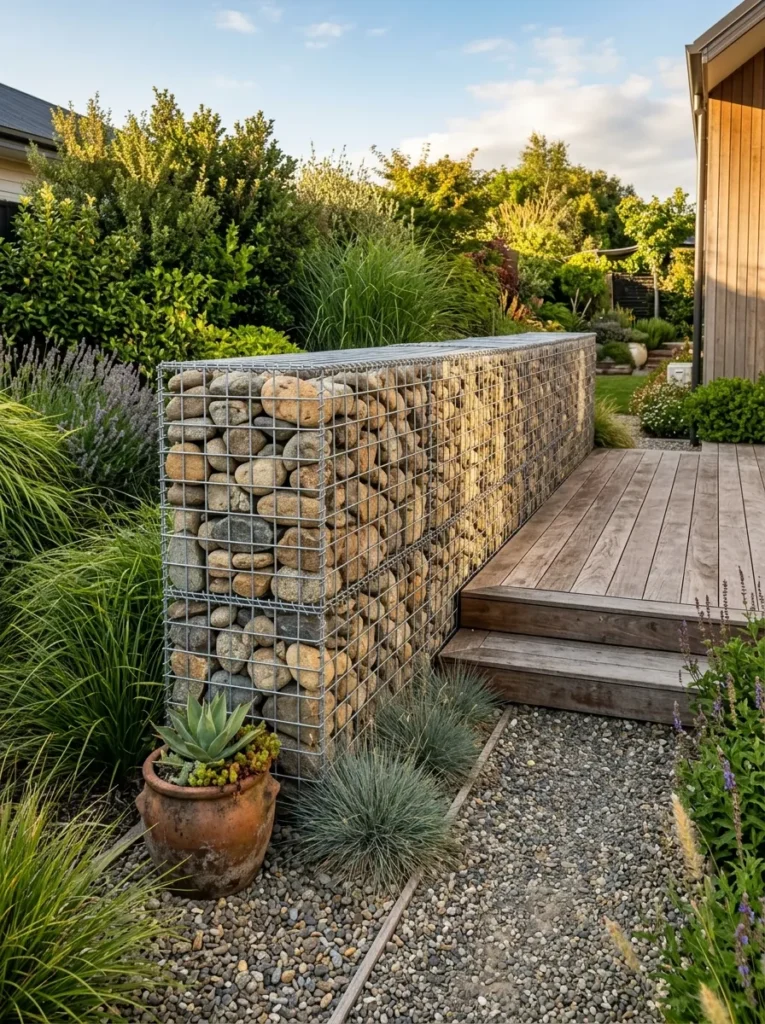
Vibe: Warm and natural — the dog boundary that looks like it was placed by the landscape rather than installed in it.
Why it works: The gabion stone wall is the dog containment solution that most completely eliminates the boundary’s visual presence as a manufactured structure — the natural stone fill within the steel mesh cages creates a surface that reads as geological rather than constructed, connecting the boundary to the mineral world of the garden rather than to the manufactured world of fence systems. At 900mm height, a gabion wall provides effective containment for most small to medium dog breeds while remaining at a scale that reads as a low garden wall rather than a full-height boundary fence, which is the specific quality that makes it the most landscape-integrated dog containment option available. The gabion wall also serves as a retaining wall function if the yard has any level changes, making it a structurally versatile solution that addresses multiple landscape design problems simultaneously.
How to get it: Gabion cages are available from landscape supply specialists in standard sizes (typically 1000mm × 500mm × 500mm) that can be stacked and combined to achieve any height and length combination. The stone fill should be sourced locally where possible — using locally quarried stone connects the gabion to the specific geological character of the site rather than importing a generic stone type. Specify basalt, granite, or river stone rather than limestone, which weathers rapidly in exposed outdoor conditions and can become fragile and discolored within a few seasons.
Shop the Look
| Product |
|---|
| Gabion cage steel mesh set |
| River stone fill natural |
| Ornamental grass plant set |
| Landscape fabric weed mat |
| Timber deck board |
4. Living Hedge Boundary in Dog-Safe Species
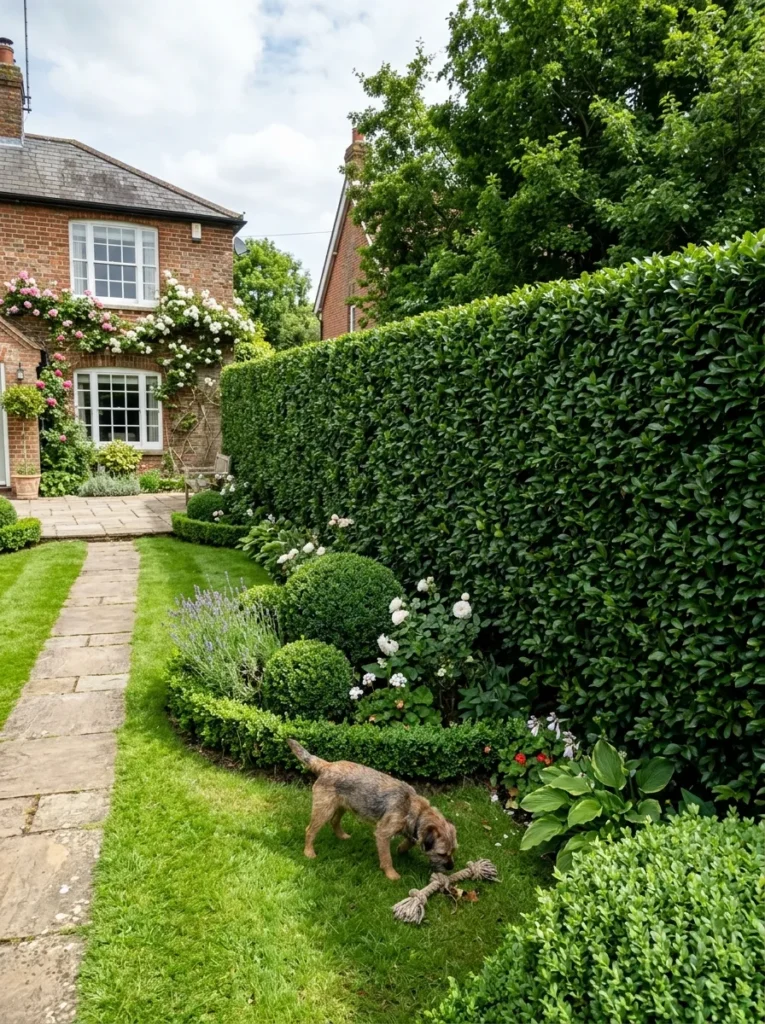
Vibe: Lush and formal — the dog boundary that is indistinguishable from a considered garden feature.
Why it works: A dense living hedge as the primary dog boundary is the containment solution that most completely dissolves the boundary’s manufactured character by making it entirely from living plant material — a dense, formally clipped hedge that is the dog boundary is simultaneously the garden’s most naturalistic edge treatment, the most visually rich boundary available, and the most carbon-sequestering and ecologically beneficial fencing solution. The key design requirements that make a living hedge an effective dog boundary are species selection (the hedge must be in a dog-safe species — box, photinia, lilly pilly, and pittosporum are all non-toxic and structurally dense enough for containment purposes) and density (the hedge must be planted at sufficient density and maintained at sufficient clipping frequency to prevent gaps through which a determined dog could push).
How to get it: Plant hedge species at 500mm centers for the fastest establishment to effective containment density — this close spacing produces full hedge density within 2–3 growing seasons for most fast-growing species. Establish a temporary wire or timber fence inside the planting line during the 2–3 year establishment period while the hedge grows to effective containment height and density. Maintain the hedge’s containment effectiveness by clipping twice yearly — in late spring and in late summer — to promote dense lateral branching rather than upward growth.
Quick Win: A temporary bamboo screen fence (bamboo roll screening available from hardware stores at $15–25 per linear meter) installed immediately in front of a newly planted hedge provides instant visual privacy and dog containment while the hedge establishes — the bamboo screen is removed after 2–3 years when the hedge reaches effective containment density, at which point the screen has degraded or can be reused elsewhere.
Shop the Look
| Product |
|---|
| Photinia hedge plant established |
| Lilly pilly hedge plant |
| Hedge trimmer electric |
| Temporary bamboo screen roll |
| Hedge fertilizer slow release |
5. Cor-Ten Steel Fence Panels for a Contemporary Garden
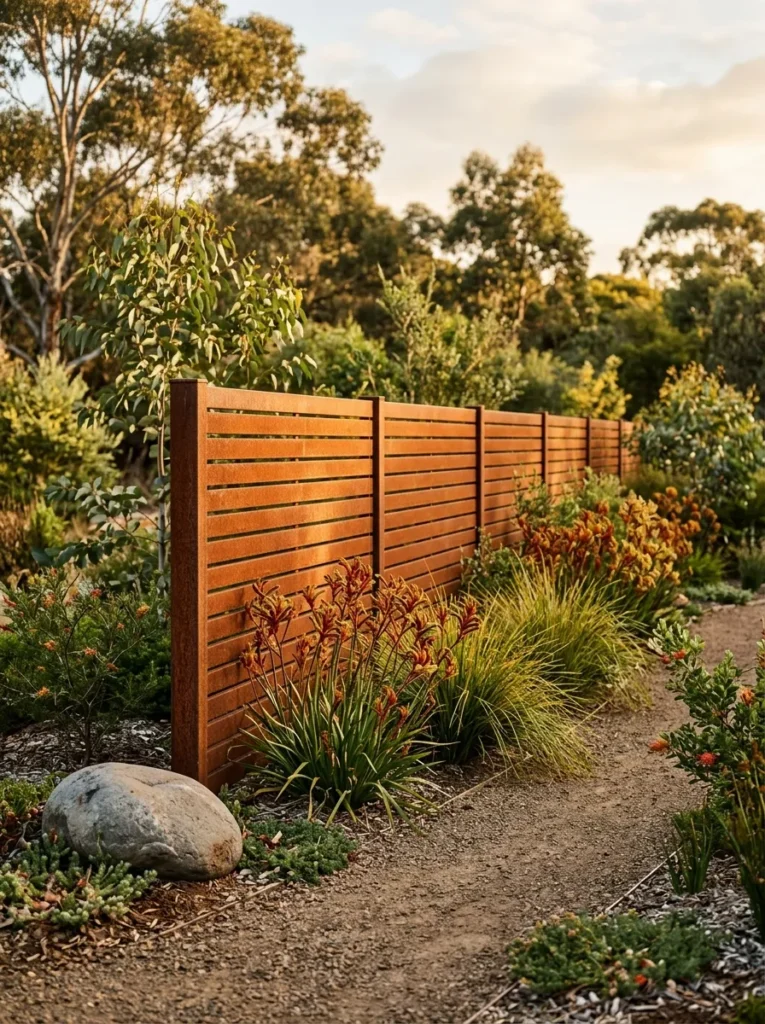
Vibe: Warm and material — the fence that makes the garden look like the material choices were made by someone who really understands this landscape.
Why it works: Cor-ten steel is the fencing material that most naturally and most specifically coordinates with the warm, earthy color palette of Australian native gardens, drought-tolerant Mediterranean landscapes, and contemporary gardens that use terracotta, gravel, and natural stone as their primary material palette. Its self-weathering property — the progressive development of a stable orange-rust patina that both protects the steel and introduces a warm, mineral color — means that a cor-ten fence improves visually over time rather than degrading, gaining the material depth and character of an aged natural material as the patina develops across the first 2–3 years of outdoor exposure. The rust color of mature cor-ten specifically coordinates with the warm ochre, terracotta, and red-brown tones of the native and Mediterranean garden palette in a way that no painted steel or timber fence can replicate.
How to get it: Specify cor-ten steel fence panels from a specialist steel supplier or landscape architecture fabricator — cor-ten (also known as weathering steel, Corten-A, or COR-TEN brand) is available as flat panel sheet, as slat sections, and as custom-cut perforated panels. Allow the patina to develop naturally over the first 2–3 years without any protective coating — the patina development is the material’s self-protecting mechanism and should not be interrupted by paint or sealant application. Ensure the fence installation avoids direct water runoff onto adjacent paving or light-colored surfaces, as the rust patina will stain any surface it drips onto during the active patination period.
Shop the Look
| Product |
|---|
| Cor-ten steel fence panel |
| Kangaroo paw plant native |
| Native ornamental grass |
| Decomposed granite path material |
| Smooth river boulder large |
6. Transparent Glass or Acrylic Panel Fence for Pool Areas
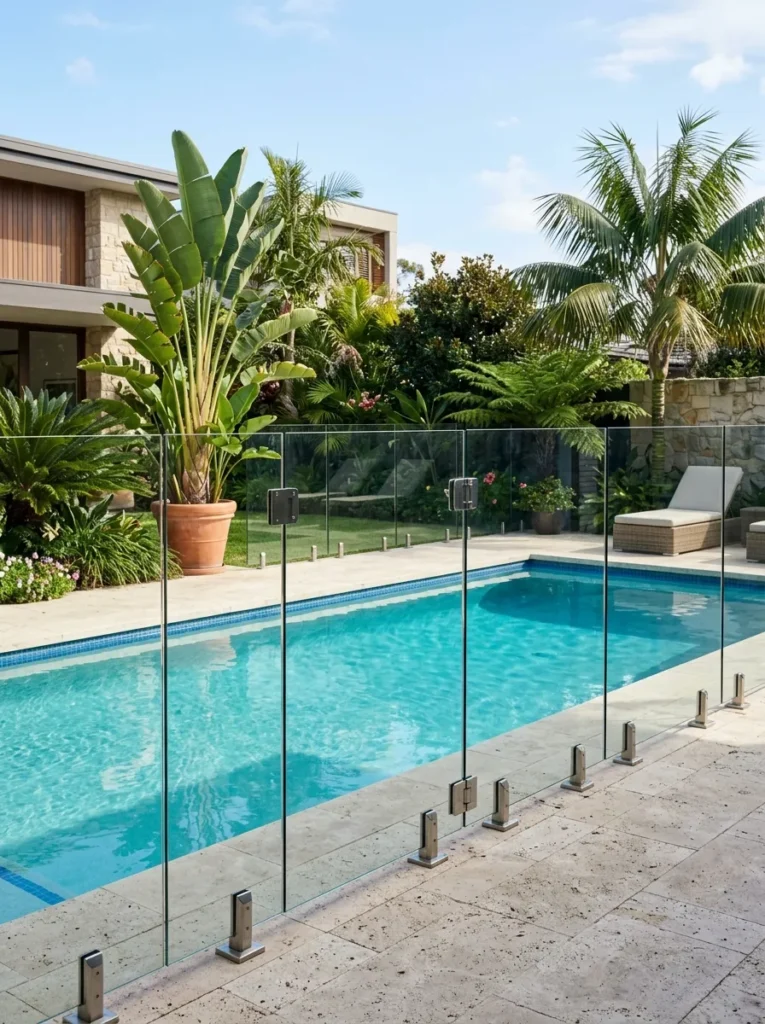
Vibe: Clean and open — the pool fence that solves the safety requirement without introducing a single visual interruption to the landscape.
Why it works: Frameless glass panel fencing is the dog and child containment solution that delivers the most visually open result — the complete transparency of 10mm toughened safety glass provides zero visual interruption to the landscape, allowing the pool and garden to be experienced as a continuous visual field from any position within the property. This transparency is specifically important in a pool context because the safety requirement of pool fencing (typically mandated by council regulation at minimum heights of 1.2–1.5 meters) creates a significant visual boundary that standard fence materials make physically and visually intrusive. Glass panel fencing satisfies the safety requirement at the legally mandated height without introducing any visual barrier, making it the only fencing solution that simultaneously addresses the safety requirement and the landscape design requirement without compromise.
How to get it: Specify 10mm toughened safety glass panels (minimum standard for frameless pool fencing in most residential jurisdictions) in standard panel widths of 900–1000mm for the most structurally efficient and aesthetically clean installation. The stainless steel spigot mount system — a floor-fixed stainless steel point-mount at the panel base — is the frameless mounting system that provides the cleanliest visual appearance, as it eliminates all visible framing from the panel faces. Confirm the glass fence specification with a licensed pool fence installer to ensure compliance with local pool fencing regulations, which vary by jurisdiction.
Shop the Look
| Product |
|---|
| Frameless glass pool fence panel |
| Stainless steel spigot mount |
| Glass fence self-closing gate |
| Pool deck travertine tile |
| Large poolside plant terracotta |
7. Picket Fence in a Heritage Style with Climbing Plants
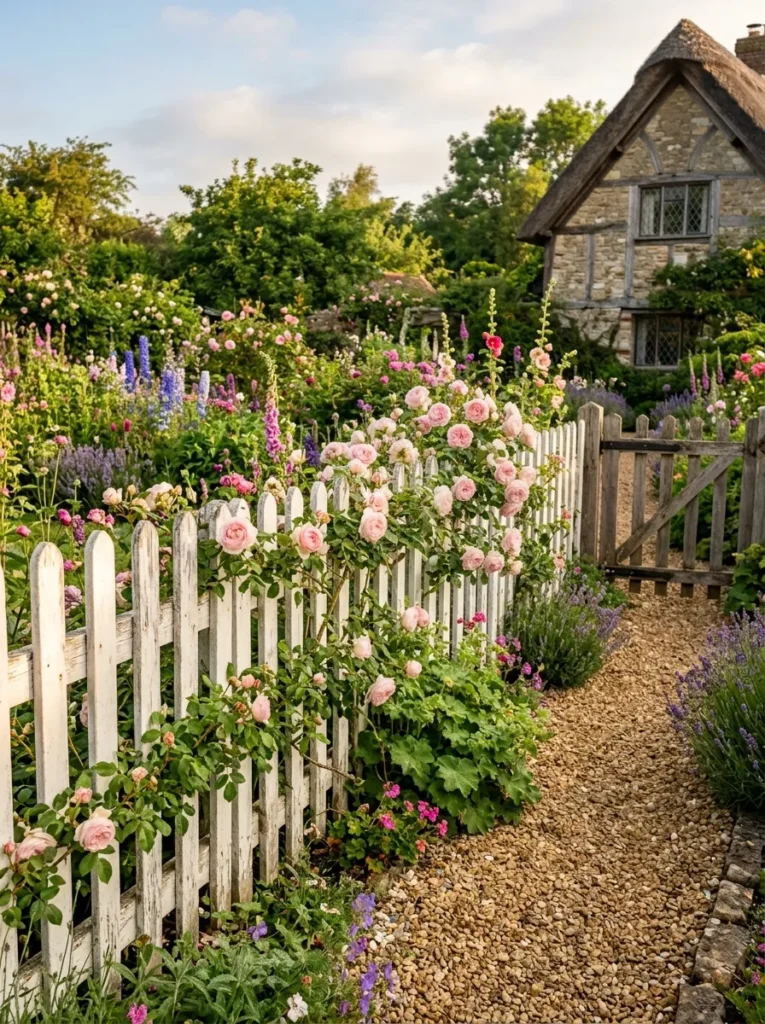
Vibe: Warm and heritage — the fence that makes the garden feel like it has a history worth living in.
Why it works: The heritage picket fence with climbing plants is the dog fence solution that most completely achieves the dual goal of containment and beauty in a cottage or heritage garden context — the picket profile’s vertical emphasis and the climbing plants’ organic softening together create a boundary that reads as a garden feature in its own right rather than an imposed security element. The climbing rose trained between the pickets is the specific horticultural choice that maximizes the fence’s visual contribution to the garden: the rose canes trained horizontally along the rail positions between the vertical pickets create a dense flowering barrier that adds fragrance, seasonal flower color, and the informal beauty of a trained climbing plant to the fence’s structural containment function. The round-top or French Gothic picket profile is the heritage-authentic design that reads as genuinely period-appropriate rather than as a generic picket.
How to get it: Install the picket fence using treated pine or western red cedar posts and rails, with pickets cut to the round-top or French Gothic profile (both easily achieved with a jigsaw or router) at 70–100mm spacings — the spacing is the critical detail for dog containment, as spacings wider than the dog’s head width allow escape for smaller breeds. Paint in a semi-gloss white exterior enamel for maximum durability and the brightest, most heritage-authentic finish. Select climbing rose varieties for their flexibility and disease resistance as well as their flower quality — David Austin’s The Generous Gardener, Madame Alfred Carrière, and Climbing Iceberg are all structurally flexible enough to train horizontally without staking.
Shop the Look
| Product |
|---|
| Treated pine picket lengths |
| White exterior semi-gloss paint |
| Climbing rose plant established |
| Heritage timber fence gate |
| Rose training wire |
8. Bamboo Screen Fence with Planted Garden Buffer
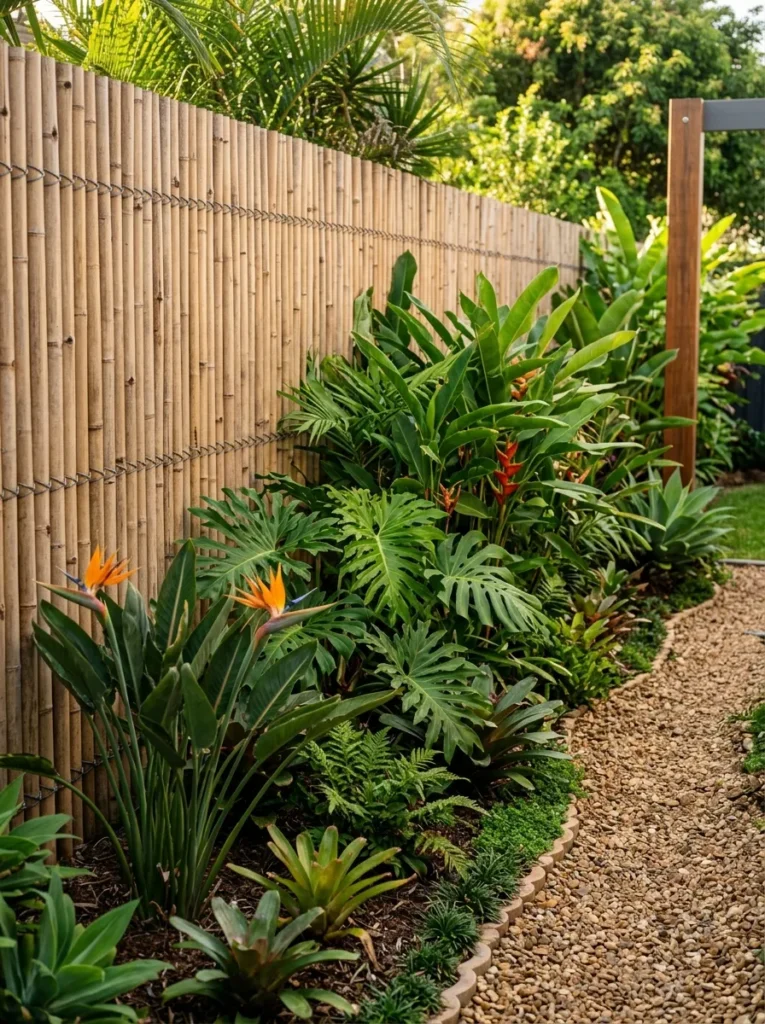
Vibe: Warm and tropical — the garden boundary that makes the yard feel like a private botanical garden rather than a fenced property.
Why it works: The bamboo screen fence with a deep planted garden buffer is the dog containment solution that most effectively creates the two-layer boundary system — a manufactured structure layer (the bamboo) and a planted layer — that landscape designers use to make residential boundaries feel like genuine garden edges rather than fence installations. The bamboo’s natural material character (its warm beige color, its irregular pole diameter, the visible binding wire that holds the poles together) reads as part of the garden rather than separate from it, connecting the fence to the organic material world of the plants growing beside it. The deep planted buffer at the fence base is the design element that most powerfully softens the fence’s presence — a planting bed of 800–1000mm depth between the fence and the garden’s circulation paths creates enough visual distance between the boundary and the garden’s primary spaces that the fence reads as the background of the garden’s plant composition rather than its foreground.
How to get it: Source bamboo screen panels from landscape and garden supply specialists — natural bamboo screen roll ($15–25 per linear meter) is available in heights from 1.2–2 meters and can be attached to a structural steel or timber post framework. The planted buffer should use large-leaf, dense-growing species that fill the buffer depth rapidly — bird of paradise (Strelitzia nicolai), large-leaf philodendron, and tree ferns all establish quickly and provide the visual density that makes the buffer effective from the first year.
Shop the Look
| Product |
|---|
| Natural bamboo screen roll |
| Steel post framework |
| Bird of paradise tropical plant |
| Large leaf philodendron |
| Gravel path material |
9. Rendered Block or Brick Wall as a Dog-Safe Garden Room Wall
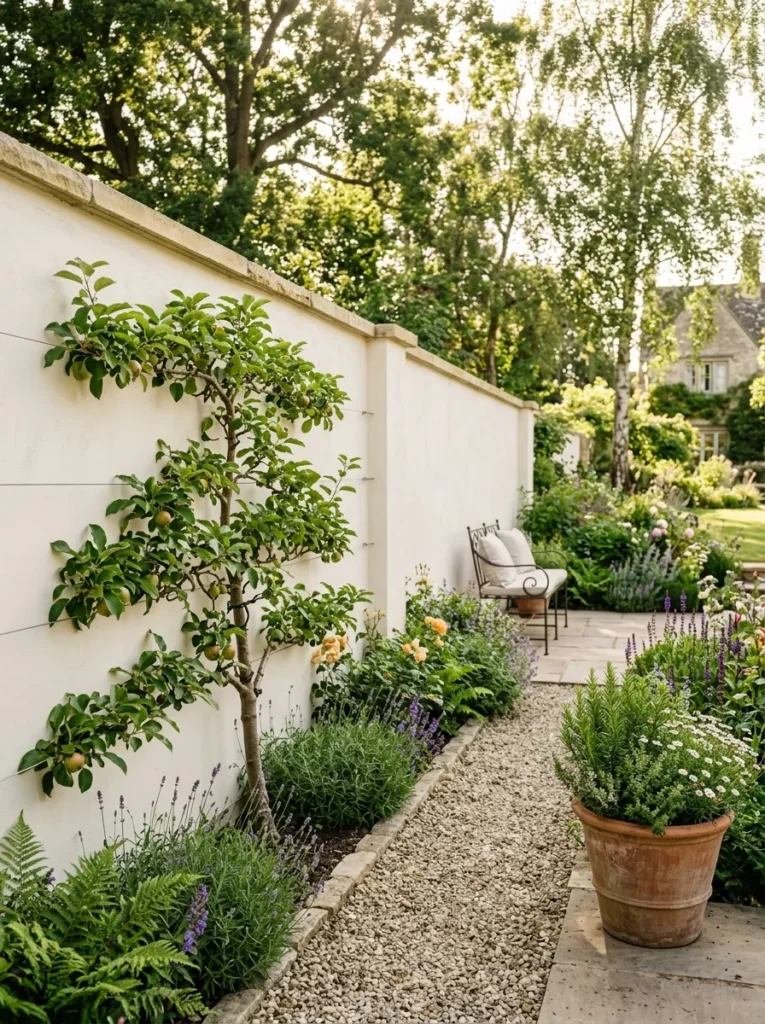
Vibe: Warm and architectural — the garden boundary that makes you feel like you live in a walled garden rather than a fenced yard.
Why it works: A rendered masonry wall at the correct height for dog containment is the garden boundary solution that most completely achieves the walled garden aesthetic — the spatial quality of enclosure and shelter that high-quality residential gardens seek but that manufactured fencing systems cannot provide. A rendered wall at 1.2 meters height (sufficient for most dog breeds) reads as a garden architecture element of genuine spatial quality — it creates garden rooms rather than defining fenced areas, provides a thermal mass that moderates the microclimate within the enclosed space, and offers a planting surface for espaliered fruit trees and climbing plants that no manufactured fence can match in garden value. The wall also provides the structural permanence that no fence system can approach — properly constructed masonry walls last hundreds of years rather than the 20–30 year lifespan of most manufactured fence systems.
How to get it: Construct from standard double-skin brick, concrete block, or rendered AAC (autoclaved aerated concrete) block — the render and capping finish applied to any of these structural systems produces the same finished appearance. Apply a two-coat lime render system (base coat and finish coat) in a warm white tone rather than a bright brilliant white — warm white limewash or lime render reads as more natural and more architecturally authentic than the stark white of synthetic render systems. Cap the wall with limestone, sandstone, or terracotta capping stones that coordinate with the garden’s material palette.
Shop the Look
| Product |
|---|
| Rendered masonry wall system |
| Lime render finish coat |
| Limestone capping stone |
| Espaliered fruit tree |
| Formal garden path material |
10. Pool Fence Repurposed as Garden Room Divider with Plants
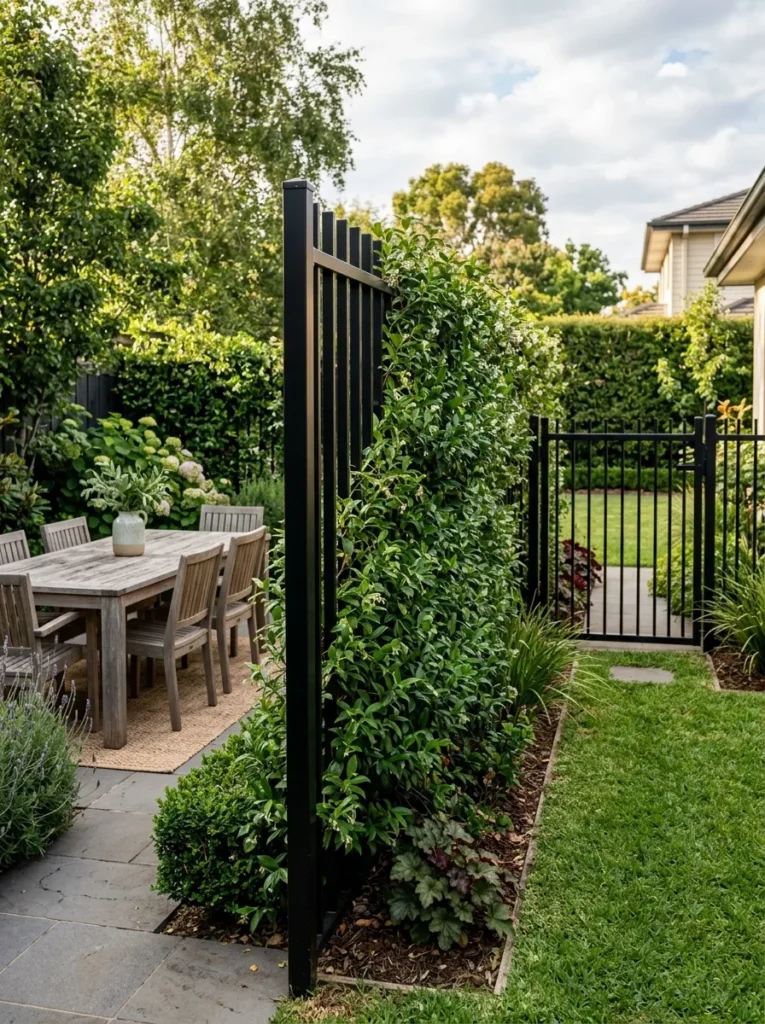
Vibe: Organized and green — the internal garden divider that creates two perfectly considered zones from one outdoor space.
Why it works: Using a pool-style aluminium picket fence as an internal garden room divider rather than a perimeter boundary is the design approach that most intelligently uses a standard containment product as a genuine landscape design element — the internal divider creates defined zones within the garden (an entertainment terrace zone and a dog-accessible garden zone) that allow both the human and canine users of the outdoor space to occupy the garden simultaneously without conflict. The black aluminium picket fence reads as a more architecturally sophisticated garden divider than a timber alternative because its slender vertical elements and dark tone create a graphic, minimal line that reads as a designed garden structure. The climbing plants trained along the picket length — star jasmine, mandevilla, or climbing roses — convert the fence face from a manufactured structure into a living green screen that reads as entirely botanical from the garden.
How to get it: Source standard pool-specification aluminium tubular fence panels (1000mm–1200mm height, 75mm center picket spacing) in black powder-coat from pool fencing suppliers — pool specification materials are more durable and better finished than general residential fencing materials, and their wider availability ensures consistent availability of replacement components. Train climbing plants onto the aluminium pickets using soft garden ties rather than wire — wire ties can damage both the powder coat finish and the plant stems at their contact points.
Shop the Look
| Product |
|---|
| Black aluminium picket fence panel |
| Climbing star jasmine plant |
| Garden plant tie soft |
| Teak outdoor table entertaining |
| Lawn grass seed shade tolerant |
11. Dog Run with Decorative Trellis Fence Surround
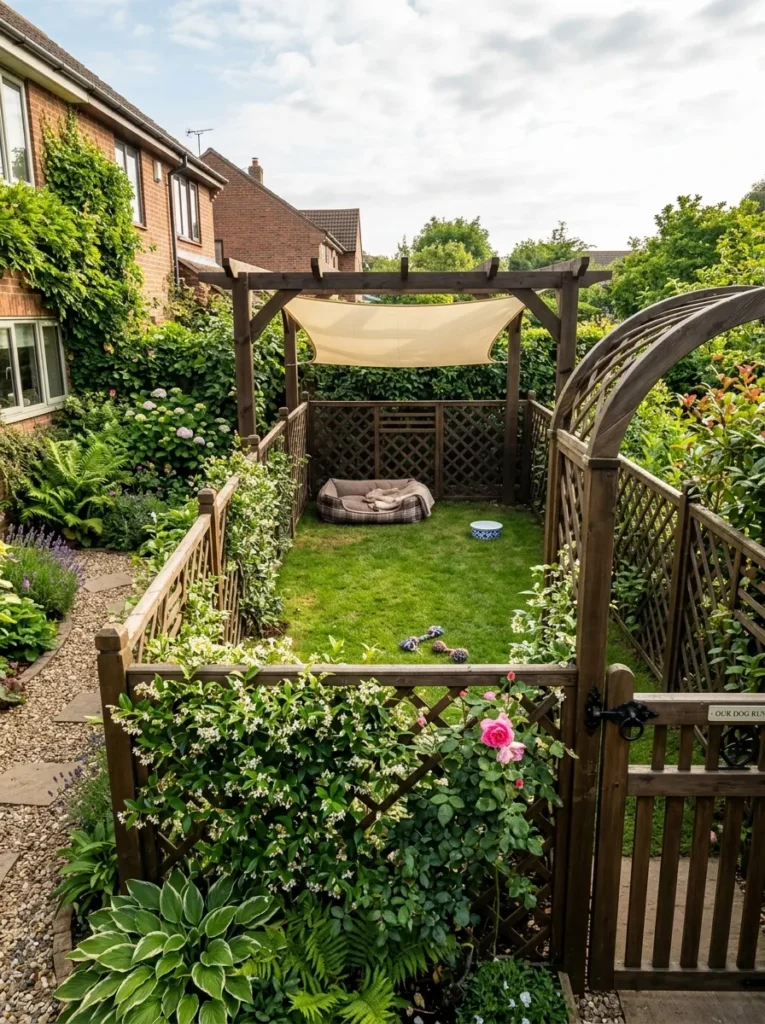
Vibe: Designed and purposeful — the dog run that reads as a garden feature rather than a pet enclosure.
Why it works: The decorative trellis-fenced dog run is the dedicated dog enclosure design that most effectively integrates the practical requirements of a dog-specific outdoor space (a secure, defined area with appropriate surface, shade, and shelter) with the aesthetic requirements of a considered garden. The trellis fence is the specific enclosure material that allows the dog run to be landscaped on its external faces while maintaining the secure, dog-proof structure within — climbing plants trained on the external trellis face completely cover the manufactured structure with living plant material, making the dog run read as a planted garden feature from outside while remaining a practical, easy-to-clean dog space within. This inside-outside material distinction — practical internal surfaces and aesthetically considered external faces — is the design principle that allows a dedicated dog enclosure to exist within a well-designed garden without dominating or conflicting with the garden’s visual quality.
How to get it: Build the trellis panels from treated pine or powder-coated steel trellis in standard 900mm × 1800mm panel sizes for cost efficiency. Install on a surface that is easy to clean — artificial grass (specifically products designed for pet use with good drainage capacity), pea gravel, or decomposed granite are all preferable to natural lawn within a confined dog area that receives concentrated use. Add a shade sail or timber shade structure at one end of the dog run — shade is a welfare requirement in any outdoor dog enclosure in a warm climate, and the shade structure also improves the visual quality of the enclosure by adding a designed overhead element.
Shop the Look
| Product |
|---|
| Timber trellis panel treated |
| Climbing rose established plant |
| Pet artificial grass drainage |
| Shade sail UV rated |
| Dog water bowl outdoor |
12. Invisible Dog Fence with Strategic Perimeter Planting
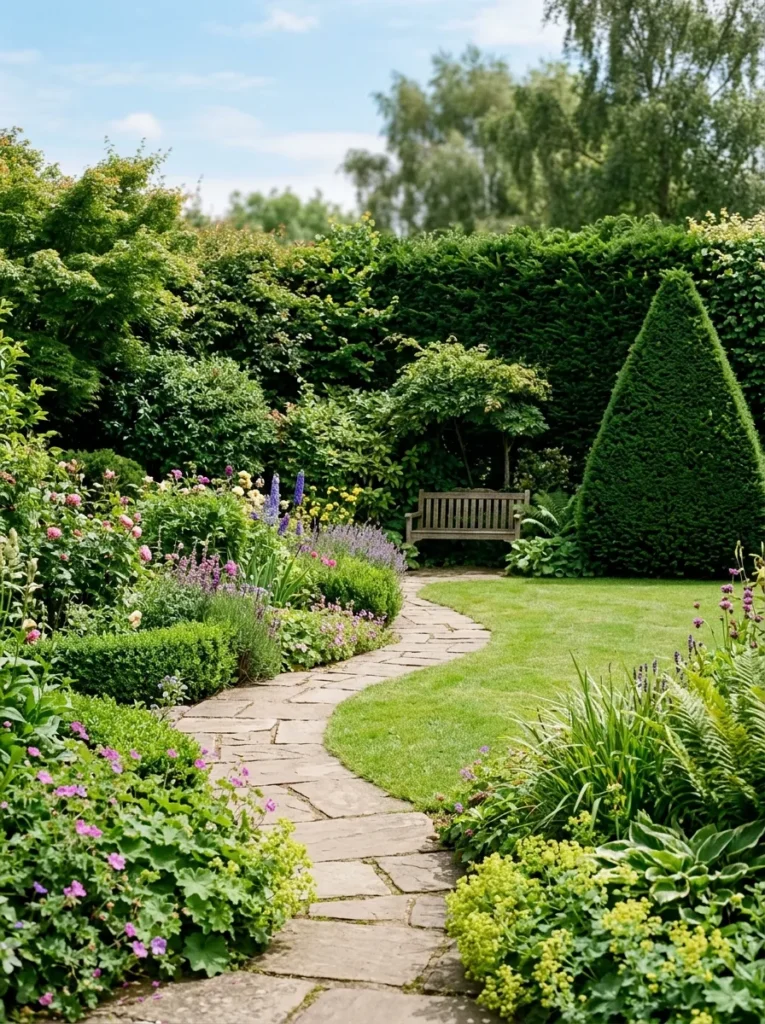
Vibe: Open and resolved — the dog-contained garden that looks as though the concept of fencing never occurred to its designer.
Why it works: The combination of an invisible electronic dog fence system with strategic perimeter planting is the containment approach that most completely achieves the unfenced garden aesthetic — a wireless or in-ground electronic fence system provides the dog’s containment boundary through a collar-based signal response system rather than a physical structure, while the strategic deep planting at the property perimeter provides the visual boundary that reads as a garden design decision rather than a safety provision. This approach is specifically appropriate for well-trained, responsive dogs whose containment is manageable through electronic fence training, and it produces a garden of genuinely exceptional visual quality because the absence of manufactured fencing allows the garden to read as a continuous designed landscape rather than a partitioned series of fenced areas.
How to get it: Source an in-ground or wireless electronic dog fence system from specialist pet containment suppliers — both PetSafe and SportDOG produce well-regarded residential containment systems suitable for most breeds and garden sizes. Plan the planting boundary to complement the electronic fence boundary: use deep planting zones (minimum 1.5 meters deep) at the property boundary in species that create visual density at dog eye level, providing a sensory deterrent that reinforces the electronic fence signal. Consult a professional dog trainer before installing an electronic fence — the training process for electronic fence containment is critical to the system’s effectiveness and the dog’s welfare, and professional guidance significantly improves both.
Shop the Look
| Product |
|---|
| In-ground electronic dog fence |
| Boundary planting native mix |
| Dense hedge planting pittosporum |
| Dog trainer consultation |
| Garden bench formal |
13. Decorative Metal Fence with Custom Pattern Panels
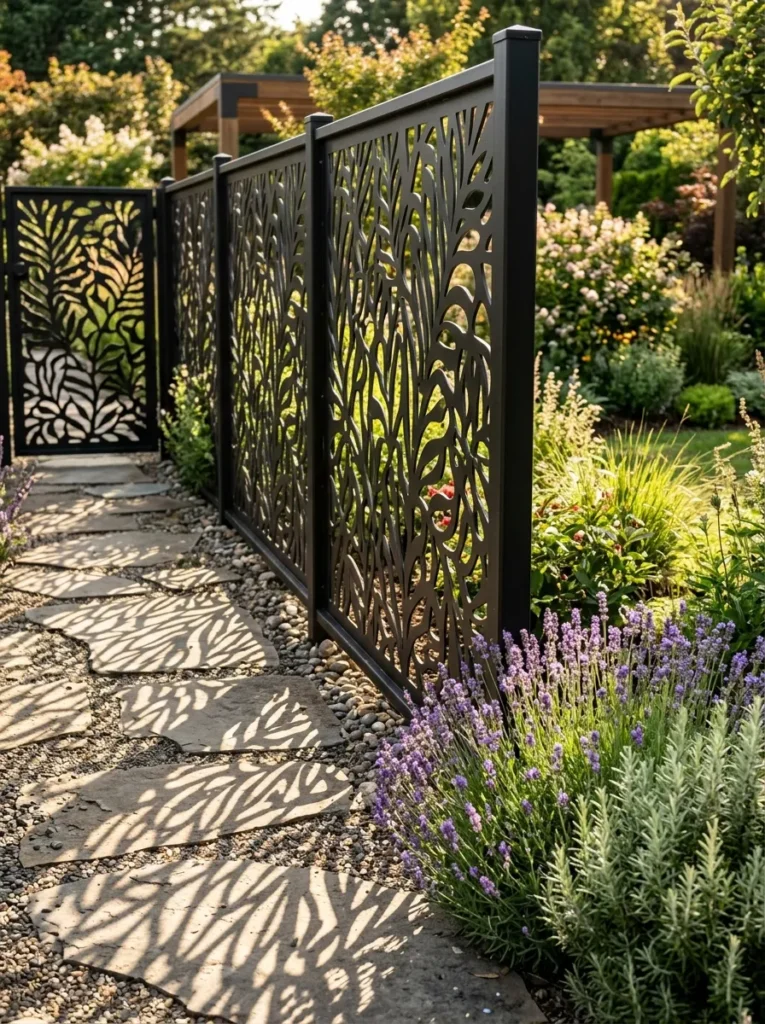
Vibe: Warm and decorative — the fence that casts a garden in a completely different light, literally.
Why it works: Laser-cut pattern metal fence panels are the dog containment solution that most powerfully demonstrates the compatibility of security requirements and design quality — by cutting a decorative botanical or geometric pattern through the fence panel, the fence simultaneously contains the dog, provides visual transparency through the pattern cutouts, and introduces a designed decorative element that contributes to the garden’s aesthetic quality. The shadow-casting quality of a laser-cut fence panel is its most distinctive design contribution: in direct sunlight, the cutout pattern projects a moving shadow across the adjacent garden path and planting, creating a dynamic decorative effect that no solid fence can produce. This shadow projection makes the fence a light installation as well as a structural boundary — its contribution to the garden changes through the day as the sun angle changes and the shadow pattern moves across the adjacent surfaces.
How to get it: Commission custom laser-cut fence panels from a local metal fabrication or CNC cutting workshop — the design file for the cutout pattern can be sourced from design marketplace sites (Creative Market, Etsy DXF files) or created custom by a graphic designer. Specify 3mm mild steel or 2mm aluminium for the panel material, powder-coated in matte black after cutting and deburring. The cutout pattern’s proportion is the critical design specification — the cutout area should be approximately 30–40% of the total panel area to provide sufficient transparency for light and air movement while maintaining the structural integrity of the panel.
Shop the Look
| Product |
|---|
| Laser cut steel fence panel custom |
| Powder coat black finish |
| Lavender plant at fence base |
| Rosemary plant established |
| Decorative gate matching pattern |
14. Dog-Safe Garden Room with Feature Fence Gate
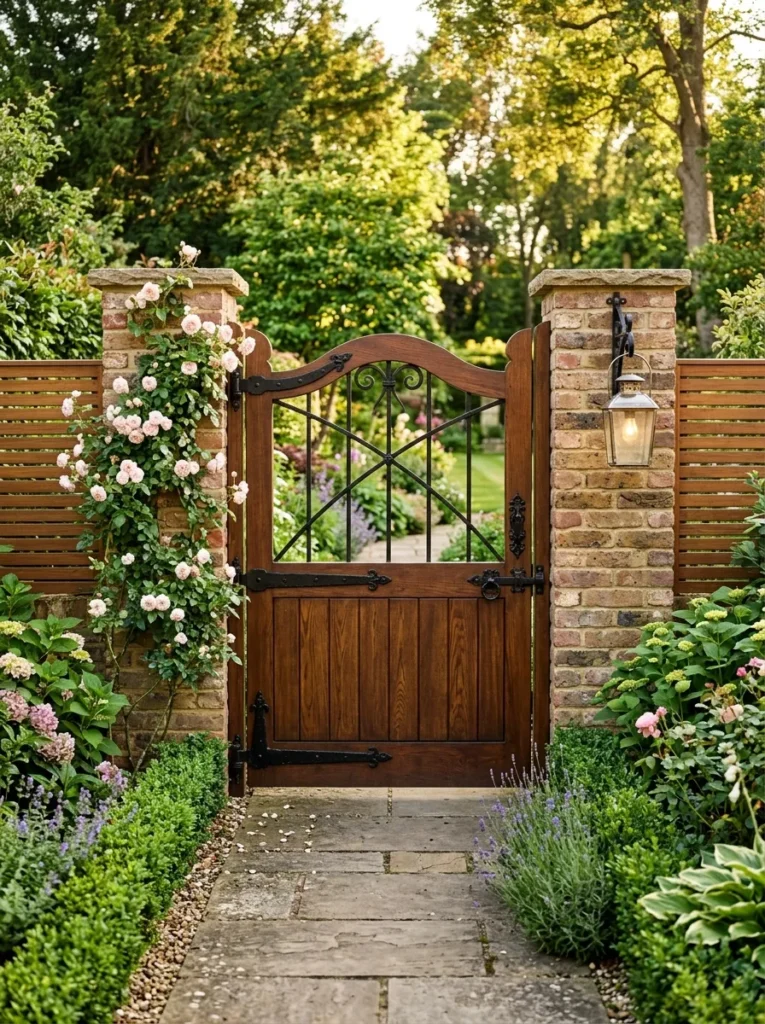
Vibe: Warm and inviting — the entrance to a dog-safe garden that makes the human arrivals feel as welcome as it makes the dog feel contained.
Why it works: The feature gate is the element of a dog fence system that most powerfully determines the overall aesthetic quality of the boundary — a well-designed gate transforms a length of functional fencing into a landscape composition with a genuine focal point, entrance experience, and design investment visible from the street or from within the garden. Most residential dog fences treat the gate as a functional element that matches the fence on either side; the feature gate approach inverts this logic and treats the gate as the primary design element, with the fence on either side serving as the supporting structure for the gate’s more significant presence. The rendered pillar columns that flank a feature gate — providing the structural anchors for the gate’s weight and the visual pedestals that give the entrance its sense of scale and permanence — are the landscape architecture detail that most elevates a residential gate from a functional to a designed element.
How to get it: Build the gate pillars from brick, rendered block, or poured concrete — the structural mass of the pillar is both practically necessary (a wide gate requires substantial structural anchorage to prevent sagging at the latch end) and aesthetically necessary (the pillar’s visual weight provides the gateway quality that makes the entrance read as a designed threshold rather than a gap in the fence). The gate itself can be sourced from specialist gate fabricators in timber or powder-coated steel — a feature gate in a decorative timber profile (arched top, decorative infill pattern) or a powder-coated steel gate with a laser-cut pattern coordinates with the other fence materials in this list.
Quick Win: Adding rendered pillar columns to an existing functional gate — building the columns around the existing post structure and rendering them in a matching warm white to the house — transforms the visual quality of an existing fence boundary at a material cost of $300–600 per pillar, producing a feature gate effect without replacing the existing gate or fence system.
Shop the Look
| Product |
|---|
| Feature gate timber decorative |
| Rendered pillar block system |
| Gate hardware heavy duty |
| Hanging pillar lantern |
| Climbing rose for pillar |
How to Start Your Dog Fence Transformation
Your single first move is to observe your dog’s specific containment behaviors for three days before selecting a fence type, height, or material — because the fence system that will work for your specific dog depends entirely on that dog’s specific attempts to escape or challenge a boundary, and selecting a fence without this behavioral information consistently results in a fence that fails to contain the dog regardless of its visual quality. A dog that digs needs a fence with a below-ground barrier (a concrete footer, a buried wire mesh apron, or a subsurface gravel layer that deters digging). A dog that climbs or jumps needs a fence whose height exceeds their measured jump capacity by at least 300mm, with an inward-leaning overhang if the jumping behavior is extreme. A dog that pushes or tests fence panels needs a fence whose panel rigidity and fixing strength exceed the force the dog can apply. A dog that fence-paces needs visual screening at eye level to reduce the external stimulus that drives the pacing behavior. None of these behavioral requirements can be selected from a catalog description — they require direct observation of the specific dog in question.
The most common dog fence design mistake is selecting a fence that looks beautiful but fails to contain the dog — resulting in an expensive and visually considered fence that requires supplementary improvised containment measures that undermine its aesthetic quality completely. The fence’s containment effectiveness is the non-negotiable starting point from which all aesthetic decisions follow: a beautiful fence that the dog escapes is a failed design regardless of its material quality or visual appeal. The correct design sequence is to establish the specific containment requirements first (height, below-ground barrier, panel rigidity, visual screening) and then identify the fence formats within this list that meet those requirements, selecting the most aesthetically appealing option from within the field of structurally appropriate choices.
Three specific investments under $200 that create immediate dog fence aesthetic improvement: (1) A planted border of lavender at 200mm centers along any existing fence base ($40–80 for a standard 10-meter run of lavender at 200mm spacing) immediately softens the fence’s visual presence and connects it to the garden’s plant world, regardless of the fence material. (2) A coat of black or deep forest green exterior paint ($25–45 for a standard timber fence run) applied to any existing timber fence immediately transforms its visual register from utilitarian to designed, as dark fence colors recede visually and read as architectural elements rather than construction materials. (3) A feature gate in a decorative profile ($150–400 from specialist gate suppliers) replaces an existing plain functional gate and creates the visual focal point that makes the entire fence boundary read as a considered design decision — the feature gate is the single highest-return investment available for improving the overall aesthetic quality of an existing dog fence system.
Realistically, a complete new dog fence installation — posts, panels, and a feature gate — in a quality material such as horizontal hardwood slat, black powder-coated steel rod, or cor-ten steel costs $200–500 per linear meter installed for a standard residential run. A budget-appropriate decorative timber picket fence costs $80–180 per linear meter. A living hedge boundary — the most cost-effective beautiful dog fence over a 5-10 year period — costs $15–35 per linear meter in plants plus the cost of a temporary fence during establishment. Most homeowners begin with the most critical boundary section (the street-facing front boundary or the boundary adjacent to the most-used outdoor area) and install the higher-quality material in this section while using a more standard material for the less-visible side and rear boundaries, allocating the budget to produce the maximum visual impact where it is most observed.
Frequently Asked Questions About Dog Fence Design
What is the minimum fence height for dog containment?
The minimum fence height for dog containment depends on the dog’s size, breed, and jumping ability rather than a universal standard. Small breeds (under 10kg) are typically contained by 900mm–1000mm fence height. Medium breeds (10–25kg) require 1200mm in most cases. Large breeds (25kg+) require 1500mm–1800mm depending on the individual dog’s athletic ability — some large athletic breeds (Labrador Retrievers, Border Collies, German Shepherds) have been documented clearing 1800mm fences. The individual dog’s tested jump height is the most reliable guide — observe the dog’s maximum jump height at its most excited state (typically during play or when distracted by a trigger on the other side of the fence) and specify the fence height at 300mm above this observed maximum. Inward-leaning fence overhangs (a 300mm section of the fence top angled inward at 45 degrees) add an effective jump deterrent for dogs that approach the maximum capacity of a straight-sided fence.
What fence materials are safest for dogs?
The safest fence materials for dogs are those without sharp edges, protrusions, or gaps at a scale that allows a dog to trap a paw, jaw, or neck. Smooth-profile materials — powder-coated steel rod, smooth-faced timber slats, rendered masonry — are inherently safer than chain-link (which allows claw entanglement), barbed wire (which is dangerous and inappropriate for residential dog containment), or timber with rough-sawn or splintering faces (which cause skin injuries during fence contact). The spacing between fence elements is the primary safety specification — gaps between fence elements should be either small enough to prevent nose-through contact entirely (less than 60mm for most dogs) or large enough that any body part that enters the gap can be extracted without force (greater than 250mm). Gaps in the 60–250mm range are the most dangerous, as they allow a dog to push a paw, jaw, or neck through but may not allow easy extraction.
How do I stop my dog from digging under the fence?
Preventing digging under a fence requires either a physical below-ground barrier or a behavioral deterrent at the fence base. The most effective physical barrier is a concrete footer extending 300mm below ground level along the full fence run — this provides a completely impenetrable below-ground barrier that no dog can excavate through. Where a concrete footer is impractical (in established gardens where excavation would damage root systems), a buried wire mesh apron (600mm wide galvanized wire mesh laid horizontally at 150mm depth, extending from the fence base outward toward the garden interior) provides an effective deterrent — dogs encounter the mesh immediately below the surface and, finding it impenetrable, abandon the digging behavior within 2–3 attempts. At the garden surface, a dense planting of thorny or aromatic plants (rosemary, lavender, or pyracantha) at the fence base discourages digging behavior by making the approach to the fence base uncomfortable.
Can I use a dog fence to create zones within my yard?
Yes — internal zoning using dog fence elements is one of the most sophisticated and most valuable applications of dog fence design in a residential garden. The most common internal zoning arrangement is the garden room divider that creates a defined dog zone within a larger garden, allowing the dog’s active area (lawn, play space) to be separated from the garden’s sensitive planting areas (formal garden beds, vegetable gardens, water features). An internal divider fence at 1000–1200mm height, using a visually lightweight material such as the horizontal slat, black rod, or trellis formats described in this list, creates defined zones while maintaining the visual continuity of the garden across the zonal boundary. Internal zone fences are typically specified at a lower height than perimeter boundaries because they only need to contain the dog within a defined garden zone rather than prevent escape from the property.
What is the most low-maintenance dog fence option?
The most genuinely low-maintenance dog fence options in order of decreasing maintenance requirement are: cor-ten steel (requires zero maintenance after the patina stabilizes — no painting, no sealing, no replacement), rendered masonry (requires re-painting or re-rendering every 10–15 years), powder-coated steel rod (requires no maintenance beyond occasional cleaning), aluminium (requires no maintenance and does not rust), and living hedge (requires clipping twice yearly for containment density maintenance). Timber fence systems require the most ongoing maintenance — staining or painting every 3–5 years for treated pine, every 5–7 years for hardwood or cedar — and have the shortest lifespan of all manufactured fence materials in most climates. If maintenance minimization is the primary criterion, a cor-ten steel or powder-coated aluminium fence provides the best combination of aesthetic quality and maintenance-free performance.
Ready to Build Your Beautiful Dog-Friendly Yard?
These 14 ideas span the full range of what a dog fence can be — from a transparent glass panel that makes a pool garden look as though containment was never a concern, and a laser-cut metal panel that casts a botanical shadow across the garden path, to a living hedge that makes the fence boundary indistinguishable from the garden itself and a feature gate that transforms a standard fence line into the most considered entrance in the street — so whether you are working with a compact urban courtyard or a generous suburban backyard, a small terrier or a large athletic breed, a budget of $500 or a budget of $15,000, there is a genuinely achievable, genuinely beautiful dog fence approach here for your specific yard, your specific dog, and your specific landscape design aspirations. The transformation begins with the behavioral audit — the three days of observation that tells you exactly what your dog does at the fence line and therefore exactly what your fence needs to do — and continues with the landscape design decision that makes the fence’s material, height, and placement serve the garden’s visual quality as much as the dog’s safety requirements. Today’s specific action: walk the full perimeter of your yard and photograph every section where an existing fence is visually inadequate, structurally failing, or aesthetically inconsistent with the garden it defines. Those photographs are the design brief that every idea in this list responds to — they identify exactly where the investment will produce the most visible and most lasting improvement. Save the fence ideas that matched your specific dog’s containment requirements and your specific garden’s material palette — those are the ones that will actually be built, and that will make your yard genuinely better for both the dog and every human who spends time in it.