Outdoor dog pen designs with style and comfort move well beyond the chain-link cage and the mud-filled rectangle toward thoughtfully designed outdoor enclosures that provide safe containment, genuine physical comfort, behavioral enrichment, weather protection, and an aesthetic quality that reads as an intentional landscape feature rather than an industrial afterthought. This article gives you exactly 15 ideas spanning permanent built structures, modular panel systems, garden-integrated enclosures, planted runs, covered designs, and small-space solutions so every yard size, every breed, every budget, and every home aesthetic finds an outdoor pen design that genuinely serves both the dog and the property.
An outdoor dog pen done well provides what a yard alone cannot — a safely contained outdoor environment where a dog can experience natural light, fresh air, grass underfoot, and the full sensory richness of the outdoor world without the risks of uncontrolled access: traffic, escape, conflict with other animals, ingestion of toxic plants or substances, and the liability and welfare consequences that unmanaged outdoor access creates. Here are 15 designs worth building.
Why Outdoor Dog Pen Designs with Style and Comfort Work So Well
The behavioral case for outdoor dog pen access is well-established and specific: dogs denied outdoor access show consistently higher rates of the stress-related behaviors — repetitive pacing, destructive chewing, excessive vocalization, house soiling — that are among the most common reasons dogs are surrendered to shelters. The outdoor environment provides the olfactory, visual, auditory, and tactile stimulation that indoor environments cannot replicate: the continuously changing scent environment of a garden (every passing animal, every rain event, every plant growth phase changes the olfactory landscape), the proprioceptive and cardiovascular engagement of varied terrain, and the thermoregulatory benefit of natural temperature variation and direct sunlight exposure. These welfare benefits are not equivalent to a daily walked — outdoor pen access provides a different category of experience (self-directed, continuous, exploratory) that complement but do not replace human-directed exercise.
The design challenge of an outdoor dog pen is specifically different from a standard garden design challenge because the primary user has requirements that human garden design typically ignores: durable, chew-resistant, weather-resistant material surfaces at nose and paw level; shade provision sized to allow the full recumbent body to be out of direct sun at any time of day; drainage that prevents the accumulation of standing water that becomes a hygiene and health problem; substrate choices that balance comfort (grass, rubber, soft ground cover), hygiene (easy cleaning, low mud retention), and behavioral appropriateness (dogs digging, scratching, and rolling are natural behaviors that substrate choice either facilitates or resists); and a visual barrier management that balances the dog’s welfare (some visual access to the exterior environment prevents barrier frustration and redirected aggression) with the household’s management preferences (some visual screening reduces fence-running behavior in reactive dogs).
The style and comfort dimensions of the 15 designs in this list address both the functional welfare requirements above and the landscape design requirement that an outdoor dog pen reading as a beautiful, considered garden feature rather than an imposed utilitarian structure. This aesthetic ambition is not merely cosmetic — a dog pen that the household finds visually acceptable is more likely to be maintained well, more likely to receive ongoing investment in enrichment and comfort, and more likely to be positioned and sized appropriately rather than hidden in the most awkward corner of the property.
Style at a Glance
| Element | Welfare Function | Design Style Edge |
|---|---|---|
| Philosophy | Safe containment plus genuine outdoor enrichment | The pen should look designed, not installed |
| Materials | Cedar, powder-coat steel, natural stone, rubber | Living hedge, pergola, landscape integration |
| Key Elements | Shade, drainage, substrate, enrichment, gate |
15 Outdoor Dog Pen Designs with Style and Comfort
1. Cedar and Steel Panel Garden Pen with Planted Border
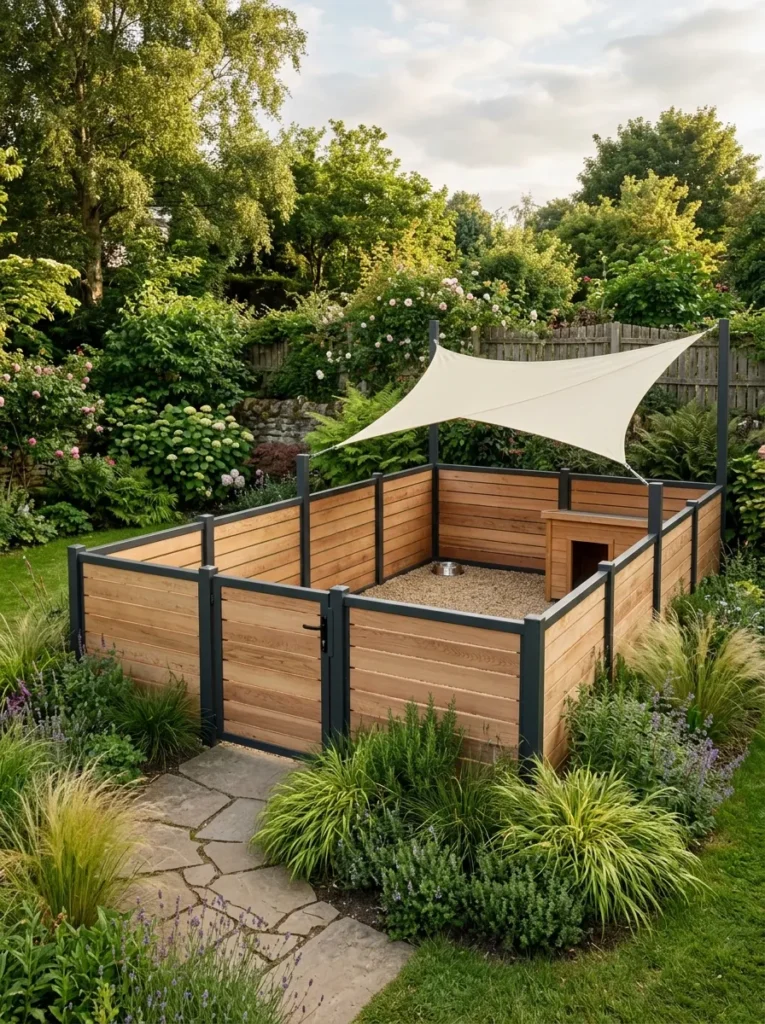
Vibe: The cedar and steel pen feels like a garden room that a dog happens to live in — the planted border and the horizontal cedar boards reading as landscape architecture rather than pet containment.
Why it works: Cedar horizontal board panels between dark steel posts apply the architectural garden boundary principle — the horizontal board orientation references contemporary residential fencing design, the cedar’s natural warm tone coordinates with garden plantings and natural materials, and the steel posts’ dark color recedes visually against the garden. The 15mm gap between boards provides the partial visual connection that reduces barrier frustration in most dogs while preventing full visual access that triggers fence-running in reactive breeds. The planted border on the exterior perimeter is the design decision that most effectively integrates the pen into the garden — it blurs the boundary between “pen” and “garden” by placing the same planting language on both sides of the fence.
Substrate recommendation: Inside, specify a combination of artificial turf (for comfort and hygiene management) over a compacted gravel drainage base, with a pea gravel section in one corner for the natural digging behavior many dogs exhibit.
Budget: Materials for a 4×6m pen: $1,500–3,500. Professional build: $3,000–6,000.
Quick Win: A planted border of ornamental grasses (Miscanthus, Pennisetum, or Carex) along the exterior face of an existing pen fence costs $80–200 in plants and transforms the pen’s appearance from institutional to garden-integrated within one growing season.
Shop The Look
| Product |
|---|
| Cedar horizontal board fence panel |
| Dark powder-coat steel post set |
| Self-latching gate cedar steel |
| Ornamental grass border planting |
| Shade sail cream 3x4m |
Also view: 14 Modern Dog Fence Ideas with Easy Access Gates
2. Pergola-Covered Dog Pen with Climbing Plants
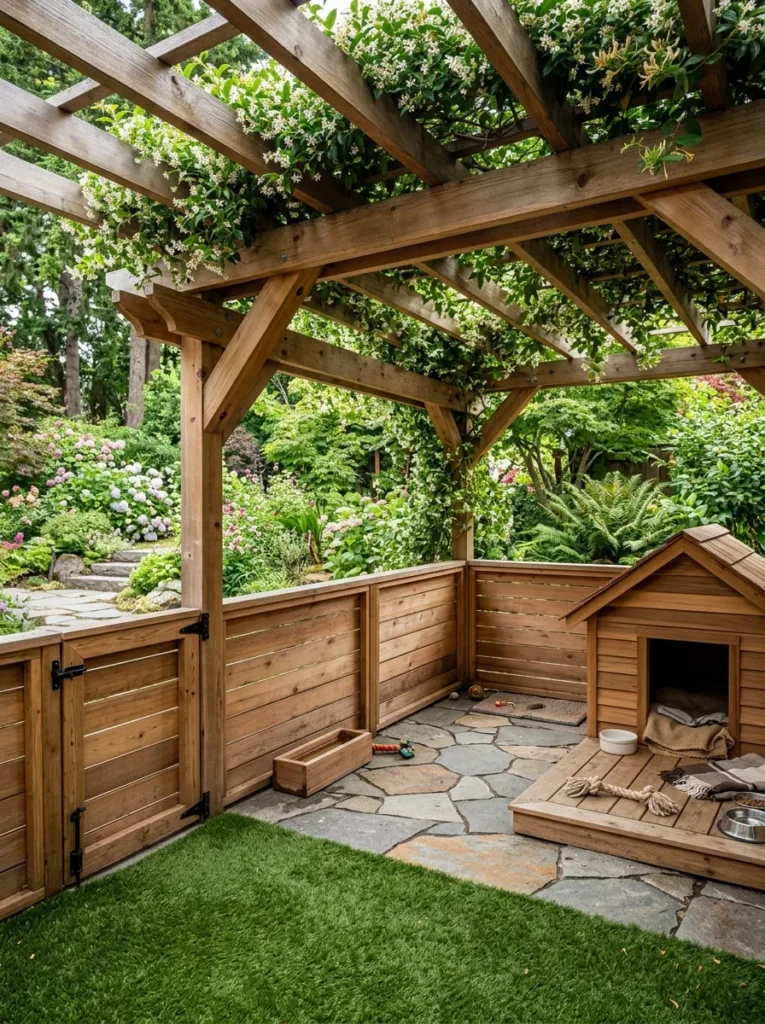
Vibe: The pergola pen feels like a garden pavilion designed for a species that deserves a garden pavilion — the climbing plant canopy and the dappled light creating an outdoor room that the dog can genuinely inhabit rather than merely occupy.
Why it works: A pergola overhead structure for a dog pen applies the outdoor room principle — a pen with a pergola overhead is not merely an enclosed outdoor space but a genuinely designed outdoor room, with the pergola providing shade, visual enclosure, and the specific quality of dappled light through plant material that distinguishes a designed garden feature from a utility structure. The climbing plants on the pergola beams serve multiple functions simultaneously: they provide additional shade (as they fill in over one to three growing seasons), they contribute fragrance to the pen’s environment, they provide visual screening of the overhead structure that reduces the exposed, institutional quality of a bare wire or metal roof, and they create a visual connection between the pen and the surrounding garden.
Plant selection: Jasmine (non-toxic to dogs, fragrant, fast-growing), honeysuckle (non-toxic, attractive to beneficial insects, beautiful in bloom), and climbing roses (non-toxic, but thorned — position growth away from dog’s reach level). Avoid: wisteria (mildly toxic), sweet peas (toxic), and morning glory (toxic).
Budget: Materials for a 3×4m pergola pen: $2,000–4,500. Professional build: $4,000–8,000.
Shop The Look
| Product |
|---|
| Cedar pergola kit 3x4m |
| Climbing jasmine non-toxic |
| Cedar dog house weatherproof |
| Raised platform cedar dog comfort |
| Artificial turf pet grade drain |
3. Small Space Balcony or Patio Dog Pen
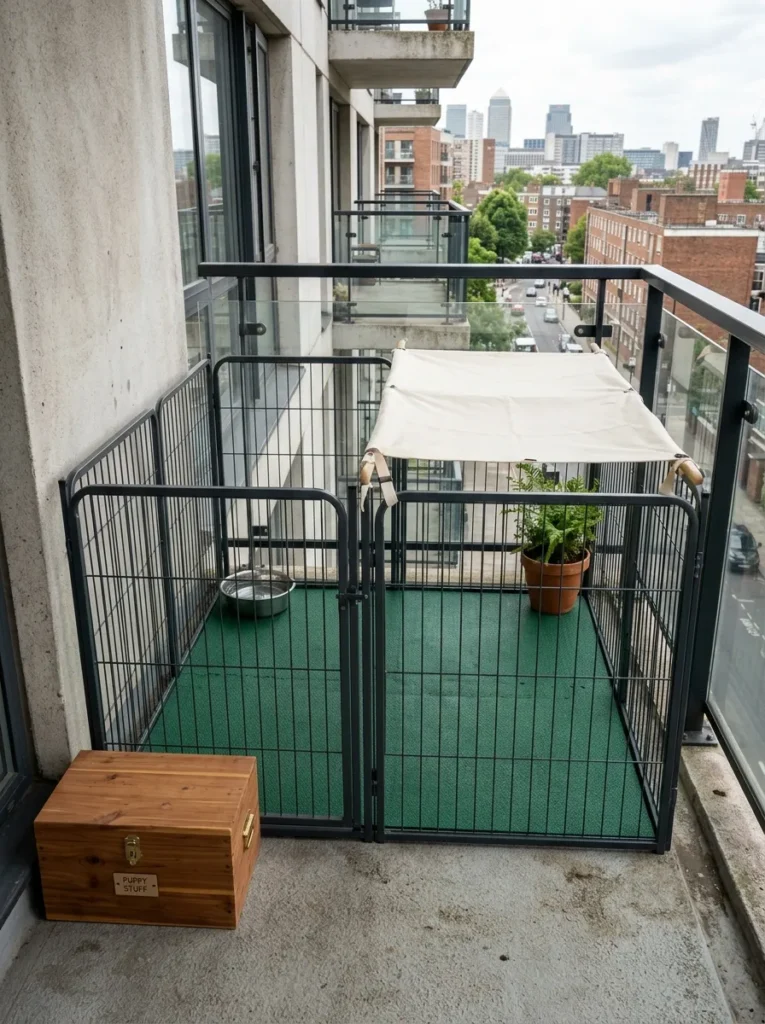
Vibe: The patio pen feels like a considered urban solution for a dog’s outdoor access needs — compact, clean, and appropriate to a context where a large enclosed garden is not available.
Why it works: A small modular panel pen on a balcony or patio applies the minimum viable outdoor access principle — for urban apartment and townhouse dogs without garden access, a properly specified patio or balcony pen provides the outdoor sensory experience (fresh air, natural light, varied acoustic environment, temperature variation) that indoor environments cannot replicate, within the physical constraints of an urban outdoor space. The rubber mat flooring is the most important single comfort specification for a concrete-floored pen — concrete is hard, cold, and abrasive to dog pads over time, and a 20–25mm thick rubber mat (ideally an interlocking rubber tile system for drainage between tiles) transforms the comfort and safety of the pen’s primary surface. The modular steel panels allow the pen to be reconfigured or relocated when the household moves.
Safety note for balconies: All balcony pens must have panels that prevent the dog from reaching or falling through balcony railings. Check the balcony’s load capacity (a wet dog plus a rubber mat plus a water bowl and dog house adds significant static load) before installation.
Budget: Materials for a 2×2m patio pen: $400–900.
Shop The Look
| Product |
|---|
| Modular steel panel set 90cm dark |
| Interlocking rubber tile green set |
| Folding shade canopy compact |
| Stainless steel water bowl large |
| Cedar storage box outdoor supply |
4. Natural Stone and Timber Pen with Garden Integration
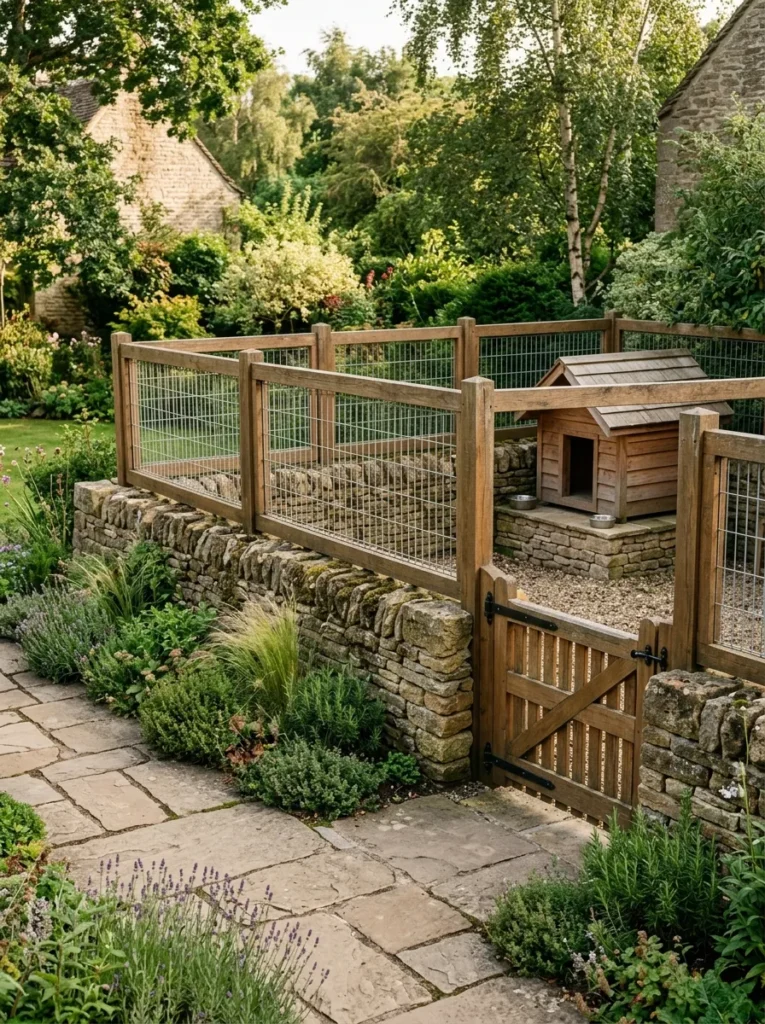
Vibe: The stone and timber pen feels like it was designed by the same landscaper who designed the rest of the garden — the stone base appearing as a garden feature wall that happens to contain a dog run above it.
Why it works: A natural stone and timber pen applies the material continuity principle — when a dog pen is constructed using the same materials as the surrounding garden features (stone walls, timber structure, wire mesh rather than solid panels), it reads as a designed extension of the garden rather than an introduced containment structure. The stone base (60cm) is particularly effective at achieving this integration because it matches the height and material of typical garden retaining walls, raised beds, and boundary elements — from a normal garden viewing distance, the pen’s stone base is indistinguishable from these features, with the dog containment function only apparent at close range.
Drainage: A stone-based pen should have a drainage inspection — the stone’s interior base must be designed to slope toward a central or corner drain point, with the pen’s floor substrate (compacted gravel topped with pea gravel or artificial turf) appropriately graded for run-off.
Budget: Materials for a 4×6m stone and timber pen: $3,000–7,000 depending on stone type. Professional build: $6,000–15,000.
Shop The Look
| Product |
|---|
| Natural stone wall construction |
| Horizontal timber rail set |
| Welded wire mesh upper section |
| Native drought-resistant plant set |
| Flagstone path material |
5. Shade Structure Dog Pen with Artificial Turf
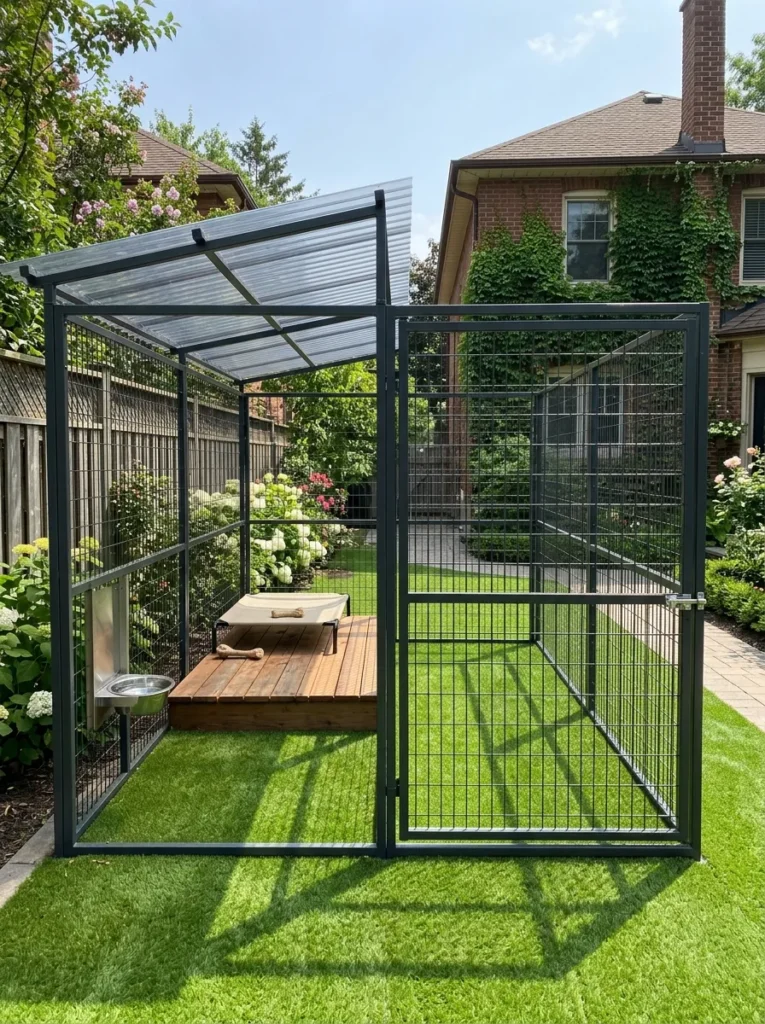
Vibe: The shade structure pen feels like an outdoor room where the dog can choose their own microclimate — the half-covered design providing the sun-seeking and shade-seeking options that thermoregulation requires.
Why it works: A half-covered shade structure pen applies the thermoregulatory choice design principle — providing both shaded and sun-exposed areas within the same pen allows the dog to self-regulate its body temperature throughout the day, moving between the warmer sun zone and the cooler shaded zone as its thermal needs change. This choice is a genuine welfare provision: a pen that is entirely exposed to summer sun can reach dangerous temperatures, and a pen that is entirely covered loses the thermoregulatory, vitamin D synthesis, and psychological benefits of direct sunlight. The half-and-half coverage ratio provides optimal thermoregulatory choice for most climates — adjust the ratio toward more shade coverage in hotter climates and less in cooler ones.
Roof specification: Twin-wall polycarbonate (10mm minimum) provides the best combination of light transmission (the shaded area receives diffused light rather than darkness) and thermal insulation (preventing the greenhouse effect that single-layer polycarbonate creates in summer). Corrugated metal provides better durability but reduces diffused light quality.
Budget: Materials for a 4×5m half-covered pen: $2,000–4,500. Professional build: $4,000–8,000.
Shop The Look
| Product |
|---|
| Twin-wall polycarbonate roof panel |
| Pet-grade artificial turf drainage |
| Raised cedar sleeping platform |
| Stainless water station outdoor |
| Steel frame pen construction |
6. Dog Run with Agility Elements
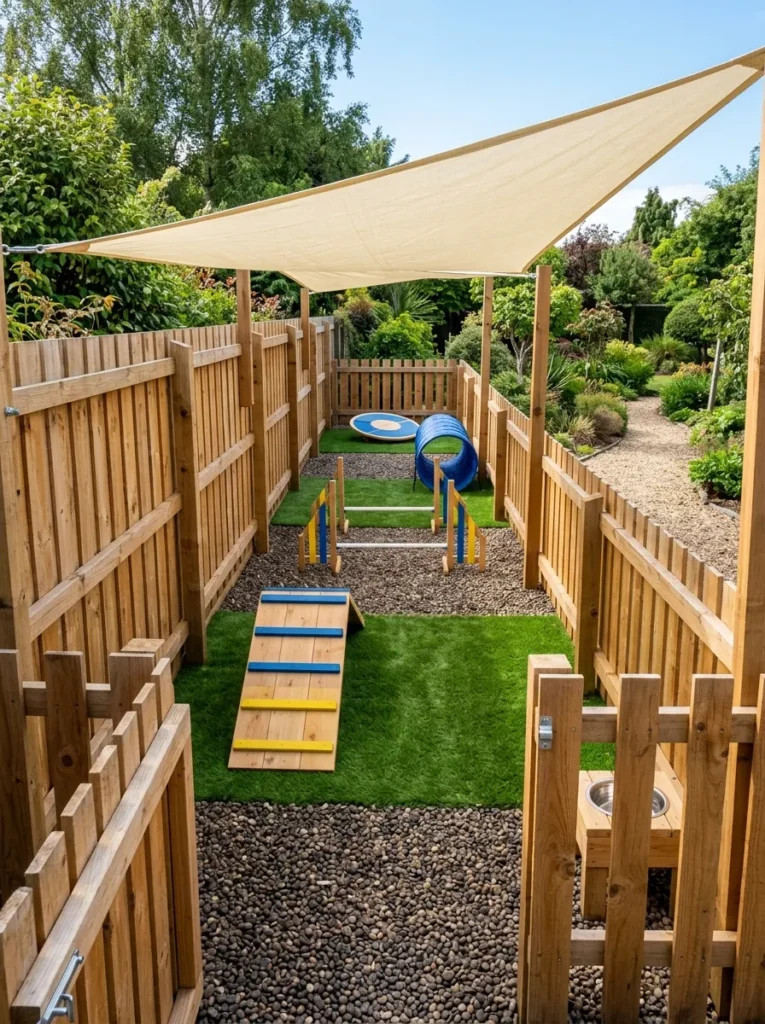
Vibe: The agility run feels like outdoor enrichment designed with actual understanding of what dogs need from outdoor time — the agility elements converting passive containment into active physical and mental engagement.
Why it works: A dog run with agility elements applies the enrichment density principle — a plain pen with space to pace provides physical containment but limited behavioral enrichment; an equivalent space equipped with even simple agility elements (an A-frame, a tunnel, low hurdles, a wobble board) converts the space from containment to enrichment, providing the problem-solving, proprioceptive challenge, and physical engagement that reduces the anxiety and frustration-based behaviors that characterize under-stimulated confined dogs. Simple agility elements are significantly more affordable than most dog owners assume — a basic A-frame and tunnel set costs $80–150 from dog sport equipment suppliers and provides years of behavioral value at a fraction of the welfare cost of a dog that is developing stress behaviors from boredom.
Substrate design: The combination of artificial turf at each agility element’s approach and landing zones and pea gravel between elements is the most durable and most hygienic substrate for a dog run. The turf provides comfort and grip at the most-used positions; the pea gravel drains and stays relatively clean between uses.
Budget: Materials for a 2×8m agility run: $1,200–2,500. Agility equipment: $200–600.
Shop The Look
| Product |
|---|
| Dog agility A-frame small |
| Dog agility tunnel standard |
| Low hurdle set two dog agility |
| Balance wobble board dog |
| Pea gravel run substrate bag |
7. Rustic Farmhouse Style Pen with White Picket and Post
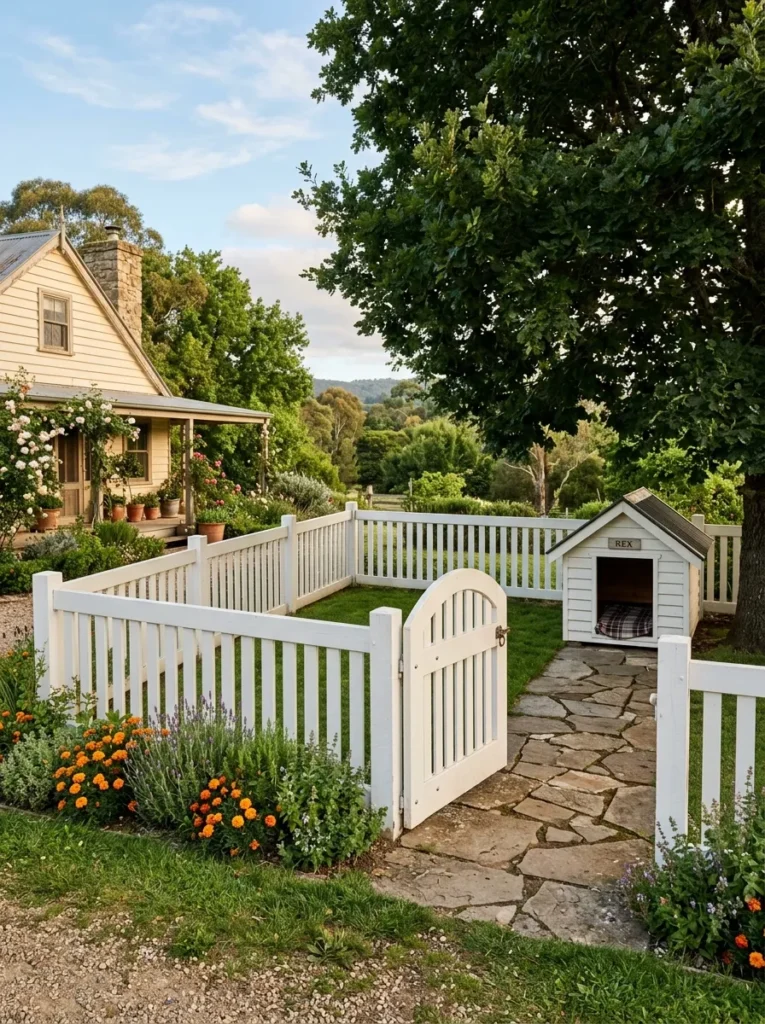
Vibe: The farmhouse pen feels like something that has always belonged beside a country house — the white picket referencing the longest-standing American domestic garden boundary tradition.
Why it works: A white picket and post farmhouse-style pen applies the architectural heritage principle — the picket fence is the most culturally legible domestic garden boundary in North American design history, and a dog pen constructed in white-painted picket reads as an intentional garden feature rather than a containment installation. The classic arch-top gate is the specific detail that elevates the farmhouse pen beyond a plain picket-fenced rectangle — the arch communicates an investment in the gate’s aesthetic quality that references the architecture of the home behind it. Natural lawn inside the pen is the most comfortable and most thermally appropriate interior substrate for a country or suburban property — it requires maintenance (mowing, patching, weed control) but provides the most comfortable, cool, and behaviorally appropriate surface for a dog.
Lawn maintenance in a pen: A natural lawn inside a dog pen requires a rotation approach for high-use areas — divide the pen into two halves and alternate access between them, allowing the rested half to recover while the dog uses the other.
Budget: Materials for a 4×5m farmhouse pen: $800–1,800. Professional build: $2,000–4,000.
Shop The Look
| Product |
|---|
| White-painted timber post set |
| Picket fence panel white set |
| Arch-top gate white timber |
| Marigold border planting |
| Lavender border planting |
8. Contemporary Black Steel Pen with Gravel Garden
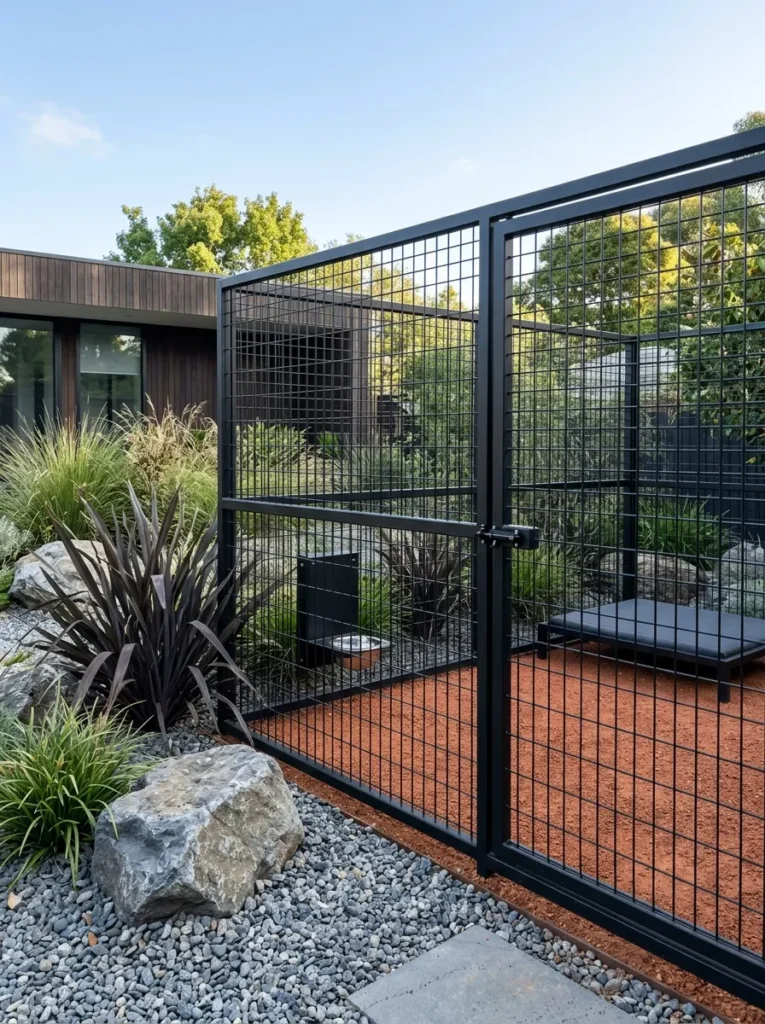
Vibe: The contemporary black steel pen feels like a landscape architecture specification — every element chosen for its contribution to a coherent dark and natural material aesthetic that reads as genuinely designed.
Why it works: A contemporary black steel pen integrated into a gravel and rock garden applies the material family coherence principle — by specifying matte black steel for the pen structure, black for all hardware and accessories within the pen, terracotta decomposed granite for the pen floor, and choosing the specific planting palette (Phormium, structural ornamental grasses, ornamental boulders) that coordinates with the black and terracotta material family, the pen becomes a designed element within the contemporary garden aesthetic rather than a structure that the garden must accommodate. Decomposed granite as an interior substrate provides excellent drainage, moderate comfort, does not retain moisture (reducing bacterial and parasite load compared to soil or clay), and is easily raked and refreshed. Its terracotta color also provides warmth against the black steel structure.
Drainage: A decomposed granite pen floor requires a 100mm depth of compacted base material (road base or Class II aggregate) beneath the DG for structural stability, with a perimeter drain or central drain point for water management.
Budget: Materials for a 3×5m black steel pen: $1,800–3,500. Professional build: $3,500–7,000.
Shop The Look
| Product |
|---|
| Powder-coat black steel frame set |
| Black welded wire mesh panel |
| Decomposed granite terracotta tone |
| Phormium structural plant |
| Black steel water station outdoor |
9. Dog Pen with Dedicated Splash Pad or Wading Pool Area
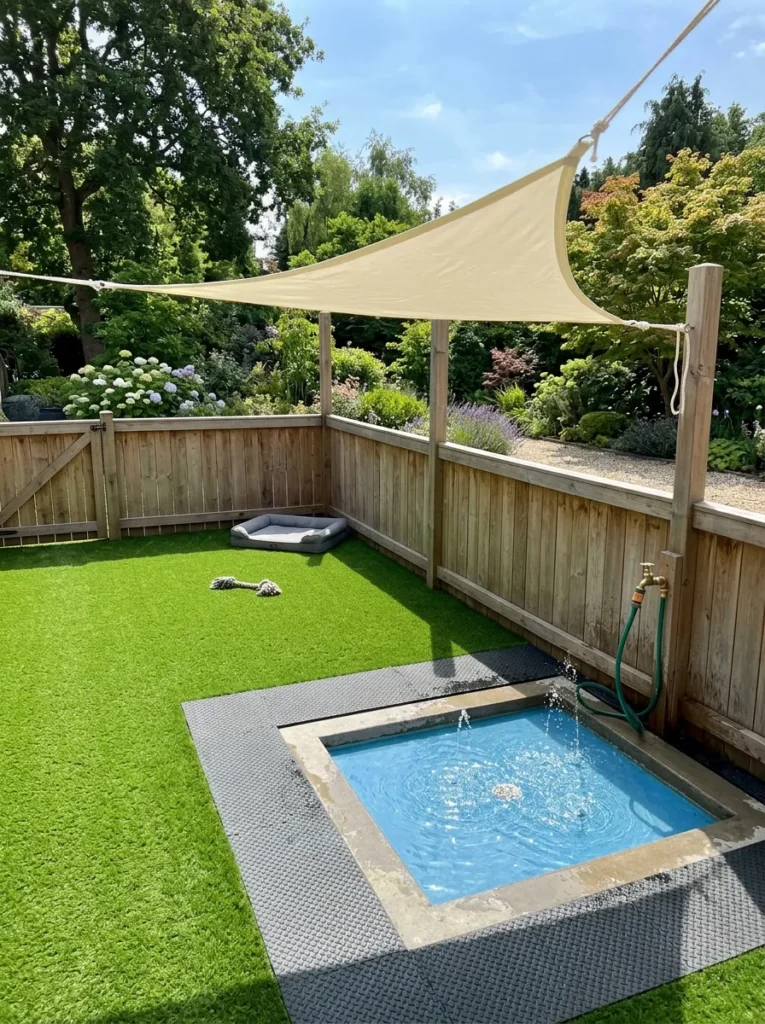
Vibe: The splash pad pen feels like a summer park designed at dog scale — the water zone providing the thermoregulation and play opportunity that makes the pen genuinely enriching rather than merely adequate in summer.
Why it works: A dog pen with an integrated splash pad or shallow wading pool area applies the thermal environment management principle — for dogs in hot climate zones or during summer months, an outdoor pen without any water feature becomes thermally hostile within hours of peak sunlight, creating the dangerous conditions (heat stress, heat stroke) that outdoor pen access is supposed to avoid. A shallow splash pad or wading pool provides the active thermoregulation option that shade alone cannot — a dog that can stand in cool water, splash, and voluntarily wet its coat can actively reduce its body temperature rather than relying entirely on passive shade. The water zone is designed as a contained corner section (not the whole pen floor) so that dogs that do not like water are not forced to navigate wet surfaces.
Concrete splash pad construction: A 150mm thick concrete pad in the pen corner, sloped 2% toward a central drain connected to the pen’s general drainage, provides a permanent, easy-to-clean shallow water area. A simple tap and hose connection at the pad allows daily fresh water fill and easy drain-and-refill management.
Budget: Splash pad addition to an existing or new pen: $300–800 (concrete) or $100–300 (hard-sided pool). Full pen with splash pad: $2,500–5,500.
Shop The Look
| Product |
|---|
| Shallow hard-sided wading pool dog |
| Rubber anti-slip mat splash zone |
| Outdoor tap hose connection |
| Shade sail water zone overhead |
| Concrete splash pad installation |
10. Under-Deck Dog Pen Conversion
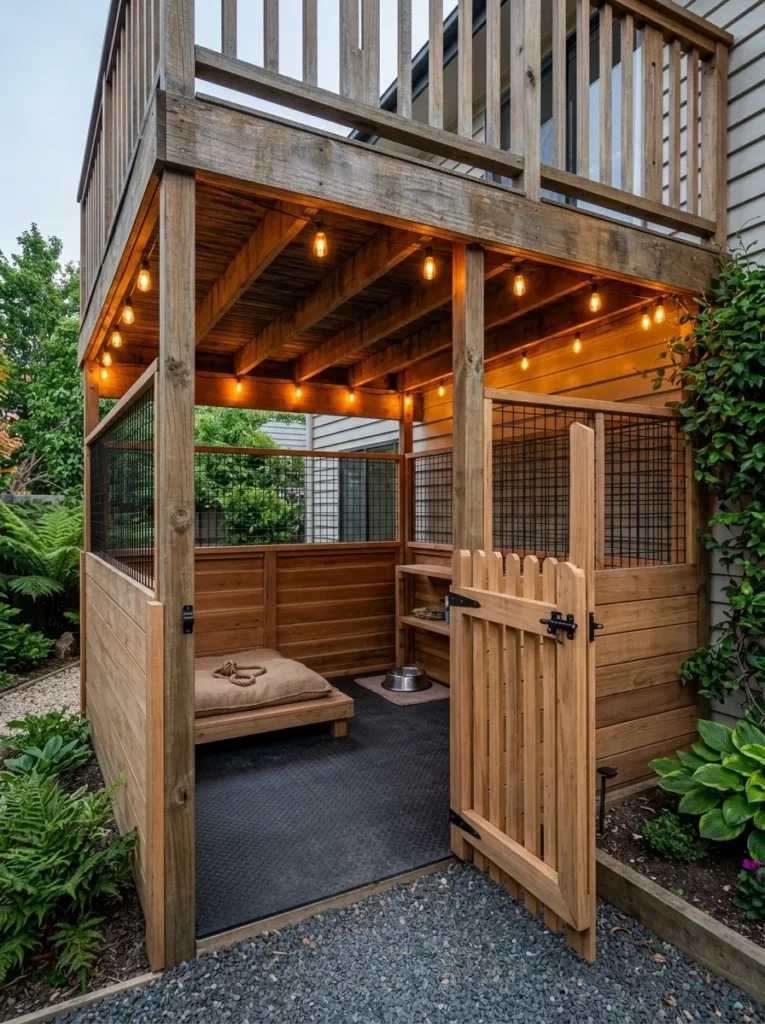
Vibe: The under-deck pen feels like the most elegantly resourceful use of existing infrastructure — the deck that was providing unused dead space above now providing permanent weatherproof shelter for the pen below.
Why it works: An under-deck dog pen conversion applies the existing shelter principle — the deck above provides a complete, permanent weatherproof ceiling that no separate shade structure or roof addition can replicate: it shields from rain, provides consistent shade, and shelters from wind on the sides where the deck’s structural elements provide natural screening. This makes the under-deck position the most sheltered and most thermally moderate location in many properties — warmer in winter (protected from wind and frost) and cooler in summer (permanent shade without solar gain) than any purpose-built covered pen structure achieves. The conversion work (enclosing the three open sides with fencing and adding the decorative gate) is significantly less construction effort than building a new pen from scratch.
The festoon lights: String festoon lights along the underside of the deck above the pen add a practical evening light source (allowing the pen to be used safely after dark) while creating the specific warm ambient quality that converts utility space to habitable space.
Budget: Conversion of existing under-deck space: $600–1,800. Professional conversion: $1,500–4,000.
Shop The Look
| Product |
|---|
| Horizontal timber fence panel under |
| Wire mesh deck underside gap |
| Decorative gate timber matching |
| Rubber mat under-deck floor |
| Festoon light warm amber outdoor |
11. Living Fence Dog Pen — Hedge and Wire Hybrid
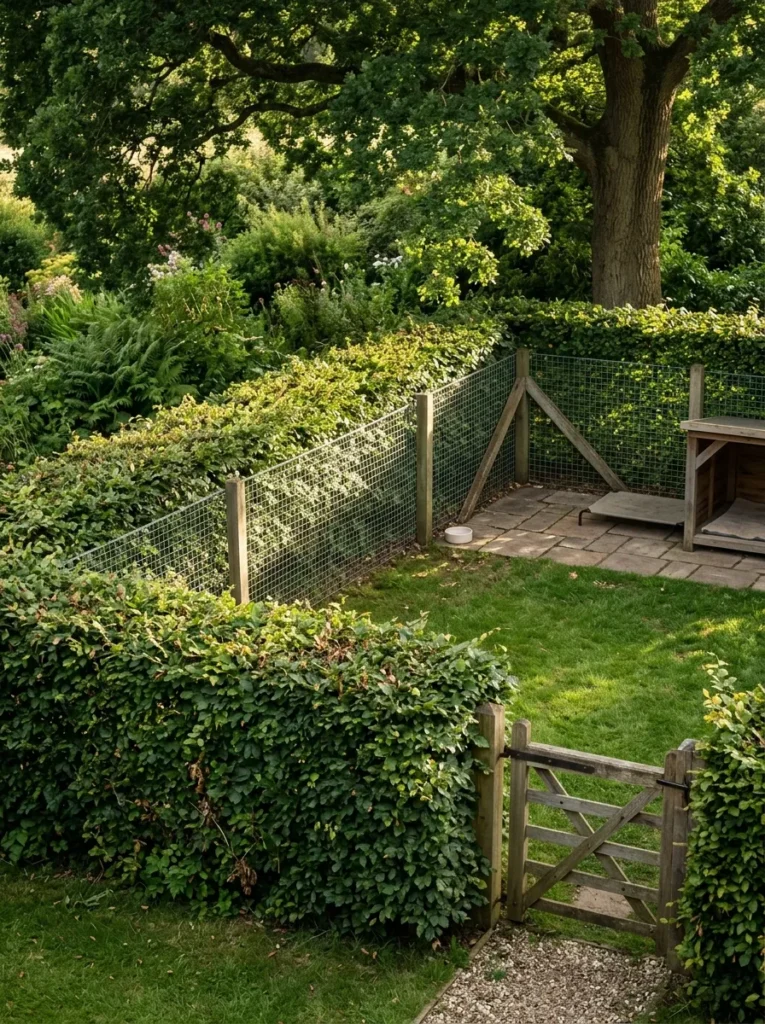
Vibe: The living hedge pen feels like the dog pen that grew naturally — the hedge’s established quality making the pen appear to have been part of the garden’s design from the beginning.
Why it works: A living hedge and wire mesh hybrid pen applies the ecological containment principle — a mature native hedge provides containment (physical barrier on the exterior face), privacy (visual screening from the exterior), wildlife habitat (nesting sites, food sources, wildlife corridor function), wind protection (the hedge’s density significantly reduces wind speed within the pen), and the aesthetic quality of natural living material that no manufactured fence can replicate. The wire mesh on the interior face (invisible from the exterior behind the hedge) provides the actual dog-containment security, because even a dense mature hedge has gaps and roots that a determined dog can potentially exploit. The hybrid approach delivers the best of both systems.
Establishment: A new hedge takes 3–5 years to reach effective containment height and density. Use a temporary wire mesh pen during this establishment period, or begin with an area where some mature hedge already exists and extend around the remainder.
Budget: Wire mesh interior plus hedge planting for a 4×6m area: $600–1,500. Professional installation: $1,500–3,500.
Shop The Look
| Product |
|---|
| Native hedge plant beech hornbeam |
| Welded wire mesh interior hedge |
| Timber gate frame hedge section |
| Flagstone rest area paving |
| Natural lawn seed renovation |
12. Luxury Dog Pen with Kennel Suite
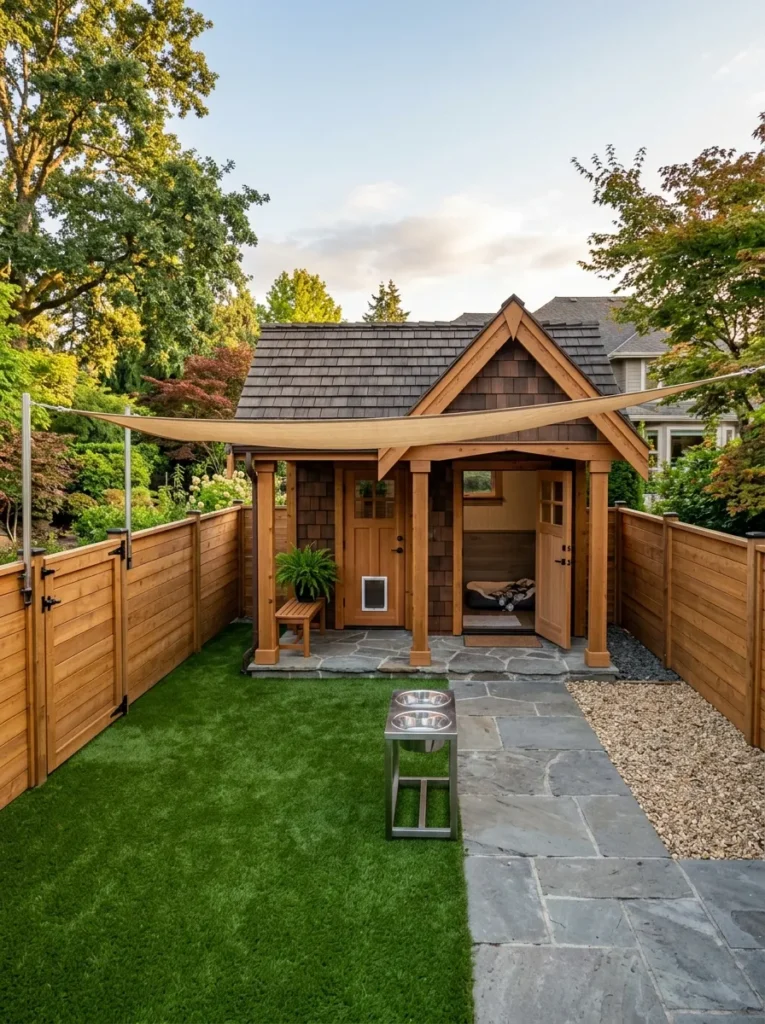
Vibe: The luxury kennel suite pen feels like the standard for what a dog’s outdoor space can be when the brief is genuinely generous — the custom kennel building, the covered veranda, and the zoned floor expressing a considered position on what outdoor dog welfare looks like at its most fully realized.
Why it works: A luxury pen with a kennel suite applies the full welfare provision principle — the kennel building with a covered veranda, an insulated interior, and a dog flap provides every component of outdoor shelter welfare: protection from rain (the pitched roof), protection from wind (the kennel walls), protection from cold (the insulated interior), access to outdoor air without fully leaving shelter (the covered veranda), and self-directed access to both interior and exterior (the dog flap). The zoned pen floor (artificial turf for exercise, flagstone for transition zones, gravel for the toilet corner) addresses the substrate requirements of different daily activities. A stainless steel combination food and water station on a raised stand provides both resources at an ergonomically appropriate height.
Kennel insulation specification: For year-round occupancy, the kennel interior should be insulated with 50mm rigid foam insulation behind the timber interior lining, with a raised timber floor (minimum 75mm air gap below the floor) to prevent cold transfer from the ground.
Budget: Materials for a 5×7m luxury pen with kennel suite: $5,000–12,000. Professional build: $10,000–25,000.
Shop The Look
| Product |
|---|
| Custom cedar kennel building |
| Cedar shingle kennel roof set |
| Dog flap large weather seal |
| Stainless steel food water station |
| Rigid foam kennel insulation |
13. Wildflower Border Dog Pen — Ecological Design
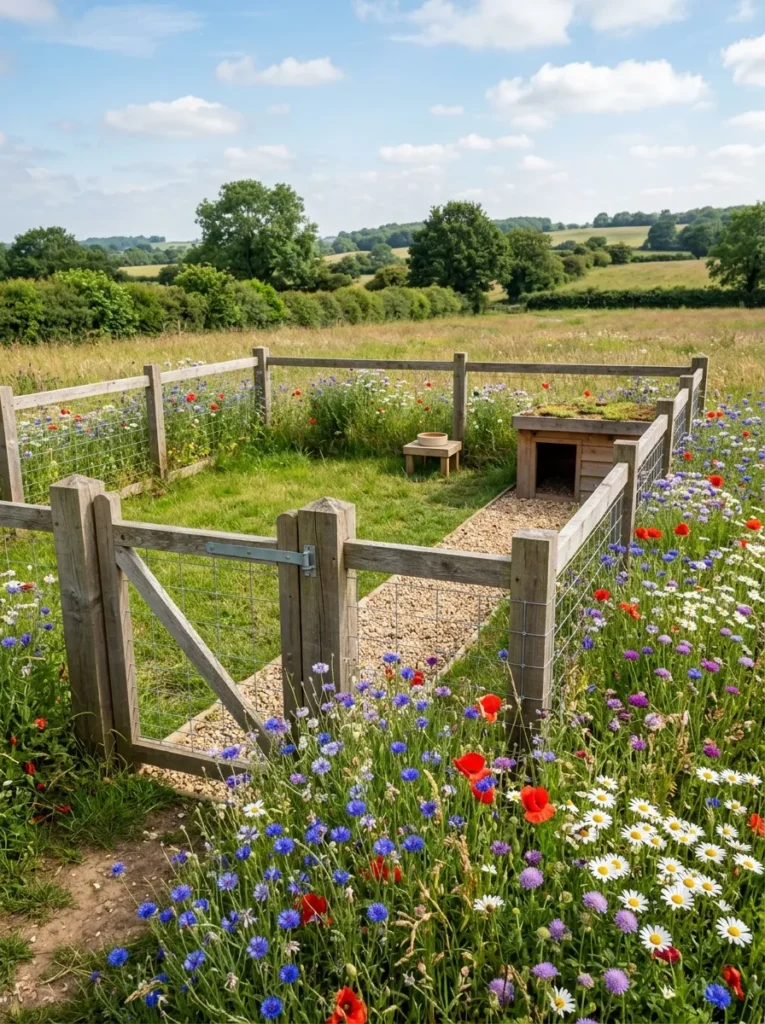
Vibe: The wildflower border pen feels like the garden was designed for pollinators and the dog pen found its place within it — the ecological planting elevating the simplest possible pen structure to something that reads as designed for multiple users.
Why it works: A wildflower meadow border around a dog pen applies the ecological multi-benefit principle — the wildflower border simultaneously integrates the pen into the garden aesthetically (the bloom diversity and visual abundance of a wildflower meadow is the most beautiful possible pen border), provides ecological benefit (wildflower borders are significant pollinator habitats, supporting bees, butterflies, and beneficial insects), and provides sensory enrichment for the dog through the varied aromatic environment and the wildlife activity that the flowers attract. The pen structure itself (simple post-and-rail with wire mesh infill) is the most cost-effective and least visually dominant fencing format available — it is the wildflower border that provides the aesthetic statement, not the fence.
Plant selection: All wildflowers specified should be verified as non-toxic to dogs before planting. Cornflower, ox-eye daisy, field scabious, and knapweed are all non-toxic. Avoid: foxglove (toxic), monkshood (toxic), and sweet peas (toxic).
Budget: Simple pen construction: $400–900. Wildflower border establishment: $100–300.
Shop The Look
| Product |
|---|
| Post-and-rail timber pen set |
| Welded wire mesh infill panel |
| Wildflower seed mix native |
| Non-toxic verified wildflower set |
| Pea gravel pen interior bag |
14. Dog Pen with Sensory Garden Elements
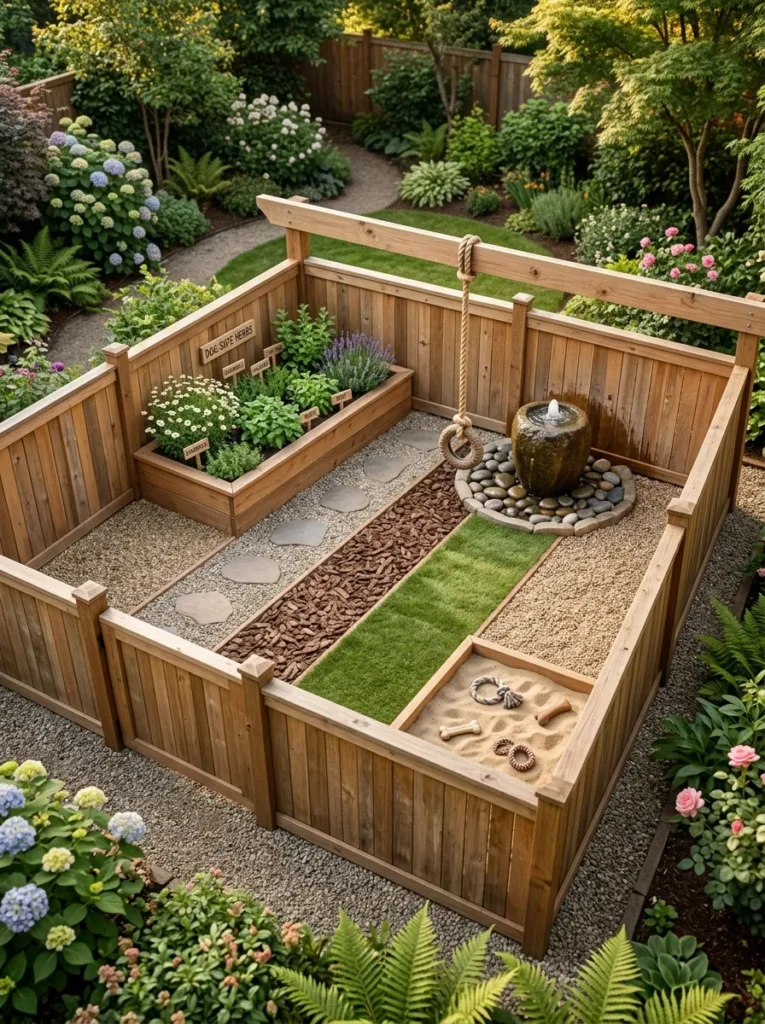
Vibe: The sensory garden pen feels like it was designed by someone who had read the research on canine environmental enrichment — each element addressing a specific sensory channel, the complete pen providing a far richer environment than any commercial pen product offers.
Why it works: A sensory garden dog pen applies the comprehensive enrichment design principle — commercial dog pen design typically addresses only the containment requirement, leaving the dog’s behavioral and sensory needs unaddressed. A sensory garden pen specifically designs for each primary sensory channel: olfactory enrichment (the herb bed with chamomile, mint, and valerian provides continuously varying plant scent), auditory enrichment (the recirculating fountain provides the specific acoustic quality of moving water that research documents as stress-reducing in dogs), tactile enrichment (the varied floor texture strip allows the dog to choose different substrate textures that stimulate different paw pad receptors), proprioceptive enrichment (the sandbox digging section satisfies the digging drive that many breeds demonstrate), and kinetic enrichment (the hanging rope and ring toy provides unpredictable movement-response interaction).
Herb safety: Chamomile (non-toxic, mild calming effect), mint (non-toxic, fresh aromatic), valerian (non-toxic, documented calming effect in dogs). All herbs should be verified against the ASPCA toxic plant list before planting.
Budget: Materials for a 4×5m sensory pen: $2,000–4,500. Professional build: $4,000–9,000.
Shop The Look
| Product |
|---|
| Raised herb bed cedar corner |
| Small recirculating stone fountain |
| Sandbox section border treatment |
| Varied floor texture materials set |
| Hanging rope toy outdoor frame |
15. Modular Panel System — Expandable and Relocatable
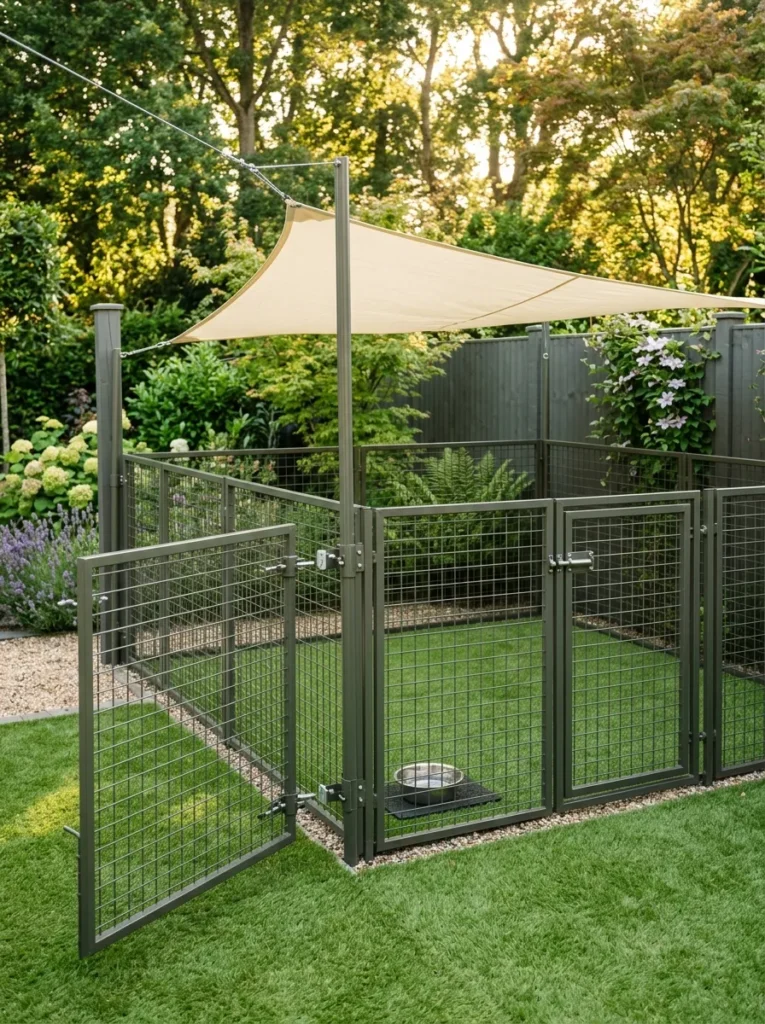
Vibe: The modular pen feels like the most intelligent solution for a household where the commitment to a permanent structure is not yet fully made — the expandable, relocatable system providing full welfare provision without permanence.
Why it works: A modular panel dog pen system applies the flexibility and investment protection principle — a permanent built pen is a significant financial and physical commitment that becomes obsolete when the dog’s size, the household’s space needs, or the property itself changes. A modular panel system provides equivalent containment and welfare provision in a configuration that can be expanded (add panels), reduced (remove panels), reconfigured (square to rectangle to L-shape), or relocated (to a new property or a new position in the same garden) without any loss of investment. The key styling decision for a modular pen is the panel color — most commercial modular pens are available in silver galvanized, which reads as industrial, or in powder-coat colors including graphite, olive green, and dark brown that coordinate with garden fence and gate colors.
Budget: Modular panel pen (8 panels, gate, 4×4m): $400–900 depending on panel height specification. Artificial turf addition: $200–400.
Shop The Look
| Product |
|---|
| Modular steel panel set 8 graphite |
| Modular gate panel matching |
| Pet-grade artificial turf roll |
| Drainage base gravel layer |
| Shade sail coordinating cream |
How to Start Your Outdoor Dog Pen Project
The single best first move before designing or purchasing any outdoor dog pen is spending one week observing the dog’s specific outdoor behavior — noting which direction the dog faces when looking out from windows or existing outdoor space (indicates the preferred view and sensory orientation), whether the dog seeks shade independently when given outdoor access (indicates thermoregulatory priority in the design), whether the dog digs, chews, or attempts to escape through or over existing barriers (indicates the substrate, material, and height specifications required), and whether the dog is reactive to visual stimuli from exterior the space (indicates whether a partially screened fence design is more appropriate than an open mesh). This observational audit, which takes a week and costs nothing, produces the specific behavioral brief that determines whether the pen needs a solid visual barrier or an open mesh, whether it needs a shade provision as a primary rather than supplementary element, and whether it needs substrate management for digging behavior.
The most common mistake in outdoor dog pen design is underspecifying the size. Research in canine behavioral welfare consistently documents that pen size has a direct relationship with behavioral outcome — dogs in larger pens show fewer stereotypic behaviors, less barrier frustration, and more positive behavioral indicators than dogs in smaller pens of equivalent enrichment provision. The minimum recommended pen size for a medium dog (15–25kg) is 3×4 metres, for a large dog (25–45kg) is 4×6 metres, and for an active or working breed of any size is 5×8 metres or larger. The most common justification for undersizing is property space constraint — but a smaller pen at minimum welfare specification is preferable to no pen, and the modular panel systems in Idea 15 allow expansion when more space becomes available.
Three specific additions under $100 that immediately improve any existing or new outdoor dog pen: a shade sail ($35–65 for a 3×3m or 3×4m sail, providing the most cost-effective shade provision available — essential in any climate where summer temperatures exceed 25°C); a stainless steel water bowl on a fixed stand ($20–35, providing a stable, hygienic water supply that cannot be tipped and that does not transfer bacterial or taste contamination that plastic bowls accumulate over time); and a hanging rope toy fixed to the pen frame ($8–15, providing the most immediately accessible behavioral enrichment available for a dog in a pen with limited other enrichment). These three additions combined for under $100 address the three most acute welfare provisions that standard pen designs overlook: thermal protection, hydration, and behavioral engagement.
Frequently Asked Questions About Outdoor Dog Pen Designs
How large should an outdoor dog pen be?
Size depends on the dog’s size, breed activity level, and the duration of daily pen use. General minimums: small dogs under 10kg — 2×3m; medium dogs 10–25kg — 3×4m; large dogs 25–45kg — 4×6m; giant breeds and active working breeds — 5×8m or larger. If the pen will be used for extended daily periods (more than two hours at a time), increase these dimensions by approximately 50%. A pen used only for short supervised outdoor access periods can be at the lower end of the range; a pen that serves as the dog’s primary outdoor environment should be at the upper end or beyond. The most consistent behavioral welfare finding in pen research is that size matters more than enrichment provision for the prevention of stereotypic and stress behaviors.
What is the best flooring for an outdoor dog pen?
The best flooring depends on the climate, the dog’s breed and size, and the management commitment available. Artificial turf (specifically pet-grade turf with a permeable backing and a drainage base) provides the best combination of comfort, hygiene manageability, and durability for most applications — it can be hosed clean, does not retain mud, and provides a comfortable surface for both active and resting behavior. Pea gravel is the best drainage substrate and the most hygienic option in high-rainfall climates, but is less comfortable for extended lying and can cause paw pad abrasion in dogs that run on it excessively. Natural lawn is the most comfortable and most behaviorally appropriate substrate but requires rotation management in a pen. Concrete is the most hygienic and most durable but the least comfortable — always use thick rubber matting over any concrete pen floor.
What shade provision does an outdoor dog pen need?
A minimum of 50% of the pen’s floor area should be in shade at the hottest time of day (typically 11am–3pm in summer). For a 4×6m pen, this means a minimum 12 square metres of shade. The shade must be available simultaneously to all pen occupants — a single dog house that one dog occupies does not provide adequate shade for a multi-dog pen. Shade sails (providing UV-rated shade over a large area at low cost), permanent roof structures (providing weather shelter in addition to sun protection), and natural tree canopy (the most ecologically beneficial shade provision) all provide appropriate shade. Never use a polycarbonate or glass roof as the sole shade provision — the greenhouse effect of these materials can create dangerously high temperatures beneath them without adequate ventilation.
How do you prevent a dog from digging out of an outdoor pen?
The three most reliable dig-prevention methods for outdoor pens are: the L-footer (welded wire mesh or hardware cloth extended 30–45cm outward from the fence base at ground level, either buried to 5–10cm depth or pegged flat on the surface — when the dog digs at the fence base, it encounters the horizontal mesh and cannot continue forward); the concrete perimeter strip (a 15–20cm wide strip of concrete poured flush with the ground surface along the full pen perimeter, providing a hard surface that prevents digging immediately at the fence); and the gravel trench method (a 30cm deep by 30cm wide trench filled with compacted gravel along the perimeter, which collapses back into the space as fast as the dog digs, discouraging continued effort). For persistent diggers, the L-footer combined with a designated sandbox section inside the pen (which satisfies the digging drive in a permitted location) is the most effective combination.
How do you make an outdoor dog pen look attractive rather than institutional?
The most impactful single design decision for pen aesthetics is the choice of fencing material — horizontal cedar boards, decorative steel panels, or white-painted picket immediately read as designed garden features rather than industrial containment, while galvanized chain link reads as institutional regardless of its companions. Beyond material choice, the three most effective aesthetic improvements are: planted borders along the pen’s exterior perimeter (connecting the pen visually to the garden), a decorative gate (the gate is the pen’s most visible element from the garden and a simple arch-top or panel-design gate communicates significantly more design investment than a plain functional gate), and a consistent material and color palette across all pen elements (matching the pen’s wood tone or steel color to the adjacent garden furniture, fence, and structure materials creates the material coherence that reads as designed rather than assembled).
Ready to Build Your Dog’s Outdoor Retreat?
These 15 designs move through every dimension of what makes an outdoor dog pen genuinely stylish and genuinely comfortable — from the architecturally integrated cedar and steel garden pen and the lush pergola-covered pavilion, to the ecological wildflower border and the sensory garden with its herb bed and recirculating fountain, to the ingeniously resourceful under-deck conversion and the expandable modular system that provides welfare provision without permanence. Starting with the behavioral observation week — watching the specific dog’s outdoor orientation, thermoregulatory behavior, and boundary-testing habits before designing anything — is the beginning that makes every subsequent design decision serve the actual dog rather than the imagined average one. It costs nothing and takes a week. From that knowledge, the pen’s orientation, shade provision, substrate, height specification, and visual permeability all become specific choices rather than general guesses. Pin the designs that match the property’s aesthetic and the dog’s behavioral profile, measure the available space this weekend, and begin the project that gives the dog what indoor life alone cannot: genuine, safe, enriching access to the outdoor world that dogs evolved to inhabit.