Cute cat drawing ideas are approachable, beginner-friendly illustration concepts that capture the most endearing qualities of domestic cats — their expressive eyes, sleepy poses, playful energy, and distinctive silhouettes — using simple shapes, clean lines, and a handful of well-chosen details that make even the most basic sketch feel charming and complete. This article gives you exactly 12 cute cat drawing ideas you will love to sketch today, spanning every skill level from absolute beginner to confident intermediate, with step-by-step guidance, technique tips, and curated product tables for every idea.
There is something uniquely satisfying about drawing cats — they offer the artist an almost unlimited range of expressive possibilities within a familiar, beloved form. A sleeping cat curled into a perfect circle, a kitten with enormous eyes peering over a cup’s rim, a cartoon cat reduced to the simplest possible geometric shapes — each subject rewards the artist with a result that is recognizable, expressive, and genuinely pleasing to look at regardless of technical skill level. These ideas range from a five-minute doodle to a fully rendered watercolor portrait worthy of framing. Here are 12 ideas worth sketching — and saving.
Why Cute Cat Drawing Ideas Work So Well
Cat illustration has one of the longest and most culturally rich traditions in visual art — from the precisely observed animal studies of ancient Egyptian temple art, where the cat held divine status and was depicted with extraordinary accuracy and reverence, through the playful ukiyo-e woodblock cats of Utagawa Kuniyoshi in 19th century Japan, to the global phenomenon of contemporary cat illustration that fills Pinterest boards, Etsy shops, and children’s book shelves worldwide. What persists across all these traditions is the fundamental appeal of the cat as a drawing subject: its form is simultaneously simple enough to be accessible to beginners and complex enough in expression, posture, and personality to reward the most skilled illustrators with endless variety.
The materials that produce the most satisfying cat drawing results for beginners and intermediates share specific characteristics: fine-tipped black pens (Micron 01 and 03 are the most widely used and recommended) for clean linework that photographs well and reproduces clearly; smooth Bristol board or marker paper for ink-based illustration; cold-press watercolor paper when color is introduced; mechanical pencils for underdrawing precision; colored pencils in a muted natural palette for soft, cat-appropriate tones; and watercolor half-pan sets for the loose, expressive washes that suit cat subject matter particularly well. The color palette for cute cat illustration leans toward warm naturals — warm ivory, ginger orange, tabby grey, calico brown, black, and the particular warm caramel of a sunlit tortoiseshell coat — with muted pops of dusty rose, sage green, and warm lavender for backgrounds and props.
Cat drawing has experienced a genuine cultural renaissance in the social media era — the intersection of the internet’s foundational love of cats with the maker movement’s emphasis on accessible handcraft has produced a global community of cat illustrators spanning every skill level, from children making their first animal sketches to professional illustrators building substantial commercial careers from cat-themed stationery, prints, and product licensing. Pinterest data consistently shows cat illustration among the highest-saving art content categories, with beginner-friendly tutorials and cute cat sketch ideas generating some of the platform’s most engaged art content.
Beginner artists benefit disproportionately from cat drawing as a starting subject because the cat’s most appealing qualities — large expressive eyes, round head shape, curved sleeping form — are specifically the features that simplify well into beginner-appropriate shapes, making it possible to produce a recognizable, charming cat drawing from the first session without years of technical development.
Style at a Glance
| Element | Trait 1 | Trait 2 |
|---|---|---|
| Philosophy | Expressive simplicity | Character over accuracy |
| Materials | Fine liner pen, watercolor, colored pencil | Bristol board, smooth marker paper |
| Color Palette | Warm ivory, ginger, tabby grey | Dusty rose, sage green, warm caramel |
12 Cute Cat Drawing Ideas You’ll Love to Sketch Today
1. The Sleeping Circle Cat
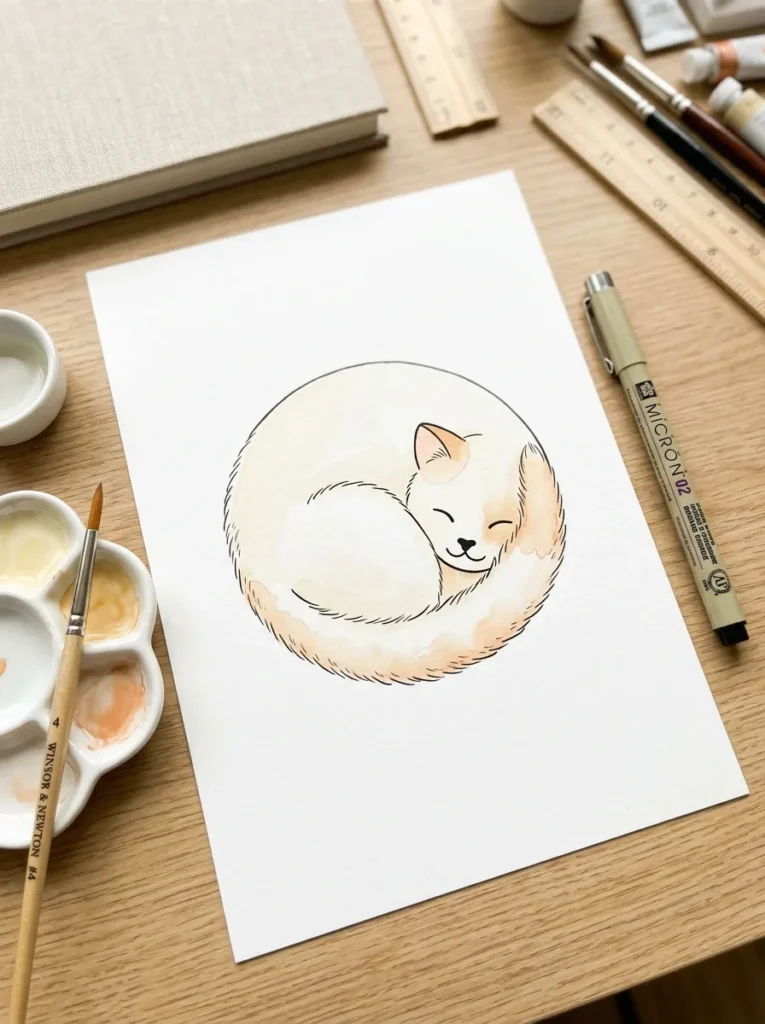
Vibe: The sleeping circle cat feels quietly perfect — the most satisfying drawing subject for a beginner because the circle is forgiving and the result is immediately charming.
Why it works: The sleeping curled cat is the most universally beloved cat drawing subject because it reduces the cat’s form to its most essential geometric element — the circle — which is simultaneously the most technically accessible shape for a beginner to draw and the most emotionally resonant shape in visual communication (circles suggest wholeness, comfort, and self-contained contentment that is perfectly appropriate for a sleeping cat). The design principle is geometric reduction: by containing the entire cat within a circular silhouette, every detail — the ear, the nose, the tail — serves to clarify that this circle is a cat, not to add visual complexity. The result is a drawing that reads as skilled because it is confident and complete, not because it is technically demanding.
How to get it: Draw a light pencil circle of approximately 6cm diameter. Sketch the cat’s head at the 8 o’clock position of the circle with the face visible — a small triangle ear at the top of the head, two closed crescent-moon eyes (the most universally cute eye shape), a small Y-shaped nose, and a simple curved smile line. Draw the body continuing around the interior of the circle from the head, with the tail curling out to complete the circle’s perimeter. Add light fur texture lines at the tail tip (three or four short curved strokes) and a single line suggesting the ear’s inner edge. Ink over the pencil lines with a 01 fine liner, erase pencil, and add a loose watercolor wash in warm ivory with a soft ginger touch at the ear and tail.
Quick Win: Drawing the sleeping circle cat in multiples — a small cluster of three circles of slightly different sizes, each containing a sleeping cat in a slightly different curl position — creates an immediately frameable composition that takes under 20 minutes and reads as a considered illustration series rather than a single sketch.
Shop The Look
| Product |
|---|
| Micron fine liner pen set 01 03 05 black |
| Bristol board smooth pad 9×12 inch white |
| Mechanical pencil 0.5mm HB drawing sketch |
| Watercolor half pan set 12 colors artist |
| Kneaded eraser gray soft drawing pencil |
Also view: 14 Modern Dog Fence Ideas with Easy Access Gates
2. Big-Eyed Kitten Portrait (COLOR)
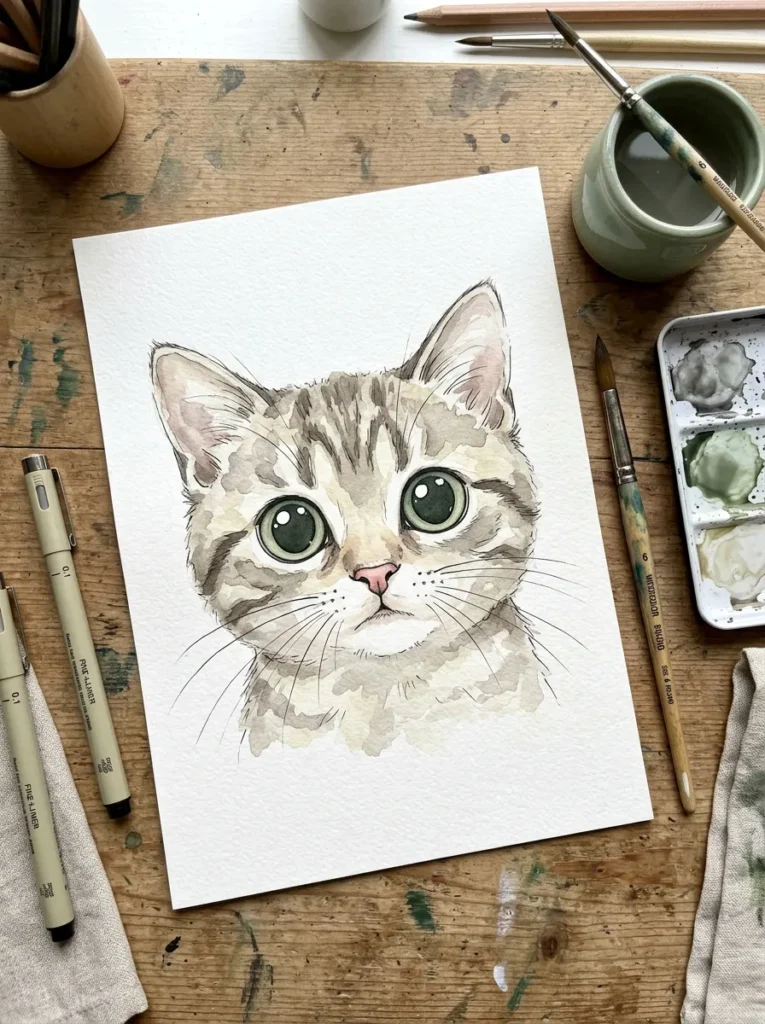
Vibe: The kitten portrait feels expressively endearing — the large eyes creating the involuntary emotional response that makes cat illustration universally appealing.
Why it works: The big-eyed kitten portrait is the cat drawing subject most directly aligned with the biological basis of cuteness response — what ethologist Konrad Lorenz termed the Kindchenschema (baby schema), the set of infantile physical features that trigger involuntary nurturing response in humans. Large eyes relative to face size, a round head, a small nose, and soft, rounded features all activate this response, which is why kitten faces with proportionally enormous eyes consistently generate the strongest positive emotional reactions in viewers. The illustrator’s task is simply to exaggerate what is already biologically appealing: make the eyes larger than natural proportion, the head rounder than strict anatomy, the nose smaller than realistic scale.
How to get it: Sketch the kitten face starting with a large circle for the head — larger than feels proportionally correct is almost always right for cute kitten portraits. Divide the face with a light cross-hair (horizontal center line for eye placement, vertical center line for nose). Place the eyes on the horizontal line, making each eye a large circle taking up approximately 30% of the face width. Add pupils as vertical oval shapes with a small white highlight dot at the 10 o’clock position of each eye. Place the nose as a small inverted triangle at the center of the face, 40% of the way down from eye line to chin. Add the ears as large, slightly angled triangles at the head’s upper edge. Apply loose watercolor washes — warm grey for tabby markings, ivory as the base — using a wet-on-wet technique for soft blending.
Shop The Look
| Product |
|---|
| Cold press watercolor paper pad A5 300gsm |
| Round watercolor brush set 2 4 6 natural |
| Watercolor paint set 24 colors half pan |
| Fine liner pen 005 01 fine detail black |
| White gel pen highlight dot eye detail |
3. Line-Only Minimalist Cat Silhouette (COLOR / LAYOUT)
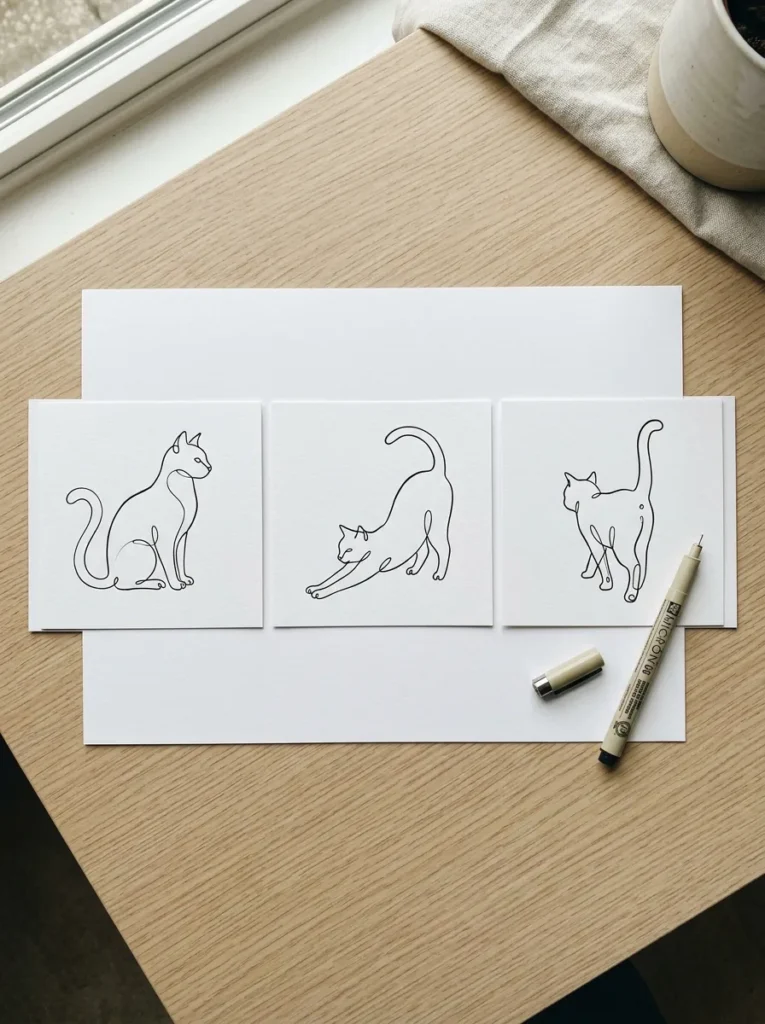
Vibe: The minimalist cat silhouettes feel graphically confident — the most technically liberating drawing exercise and the most immediately striking result.
Why it works: The one-line continuous cat drawing is the illustration technique that most effectively demonstrates a fundamental truth about drawing: character and recognizability come from the accuracy of the gesture — the essential silhouette and pose — rather than from the accumulation of detail. A cat’s most recognizable qualities — the upright tail, the pointed ear, the arched stretching back — are all contour qualities that are fully captured by a single continuous line, which means the one-line method produces drawings of immediate recognizability and considerable graphic power. The design principle is gestural economy: the fewer lines used to convey the cat, the more confident and considered the drawing reads — provided the essential gesture is correctly observed.
How to get it: Study five or six reference photographs of cats in clear, readable poses — sitting upright, stretching forward, walking away, lying flat — before drawing. Choose the three poses with the clearest and most distinctive silhouettes. Practice each pose as a pencil scribble three or four times to find the single most efficient line path through the pose. When comfortable with the path, draw the final version in pen without lifting — begin at the nose, travel along the back and tail, return along the belly, complete the feet, and finish at the nose. The single unlifted line creates small imperfections and directional changes that read as hand-drawn expressiveness rather than error.
Shop The Look
| Product |
|---|
| Fine liner pen 03 black Micron drawing sketch |
| Smooth white card stock A5 220gsm set |
| Drawing reference book cat anatomy pose |
| Simple black frame A5 triptych display set |
| Pencil set HB 2B 4B drawing under sketch |
4. Watercolor Wash Tabby Cat (MATERIAL)
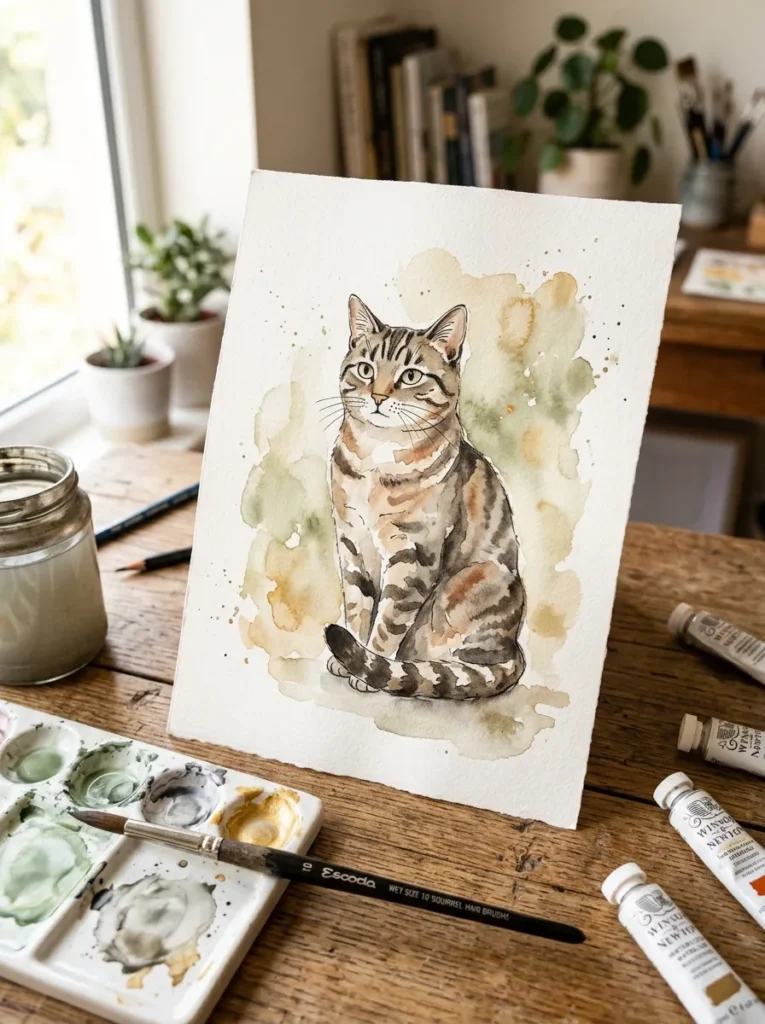
Vibe: The watercolor tabby feels loosely alive — the wet-on-wet technique capturing the soft, warm quality of a cat’s fur better than any tight rendering technique.
Why it works: Watercolor’s wet-on-wet technique is the most appropriate painting method for cat fur because the soft, bleeding edges created by applying pigment onto a pre-wet surface exactly replicate the visual quality of fur — the soft, gradual transition from one color to another without hard edges that characterizes the surface appearance of a cat’s coat. Tabby stripe markings applied wet-on-wet bleed slightly into the surrounding fur color, creating the natural, slightly blurred quality of actual tabby markings rather than the unrealistic precision of stripes applied with a dry brush. The technique is also specifically beginner-friendly because the bleeding quality means small directional errors self-correct as the paint settles into the wet ground.
How to get it: Lightly sketch the cat’s sitting outline in pencil on 300gsm cold-press watercolor paper. Wet the entire cat silhouette area with clean water using a wide flat brush — the paper surface should shine with water but have no standing puddles. While the surface is wet, apply the base fur color (warm grey or ivory) across the body using a loaded round brush, working quickly. Drop the darker tabby stripe color (warm charcoal grey) onto the wet surface at the position of the tabby markings and allow it to bloom and spread naturally — do not direct it with brush strokes. Allow to dry completely (30 minutes) before adding the face details with a 005 fine liner — the dried watercolor provides the perfect ground for clean pen linework.
Shop The Look
| Product |
|---|
| Watercolor paper cold press 300gsm A4 pad |
| Wide flat wash brush 1 inch natural hair |
| Watercolor set warm grey ivory charcoal tones |
| Fine liner 005 pen black detail face |
| Water brush pen set portable watercolor travel |
5. Chibi-Style Cartoon Kitten (ACCESSORIES / COLOR)
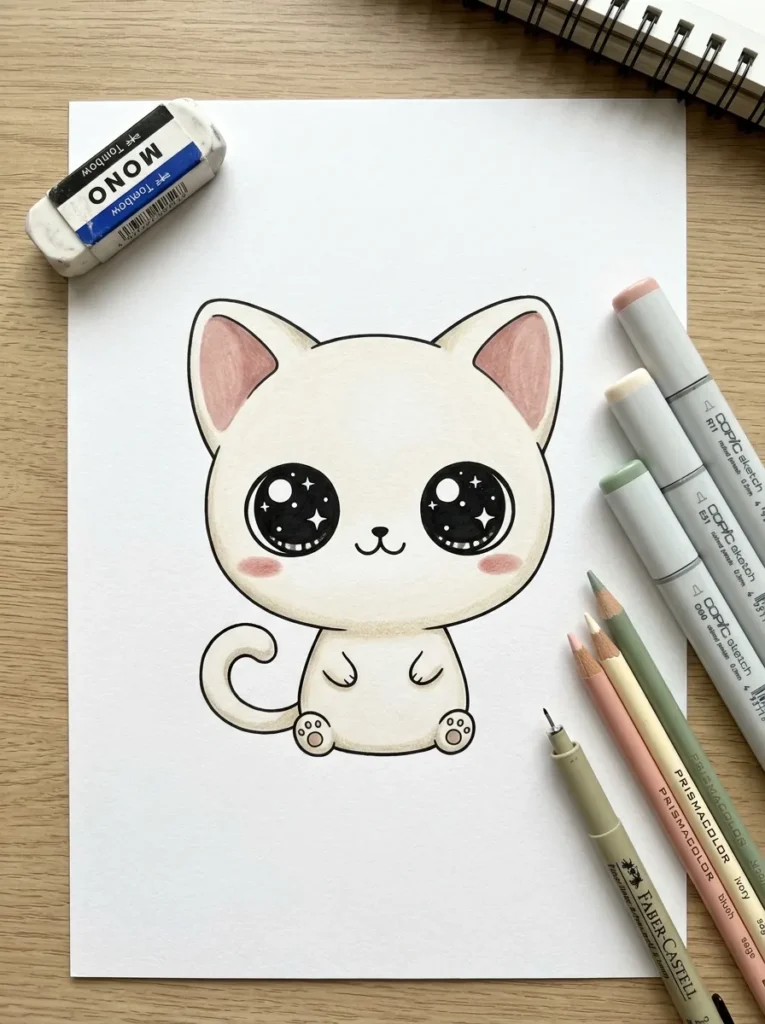
Vibe: The chibi kitten feels playfully joyful — the exaggerated cute proportions producing the maximum possible charm response in every viewer.
Why it works: The chibi drawing style — derived from the Japanese term for small or short and used to describe the exaggerated cute proportion style where the head constitutes 60–70% of the character’s total height — is the most systematically optimized approach to cute character illustration because it deliberately maximizes every feature that triggers the human cuteness response simultaneously: oversized head, enormous eyes, tiny body, simplified round forms throughout. The design principle is proportion exaggeration: by pushing every cute quality beyond natural proportion into deliberate cartoon exaggeration, the chibi style produces a character that reads as maximally cute rather than attempting to replicate real-world kitten proportions, which are less cute than the idealized version.
How to get it: Draw the head first as a large circle, then add the body as a much smaller oval below — the head should be visually larger than the body for genuine chibi proportions. Add ears as large, rounded triangles (softer than realistic cat ears) at the upper edge of the head. Draw the eyes as large circles taking up approximately 40% of the face width, then add pupils as smaller circles within the eyes with two or three small star-shaped highlights. The nose is a single small dot or tiny triangle, the mouth a simple W or curved line for a happy expression. Color with soft, muted tones — blush pink for the inner ear and cheek blush, ivory or cream for the body, with a simple colored background that frames the character without competing with it.
Shop The Look
| Product |
|---|
| Colored pencil set 36 colors muted natural tones |
| Bristol board smooth pad 11×14 inch white |
| Black fine liner pen set 005 01 03 chibi art |
| White gel pen highlight star eye detail |
| Pencil eraser set soft white drawing clean |
6. Cat in a Teacup Illustration (ACCESSORIES / LAYOUT)
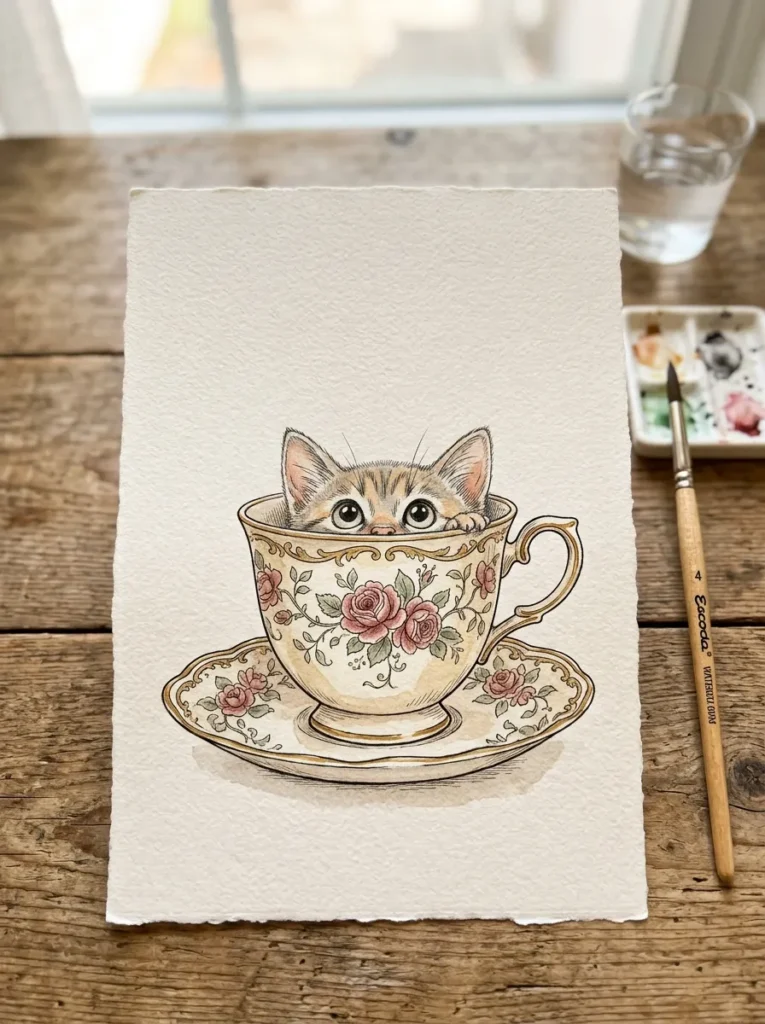
Vibe: The cat-in-a-teacup feels warmly whimsical — the combination of domestic object and cat face creating a composition of immediate visual delight.
Why it works: The cat-in-a-teacup is the cat drawing idea that most effectively uses compositional framing — the teacup rim creates a circular frame that focuses attention on the kitten face appearing above it, and the contrast between the rigid geometric precision of the decorated teacup and the soft organic forms of the kitten face creates a visual tension that makes the composition more dynamic and interesting than a simple cat portrait. The design principle is scale surprise: the kitten’s eyes and ears appearing above a human-scale teacup creates the delightful size-relationship implication that this is a very small kitten (or a very large cup), which adds a story-telling quality to the illustration that a straightforward cat drawing cannot achieve.
How to get it: Draw the teacup first — a classic rounded teacup shape with a clear horizontal rim line and a saucer below. The cup’s width should be approximately 8cm at the rim and 5cm at the base for a pleasing proportion. Draw the floral decoration on the cup body using fine pen linework — small five-petal flowers and leaf clusters in a repeating pattern. Now draw the kitten appearing from inside the cup: only the top of the head (from eyes upward) and ears should be visible above the rim line, with the tiny paw tips visible gripping the rim’s outer edge. The kitten’s enormous upward-looking eyes are the composition’s focal point — make them large, round, and directed toward the viewer. Apply watercolor washes to the teacup in warm ivory with dusty rose floral details, then a warm grey wash over the kitten elements.
Shop The Look
| Product |
|---|
| Fine liner pen set 005 01 03 05 illustration |
| Watercolor paper cold press 300gsm pad |
| Watercolor set dusty rose sage green ivory |
| Round brush set sizes 0 1 2 detail watercolor |
| Pencil 2H light under-drawing sketch guide |
7. Gesture Sketch: Five-Minute Cat Poses (LAYOUT)
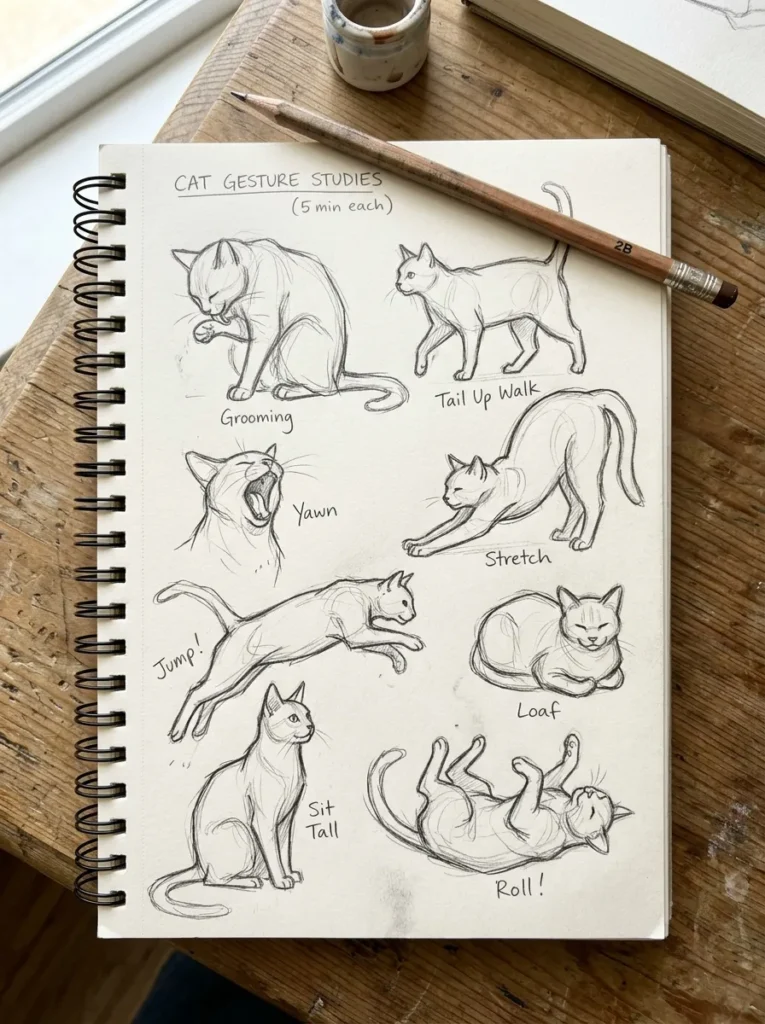
Vibe: The gesture sketch page feels loose and alive — the confident imprecision of quick gesture drawing capturing cat energy more effectively than careful slow rendering.
Why it works: Gesture drawing — making quick, loose sketches that capture the essential movement and energy of a pose rather than its precise details — is the most efficient skill-building practice available to any cat artist because it trains the hand and eye to identify and record the most important visual information in a subject quickly, which is the foundational skill that makes all subsequent drawing more confident and accurate. Cats are particularly valuable gesture subjects because their poses are naturally dynamic, their silhouettes are distinctive and immediately recognizable even in loose interpretation, and their behavior provides an unlimited range of reference poses for anyone who shares their home with a cat. Five minutes per pose is long enough to capture the essential gesture without allowing the artist to lose the loose, energetic quality that makes gesture drawings so vibrant.
How to get it: Set a five-minute timer for each pose — the time constraint is the creative tool, not a limitation to be worked around. Begin each gesture sketch with the spine line — a single curved stroke that captures the cat’s overall body orientation and energy direction — then build outward with the major body masses (head, torso, hindquarters) as simple ovals. Add legs as simple tube shapes and the tail as a single curving line last. Do not erase — every mark, including the incorrect ones, contributes to the loose energy of gesture drawing. Fill one sketchbook page with eight poses before looking critically at any individual sketch — the page as a whole, not any single drawing, is the practice unit.
Shop The Look
| Product |
|---|
| Sketchbook spiral bound 9×12 cream paper |
| Pencil set 2H HB 2B 4B 6B drawing gesture |
| Cat reference book poses anatomy drawing |
| Drawing timer app phone 5 minute gesture |
| Kneaded eraser gray soft light sketch |
8. Botanical Cat: Cat with Flower Crown (ACCESSORIES / COLOR)
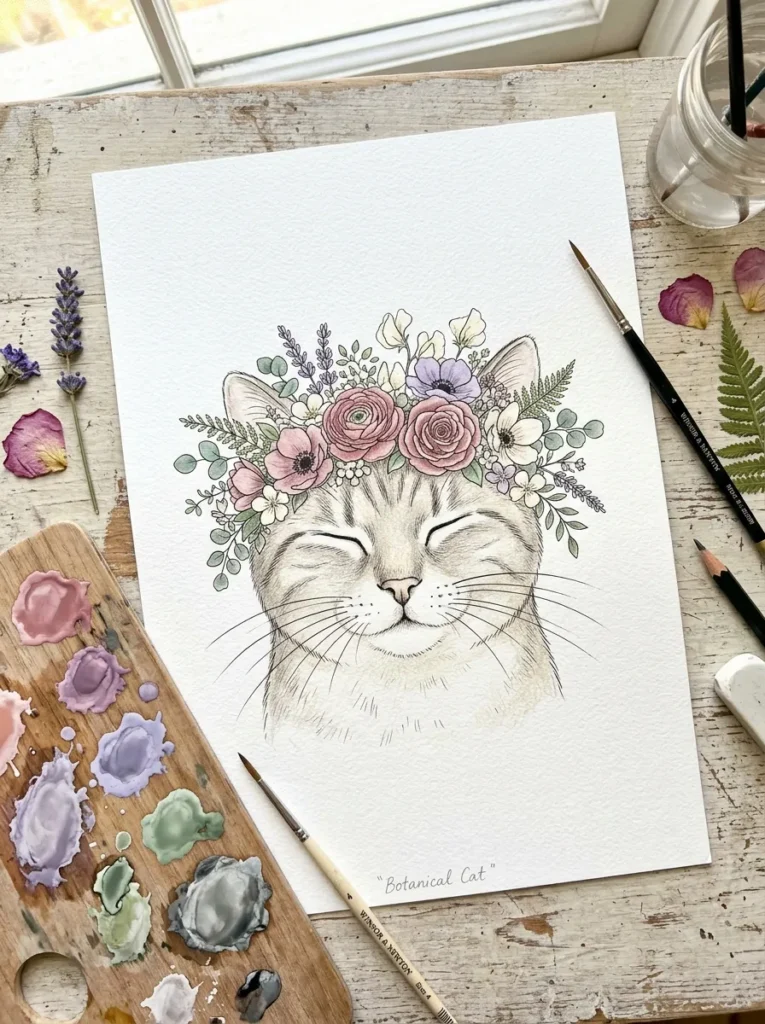
Vibe: The botanical cat feels fresh and quietly joyful — the flower crown adding botanical richness to the cat subject in a way that makes the illustration feel genuinely romantic.
Why it works: The botanical cat with flower crown is the cat drawing idea that most effectively combines two separately beloved illustration subjects — cat portraits and botanical illustration — in a single composition that draws the visual energy of both. The design principle is subject contrast: the soft, organic forms of the flower crown (varied petal shapes, leaf forms, color variety) contrast with the clean, graphic forms of the cat face below (circular eyes, triangular ears, whisker lines), creating a composition where each subject makes the other look more interesting by contrast. The closed eyes of the cat communicate peaceful contentment that is specifically appropriate for the flower crown subject — a contented cat wearing flowers reads as naturally correct in a way that an alert, wide-eyed cat in the same situation might not.
How to get it: Draw the cat face first without the flower crown — a simple round-headed cat with closed eyes (two curved crescents), a small nose, and a curved mouth. The closed eyes are the key expression choice: they communicate contentment, which makes the flower crown feel like a natural extension of the cat’s peaceful state. Once the cat face is complete, design the flower crown as a separate element sitting across the top of the head. Include three to four different small flower types in the crown — simple five-petal flowers, small daisy heads, tiny rose buds — interspersed with leaf sprigs. Watercolor the flowers first, then shade the cat face with soft colored pencil, keeping the cat’s palette warm-neutral to ensure the flowers remain the color accent.
Shop The Look
| Product |
|---|
| Watercolor brush pen set portable 6 colors |
| Colored pencil set warm neutral skin tones |
| Fine liner pen 005 01 botanical detail |
| Pressed flower reference set botanical study |
| Cold press watercolor paper A4 300gsm |
9. Negative Space Cat Silhouette (COLOR / MATERIAL)
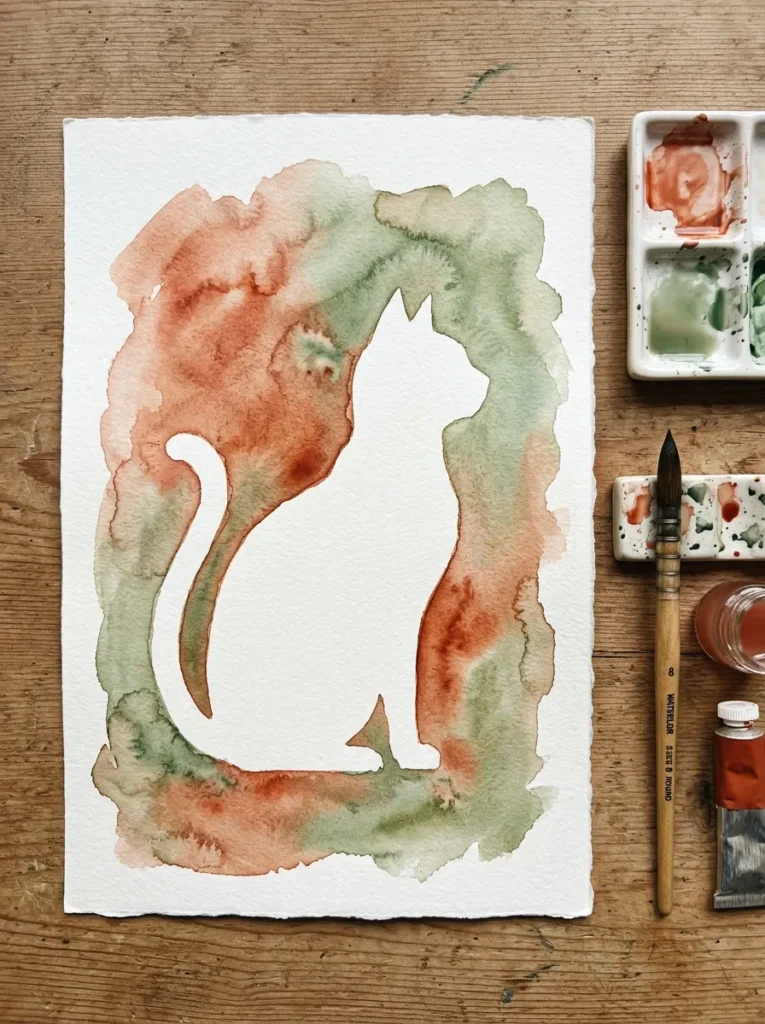
Vibe: The negative space cat feels graphically surprising — the technique of defining a subject by painting everything around it producing an unexpectedly striking result.
Why it works: The negative space cat silhouette reverses the conventional relationship between subject and background in illustration — instead of painting the cat and leaving the background as white paper, the background is painted and the cat is revealed as the remaining white paper space. This technique produces a result of considerable graphic power because the white cat silhouette against a warm colored background reads as luminous and dimensional — the white paper appears to glow against the surrounding watercolor wash. The design principle is figure-ground reversal: by making the background the positive painted element and the subject the negative unpainted space, the illustrator creates a visual tension that makes the composition more dynamic than a conventionally rendered subject on a plain white ground.
How to get it: Lightly sketch the cat silhouette in pencil on watercolor paper — a clear, readable sitting cat pose with upright tail and pointed ears, approximately 12cm tall. The pencil line marks the boundary between background and cat. Mix a warm terracotta watercolor wash and begin painting the background, working carefully up to the cat silhouette’s pencil line and leaving the paper inside the silhouette completely unpainted. Add a secondary sage green wash to areas of the background while the first wash is still damp, allowing the two colors to blend organically. Work around the entire silhouette, maintaining clean edges at the cat boundary. When dry, erase the pencil lines — the white paper cat silhouette remains as the subject.
Shop The Look
| Product |
|---|
| Watercolor paper 300gsm cold press A4 pad |
| Watercolor paint terracotta sage green set |
| Fine round brush size 4 6 control edge |
| Pencil 2H light silhouette sketch guide |
| Flat wide brush 1 inch background wash |
10. Doodle Cat Pattern Sheet (SMALL SPACE / LAYOUT)
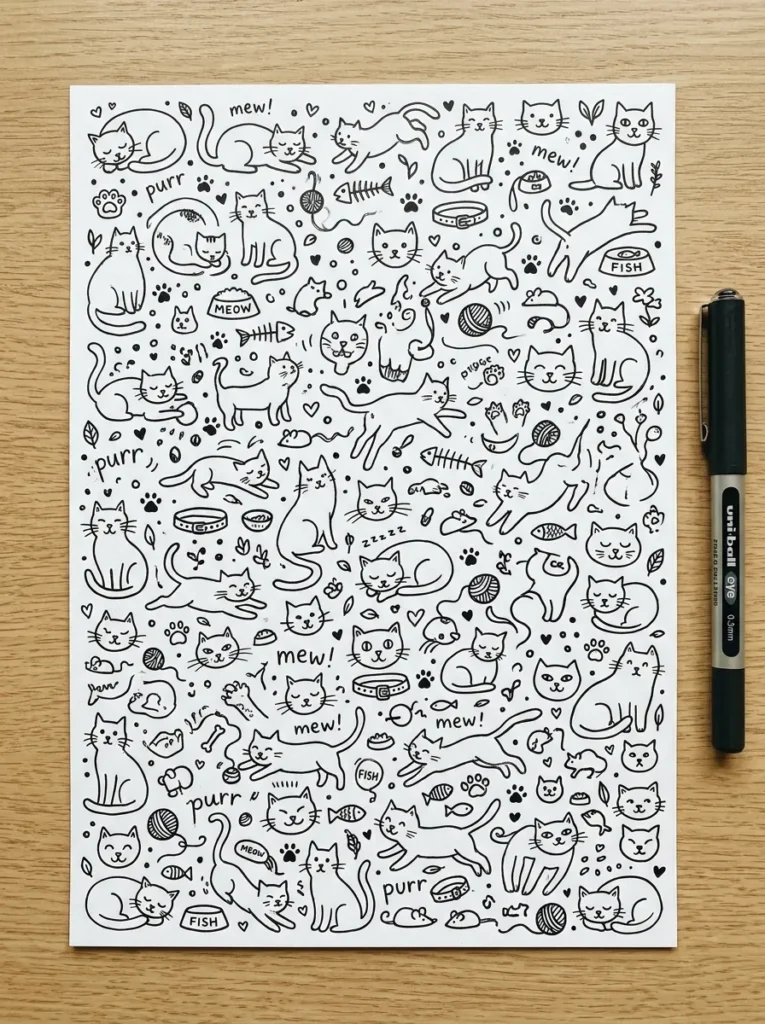
Vibe: The doodle pattern sheet feels playfully abundant — the most liberating cat drawing exercise because every individual mark is small enough to be imperfect and the overall result is always charming.
Why it works: A doodle cat pattern sheet is the cat drawing idea that most effectively removes creative self-consciousness from the drawing process — because every individual doodle is small (1–3cm), simple (5–8 lines maximum), and surrounded by 30 or 40 other doodles that collectively create the work’s visual quality, no single mark carries enough responsibility to create drawing anxiety. The design principle is accumulation: the pattern’s quality emerges from the quantity and variety of marks rather than the refinement of any individual one, which makes this project specifically appropriate for beginners who feel intimidated by a large single drawing but can comfortably make 40 small ones. The finished sheet is also immediately useful — as wrapping paper, background texture, or reference material for future individual drawings.
How to get it: Begin with the simplest possible cat doodles in the corners of the sheet — a small sleeping circle cat, a simple seated cat silhouette, a front-facing cat face — to establish scale and build confidence. Work from the corners inward, filling the sheet organically rather than in rows, rotating the paper as you work to prevent directional fatigue. Intersperse cat forms with cat-related elements — fish skeletons, yarn balls, paw prints, food bowls, small fish shapes — to add variety to the pattern. The doodles should be small enough that 40–60 fit on a single A4 sheet with comfortable spacing between them — approximately 1.5–2cm for the average doodle, with some smaller accent marks filling gaps.
Quick Win: A completed doodle cat pattern sheet photographed flat and printed on a home printer at A4 or A3 scale produces instant, genuinely charming gift wrapping paper for under $1 per sheet — one of the most cost-effective applications of any drawing skill at any level.
Shop The Look
| Product |
|---|
| Fine liner pen 01 03 doodle black smooth |
| Smooth white drawing paper pad A4 |
| Ruler set 15cm 30cm doodle grid guide |
| Black ink pen set varied tip size doodle |
| Clear sleeve protector A4 pattern sheet |
11. Colored Pencil Realistic Kitten Portrait (MATERIAL / COLOR)
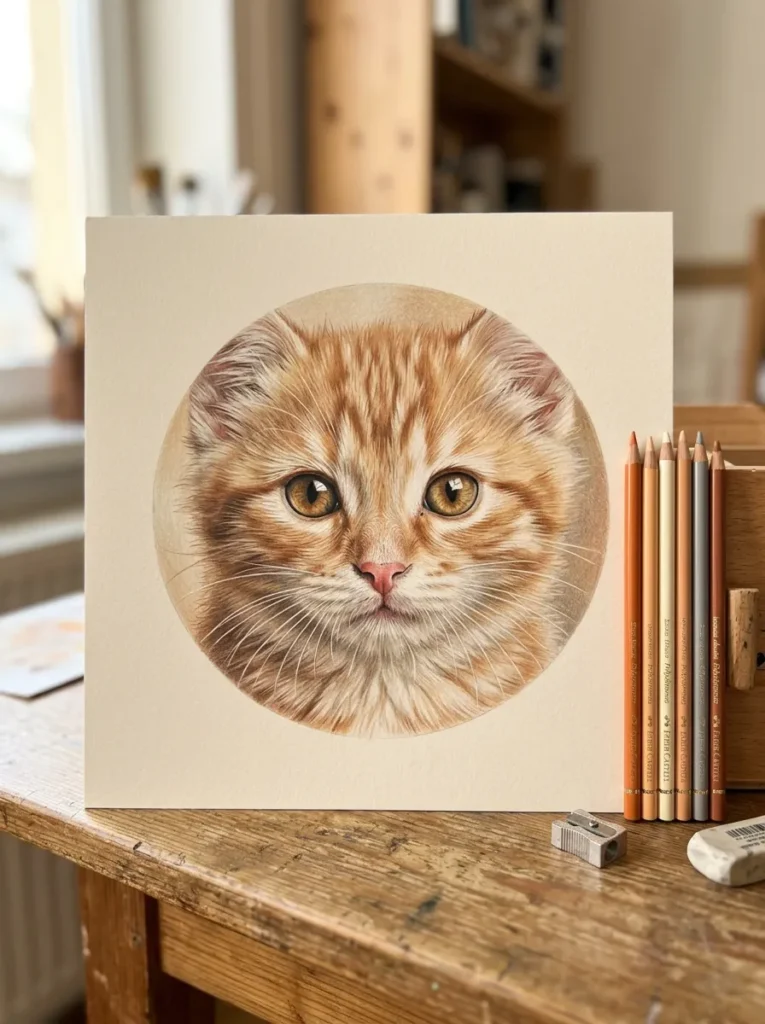
Vibe: The colored pencil kitten portrait feels warmly detailed — the most satisfying slow-craft cat drawing that rewards patience with a result of genuine beauty.
Why it works: Colored pencil kitten portraiture is the cat drawing idea that most rewards patient, layered technique — the medium’s defining quality (gradual color building through multiple transparent layers) is specifically suited to rendering fur because each layer of pencil strokes adds both color and directional texture simultaneously, creating the visual effect of individual fur strands lying in a consistent direction. The design principle is directional layering: colored pencil strokes applied consistently in the direction of fur growth (outward from the nose, downward on the chest, following the curve of the cheek) create fur texture automatically as a byproduct of correct technique, making the medium more forgiving of imprecision than other rendering approaches.
How to get it: Work on smooth Bristol board rather than textured paper for colored pencil — the smooth surface allows more precise color layering and burnishing than textured paper, which breaks up the pencil strokes before they can blend fully. Begin with the eyes as the portrait’s focal point — establish the amber iris color in the first session, as all surrounding fur values will be calibrated relative to the eyes. Apply fur strokes from the face outward, following the direction of natural fur growth — use a reference photograph to confirm fur direction at each area of the face. Layer colors from light to dark (ivory first, then ginger, then the darker orange-brown of stripe markings last) with each layer burnishing into the previous one for smooth color transition.
Shop The Look
| Product |
|---|
| Colored pencil set professional 72 colors |
| Bristol board smooth 11×14 inch pad white |
| Colorless blender pencil burnish smooth |
| Cat reference photo print A4 ginger kitten |
| Fine point eraser electric detail highlight |
12. Seasonal Cat: Holiday and Festive Illustrations (COLOR / ACCESSORIES)
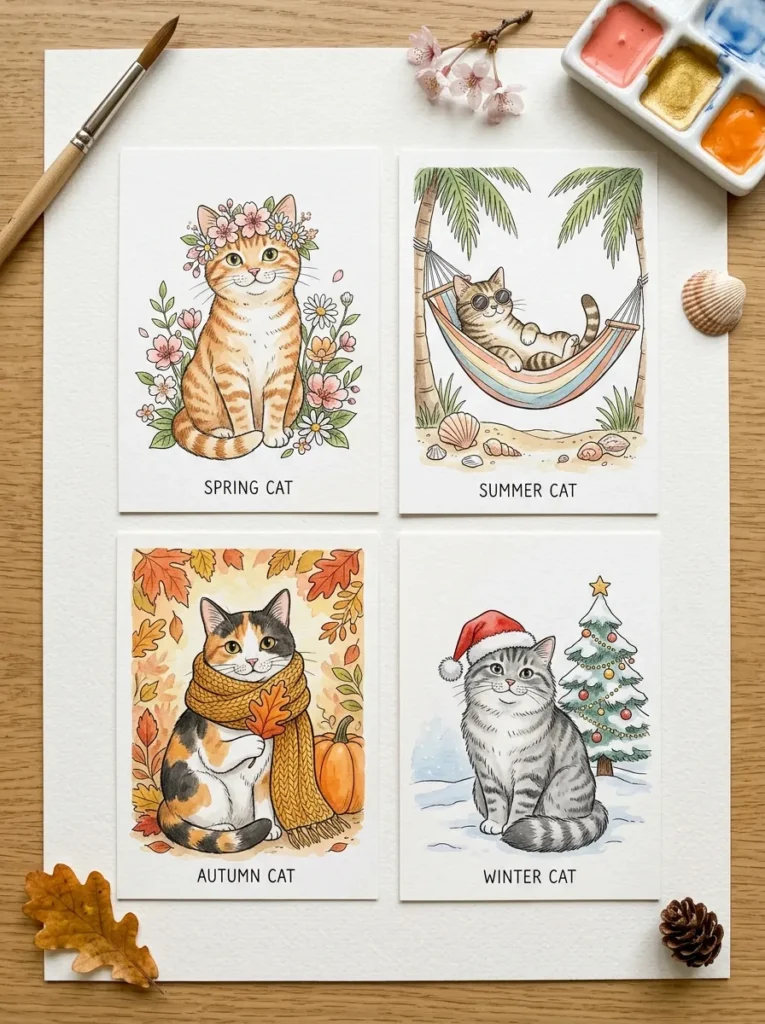
Vibe: The seasonal cat series feels warmly playful — four illustrations that work individually as cards and together as a displayed set of genuine charm.
Why it works: A seasonal cat illustration series is the cat drawing project that most effectively produces a complete, commercially viable body of work from a single creative session — four illustrations sharing a consistent style, character, and format constitute a complete product series (greeting card set, print series, sticker sheet, calendar) rather than four individual sketches. The design principle is character consistency: using the same cat character — same head shape, same eye style, same line weight — across all four seasonal variations creates the serial visual identity that makes the set feel designed rather than collected. The seasonal props (flower crown, sunglasses, scarf, Santa hat) carry all the seasonal differentiation while the cat character remains constant, which is the structure of the most commercially successful illustrated character series.
How to get it: Design the base cat character first — an A6-sized cat face and upper body in a consistent, appealing style — before introducing any seasonal elements. This becomes the template repeated four times, with only the seasonal props changing. Draw all four cat figures in pencil before inking any of them, ensuring the character proportions are consistent across the series. Assign a specific seasonal color palette to each card (dusty rose and sage for spring; coral and golden yellow for summer; warm orange and brown for autumn; cool blue and silver for winter) and apply these palettes to both the cat and the seasonal props, creating tonal coherence within each card while maintaining visual distinctiveness between them.
Shop The Look
| Product |
|---|
| Watercolor brush set round 0 2 4 6 seasonal |
| Watercolor half pan set seasonal color range |
| Fine liner pen set 005 01 03 05 illustration |
| White card stock A6 220gsm set of 20 |
| Colored pencil set muted natural seasonal |
How to Start Your Cat Drawing Journey
Your single best first move is to draw the sleeping circle cat from idea number one before attempting any other project on this list — not because it is the most impressive, but because its geometric simplicity makes it achievable in under ten minutes regardless of prior drawing experience, and the completed result is immediately charming enough to build the creative confidence that makes every subsequent drawing session more likely to happen. The first completed drawing is the most important because it establishes the fundamental truth that making a recognizable, appealing cat drawing is both more accessible and more immediately satisfying than most beginners assume.
The most common beginner mistake in cat drawing is beginning with a complex, highly detailed reference image and attempting to replicate every visible detail simultaneously — which produces a drawing that is overwhelmed by information, abandons the essential gesture quality that makes cats recognizable, and discourages continuation. Fix this by choosing the simplest possible reference — a sleeping cat, a sitting silhouette, a straight-on face — and simplifying it further before beginning to draw. Ask: what are the three most essential lines that make this recognizable as a cat? Draw those three lines first and add detail only after the essential gesture is established and correct.
Three specific items under $50 that unlock the greatest range of projects from this list: a Micron fine liner pen set in 005, 01, and 03 sizes ($10–$14) that covers every ink drawing project in the list and produces the clean, consistent linework that makes cat illustrations photograph and reproduce well; a 12-color watercolor half-pan set in muted natural tones ($14–$18) that provides the color capacity for the tabby wash, the botanical cat, the negative space silhouette, and the seasonal series; and a pad of 300gsm cold-press watercolor paper ($12–$16) that provides the correct surface for all watercolor-based projects and is robust enough to handle wet-on-wet techniques without buckling — three purchases that collectively unlock ten of the twelve projects in this list for under $50 combined.
A single cat drawing session of one hour produces one to three completed illustrations depending on complexity and speed. A complete seasonal cat series (four A6 illustrations in the same style) takes one full afternoon at 90 minutes per illustration. A careful colored pencil kitten portrait at A5 size requires three to five hours of focused work across multiple sessions. The most valuable investment in cat drawing skill development is daily practice of five-minute gesture sketches — ten minutes of gesture drawing practice daily produces more skill development than two hours of careful rendering practice weekly, because the gesture practice builds the observational speed and mark-making confidence that underlies every subsequent drawing decision.
Frequently Asked Questions About Cute Cat Drawing Ideas
What is the easiest cat drawing idea for a complete beginner?
The sleeping circle cat is genuinely achievable by anyone who can draw a circle — which is every person with a pen and paper. Its success depends on one simple observation (cats curl into a circle when sleeping) and three minimal details (a small ear, a tiny face, a tail completing the circle perimeter), making it the most accessible entry point into cat illustration regardless of prior drawing experience. The doodle pattern sheet is the second most accessible project because its small scale and non-precious context (the sheet is always surrounded by more doodles) removes the performance anxiety that beginners experience with a single large, prominent drawing.
What materials do I need to start drawing cats today?
The minimum viable cat drawing kit is a single mechanical pencil (0.5mm HB) and one fine liner pen (Micron 01 or equivalent) on any smooth white paper — printer paper, the back of an envelope, a notebook page. This three-item kit costing under $10 is sufficient for projects 1, 2, 3, 5, 6, 7, 10, and parts of 8 and 12. Adding a 12-color watercolor set and cold-press watercolor paper extends this to cover the full list. The single most impactful quality upgrade available for under $5 is switching from printer paper to smooth Bristol board for ink-based drawings — the smooth surface allows cleaner line control and erases more cleanly, which measurably improves the appearance of finished work.
How do I make cat eyes look cute rather than scary in my drawings?
The difference between cute and unsettling cat eyes in illustration comes down to three specific decisions: the highlight placement, the pupil shape, and the eyelid curve. A white highlight dot placed at the 10 o’clock position of each iris (upper left) creates the impression of reflected light that communicates life and warmth. A vertical oval pupil shape is more cute-appropriate than a horizontal or circular pupil. And a gentle upward curve of the upper eyelid — rather than a straight or downward line — creates the impression of wide-open, interested eyes rather than narrowed, suspicious ones. Applying all three decisions simultaneously produces the characteristic large, warm, expressive cat eyes that define cute cat illustration across every style from chibi to realistic.
How do I draw cat fur texture convincingly?
Cat fur texture is created through directional mark-making rather than random scribbling — the direction of each pencil or pen stroke should follow the direction of actual fur growth on the part of the body being drawn: outward from the nose along the cheeks, downward on the chest and belly, along the back from shoulder to tail. For colored pencil, applying light pressure in short strokes following fur direction creates convincing fur texture as a byproduct of correct mark-making. For pen and ink, a series of short, slightly curved parallel strokes (2–4mm long) following fur direction creates the hatching pattern that reads as fur. For watercolor, the wet-on-wet technique creates soft fur edges naturally — add darker color with a loaded brush tip to the wet ground and allow it to spread into fur-like soft marks without directing it with brush strokes.
How do I develop a consistent personal style for cat illustration?
Personal illustration style develops through repetitive drawing of the same subject — drawing the same cat face fifty times produces more style development than drawing fifty different cat subjects once each, because repetition allows the maker to identify and amplify the specific distortions and simplifications that make their version of a cat feel uniquely theirs. The most effective style development exercise is drawing the same simple cat face daily for thirty days, making a deliberate decision about one element at each session (today I will make the eyes larger; tomorrow I will simplify the ear to a single line; the next day I will try a different nose shape) and retaining the choices that feel most natural and most distinctively personal. After thirty iterations, the choices that have survived repeated revision constitute the beginning of a personal style.
Ready to Start Sketching Your Cute Cat Drawings?
These 12 ideas span the full range of cat illustration possibility — from the geometric simplicity of the sleeping circle cat and the graphic confidence of the one-line silhouette, through the loose warmth of the watercolor tabby and the playful exaggeration of the chibi kitten, to the botanical romance of the flower crown cat, the graphic surprise of the negative space silhouette, and the patient rewards of the colored pencil portrait — covering every skill level, every material, every time commitment, and every possible use from five-minute daily practice to exhibition-worthy finished work. Begin with the sleeping circle cat today — draw it now, before the article is closed and the intention fades — because the first cat drawing made is the one that makes the second inevitable. Today’s specific action: find one pen and one piece of paper, draw one circle, and add the three details that make it a sleeping cat. When you hold that first small finished drawing — a recognizable, charming cat made in under ten minutes from the simplest possible materials — you will understand exactly why cat drawing has captivated artists across every culture and every century, and why your own version of it, however simple, is worth making and worth saving. Save your favorites now, especially the sleeping circle cat and the seasonal series — they are the two ideas that, once begun, become daily practice habits and annual creative traditions that improve with every iteration.